




Mailport: May 2010
Letters to the editor in May 2010 included topics: lightning, tsunami warnings, MOB retrieval and cam cleats.

Whats a Deluxe Pickup Stick?
Overheard aboard a bareboat charter at the Bitter End on Tortola, British Virgin Islands, at sunset circa 1978: "I wish George would hurry up and whack all those big orange balls out of the way, so we can anchor." There are still many places where snagging a mooring requires someone who knows the business end of a boat hook, but in most of New Englands municipal harbors, the ubiquitous mast buoy has made the chore infinitely easier. These "pickup sticks" are now standard in the region (much to the chagrin of area divorce lawyers). If you are tasked with maintaining your own mooring-and you don't yet have a good pickup stick-we can recommend a replacement: a "deluxe" mooring buoy from Island Mooring Supplies. Now, before the idea of a deluxe pickup stick starts you choking with laughter, please bear with us.

Cape Dory 25 Do-It-Yourself Refit
Cape Dory sloops-even those like the 25, which was not designed by Carl Alberg-have one of the most loyal followings among production boats. These loyal owners, added to a reputation for quality construction, enables Cape Dory boats to hold their resale value well, making them prime candidates for a do-it-yourself project boat like Practical Sailors test boat, Satori, a 1981 Cape Dory 25.Satori was purchased in 2008 in Sarasota, Fla., for $1,500. Although structurally sound for a boat her age, the interior had been gutted.Satoris sale price included an inventory of like-new sails, a new 5-horsepower Nissan outboard, and ground tackle. Completely rebuilding a boats interior would seem daunting to many, but Satori owner Jon Perkins is a carpenter by trade so he had the tools, resources, and know-how to get the job done. Cape Dory is an ideal fixer-upper boat, if the owner is up for the project. On today market, the Cape Dory 25 can fetch $3,000-$8,000. The pocket cruiser is also an excellent boat to fix and sail as a nice weekend cruiser for a family or a coastal cruiser for a couple.
Practical Sailor Takes a Close Look at the State of Boat Cleats
Boat cleats are an elegantly simple yet essential piece of marine hardware. Yet, after scrutinizing cleats at the Annapolis and Miami boat shows, it appears that while there a few innovative designs and tried-and-true classic models, many builders are using sub-par installations. The shape of a cleat needs to take in the significance of how a cleat locks a line in place and yet still allows a crew member to control the easing or snubbing process. Proper topping and backing cleat plates can greatly improve cleats durability and long-term performance. Some hide-away cleats or pop-up cleats have water drainage issues and less-than-robust support structures. Other designs use the less-secure rings and eyes instead of proper cleats.
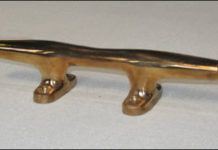
Ode to the Long-forgotten Deck Cleat
The devastating train of hurricanes that rolled through Florida in 2004 and 2005 gave engineers an opportunity to see firsthand what happens when a modern boats mooring points and lines are pushed to their limits. A post-mortem look at many lost boats revealed shocking design and construction oversights that contributed to the carnage. Buttonhole-size chocks made it impossible to add chafe gear. Sharp turns at chocks and hawseholes sawed lines until they broke. Tiny, poorly installed cleats yanked free from soggy, cored decks. Cheap cast aluminum cleats riddled with air pockets simply snapped.
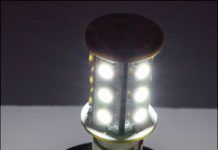
Practical Sailor Tracks Down the Best LED Tri-color Light
Practical Sailor found that the full brightness that LEDs offer, coupled with a huge energy savings, a wide tolerance to voltage changes, and a very long expected lifespan, make LED a great alternative to incandescent lights for masthead tri-color. The tradeoff is the considerable heft of the price tag. Practical Sailor tested LED tri-color lanterns from Orca Green Marine (OGM), Signal Mate, and Lopolight. We also evaluated LED tricolor bulbs designed to replace those in the popular Aqua Signal Series 40 tri-color light. Those were bulbs from Lunasea, Dr. LED, and LED Shop.
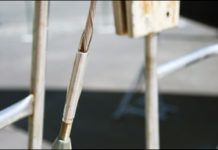
PS Advisor: Replacing Wire Rigging
Over the years, I’ve heard various timeframes for when to replace standing rigging, but I’ve never seen any empirical data to back up those recommendations. It would be very informative to know from a metallurgical/metal failure point of view estimated lifespans of the average wire used for standing rigging.

Mailport: 12/09
I have a Pearson Ensign 1962 now at a slip in New Rochelle, N.Y. This season marked the first time we had the luxury of keeping our boat at a slip. In order to maneuver through the marinas byways without worrying, I bought a 24-volt Minn Kota outboard (80 pounds of thrust) and two 12-volt batteries, which I hook up in series. Not only am I able to stop start, turn, etc., in the marina, but-to my surprise-in the calm sound water, I can nip along at about 3-4 mph with myself, two crew, and the 3,000-pound boat. The result is that Ive only used my 5-horsepower Mercury outboard once this year. My electric outboard doesn't stall; it has variable speed like no ones business; reverses with relative ease, and is less expensive-though more cluttered-than the self-contained electric outboards you recently reviewed. Am I part of a growing trend or just weird? If the former then it might be worthwhile testing electric outboards for boats my size (22.5 feet) and commenting on their applicability.

Mailport: 11/09
To keep from being pulled under in a collision between a tanker and my sailboat, I "pulled the ripcord" to release the snap shackle on my Standard West Marine Safety Tether . The tether release lanyard was outfitted with a series of balls. (See bottom photo at right.) I had rehearsed reaching for and feeling the release toggle many times so it would come naturally in an emergency. The balls have a distinct feel. There was nothing on my PFD or foul-weather jacket that resembled them. The replacement tether I bought from West Marine (ISAF Specification Safety Tether, No. 9553504) has a new toggle on the snap-shackle release lanyard that consists of an open triangle of plastic. This is dangerous, in my opinion! In my first few hours of using the new tether, in moderate sea conditions, I managed to snag the triangular loop on something and release the snap shackle. I am now replacing all triangular loop pulls with bead pulls that I have crafted myself.
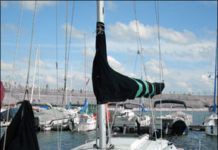
PS Advisor: Replacing Lifelines
The International Sailing Federation (ISAF) and other regulatory bodies frown upon using PVC-coated 7x7 wire for lifelines. As you noted, this is because lifelines should be easily inspected for corrosion or other signs of possible failure. The corrosion that can take place under the coating is not just a saltwater issue. Air quality and other factors also can lead to corrosion. We suggest uncoated, 1x19 stainless-steel wire with swaged terminals—3/16-inch wire for upper lifeline and 1/8 inch for the lower. Uncoated 1x19 is easy to inspect, and even though the top wire is overkill from a tensile-strength perspective, it will be durable and almost as comfortable to lean against as the coated wire. It’s also more convenient to lash netting to than a smaller-diameter option.

Small Boat, Big Keel Why This 27 Footer Works
What makes a small sailboat truly seaworthy? In this video, we take a deep dive into the Pacific Seacraft Orion 27, a rugged, long-keel...



Latest Sailboat Review
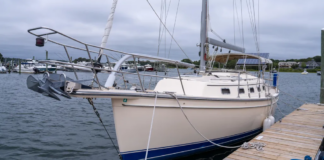
Island Packet Estero Used Boat Review
Florida-based Island Packet targets a relatively narrow niche, so the toughest competitors to its new boats are often older Island Packets. Introduced in 2010, the 36-foot, shoal-draft Estero is the company’s latest attempt to introduce a distinctive model that doesn’t stray too far from the company’s proven formula for success: moderate displacement, full-keel cruisers designed to be lived on, sailed far and in comfort, and endure the bumps, scrapes, and storms that cruising boats inevitably encounter. After sailing the Estero on Florida’s Sarasota Bay and inspecting its interior, construction, and systems, Practical Sailor testers noted that the shoal-water cruiser will appeal strongest to Island Packet fans who’ve been waiting for a shoal-draft, easy-to-sail boat that compares to the IP37 in terms of interior space. These strengths will be most apparent on intracoastal or riverine adventures like the Great Loop.