




Farewell to Skip Allan’s S/V Wildflower
Anyone who has ever run before a gale knows how exhilarating it can be. On the right boat, in the right conditions, the adrenaline rush is as intense as any we’ll feel in this world. Bull riders, surfers, and skydivers get a few seconds of excitement. An ocean gale can last for days ... and that’s where the problem lies. With your senses completely in tune with the boat, wind, and sea, the experience of hurtling down an ocean wave stirs the soul. But as the hours pass and day turns to night, the thrill gives way to exhaustion. Mostly, you’re too busy to be afraid, but each mountain of green water that fills the cockpit brings doubt. How high will these waves get? How long can I last? Even with a drogue streaming off the stern to slow down the boat, running before storm-driven waves entails a great deal of risk. There’s danger enough aboard a fully crewed boat, as the rig, sails, and steering gear get pushed to the brink.
Farewell to Skip Allans S/V Wildflower
Anyone who has ever run before a gale knows how exhilarating it can be. On the right boat, in the right conditions, the adrenaline rush is as intense as any we’ll feel in this world. Bull riders, surfers, and skydivers get a few seconds of excitement. An ocean gale can last for days ... and that’s where the problem lies. With your senses completely in tune with the boat, wind, and sea, the experience of hurtling down an ocean wave stirs the soul. But as the hours pass and day turns to night, the thrill gives way to exhaustion. Mostly, you’re too busy to be afraid, but each mountain of green water that fills the cockpit brings doubt. How high will these waves get? How long can I last? Even with a drogue streaming off the stern to slow down the boat, running before storm-driven waves entails a great deal of risk. There’s danger enough aboard a fully crewed boat, as the rig, sails, and steering gear get pushed to the brink.
Snatch Block Test Update
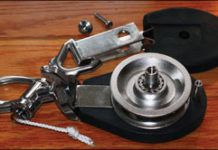
Practical Sailor evaluated six snatch blocks in August 2007, with the Harken 1609 receiving the nod as the best all-around snatch block. As a follow-up, Practical Sailor compared two Ronstan snatch blocks, the Ronstan 6831 and the Ronstan 6751, to the Harken block. The Ronstan RF-6751 sports an investment-cast stainless-steel sheave, a heavy-duty latch, and side plates covered with thick, thermoplastic rubber cheeks. The block’s ruggedness and user-friendly latching function make it ideal for heavy duty applications on a cruising boat. Ronstan’s RF-6831 has a stainless-steel frame and tough PVC cheeks. It is representative of Ronstan’s alloy-sheave blocks with its high-quality construction, mid-range cost and working load. Although Practical Sailor prefers the Harken for everyday use, both Ronstan blocks are well-suited for cruising sailors.
A Tale of Two Trysails
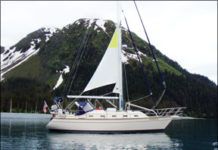
Storm trysails rarely get the close look they deserve. Designed to replace the mainsail in a severe storm, it spends most of its life in the sail locker. Trysails should be cut flat, and the center of effort located to optimize stability and helm balance. Generally, the trysail’s clew should be just above the boom, its tack just above the furled mainsail’s head and its head near the mid-point of the mast. It is best to work closely with a sailmaker or a boat’s designer to get the right size and shape trysail. When inspecting or commissioning a trysail, pay close attention to detail at the head, clew, tack, leech, and luff.
Extending the Bow: Are Add-on Sprit Kits Worth It?
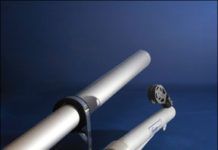
Easy-to-handle, lightweight sails continue to gain in popularity with performance-oriented cruisers. Setting a large, light-air sail a couple of feet ahead of the boats stem improves performance and sail-handling characteristics but presents challenges and risks. Practical Sailor reviews four aftermarket bowsprit kits and examines whether adding a spar to the front of your boat is safe, effective, and worth the added cost and effort. Aftermarket sprit kits by Forespar (Banana Sprit), Forte, Selden and Sparcraft are reviewed.

Singlehanded Sailors Notebook
First contested in 1978, the Singlehanded TransPac (SHTP) offshore race crosses 2,120 miles of Pacific Ocean from San Francisco Bay to Hanalei Bay, Kauai. Though the singlehanded race has been dubbed a bug light for weirdos, world-class navigators and sailors often throw their lot in with the pack. Longtime singlehanded racer and cruiser Skip Allan took time out from his TransPac preparations to outline the equipment he keeps onboard Wildflower, his 27.5-foot Thomas Wylie-designed sloop/cutter. From his Sail-O-Mat windvane to boom vangs to tiller pilots, Allan discusses a range of gear helpful to all singlehanded sailors and small boat sailors. He outlines his sail inventory and storm tactics, along with his approach to provisioning and eating at sea. A second installment of the Singlehanded Sailors Notebook will take a look at onboard electronics and safety gear for the solo sailor.
New Twist on Furlers: New Generation of Roller-Furling Systems For Light-Air-Sails Skip the Fixed...
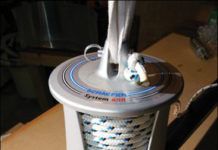
Roller furling has pushed headsail piston-hanking headsails to the brink of extinction. But it also results in a significant loss in light-air efficiency. Meanwhile, genoas, drifters and reachers have become orphans without a stay on which to hank. A new generation of light-air roller-furling sails aims to resolve these issues. They require no fixed stay and, on a properly equipped boat, they can be set, furled, doused, and dropped with relative ease. Practical Sailor reviews seven roller-furling systems for light-air sails, including models from Bamar, CDI, Colligo, Facnor, Harken, Karver and Schaefer.
Taming the Main: Sail-Handling Systems for Bigger Mainsails
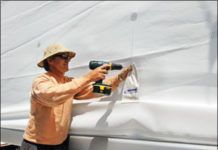
More often than not, boat buyers these days are looking for bigger boats with mainsails to match—and the larger the mainsail, the bigger the chore of flaking it. That’s where sail-flaking aids like lazy jacks, cover/lazy jack combos, and the innovative Dutchman systems come into play in the battle to tame the main. Practical Sailor’s close comparison of these options provides valuable insight into what is the best sail-flaking device for you and your boat. Find out what you need to take the gymnastics out of mainsail- handling. Mainsails up to about 250 to 300 square feet are easy enough to handle that flaking aids are optional rather than essential. However, if you have a boat with a 300- to 500-square-foot mainsail, take a look at what PS testers have to say about the Dutchman, lazy jacks (E-Z Jax, Harken jacks, etc.) and StackPack-type of systems (Mack Sails, Schaefer, and Doyle Sails, etc.).
Riding Sails to Tame Those Anchor-Dancing Boats
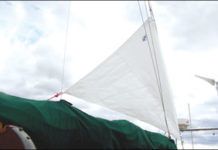
Practical Sailor recently evaluated a radically new designed riding sail, the FinDelta Anchoring Sail from Banner Bay Marine, which uses three panels instead of the traditional single panel. According to Banner Bay, as the boat tries to swing, the sails forward fin generates a thrust vector to one side only, gently realigning the boat. By comparison, a traditional, single-panel anchoring sail still allows some degree of sailing at anchor as the sail backs and fills from one side to the other, often resulting in flogging. The FinDeltas design also reduces one of the most common complaints of traditional riding sail users: noise. The FinDelta doesn't require attachment to the backstay-an excellent conduit to transmit the vibration from flogging anchor sail-and so noise is greatly reduced. While the single-panel riding sail has served sailors well for centuries, this new design intrigued our testers, and a head-to head-comparison between it and the traditional Sailrite riding sail was launched.
Used Nylon Three-Strand Rope Faces The Ultimate Endurance Test
The nylon three-strand dock lines used for this test had weathered significantly, and chafed noticeably where the lines exited chocks and made contact with cleats. We put these lines under increasing tension in laboratory conditions and tested them to destruction. Our test shows that even when the effects of chafe were eliminated, up to 75-percent of the original tensile strength in our sample ropes was lost. These findings fly in the face of the conventional rhetoric that views nylon as such a strong material that one should always opt for thinner line due to its better elastic effect. To the contrary, within reason, this overly springy, rubberband-like function is a foe rather than a friend. We left the lab realizing the importance of taking a close look at dock lines and other nylon-line applications, noting the last time they had been replaced and why tropical storms and noreasters take such a heavy toll. A new set of dock lines is cheap insurance, and money well spent.
Morgan 382 – The $30K Boat Nobody Talks About
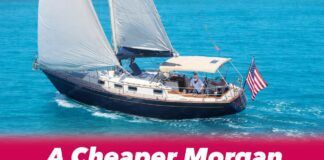
The Morgan 382 might be one of the most overlooked cruising sailboats ever built. Designed by legendary naval architect Ted Brewer and produced between...



Latest Sailboat Review

Jeanneau 55 Boat Review
This recent sailboat from Jeanneau may as well be a spaceship. They’ve taken all the time-honored designs of a monohull aft cockpit and turned...