

Water Tank Filters
You would think that with all the emphasis cruising sailors put on their boats and equipment, we would pay a little more attention to ensuring a clean and safe supply of water. This is less a concern in developed countries, where dockside water is safely treated or bottled water is affordable and readily available. However, once you begin to expand your horizons, ensuring a clean water supply requires more thought and effort. This is the first report in a three-part series on equipment and practices that no matter where you and your boat are, you can be reasonably sure that your on-board water supply is safe.

Types of Filter Media
Water filtration isn't rocket science, but some filter media is better suited for the marine environment than others. And, as we found in our test, some cartridge designs are better than others. Here are the most common types.

Filters for Water Tank Vents
Ever find a bug doing the backstroke in your water tank? We have. Would you leave a glass of water sitting uncovered for weeks and then come back to it? Of course not, but many builders either lead the hose to a mushroom-type through-hull fitting, or terminate it inside the cabin, with nothing to keep the ubiquitous critters from seeking shelter, fresh water, or a nesting site.
Fighting Sulfation in AGMs
In recent years, the popularity of absorbed glass mat (AGM) batteries has soared, yet few owners truly know how to take care of them. If you want to get your moneys worth out of a new AGM battery or battery bank, it should be installed as a system-not simply dropped in as a replacement for flooded batteries.

Tracking Marine Batteries
Each AGM battery we tested underwent a minimum of five discharge and recharge cycles to a loaded 11.7 volts before being ampere-hour-capacity tested. This cycling ensured that each battery had cycled up to its rated amp-hour (Ah) capacity. If the battery did not cycle up to rated Ah capacity, we ran a few more cycles and tested again.

12 Ways to Extend Your AGM Batterys Life
12 Ways to Extend Your AGM Batterys Life
Heart Replacement
Sixteen years ago, contributing writers Joe and Lee Minick equipped their Mason 43, Southern Cross, with a Heart Interface Freedom 20 charger/inverter and a Link 2000R from Cruising Equipment, both made by companies based in Valley Forge, Penn. When both of these units were ruined during a knockdown (see PS, April 2013 online), they were forced to look for a replacement.

Taking the Other Way Home
Our 38-foot catamaran, Josepheline, was built by Lightwave Yachts near Brisbane, Australia. Josepheline draws 3 feet, 6 inches and has a 22-foot beam. It is a fairly conventional design: mini fin keels, two forward queen berths under the bridgedeck, a double berth aft to starboard, and a decent sized shower and head located aft in the port hull. Shes stood the test of time-and distance. Weve cruised about 35,000 nautical miles aboard Josepheline.

Painting Water Tanks
When it comes to onboard water tanks, we prefer stainless, fiberglass, and even roto-molded tanks (in that order) to aluminum ones. Aluminum tanks tend to pit and corrode over time, often needing to be replaced. The insides of the two 60-gallon aluminum water tanks in our 30-year-old Valiant 40 were more like a nasty moonscape than a drinking source. Their surfaces were pitted and rusted from what looked like a reaction to long-time use of chlorine.
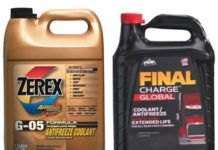
Engine Coolant Replacement
In your recent article on engine coolants (see PS October 2014 online), you wrote about replacement intervals for coolants, and Im looking for clarification. You indicated that the following heavy-duty coolants for diesels were coolants, not antifreeze: Zerex GO5, Peak Final Charge NOAT, and Detroit Diesel Power Cool Plus. You also suggested that I replace the coolant every 1,000 hours, . . . (and for little used engines) changing the coolant every five years is a more practical approach.
Latest Logbook

Practical Sailor Logbook – September 2026
In September we tour the Hans Christian 48T — the offshore cruiser many sailors call the holy grail — walk the custom Antigua 60...

Video: The BEST Sailboat You Can Buy for $35,000 – Catalina...
If you’re searching for a mid-30-foot sailboat, affordable cruising sailboat, liveaboard sailboat, first sailboat, or a capable used sailboat for coastal cruising, the Catalina...



Latest Sailboat Reviews

Learning by Doing on a $5,000 Catalina 30 Mk II
When Davis’s mother started talking about wanting to do something “big” for retirement, Davis and Gloria half-jokingly threw out an idea that seemed suitably...