

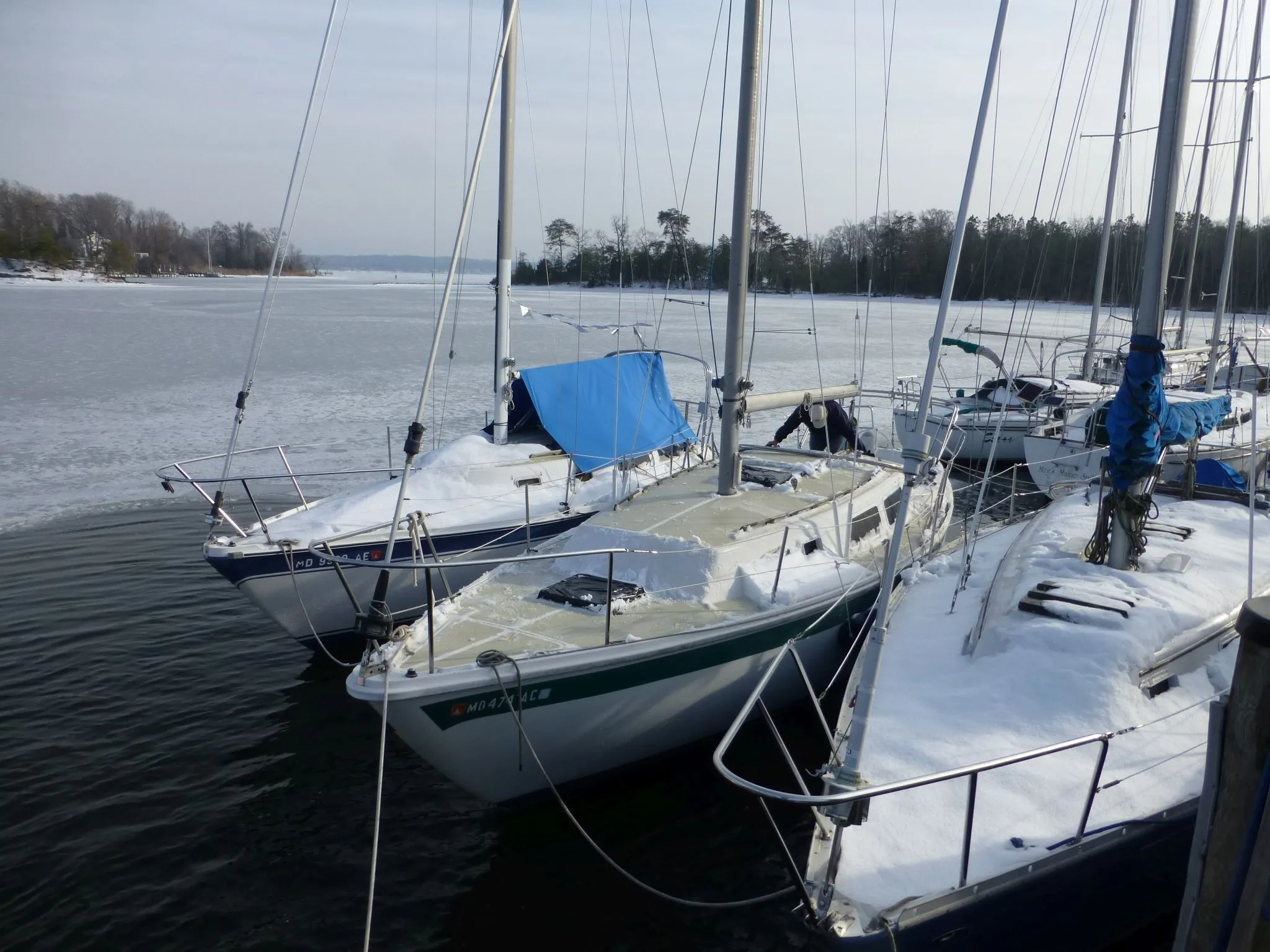
Winter temperatures are challenging for year-round sailors. Appropriate clothing is vital, including waterproof socks, layering for the legs and midsection, finishing off with a balaclava, hat, and even ski goggles. The boat requires winterizing. Inboards are challenging to winterize if actually used, and ice in the potable and waste plumbing can break fittings even in occupied boats if any piping wanders through unheated spaces (or the heat is off). The electrical system seems like the simplest part.
To continue reading this article or issue you must be a paid member. Sign in

Join Practical Sailor
Get full access to Practical-Sailor.com – more than 4,000 articles – for just $34.
Join today and save 42% off our full price.







They sell lithium batteries with heaters inside. This prevents most of the problems.
Yes, true. As long as the battery is plugged into a charging source with sufficient power, the battery stays above freezing. My batteries have such a system. But there are still two problems:
1. Many boats go for months without use. They may be connected to charging, but dock power can fail for weeks after an ice storm (we just had a big one), and solar panels are commonly covered for weeks or months with snow. If a heater tried to keep the batteries above freezing, they would go flat. Thus, the heating systems for marine batteries are not designed to heat from their own charge, as they are for electric automobiles. They only heat from a charging source.
2. Marine battery heaters only work when there is charging power. In the slip you can lose power due to an ice storm or even a breaker popping, and you won’t know about the latter until your next visit, months later. On the hard you rely solely on solar, and my panels (Chesapeake Bay) are typically covered for weeks at a time in winter. Farther north that could be months at a time. No charging power input = no heating.
Any winterization plan that relies on a consistent power supply, either from the dock or solar, is not robust. This includes frost watch heaters. Without frequent monitoring there is no way to know if power delivery is consistent. It’s not like your house or place of business, where power interruptions are noticed and breakers are reset.
I sense your analysis is too simplistic. First, AGMs should not be discharged below 50% without loss of capacity. Same as if Lithium is charged at too low of a temperature. So… you need to extend your analysis to include degradation of each battery type being recharged below “recommended” parameters. My sense, Lithium is more robust to low temps with full discharge than AGMs. All that said, plenty of monitoring systems to let you know temperature in the boat, loss of power and SoC. Solvable problem, IMHO
Peter: Yes, what you say is quite correct. Lead acid batteries have shortcomings, which is why we are so interested in lithium. These shortcomings are well known: loss of voltage and useable capacity at low temperatures; reduction in life span if discharged too deeply; limited charging rates. Our point was only to highlight that lithium also has vulnerabilities.
Lithium batteries are commonly supplied with robust monitoring systems. But for many, the boat is either hours or an airplane flight away, and the owner is not going to jump up when his cell phone app tells them there is a problem. For better or worse, it will wait until spring, same as with lead.
It is worth noting that ICE automobiles still use lead, even at the high end, and that Teslas have a small lead battery to backup the electronics. Lead is not dead, not yet.
As I said, I switched to lithium, and so far I’m happy.
I keep my boat in the water in Petersburg Alaska, though I live in the lower 48. I run Intrinsically safe bilge heaters. I always carry a heavy duty portable jump start battery (though it will suffer in cold weather too). And yes, my boat has a lead acid cranking battery in addition to lithium for everything else. Monitors for shore power, engine room temperature, battery voltage, bilge pump and bilge high water alarm give tremendous peace of mind (very happy with Siren/Yamaha). Finally, I won’t leave my boat without a paid/skilled local boat keeper who is only a phone call away and checks on her weekly. Peace of mind costs more but it’s worth it.
Leaving a boat for a long period is always high risk. Relying on anyone else to check it is not the answer either. I spent a few years with the boat in various places while moving her from the UK to North America, and there were always problems. Now I will always opt to get the boat hauled in a yard. You can then shut everything down without worrying about the bilge pumps failing or the dock power getting disconnected. With lithium batteries, if they are topped up to near full and there is no power drain, they will happily stay charged all winter. With lead acid you need to arrange to have someone go on board and turn on the charger for 24hrs about once a month. If lead acids are left, they will slowly discharge and sulphate at the same time. Leaving them for several months will lead to a significant loss of capacity. Leaving a charger connected is not the answer. I had a charger fail and came back to find the batteries boiled dry and wrecked. Luckily, it did not start a fire!
Your profile on lithium capacity at low temperatures also reinforces my belief that you need to plan your bank size to run batteries no lower than 50% SoC, even with lithium. It leaves you with no reserve in the event of a charging issue, whether due to cold weather or a failed charging system.
I use a programmable switch that can be set to turn on and off. It has a temperature probe in the battery box to sense the temperature. The switch is set to turn off at 37 degrees. And come on at 40 degrees. I plug a 120V, 20-amp lithium battery charger into the 120V switch. This allows the charger to be shut off when the set temperature is reached and to turn back on when the temperature reaches 40 degrees. I have about $50.00 in setup costs. HTH
Thanks, JD
I cover my lithium bank with a wool blanket (wool is flame retardant) and place a 60 watt trouble light low in the battery compartment under the blanket. It heats up the battery compartment surprisingly fast to at least 45 degrees when temperatures outside are well below freezing. Then I charge the lithium bank to 100% SOC and shut off all power to the boat. My phantom power draw is 1.5% capacity per day. After a month my SOC is at 55%, and I heat up the batteries, recharge and again, shut down all power (power left on leads to galvanic corrosion of your running gear). Fortunately, I live close to the boat in Annapolis MD and am able to regularly check up on her. It’s not really necessary, given marelon seacocks and proper winterization. I just like seeing the boat!
not really necessary,