

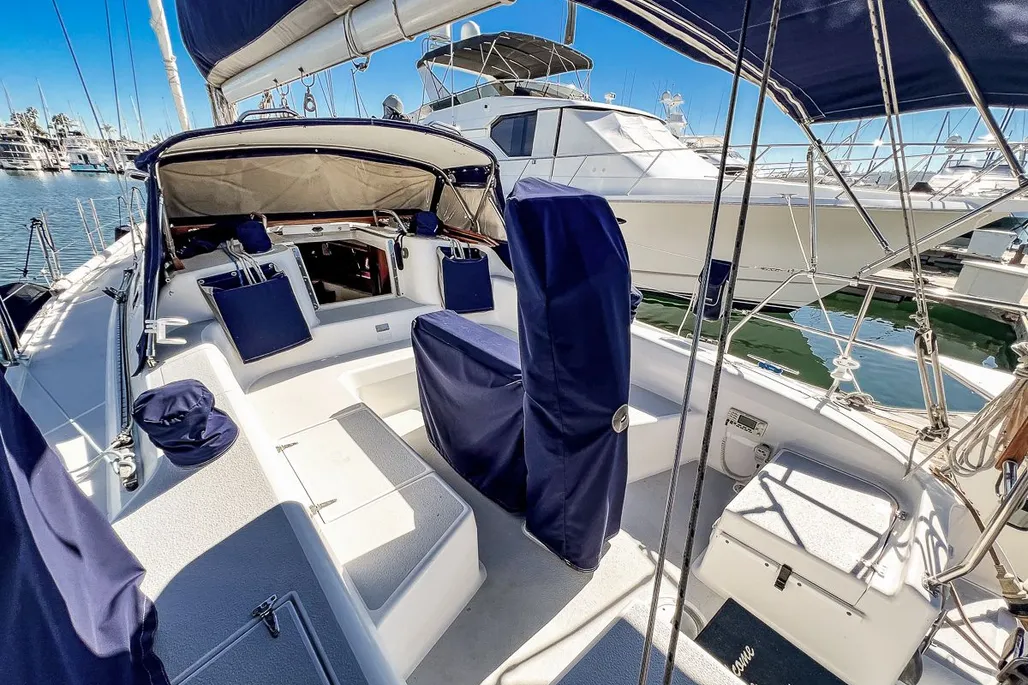
Are you in the market for a 35 to 40 foot sailboat under $100,000? Are you considering a Catalina 380? Have you seen a Catalina 380 that catches your interest and are asking yourself about the pros and cons of this cruising sailboat? A comparison of a few boats in the same size and price range under $100,000 may be appropriate. Let’s compare the Catalina 380 to the Dufour 40, Hunter 40.5, Island Packet 35, Hunter 386 and Beneteau 373, all available in the under $100,000 range.
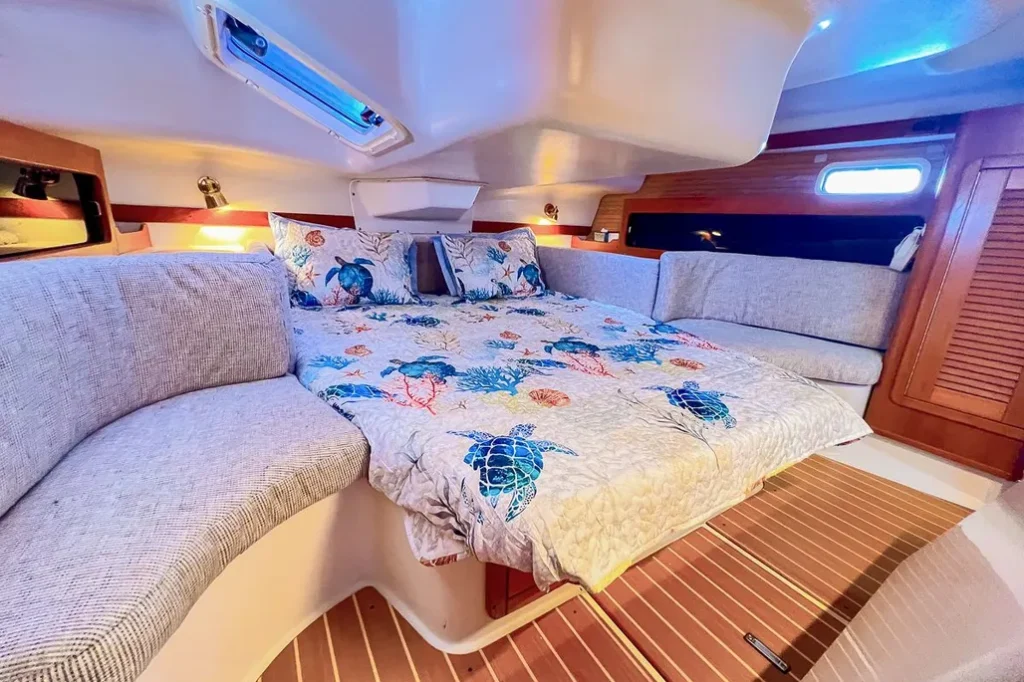
The Catalina 380, initially emerging from the factory in 1997, is one of the best cruising boats ever designed. A boat that could fit a sugar scoop transom, an island bed in the aft cabin in a conventional aft cockpit sloop and offer room to cruise has plenty to offer. But more on this design later. First, let’s look at the comparisons of its day.
Dufour 40
Dufour Yachts is a French producer that has been making boats since 1964. The Dufour 40 footer measures out to 40.41 ft. (12.32 m) and is a culmination of building experience and knowhow built into a performance-oriented cruising boat. Production of the 40 began in 2005 and, of all the boats we’re looking at in this article, the Dufour 40 is by far the fastest. If you’re a club racer, you’ll like the PHRF rating of 83. She is quick.
She is also spacious and accommodating with a 13 ft. (3.90 m) beam and, weighing in at 17,000 lb., she is all too happy to be out there 25 knots of wind with a reef in the main. With no wind at all she hustles along reliably with her 55 hp Volvo.
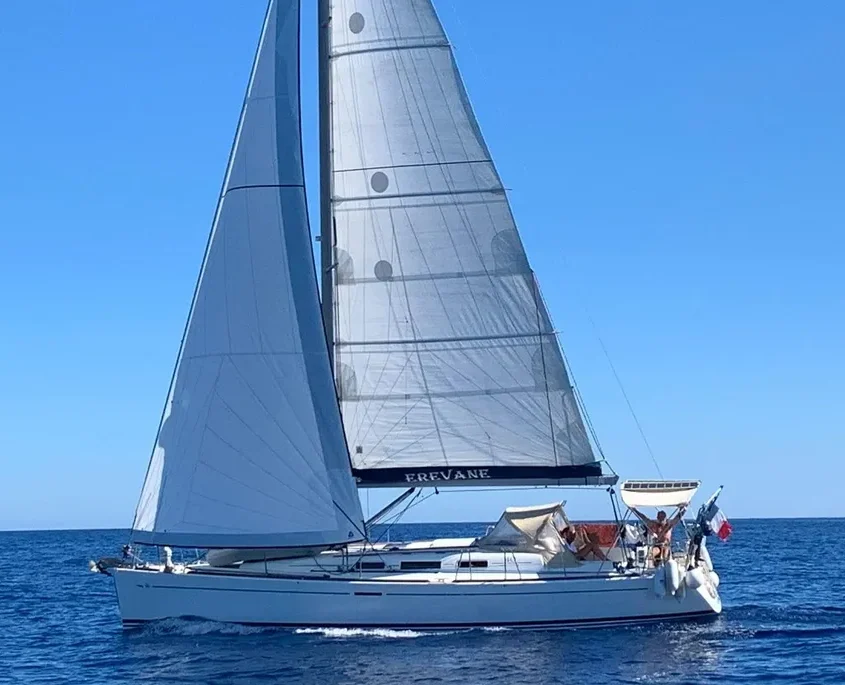
On the market, a reasonable condition Dufour 40 can be had for about $100,000 USD which makes the boat not only the fastest in this comparison, but also the most expensive.
Downsides
A downside to the Dufour 40 is the interior accommodations. Spacious as she may be, it appears that the designers were expecting more of a close quarter racing crew, not a small family. The V-berth would have to be considered the master stateroom. It’s the largest sleeping accommodating aboard but without a great deal of extra space. The two aft cabins are very tight doubles, more likely single berths.
Something to be aware of from a maintenance perspective, the 20-plus year old teak side decks will probably be in need of work. Watch out for deck core rot, which is an issue common with fastened teak decks.
Hunter Legend 40.5
Unlike the later model Hunters with the B&R rig, the Legend series of Hunters came with a regular backstay. Owners love these boats and there is an active, dedicated owners’ group ready to share wisdom on upgrades and maintenance. You won’t be alone with the purchase of a Hunter.
With an overall length of 40.17 ft. (12.24 m) she is the largest boat in this comparison group. At 20,000 lb. she is also the heaviest. But because of her age, 1991 to 1997, she will also be the least expensive in the group. A decent model will come in at around $75,000 USD. Where the Dufour only provided a V-berth as a master stateroom, the Legend 40.5, like the Catalina 380, provides room for an island bed in a reasonably spacious aft cabin.
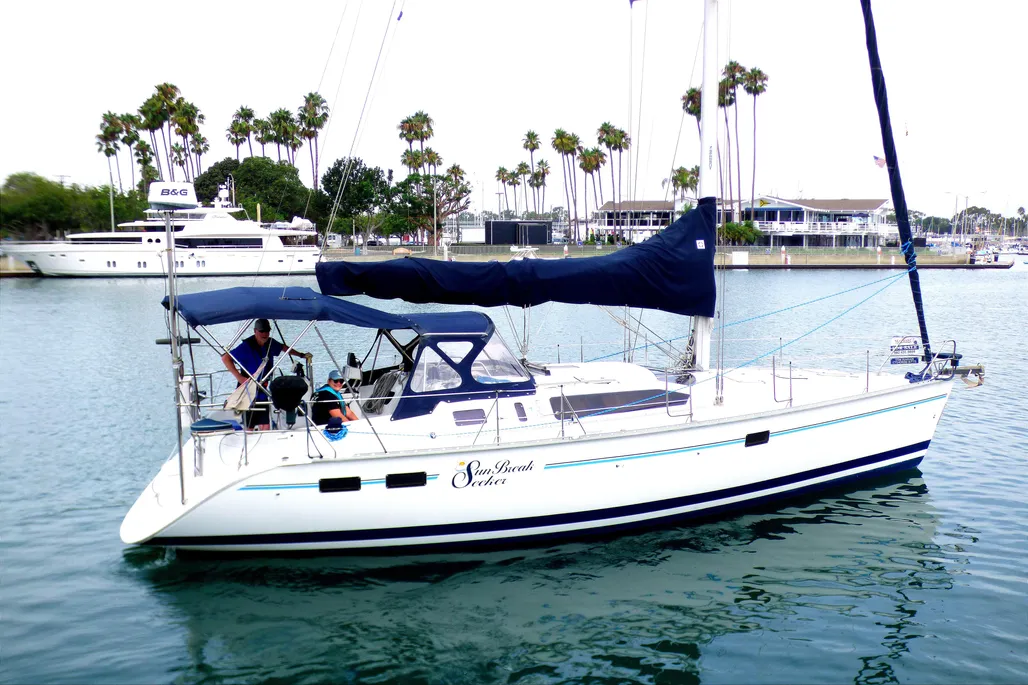
Maneuvering under power should be relatively easy as power options were either a Volvo MD22L for the early models, or a JH4 series Yanmar. Club racers loved these boats because they are quick to the windward mark with a PHRF rating of 108.
Downsides
But the Legend does have its drawbacks. Being a 90s boat, there are things to look out for. Number one was the factory installed aluminum waste tanks. They are subject to early internal corrosion, so hopefully a previous owner has already replaced this item. The interior fit and finish is not quite as nice as the comparison boats, but these boats are getting old now. That age could also pose problems for financing and insurance.
Island Packet 35
If you can spell the word sailboat, you know the name Island Packet. Ocean going, full keel, and over-built; all those words synonymous with Island Packet. The 35 has an almost cult following-esque owners’ group. You’re not just buying a boat here, you’re buying into the Island Packet family. That can be a pretty big selling point.
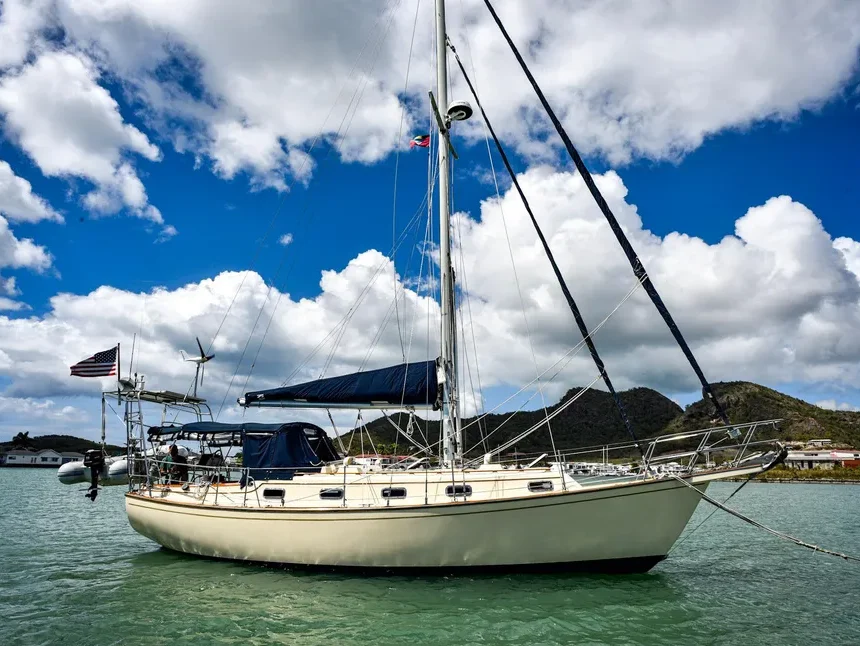
A well-maintained boat can be had for about $85,000 USD. That sounds like a lot for the smallest, and oldest boat in this comparison. It was manufactured from 1988 to 1994, yet it is still fetching close to $100,000 USD. That is a testament to the longevity of these sturdy boats.
At 17,500 lb. for a 35-ft. boat and powered with reliable 35-hp Yanmar, the Island Packet is well suited for ocean work and keeping your family safe in a blow. With a full keel and relatively narrow 12-ft. (3.66 m) beam, she is by far the most comfortable boat in a seaway when compared to the others in this article. Island Packet has been building these heavy boats for a long time—she has plenty of fiberglass and brute force strength.
But every boat is a compromise and Island Packet is no exception. With a full keel and maximum wetted surface, Island Packets may be comfortable but tend to be slow and much less likely to point to windward well. With a PHRF rating hovering around 185 she won’t be rounding any marks first. Compared to the other boats with fin keels and spade rudders, there will be more tacks to if your destination is to windward. Maneuvering in close quarters will also pose a challenge.
Downsides
Far and away though, research identifies a glaring problem with this boat—chainplates. Constructed during the 80s and 90s, Island Packet was using 304 stainless steel and imbedding the chainplates in the glasswork. This caused premature corrosion and chainplate failure. Not particularly reassuring for an ocean-going sailboat. If the boat has had the chainplates replaced, consider yourself fortunate. This project is both time consuming and excessively expensive. If the chainplates are replaced with 316 stainless steel, the boat would be a good choice.
One of the other compromises with this heavy design is that the narrow 12-ft. (3.66 m) beam limits the expected interior space for a 35 ft. (10.77 m) hull. As a true ocean-going boat you wouldn’t be sleeping in the V-berth anyway, but the very tight aft berth that runs fore and aft does not provide a great deal of space either. While it is appropriate in a seaway, it is probably not so comfortable at anchor or secured to a dock.
Hunter 386
One of the most popular boats in this comparison, the Hunter 386, is hard to beat as far as comfort goes. At 16,000 lb. she is relatively light but still heavy enough to do some coastal cruising and island hopping. The average PHRF rating hovers around 140, certainly not the fastest in this comparison. Powered with a reliable 40-hp Yanmar, the Hunter 386 has a 12-ft. 6-in. (3.83 m) beam and very generous freeboard, making for one of the most livable interiors of sailboats in this class.
The 386 is from the 380 family of Hunters and owners love them as floating condominiums or summer cottages, frequently anchoring out for days on end in their favorite spots. This is a very livable boat for weekends and extended trips.
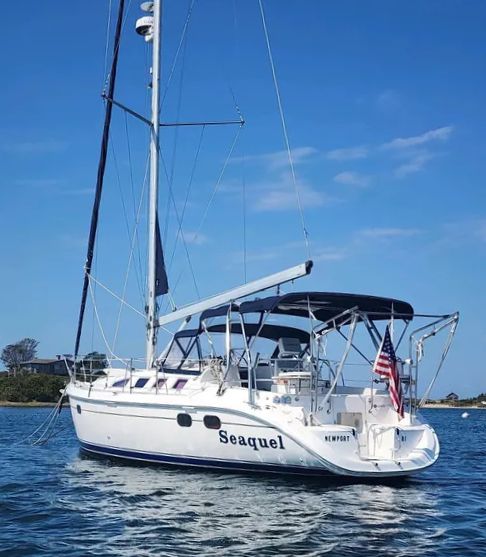
The 386 provides a reasonable master stateroom aft with a bed athwartships. The first one in will have to climb over the partner to get out in the middle of the night. The V-berth is also a reasonable size with a small vanity, but not much in the way of everyday storage.
Downsides
Where this boat falls short for some sailors is in the sailing department. While the Hunter 386 sails just fine, this is the Hunter with the B&R rig that doesn’t have a back stay. The mast is supported fore and aft by raked spreaders and additional rigging. Trimming the massive mainsail for that last bit of boat speed can become frustrating for the sailing enthusiasts. The aft raked spreaders prevent the main from going all the way out on a broad reach or running downwind. With a fractional rig where most of the sail power is in the main, that can get on your nerves.
Stepping the mast for repair or winter storage can also become a real effort in removal and re-stepping. Mast tuning may best be left for professionals.
Beneteau Oceanis 373
The boat that compares best with the Catalina 380 is the Beneteau 373. It is in relatively the same price bracket on the used boat market at about $80,000 USD—the Catalina 380 and Beneteau 373 are trimmed out about the same. They have the same beam at just over 12 ft. (3.7 m), allowing for generally the same amount of space in the salon.
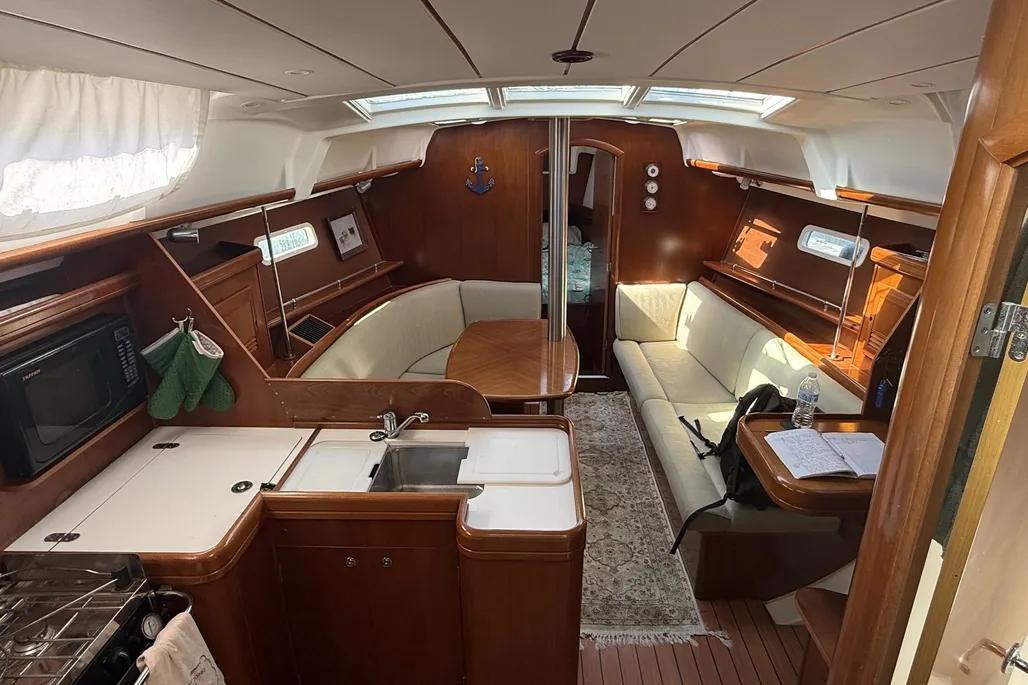
The interior of the Oceanis is laid out similar to the Catalina, with the L-shaped galley and aft head with separate shower stall. There is an adequate aft cabin, whoever climbs into the athwartship bed first is trapped there. Need to use the facilities in the middle of the night? Climb over your mate to get out.
The average PHRF rating for the Beneteau 373 is 130, comparing favorably with the Catalina 380’s 126. The Beneteau 373 came with a 40-hp 3JH4E Yanmar.
One of the downsides with the Beneteau line is the cast iron keel, a perpetual maintenance issue. The boats are kind of the same tool for the same job. But that’s where the similarities end.
Catalina 380
The Catalina 380 is a full foot and a half longer than the Beneteau Oceanis 373. Catalina used that extra length to provide a longitudinal bed with access on both sides. Clever.
The Beneteau is spry at 14,000 lb. and performs well in light air, is quick around the marks and a lot of fun to sail. But the Catalina is almost in a different class. This is likely the most important difference between these boats, the Catalina 380, and all of its competition. The Catalina is a full 5,000 lb. heavier at 19,000 lb. in weight before you add water, fuel and cruising gear. Grossing at 20,000 lb. ready to sail, the Catalina will provide a more comfortable ride, and is more capable in a squall or big waters. When you’re halfway across the gulf stream from Florida and things get scary, you’re going to wish you had bought the Catalina. The slightly higher PHRF rating of 126 won’t mean much.
Owners’ Opinion
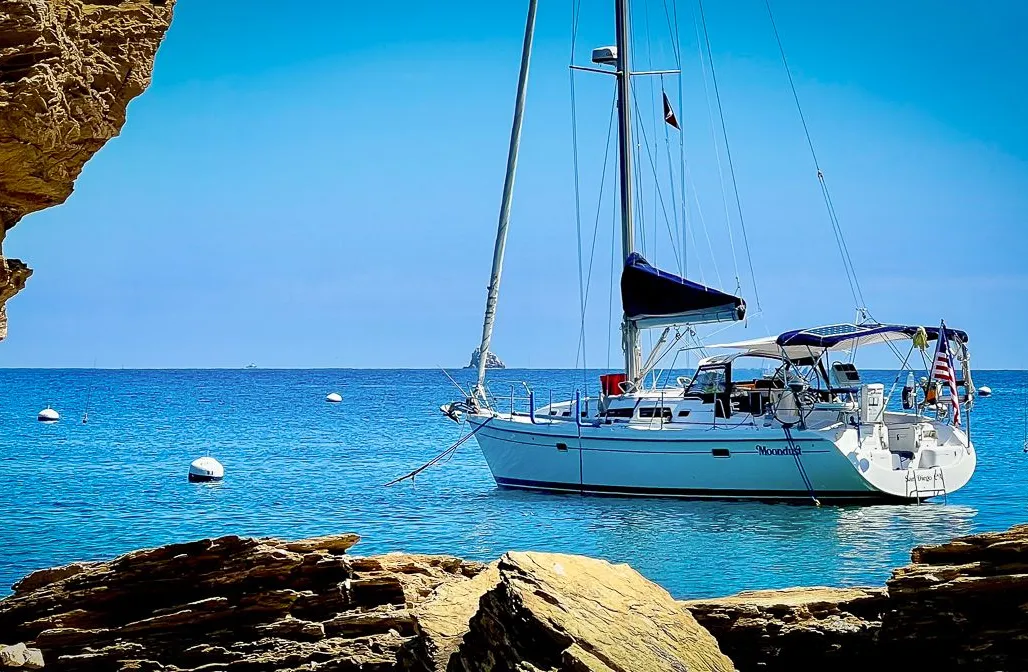
In discussion with Catalina 380 owners, it was learned that most shopped around a lot, even creating spread sheets to document different models, pros and cons, resale values, and capsize ratios. Catalina owners are pretty smart, careful sailors. The general consensus was that they love their 380. Of course they do, they have one. The 380 was better than anything else they looked at. They loved the cockpit layout, the interior space, the galley, the massive salon, and simply adored the aft cabin island bed. Although the aft cabin is generally the accepted sleeping quarter, the V-berth is also large enough for a 6 footer’s comfort. The headroom was most welcome for those sailors over 6 ft. in height. They loved the separate shower stall in the head, which is a luxury on a 38 ft sailboat. They loved the over-weight build of the boat, and not bothering to reef until well past 20 knots.
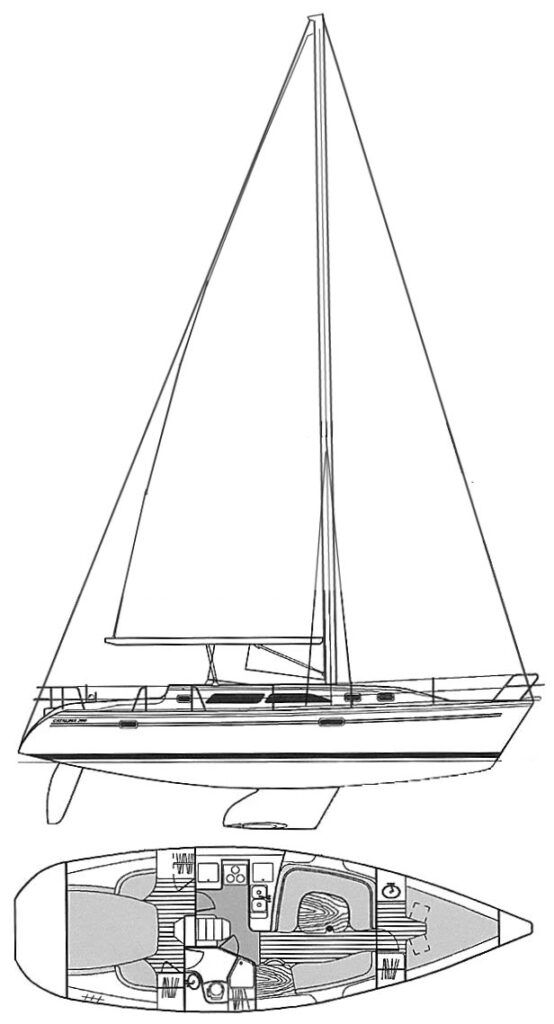
Sailboat Specifications Courtesy of Sailboatdata.com
Hull Type: Fin w/spade rudder
Rigging Type: Masthead Sloop
LOA: 38.42 ft / 11.71 m
LWL: 32.42 ft / 9.88 m
S.A. (reported): 723.00 ft² / 67.17 m²
Beam: 12.33 ft / 3.76 m
Displacement: 19,000.00 lb / 8,618 kg
Ballast: 6,800.00 lb / 3,084 kg
Max Draft: 7.17 ft / 2.19 m
Construction: FG
First Built: 1997
Builder: Catalina Yachts (USA)
Designer: G. Douglas / Catalina
Make: Westerbeke
Type: Diesel
HP: 42
Fuel: 26 gals / 98 L
Water: 102 gals / 386 L
S.A. / Displ.: 16.31
Bal. / Displ.: 35.79
Disp: / Len: 248.92
Comfort Ratio: 30.24
Capsize Screening Formula: 1.85
S#: 2.12
Hull Speed: 7.63 kn
Pounds/Inch Immersion: 1,428.31 pounds/inch
I: 50.92 ft / 15.52 m
J: 14.67 ft / 4.47 m
P: 44.83 ft / 13.66 m
E: 15.67 ft / 4.78 m
S.A. Fore: 373.50 ft² / 34.70 m²
S.A. Main: 351.24 ft² / 32.63 m²
S.A. Total (100% Fore + Main Triangles): 724.74 ft² / 67.33 m²
S.A./Displ. (calc.): 16.35
Est. Forestay Length: 52.99 ft / 16.15 m
The Beneteau is newer, manufactured from 2004 on. The Catalina is a bit older and may be harder to finance and insure. Unlike the Beneteau, the Catalina 380 started production with a Westerbeke 42-hp diesel, eventually switching over to the Yanmar 3JH series at Hull #225 in 2000.
Engine access is under the companionway steps for the front of the engine, and then a large box structure in the aft cabin is removable allowing unfettered access to the aft end of the engine and transmission.
Downsides
But as with any boat, there were some complaints. Sleeping in the aft cabin island bed, the headroom is very low under a box that contains the steering pedestal gear. It’s a relatively small box, but probably right where you don’t want it.
There is very limited space in the galley for cooking gear. More storage would have been nice. Most owners would have liked to see the open storage selves in the salon as cabinets, which would clean up the space visually and keep items in place when the going gets rough.
On deck, the mainsheet arrangement is available at the trailing edge of the cabin trunk, both port and starboard side. It gets a bit awkward. Most sailors simply put a stopper knot at one end and adjust the mainsheet on the other. With a massive interior, the cabin trunk is taller than that of the Beneteau. Getting around on deck, particularly towards the bow, is a bit more difficult. The cockpit table has supports that always break, which is an expensive repair each time.
But the biggest complaint, by far, was early 380 owners wishing they had a Yanmar instead of the Westerbeke. Owners have reported burned/broken valves a long way from home and having to limp back at low speed on less than all four cylinders. Reports of issues with the Westerbekes are all too common.
Conclusion
If you’re in the market for a 35- to 40-ft. sailboat under $100,000 USD, you too are compiling spreadsheets to get the most value for hard earned dollars—you’ll find that the Catalina 380 quickly rises to the top. After weighing all the pros and cons, and all other things being equal, it may just come down to that aft cabin bed. And that may be a good enough reason.
Market Scan Contact
1997 Catalina 380 Crow's Nest Yachts
$110,000 USD 949-779-5575
San Diego, California Yacht World
2001 Catalina 380 Southwind Marine LLC
$125,000 414-626-1490
Milwaukee, Wisconsin Yacht World
1999 Catalina 380 Bluenose Yacht Sales- Newport
$82,000 508-419-9304
Warwick, Rhode Island Yacht World





Fabulous article.
I sail all kinds of boats and have enjoyed many kinds of sailboats over my lifetime. I’m a snowbird (Florida in winter Wisconsin in summer) but I return for a couple weeks for Christmas and to sail my DN iceboat. I have built 2 of them one as a teenager and another when I was in my 30s. I’m 75 now and still enjoy sailing on warm water in Florida and the Caribbean. But nothing matches thrill of sailing on ice.
Has Practical Sailor ever done or consider a story about ice-boating?
Very nice. But how is it related to this fine article?
That’s a great idea!
Fine article! We definitely want to see more comparisons per class…
As always, it is a matter of the intended use. Island Packet would be a good choice for a serious offshore cruising where the Beneteau and Dufour are the more likely shorter coastal cruisers and comfortable day sailers. Indeed, the Catalina 380 has a good balance between comfort, performance and reasonable build quality for both coastal and offshore cruising.
Thanks for the excellent article!