

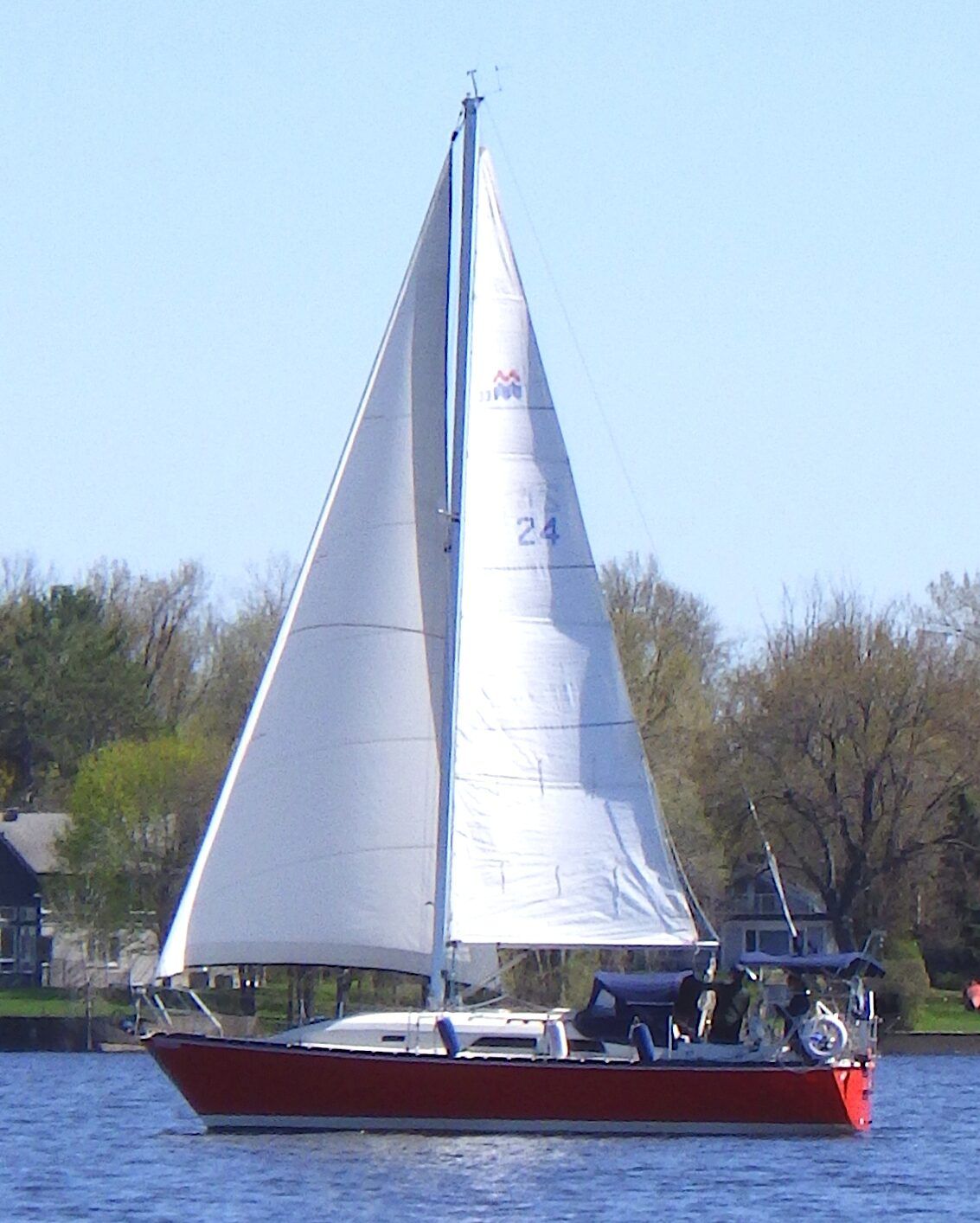
Mirage Yachts Limited was a Canadian boat builder located in Quebec. The first production boat was a Mirage 24 introduced in 1972, their first year in business. Mirage Yachts went on to produce several size boats until their closure in 1989. One of their bestsellers was the Robert Perry designed Mirage 33, which proved to be a great family cruiser.
Design
The Mirage 33 was only built in 1982, although some people do claim to have a 1983 but there are no records of them being built post 1982. Robert Perry who had designed previous Mirage models, was also commissioned for the Mirage 33. Built in Vaudreuil, Quebec in Canada, the Mirage 33 quickly established itself as a racer/cruiser. With a relatively low displacement, a bolted fin keel drawing 5 ft., a spade rudder and a roomy deck and interior, the Mirage 33 is perfect for the Great Lakes. She has a graceful hull speed of 6.93 knots and a PHRF of 156 and came with a Yanmar 2GM diesel engine as the auxiliary power.
Deck
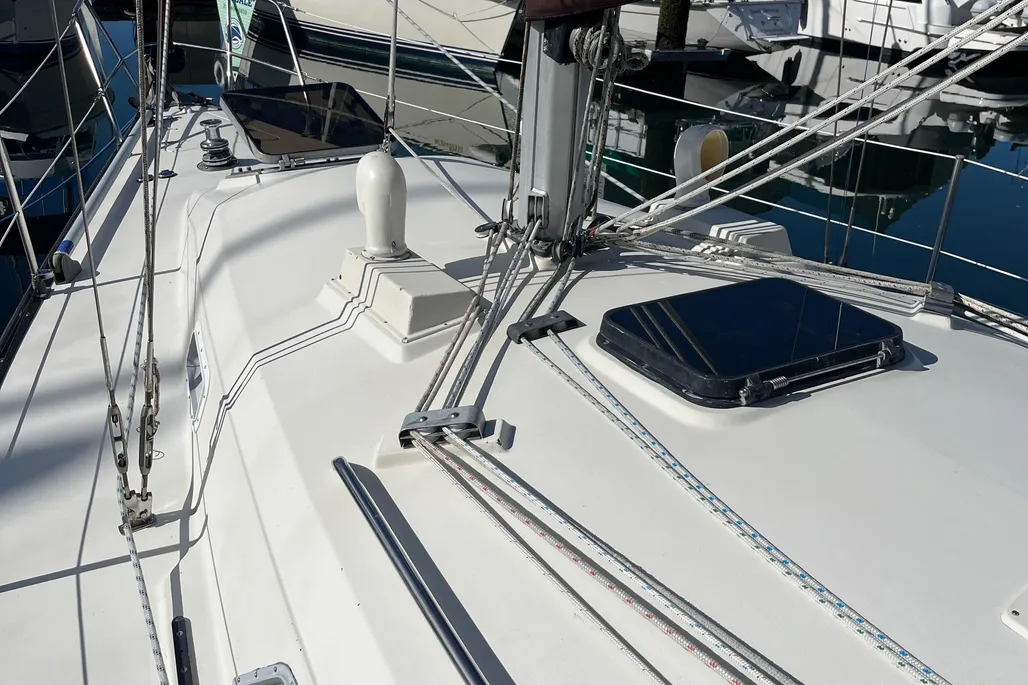
The deck is all around quite spacious. The wide side decks ensure a safe walk to the bow. On the foredeck you’ll find a roller furler and an electric windlass. The electric windlass makes it easy to release and retrieve the anchor that lays on the anchor roller. Two versions of the anchor locker were available. One had the anchor locker on the foredeck accessed by a door, the other option sent the rode and chain down below in a locker forward of the V-berth. Both versions were big enough to hold over 200 ft. of rode and chain.
The coach roof has the traditional teak railings which is a nice touch, six closed port windows and two hatches.
Cockpit
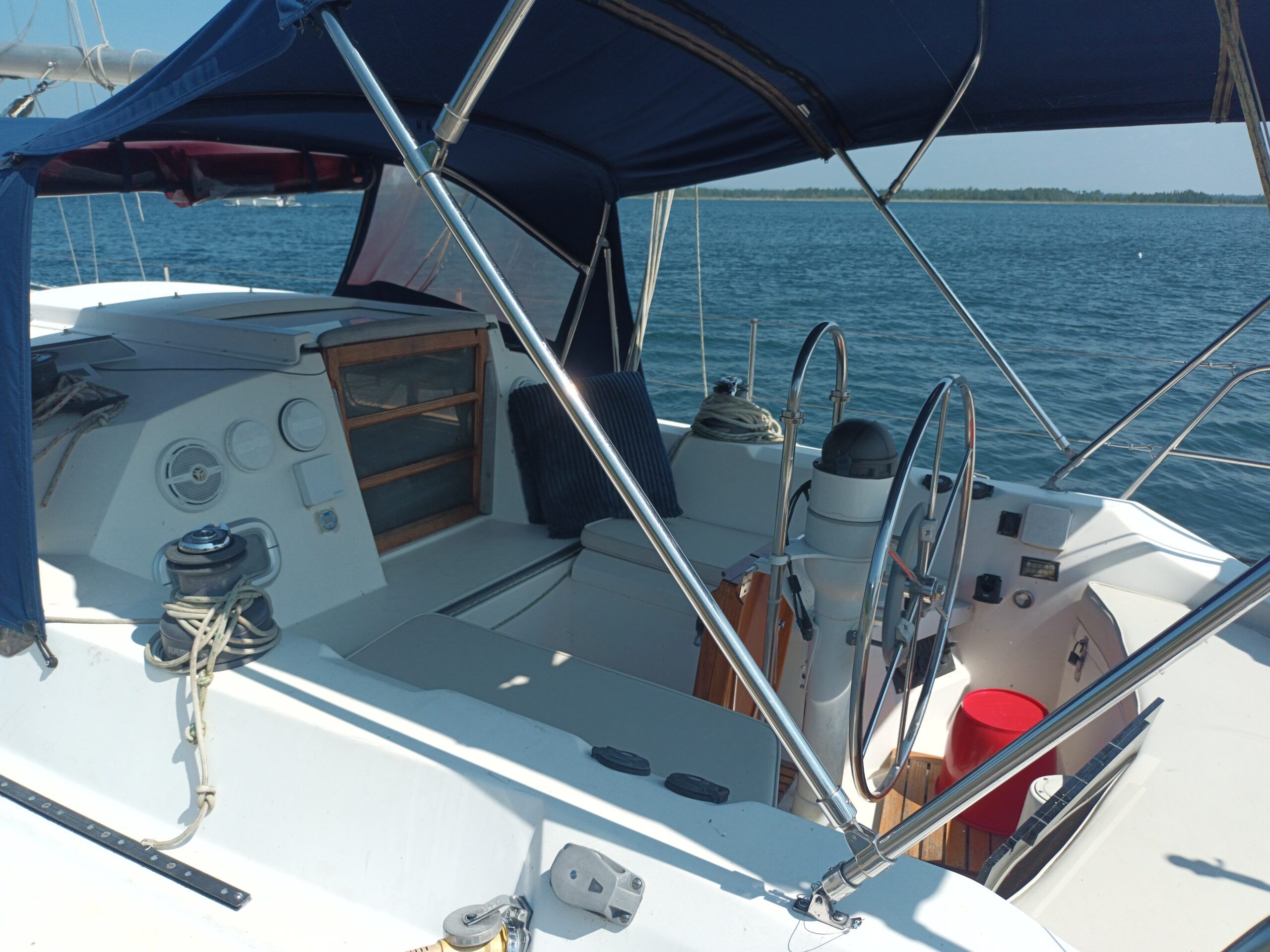
The cockpit is decent-sized, only a bit tight around the large wheel since it is so close to the cockpit benches. The size and proximity of the wheel makes it difficult to walk around. Nonetheless, the cockpit is still spacious enough to sit comfortably and eat at the fold down table. The lockers are spacious and the lazarette is huge. There’s also a separate propane locker used for the barbecue and interior stove. The traveler sits in the cockpit at the companionway door. Some have chosen to relocate the traveler to the coach roof which in my opinion makes more sense. I’m not a fan of travelers in the cockpit.
The entire deck is covered with a nonskid application. The boat I surveyed had a deck that showed its age. Lots of cracking and grazing, but solid with no signs of delamination or high moisture. The single spreader mast is deck stepped. The chainplates are located inside, keeping them away from the elements and easy to inspect. All lines lead to the cockpit to four self-tailing Lewmar winches.
Interior
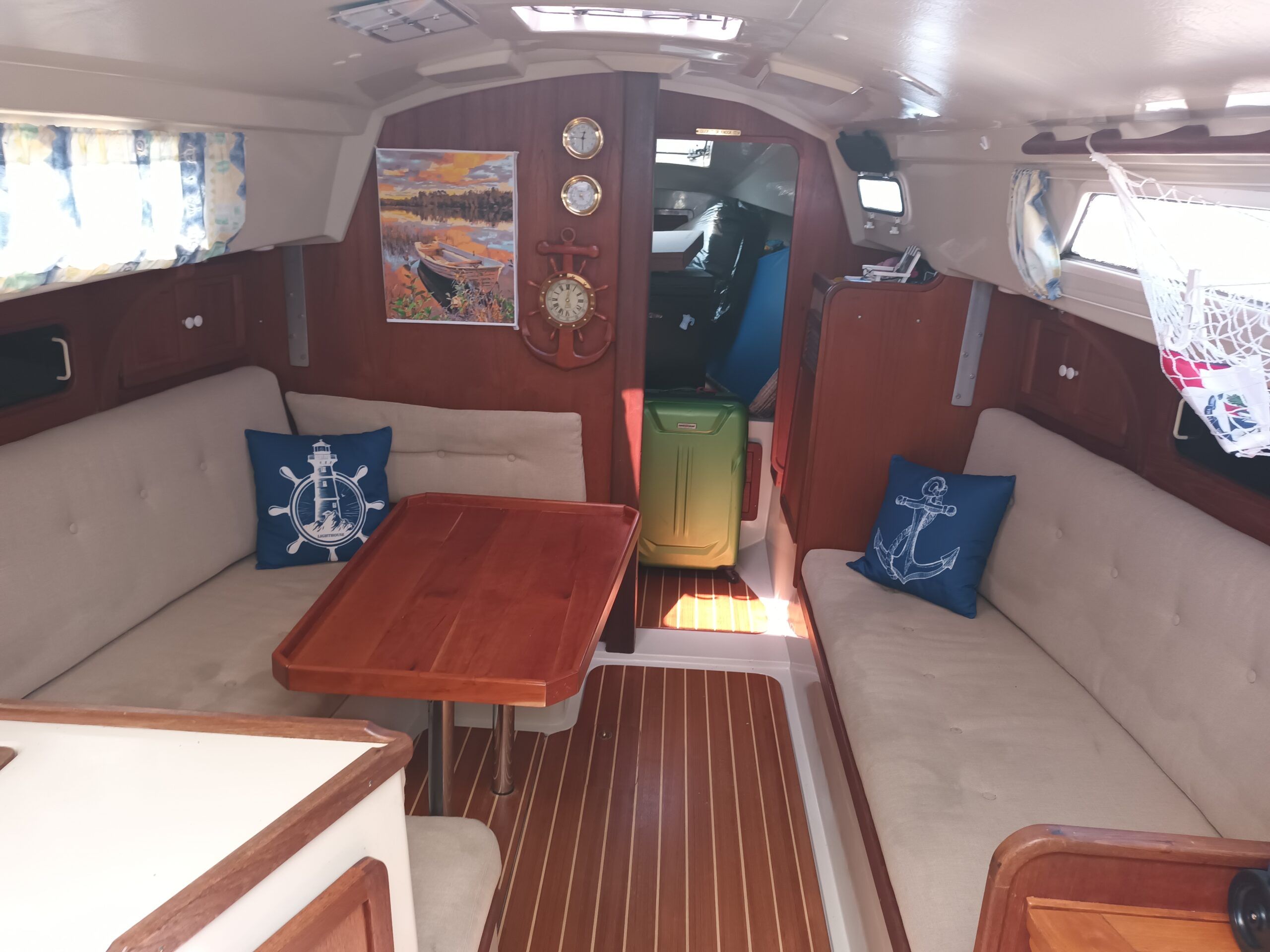
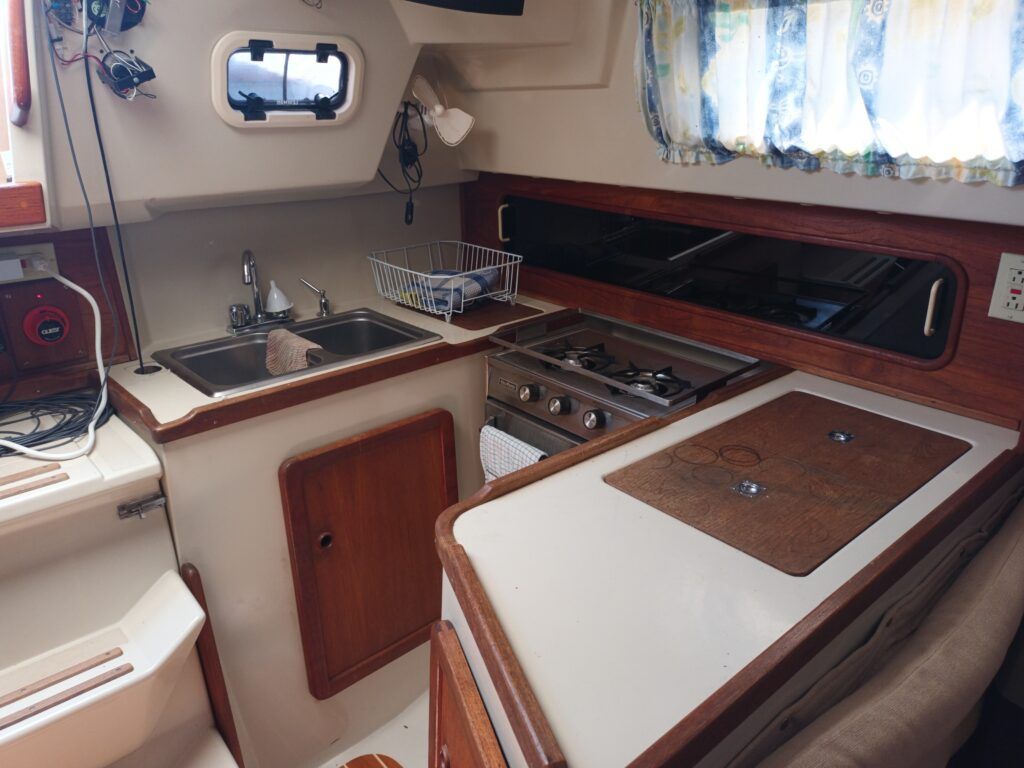
The interior is impressive in many ways. Bright, spacious, well laid out with a headroom of 6 ft. 5 in. The layout of the galley is very functionable. From the stainless steel gimbled stove/oven to the very large chest fridge/freezer, to the sink with pressured water, the area feels large for a 33-ft. boat. The galley boasts sufficient stowage for pots, pans and dishes.
The port side dinette settee and table are comfortable and can seat four people comfortably. The table lowers into a double bed. There’s also a starboard settee which functions well for casual conversation but is definitely not ideal for a sit-down dinner. The quarter berth is wide and deep. A perfect storage area if you don’t have a visitor. The V-berth is of average size and is ventilated by a large opening hatch.
The head is tiny. Fitted with a sink and a manual toilet, it would be impossible to swap out the toilet to install a composted version, which I find to be a huge negative.
The navigation table is to starboard and provides sufficient space for its intended purpose. The walls are light wood with teak and holly flooring. The Mirage 33 has a lot of stowage space. It’s important to note that since the bilge is extremely shallow, a bilge pump is not installed. Instead, water is removed via the manual gusher pump located in the cockpit.
Performance
Mirage Yachts was originally founded to compete with C&C Yachts, particularly in smaller size boats, mainly with their flagship Mirage 24. Built structurally robust with a racing design, the 24 eventually transformed into the 33. With a displacement of 9,300 lb. and its fin keel, the 33 cruises nicely at nearly seven knots.
The Mirage 33 came standard with a sloop rig, a Harken roller furling, a 195 sq. ft. main sail and a 273 sq. ft. jib/genoa. Genoa tracks, self-tailing winches and dual backstays were also standard equipment. A boom vang was an option.
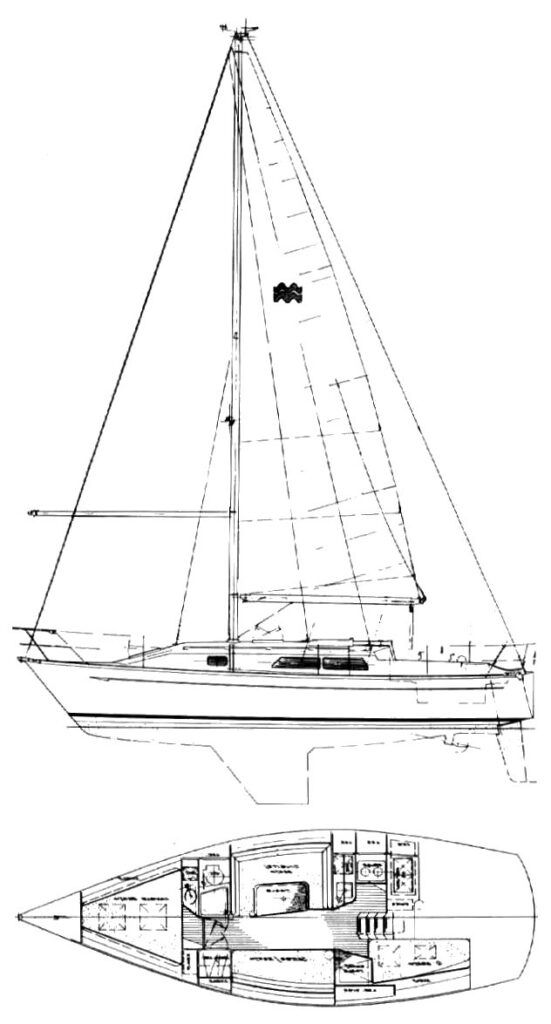
Sailboat Specifications Courtesy of Sailboatdata.com
Hull Type: Fin w/spade rudder
Rigging Type: Masthead Sloop
LOA: 33.50 ft / 10.21 m
LWL: 26.75 ft / 8.15 m
S.A. (reported): 468.00 ft² / 43.48 m²
Beam: 11.67 ft / 3.56 m
Displacement: 9,300.00 lb / 4,218 kg
Ballast: 3,500.00 lb / 1,588 kg
Max Draft: 5.00 ft / 1.52 m
Construction: FG
First Built: 1982
Builder: Mirage Yachts Ltd. (CAN)
Designer: Robert Perry
S.A. / Displ.: 16.99
Bal. / Displ.: 37.63
Disp: / Len: 216.90
Comfort Ratio: 18.94
Capsize Screening Formula: 2.22
S#: 2.51
Hull Speed: 6.93 kn
Pounds/Inch Immersion: 1,115.43 pounds/inch
I: 42.00 ft / 12.80 m
J: 13.00 ft / 3.96 m
P: 35.50 ft / 10.82 m
E: 11.00 ft / 3.35 m
S.A. Fore: 273.00 ft² / 25.36 m²
S.A. Main: 195.25 ft² / 18.14 m²
S.A. Total (100% Fore + Main Triangles): 468.25 ft² / 43.50 m²
S.A./Displ. (calc.): 17.00
Est. Forestay Length: 43.97 ft / 13.40 m
The combination of moderate displacement and generous ballast offers a stiff, comfortable ride. One complaint is that the 33 is a bit tender in winds approaching 20 knots, especially in gusts. Most sailors have had positive experiences and are happy with its pointing abilities and overall sailing performance.
For a modern sailor, the Mirage 33 delivers traditional build quality, well-balanced performance, and a platform that’s both comfortable and upgradeable. The Mirage 33 is comfortable for extended cruising or coastal passages for single handlers and families alike.
Engine
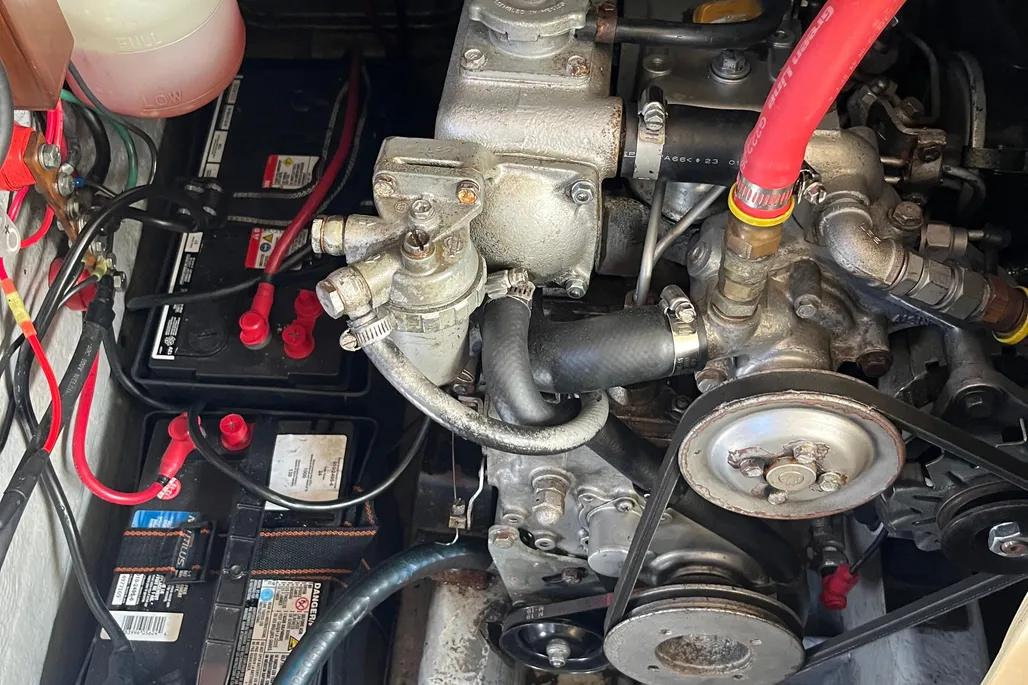
The Yanmar 2GM diesel engine provides 15 hp at 3,400 RPM and is usually paired with a Kanzaki transmission. Some are cooled by direct sea water while others also have a heat exchanger. The engine is located under the cockpit and can be easily accessed by removing the cabin stairs. A better but less convenient entry is located in the port side cockpit locker. A large panel can be removed enabling better access to the side and rear of the engine. The engine room is very compact and can only hold two batteries. The stainless steel 20-gallon fuel tank is located at the rear of the engine.
Construction
The hull is solid fiberglass with a lead bolted on fin keel and a spade rudder. The deck is balsa cored covered with a non-skid gel coat. The deck is bolted and glued to the hull and covered with an aluminum toe rail. The chainplates are attached to the interior bulkhead for easy inspection.
Normal grazing and spidering appears on deck with little complaints about soft spots or delamination.
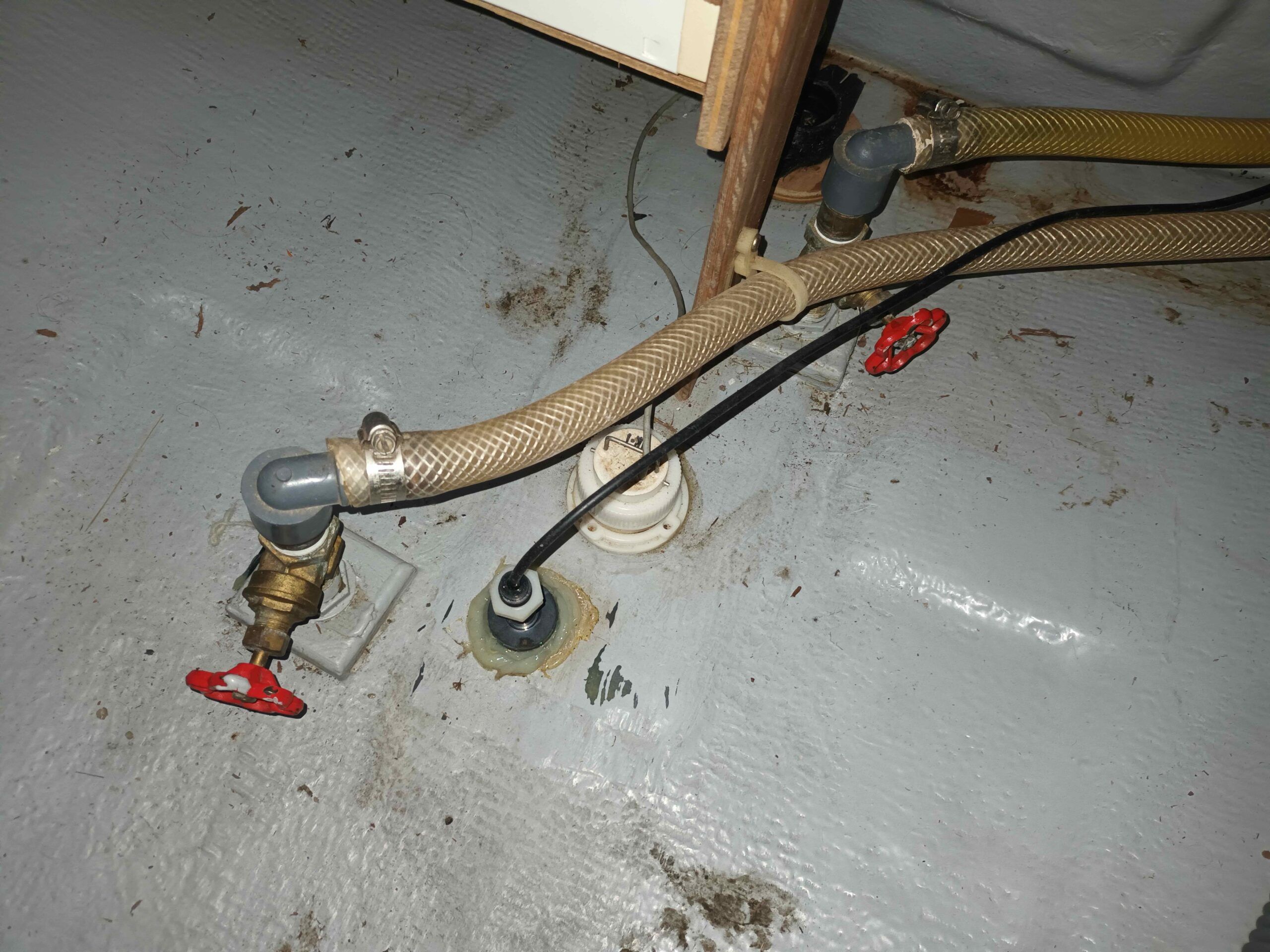
Gate valves were used on most Mirage 33s and by now should have been replaced with proper seacocks. Gate valves are not recommended below the water line. They are prone to failure.
A weak point on this boat is the stemhead (bow plate), where the forestay connects. Some have reported that the stemhead let go, allowing the mast to crash down into the cockpit. Although uncommon, it is a good idea to thoroughly inspect the above-mentioned area.
Conclusion
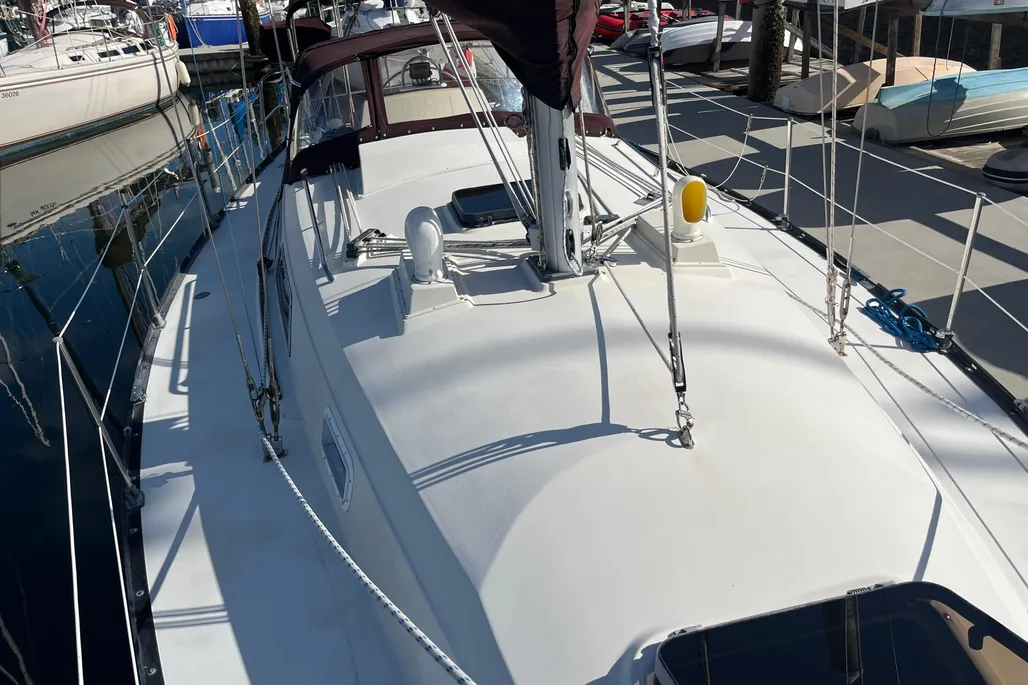
The Mirage 33 is not a common sailboat. You cannot find many for sale. There are few online active groups, and general information is difficult to find. You’ll seldom run into one at anchorage or a marina.
Upgrades
Since she’s a 43-year-old boat, certain upgrades would be beneficial such as electronics, newer DC panel, cushions and bright work. Adding USB ports, a solar system with lithium batteries, a hot water tank, Starlink and a low amperage refrigeration system would easily make her a comfortable live-aboard.
Reunited With an Old Favorite
Fifteen years ago, I was fortunate to survey a 1982 Mirage 33. I remember it for being so clean and bright—the layout was functional and spacious. It showed owner’s pride. In the past few years, I had been looking for another sailboat to spend my summers on in Northern Ontario, mainly on the North Channel of Lake Huron. My close friend John mentioned that a Mirage 33 was for sale in the marina where I previously stayed. He sent me pictures along with his honest opinion. I wired the money to the seller, buying the boat sight unseen.
The boat seemed familiar, so I dug through my survey reports and sure enough it was the same boat that I surveyed fifteen years prior. I finally got reunited with her again in July 2025. She still looked fabulous although showing her age. The mentioned gate-valve replacement that was noted in my survey report under “Issues of immediate attention” was not done. Priority number one for me! I spent the summer making her my own. Mostly cosmetic stuff. I had forgotten about the powered winches, which isn’t all that common on this size boat, but are a nice addition.
Bottom Line
If you are looking for a spacious 33-footer with good sailing performance, odds are that you’ll be happy with this vessel. At times you’ll find one for sale. Priced between USD$15,000 to USD$ 24,000 you are getting a lot of boat for your money with many more years of sailing left in her.
Market Scan Contact
1982 Mirage 33 Thunderbird Yacht Sales
$23,900 USD 604-315-7157
North Saanich, British Columbia Yacht World






My 1983 M33 Hull 77 has a cored hull below the waterline, not solid at least under the V-berth. I had no signs of water infiltration below the waterline.
One annoying issue is that the shaft is 7/8 inch, which I am told is too small for a 33-foot sailboat. Also, I’ve broken the propeller strut twice in 12 years. It too is undersized.
Last winter, I took his 42-year-old boat to the Bahamas from Canada and back. She performed fabulously.
Hi,
What is the core in the hull below the waterline and where? Balsa ?
My understanding is that these sailboats were not cored.
Do you know whether Mirage changed its production method at a point in time?
Cheers
I thought she wasn’t cored until I put a thru-hull in, and it turned out she was balsa-cored.
Given the weight of 9300 lb, I don’t think they changed the core.
HULL #77
I own a Mirage 35. The M33 and the M35 are nearly identical except for the reverse transom. The picture of the boat under sail in the article is a Mirage 35.