

Along a stretch of Atlantic coastline in Brittany, France, a 41-foot wooden catamaran is taking shape in a modest workshop where the rusty corrugated iron sliding side door is rarely closed for long. Volunteers drift in, neighbors stop by, and conversations often stretch beyond the work site and to the local port-side pub after hours for a few cold ones.
This is the Floating Stories Lab boat build: a 12-meter Polynesian-inspired, Wharram Designs Narai Mk IV, being constructed by my husband, Remy, and me—both with no previous boat building experience—along with a rag tag community as a future circumnavigable vessel for research, storytelling and citizen science.
Readers of Practical Sailor may recall our earlier article, “Why Choose the Wharram Design?” where we explained how we arrived at this choice of boat. But what happens when a set of ideals meet DIY design plans, real materials, a limited budget, and a constantly evolving skill set?
Good Enough Versus Perfect
The appeal of Wharram Designs is often summed up in a few words: minimalist, accessible, and easily repairable. All of that holds true while also being affordable to build and maintain. What becomes clear during the process of building one from scratch is that the simplicity of Wharram Designs is genuine. These are forgiving boats to build, structurally legible, and intended for ordinary people willing to work with their hands. The challenge lies less in complexity than in showing up consistently, learning as you go, and doing each stage well enough to carry the next.
Where you sit on the spectrum between “good enough” and perfection is a personal choice, and often a practical one. It depends on time, energy, and tolerance for rework. We’ve found ourselves leaning toward the perfectionist end, which brings its own set of challenges—learning when to let go of details that don’t affect safety or performance, and accepting that progress sometimes matters more than refinement. That balance becomes even more nuanced in a shared build environment, where different hands and skill levels are part of the process.
From the outset, we’ve been working within familiar limits: budget, time, tools, and our own inexperience. We also set a few additional constraints—prioritizing durability, considering material impact where possible, and opening the build to others rather than treating it as a closed project.
Working From Plans—And Around Them
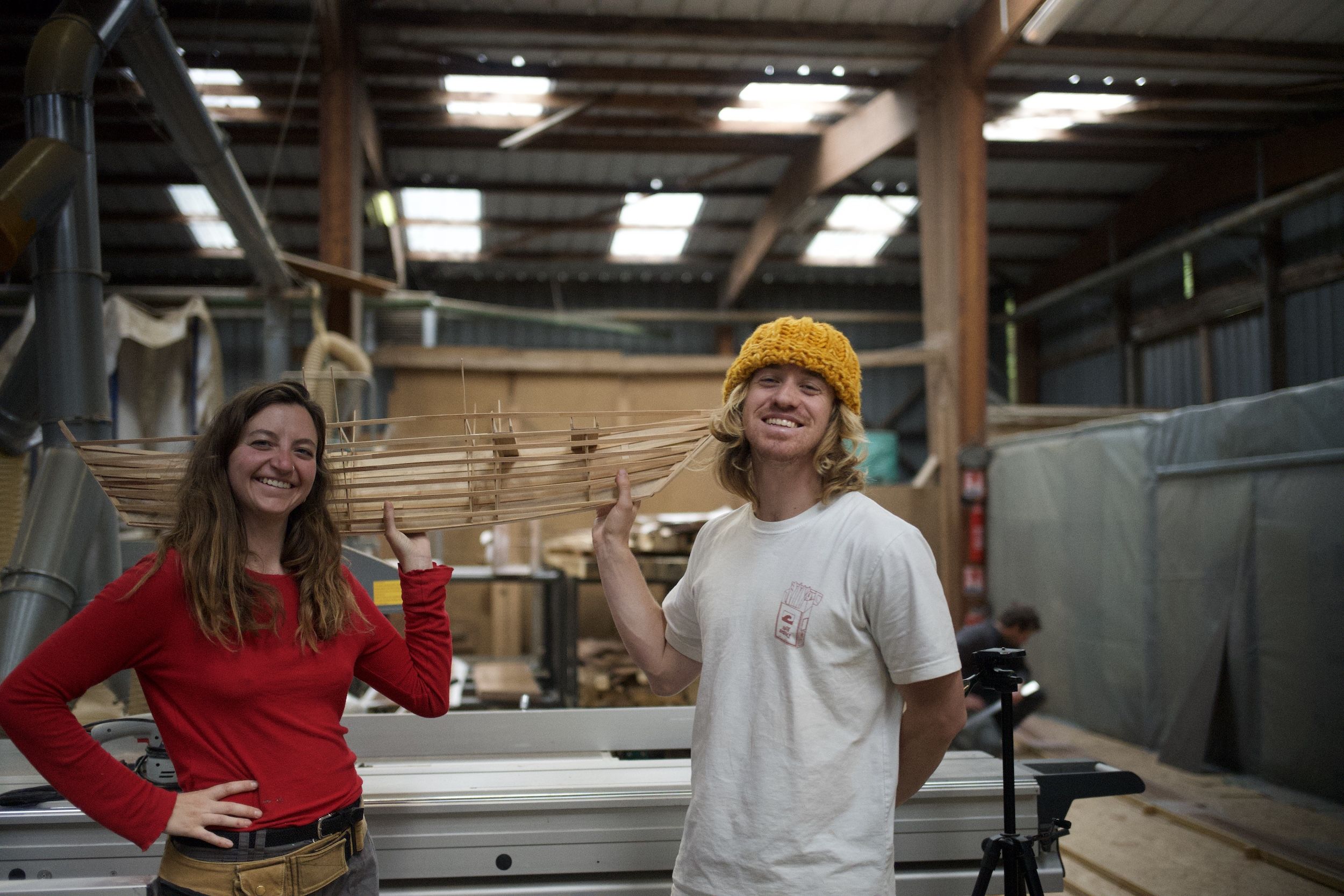
Wharram plans have earned their reputation through decades of use. They are conservative by design, and that conservatism is part of their reliability. At the same time, they reflect the materials and assumptions of their time.
Our approach has been to stay close to the plans while making small, deliberate adjustments where it made sense. Much of this has been guided by a retired professional boatbuilder, Pascal Petit, who has more than 65 builds behind him. Dropping in regularly, especially to lead major build phases and teach new skills, his influence has led us not to rewrite the design, but to question details. Where can weight come out? Where can loads be better distributed? Where has common practice moved on?
One of the first areas we revisited was the stringer layout. The plans call for fewer, thicker members. Using Movingui hardwood—denser than the European Douglas fir often used—we shifted to more and thinner stringers: ten instead of seven. It means more cutting, scarfing, epoxying, and more time spent aligning everything, but the hull will become more evenly supported, particularly as planking progresses. The trade-off is clear: more labor up front, but a lighter and more balanced structure overall.
A similar logic led us to adopt a notched stringer system, drawing from Wharram’s more modernized Tiki designs, rather than relying on bulkhead framing. This results in less timber involved, fewer intermediary pieces, and a lighter load.
The decision to scarf rather than use butt blocks has probably been the most debated. Butt joints are quick and forgiving, which explains their place in many amateur builds. But they add weight and create stiffness changes at each joint. Scarfing, while slower and less forgiving, produces a cleaner, stronger and more continuous structure. We’ve now scarfed all backbone components and most of the bulkheads, coated with two coats of epoxy and peel ply (more on that below). Attempting to scarf full sheets before cutting—standard in professional yards—proved beyond our patience, and perhaps our current skill level.
We opted to use thickened epoxy fillets and double-bias fiberglass cloth to create lighter, stronger beam troughs. This allows for smoother load transitions and fewer areas where moisture could accumulate and cause rot.
Materials Don’t Behave the Same
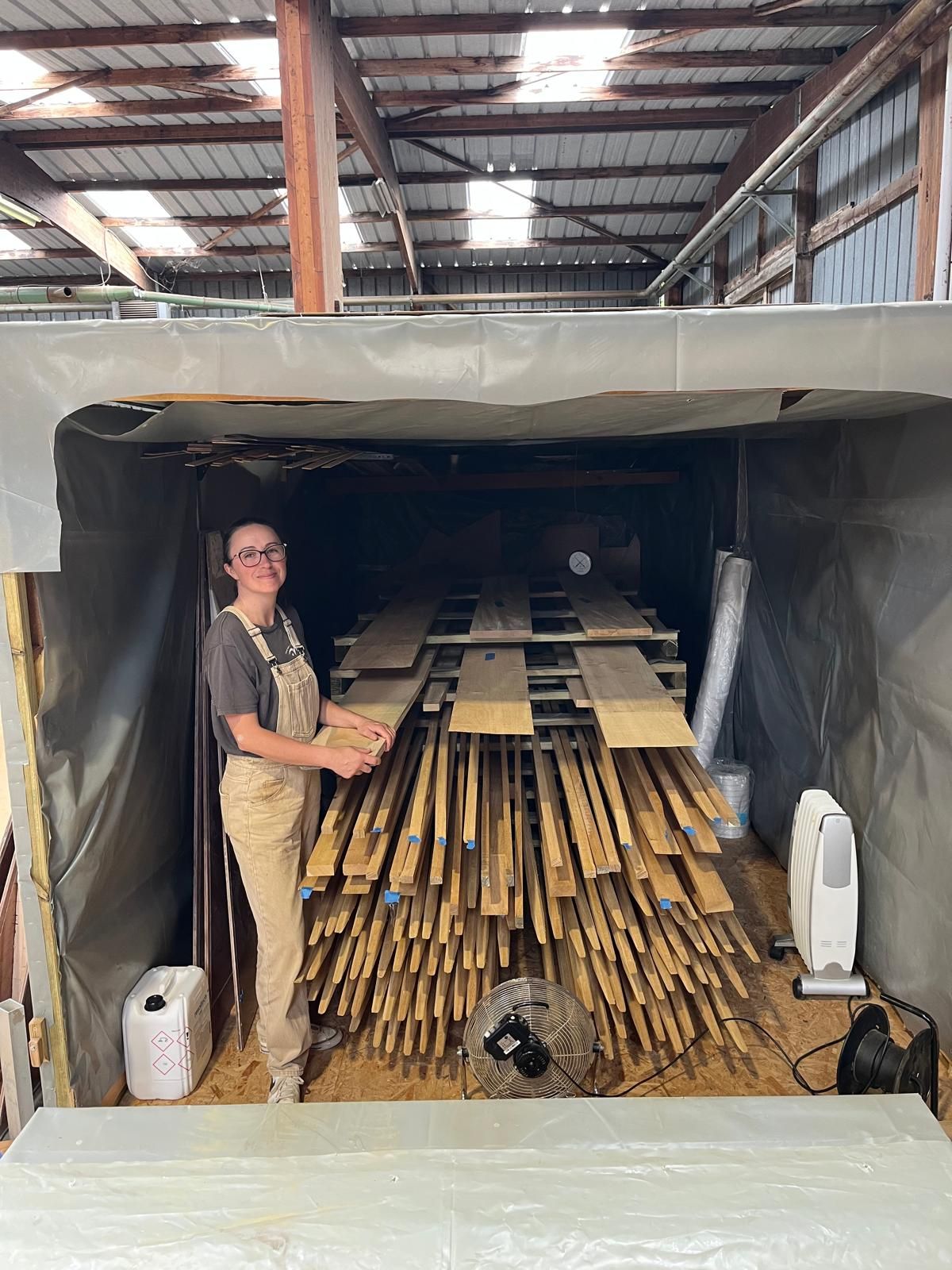
Material choice has introduced its own set of lessons.
We are using okoumé plywood for backbone components and bulkheads, after rejecting an initial batch of French maritime pine. Okoumé is light and stable, but noticeably more absorbent. That became obvious as soon as we began coating with epoxy.
Working with Resoltech 1020 ECO resin and 1026S hardener, the okoumé absorbed less resin than expected. That has direct implications for cost and protection. Insufficient saturation at this stage risks problems later.
So, we adjusted our approach. The interior okoumé components received two coats during the build, with a third ‘varnish’ planned once construction is complete. The maritime pine, which will be used for planking and the rest of the boat’s plywood needs, is thirstier and will receive just two coats of epoxy in total (prior to assembly) before being glassed externally. It’s a small distinction but an important one as treating all plywood the same would have left parts of the structure under-protected.
We had hoped to use a fully bio-based, BPA-free epoxy system from Change Climate, derived from algae. In tests with Pascal, who has decades of composite experience, it performed exceptionally well, both in lamination and under stress. But supply chain realities intervened and our European distributor is out of stock. Sourcing it directly from Australia proved impractical for the time being. We hope to complete the interior work with this option. It’s a reminder that, for most builders and boat owners alike, availability is as important as performance.
Moisture: The Quiet Constraint
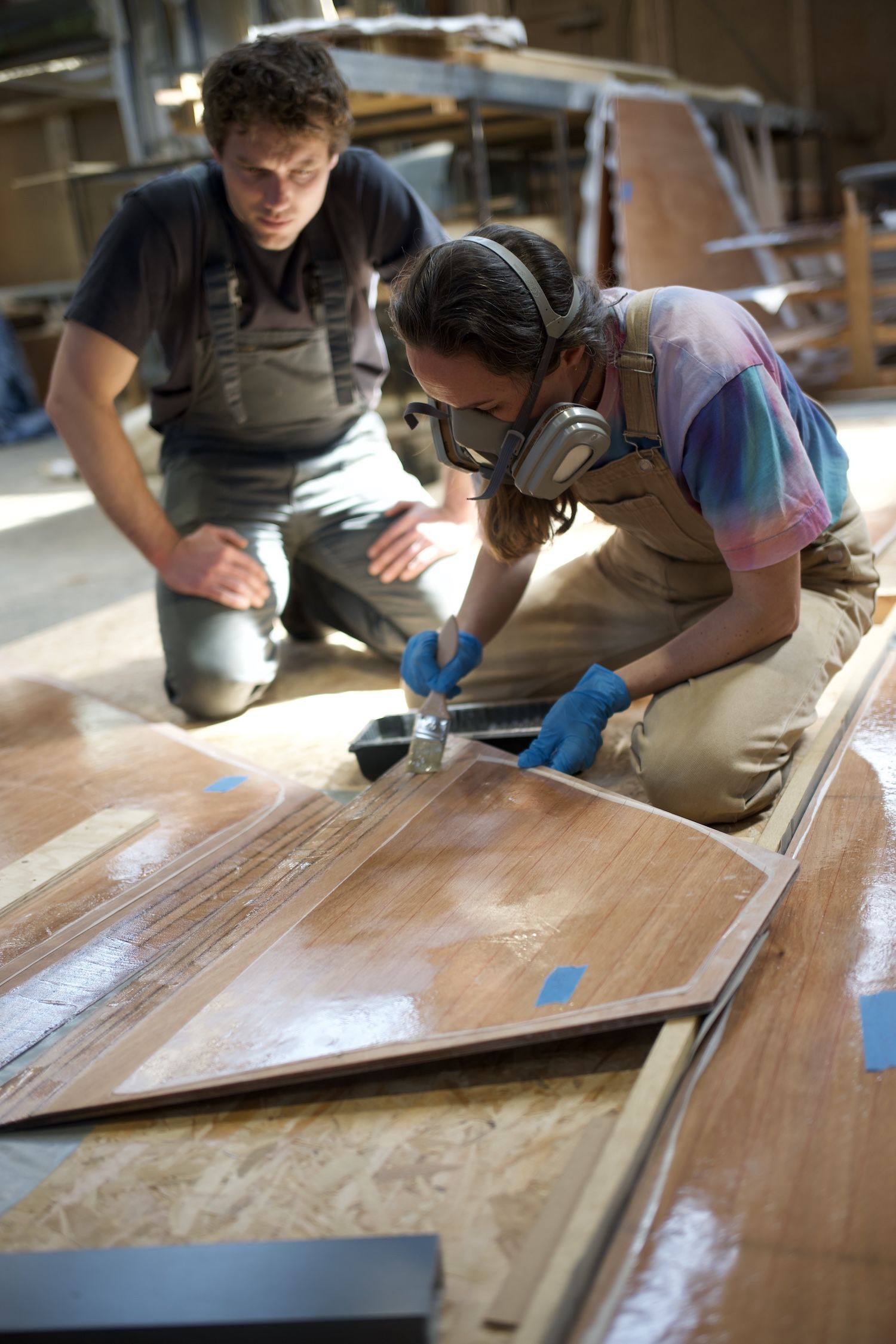
If there has been one constant challenge throughout the build, it has been moisture.
A long Breton winter slowed progress and reinforced just how sensitive plywood, timber, and epoxy construction is to humidity. The valuable book Gougeon Brothers on Boat Construction makes the point repeatedly: moisture content directly affects both epoxy bonding and the mechanical properties of wood itself. Wet timber limits epoxy penetration, increases the likelihood of future movement after assembly, and significantly reduces stiffness and strength.
That final point is often overlooked by amateur builders.
In the book, a chart showing how the physical properties of timber increase as moisture content decreases below the fibre saturation point, typically around 24–25 percent moisture content for most species, caught our attention. Depending on the property measured, every 1 percent reduction in moisture content can produce measurable gains in performance. Compression strength, bending strength, shear resistance, and stiffness all improve as wood dries.
In practical terms, reducing hardwood moisture content from around 16 percent to 10 percent can increase:
- bending strength by roughly 20–25 percent,
- compression strength by more than 30 percent,
- and stiffness by around 10–15 percent, depending on species and grain orientation.
Building a Drying Chamber
That became especially relevant in our case because we chose to use Movingui hardwood for the stringers rather than the Douglas fir specified in the original plans. Movingui is denser and mechanically stronger, but again, we also modified the geometry (more stringers, thinner sections).
On paper, reducing section size can appear counterintuitive because timber stiffness is heavily dependent on depth. Halving the height of a timber member dramatically reduces its individual bending stiffness. But boat structures are never just isolated pieces of wood. Once epoxy bonded to plywood planking and encapsulated within fiberglass skins, the hull begins behaving more like a composite monocoque structure, where the skin, stringers, fillets, and laminates all work together to distribute loads.
In that context, moisture control becomes even more important. Drier timber not only improves the strength of the wood itself but also improves dimensional stability and epoxy adhesion within the larger composite system.
Our solution was to build a simple drying chamber from recycled insulation panels fitted with a commercial dehumidifier (a valuable investment), fan, and small heater. The goal has been to bring hardwood moisture content down to around 10 percent before encapsulation and to stabilize plywood prior to bonding.
It now also doubles as a curing chamber for epoxy work. It’s not sophisticated, but it has introduced a level of consistency that would otherwise be difficult to achieve in an open coastal workshop where humidity can shift dramatically within a single day.
Many boatbuilders I spoke with are now using this material; it’s clear after just two months of using it ourselves that the practical advantages quickly compound: Reduced sanding between coats Improved secondary bonding Removal of amine blush More consistent laminate quality Better resin control Stabilizes fabrics during cure Cleaner seams and transitions Protection during curing Simplified finishing In a build involving multiple hands and varying experience levels, peel ply also removes a layer of variability. Laminates become more predictable, prep work becomes faster overall (you get faster at cutting and rolling peel ply!), and the cumulative time savings are significant. We are currently exploring recycling options for the cured nylon fabric, as the amount generated over the course of a full boat build quickly becomes substantial.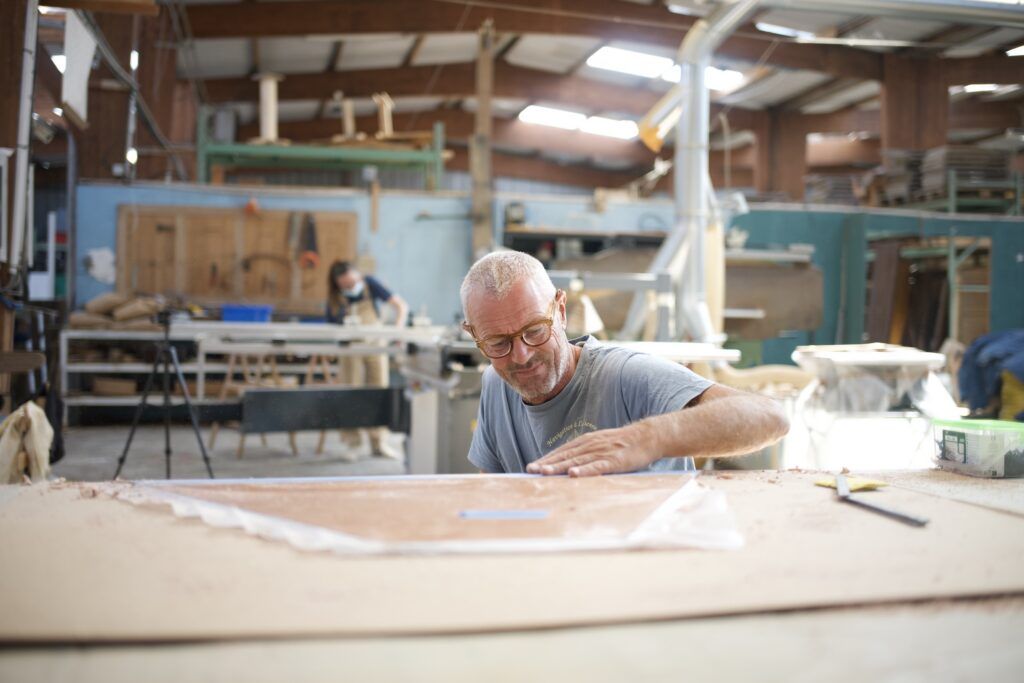
An Unexpected Outcome
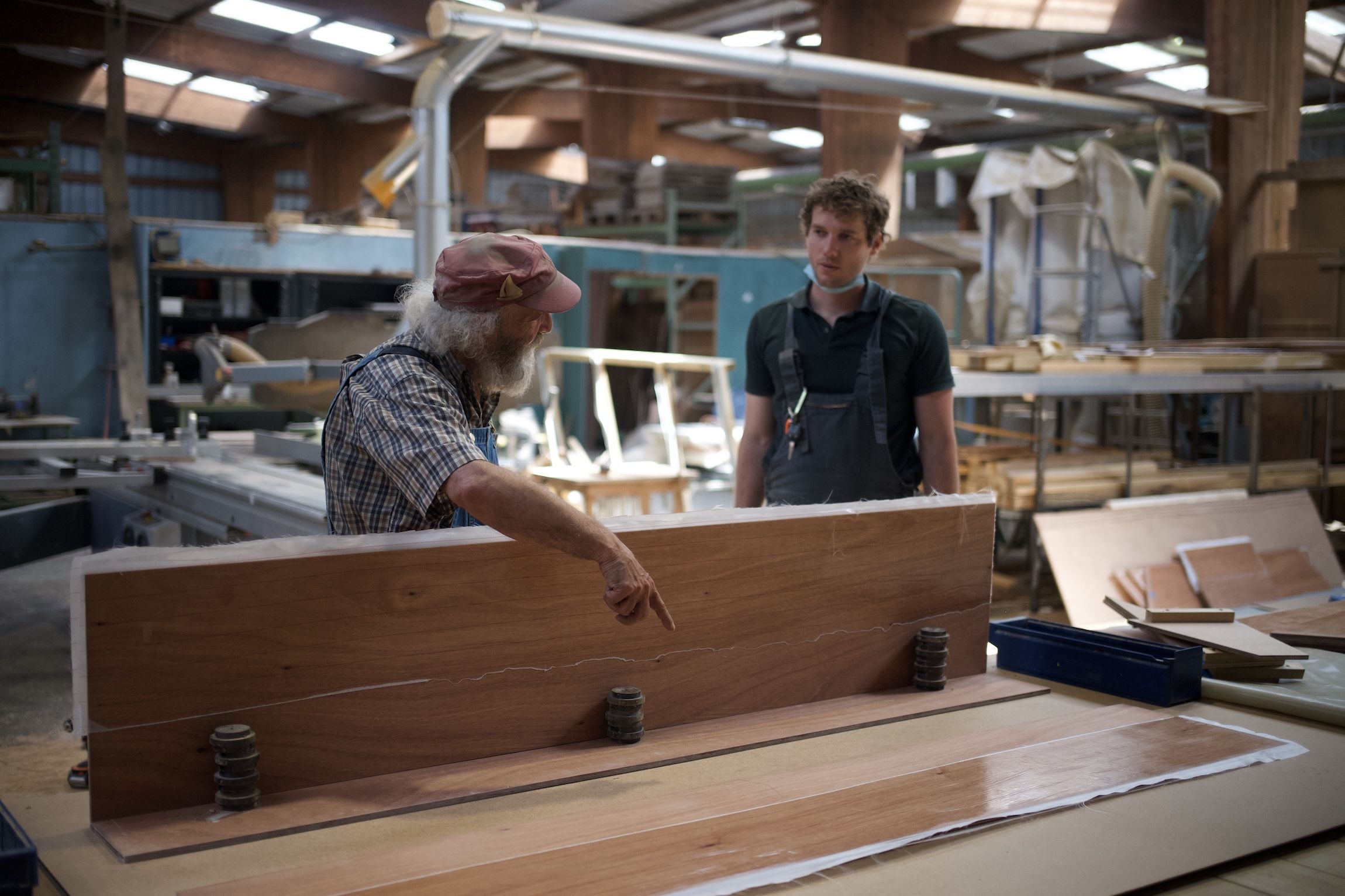
The project also began with an unexpected interruption. Just one week after receiving the workshop keys, Remy broke his neck in a cycling accident. Recovery was fortunately successful, but it forced us to slow down early and reminded us that boatbuilding, like sailing itself, rarely unfolds according to plan.
What we didn’t expect, at least not this early, was how quickly the project would draw people in.
Remy and I are working seven days a week, fitting the build around our day jobs, running the association, and family life with three children. We assumed the early stages would be slow and largely solitary and the attraction would come post splash.
Instead, people started showing up before the work site floor was even built.
Some stay for a day, others for weeks. Retirees, students, neighbors, passing sailors. Tools appear, advice is shared, materials are offered. Others support from a distance, joining the Floating Stories Lab’s membership community and contributing to the wider project.
Passing It On
We just hosted our first ever Boat Build Residency, welcoming four participants with no previous boat building knowledge from across Europe and America. In just a week we all tackled about two months of projects, through smiles, laughter, and plenty of dancing.
Boatbuilding is often imagined as a solitary effort. But the lineage behind these designs suggests otherwise. Polynesian voyaging canoes were built collectively, with knowledge passed through practice rather than instruction manuals. Later, traditional boatyards worked in much the same way, with skills learned by watching, then doing.
What’s happening here feels closer to that than to the image of a lone builder in a shed. Just a day before the residency, Pascal taught Remy and me how to make fillets and build a beam trough. The next day, we were teaching our residency participants, who went on to create three more.
The nature of the design helps. Even with modifications, the Narai remains accessible. It doesn’t require specialized infrastructure or complex systems. Someone with no prior experience can understand a task, try it, and contribute meaningfully.
Looking Ahead
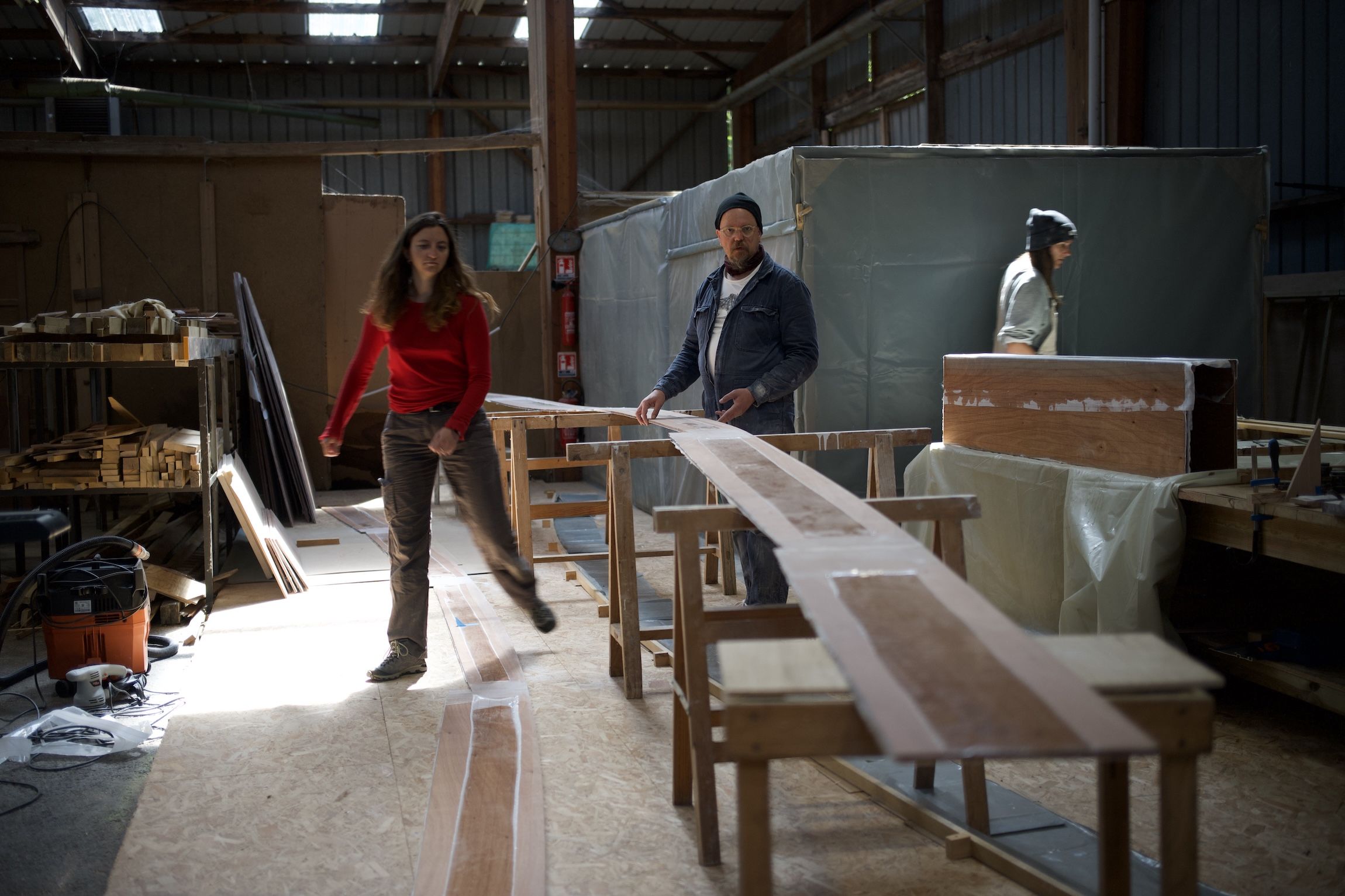
At the time of writing, the major assemblies are still to come. We are in the middle of assembling the backbone; from there the bulkheads and beam troughs will be added and we’ll have two upside-down hulls beginning to take shape. There are almost 100 stringers to epoxy and peel ply (twice) before fixing these to the bulkhead notches. By the end of summer, we anticipate adding the plywood planking and painting the bottom of both hulls before flipping them over to continue with interior work, cabin tops, and finally the centre deck, rigging, and final details.
Despite the workload ahead, a substantial part of the project is already in place: the accumulated knowledge, small improvements, and the growing group of people connected to the build.
The entire build is being documented on YouTube and social media and shared across our blog and Substack newsletters, and we have a goal to splash in the European summer of 2028.
Learn more: www.floatingstorieslab.org
YouTube: https://www.youtube.com/@floatingstorieslab