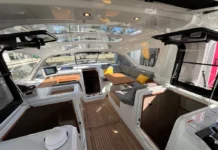
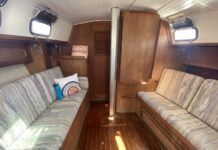
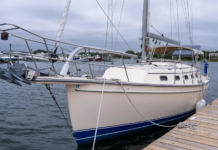
Arguably, the Catalina 34 first produced in 1985 with 1,438 constructed of various marks, and the Catalina 36 first produced in 1982 with 1,766 constructed through various marks, were important boats in the sailing world. Most of these boats are still around and hold value. Many still sail in the Caribbean and, for a smaller, more affordable sailboat, these popular models have performed well over the years. So, when Catalina makes a new boat in that size range, we just have to take a look.
The older 34 and 36 models are still staples in the sailing world. If you want to buy a recent sailboat in that size range today in a sub-$50,000 category, they will be on your short list to look at—and for good reason. These are great boats. While they are not as fast as the C&C line in that size range, they are adequately fast and they give you far more comfort, more living space, are easier to live with, and are easier to cruise in than the C&Cs.
6 Series
What we’re looking at today is the new Catalina 356 from the recent 6 Series of boats first produced in 2024. Overall length is 36 ft. 6 in. (11.12 m) with a beam of 12 ft. (3.65 m), so she’ll still fit in whatever slip your marina has available. We discuss this series often because they’ve done a lot of new stuff here.
Just because this is a 36-foot sailboat, don’t be dismissive. She’s not exclusively a little day sailor or weekender. The Catalina 356 actually has good things going on like a proper propane locker and two water tanks holding a total of 96 gal. (363 L), which is a lot. When I was living on my boat, I had just 60 gal. (227 L) and I got by just fine.
On Deck
Sailboat Specifications Courtesy of Sailboatdata.com
Hull Type: Fin w/spade rudder
Rigging Type: Fractional Sloop
LOA: 36.50 ft / 11.13 m
LOD: 34.50 ft / 10.52 m
LWL: 30.17 ft / 9.20 m
S.A. (reported): 650.00 ft² / 60.39 m²
Beam: 12.00 ft / 3.66 m
Displacement: 16,800.00 lb / 7,620 kg
Ballast: 5,200.00 lb / 2,359 kg
Max Draft: 6.67 ft / 2.03 m
Construction: FG
Ballast Type: Lead
First Built: 2024
Builder: Catalina Yachts (USA)
Designer: Gerry Douglas
Make: Yanmar
Model: 3YM30AE
Type: Diesel
HP: 30
Fuel: 30 gals / 114 L
Water: 38 gals / 144 L
S.A. / Displ.: 15.91
Bal. / Displ.: 30.95
Disp: / Len: 273.11
Comfort Ratio: 29.58
Capsize Screening Formula: 1.88
S#: 1.69
Hull Speed: 7.36 kn
Pounds/Inch Immersion: 1,293.61 pounds/inch
Don’t be fooled by the size of the Catalina 356, she’s got all the big-kid toys. Up front she has Catalina’s substantial stainless-steel double anchor roller supported with a rod secured to the stem—very strong. A deep chain locker with an electric windlass is protected by the piston-supported bulbous lid. The foredeck is clear with room to work. A single opening hatch adorns the nicely sloping coach roof. Other deck features include the long stainless-steel grab rails on the coach that extend from just forward of the dodger to the stays.
Rig
The 356 sports a deck stepped fractional Selden rig that is apparently lighter and stronger than previous masts, and still supports in-mast furling. The spreaders are swept back a bit, which may encumber downwind sailing, but not as much as similar Hunters with the B&R rig. The stays are set inboard against the cabin trunk, allowing easy passage forward on the wide side decks.
All sail control lines lead aft, exposed on the coach roof, to the cockpit where line locks and self-tailing winches make working the sails a breeze. The starboard winch is powered for handling the halyards. There are long genoa tracks set inboard along the cabin trunk, allowing for great sheeting angles for going to windward.
Traveler vs. Bridle System
Missing on the boat we looked at is a mainsheet traveler—it’s been replaced with a double-ended bridle system. Mainsheet trimming can be done from either side of the coach roof, which is interesting. Many of the slightly older Catalina boats came with this double-ended mainsheet system, even on regular travelers, and the owners quickly tied off the double-ended design and ran a sheet terminating on just one side. I’m curious how many owners of this new boat might do the same.
Hull

The new keel designs have been perfected to provide more lift and less drag. Perhaps most importantly for us who sail in thin water, less draft. The shoal version is now 4 ft. 6 in. (1.37 m). For the performance-oriented sailors with deep water, the 6 ft. 8 in. (2.0 m) keel is optimal. If you’re looking at one of these on the used market in a couple of years, make sure you ask about the keel. There’s a big performance difference if you can go deep—they are better pointing and faster to windward, but harder to live with if you plan on sailing in Florida or the Bahamas. This could be a selling factor depending on where the boat is located.
Mechanical
The Yanmar 3YM30AE will push this 15,000 lb. (6,804 kg) cruiser along just fine. It is a bit on the light side for this size boat, but the Yanmar 30 is adequate for the task. For fuel she has 30 gallons (113 L). Engine access is available to all sides under the companionway steps and through panels in the aft cabin and in the head compartment. The engine start panel is next to the helm on the starboard side of the cockpit. The single control lever is on the right side of the binnacle, where it should be.
Cockpit
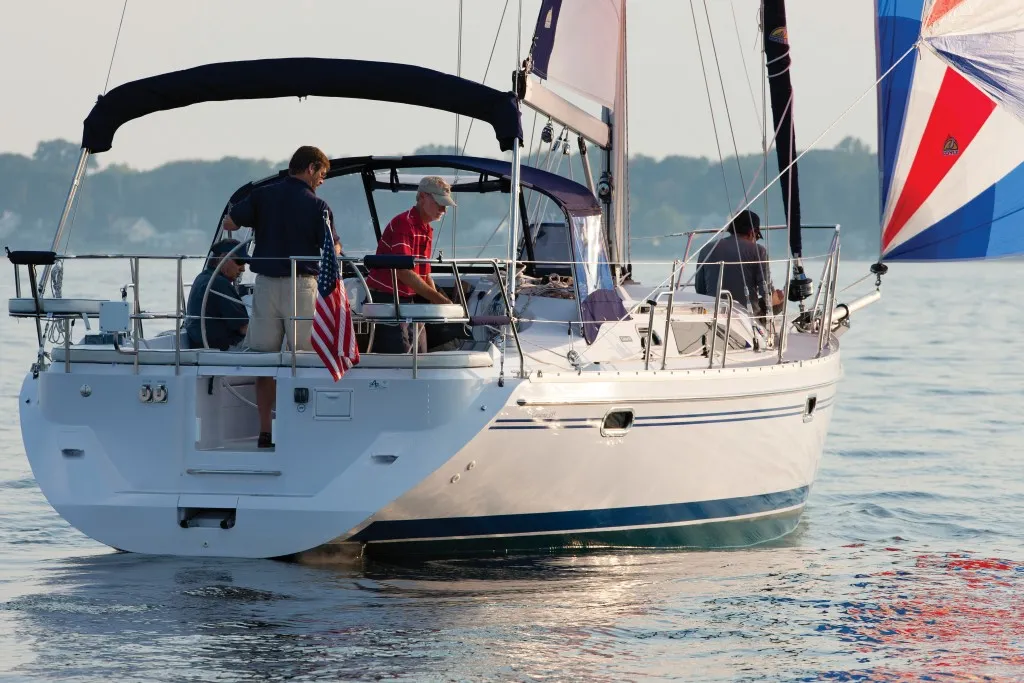
The cockpit has a raised helm seat that gives you optimal visibility over the coach roof. Cockpit seats are angled back slightly to provide more comfortable back support and safety. Seemingly standard on Catalinas of all sizes, the stern rail has my favorite seats in the corners. The cockpit’s expansive layout facilitates easy access to the side decks.
Lockers and Stern Access
There is a cavernous cockpit locker on the port side with ample storage space for all your essential items. Stern lockers include a propane locker to port with room for two cans, and a deep storage locker to starboard. Aft of the cockpit there’s a sugar scoop for easy access to the dinghy and dock should you be moored Mediterranean style.
Helm
Twin backstays with outboard chain plates maximize space around the single helm position. The low-profile binnacle is a welcome change, not falling into the trap of the over-height binnacles that obstruct views. Mounted in front of the Edson folding wheel is room for a chartplotter—the plotter table includes hand holds for going forward into the cockpit in lumpy seas. The binnacle is molded into an optional short center folding cockpit table. It does tend to interfere with a working cockpit but is very welcome for evening entertainment.
Winches
There are well-positioned, self-tailing two speed winches within easy reach of the helm allowing access to genoa control without having to move forward. There is a lack of molded space for additional winches on the coaming should a second pair be wanted. There is room for a second pair, just not a molded base. Unfortunately, as in many sailboats with mid-boom mainsheets terminating at the trailing edge of the coach roof, adjusting the main still calls for leaving the helm.
Below Decks
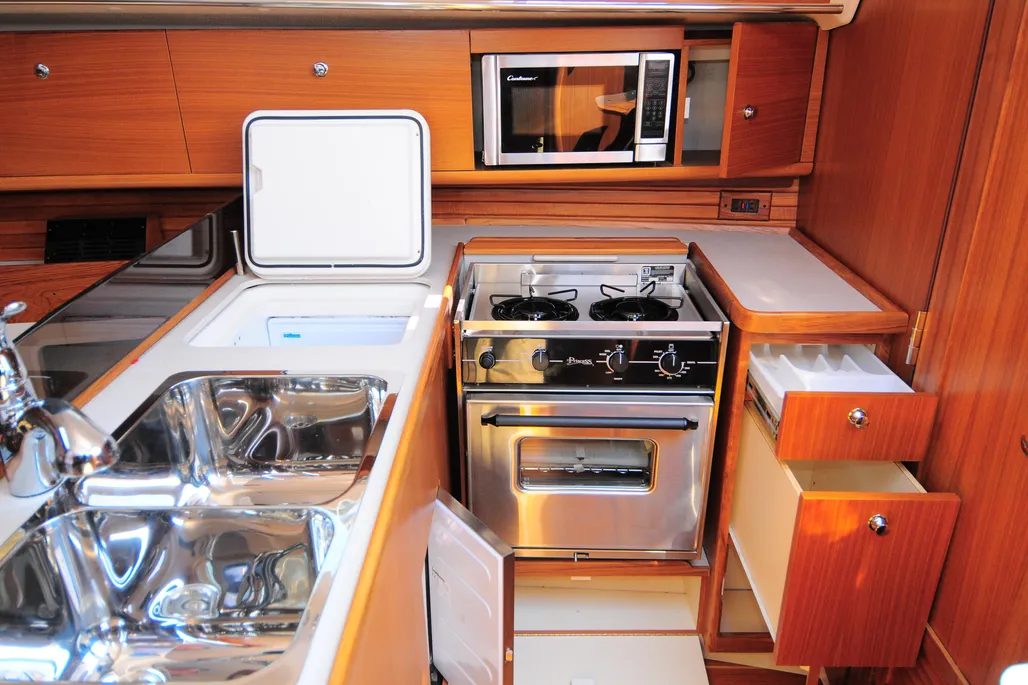
Going below it’s hard to tell the difference between the 356 and her bigger sisters. The same high-quality woodwork, fiddles where they should be, grab rails where needed, and rounded corners as far as the eye can see. A vertical grab post attached to the centerline cabinetry of the galley is most appropriate for navigating into the cabin in any kind of a seaway.
There’s very little in the way of the Ikea-style finish visible on many modern production boats. The wood grains all line up with high-gloss varnish where appropriate. I love the pop of the white upholstery that brightens up the interior and makes it appear more spacious than it already is.

Nav Station
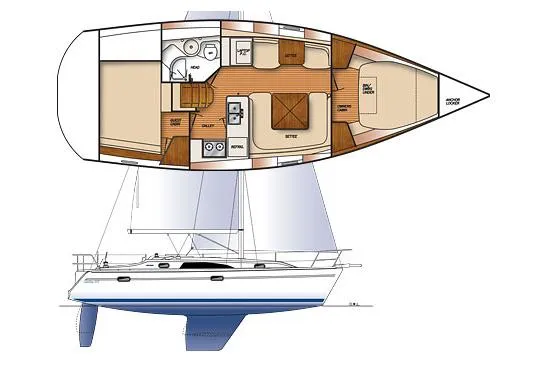
A small aft facing navigation table with storage is to port just ahead of the head compartment and provides limited space for instrumentation. The boat’s electrical control panel, hidden behind a tinted plexiglass door, is mounted against the hull cabinetry. The aft port side seat can be used for the navigation table. The two port side seats are divided with a small table/armrest area.
Saloon
The U-shaped seating area to starboard is large enough to comfortably seat four, six in a pinch. The main saloon is spacious enough to properly entertain guests with a table that is a work of art—a square table that folds out every which way you might ever need. It can also be raised or lowered depending on use. For meals, entertainment or working on your laptop, this table can do it all. For a 36-ft. sailboat, what Catalina has fit into the hull without feeling cramped is quite amazing.
Head

The head is immediately to port at the bottom of the companionway, complete with shower and a capacious 27-gal. (106 L) holding tank. A curved shower curtain keeps the majority of the pure white compartment dry. An overhead hatch provides ventilation, while a fixed window provides additional light.
Galley
The U-shaped galley is to starboard and large enough to feed a family. The shape is designed to keep you in place in a seaway. The deep double sink is near the centerline with a top-loading fridge/freezer just outboard and a two-burner propane galley range against the hull. For a 36-ft. boat there is plenty of well-organized storage space available.
Aft Cabin
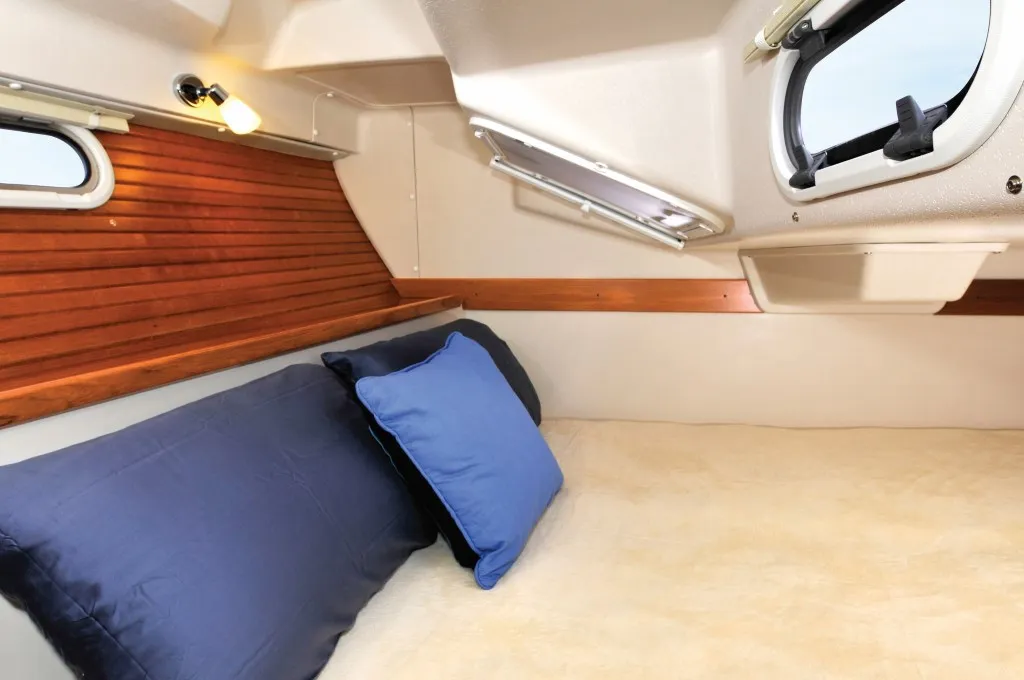
Aft of the galley is an athwartships double berth in the aft cabin. Although standing headroom is limited by the cockpit sole overhead, the space itself is quite welcoming. There is an opening hatch into the cockpit for ventilation and an outboard fixed window for additional light.
V-berth
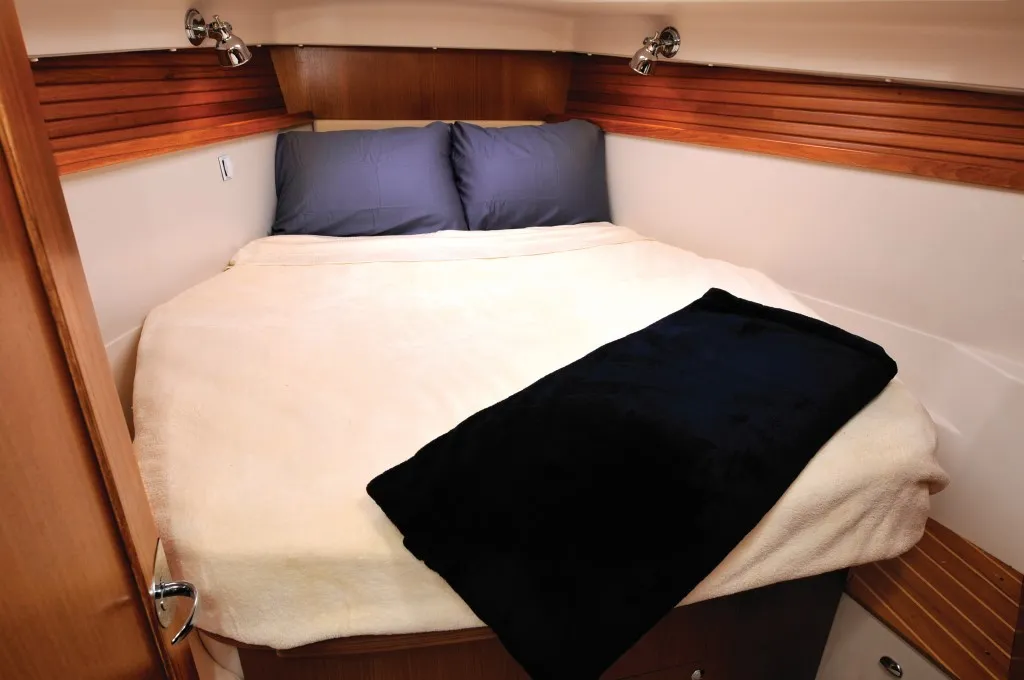
For the owners, the forward V-berth has an island style bed with plenty of storage in a large bin underneath with additional drawers and a hanging locker. A small seating area along the port side with a tiny desk/countertop complements the space—all very practical.
Catalina Quality
The Catalina 356 is an excellent example of just how good Catalina has become at making boats. All their boats seem the same, in a really good way. When you look at things like the hinges, fasteners, blocks and the hardware selection they use, the quality of these boats has evolved into something very decent. The smooth angles and glass work, the rounded corners and stainless-steel grab bars everywhere your hand might land, all developed over experience and time.
What Catalina is today is one of the most refined builders that we see on the market. They made a plan back in the 1970s and they put everything into it, executing the plan perfectly over the decades without falling into trendy traps along the way. From the time-honored 34 and 36, the recipe is still the same; Make the boat the best they possibly can and listen to the owners for feedback along the way. No gimmicks, no BS, just a very well performing and comfortable sailboat.

Market Scan Contact
2026 Catalina 356 G. Winter's Sailing Center
Request price
+12157742630
Riverside, New Jersey Yacht World
2026 Catalina 356 Chesapeake Yacht Sales
Request price 804-375-5005
For Order, Deltaville, Virginia Yacht World
Catalina Comparison
I know cruising couples are very into their 42-to-45-ft. sailboats, but if you have more of a minimalist attitude towards sailing, this boat genuinely gives you every single thing you can need in every way you need it without too much extra boat. Everything here is very well made and well executed, but outside she’s still just a 36-footer. Cheaper to own, cheaper to operate, easier to dock with less money per foot on the haul-out and storage. She’s lighter, nimbler under way, and easier to keep clean. You still get everything that big boats give you without really losing anything.
Price Point
And speaking of gain, with a base price of $280,000 USD brand new, that’s a lot for a 36-ft. sailboat. But for what you get on board, this is basically everything you would get on a $500,000-plus 42-ft. sailboat with less of a hassle and way less money. Even better, Catalinas hold their value better than most. Even the 10-year-old versions of boats like this are going for over $200,000.
Holding Their Value
Historically, Catalinas age very gracefully and sell super-fast when they come on the market. They are so well made that they don’t really deteriorate very much over time. Thinking about those sorts of Ikea, stamped out production boats that are kind of falling apart after 10 years, the Catalina line of boats just doesn’t crumble. I’ve looked at a lot of 10–15-year-old Catalinas, even 20-year-old models, and they’re still in incredibly good shape. The 356 might be the new 34 and 36 and I think they did a great job giving us big boat stuff in a relatively small boat.
Temporary Production Pause
As a footnote to this review, recent information has surfaced that Catalina Yachts has temporarily paused production at their Florida factory as of October 2025 due to a short-term financial challenge. We hope there will be a resolution to this issue shortly. See our report on this development: