

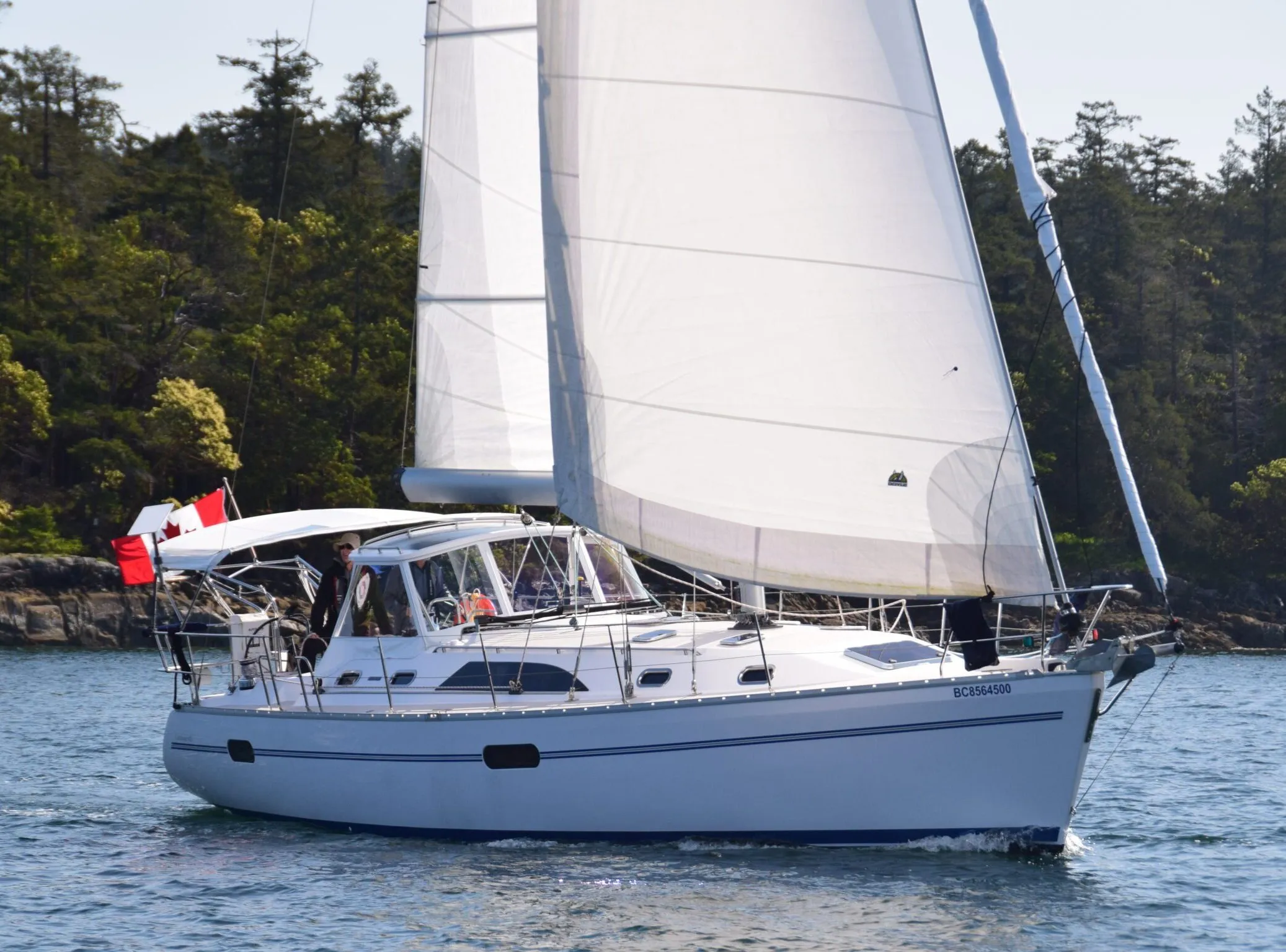
Rob Miller began his sailing life in dinghies in the waters south of the suburbs of Vancouver, British Columbia at age 10. Interest in sailing continued through his formative years and eventually a career moved him and his family to a sailor’s paradise at the south tip of Vancouver Island. Surrounded by ocean waters with the Canadian Gulf Islands, Desolation Sound and the American San Juan Islands all within reach, Rob and Maureen purchased a C&C 29 as their first cruising sailboat. Sailing life agreed with the family and eventually they moved up to a Catalina 320, expanding their horizons to include facing the open Pacific Ocean with a circumnavigation of Vancouver Island in 2023.
Since they were firmly hooked on the sailing life, and had goals of sailing further north to the Central Coast and islands of Haida Gwaii, a boat with more creature comforts and carrying capacity was called for. Although they weren’t specifically looking for a Catalina 445, they were impressed with the attention to detail presented by Catalina Yachts. They were also impressed with the interior layout of the 445, the teak interior, the storage capacity and the clean deck, but they were not interested in the in-mast furling common to the models available on the market. After going into a discussion group to learn more about the 445, they discovered a local 2016 boat with factory in-boom furling that would be for sale shortly. The rest is history.
Catalina History
Catalina Yachts really doesn’t need any introduction in the sailing world. A survivor from the heyday of the fiberglass boat building explosion of the 70s and 80s, Catalina evolved and adapted, building boats that were appealing to both cruisers and racers. From the diminutive 25 to the massive 54, Catalina has designed and constructed them all successfully. Gerry Douglas, chief designer with the company and designer of the Catalina 445, retired after four successful decades with the company. As has been written and stated many times, Catalina learned to listen to their customers and incorporate client ideas into their designs. The Catalina 445 demonstrates that mantra.
Hull
The hull is solid fiberglass with balsa core from the waterline up. The deck is also balsa cored with solid glass hardpoints incorporated where winches and other gear is attached. A structural fiberglass grid distributes the loads from the rig, keel, engine and other heavy components into the hull. Catalina still uses the more expensive lead for their keels, a feature that will provide less trouble into the future. Snowbird is the deep keel version with a 6-ft. 8-in. draft. A 5-ft. wing keel is also available from Catalina.
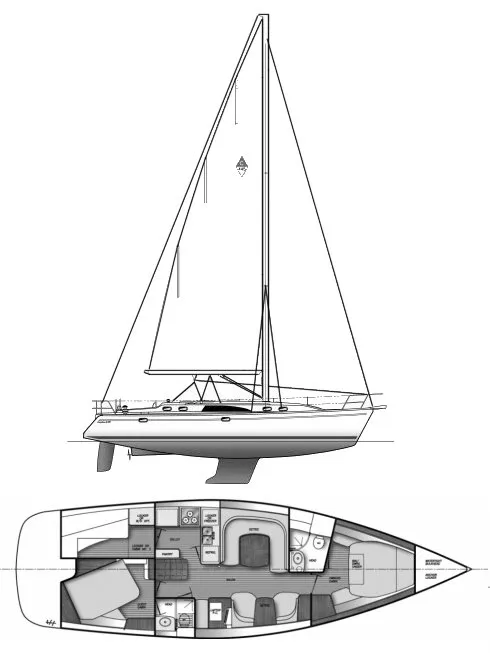
Sailboat Specifications Courtesy of Sailboatdata.com
Hull Type: Fin w/bulb & spade rudder
Rigging Type: Fractional Sloop
LOA: 44.42 ft / 13.54 m
LOD: 43.25 ft / 13.18 m
LWL: 38.33 ft / 11.68 m
S.A. (reported): 856.00 ft² / 79.53 m²
Beam: 13.58 ft / 4.14 m
Displacement: 23,500.00 lb / 10,659 kg
Ballast: 7,200.00 lb / 3,266 kg
Max Draft: 6.92 ft / 2.11 m
Construction: FG
First Built: 2009
Builder: Catalina Yachts (USA)
Designer: Gerry Douglas
Make: Yanmar
Model: 4JH5
Type: Diesel
HP: 54
Fuel: 66 gals / 250 L
Water: 179 gals / 678 L
S.A. / Displ.: 16.76
Bal. / Displ.: 30.64
Disp: / Len: 186.30
Comfort Ratio: 28.03
Capsize Screening Formula: 1.90
S#: 2.85
Hull Speed: 8.30 kn
Pounds/Inch Immersion: 1,859.88 pounds/inch
I: 53.50 ft / 16.31 m
J: 15.67 ft / 4.78 m
P: 51.50 ft / 15.70 m
E: 17.00 ft / 5.18 m
S.A. Fore: 419.17 ft² / 38.94 m²
S.A. Main: 437.75 ft² / 40.67 m²
S.A. Total (100% Fore + Main Triangles): 856.92 ft² / 79.61 m²
S.A./Displ. (calc.): 16.78
Est. Forestay Length: 55.75 ft / 16.99 m
Mast Height from DWL: 62.83 ft / 19.15 m
On Deck
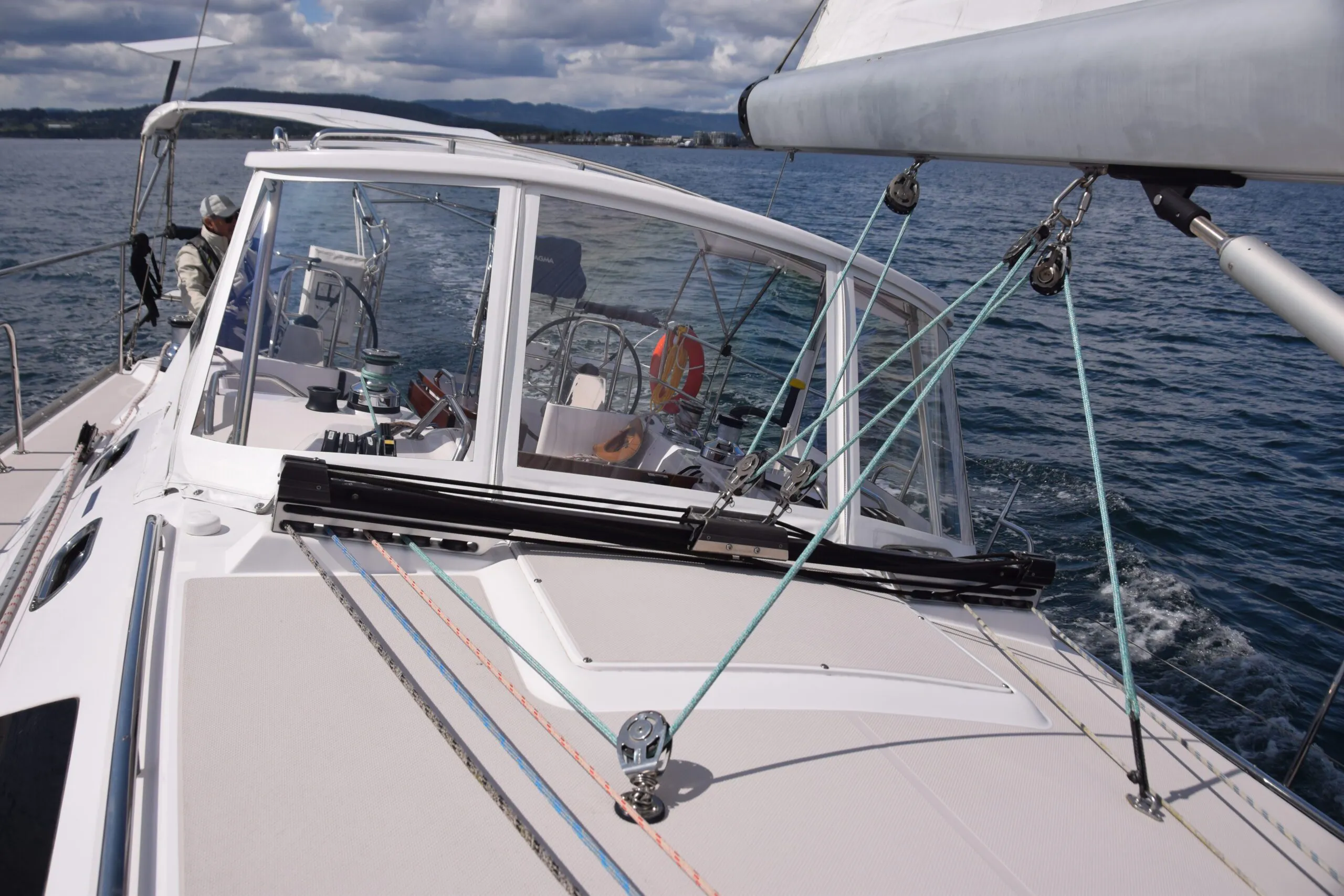
Traditionalists will sadly note that there is not a stick of exposed teak on the deck of the 445. Sailors will also make the same mental note, and applaud the lack of maintenance that teak would require! All handholds, and there are plenty, are stainless steel and located in all the right places. The side decks are wide and free of tripping hazards. The stays are set well inboard with the long genoa tracks on a raised ridge at the turn of the cabin trunk and set proud, not recessed into the deck. This will allow for the addition of oversized genoa cars and control lines if desired.
Double lifelines connect the pulpit to the pushpit with a properly supported boarding gate just forward of the cockpit. The pushpit top bar has been extended forward for the length of the cockpit right to the boarding gate. This provides a very secure handhold while stepping over the coaming. Very thoughtful. A slotted toe rail runs from bow to stern, handy for attaching fenders and blocks.
Foredeck
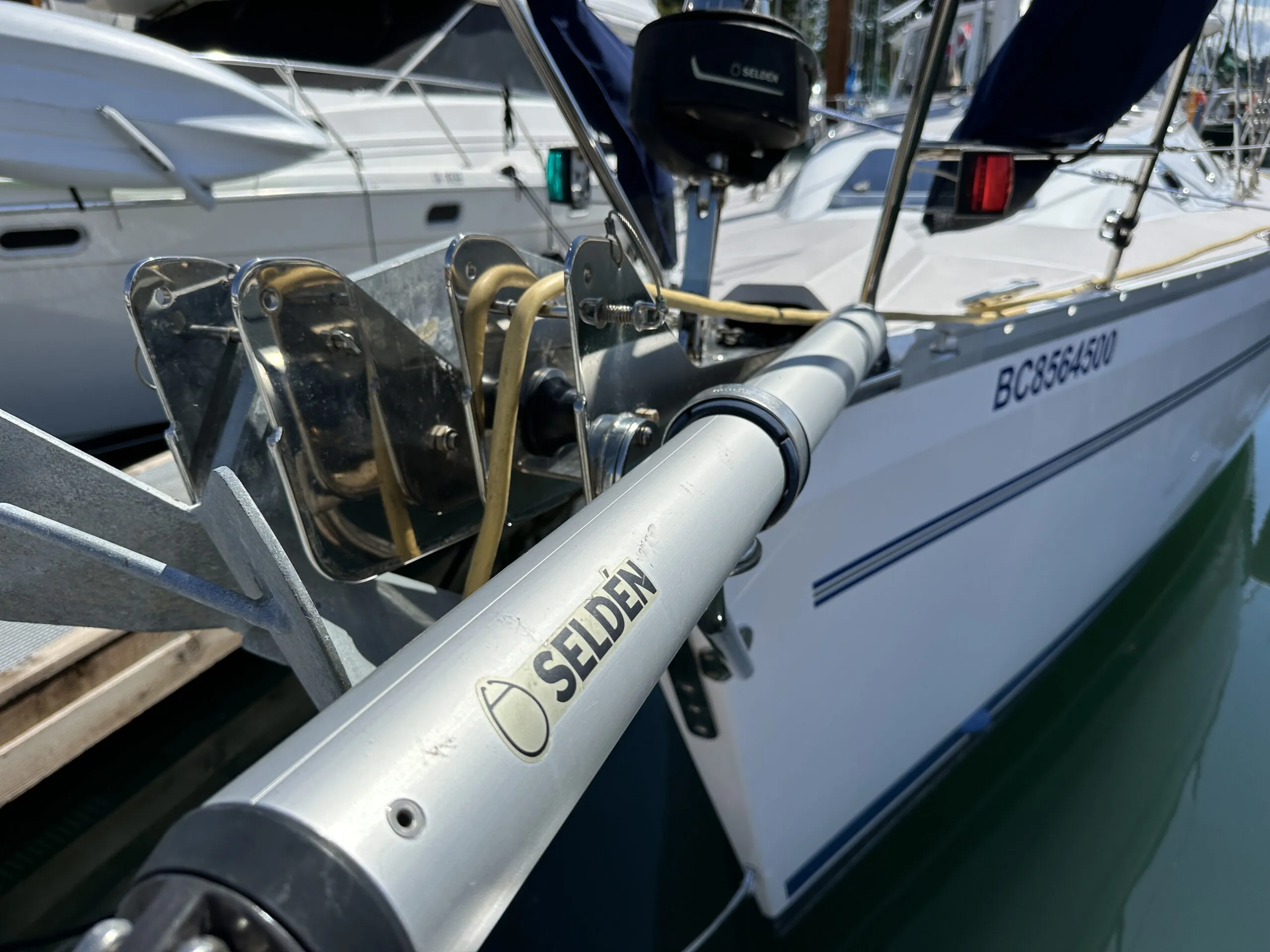
The foredeck is completely unobstructed with only a raised portion of the anchor locker lid breaking the clean lines. This longitudinal hump on the lid is provided to clear anchor shanks and chain, but does interfere with foot placement when working the bow. The double anchor rollers project well forward of the hull and allow for substantial ground tackle. A Selden bowsprit lays alongside for the off-wind sails. The deep anchor locker is partially divided, separate compartments for each anchor chain. A top shelf holds the windlass and controls. The problem I see with this arrangement is the depth of the locker and, potentially, the difficulty in reaching the bottom should something be dropped, or if cleaning is required.
Cabin Top and Dodger
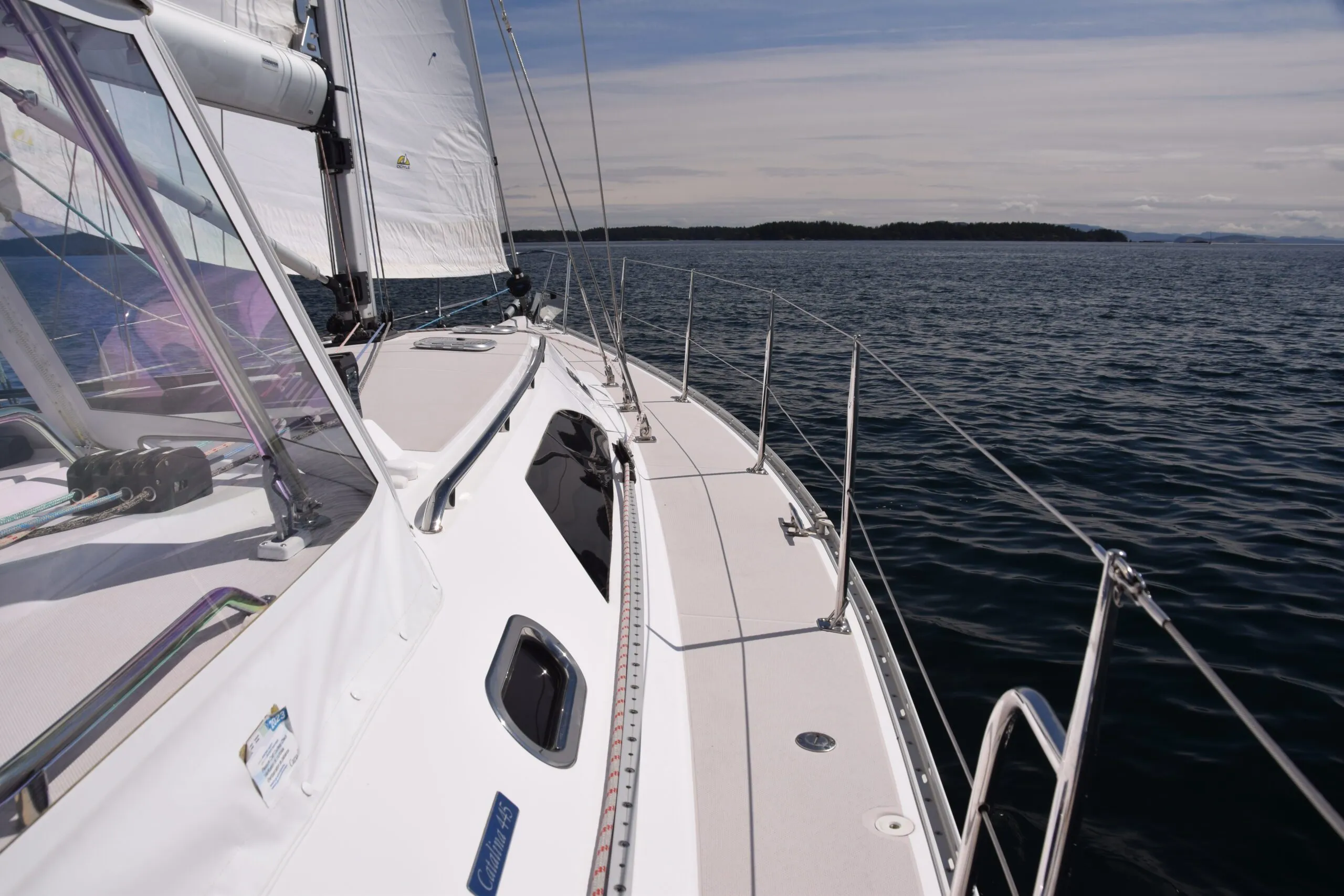
Moving aft, the cabin top is also clear of all obstructions with only the five opening hatches to deal with. This would only be an issue when flaking a traditional main onto the boom. Catalina options included a traditional boom, in-mast or in-boom furling, the in-mast being the most popular.
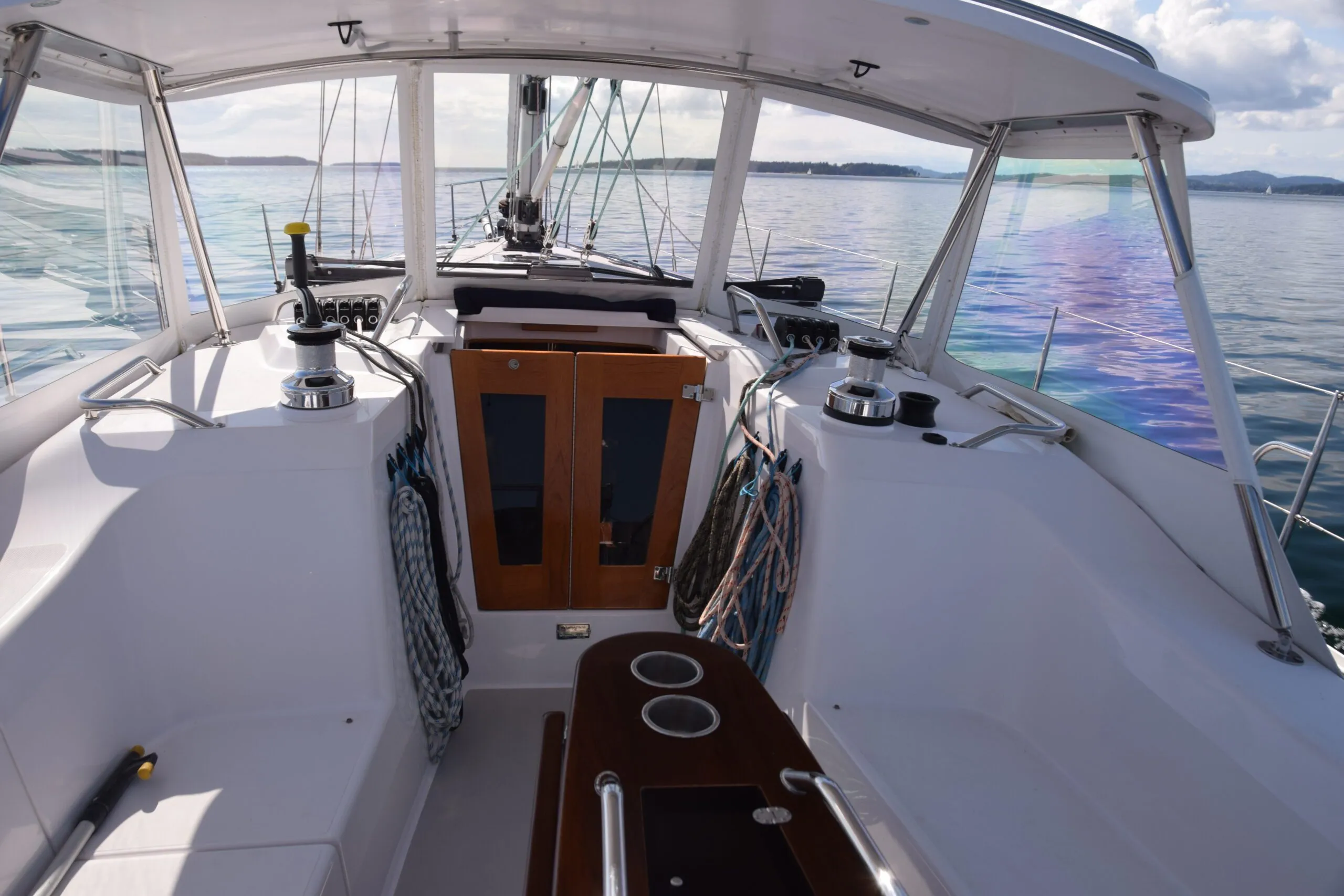
Another Catalina option aboard Snowbird is the solid dodger with removable plastic window panels. The height allows standing headroom beneath but prohibits an unobstructed view forward from the cockpit. This isn’t a problem on a dry day. But seeing debris in the water through a rain-streaked window may prove challenging. The top of the dodger hosts solar panels to supplement electrical power demands.
An aft-mounted bimini, also an option from Catalina, does a fine job of keeping the harsh sun off the twin helm positions but does limit views of the mainsail. Rob installed plastic windows above each helm, but the helmsperson must lean forward and then peer upwards to see the mainsail telltales. Rob has intentions to enlarge the windows aft.
The Cockpit
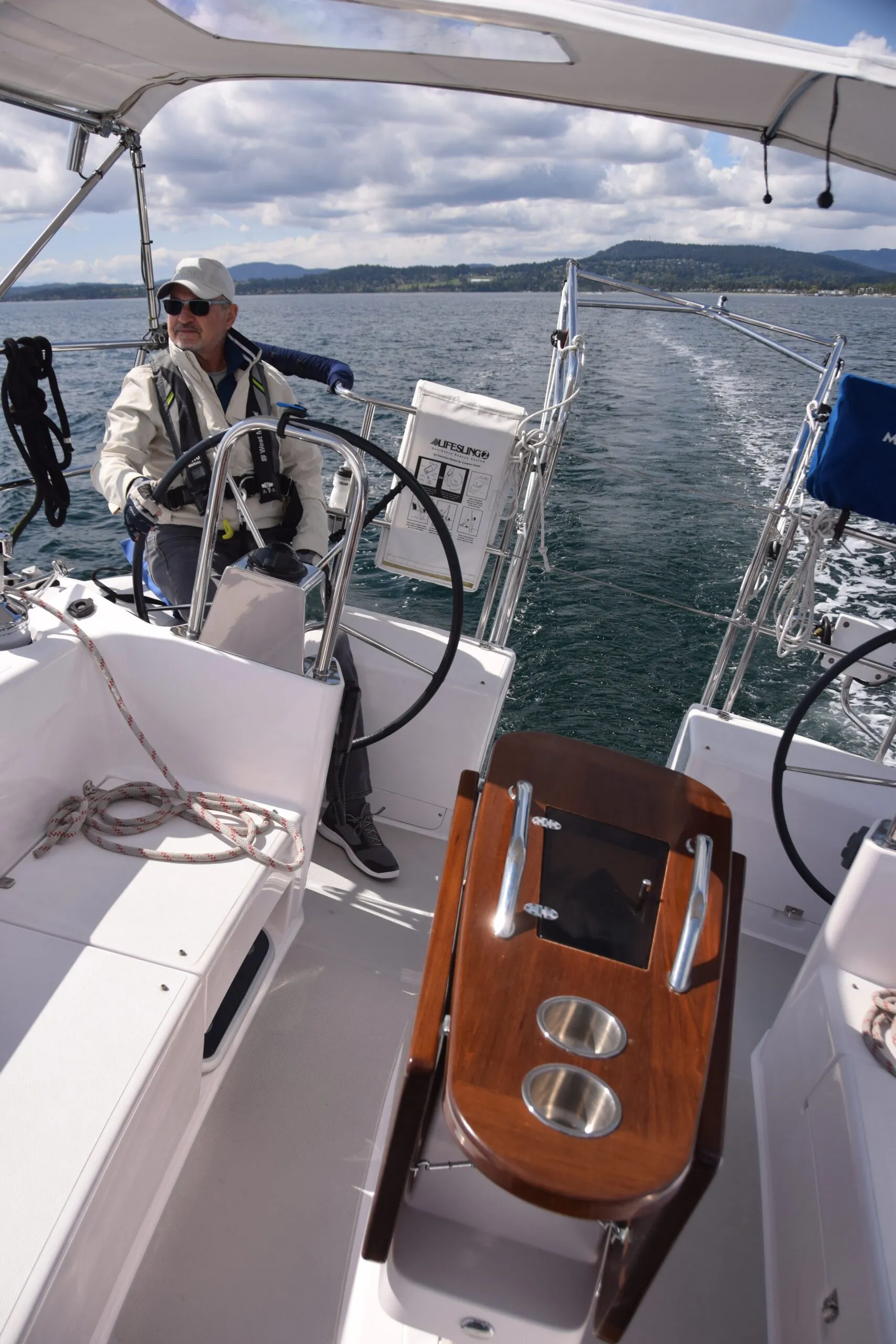
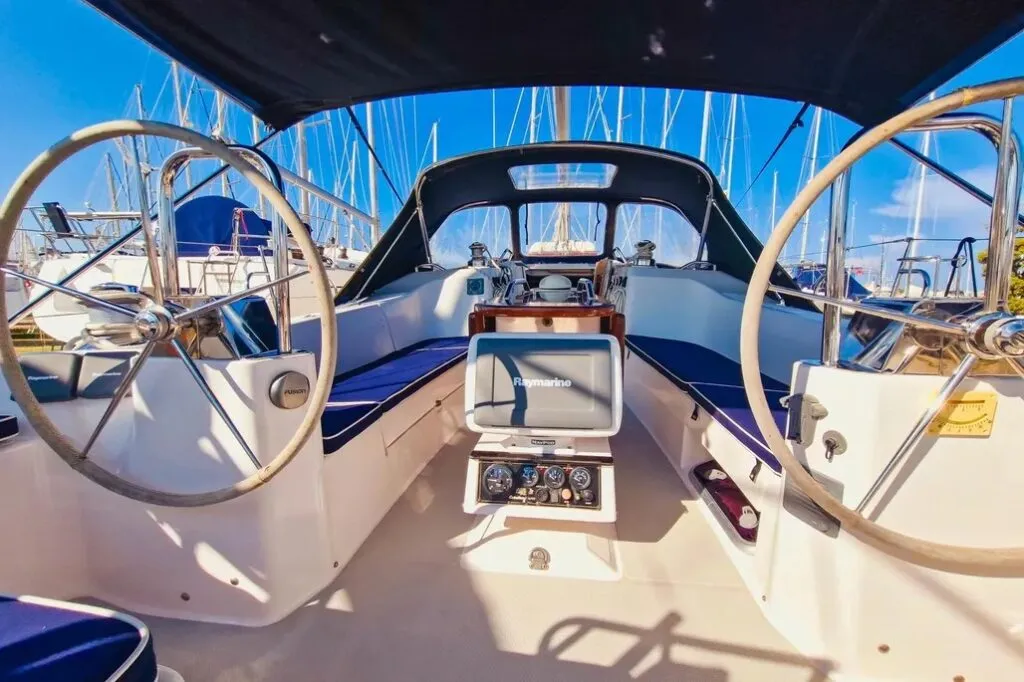
This is where the crew and guests are likely to spend the majority of their time aboard any sailboat. As always, Catalina has studied the ergonomics and developed a very comfortable cockpit both at rest and underway. The seats are long with the cabin bulkhead at just the right angle for back support. The cockpit coamings are the same, tall enough for good back support and yet easy to climb over. The cockpit table is just the right size for entertainment and yet does not interfere with working the boat under sail. With fold out leaves and cup holders, the table also provides stainless steel hand holds to assist in movement within the large area. The aft end of the table holds the engine instrument panel and, for Snowbird, the Raymarine chart plotter.
Twin Helms
With the two wheels the helmsperson is separated from the crew/guests. There is plenty of room at the helm, athwartships as well as fore and aft. The position is definitely not crowded. Raymarine sailing instruments are at knee level and duplicated at both helms—more on this later. Engine throttle/gearshift control are at the starboard helm. I’ve often wondered about the logic of this set-up, common on sailboats with dual wheels. If power boats can have duplicate engine controls at upper and lower control stations, why can’t sail boats have them port and starboard helms? Docking port-to places the helmsperson a considerable distance from the dock for both viewing as well as stepping off.
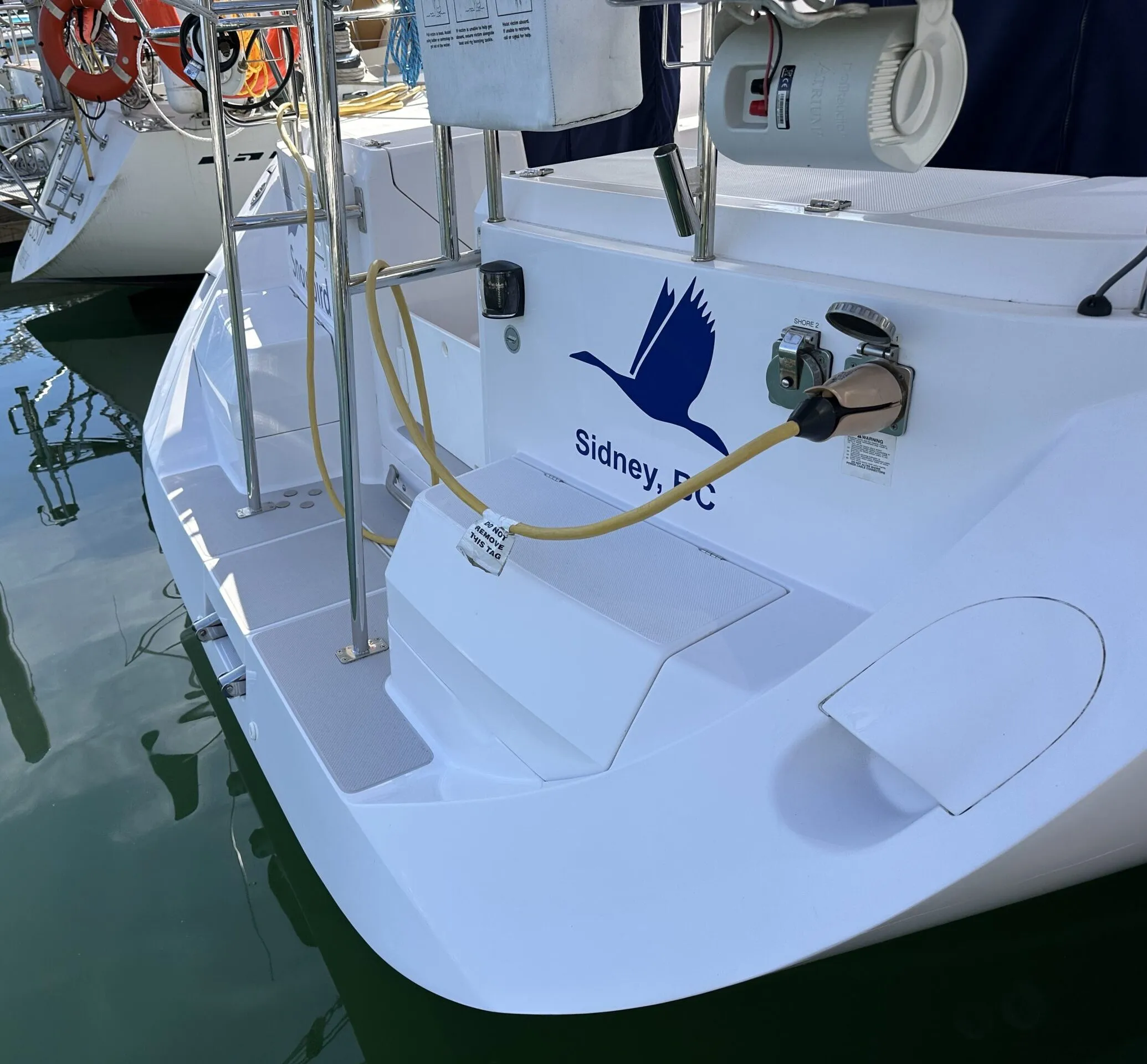
Between the two helm seats the open transom leads to a small swim grid. A propane locker occupies most of the port side and an identical locker for swimming gear on the starboard side. This area is not large but ideal for boarding from a dinghy or, as the label suggests, climbing aboard after time in the water. A boarding ladder is neatly tucked under the platform. On Snowbird, dinghy davits hang over this area providing all sorts of handholds.
The Rig
The 9/10ths double-spreader Selden mast is deck stepped on a cast aluminum plate that has room for multiple turning blocks for halyard and line control. As mentioned earlier, options included in-boom furling and Snowbird is equipped with a Schaefer boom furling system supported by a rigid boom vang. With the requirement that the boom be precisely 90 degrees to the mast when raising or lowering the full-batten mainsail, the vang holds the boom in a fixed position and, in this set-up, does not allow for adjustment under sail.
I’ve seen similar boom furling systems where the sailor can adjust the boom position under sail but must remember to ensure the correct position before lowering the main. On Snowbird this is not an option. Adjusting the leech or luff of the sail can only be accomplished by a combination of tensioning the halyard and furling the boom mandrel. The positive of the boom furling is, of course, the advantage of a fully batten main for sail shape.
The stays terminate at deck plates close to the cabin trunk and are supported below decks by visible stainless-steel rods tying them to the fiberglass grid of the hull. The double backstays terminate at the stern quarters leaving access to the open transom free of obstruction. But there are no provisions for on-the-fly backstay adjustment.
Sail Control
The mainsheet is mid-boom with a rather unique line setup that leads to a robust traveler and back into the cockpit. The traveler has custom feet that allow for sail control lines to lead back under the dodger and into clutches and winches on the coach roof, all very handy from the cockpit. There is no need to leave the cockpit for sail control.
Foresail
The foresail is set on a Selden furler with plenty of room underneath for anchor handling. As mentioned, the genoa tracks stretch from amidships to the cockpit allowing for accurate sheeting angles for a variety of jibs and genoas.
Although Snowbird does have an owner installed Selden bowsprit, this was also a factory option for an asymmetrical spinnaker or Code 0 off-wind sail. There is no hardware for a symmetrical spinnaker, nor coaming cutouts for a second pair of winches at the aft end of the cockpit. An odd oversight for a model touted by Catalina to be at the edge of the racing line.
Interior
Catalina Yachts have always been able to fashion a companionway that invites sailors below and at the same time be fully functional for safety as well. With plenty of handholds and wide, cantilevered steps into the main cabin, going below even with the boat heeled over is not an exercise in gymnastics. Yes, this is a big boat with five steps from the cockpit to the cabin sole, but it’s not a ladder and there is no need to climb over a high deck bridge.
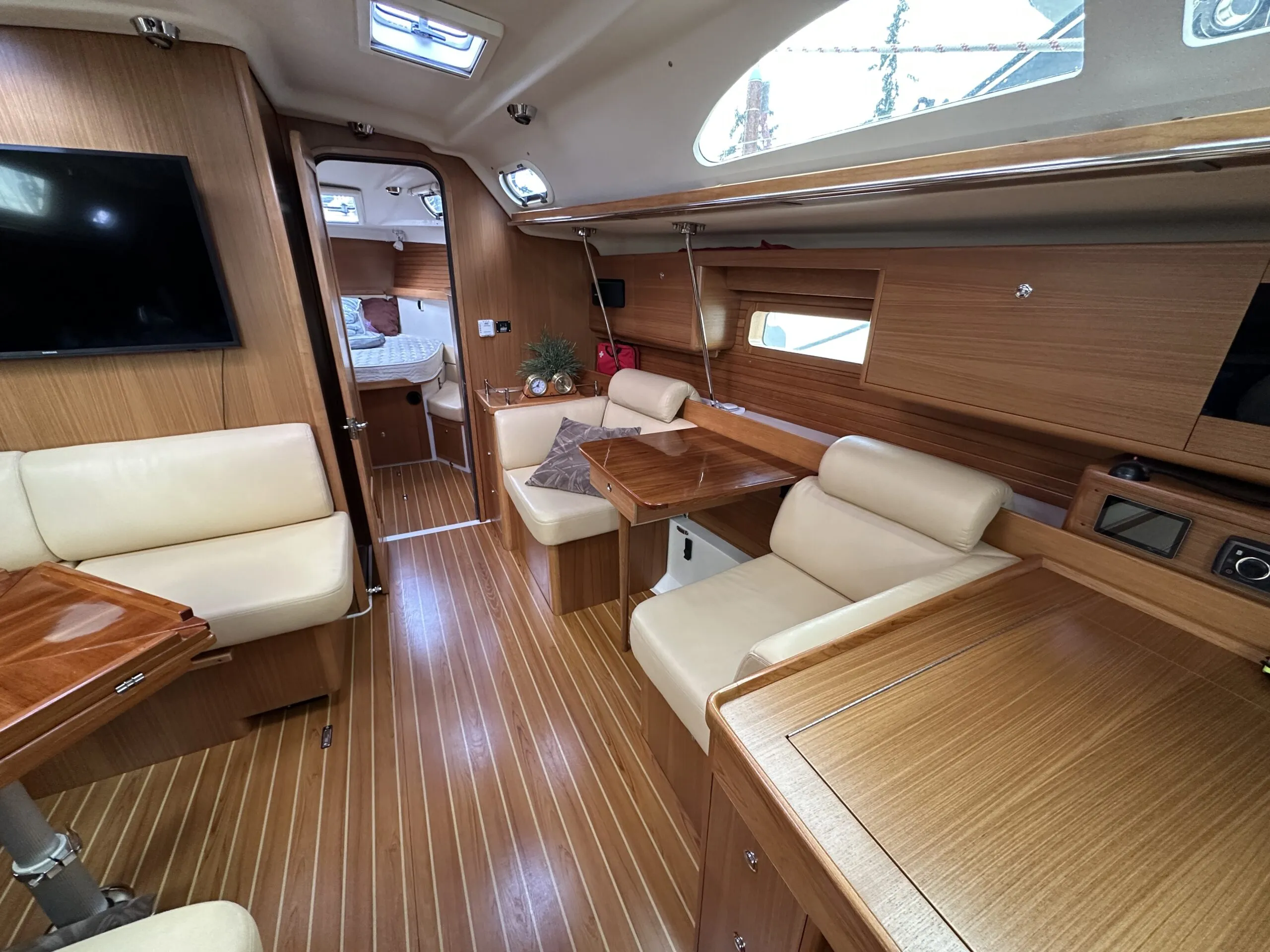
First impressions are of a bright, airy cabin with plenty of room for a gathering. Warm, honey-colored teak accented by white counter tops and white leather upholstery create a visually open space. Some traditionalists may consider this a bit of a sterile interior, particularly as the overhead is also a stark white. But give Catalina credit for staying with a teak interior that doesn’t look like an Ikea box. The effect is one of a large, roomy interior with a plethora of windows and hatches allowing daylight to expand the cabin even further. And in the Pacific Northwest where gloomy days occur in even the sunniest of sailing seasons, the feeling of spaciousness is all important.
Galley
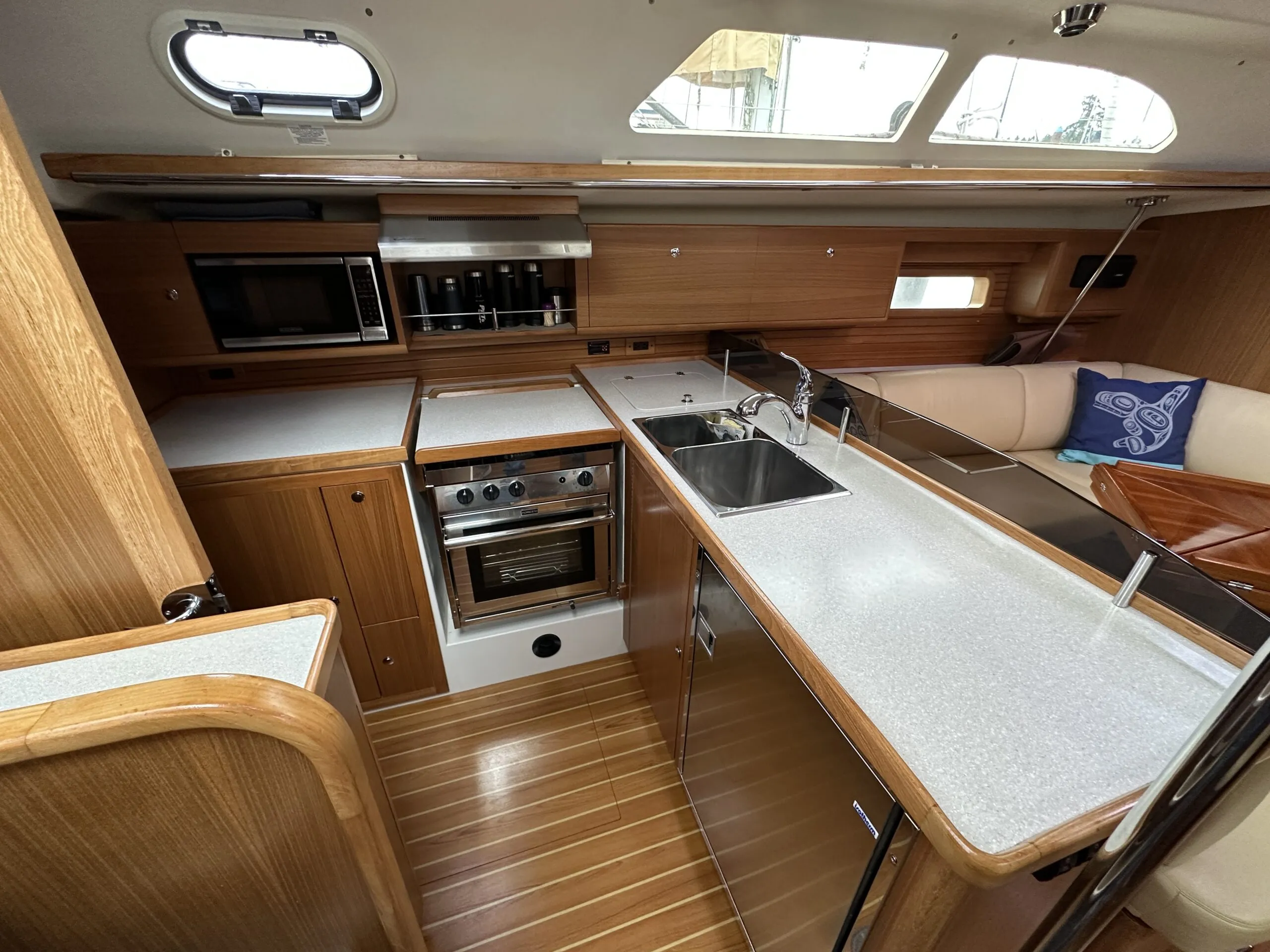
The L-shaped galley is immediately to port at the bottom of the companionway, the main counter stretching across to partially block forward access to the salon. A sturdy polished stainless-steel post at the end of the counter provides a grab handle at the bottom of the companionway stairs, a grab point often missed in boats this size. The high fiddles surrounding the counters will keep items off the cabin sole and a splashguard will keep errant galley water off the salon upholstery. Deep double stainless-steel sinks are mounted between the front opening refrigerator on the boat centerline and the top-loading freezer to port.
Although front loading refrigeration is not optimal for energy conservation, it does ensure uninterrupted counterspace for meal preparation. If freezer capacity is not critical, the top-loading freezer could also be used as a refrigerator, which would certainly be more efficient. The three-burner Force 10 stove/oven is located against the port hull and has an overhead stainless steel powered vent. Storage space abounds both under the counter as well as above. The cabinet for pots and pans has form-fitting cut-outs to keep them from clattering around in a sea.
Flex Cabin
Astern of the galley is the solid teak door to the port side aft cabin. Catalina offered the 445 in the three-cabin layout with two aft cabins, one of which is called the “flex cabin.” This can function as either an aft cabin or a workshop. Aboard Snowbird, this is set up as a workshop. As Rob and Maureen are generally going to be the only sailors aboard, and access is inconvenient through the galley, this option makes all sorts of sense. With plenty of storage and a work bench, this is a useful option for this space. With the large port side cockpit hatch open, this compartment is open to the sky with unlimited headroom and an airy feel. A great innovation on the part of Catalina. It would not take much work to convert it back into a sleeping cabin.
Main Head
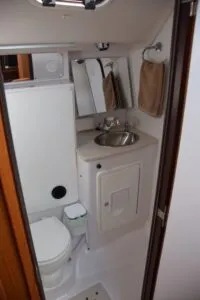
Immediately to starboard of the companionway is the main head compartment with toilet and shower. The compartment has doors to the salon and aft cabin with a single opening hatch for light and ventilation. Finished in easy-to-clean white melamine, it serves its intended purpose without embellishment.
Aft Cabin
The starboard side aft cabin has a double mattress fitted diagonally, leaving room along the hull for gaining access. Interestingly, Catalina divided the aft cabins favoring the starboard side, stretching it over the centerline to provide more room, thus making it more of a useful space. There is a large opening hatch into the cockpit for ventilation and a fixed port against the hull for additional light. A substantial hanging locker and drawers complete the aft cabin.
Nav Table
Forward of the head is a proper navigation table and electrical panel. The seating faces forward on a chart table that is horizontal (not tilted) with proper fiddles. A pencil on the table will stay put! There is plenty of storage under the table with the traditional lifting lid. I sometimes wonder about the logic of this arrangement, common on many sailboats. Having to move items off the lid to gain access to storage seems counterproductive. A shallow, sideways-opening drawer would make more sense. And yes, there are two substantial deep drawers in the cabinetry under this table as well.
Against the starboard hull is the electrical panel hidden behind a darkened plexiglass fold-down panel. The panel certainly cleans up appearance, but it’s not something I would favor. I always want to know what’s going on electrically while aboard. If there are meters and switch positions to note, I want to see them at a glance. Rob has installed additional electrical monitors at the nav station below this cover for that purpose. Behind the plexiglass, the factory monitoring meters are digital and all breakers and well labelled and easy to read. An additional panel just forward of the nav station proper has space for supplemental instruments, but not enough room for a chart plotter repeater.
Main Salon
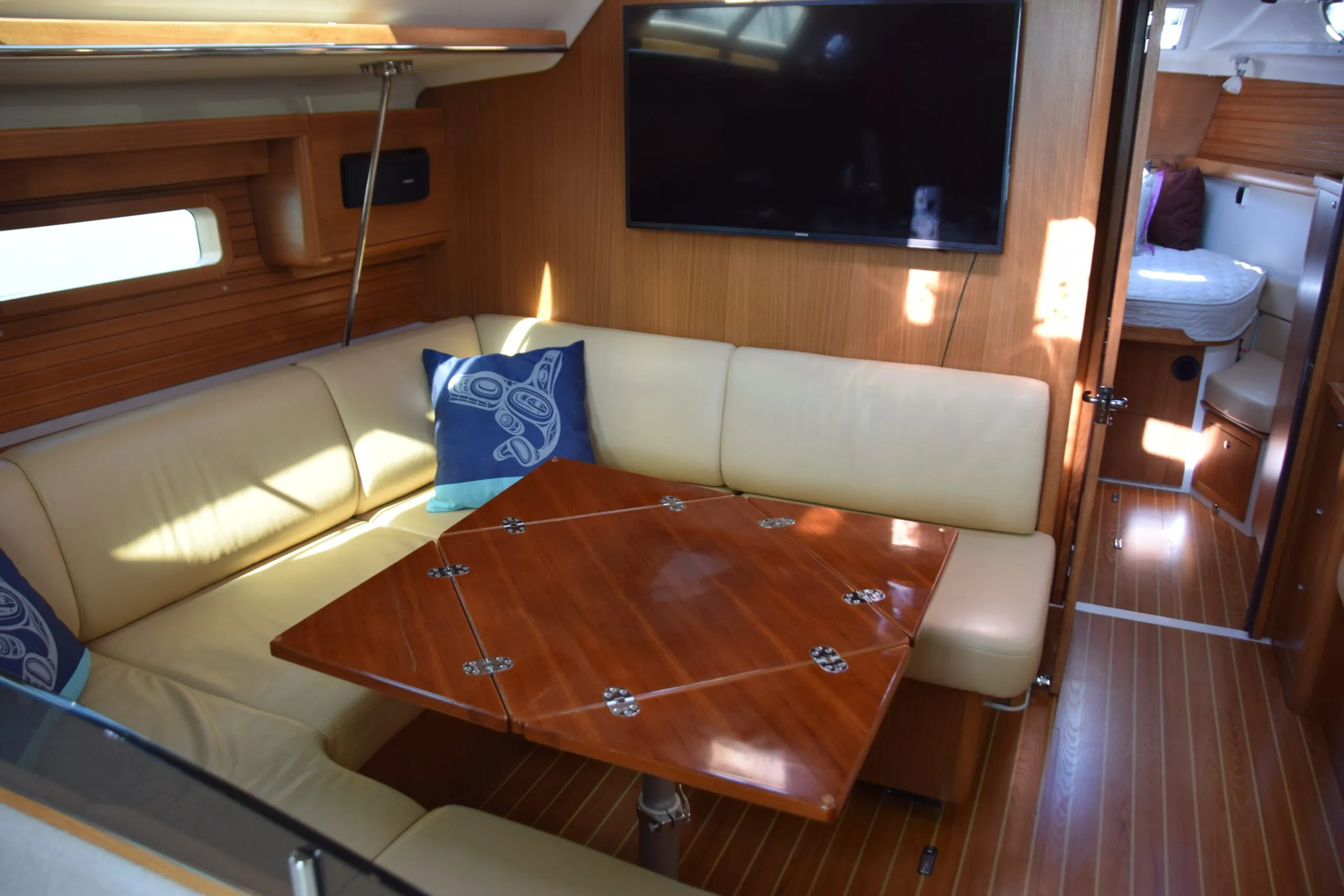
Moving into the main salon gives an impression of roominess and comfort. The U-shaped dinette is to port with white leather upholstery and a small adjustable table. The table can be expanded into a proper dining table with room to seat six comfortably. It can also be lowered to create a double bed for additional guests. To starboard are two chairs separated by a removable table/drawer supported by a post. Remove the table and this area can be converted into a sea berth. Fixed portlights port and starboard at shoulder height allow outside viewing as well as bringing additional light to the cabin. There is storage provided in teak cabinets against hull on both sides of the cabin. The fixed and opening portlights of the cabin trunk, along with overhead hatches, provide more than adequate ventilation and lighting.
A stainless-steel handrail just under the upper portlights run for the length of the cabin on both sides, critical for moving about in any seaway. Even so, it’s a bit of a stretch to either handrail with furniture in the way. I would have liked to see a similar handrail down the center of the coach roof.
V-Berth
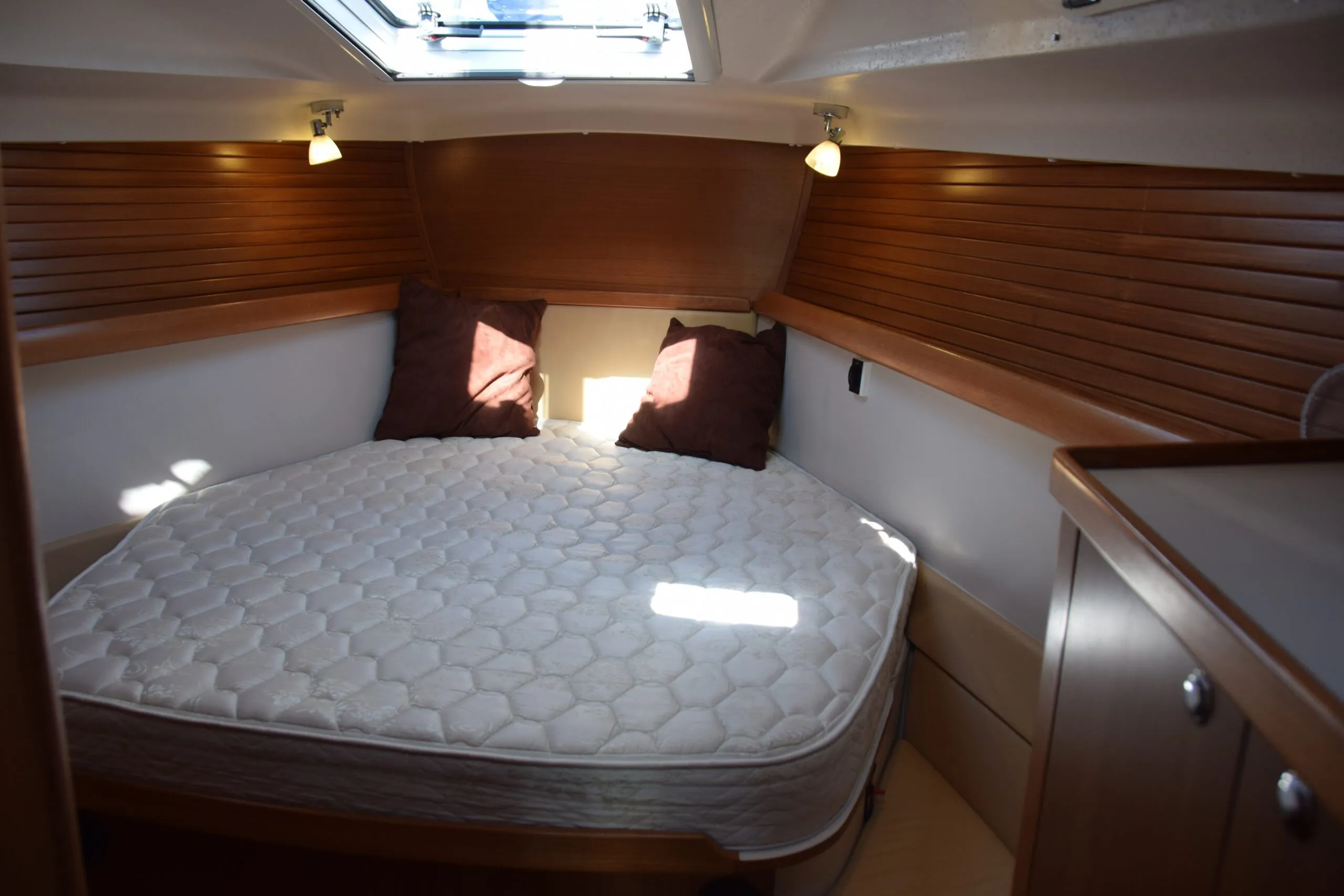
Moving forward is the V-berth and accompanying forward en suite. Headroom is carried forward and there is no need to duck. A large deck hatch and opening portlights make this a bright and airy cabin. The pedestal bed with a properly sprung mattress allows entry from cushioned seating benches on both sides. The hull is finished in a combination of white vinyl and teak slats, neither of which dominate. Plenty of storage is provided in drawers and hanging lockers.
En Suite
The en suite is all white melamine finish with an opening hatch and portlight. The shower stall is separated with a glass door which should reduce the amount of post shower cleaning. However, the compartment is on the small side and may feel confining to many.
Throughout the interior of the Catalina 445 the traditional teak and holly sole is firmly fastened to the underlying grid. Secured hatches allow access to bilge and mechanical equipment. There wasn’t a creak out of the sole or hatches while walking through the cabins.
Mechanical
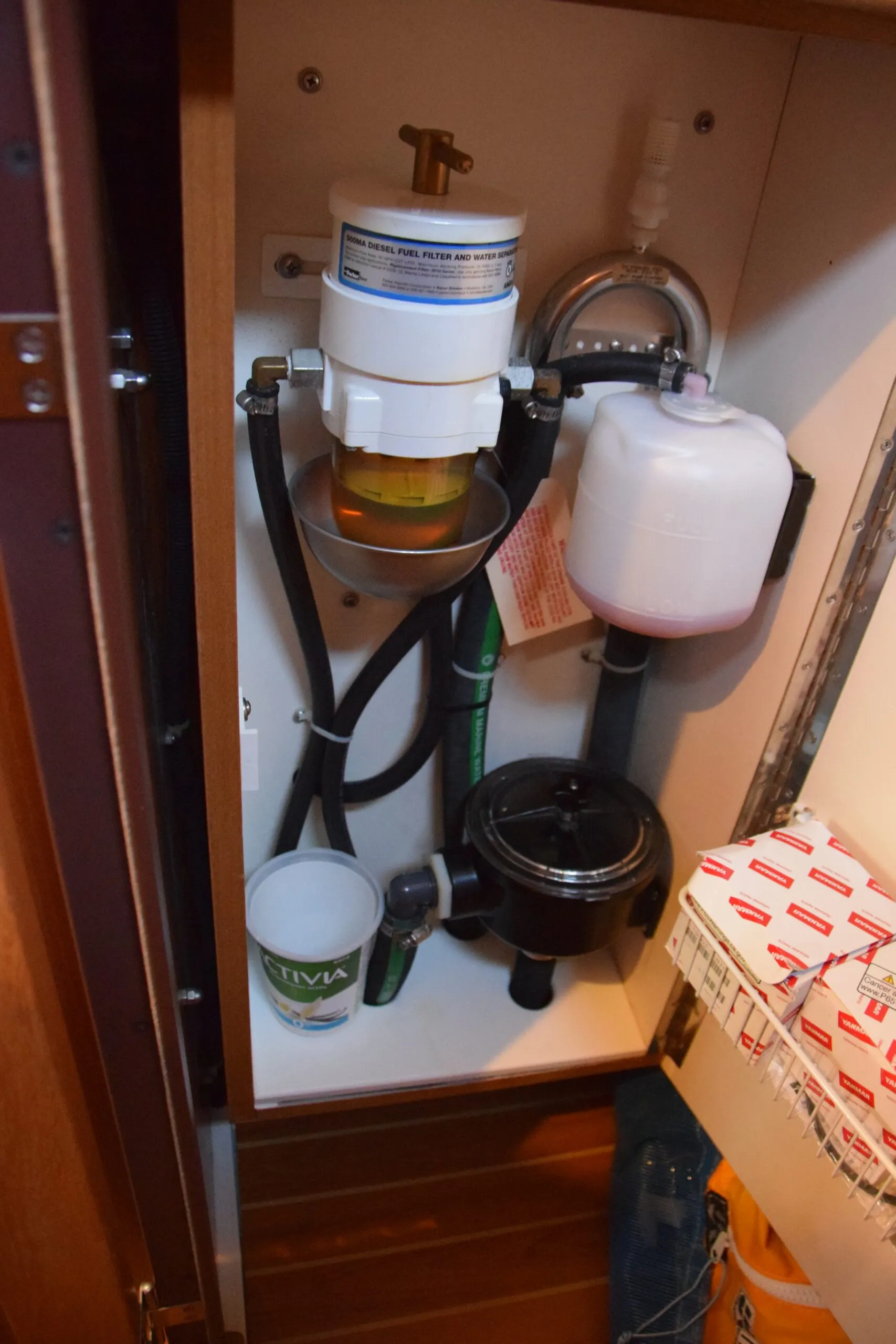
Snowbird is powered by a Yanmar 4JH5E four-cylinder diesel producing 53 hp (39 kw) at 3,000 rpm located in a very tight engine box under the companionway stairs. Removing the stairs and lifting the lid provides access to the top of the engine and the oil dip stick. Access to the transmission is behind cabinetry in the aft cabin. There is a convenient locker in the port side workshop, sealed from the engine compartment, that houses the raw water strainer, primary fuel filter and coolant overflow tank. Very handy for a quick check before getting underway. My concern would be complacency over time, not taking the time to open up the engine compartment to check oil level and overall engine condition (belts, oil or coolant leaks, etc.). Time will tell.
Water, Fuel and Holding Tanks
The Catalina 455 carries 66 gallons (250 liters) of fuel in a single tank aft. A factory option was an 18 gallon (68 liter) auxiliary fuel tank also located aft. With that option, Snowbird carries a total of 84 gallons (318 liters) of fuel. Water capacity is a total of 178 gallons (676 liters) in three tanks, two in the main cabin under the cabin floor and one under the V-berth. Holding tanks in each head are gravity discharge, or deck pump-out, with a total capacity of 54 gallons (204 liters). The toilets are macerating electrics.
Batteries
Snowbird has AGM house batteries with upgrades to all its associated control hardware and monitoring systems. As this will be the first full season of cruising for Rob and Maureen aboard the 445, time will tell if the electrical system will stand up to the challenge of daily consumption. Although there is room for a genset in the aft lockers, alternatives will be considered before that option is contemplated.
Air Conditioning and Heating
Although factory air conditioning is available from Catalina, it was not installed aboard Snowbird by the original owner. In the Pacific Northwest a reliable heater is far more critical for those chilly mornings and days. The warmth of an Espar hydronic heater graces the cabins of Snowbird this year.
Performance Under Power
Rob and I backed out of Snowbird’s slip under partly cloudy skies and light winds. With a spade rudder, fin keel and three-bladed fixed propeller, the 445 behaved exactly as anticipated. Rob has added a proportional bow thruster over the winter to add extra maneuverability in the tight quarters of the home marina. This addition adds a degree of comfort when approaching typical marinas of the Pacific Northwest.
Engine noise in the cockpit was very acceptable with the diesel a considerable distance away, low in the hull. Rob’s comfortable cruising speed is 6.5 knots at 2,100 rpm. Pushed to 2,800 rpm the slippery hull reached 7.5 knots against a light breeze, still 200 rpm below the rated 3,000 maximum continues rating. However, the noise level increased significantly and, as Rob says, what’s the hurry?
Although considering a feathering or folding propeller, Rob likes the simplicity of a fixed piece of metal under the hull, nothing extra to worry about. Steering response with the large rudder was as expected and the 445 was able to turn in tight radiuses.
Performance Under Sail
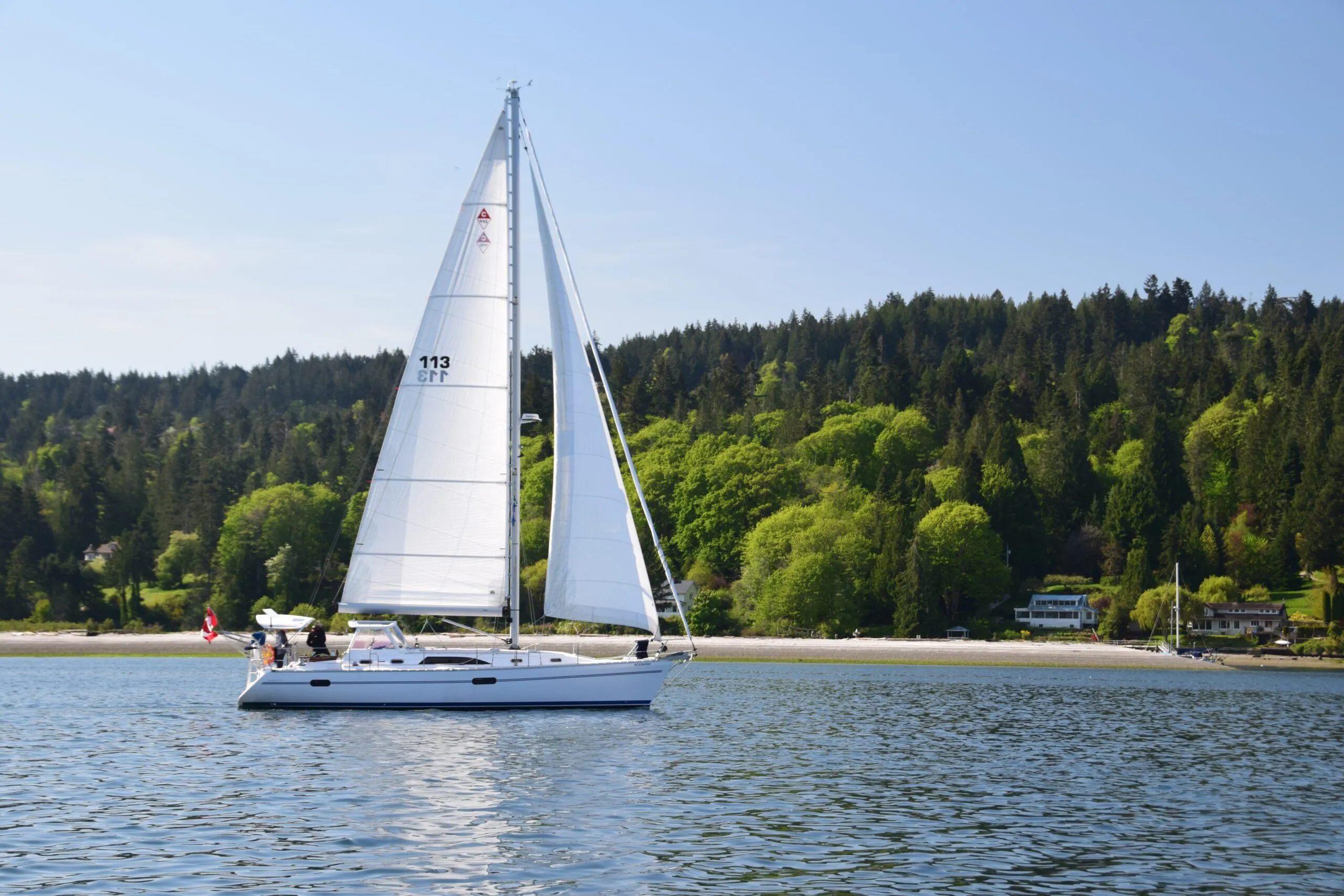
With a light wind rippling the water the main was hoisted using the electric two-speed Lewmar winch on the cabin top. With the electric winch only working one speed under power, and keeping tension on the furling line, this took a fair amount of time. Rolling out the 110% genoa took no time at all. Snowbird was soon heeling gently into the variable breeze. Climbing to windward at 3.5 knots in 5 knots of true wind speed I was impressed with the light-air performance. A 135% genoa, a purchase on Rob’s shopping list, would make a welcome difference.
Hard to See the Tell Tales
Seated on the leeward cockpit coaming, a very comfortable sailing position, I could see the genoa tell-tales but not the main sail. The bimini was in the way. The Raymarine sailing instruments were at knee level below the wheel and could not be seen without crouching down. Not a good sailing combination. This could be remedied by having a dedicated wind instrument at eye level somewhere forward in the cockpit, or, of course, removing the bimini.
Smooth Sailing
The wind picked up nicely as the day progressed and reached 10 to 12 knots of true with the 445 heeling nicely and charging forward, clicking off miles in a very comfortable fashion. Climbing over the side and foredeck to capture photos I found no lack of handholds with the boat very stable under foot. Tacking through 100 degrees proved effortless with the small genoa and electric winches right at hand at each helm station.
Single-Handing
The main is another matter. Trimmed at the companionway, a single-handed sailor must leave the helm to go forward to undertake that task. Adjusting the traveler is made simple with both port and starboard control lines side by side on the port side. Very convenient. Running off the wind the 445 proved just as slippery reaching over 6 knots on a broad reach. The Code-0 was not tested due to time constraints.
Dual Helms
With dual wheels there is definitely more resistance to steering input due to the added mechanical linkage. There is virtually no feedback from the rudder with the only indication of excess weather helm a glance at wheel position or instrumentation. This is not uncommon in the dual wheel set-up.
Conclusion
Catalina Yachts have been successful over the years for a reason: They have produced boats in a variety of sizes and shapes that sailors with a wide range of experience and desires are comfortable with. The Catalina 445 is no exception. Well designed with everyday use in mind, no shortcuts in robust construction, and beautiful finish to please the eye, the 445 is a substantial boat for a cruising couple.
In Snowbird’s configuration, she is the perfect platform for extended cruising into the remote fjords of central and northern British Columbia. She has the carrying capacity and the sailing ability to accomplish Rob and Maureen’s goals in style and comfort. Ocean passages would be a different matter. Although the Catalina 445 is more than capable of ocean sailing, a furling main of any type, and the tall, rigid dodger are far too susceptible to storm damage. Risk assessment would have to be considered. As time has proven, another successful design from Catalina Yachts.
Market Scan Contact
2011 Catalina 445 Network Yacht Brokers Lefkas
$267,305 USD (tax included) +30 26828 88015
Preveza, Greece Yacht World
2010 Catalina 445 Massey Yacht Sales & Service
$289,900 USD 941-769-9631
Palmetto, Florida Yacht World
2022 Catalina 445 Chesapeake Yacht Sales
$479,000 USD 804-375-5005
Deltaville , Virginia Yacht World





The caption under the Mechanical photo is not quite accurate. The black item at the bottom of the photo is the engine’s sea water strainer, not an emergency whale pump.
Good eye Thomas! I knew that, of course I did! I try to be perfect, but…….. Thanks for the comment, I appreciate the feedback.