

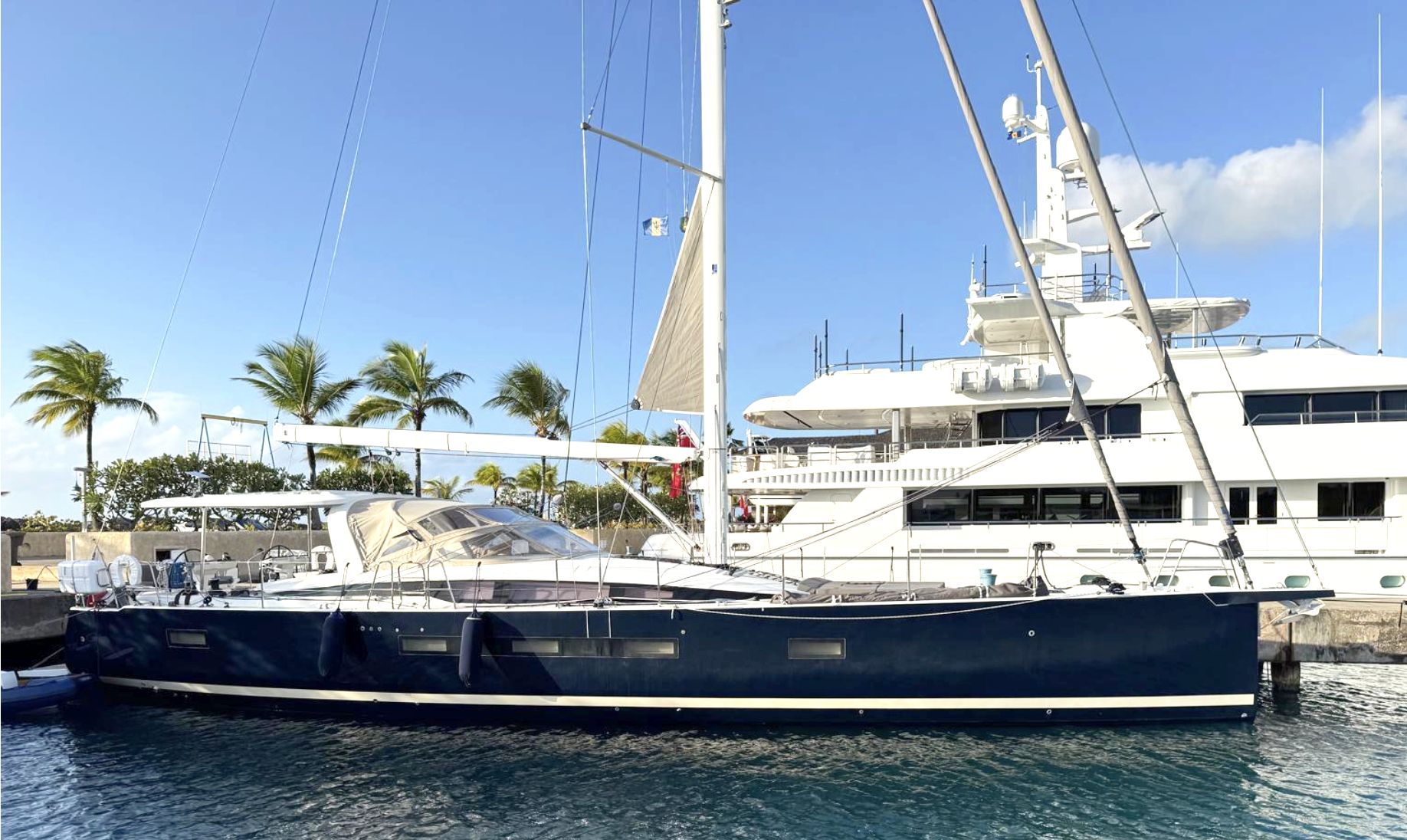
From the drawing board of Philippe Briand, a renowned marine architect over the past four decades, comes the Jeanneau Yachts 65. This boat is a development of the very successful Jeanneau 64, first produced in 2015.
In Philippe Briand’s own words:
“In my view, the Jeanneau Yachts 65 offers a conclusive argument for why monohulls are a better choice for extended voyages than multihulls, as they’re more comfortable at sea, safer and more fun to sail. Indeed, the Jeanneau Yachts 65 is what we call une valeur sure, or a safe bet, for any owner.”
Those are pretty big words. This better be a big boat—and it is!
Emerging from the factory in 2022 with an overall length of 66 ft. (20.2 m) and a beam of almost 18 ft. (5.4 m), the Jeanneau 65 weighs in at almost 70,000 lb. (31,000 kg) of which 20,600 lb. (9,350 kg) is in the keel.
Right out of the gate this is not your average sailboat. Jeanneau takes direct aim at the long-distance sailor who might otherwise purchase a catamaran. This boat gives them a lot of very good reasons to stay in the monohull stable—that’s the goal anyway. Let’s see if they pulled it off.
Design
Sailboat Specifications Courtesy of Sailboatdata.com
Hull Type: Fin w/bulb & spade rudder
Rigging Type: Fractional Sloop
LOA: 66.27 ft / 20.20 m
LWL: 59.06 ft / 18.00 m
S.A. (reported): 1,829.86 ft² / 170.00 m²
Beam: 17.72 ft / 5.40 m
Displacement: 68,343.00 lb / 31,000 kg
Ballast: 20,613.00 lb / 9,350 kg
Max Draft: 9.68 ft / 2.95 m
Construction: Vacuum infused hull, sandwich balsa/ polyester.
Ballast Type: Cast Iron
First Built: 2022
Builder: Jeanneau (FRA)
Designer: Philippe Briand/Andrew Winch
Make: Volvo
Model: D4-175
Type: Diesel
HP: 175
Fuel: 218 gals / 825 L
Water: 264 gals / 1,000 L
Headroom: 6.20 ft / 1.89 m
S.A. / Displ.: 17.60
Bal. / Displ.: 30.16
Disp: / Len: 148.10
Comfort Ratio: 37.53
Capsize Screening Formula: 1.74
Hull Speed: 10.30 kn
Pounds/Inch Immersion: 3,739.41 pounds/inch
Mast Height from DWL: 95.47 ft / 29.10 m
Approaching this very beamy monohull from the stern shows a substantial dinghy garage behind the electric fold-down transom. This boat is big enough that it takes three steps up from the swim grid to the cockpit on stairs that fold with the transom. Besides the access through the transom, the garage can also be accessed through a cockpit hatch, critical when sailing offshore and you don’t want to lower the transom. The twin helms have been pushed back to maximize the cockpit and offers the equivalent space to any catamaran out there—and I think they’re right. This outdoor living space is similar to a big Lagoon or Fountaine.
Cockpit
The Jeanneau 65 also has what’s become the Jeanneau trademark that we love so much, the sloping side deck, or walk-around cockpit. We saw this on the Jeanneau 350 last year. If you’re operating this boat, you can use both helms and access both side decks without stepping over your passengers or letting anyone get in your way. The LOA of this boat may be over 66 ft. but you can access all of it without ever tripping over anyone in the cockpit.
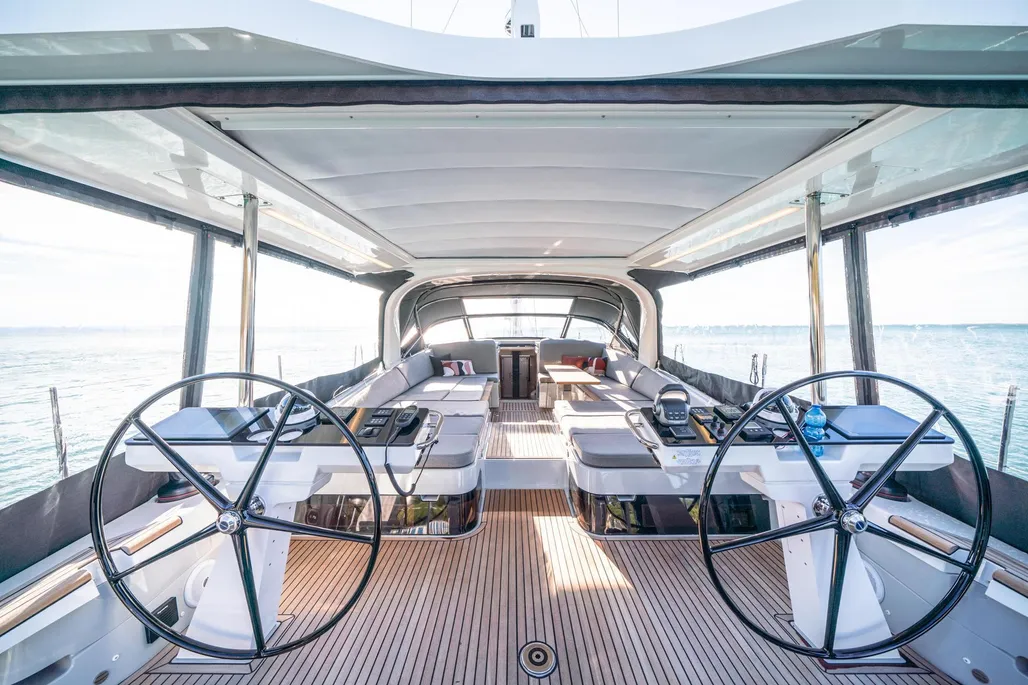
The twin pedestals support carbon fiber wheels, two large chart plotters and twin compasses. The engine and thruster controls are electronic and inboard on the starboard pedestal accompanied by the sailing instruments. This could easily be duplicated on the port pedestal should the need arise. Standing 18 ft. away from the port side of the hull while docking on that side can be a bit intimidating. The helmsperson has a small seat outboard of the wheels for a better view forward and up at the sails. The aft cockpit seat is a bit too far back to be used as a steering position, but this leaves plenty of real estate for the helmsperson to move about. Primary and secondary winches are forward of the pedestal, generally out of reach of the helmsperson. Sailors tending these winches will be at the aft end of the lounge area, or outboard at the lifeline on the sloping ramp going forward.
The lounge part of the cockpit is a step up from the helm position and I can imagine guests and family hanging out in this massive, twin table area while dedicated sailors happily perch behind the helms, all able to interact the whole time but enjoying this boat for very different reasons. The seating area is large with proper back support, even for those that wish to face forward.
Dodger
Forward of the cockpit is a spray hood dodger based on an arch that houses the main sheet. Another factory option is the hardtop that extends from dodger to behind the helm stations. A large opening skylight allows for a view of the mainsail. While offering amazing protection for those in the cockpit, some test sails show that the dodger may be hard to see around when you’re working on some tight maneuvering—a price to pay for all that protection. But we expect that you wouldn’t be maneuvering this boat in tight places single handed anyway. The standard bow and stern thrusters will make docking fairly easy.
Deck
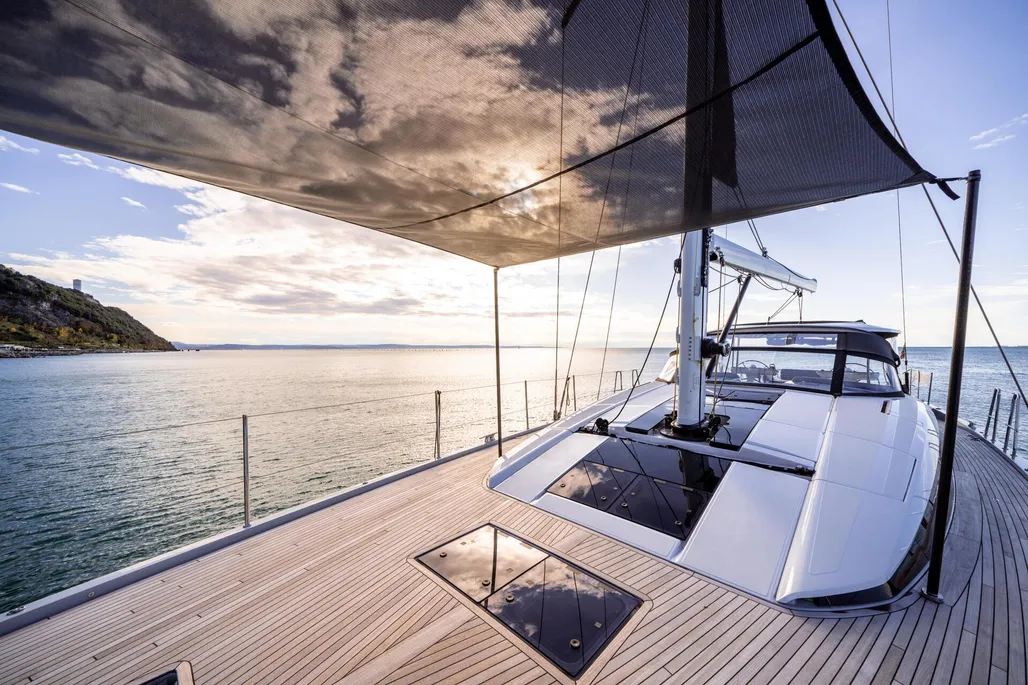
Moving up the side deck we note the outboard chainplates bolted to the side of the hull, a feature that all the French boats seem to be adopting now. We were talking in the office the other day and remarked how the only big manufacturer that still seems to use inboard chain plates in big boats is Catalina. Everyone else seems to have gone to the outboard shroud mounts with a 100% or smaller self-tacking jib that doesn’t require close sheeting angles aft of the mast. What is surprising is the lack of a grab rail along the coach roof. For those times you’re moving forward in heavy seas, the recessed groove in the coach roof does not extend far and I question if this will work with gloves on. I’m also a bit concerned about sticking fingers into a groove when the boat lurches.
This boat has a self-tacking jib on a track just forward of the mast, controlled by a single jib sheet led back to the cockpit. There are no genoa tracks on the side deck—that’s kind of interesting.
Foredeck
Up front we have three large deck hatches dominating the foredeck with an additional hatch on the leading edge of the cabin trunk. This foredeck also accommodates a cushion pit in the Miami sunshine. A large anchor locker occupies the bow with a molded single anchor roller. Perhaps not ideal for a true world cruiser where a second anchor is the norm. The windlass sits proud on the teak deck well aft of the bow roller. Some provisions will have to be made to protect that teak from the chain. The bow pulpit is open forward, just the two side supports. For an ocean-going boat we wonder why we don’t have a full pulpit up here. Should a problem occur with the foresail, Code 0, furling gear or anchor, a full pulpit would certainly add to the security.
The furling gear is a powered unit with provisions for a furling Code 0 built onto the leading edge of the anchor platform/bowsprit.
Rig
The triple spreader fractional rig mast is massive. Keel stepped, with an in-mast furling mainsail on this boat, everything is oversized for ocean sailing. All sail control lines lead back to winches and line stoppers at the trailing edge of the coach roof, protected on deck by paneling. No lines to step on when traversing the coach roof. There are a few sail control options. On the boat being reviewed, we have the “family friendly” arrangement. The mainsheet blocks are located on top of the arch and out of the way. But you can also opt for the tall rig which comes with a main sheet arrangement that comes to the cockpit floor, well within reach of crew.
Despite being the biggest boat in the range, all the fiberglass work on board was topnotch and the finish work is excellent. Something we’ve come to expect from Jeanneau.
Catamaran vs. Monohull
The outside of this yacht certainly does give me pause when I’m considering a catamaran. I think with so many people choosing catamarans these days, it’s important to highlight why you may want a monohull instead. Yes, you’ll be heeling over occasionally and yes, they’re narrower overall, but this is a proper sailing boat and heeling means that the boat can still spill excess wind on its own. You don’t get that safety factor with a catamaran. With two hulls you must constantly be alert to wind conditions and be ready to reef at a moment’s notice to keep from being overpowered.
Out on the water, a catamaran has a totally different motion. They tend to wobble about on the wavetops where the monohull pushes through the waves. Of course, there is the giant elephant in the catamaran room, the inability to self-right should the worst happen. An ocean-going, keel stepped, 70,000 lb. monohull will be the safer option should you be out in a North Atlantic gale—it just will. The catamaran also comes with higher haul-out and maintenance costs along with the requirement for specific mooring slips in marinas. Jeanneau so far seems to have nailed it with catamaran competition out here.
Interior
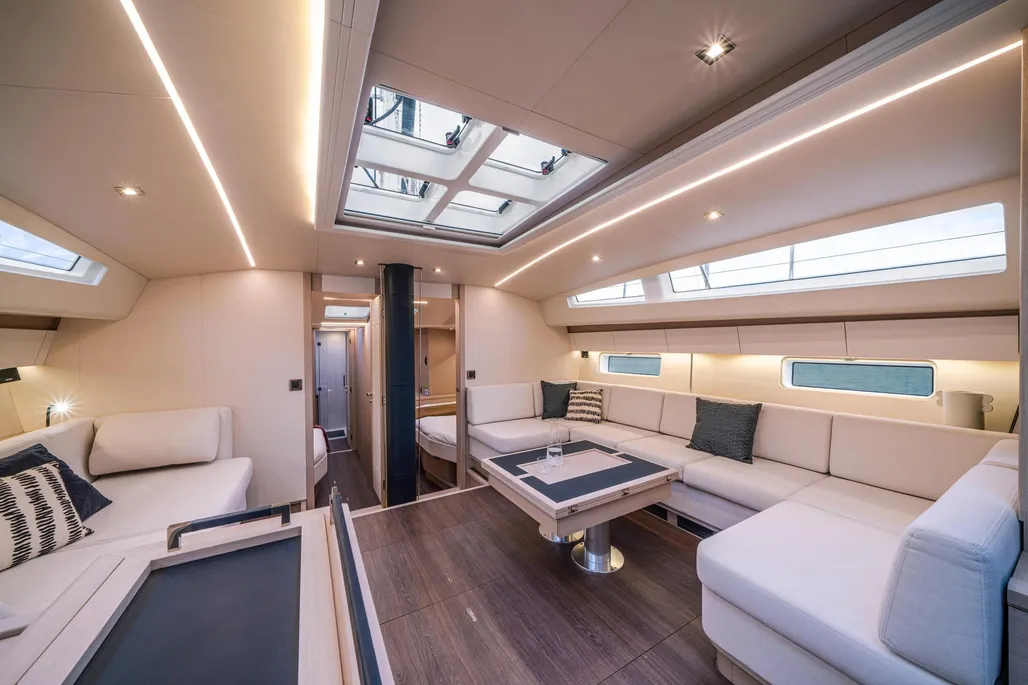
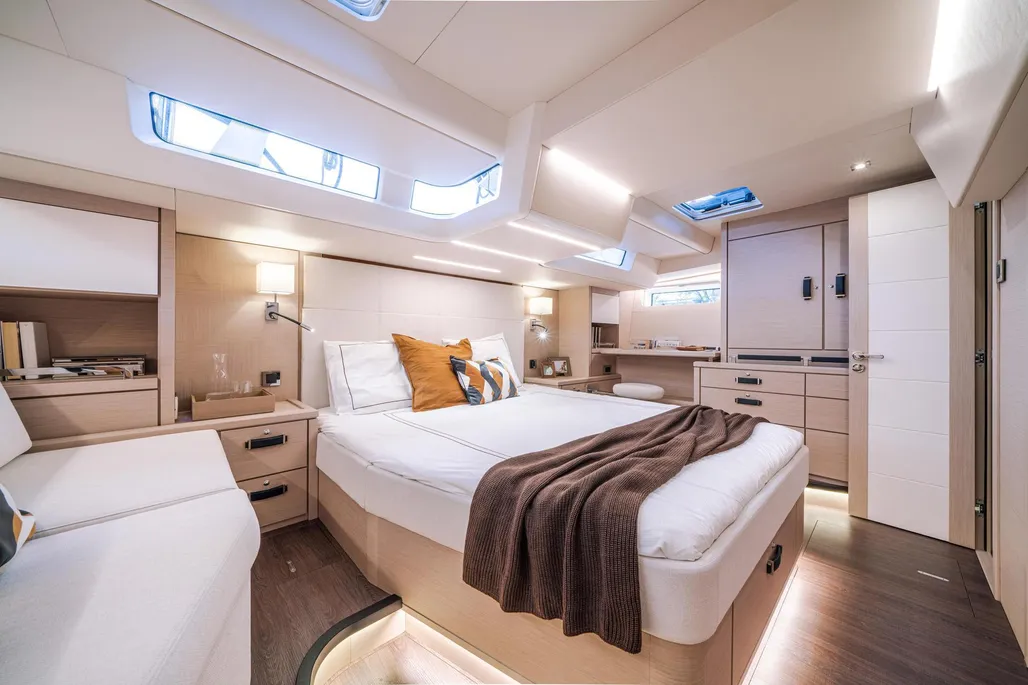
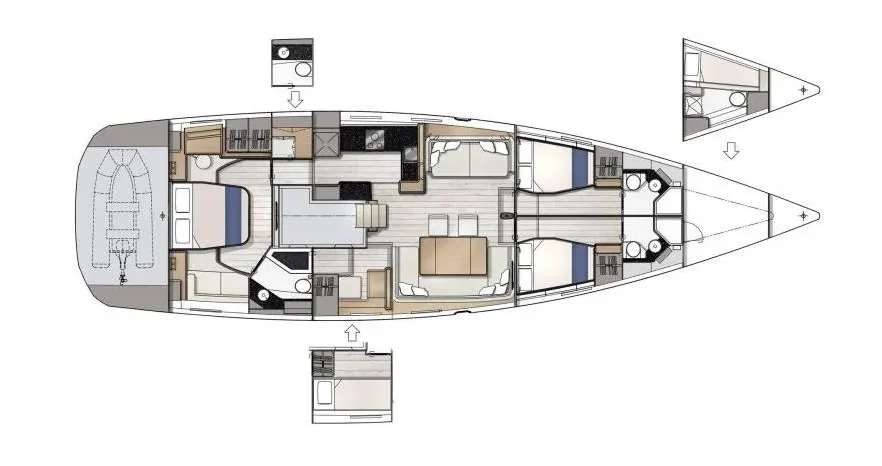
The Jeanneau 65 comes from the factory with a wide range of layouts. The boat we are reviewing at the Miami Boat Show has the three cabin and three heads layout. The fact that this is a 65-ft. boat is obvious with huge interior spaces, plush seating down both sides of the saloon and a large, fully equipped galley. With a price tag in the $2 million bracket, the interior needs to be topnotch—and it really is on this boat. Light oak paneling and trim complement the white accents and cushions. Side windows in the cabin top, windows in the hull behind the settees and hatches in the overhead bring copious amounts of light into the main cabin. Numerous hatches and portlights do the same for the forward cabins and master stateroom.
Nav Station
Through the companionway and to starboard we find the full size, comfortable, forward-facing navigation station with plenty of storage and room for instruments. Both the nav station and galley are a step down from the slightly raised saloon. The raised saloon allows for heavy equipment and fluid storage to be centered low in the hull under the saloon sole. A recessed and protected electrical panel is located at the nav station as well. Behind the nav station, and another step down, is a cupboard with a washer/dryer unit with additional storage. All the hardware is nicely placed with working latches, although I did find one that needed a bit of tightening—an easy fix.
Engine Access
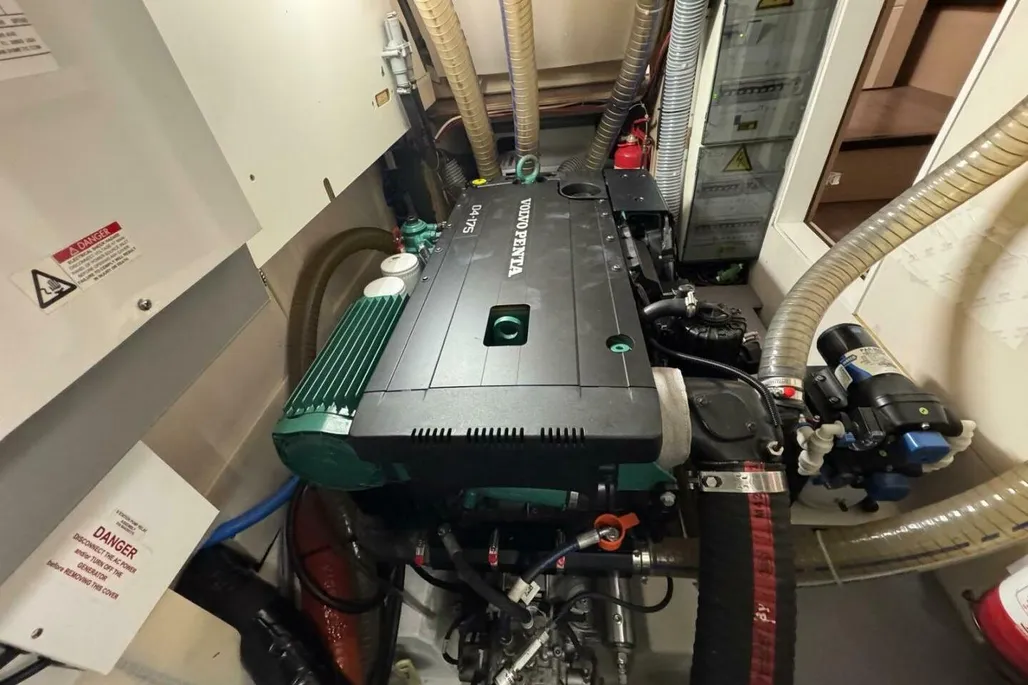
There is an access door (not panel!) to the engine room that you can actually get into. The engine room is heavily insulated with easy access to the D4-175 hp Volvo.
Galley
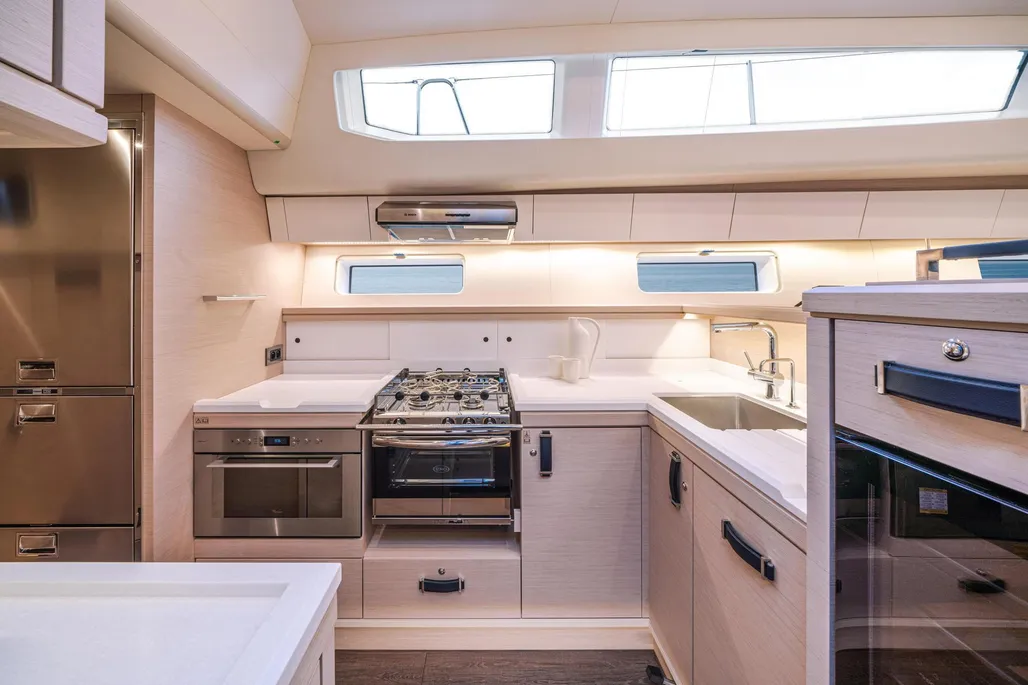
To port of the companionway is the L-shaped galley with plenty of storage space and, as in almost every boat, a shortage of usable counterspace. Access to the master stateroom aft is through the galley.
Lack of Handholds
One disappointment I encountered entering down the four steps into the cabin; there are no handholds accompanying the steps, only two vertical handholds on the interior walls inside the cabin. Handy when climbing out, not very useful when entering. And once at the bottom of the step and planning to move forward, you’re on your own. Nothing to grab next if the boat is bouncing around. Not really conducive to ocean passages.
Saloon
The main saloon has a U-shaped seating area to starboard with a powered, folding table. In the up position and extended it will comfortably seat six or more guests. In the lower, folded position it becomes a coffee style table suitable for socializing after dinner.
Cabins
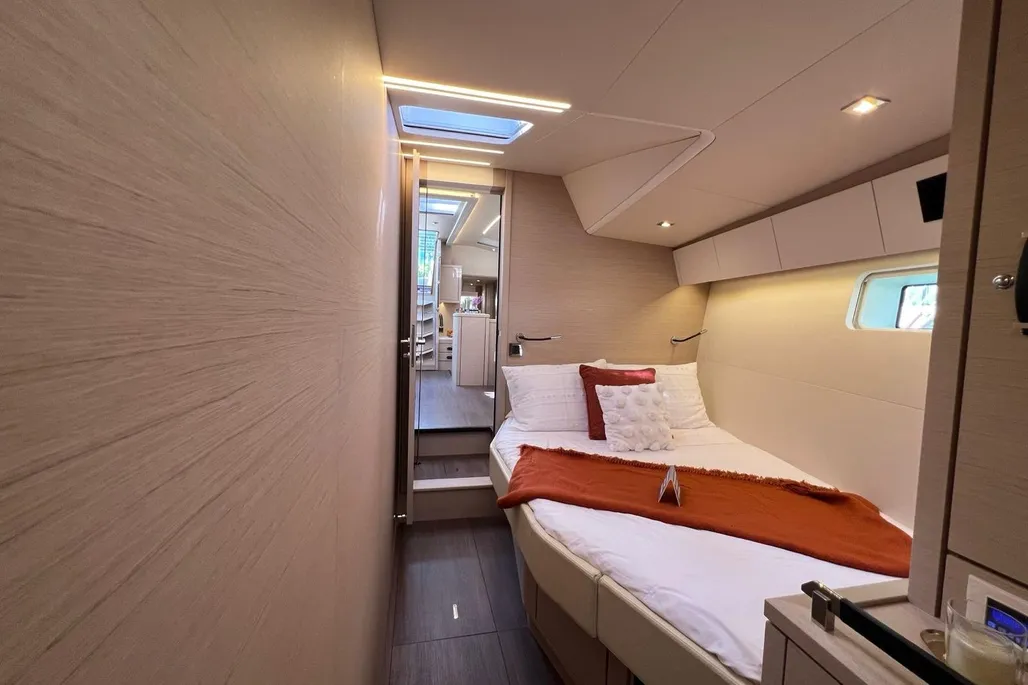
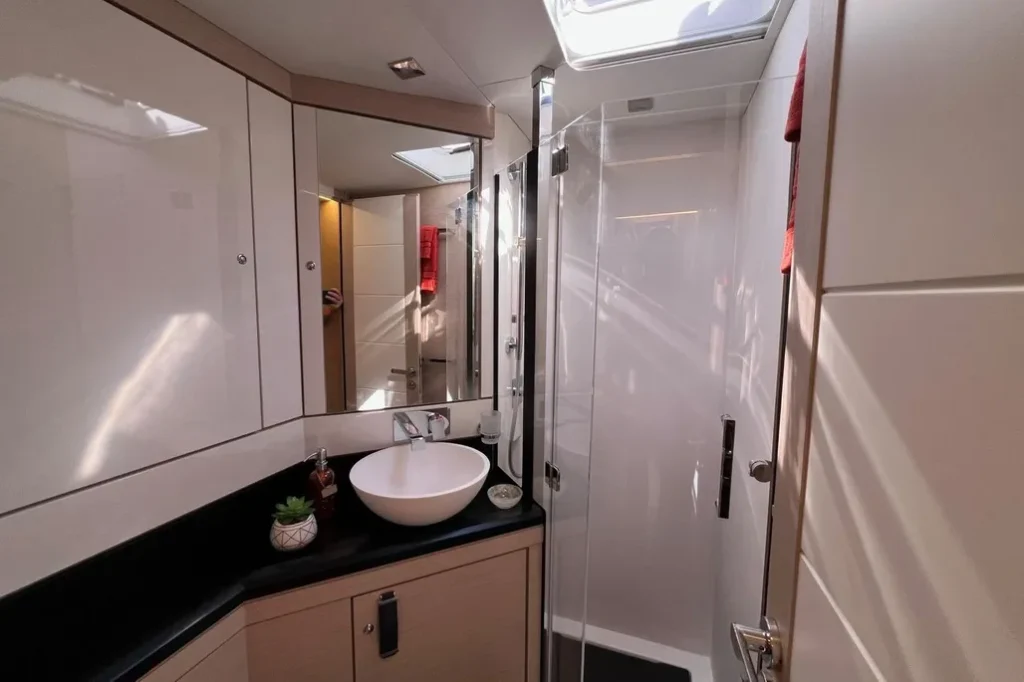
Through the saloon and around the keel stepped mast the Jeanneau takes another shot at the catamaran layout. There are two cabins on either side of the center line. Just like aboard a cat. The side cabins are mirror images of each other with pullman style bedding. The pullman layout is a favorite amongst sailors. Both cabins extend forward to a private head for each cabin, complete with all the usual amenities including a good-sized separate shower compartment. This is an extremely cool layout as you effectively get two very comfortable and usable private staterooms for your guests or family. These two cabins are as nice as the master cabin on a typical 42-ft. boat. The hardware and workmanship are excellent and I admired the craftsmanship.
Master Stateroom
Astern of the galley, the master stateroom covers the whole width of the hull. Palatial in size with a standard flat screen television, desk, seating area and large private ensuite—a much better master stateroom than any catamaran I’ve ever seen. The stateroom is gorgeous with huge amounts of hanging storage space and numerous drawers. Because it’s a monohull, you should be able to sleep more soundly without the waves crashing into the bottom of the bridge deck. Do any catamaran sailors disagree?
All very impressive.
Squeaky Cabin Soles
There is one thing that bugs me about these new boats and, if you’re a regular reader, or viewer of the Practical Sailor YouTube channel, you’ve been expecting this–squeaky cabin soles. A creaky boat with ill-fitting floorboards or finish work will drive me mad. I know if it creaks and groans at the dock, once you go out sailing and the boat starts twisting and stressing the hull, it’s going to be maddening down below. And if a new boat does this, imagine what it’ll be like in ten or 20 years. So far on my tour, this 65-footer hasn’t made a sound, until I get to the galley. Maybe this is minor, and I’m nitpicking, but I want my $ 2 million boat to avoid creaking and groaning underfoot. Seriously, my only complaint about this boat was this creaky step in the galley.
Conclusion
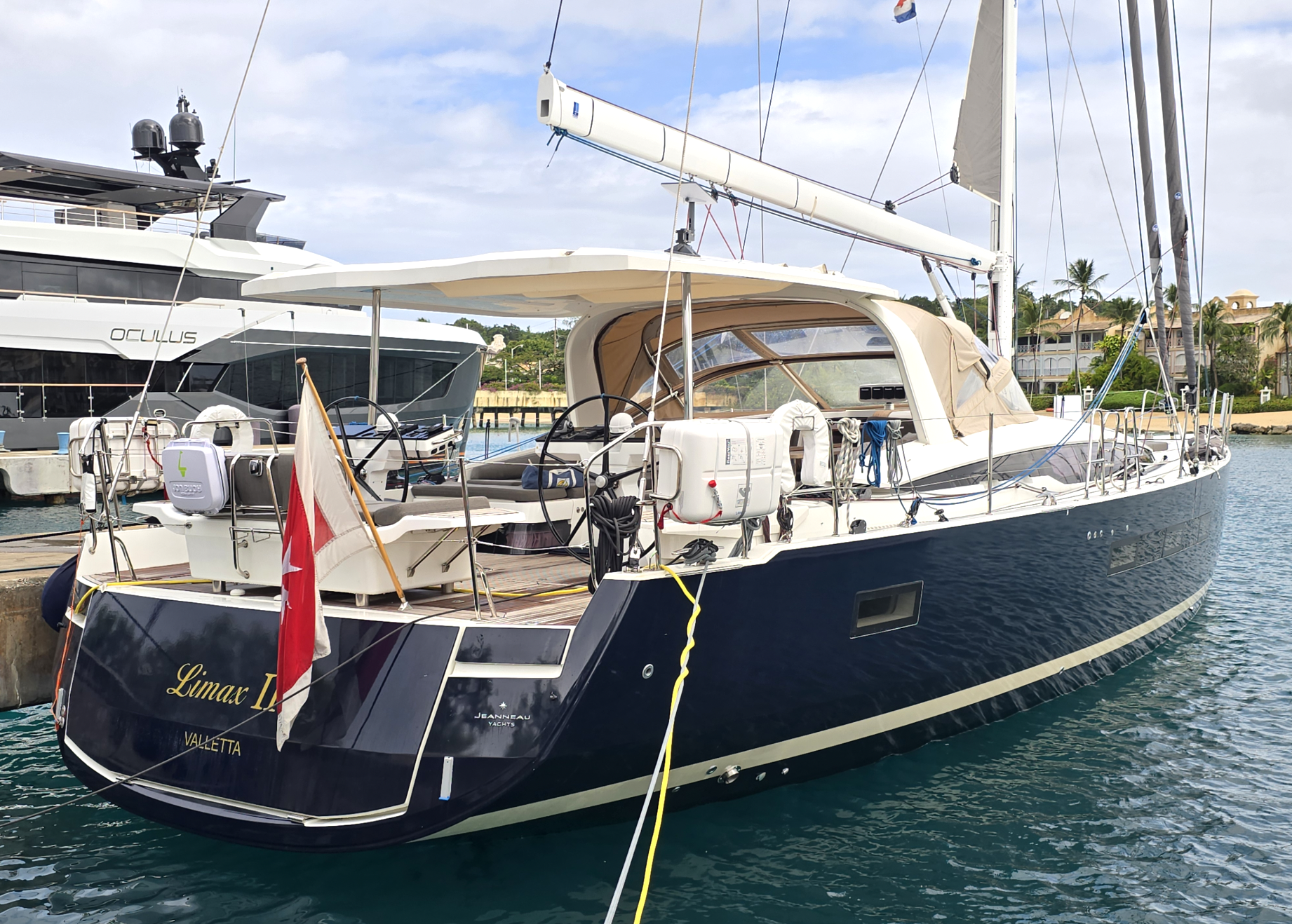
I think what Jeanneau is doing is admirable. Taking a pot shot at the big catamarans and saying “Hey, you can still buy a monohull and get all the huge space and comfort that you want. Don’t buy at cat.” I agree with them.
I really love this boat despite the creaky floor in the galley. The space, layout and organization are complemented by craftsmanship that is amazing. The weight, the keel stepped mast, the dodger and available hardtop along with the rigging option of a mainsheet on to the cockpit floor, I love all of it. The shot they’re taking at the catamaran makes it all even better.
I’m obviously in the monohull camp!
Market Scan Contact
2023 Jeanneau 65 BVI Yacht Sales LTD
$1,900,000 USD 941-344-3916
Saint Martin, Saint Martin Yacht World
2023 Jeanneau 65 Glenn Walters
$1,649,000 USD +14012695934
Newport, Rhode Island Yacht World
2023 Jeanneau 65 Alessandro Ermetici
€1,290,000 +34 670 667 446 / +34 629 53 95 96
Naples, Napoli Yacht World

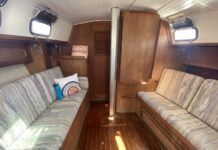
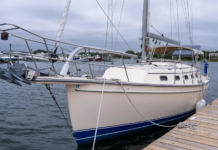



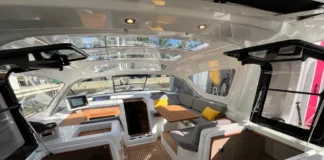
Interestingly, the accommodations layout is almost identical to the Swan 59 that we owned for many years, an exceptionally comfortable, bulletproof, and sea kindly offshore yacht. Sisterships tend to sell for <$500k.