

What if I told you that the most radical sailboat you’ve never heard of looks like a turtle, weighs in at 17 tons (17,200 kg), and is made almost entirely of thick aluminum? Meet the Tortue 147, the floating sea turtle with a French passport and a rebellious soul. She does not look like a Lagoon, or a Leopard, or any other catamaran you’ve seen bobbing around in any anchorage. This boat looks like it was beamed in from an alternate future where art, function and off-grid survival had a baby, and that baby is a futurama floating home. This isn’t just a sailboat, it’s a manifesto crafted for dreamers, explorers, and anyone else who has ever looked at a map and thought: “What’s out there?”
Design
The Tortue 147 is a 48-ft. (14.7 m) aluminum exploration catamaran built by Cataruga, a boutique shipyard on the Indian Ocean in Tanzania, Africa. Founded by French visionary Jean Sommereux, it’s the flagship of a philosophy that flips the modern yachting world a bit on its head. Instead of being optimized for charter revenue or sleeping accommodations, it’s optimized for autonomy. Instead of wide sugar scoops and electric winches everywhere, you get a toughened structure, slow living vibes, and a sense of reliability that laughs in the face of reefs, logs and storms. This is a catamaran for the post apocalypse, and they mean that in the best possible way.
Construction
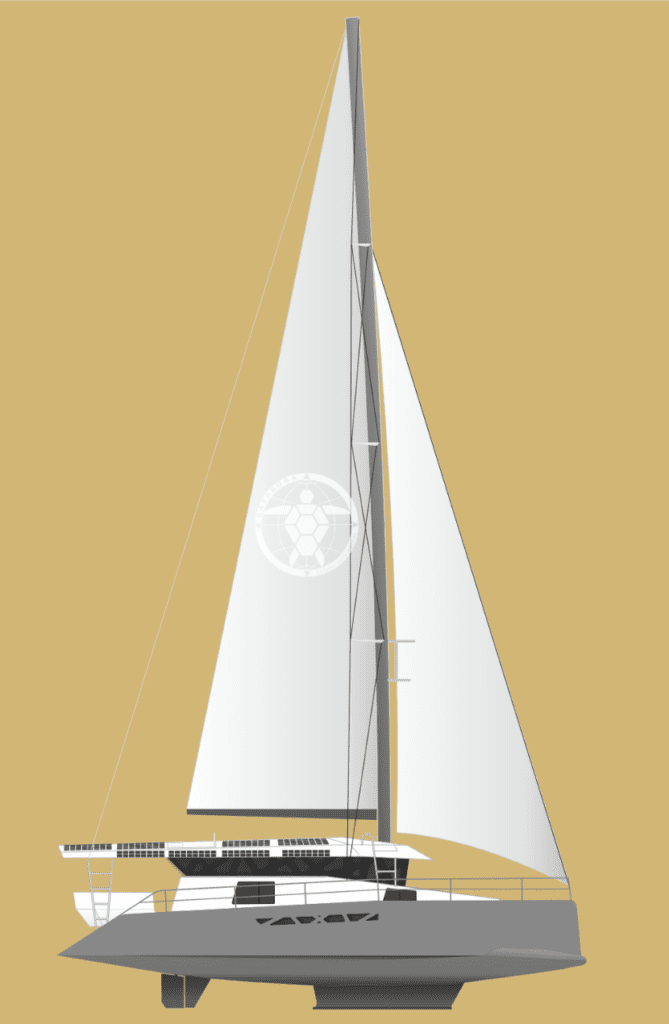
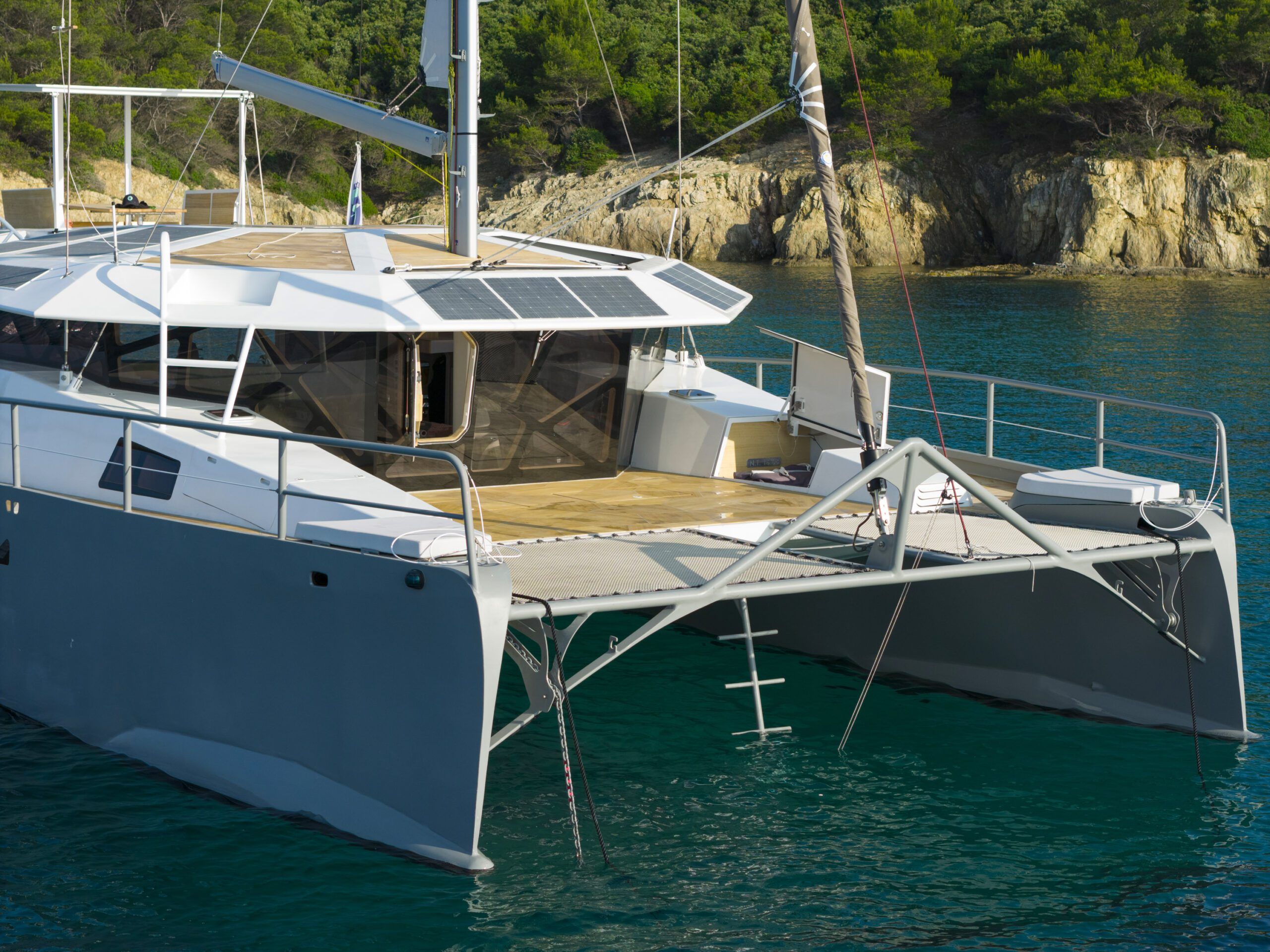
Every Tortue 147 starts with raw aluminum plates, 8 to 10 mm thick. Basically, armor. Some joke that this boat could bounce off an iceberg. You won’t find any balsa cores here, no coring in the hull, just plate on frame—ruggedness built to take a beating in the wild corners of the world. And this isn’t just a heavy-duty catamaran, it’s a smart catamaran. At the bow it’s got pronounced bulbous tips, not for style or anything, but to reduce pitching.
At the stern you’ll notice something unusual too, long sleek tails. They stretch out to balance the boat longitudinally, giving it stability without adding bulky weight. The result: a boat that sails soft, like it’s hugging the ocean. And here’s something kind of genius, long keels and protected skegs under the twin rudders. Why? So you can take this to the beach. You read that right. When the tide goes out the Tortue just sits down flat, like a turtle taking a nap on a rock. Even with a draft of just under 5 ft. (1.5 m), that means no drama in tidal zones, no panic in the shallows, no need to haul-out for every repair. You can fix it wherever you find a sandy beach or drop the hook.
Sailboat Specifications Courtesy of Cataruga
Architect Jean Sommereux
Designer Jean-Michel Kalfon
Length 14 m 70
Width 7 m 85
Draught 1 m 50
Equipped weight 20 tons
Water tank 1200 lit
Diesel tank 1300 lit
Standard engine 2x57 hp + 2x10 kw
Surface of sails 92 - 240 sq m
Solar panels 5500 w
Dinghy 3m 60 6 crew 25hp
Navigation TimeZero, AIS, VHF DST810, NMEA 2000, Victron, Ship heart sonar and radar Furuno
On Deck
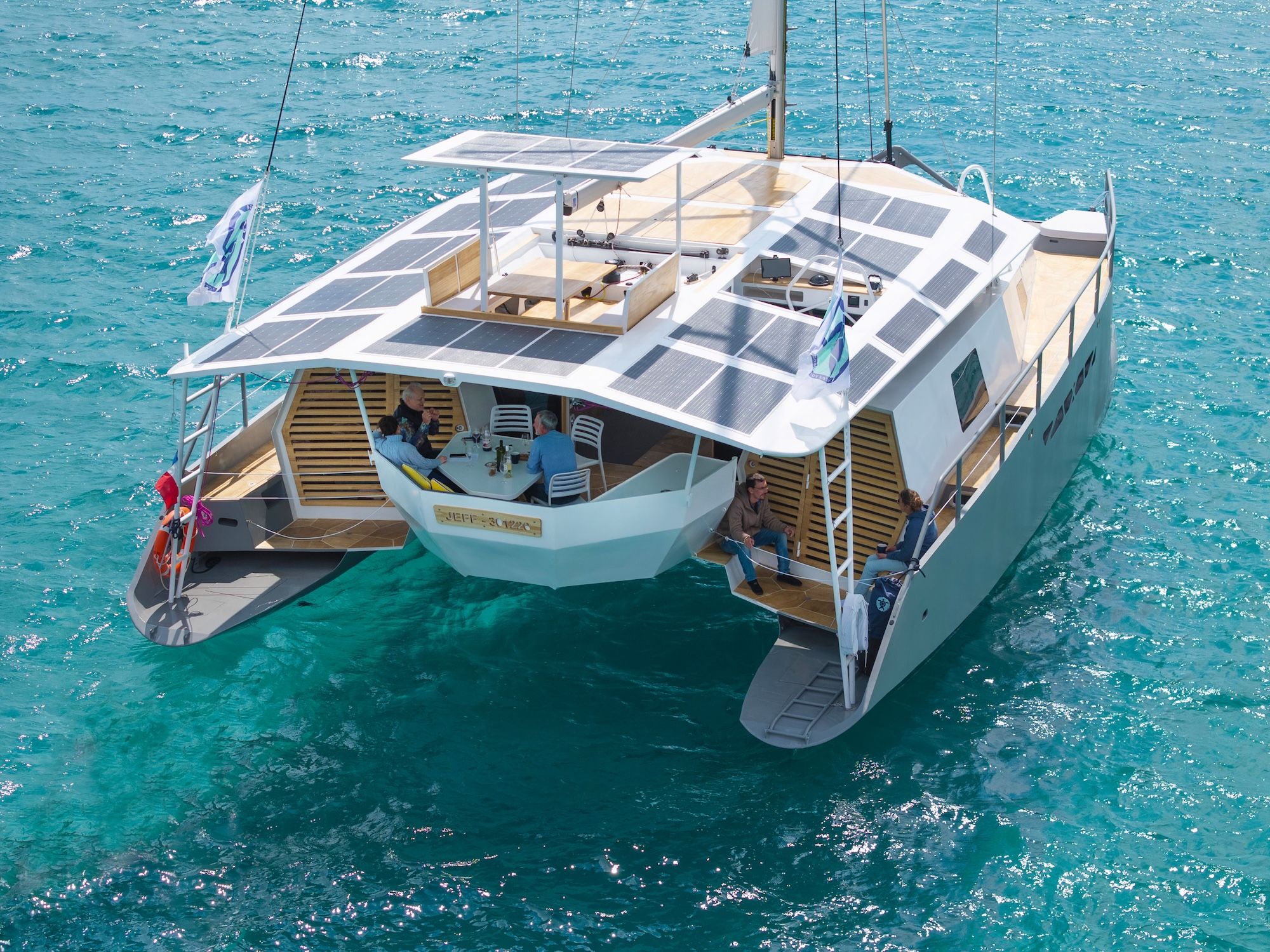
The decks and all interior wood are Paulownia, a fast growing, lightweight and stable material resistant to rot and decay. It is a sustainable hardwood from the forests of Asia and China. The coach roof, and it’s a very large coach roof, is covered with solar panels from bow to stern, broken only by the upper steering station over the port side hull, and a central lounging area.
At the stern is one of the best parts of this remarkable vessel, the balcony cockpit—yes, balcony. It isn’t your typical massive outdoor lounge, but rather a small, suspended platform that lets you feel the wind, watch the waves, and sip your coffee like you’re on a floating terrace in the south of France. It’s cozy and protected and perfect for that first sunrise of the day, or the last glass of wine in the evening. Open to the main cabin through massive doors, this balcony extends the living space in a luxurious manner.
Some folks might say the rig looks a little slender, and that’s fair. The designers even suggest using a square-topped main sail to increase off-wind performance and lower the center of gravity. But again, the mission here isn’t performance, it’s endurance, it’s sustainability, it’s independence. This boat is for people who value time more than speed.
Interior
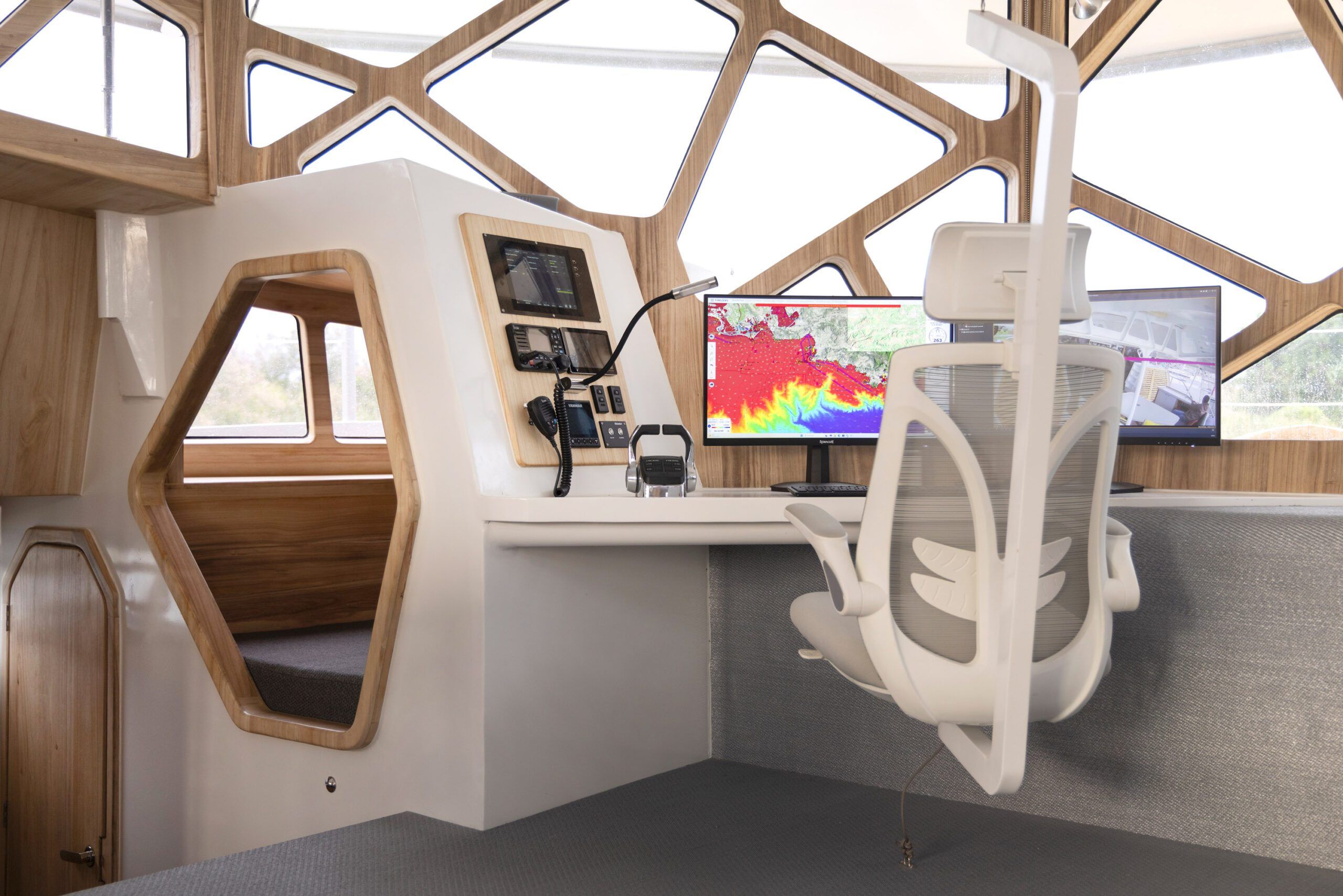
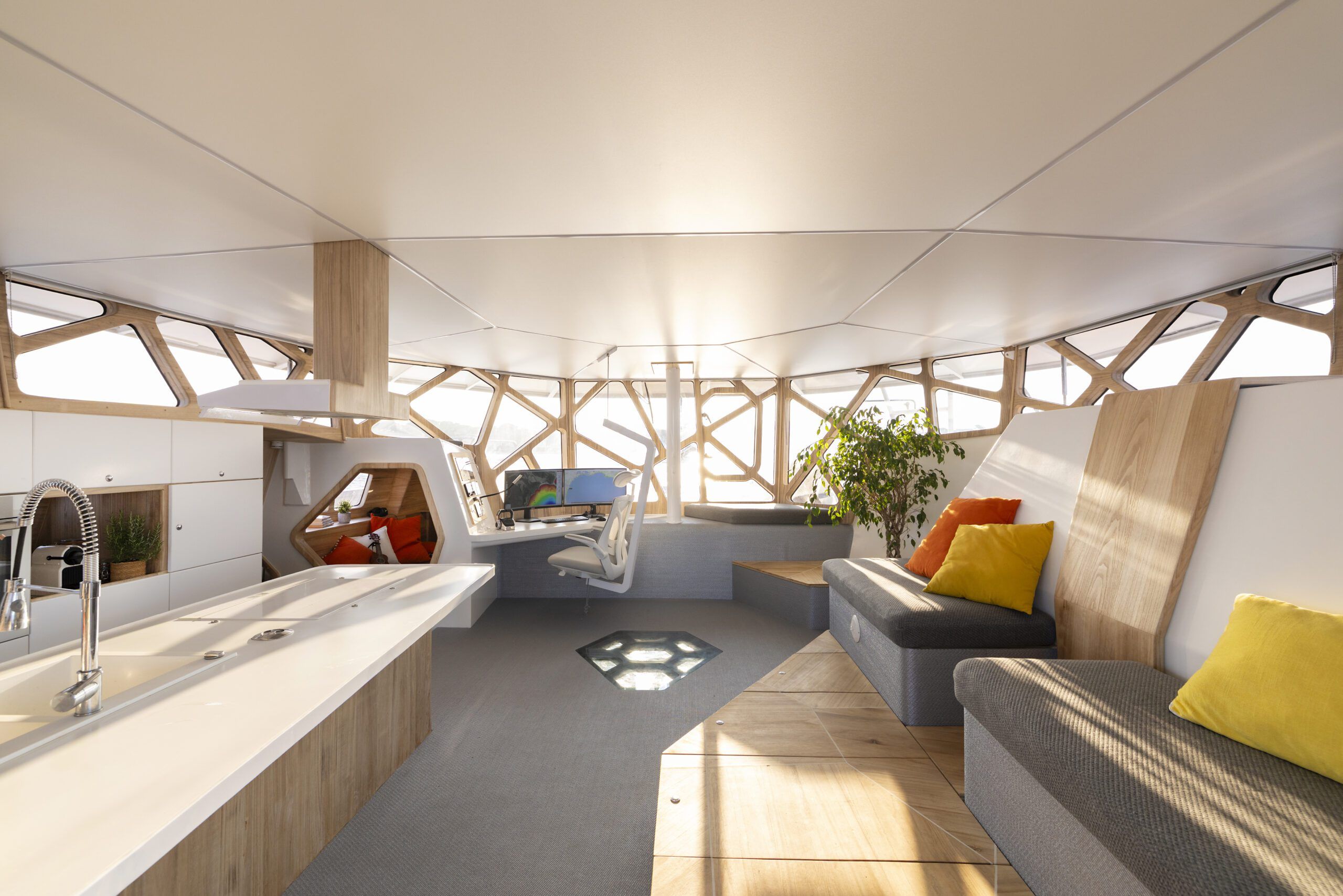
Inside this boat, the vibe is totally different from anything else on the water—it’s nothing like I’ve ever seen. Step into the saloon and you’ll find curves and wood and soft light filtering through stained glass windows. The nav station seat floats in midair, suspended from the ceiling like a sculpture. And the whole aesthetic? Think eco mountain chalet meets Jules Vern. There’s no glossy gelcoat or fake teak here, it’s all raw and designed for real life. The entire upper portion of the main cabin is window, divided by sculpted frames that define the artistry that is the focus of this vessel. With this massive amount of room, you can just spread out and enjoy the space or bring your family and friends. It has two heads, tons of storage and views that never get old.
Galley
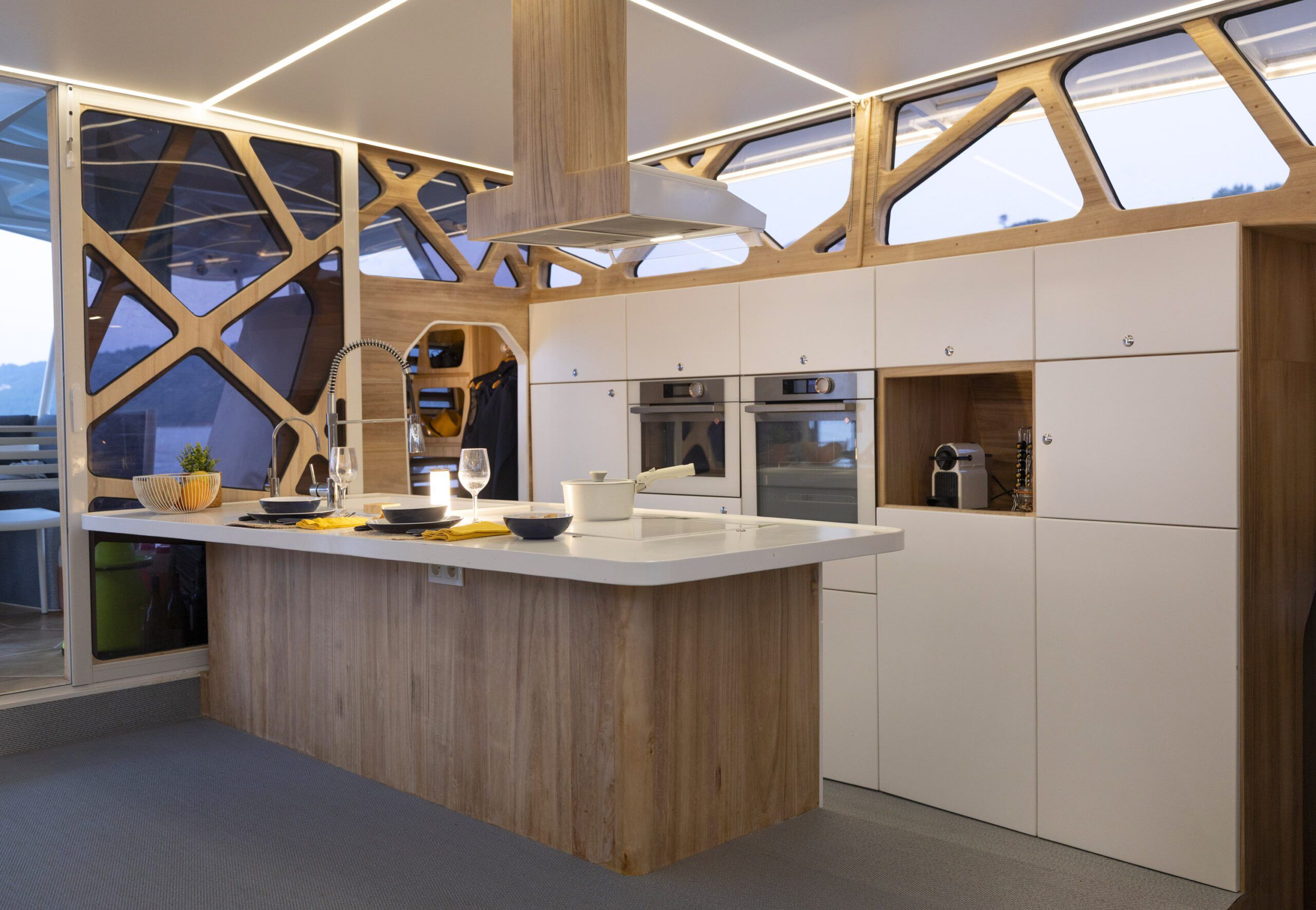
From the cockpit, the port hull opens up to a “mud” room for wet weather gear and jackets, then forward into a large, bright galley space that faces the main cabin over an island-like counter. Preparing meals here is a social occasion while enjoying the company of family or guests, not tucked away and out of sight.
Cabins
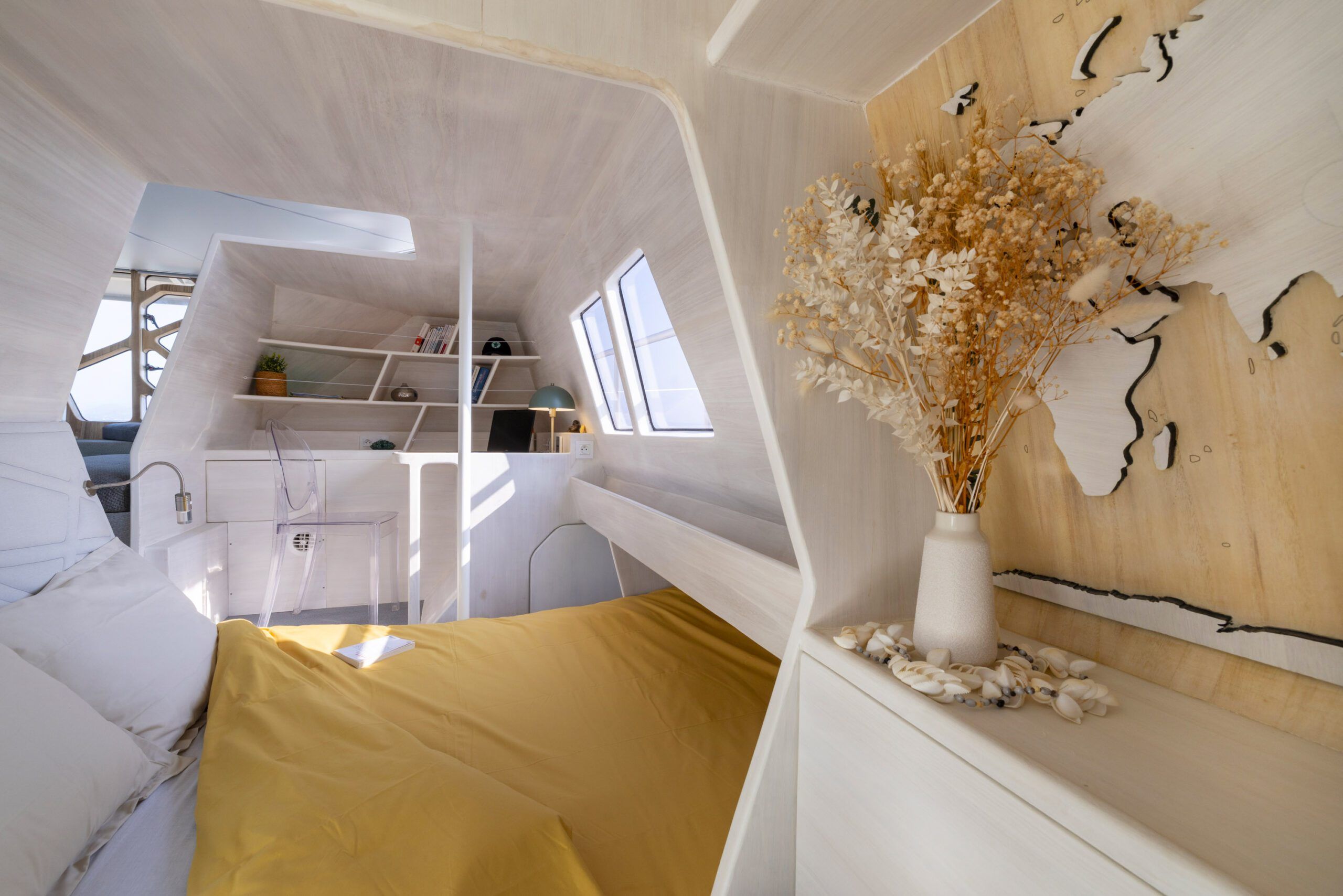
Forward of the galley in the port hull is one of the three cabins included in this boat, complete with ensuite and shower. With all the wood surrounding this space, a Swedish sauna comes to mind. Aft in the same port hull is another double berth.
Nav Station
Just inboard of the galley, and at the leading edge of the main cabin, is the navigation station/office space with that unique navigation chair—cool. Windows are all-encompassing and, with the artistry of the supporting wood framework, create a brilliantly lit main cabin space that opens up to the cockpit aft. In the middle of the cabin sole is an interesting glass-bottom view port that’s obviously strong enough to walk on, and yet clear enough to see marine life floating by while at anchor.
Starboard Hull
Stepping down into the starboard hull, there’s room for a washing machine and a cozy single berth athwartships—a cozy place for children or storage. Forward of that is another double berth with outdoor access near the bow. Aft on that hull is the master stateroom with two office-like spaces, an ensuite with showers, a double bed athwartships, and access to the cockpit area through a glass sliding door. The artistry of the main cabin windows is repeated here.
Mechanical
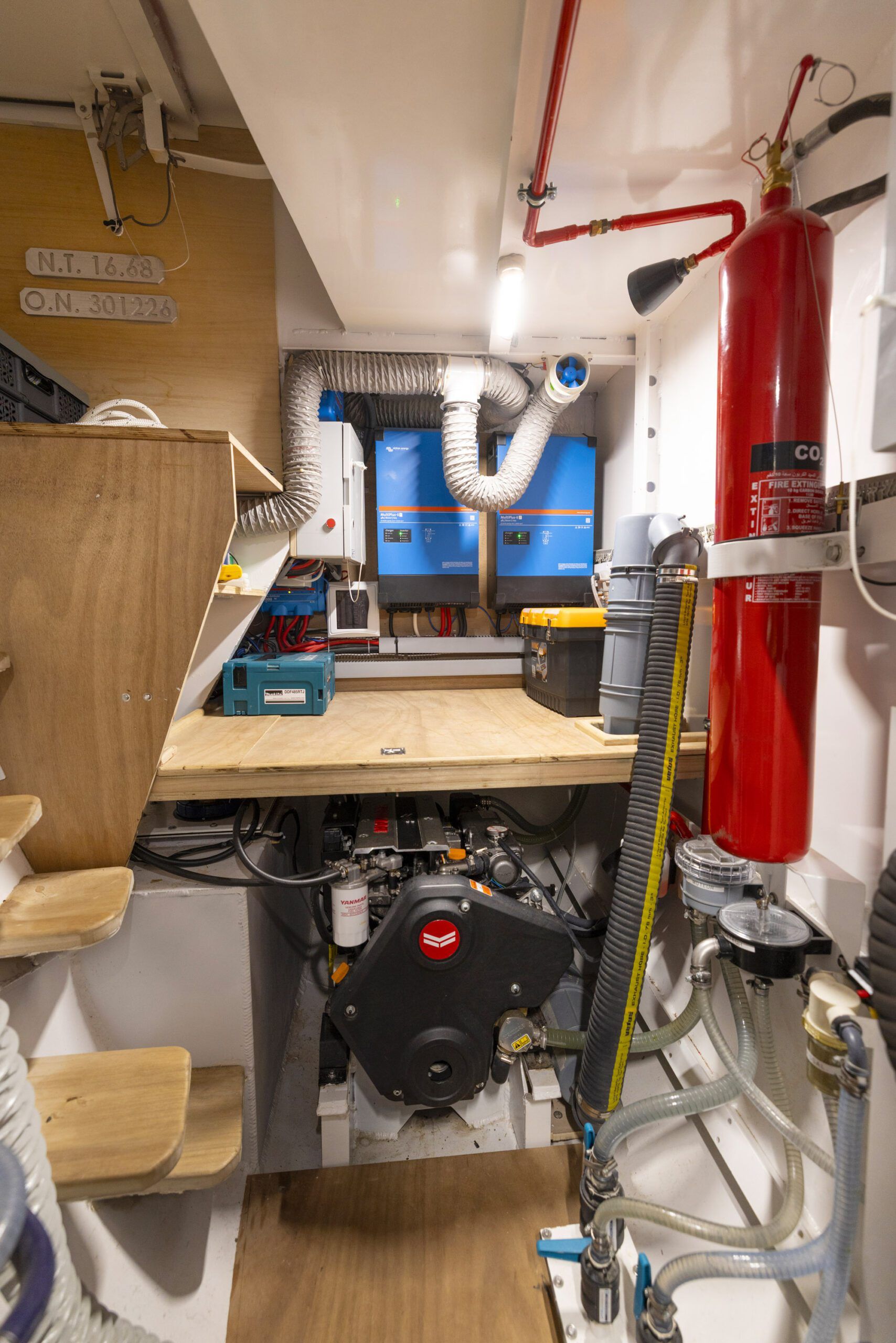
Let’s talk about power. This boat is a hybrid beast. Under the deck there are two 57 hp diesels. Standard stuff, right? But next to them you’ll find two 20 kw electric motors. That’s right, this boat is dual propulsion. Silent gliding along when you want peace, the diesel when you need the diesel grunt. In pure electric mode it only goes about 12 nm, but that’s all you need to get out of the slip or marina, or out of a quiet anchorage, without waking everyone up.
Solar
Up top, the 5.5 kw of solar panels on the coach roof and deck feed a massive 65 kw lithium battery bank. And just to be clear, this isn’t the kind of battery system that trickle charges your fridge overnight. This is the kind of battery system that lets you run electric motors and water makers and lights and tools and even an induction stove, all while watching the sunset with a cold drink.
Fuel and Water
Fuel and water capacity? Let’s just say you can disappear for a little while. 290 gallons (1,100 liters) of diesel and 320 gallons (1,200 liters) of water. Plus, there’s a watermaker that makes 26.4 gallons (100 liters) per hour. You’re not just visiting remote places with this boat, you’re moving in. And that’s the whole point. The Tortue 147 isn’t trying to be a racer, it’s not trying to be a floating hotel with the charter company, it’s trying to be a home, one that floats, sails and charges itself.
Performance
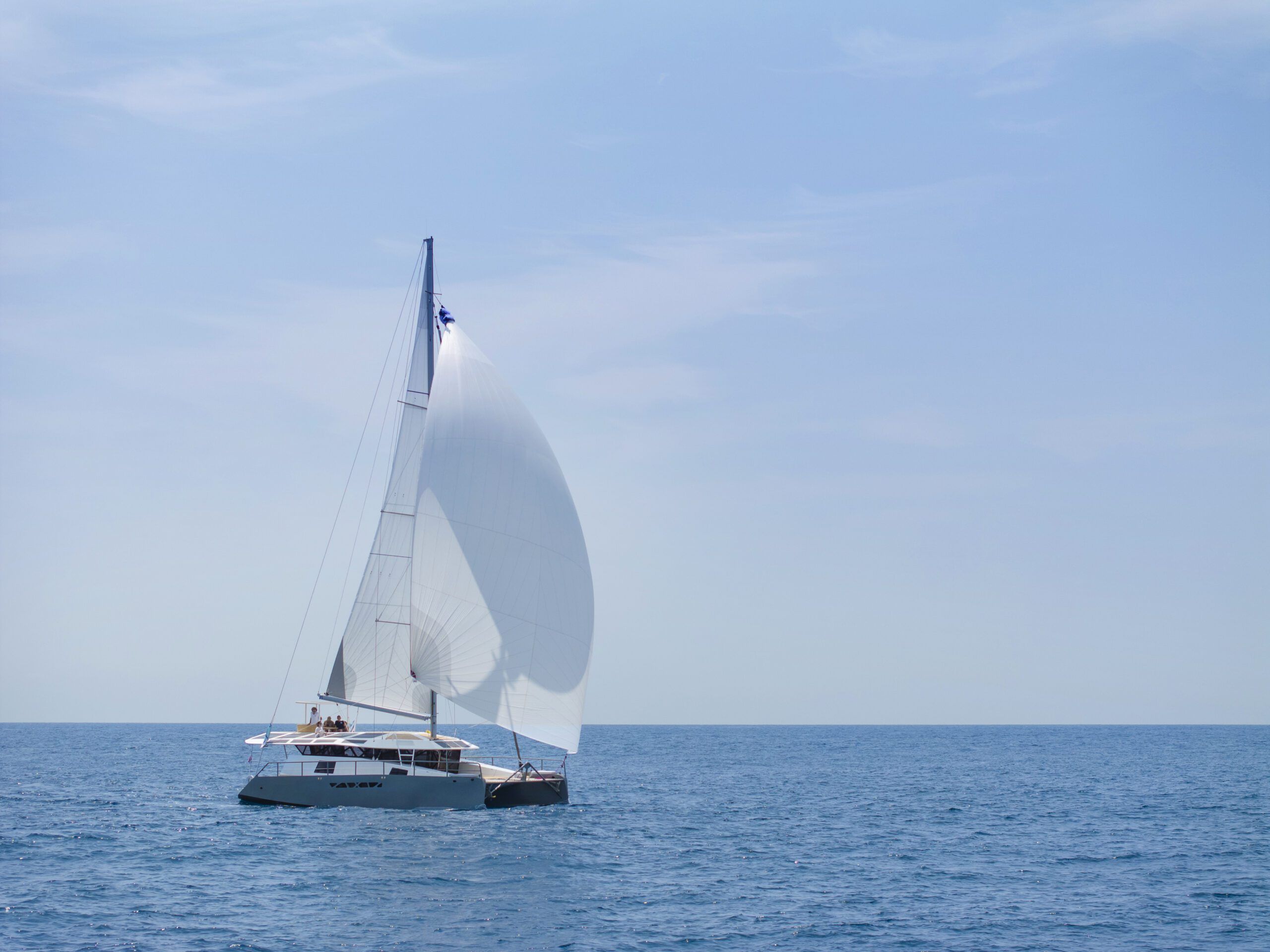
Now, is it fast? Well, let’s be honest. This is not a racing catamaran. The Tortue 124 carries between 1,000 and 1,500 sq ft (100 and 140 sq m ) of sail, which is respectable, but it’s not built to win regattas. It’s built to survive off grid, in the ocean, to ride out gales at anchor, and keep you comfy when the nearest marina is 2,000 miles away.
Conclusion
So, what’s the damage? Well, this kind of artistry doesn’t come cheap. Base price is around two million, and yes, that’s a big number. But then, how much would you pay for a house that can cross the oceans, powers itself, and can be dropped onto a beach anywhere in the world? Because that’s what this catamaran is: a house, a fortress, a floating sanctuary.
The name Tortue says it all. That’s French for “turtle”—slow, deliberate and protected by armor. And completely at home wherever it goes. It isn’t the flashiest creature, the humble turtle, but it has survived for hundreds of millions of years. The Tortue 147 is cut from that kind of cloth.
If you’re the kind of sailor who dreams about vanishing into the horizon, or if you want to explore without leaving a footprint, if you want a boat that doesn’t just float, but endures, this might be the most interesting catamaran that we’re going to meet this year.
What do you think? Too much? Leave a comment.



These catamarans just get uglier and uglier. I’ll take my 1986 Cheoy Lee Pedrick 41 over that butt-ugly piece of tin. I would be laughed off our small-town city dock if I showed up in that thing. Bleh!
Trail along with the Transpac fleet and then continue along around the world. But are mechanical parts available worldwide? I like it.
It’s not a beauty queen, but it’s certainly better looking than the majority of the cookie-cutter modern charter cats out there. To compare it to a classic monohull would be like comparing a ’57 Ford Fairlane to a modern Mercedes overland expedition truck. Sure, they’re both wheeled vehicles, but that’s about where the similarites end. I think the author nailed the description of “eco mountain chalet meets Jules Vern”. While so many new boats feature ultra bland interiors straight out of an Ikea designer’s book, Cataruga’s designers left no detail unconsidered. Funky for sure, but everything was done intentionally and with a distinctive style. And in 50 years when this beast is still plying the seas, it will have that retro-cool vibe that its rocking today.
This article reads more like an ad than a review.