

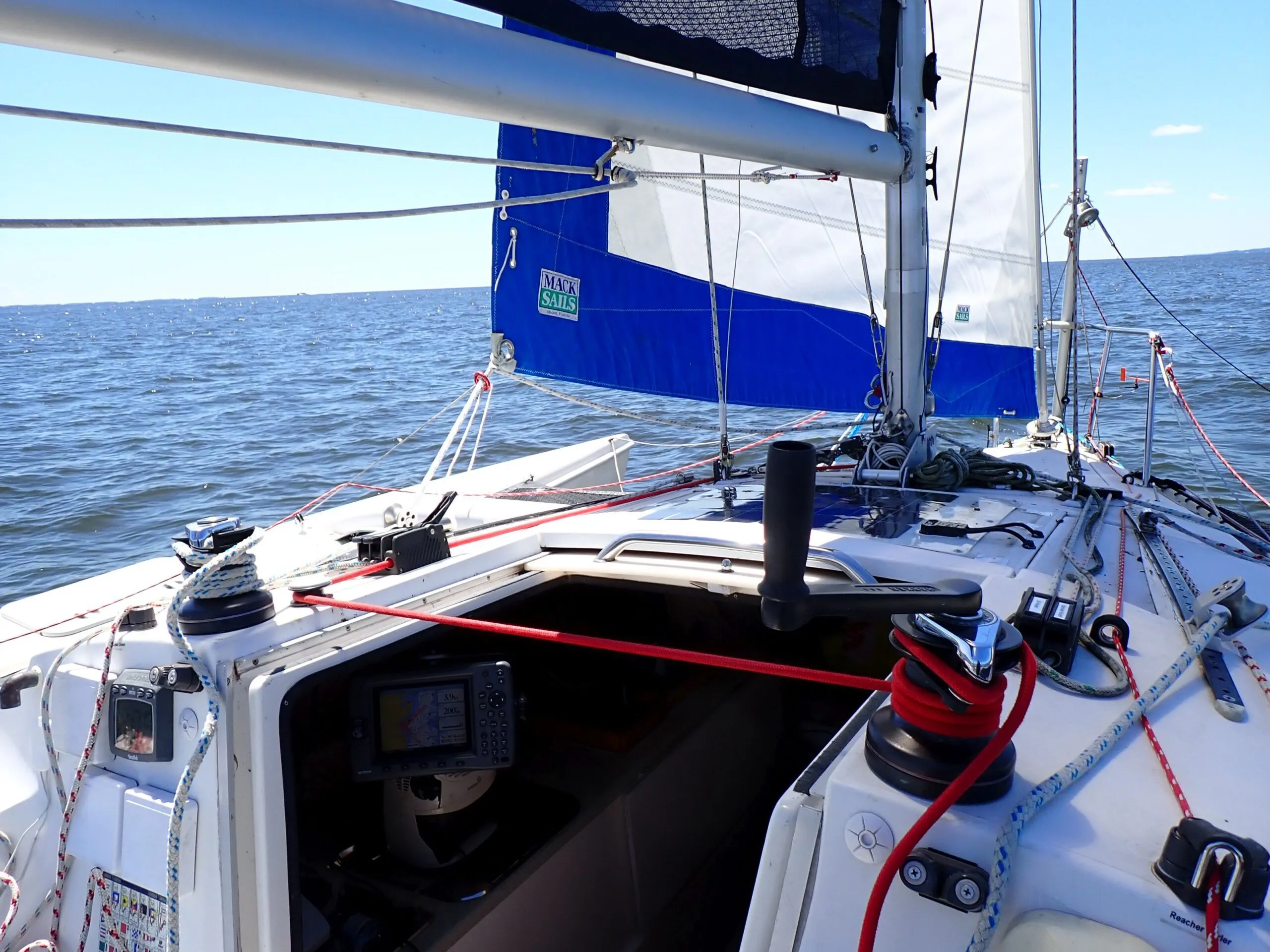
It was snowing and I needed a project. Ever since the article on cross sheeting, “Where Winches Dare Go,” I’ve been wanting to add a block to simplify my reefing process. The low friction ring on a sling method presented in the article worked well enough, but it required a few extra steps, added some friction, and just wasn’t as slick as I like my rigging to be.
As with most boats, winches are fed through a row of clutches and serve multiple functions. If the jib, which is not led through a clutch, is sheeted in tight while shaking out a reef, there is no winch available for the main halyard. Yes, you could feed the sheet through a clutch, but on a sporty boat like the F-24 this is a bad idea, and rubs many old school sailors wrong on principle; we dislike the very idea of having a sheet we cannot let fly, and we can list capsizes and knockdowns where this was a factor.
To Buy or to DIY
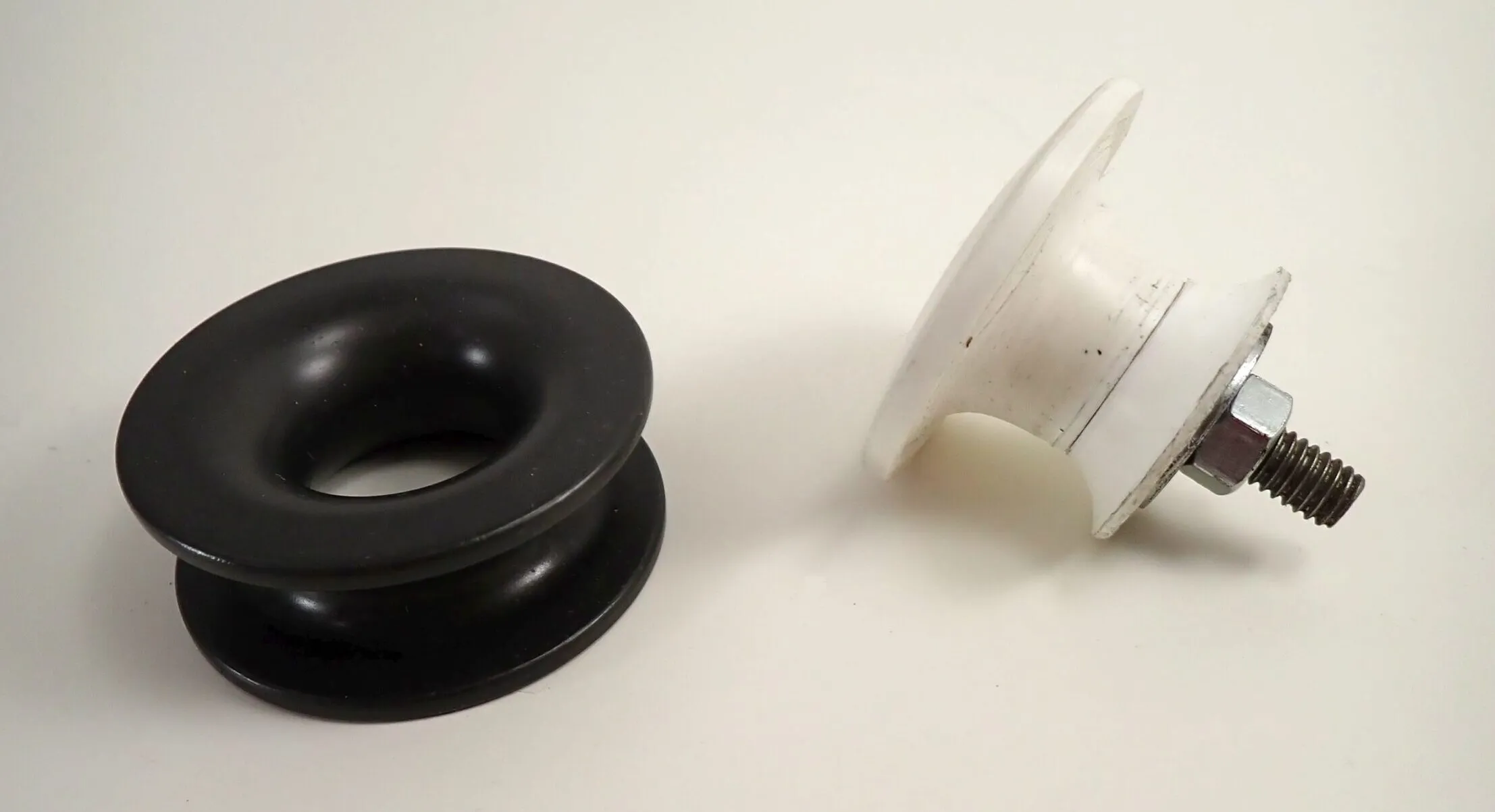
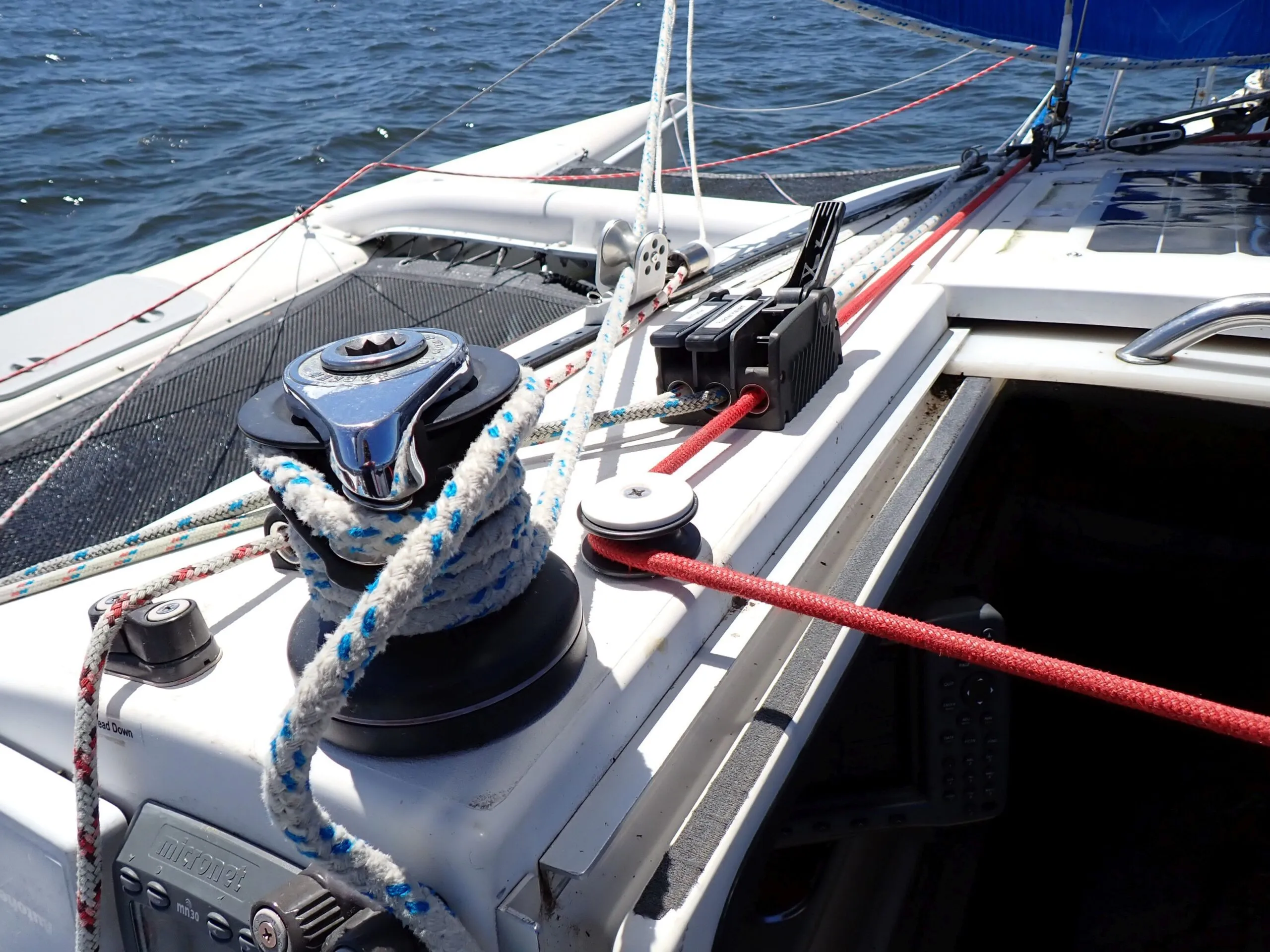
I could have bought a Spinlock Winch Feeder block (about $80), and they do work well, but where’s the fun in that and I needed a shop project. I also like the broader range of angles that the large low friction ring would accept. So I took the same low friction ring, and using a lathe, turned a two-piece core from HDPE that closely matched hourglass-shaped interior profile of the ring.
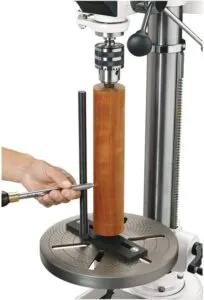
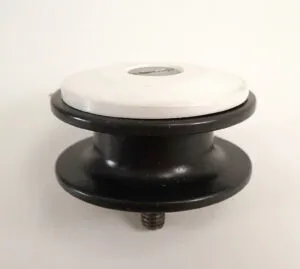
HDPE core is very slippery, and running against the smooth anodized surface of a low friction ring it is nearly as efficient as ball bearings. Although technically a metal lathe was used, the curves were cut freehand with wood lathe tools on a wood lathe like tool rest, so this could have easily have been done on a wood lathe or even a drill press with a lathe attachment (Shop Fox Drill Press Lathe Attachment, $60).
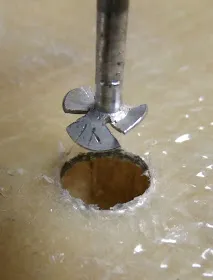
A single 3/8-in. bolt secures it to the deck. The hole was drilled through the top skin only, the balsa core removed using a modified roofing nail, the cavity filled with slightly thickened epoxy and chopped fiberglass strands, and then drilled through. A ¼-in. thick aluminum backing plate spreads the load.
Bottom Line
Now I can use the starboard winch primary or secondary with any of the port clutch lines. No conflicts during reefing no conflict when it is time to reef or shake out. The jib sheet can remain on the primary winch and the halyard is easily redirected to the lazy sheet winch, making the operation easy to handle from one spot with no set-up time. I’m tempted to add one to the starboard side, but there is no equivalent winch conflict.








A 90 degree turn increases the load by 41% if the block has zero friction (not possible in the real world). Please make sure that your home-built block is up to the load. A failure of that block would be life-threatening to anyone in the path. We had a racer at our club killed by a spinnaker snatch block that gave way under load.
Spend a couple of dollars on a block that has a tested safe working load and make sure that you calculate the actual working load based on the angle of deflection. Most turning blocks are intended to slightly change the angle to align with a winch or a stopper, not to dramatically change the direction.
Scary story. Spinnaker snatch blocks have a nasty failure path when they go. A classic case. The safety tip is to NEVER stand inside the sweep of a highly loaded block. Failures happen. This bit of wisdom goes back to the dawn of sail.
Yes, the load is 141% of line tension at 90 degrees and 200% of line tension at 180 degrees. However, most blocks are rated at 180 degrees (Spinlock, below, for example), so actually, 90 degrees is 71% of rated load. The most common service for winch feeder blocks is a 90 degree deflection (cross sheeting), but 180 degrees is commonplace.
The article did not quote a load limit, nor did we give an exact design. In this case, the breaking load a 3/8-inch center bolt in such an installation would be about 5,000 pounds and the working load with a 4:1 safety factor would be about 1,250 pounds. It would bend and jam long before that. The equivalent Spinlock Winch Feeder (1/2-inch center bolt) has a working load of 1,500 pounds. Makes sense. Most likely, in both cases, the limiting factor is the deck reinforcement and backing plate. On this boat (24 feet) exceeding a working load of 600 pounds would require a gorilla on the winch. A complete failure would cause the line to snap forward about 8 inches into an area no one stands. This is a safe installation.
But rlemoine make an excellent point. As always, the installer should understand the maximum load. If you are not an engineer, ask one.
You mentioned ‘blowing’ dust away. It’s important, (to U’re lungs), to blow one good blow, rather that take a 2nd breath, (of dust U just disturbed), or turn away to take a 2nd dust free breath. Also with 1 wrap of spin sheet on lee winch, we had a slippery semi tube between to winches (because of curve & nonslip on hatch), so crew on windward net could use windward winch, (with more wraps). My best idea?, is a second release position, near the mast for quick release while foreword. It can be made to double the main sheet power, (inside the boom forward to the gooseneck, then down to deck cleat). I.E. if one release is on the aft traveller, & U are working near the mast, U have a 2nd release point at U’re feet, (as long as it’s pulled in some).