To provide the best experiences, we use technologies like cookies to store and/or access device information. Consenting to these technologies will allow us to process data such as browsing behavior or unique IDs on this site. Not consenting or withdrawing consent, may adversely affect certain features and functions.
The technical storage or access is strictly necessary for the legitimate purpose of enabling the use of a specific service explicitly requested by the subscriber or user, or for the sole purpose of carrying out the transmission of a communication over an electronic communications network.
The technical storage or access is necessary for the legitimate purpose of storing preferences that are not requested by the subscriber or user.
The technical storage or access that is used exclusively for statistical purposes.
The technical storage or access that is used exclusively for anonymous statistical purposes. Without a subpoena, voluntary compliance on the part of your Internet Service Provider, or additional records from a third party, information stored or retrieved for this purpose alone cannot usually be used to identify you.
The technical storage or access is required to create user profiles to send advertising, or to track the user on a website or across several websites for similar marketing purposes.









I would add a string of half hitches. Two round turns and a string of hitches is a common way to secure a dock line to a piling. A string of half hitches is the standard way to tie-off a lifeline or standing rigging lashing (PS tested this –at least 6 hitches for Dyneema lashings). Easy to adjust, very strong, and reliable as long as the tail is secured against loosening with a seizing or close double overhand around the standing part.
Hi drew, thanks for your comment and suggestions. And I certainly agree with those knots and technics. As you know, when it comes to knots, we can go on and on and come up with a few dozen knots, based on personal choices. BTW, the article is intended to show a few basic knots, with a special attention on how to accomplish these using one hand. Also, as I’ve learned over the years, many knots, albeit the same, have different names depending where you are!
One knot, especially for sailors, is an absolute necessity. Everyone experiences a winch override at some point – usually at the most inopportune time. With a “taunt-line-hitch” tied to the load-side of the override, the tail can be lead to another winch to take the pressure off the fouled line, and the override released.
Thanks Leo. I’ve never heard of a “taunt line hitch” and will certainly look it up..
Just looked it up, it’s a taut knot. And yes that is a good knot but not sure I understand you description of how to use it to release an overridden line on a winch.
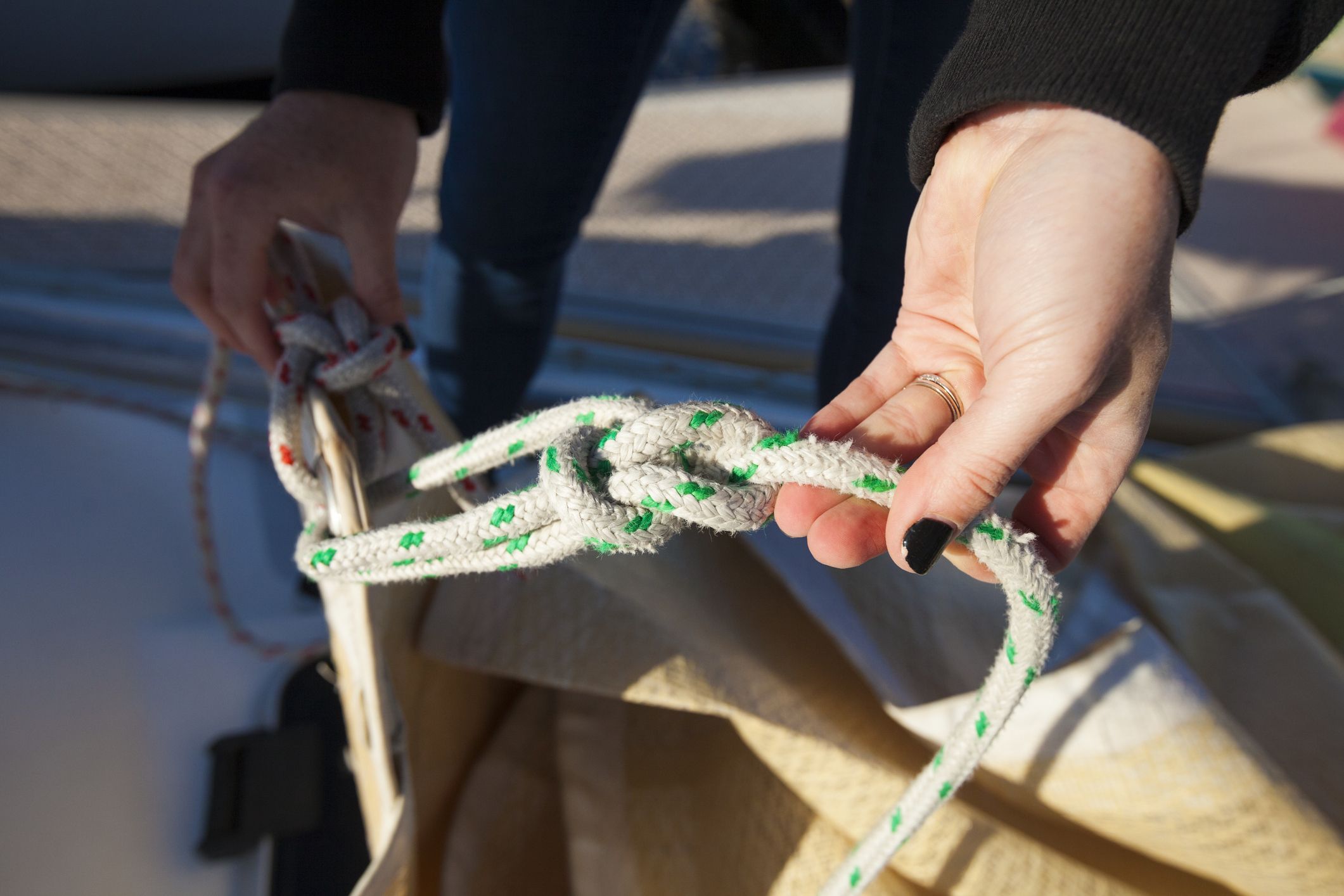
Sorry, but I believe there are some important errors in this article that are misleading. The knot identified as a “rolling hitch” in not a rolling hitch. It is not even a hitch. A hitch is used to tie a line to something. This is a stopper knot and not a rolling hitch. Secondly, the knot identified as a “reef knot” is not a reef knot. It is a dangerous thief knot that will slip easily to the point that it will fall apart when put under stress. A reef knot should be used as a binding knot as when reefing a sail to the boom. It is not that great for tying two ropes together. Use the sheet bend for that. The reef knot can slip, but not as easily as the thief knot shown. The two free, working ends (short ends in this case) that he wrongly calls the “bitter ends” throughout the article on a reef knot should both be on the same side of the reef knot pointing in opposite directions. The bitter or standing end of a line is the far end that is attached to something. This term evolved from tying the end of the anchor rode to the bitts, but it could be the end of your bow painter that is tied to the boat. If the gentleman used the thief knot as shown to tie two lines together in order to secure his boat to shore, I think he’s lucky to have his boat still there when he returned.
Hi Rick and thank you for your time for sending your comment. Indeed I seem to have mislabeled the one labelled rolling hitch as it is a “stopper” knot.
As for the reef knot, I use this when I need to extend a line with an other of the same size and material. This knot would be used for somewhat temporary needs. However, the ends of each line, when left longer, can also be tied down or chock around the opposite line to prevent slipping if needed or kept under tension.
As for my use of the term bitter end, I do understand it’s origins, but it has become a pretty common name indicating for the end of a line. But I will try and remember the proper term, standing end, moving forward.
Again, thank you for your comments Rick. I really do appreciate them and do take away the extra knowledge.
Sorry Marc, but Rick is right. That is not a reef knot or a square knot (same thing). It is a thief knot, used to detect if someone’s been in the pantry.
I use the alpine figure eight very often and I think it should be learned and kept as a go to whenever you need to set an eye along a line.
Do you mean a butterfly knot or a figure 8 on a bight? A butterfly loop (aka alpine butterfly loop) is the only common knot with “alpine” in it. commonly used to add a loop in the center of a line. A figure 8 on a bight is also common for this.
Yes, a butterfly loop can be tied with one hand, although even hanging from the side of a cliff (I’m still a frequent climber) or climbing the mast I have never needed to tie any knot more complicated than a slipped half hitch or figure 8 on a bight with one hand, and the figure 8 was only because I could. Being able to tie each knot wearing mittens in the dark, on the other hand, can come in handy, which is why climbers stick to just a few simple knots.
Yes, Alpine butterfly knot….that’s the one. Sorry for the name twist – I learned it while climbing and very usefull and simple – hard with one hand, but it’s douable
Hi Tony, Thanks for your comment and suggestion on the Alpine Figure Eight. I will certainly look it up. BTW, can it be set using one hand?