

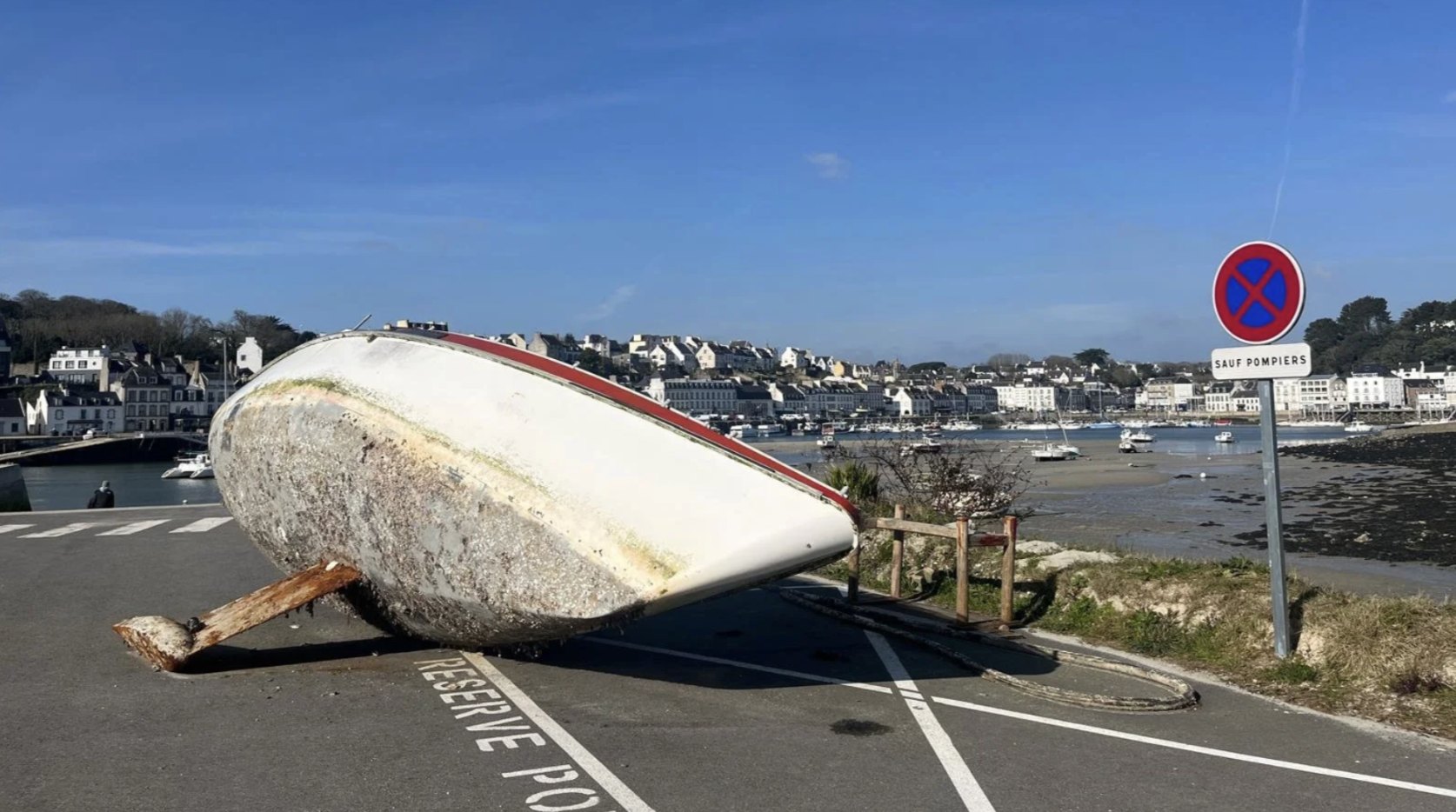
I scramble down sharp boulders from the car park to the muddy banks of the estuary, cautious not to slip, metal shellfish gathering basket in one hand, handheld Bluetooth microscope and smart phone in the other. The tide is exceptionally low, revealing the local cemetery of boats stranded along the shoreline.
Crouching beside the first boat, a salty breeze brushing my tangled hair, I begin today’s fieldwork, pinning the boat’s GPS location one-by-one, photographing hull and deck damage, observing the spillover of paint flakes and glass-reinforced plastic (GRP, commonly referred to as fiberglass) chunks lying in the mud, and taking more photos with the microscope projecting live images to my phone. Here, in the Goyen River-Estuary in Finistère, Brittany, the stunning sunsets that reflect on the windless river’s surface like sea glass hide a slower disaster.
As an ocean-loving storyteller currently hand-building a 41-ft. Polynesian-inspired wooden catamaran, I fell into this citizen science work by accident, and now regularly find myself trudging through sinking mudflats grappling with awe and guilt. These boats I stand beside, once launched proudly and rigged for freedom, now leak their structural skins into the surrounding aquatic ecosystem.
I do this work as part of the Floating Stories Lab Association’s Regenerative Tides: Sailing for Solutions (ReTISS) Project, a citizen science initiative engaging coastal communities in mapping abandoned, derelict and damaged boats, analyzing associated micro-pollution, and crafting new narratives that aim to repair and regenerate.
The Hidden Legacy of GRP
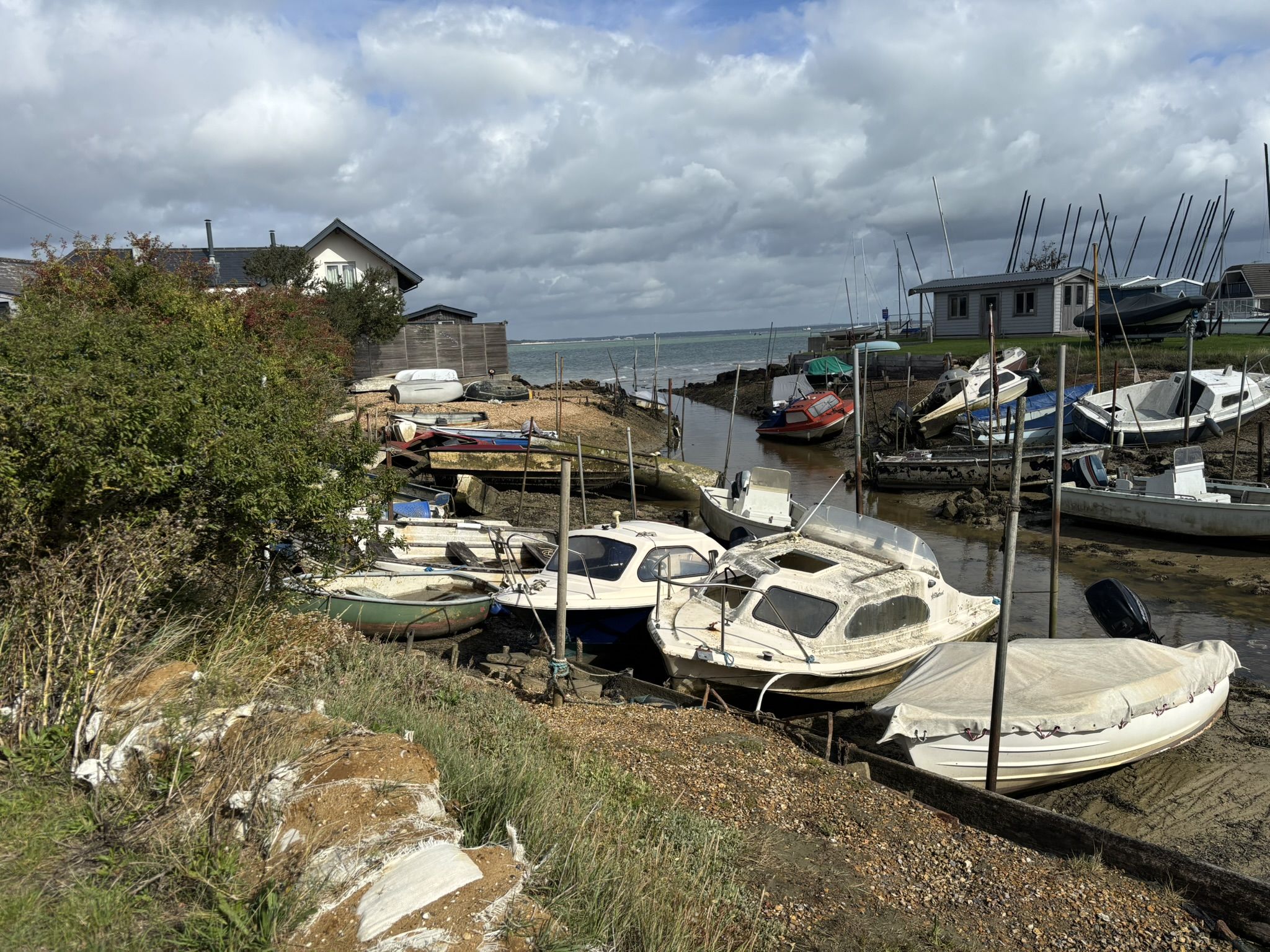
I bend down to photograph a chunk of glass-reinforced plastic shed from the hull of an abandoned boat rotting in the mud. Consider how this material revolutionized boat-building from the 1960s onward. Lightweight, strong and water resistant, the invention of GRP ignited the mass production of plastic leisure boats. The industry went wild as did boat owners; those affluent enough quickly snapped up shiny new plastic boats that, over the decades and especially post-Covid, are skyrocketing in demand.
Yet those very qualities that centered GRP in boatbuilding and enabled the churning out of mass produced recreational, commercial and racing hulls turns into a long-term liability when the vessel reaches end-of-life. Indeed, well-made marine composites work brilliantly, until they don’t. See “A Brief Modern History of Fiberglass.” Remarkably, the industry and boat owners alike didn’t spare much time to think about what happens when these composite boats are no longer fit for use.
It was during the pandemic that I, like many others, began my search for a sailboat. My dream was to create a Floating Stories Lab; refit a sailboat I’d co-captain with my husband as a platform for ocean-centric storytelling, research and community engagement circumnavigating the globe. With minimal budget and heavily influenced from watching too many boat refit YouTube channels during France’s multiple Covid-19 lockdowns, we scoured the secondhand market for a cheap, neglected GRP boat.
Shortly into our search, Dr. Corina Ciocan and her team from the University of Brighton discovered that marine bivalves—oysters and mussels—were ingesting GRP and resin from end-of-life boats in Chichester Harbour in the United Kingdom, stopping us in our tracks.
GRP in the Food Web
Ciocan and colleagues found up to 11,220 fiberglass particles per kilogram wet weight in wild oysters (Ostrea edulis) collected near an active boatyard. Mussels (Mytilus edulis) recorded around 2,740 particles/kg. These numbers challenged assumptions about GRP durability and marine isolation, with the research also highlighting seasonal peaks correlating with boat maintenance winter-work: sanding, cutting, repair release micro fibers into the surrounding aquatic ecosystem. Their findings were published in the prestigious Journal of Hazardous Materials.
Under the microscope, these particles appeared as transparent, cylindrical glass shards, ranging from 50–250 µm long—small enough to be drawn into the digestive glands of bivalves. The study confirmed their composition as aluminosilicate glass bound with poly diallyl phthalate resin—one of the composites used in GRP boat hulls. The research warns that these fibers can impair feeding, cause tissue inflammation, and potentially affect survival. And unlike conventional microplastics, GRP fragments contain asbestiform-like silicate fibers—sharp, persistent and potentially harmful if ingested in quantity.
Legacy Health Costs of GRP
Coming from three generations of marine craft artisans—my grandfather and his brothers built kayaks, surfboards, boats, swimming pools, and other GRP-based products (even garden furniture) from the 1960s onward—I grew up acutely aware of the material’s negative reputation for human health. All of them died relatively young from various lung-related diseases and cancers. Because of this history, and as a surfer riding composite boards myself, I have long understood that anyone working with composites must use proper protective equipment, especially to prevent toxic particles and fumes from being inhaled or entering through the eyes, nose or mouth.
It should come as no surprise, then, that GRP also poses a serious hazard to marine life. Still, I was shocked to learn about the sheer number of end-of-life boats—reports suggest hundreds of thousands across Europe alone, likely far more—that are never properly disposed of. Instead, they are abandoned or dumped, left to leach a toxic cocktail of materials into marinas, estuaries, rivers, basins, inland waterways, and even the open sea when scuttled.
GRP Lacks End-of-Life Pathways
A further study, led by Professor John Summerscales at the University of Plymouth, also highlights this systemic problem. Examining the manufacture, life-cycle impacts and disposal challenges of composite materials, the research shows how GRP boats lack viable end-of-life pathways: landfilling is costly, recycling is rare and abandonment is common. Once left in the intertidal zone or neglected afloat, hulls weather, crack and shed fibers and resin fragments.
As these structural layers break down into near-invisible needles in the water, coastal filter feeders and other organisms inevitably draw them in, where the shards pierce their gills and cannot be expelled.
ReTISS Citizen Science
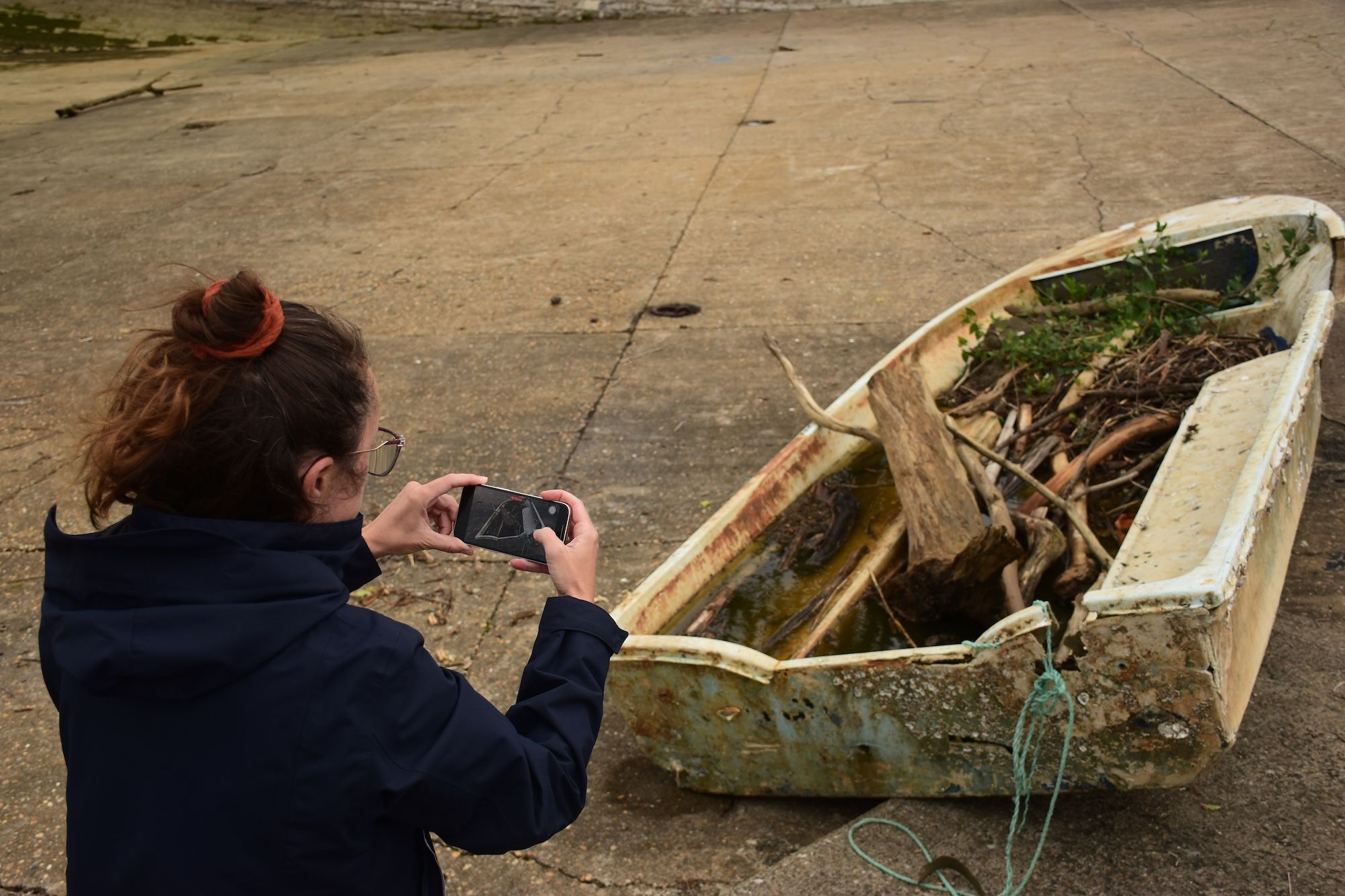
ReTISS began when we realized that policy-makers are failing to act on the issue, frequently citing a lack of data on end-of-life boats. With a small EU-funded grant, the Floating Stories Lab Association launched a pilot in Brittany that has now expanded across to the UK, with citizen scientists from local communities walking shorelines. We log the “Bad Boats,” documenting their location, visible damage and pollution, surrounding environment observations, and even micro-photos of exposed GRP and peeling paint.
Local middle school students are spearheading research in the Goyen, expanding their contribution to collect and analyze oyster and mussels, including the Native European Oyster, which is only recently making a comeback. In four, two-hour fieldwork and lab sessions at Bois de Loqueron College in Plouhinec, we discovered GRP shards and microplastics in every sample of (up to) 5 mm gill tissue samples.
Oysters Are Not Cleanup Crews
Filter-feeding bivalves such as oysters hold enormous ecological value: they accumulate nutrients, filter water, build reefs and stabilize sediments. In recent years, a growing number of projects have begun deploying oysters as “vacuum cleaners,” placing them in polluted waterways to absorb human-caused contamination. But this approach is not only overly simplistic and ethically questionable—it also overlooks a key risk. When oysters ingest plastics or GRP particles, they can become vectors of contamination rather than solutions.
Our ReTISS fieldwork reinforces this reality. Ciocan’s research shows that oysters and mussels are continually exposed to boat-derived waste, ingesting thousands of glass fibers and resin fragments that accumulate in their digestive glands and may impair their physiology or survival. In such cases, the oyster becomes a reservoir of marine debris embedding our waste directly into the food web, and ultimately into the organisms, including humans, that consume them.
People, Place and the Politics of Repair

Over the past months, ReTISS has brought together community members across borders as we center a multidisciplinary approach to this complex waste issue. Contributing to meaningful science through mapping and field-based observation is not just the work of marine biologists, it is a role anyone in a coastal community can take on.
Inviting artists to participate in a Citizen Science Creative Residency, we explored how creative practice can shift the narrative around “ghost boats” from romanticized relics to active sources of ecosystem pollution.
Meeting with boat owners, we have heard how maintenance yards around the world often lack filtration systems for sanding dust and wash-offs, and how these same facilities accumulate end-of-life vessels with no clear disposal pathway.
Wreck Removal as Ecosystem Recovery
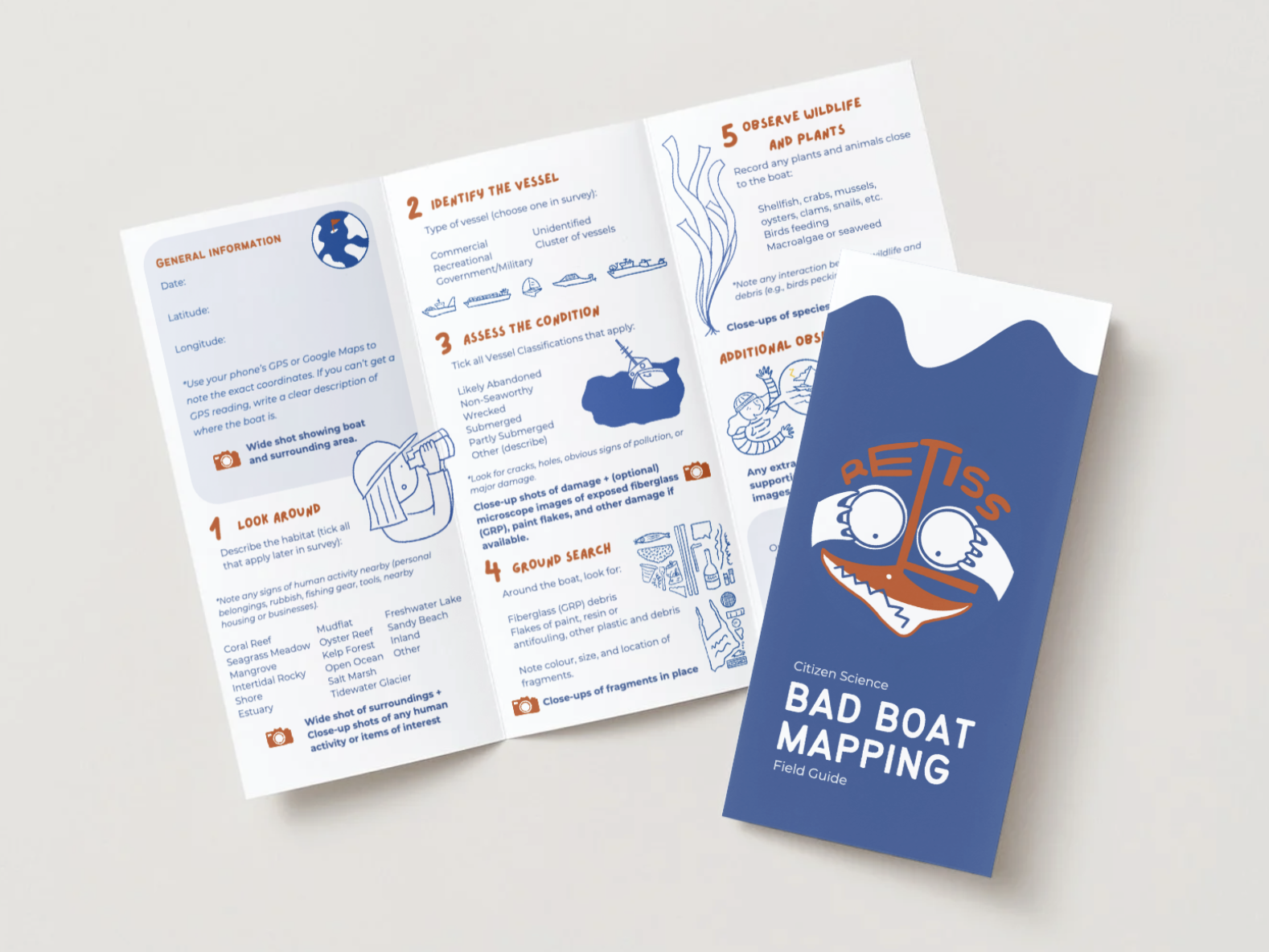
Thus far, the ReTISS project has logged almost 100 end-of-life boats along the Brittany and U.K. coast, with over 93 percent of these vessels abandoned in estuaries and 29 percent situated directly beside oyster reefs. Anonymous citizen scientists have submitted more than 150 photographs of derelict boats, including microscopic images taken on-site. Our team has produced multilingual field guides and an educational video teaching citizens how to map abandoned vessels in their local areas. The work is ongoing, and we are calling upon more coastal citizens to get involved, and for governments to act.
Removing these wrecks from the ecosystem is not simply a matter of aesthetics or navigational safety; it is an investment in ecological recovery. Clearing degraded hulls reduces chronic toxic loading, allowing filter-feeders, algae, seagrass, juvenile fish and benthic organisms to rebound. As water quality improves and habitat stress decreases, biomass can increase significantly: oysters grow more readily, sediments stabilize, and the complex web of species that depends on healthy reefs begins to return. In this way, removing abandoned boats is not just a clean-up effort, it actively restores ecological value and strengthens the long-term resilience of coastal ecosystems.
Designing Out Fiberglass Waste
From the composite-engineering side, we have found that life-cycle assessments (LCAs) of GRP boats reveal a key weakness: end-of-life disposal is rarely accounted for, leaving enormous externalities unaddressed. Research into sustainable composites—natural fibers, recyclable resins—is growing, but regulation and disposal infrastructure lag far behind. See “Glues and Resins: Can Boatbuilding Be Regenerative?”
In the meantime, we must stop treating oysters as our cleanup crew. They already carry the burden of filtering their ecosystems. Asking them to absorb our pollution, which includes plastics and GRP fibers, simply transfers the problem down the food chain. The real question is: Why are we still designing materials and objects without viable end-of-life pathways? When we abandon boats, we abandon responsibility, our custodial duty to the ocean.
What if instead we saw derelict hulls not as waste but as data-nodes? What if boat-builders, harbor masters, sailors and citizens mapped them before they sank or disintegrated? What if maintenance slipways had capture systems for sanding dust and resin wash-off? What if recycled boats, stripped of toxic materials, became playgrounds, housing, or creative studios rather than dangerous derelicts littering our waterways? See “What Do You Do With Old Fiberglass Boats.”
Toward a Regenerative Fleet
ReTISS aims to center citizens in data collection to help imagine a regenerative marine craft paradigm. We invite future boat-owners to consider co-sharing or to become members of the Floating Stories Lab Association, gaining access to our hand-built Polynesian-inspired wooden catamaran. See “Why Choose the Wharram Design.” We invite local schools and communities to adopt our mapping initiative, and for scientists to use the publicly accessible GIS map to identify potential GRP pollution hotspots for further analysis.
We encourage boatbuilders and manufacturers to assess ecological impacts in their LCAs and to innovate toward marine-symbiotic materials. We ask policymakers to include end-of-life hulls within marine debris frameworks. And we ask the public to recognize that the beautiful hull drifting offshore still has a story: of materials, time, wear, water. And in that story lies our human custodial responsibility.
More Information
The Floating Stories Lab (FSL) is a French non-profit association, hand-building a 41-ft. Polynesian-inspired wooden catamaran as a voyaging platform for storytelling, citizen science, and ecological research.
Co-founder and President Angie Richard is a documentary filmmaker, researcher, and founder working at the intersection of ocean, lived experience, and regenerative creative practice.
Regenerative Tides: Sailing for Solutions (ReTISS) Project Page: https://www.floatingstorieslab.org/regenerative-tides
Bad Boats Map: https://storymaps.arcgis.com/stories/b0ca3faa1b4049c28e49b59bc1a0a30a
Further Reading
Wooden Boat Revival: Can Boatbuilding Be Regenerative?
Considering Fiber-Reinforced Composites for Sheathing












Important story Angie. Nice work. Is disused GRP a raw material that can be repurposed?
this is a very worthwhile effort… every time I see an abandoned boat (often a hurricane victim), I remember that essentially every GRP boat ever produced still exists in some manner… some dead boats have been repurposed somehow and some exist buried in landfills, or on the bottom or just rottng up some creek… but they generally don’t go away, at least, not very far…
unfortunately, these boats tend to be pretty widely distributed so having enough in one place to do something with their materials, commercially, is an issue even assuming we knew how to use the materials.
fortunately, classic fiberglass boats are still highly desired by some… and with sailboat manufacturers struggling to survive, maybe more old boats will continue to be refit…
so, how might we see dead GRP, carbon fiber, etc as underutilized resources more than a waste problem? IN ALL NEW PRODUCTS, designing for lifecycle is the key, but we barely do that now and only in a few situations… for example, seeing this as a product/process design problem, and making car manufacturers responsible for their product lifecycle, has helped some… not yet the case with our incredible high tech Wind Turbine blades.
The battery people are starting to creatively repurpose these incredibly valuable resources… why not GRP, carbon Fiber, etc… engineers THRIVE on good meaty problems like these… they can be solved, the question is will and it’s cousin, money.
No one seems to be at all concerned about those huge Wind Turbine blades.
Thanks for this. It is a good reminder that, as sailors, we also carry some ecological responsibility. It is becoming more of a problem in all areas as so much stuff we have is not designed to be repairable but disposable. Everything from mobile phones to clothes. As someone who writes about repairing and renovating sailboats, I see this as not just an ecological problem but also a way to make sailing more accessible. The production boat industry seems to be heading down a path towards accepting that boats costing hundreds of thousands of dollars may be at the end of their lives in 15-20 years.
My view is that this is not a scientific, engineering or ecological issue but a cultural one for the industrialized countries. We need a change in attitude towards the value of the care and maintenance of the things we own and away from social status being linked to having ‘new stuff.’ We used to repair and reuse stuff because we had to, now we need to do it because it is the right thing to do.
Same problem as windmill blade end-of-working-life disposal. Is there a better solution than building another Mount Trashmore?
There are some definite advantages to GRP, but this is a downside. Most people are probably aware of the upsides of GRP vs. wood. What are the downside comparisons? Have these been established from the environmental perspective?