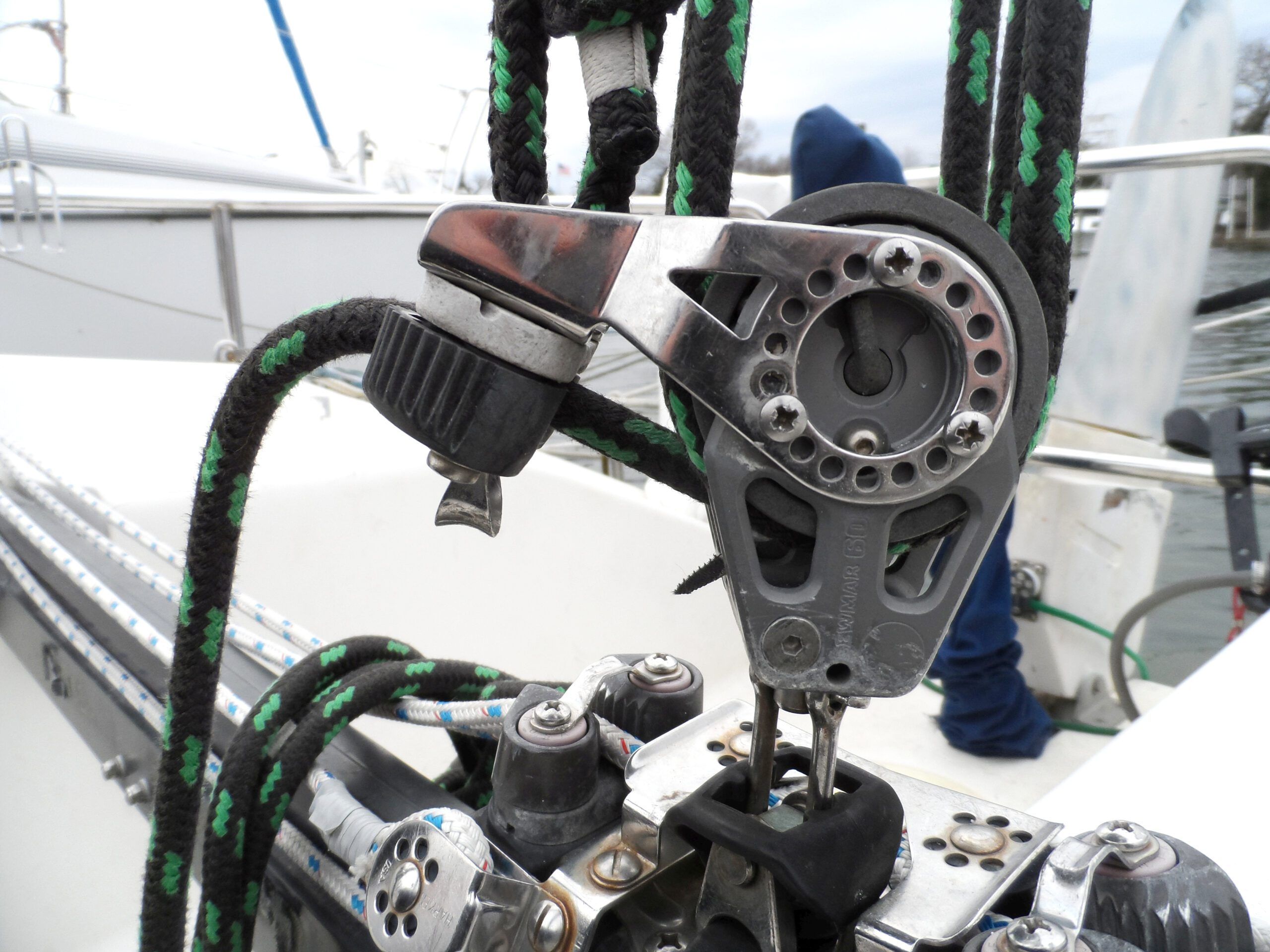
Cam cleats are a marvel for their ability to quickly hold and then release lines under moderate tension. They are found on the simplest of dinghies, Olympic sailing machines, family cruisers and round-the-world boats. They also have their limits. They are intended only for lines that can be hand held, they can be hard to release under load, and they can fail to hold if the line enters at a foul angle.
The following are reader questions and complaints. Most relate to operation subtleties or installation errors:
“The rope won’t go in the cleat when the wind is blowing.”
First, there must be room below the plane of the cleat to pull the rope down. Not much, but enough for your knuckles plus some. Better yet, the cleat should be near an edge, so that it can be pulled sharply downwards.
Second, and more common, is that the rope must be moving away from the cleat, towards you, as the rope is pushed down into the cleat. You can’t just push down and expect the cleat to open. The cams need to rotate open for the rope to enter, and this is helped by the rope moving away from the cleat. You can force the rope in, of course, but it’s bad for the rope and not easy.
“The mainsheet won’t uncleat when the wind is blowing. I almost capsized.”
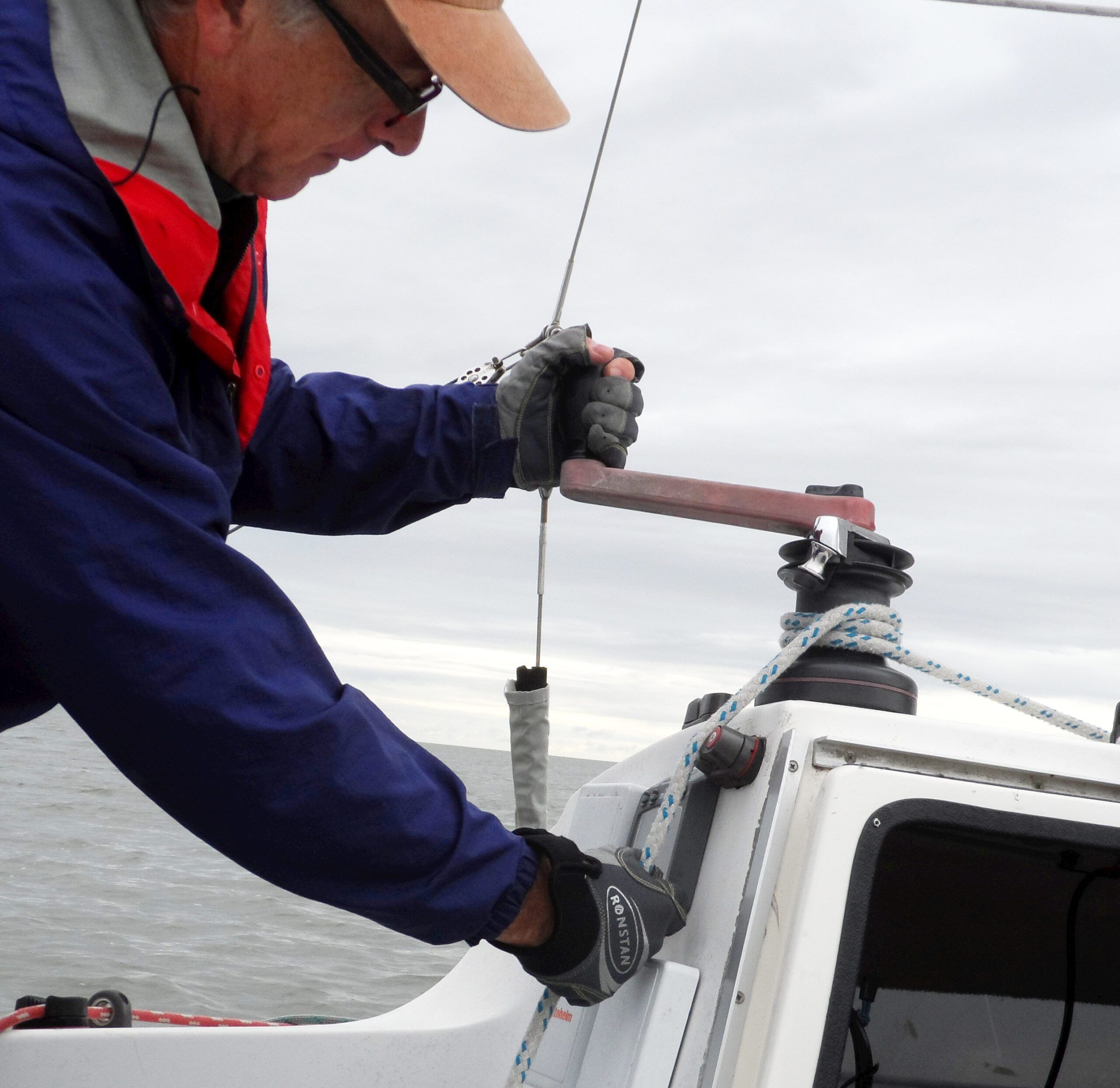
First, you must pull hard enough on the rope to relieve at least some of the load from the cams. It helps a great deal if you can get the rope moving towards you, if only a fraction of an inch. This may be counter intuitive, because in a gust you are trying to release the sheet, not pull it in, but pulling the rope allows the cams to rotate, after which the rope will glide right out. If the wind has built to where you cannot pull the sheet in by hand, you need to reef, and perhaps a winter project should be to increase the purchase of the tackle.
Universal Release Design for Every Trimmer Position
Second, the cam cleat must be angled so that that you can comfortably pull at least 15 degrees above the plane of the cam cleat, and 20 to 30 degrees is much better.
On tender boats, release must be instantaneous with a straight pull from anywhere you are likely to be holding the sheet. Trimming positions include not only the cockpit seats but also sitting up on the coaming, and for dinghies and multihulls, hiking hard, out on the trapeze, or sitting on the nets. Providing this angle can make the sheet more difficult to cleat from some positions, but you will be wearing gloves and the lower block should be a ratchet block with a good grip, so you can hand hold it in gusty conditions for a while if need be. Note: The angle can be up or down on mainsheet tackles, depending on the tackle style.
Imagine my surprise, on my new-to-me F-24 trimaran, when I was driving from the windward ama and realized that the coaming blocked my ability to release the main sheet. A gust hit and I hastily scrambled into the cockpit to avert capsize. It is common for the cleat to be set for easy when sitting right beside the tackle, but universal release is more important. I made the adjustment before I went home.
“The cam cleat holding my winch tail releases in gusts.”
First, the cam cleat should not be holding more than hand tension. Are there enough wraps on the winch to hold the load? Perhaps you ground the sheet in with only two turns on the winch, but the wind increased or you changed course, the load increased, and now more turn are needed.
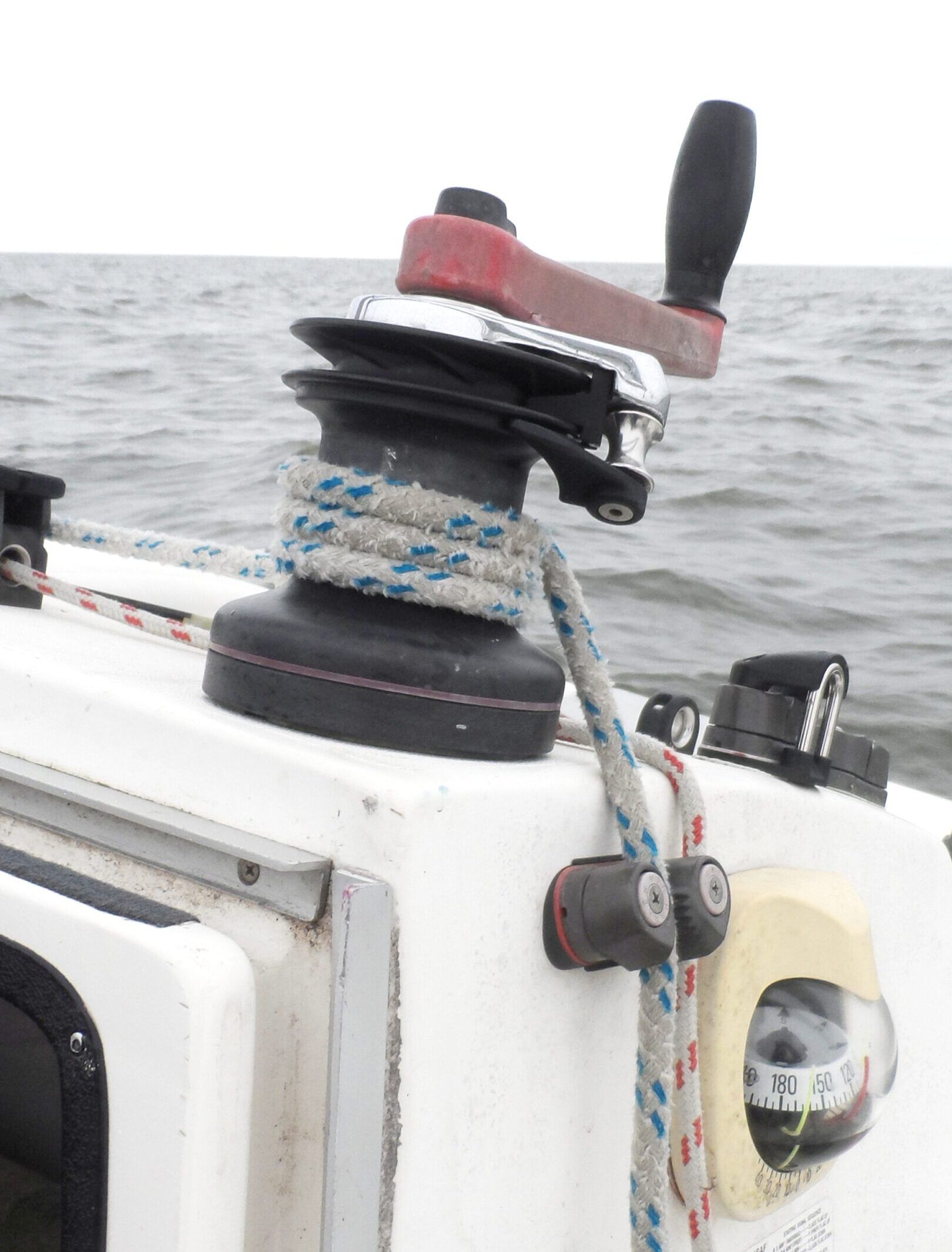
Second, is the rope angling up from the cleat towards the topmost turn on the winch? Probably yes. Is the cleat on an angled riser that matches this angle? Probably not, and as a result the rope is pulling upwards through the cams, sliding out, almost as though you are trying to release it. This greatly reduces holding power, as we will see later in this article.
Fairlead or Not?
For a winch tail, obviously not. You need to be able to add and subtract turns. For multipart tackles, obviously yes; the fairlead is what pulls the swiveling tackle around to face you. Pendants top or bottom can make good low-friction swivels. For other applications, integral fairleads can help align the rope through the tackle, but don’t ask too much of them. The entry and exit should be within 15 degrees of centered if possible, turning the line with pulleys and external fairleads as needed. This is also true of clutches (10 degrees maximum).
For a full review of cam cleats, applications, and past PS reviews, please enjoy these articles from the archives:
“Testing Cam Cleat Appetite and Durability,” April 2023.
“Cam Cleat Wisdom,” November 2018
“Deck Gear Clamp-down: Cam Cleat vs. Self-tailing,” February 2023
Why We Tested
While the above basic guidance should see you through proper cam cleat installation and use, we never quantified exactly what those cleating and release angles should be or what the effect of off-plane loading is on holding power and release ability. Time to test.
What We Tested
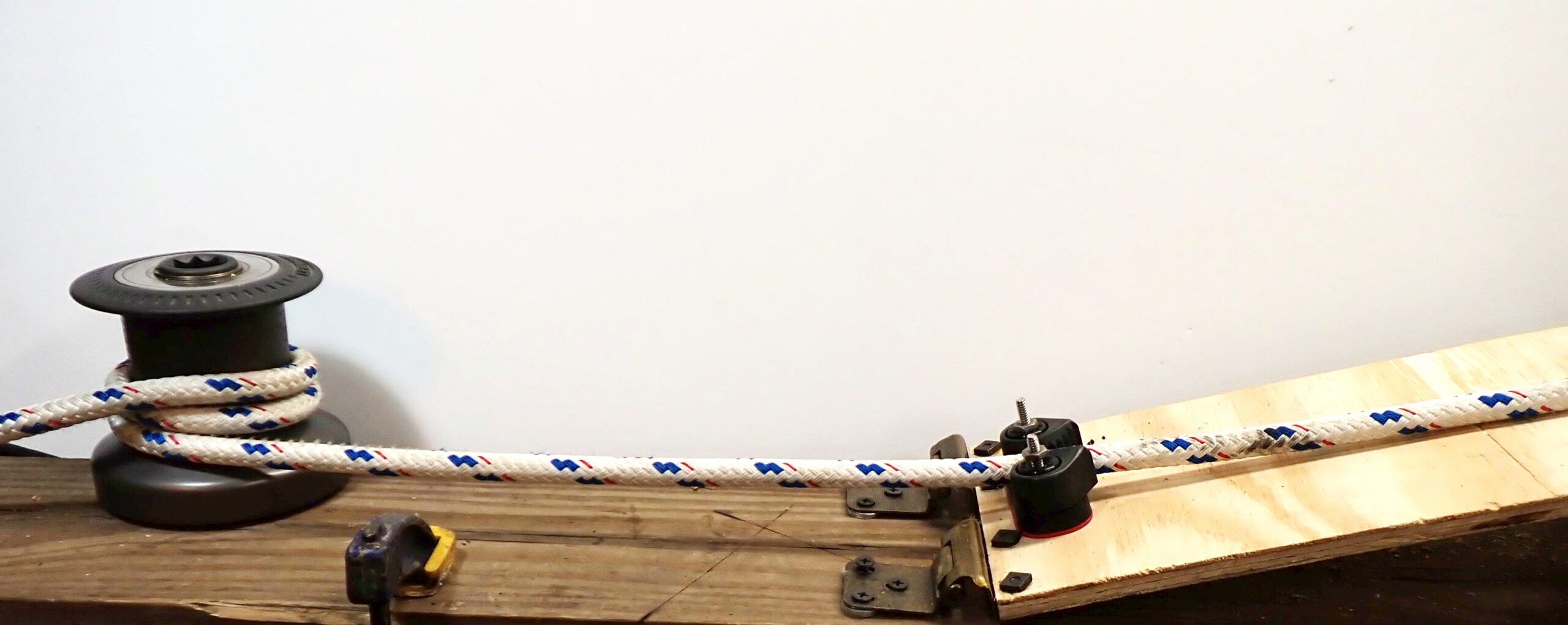
We tested using the Harken Cam-Matic 150, which has a working load limit of 300 lb. and a line size range of 3 to 12 mm. We tested with ½-in. (12.5 mm) polyester double braid and 6 mm Dyneema 12-plait single braid. Obviously, results will vary with line type and size, as well as cam cleat brand and model.
How We Tested
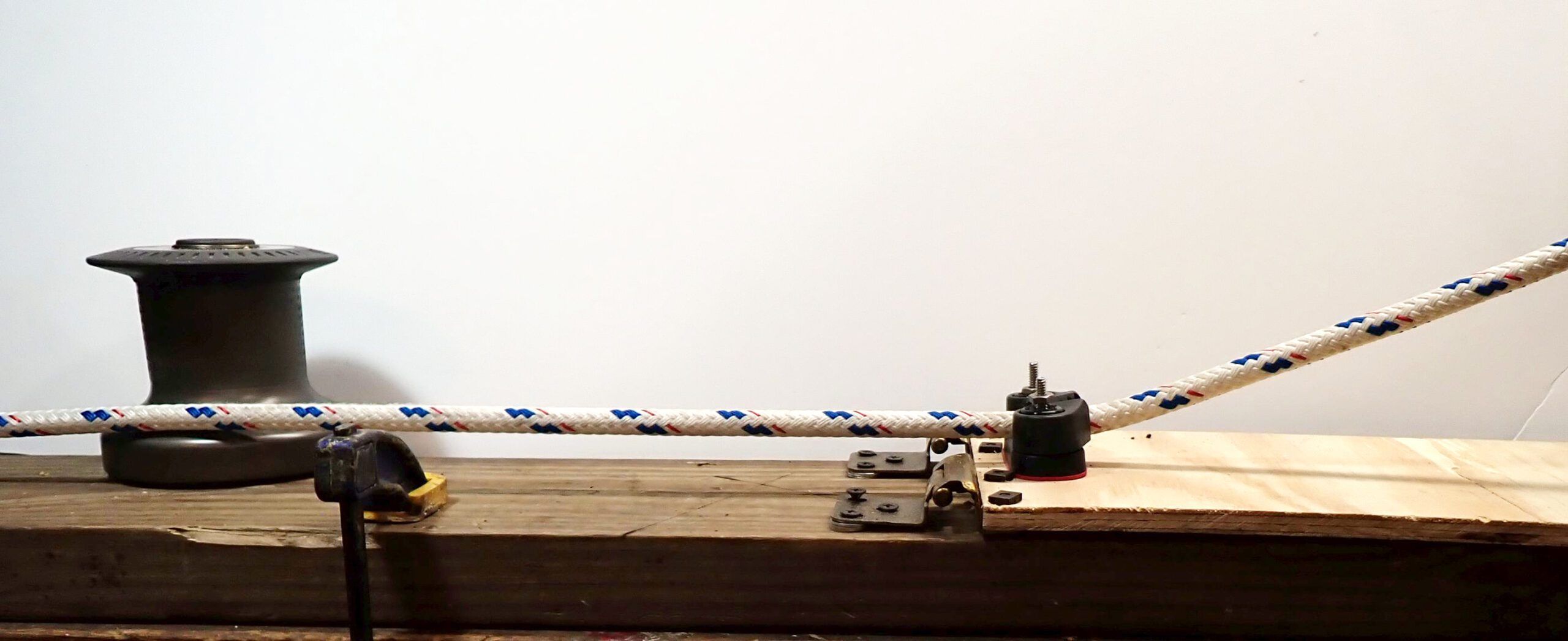
We tested both cam cleat holding capacity at a range of entry angles, and release at a range of exit angles. Tension for holding capacity was supplied by a winch, and tension for release by a fixed 40-lb. weight.
Entry Angle and Holding
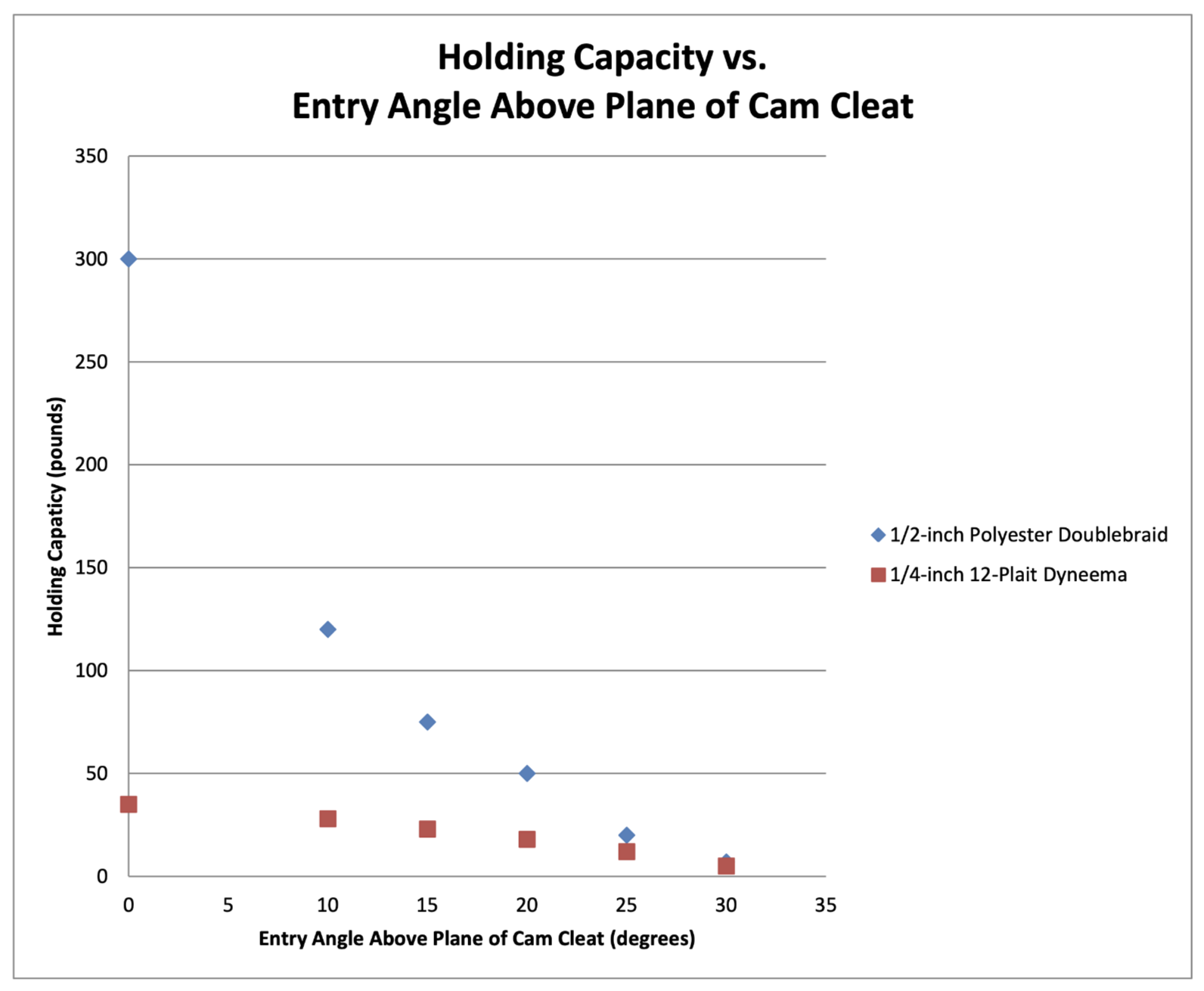
Holding was tested by winching the line at a range of cam cleat entry angles and recording the force at which it slipped. We did not test past the rated WLL of the cam cleat; if the load is greater than that you should either use a clutch or add more turns to the winch. We did not test holding or release below the plane of the cam cleat (negative angle); holding capacity will be the same as zero angle and the cleat will not release by pulling unless there is some upwards angle.
Observations on Holding Performance
Polyester gave consistent results, always within about 15 percent on repeat trials. Dyneema, on the other hand, was unpredictable. At lower angles (less than 20 degrees) and if set carefully, it would generally hold about 25 percent less than polyester, but if not set perfectly or if the load was cycled a few times, the line would creep upwards between the cams and release at very low values, typically, near 20 lb., even when it had held as much as five times more on a steady pull.
We plotted the lower values, since within a few gusts that is what could happen. At higher angles Dyneema holding was completely unreliable. We’ve used cam cleats for naked Dyneema control lines, but testing confirmed our observation that this is only for very low loads in non-critical applications. Not a furler line or sheet, for example. It’s too easy to bump it loose. OKish for minor tweaks and don’t expect reliability.
If you want to secure a Dyneema line in either a clutch or cam cleat we recommend splicing a Dyneema cover over the affected section; it will be easier to handle and the holding will be more reliable. See “Adding a Polyester Cover to Dyneema Single Braid.”
Exit Angle and Release
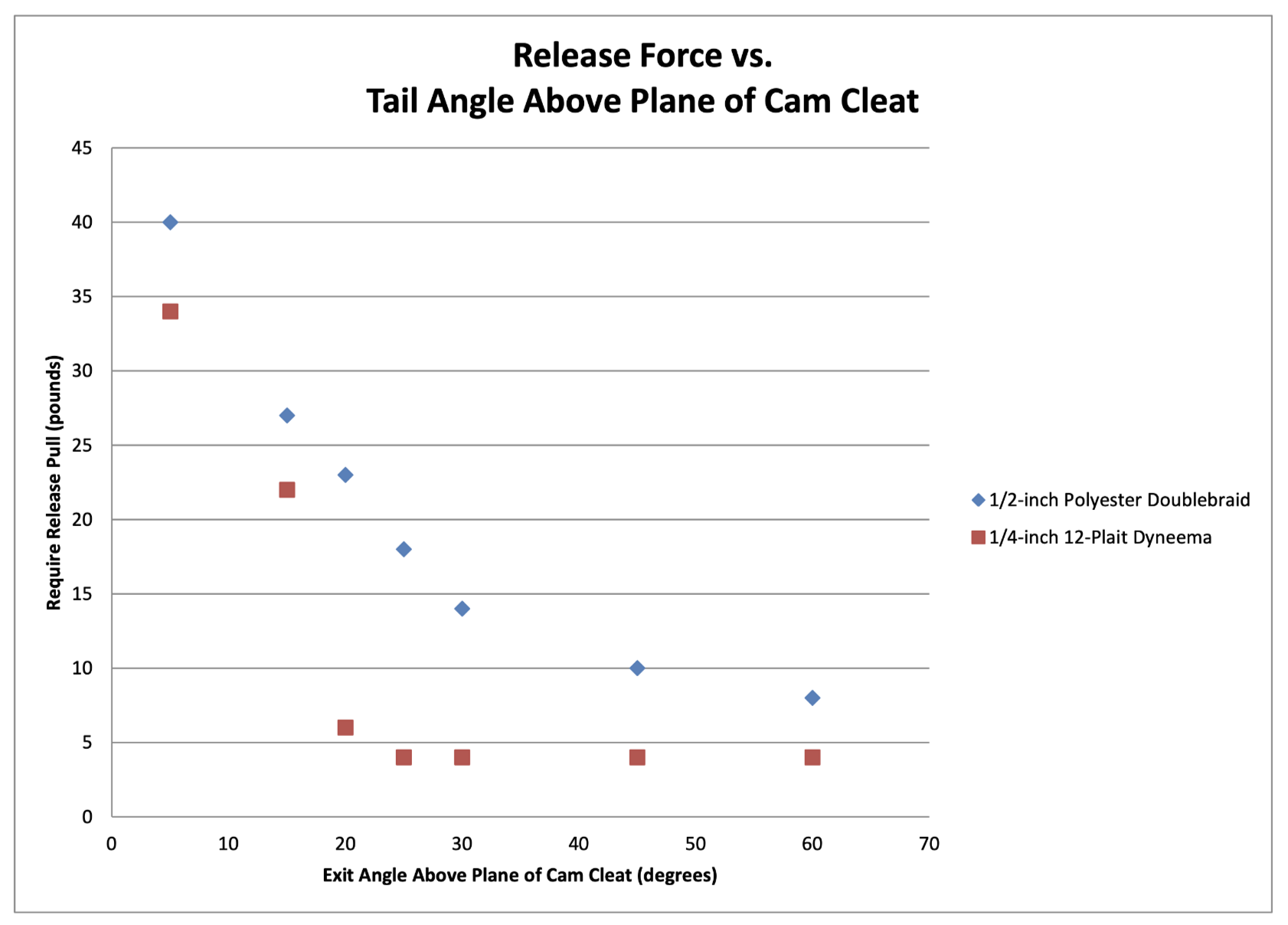
In these tests we wanted to see how the exit (pull) angle affected ease of release. We held the line tension at a constant 40 lb., a high but reasonable value for a hand-tensioned tackle (winch tail tension should be in the same range). We measure the force required to release the rope from the cam cleat through a range of angles.
Observations on Release Performance
If the pull equals the load and the line is moving towards the trimmer, virtually no angle is required; the cams unload and rotate, and the line glides right out. If the pull is less than the load, the rope has to slide sideways through the cams, the difficulty of which relates to rope friction and the load on the cams. When the force at an angle exceeds the friction exerted by the cams on the rope at the remaining load, the rope slides out. It’s best to give the rope a firm steady pull. If the rope is on a winch tail and is highly loaded, give the handle one click and the rope will glide right out. Dyneema is slippery, so it slides right out at any significant angle, making lines prone to accidental release.
Why Angle Matters More Than Force
What happens if there is a very small entry angle, slightly reducing holding capacity, and a moderate exit angle? Could this make release of sticky lines, such as a mainsheet, more reliable in a blow?
At 10 degrees entry angle the holding capacity with ½-in. double braid is still over 100 lb. and the release force with a 15 degree angle drops from 27 to 16 lb. The line was slightly more difficult to cleat properly, which was difficult to quantify. At 7 degree entry angle the holding capacity was over 150 lb. and the release force was 21 lb. We then tested the 7 degree entry angle (a thin wedge) on the mainsheet cam cleat of our F-24, which can be difficult to release when overloaded in a gust. Yes, it released more easily, but cleating was just enough more cumbersome that we switched it back. It never slipped, when properly cleated, but we had to pay more attention, negating any release advantage in our opinion. We’d rather hand-hold the sheet in strong conditions, until we get a reef in.
The greater the exit angle the easier it is to release, until it starts to level out above 30 degrees. After that it’s mostly the friction it takes to drag the rope sideways, under load, across the cams; the greater the angle, the greater the sideways pull, but the less the cams are unloaded by the pull. The two are offsetting. Dyneema release force levels out at about 20 degrees, sliding easily and releasing somewhat unpredictably. We also had to carefully set the line between the cams to get it to hold for each test.
Summary
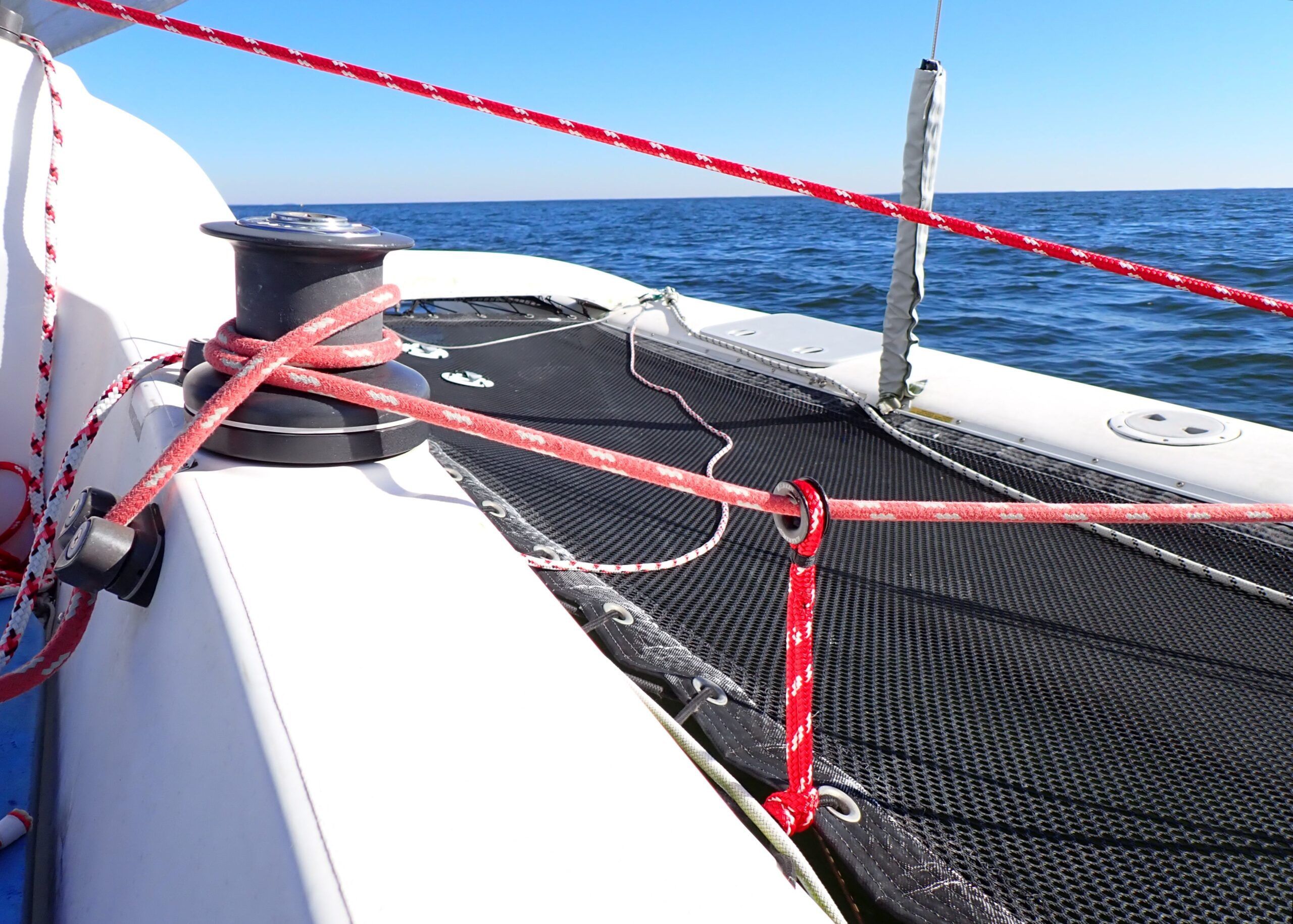
Small wonder that cam cleats installed next to winches to replace horn cleats commonly fail to hold. The upwards entry angle can easily exceed 15 degrees, dramatically reducing holding capacity and making cleating difficult. The cam cleat should be mounted a greater distance away on an angled riser as needed to eliminate the angle, or on a bulkhead below. Likewise, the release angle should be greater than 20 degrees for easy release. Cleating angles should be 10 to 20 degrees below the plane. However, both cleating and uncleating are easier if the rope is moving towards the trimmer, allowing the cams to rotate open freely, in which case very little angle is required. But there has to be some, so always allow 20 degrees above and below and never get caught with a cam cleat that can’t be released from you trimming position!