

Plenty of day sailors and dingy owners are sold on the appeal of clean, quiet electric outboards, but do they make sense for cruising sailors who need to cover long distances, day after day?
The Electric Outboard Buyer’s Guide recently published by Practical Sailor garnered plenty of interest and comments from readers. Where dinghies and sub-20-foot sailboats are concerned, 3-to 5-horsepower electric outboards with integral batteries are increasingly competitive. But where larger boats and long-range cruising plans are concerned, sailors will discover that the electric outboard options in the 5-horsepower to 9.9-horsepower (hp) range are much more expensive and require much larger, heavier and equally expensive remote batteries.
Consider a few basic questions before choosing electric over gas. When the wind dies, can an electric outboard propel a 20- to 30-foot boat near hull speed for hours on end? Can you “refuel” a battery, like you can a gas tank, within 10 minutes? Can an electric outboard also keep a house battery charged, as an alternator-equipped gas outboard can? The answers here, respectively, are no, no and no.
Now consider some tougher, what-if questions. Can an electric outboard keep your boat going at cruise speeds even against 1-knot-plus currents, choppy conditions, 15-knot-plus headwinds or the combination of all three? If you need to get back to shore quickly because a crew member is sick or injured or because a storm front is headed your way, will you be content to go slow because your battery will only last one hour at wide-open throttle? Again, the answers are no and no.
Sailboat + Gas Outboard = Hybrid Vehicle
Yes, there are notable drawbacks to gas engines: Co2 emissions, noise, exhaust, the dangers of carrying gas, heavier motor weights (without considering batteries), and the ongoing cost of fuel, oil and maintenance. Nonetheless, one can think of a cruising sailboat equipped with a gas outboard as a hybrid vehicle that offers the best of both worlds. As long as there are favorable winds, you can sail and enjoy the “ah” moment when you shut off the gas engine. When the wind dies, blows from the wrong direction, or you need to get to shore with urgency, a gas outboard will get you there without range anxiety.
Yes, gas tanks, like batteries, have range limits, but back when I owned a Tanzer 22 with a 6-hp Tohatsu outboard (with a three-gallon tank), I could easily count on more than 8 hours of 4-knot-plus cruising speeds (or 6 hours at the boat’s full hull speed of 5.8 knots). A six-gallon tank provides even more of a cushion when expecting great distances between gas docks.
At August 2025 prices, that same 6-hp Tohatsu Sail Pro gas outboard can be purchased for around $1,900, while a 6-hp electric outboard, like the ePropulsion Navy 3.0 or Torqeedo Cruise 3.0, will cost anywhere from $5,900 to $6,550 when equipped with the manufacturer-recommended battery. The cost difference between gas and electric of $4,000 to $4,650 will obviously pay for many years worth of fuel and maintenance—and even a replacement outboard.
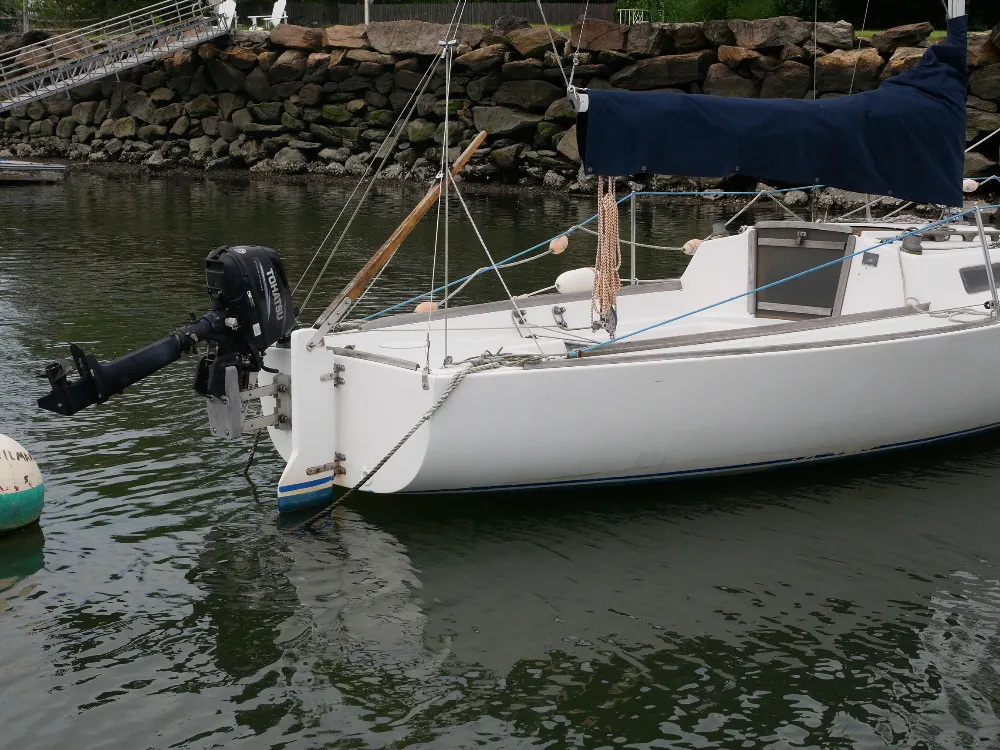
For comparison, test data for a Catalina 25 powered with a 6-hp Navy 3.0 paired with a big 4096-watt-hour battery shows one can expect only about 2 hours and 40 minutes of 4-knot-plus e-motoring (at best, as the test was conducted in light winds with one passenger). What’s more, the captain could not simultaneously recharge a house battery while also running electronics, as you could with an alternator-equipped gas model. Finally, once the battery is depleted, recharging would take at least four hours with an extra-cost “fast” charger, versus spending 10 minutes at a gas dock. Falling battery prices and improving battery capacities may change the equation within five years, but at this writing, plenty of buyers of outboards are still choosing gas.
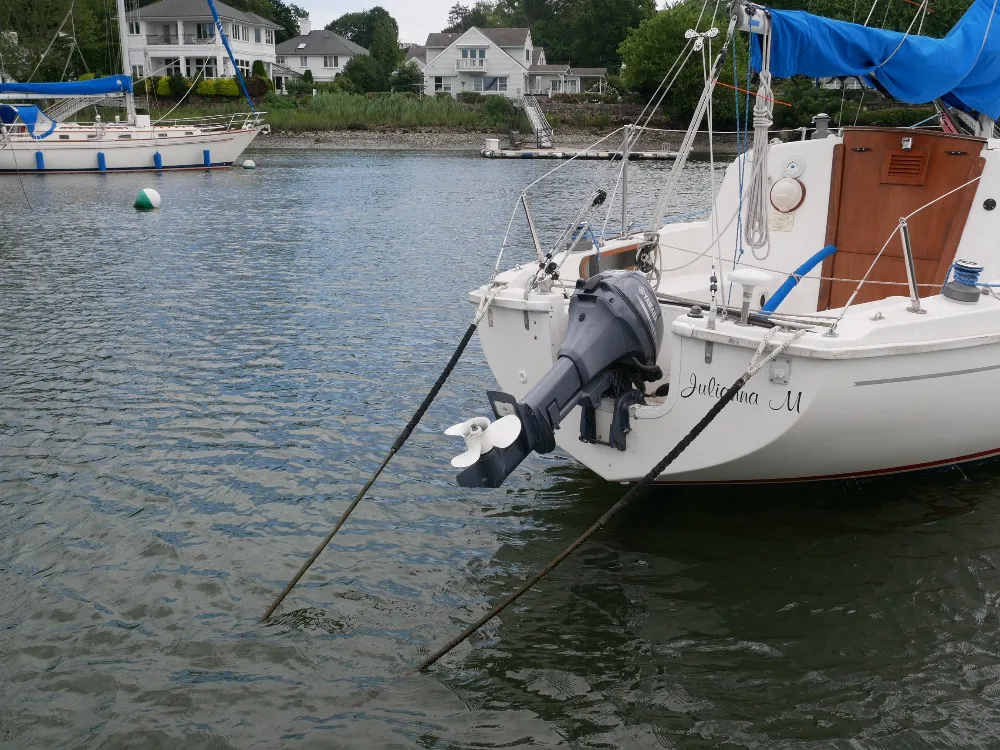
(Photo/ Doug Henschen)
What to Look For in a Gas Outboard
Whether this analysis has changed your mind or just confirmed your previous inclination to choose a gas outboard, let’s consider what to look for in gas models well suited to 20- to 30-foot cruising sailboats.
Horsepower
Gas outboard standards are long established and rate watts/horsepower at the prop shaft. When choosing a gas outboard, go with the horsepower rating recommended by your boat’s manufacturer. If the manufacturer suggest a horsepower range, go with at least 80 percent but no more than 100 percent of maximum recommended horsepower. There’s no sense in overpowering a displacement sailboat that can’t be pushed much beyond hull speed. A too-big engine will just consume more fuel than necessary and potentially throw off the weight distribution of your vessel.
If your boat doesn’t have a rating or you don’t know the rating, there are two rule-of-thumb formulas to calculate appropriate horsepower for displacement sailboats. One formula is to make available at least one horsepower for every thousand pounds of displacement. This measure can be considered to be a minimum, because displacement figures are generally for empty boats without accounting for crew, fuel and provisions.
The second formula is: (Displacement in pounds ÷ 1,000) × (Sail Area in square feet ÷ 100) = HP.
This calculation is closer to a maximum. Note that a boat’s displacement and its weight are two different measures. Boat owners can find displacement and sail-area data for the vast majority of production sailboats at SailboatData.com.
To illustrate, the owner’s manual for the Tanzer 22 recommended a 6-hp outboard. The boat has a displacement of about 3,000 pounds, so the first calculation would call for at least 3 hp. The second calculation (3,000 ÷ 1,000 = 3) x (225 sq. ft. sail area ÷ 100 = 2.25) would suggest a 6.75-hp motor.
In another example, Catalina recommended anywhere from 8-hp to a whopping 15-hp outboard for its 25-foot Catalina 250, a model first built in 1995. The boat displaces 4,200 pounds, so the first calculation, rounding up, would suggest at least 5 hp, while the second calculation (4,200 ÷ 1,000 = 4.2) x (265 sq. ft. ÷ 100 = 2.65) = 11.2 hp. There’s no 11-hp outboard available on the market, so I’d round down to 9.8 hp or 9.9 hp (which are effectively the same rating).
Displacement
This displacement figure measures the volume of the engine’s cylinders. As old-school gearheads know, “There is no replacement for displacement.” If you’re comparing two outboards with the same horsepower rating, count on the one with higher displacement to offer more low-end torque. The possible downside of higher displacement is higher fuel consumption, although other factors influence fuel efficiency. A higher-displacement engine with electronic fuel injection, for example, might offer better fuel economy than a lower-displacement carbureted engine (see “Fuel delivery system” below).
Cylinders
Two-cylinder engines offer smoother operation than one-cylinder engines, but weight increases by more than 50 percent when you jump from a 5 hp or 6 hp one-cylinder engine up to a 8 hp, 9.8 hp or 9.9 hp two-cylinder engine. Don’t add that weight unless your boat calls for the higher horsepower.
START SLIDESHOW
Weight and Power-to-Weight Ratio
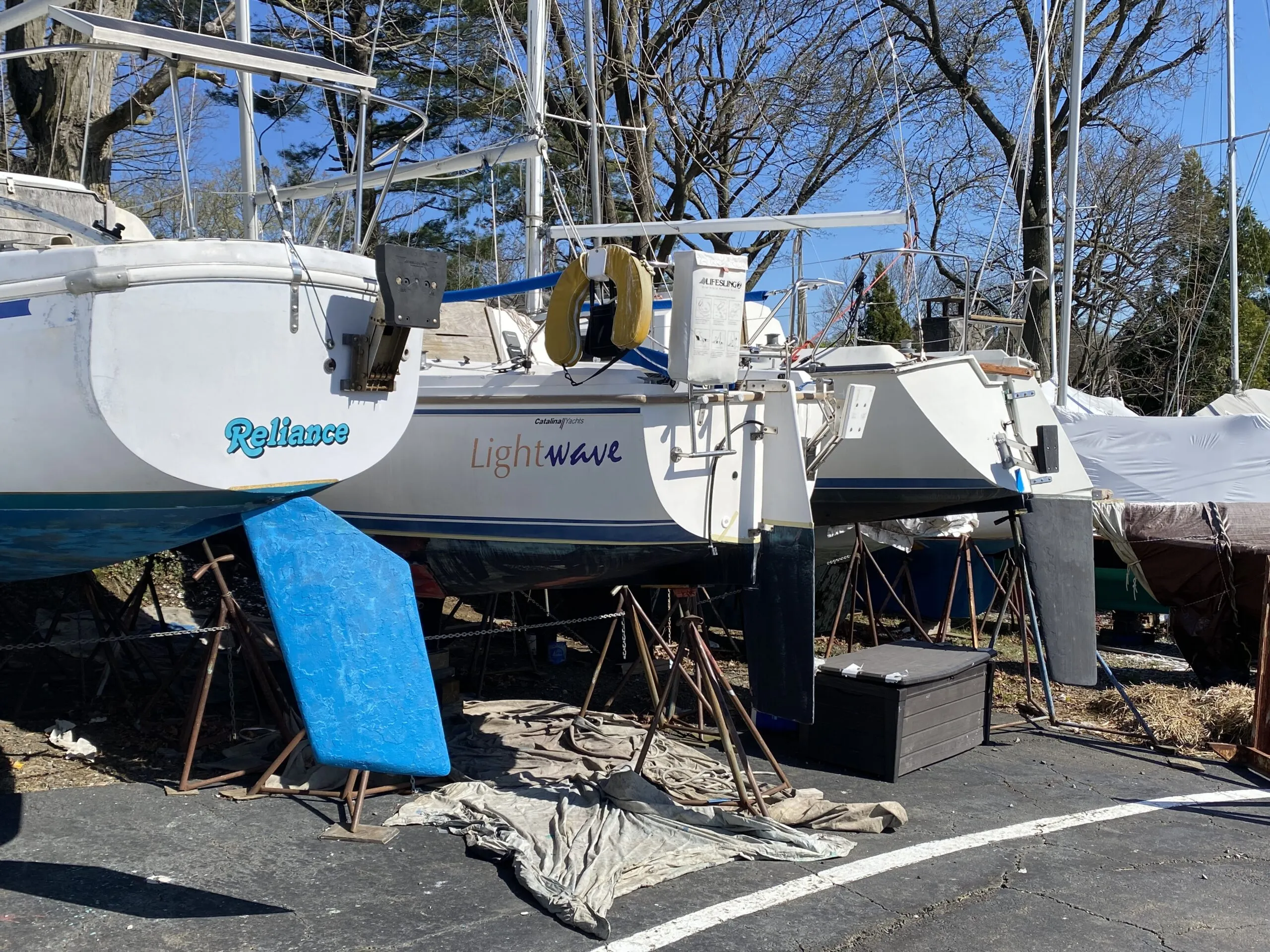
Weight matters on small boats, and an outboard/fuel tank (or battery) combo at the back of the boat that is too heavy can throw off a boat’s balance and waterline. Unless your boat has a transom cutout and/or motor well, you’ll also need a bolt-on motor bracket, which will add 10 to 20 pounds to the total package. Choose a beefy bracket that’s rated for the weight and horsepower of your intended four-stroke outboard—one with heavy springs and a good-sized handle that will help you lift the motor.
Also keep in mind that you’ll need a 3-gallon or 6-gallon gas tank, which, when filled, will add at least another 22 pounds to 42 pounds to the back of the boat. Motors with a higher power-to-weight ratio at a given horsepower rating will give you comparable top-end power with less weight.
Fuel Delivery System
Carburetors are still the proven fuel delivery system for six out of ten models in this buyer’s guide, but electronic fuel injection (EFI) is gaining ground. The benefits of EFI include faster throttle response, improved fuel economy, easier cold starts, and reduced maintenance. Another possible downside of EFI is that the sensors, injectors and electric pumps used in EFI systems aren’t as easy or low-cost for do-it-yourself types to diagnose and repair.
Bad gas will foul carbs and EFI systems alike, so stick with trusted fuel sources, filter the fuel if in doubt, and check out Practical Sailor’s test of ethanol fuel treatments that promise better performance and fuel stabilization for long-term storage.
Shaft Length
Nine out of the 10 outboards in this guide have 25-inch “extra-long” shafts. The one exception, the Mercury 5MLHA Sail Power, is a 5-hp model with a 20-inch “long” shaft. On a displacement boat in the 20- to 30-foot range, you’ll want the prop as deep in the water as possible. Sailboats with pointy ends tend to pitch more than powerboats in rolling seas, which can cause the prop to lift out of the water (a.k.a. ventilate) and suddenly and unnervingly rev up to high RPMs.
An extra-long shaft also makes it less likely for the prop to lifting out of the water when motoring under sail and healing, which is particularly a concern if the motor is mounted off center on the windward side of the transom. A shorter-shafted motor might also pop out of the water on a light boat when a crew member heads up to the bow to drop the anchor or handle a dock line.
Model HP Displacement/ Top RPM CYL Weight (lbs.) Power to Weight Ratio watts/KG Fuel sys. Shaft length Alternator Prop dia. x pitch (in.) / Blades Start Online prices*
Mercury 5MLHA Sail Power 5 123 cc / 5500 1 59 139.3 watts/kg carb 20† 4 amp 50W 8.3 x 6 / 3 Manual $1,649
Tohatsu MFS6D Sail Pro 6 123 cc / 6000 1 60 164.4 watts/kg carb 25 5 amp 60W 8.3 x 6 / 3 Manual $1,883
Honda BFP8DK3XHS 8 222 cc / 5000 2 113 116.4 watts/kg carb 25 12 amp 148W 10 x 6.5 / 4 Electric $2,907
Tohatsu MFS9.8CWEFUL-25 9.8 209 cc / 6200 2 95 169.5 watts/kg EFI 25 7 amp 84W 8.7 x 5 / 4 Electric $2,880
Honda 9.9 HP BFP10D3XH 9.9 222 cc / 5500 2 107 152.2 watts/kg carb 25 6 amp 76W 10 x 6.5 / 4 Manual $2,907
Honda 9.9 HP BFP10D3XHS 9.9 222 cc / 5500 2 113 144.1 watts/kg carb 25 12 amp148W 10 x 6.5 / 4 Electric $3,260
Mercury 9.9 EXLH-CT 9.9 209 cc/ 6000 2 111 146.6 watts/kg EFI 25 12 amp 145W 8.9 x 8.5 / 4‡ Electric $3,184
Mercury 9.9 EXLHPT-CT-Pro Kicker** 9.9 333 cc / 6000 2 118 137.9 watts/kg EFI 25 12 amp 145W 8.9 x 5 / 4 Electric $3,690
Suzuki DF9.9 BTHX5** 9.9 327 cc / 6000 2 127 128.1 watts/kg EFI 25 12 amp 144W 10 x 5 / 4 Electric $2,890
Yamaha T9.9 XWHB High Thrust 9.9 212 cc / 6000 2 104 156.7 watts/kg carb 25 6 amp 76W 11.75 7/ 3 Electric $3,453
* Lowest price found online in August 2025
** Includes power trim and tilt
† 25-inch shaft model available with alternator as extra-cost option
‡ 5-inch pitch, 4-blade prop designed for displacement speeds available as extra-cost option
Alternator
All ten models in this guide include an alternator, a feature that will help keep a house battery topped up. Even if the house battery has gone completely flat, an alternator can provide enough juice to power a VHF radio, run navigation lights after dark, and recharge a cell phone, making it an important safety feature.
Rated at anywhere from 4 amps/50 watts up to 12 amps/148 watts (at cruise-speed RPMs), these small-outboard alternators listed in this guide offer plenty of juice to keep a lead-acid or AGM dual-purpose starting/deep-cycle battery charged for low-draw loads such as LED lighting, dedicated wind and depth instruments, phone charging, or limited use of a VHF. These models are not powerful enough, however, to keep up with the demands of big multifunction displays, radar, always-on refrigerators, air conditioning, or recharging run-down deep cycle or electric outboard batteries (for which you’ll need shore power and/or serious supplemental solar power).
Prop Diameter and Blades
Most outboard props are designed to go fast, but most of the the sail-oriented models in this guide feature bigger props with a lower pitch, in the 5-inch to 6.5-inch range, to match the slower speeds of displacement boats. A larger diameter and four blades, rather than three, gives a prop more thrust, making these designs popular for use with heavy, slow-moving pontoon boats and trolling use as well as sailboats.
Starting
Most people won’t have difficulty with the manual pull cords on these small outboards, as starting is very reliable on modern, four-stroke engines with solid state ignition systems. Nonetheless, many buyers find electric starting to be a desirable feature on larger, two-cylinder models. Electric start will add a few pounds to the motor and will require another 10 to 12 pounds for a small starting battery (not included). The minimum battery required is typically a 12-volt, 35-40 amp hour battery delivering 270-330 cold cranking amps—a size/capacity also typically used for motorcycles and personal watercraft. Starting a motor of this size is not a huge load, but don’t use a deep cycle house battery, as such batteries are not designed to deliver cold cranking power.
Note: All EFI models in this guide also have electric start, which makes sense given that both EFI and electric start usually require battery power. Note that all electric-start models in this size range also have manual starting as a backup option.
Prices and Model Years
We list lowest prices for 2025/2026 models found online in mid-August 2025. Most manufacturers no longer have formal model years that are distinct from calendar years. The serial number stamped on the manufacturer’s plate typically notes the calendar year in which the motor was manufactured (thought it may be noted by a two-digit code). Annual dealer programs still tend to start mid-year, so watch for rebates, buying incentives and older models available at a lower cost in late summer.
With all the news of tariffs and trade wars in 2025, use the prices listed in this article as a point-and-time reference. Prices may increase, with possible differences in price changes depending on the country of origin. The majority of the outboards listed in this guide are made in Japan, including the Hondas, Mercurys (in this HP range), Tohatsus, and Yamahas. Suzuki’s DF9.9 BTHX5/BTHW5 is made in Thailand.
Power Trim and Tilt
This feature, which pivots the power head forward and the outboard leg back with the push of button, is standard on the Mercury 9.9EXLHPT-CT-Pro Kicker and the Suzuki DF9.9 BTHX5/BTHW5. Power trim and tilt, which adds yet more weight, is available in every lineup, so we list the model number, weight and cost of several higher-end models where power trim and tilt is factory installed.
Note that power trim and tilt (and, for that matter, manual tilt) may not lift the prop completely out of the water if you are using a fixed mount or built-in motor well rather than a bracket. A bracket raises and lowers the entire outboard by 10 inches or more. Once under sail, owners of boats with brackets will generally lift the bracket first and then manually tilt up the prop, turning the motor to one side and being careful not to impinge the fuel line or break the fuel-line fitting.
Remote Throttle and Gear Shift
Outboard controls might be hard to reach on larger sailboats with tall transoms. Mercury’s 9.9-hp models are notable for a “Shift-in-Grip” design that puts all controls at the end of the tiller. Owners of high-transom boats also might want to consider remote models offering a combination throttle/gear shift control or throttle/gear shift/power trim-and-tilt control that can be mounted up in the cockpit. Remote motors can be locked in a centered position, leaving steering to the rudder.
Beyond Features and Stats
Dive into the stats, prices and descriptions in the slides below covering 10 gas outboards suited to sailboats. Keep in mind that a local service relationship and convenience may matter more than a five-pound difference in weight or $200 difference in cost. If your marina or a local boat dealer handles a model listed in this guide, it might be worth it to pay slightly more to get their help with unboxing, prep, installation, break-in advice, and ongoing service support rather than buying from an online store.
Buyers who are fit and strong might be able to handle a 60-pound 5-hp or 6-hp gas outboard by themselves, but lifting a cumbersome 97- to 128-pound 9.9-hp outboard is a two-person challenge. The money you’ll save opting for a gas outboard (rather than the much more expensive electric outboards in this range) will more than pay for professional installation and years of service support.
Contacts
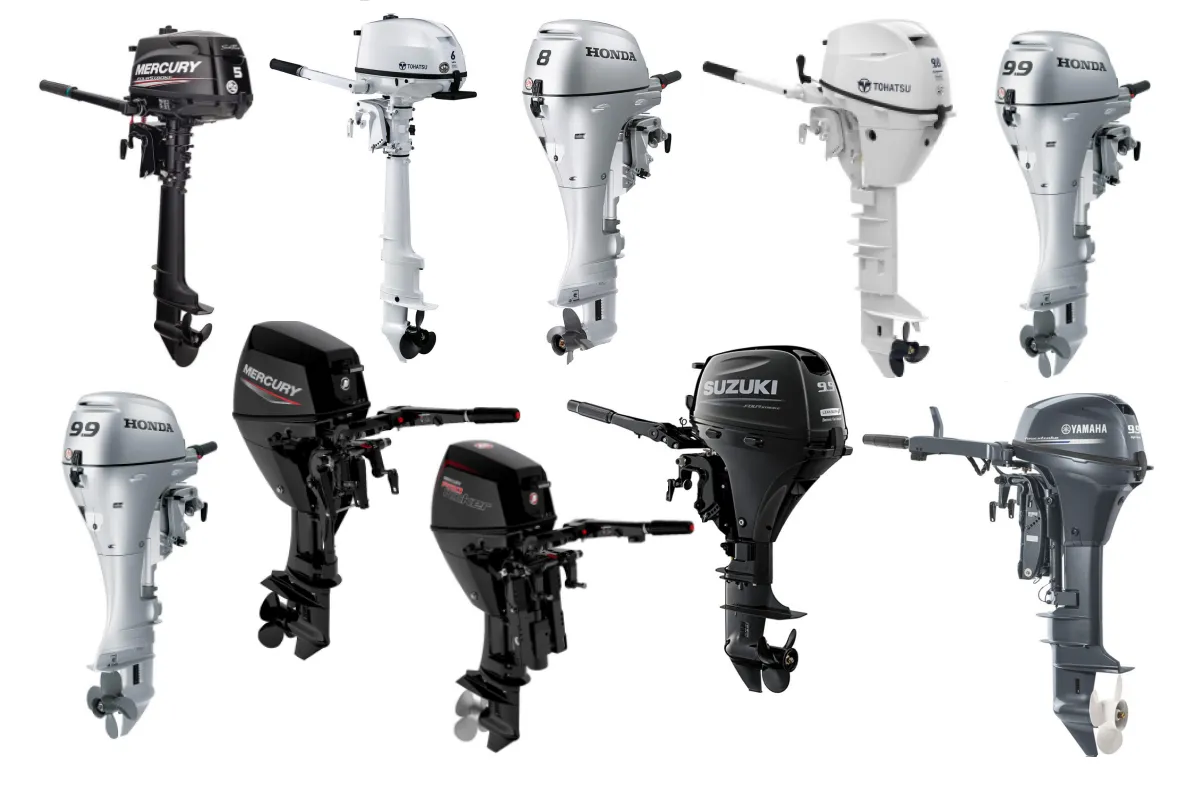
1. Mercury 5 HP 5MLHA Sail Power
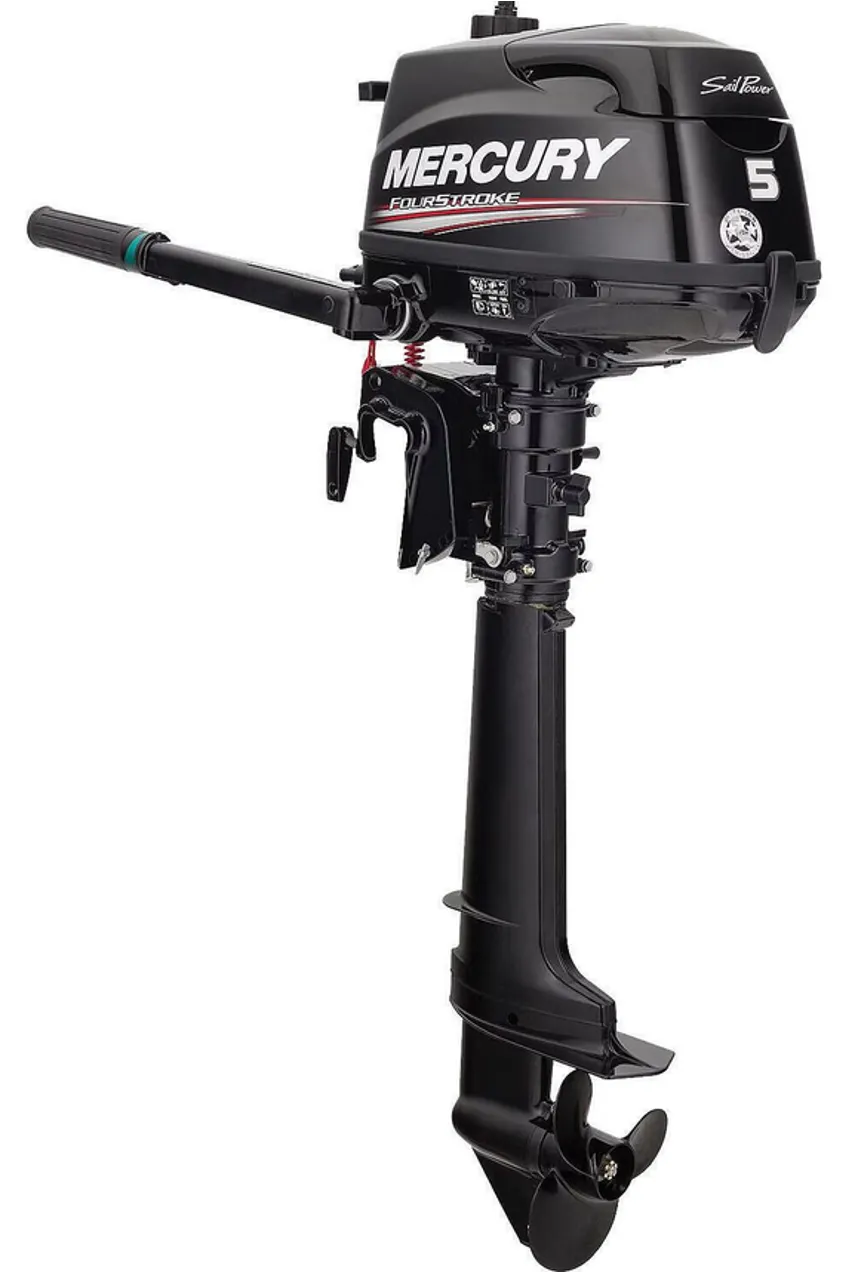
Description: Available through online retailers as well as through the vast network of Mercury Marine dealers, this “Sail Power” model combines a long (20-in.) shaft, built-in alternator and larger-diameter, lower-pitch three-blade propeller designed for sailboats. Exhaust relief hole in the lower unit improves reverse thrust by reducing prop aeration. Includes internal 0.3 gallon tank (external tank and fuel line optional). Extra-long, 25-inch-shaft model available (with alternator as optional, dealer-installed feature).
- Horsepower: 5.0
- Displacement/top RPM: 123 cc/5500
- Cylinders: 1
- Weight (lb.): 59
- Power-to-weight ratio (watts/kg): 139.3
- Fuel system: Carb
- Shaft length (in.): 20
- Alternator (amps/watts): 4/50
- Prop diameter x pitch/blades: 8.3 x 6/3
- Starting: Manual
- Online price*: $1,649 (*Lowest price found online August 2025)
2. Tohatsu 6 HP MFS6DWDSPROUL Sail Pro
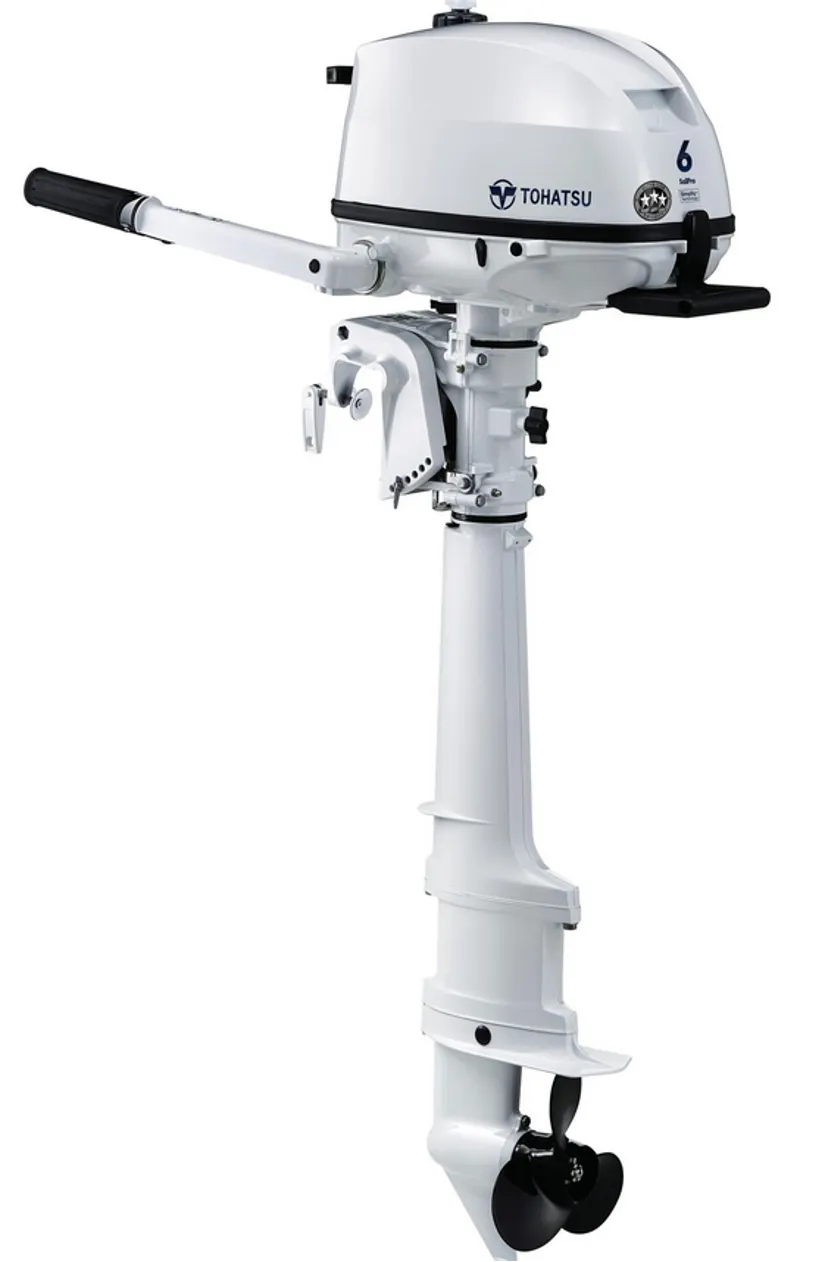
Description: Boasting the highest power-to-weight ratio among 1-cylinder outboards, the 6-hp Sail Pro model features an extra-long shaft, a large-diameter, low-pitch prop and a 5 amp/60 watt alternator. Includes both an internal tank and a 3-gallon external tank and fuel line. Beluga White color stays cool and complements many sailboats.
- Horsepower: 6.0
- Displacement/top RPM: 123 cc/6000
- Cylinders: 1
- Weight (lb.): 60
- Power-to-weight ratio (watts/kg): 164.4
- Fuel system: Carb
- Shaft length (in.): 25
- Alternator (amps/watts): 5/60
- Prop diameter x pitch/blades: 8.3 x 6/3
- Starting: Manual
- Online price*: $1,883 (*Lowest price found online August 2025)
3. Honda 8 HP BFP8DK3XHS
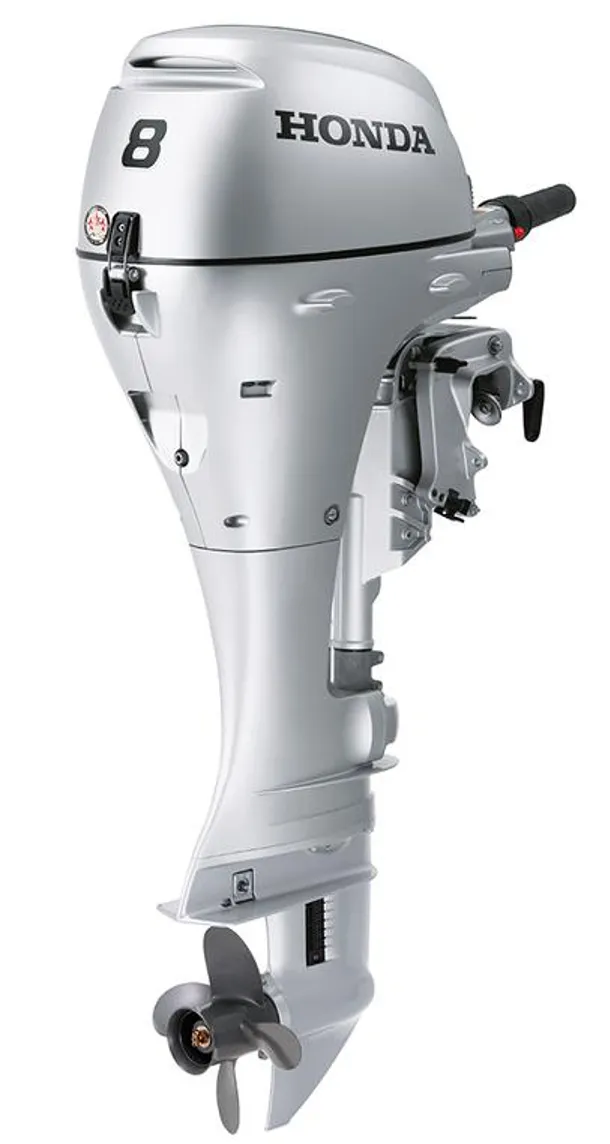
Description: This is the only 8-hp outboard on the market available with a 25-in. shaft. Weight is identical to the 9.9-hp model on which it is based, but with its high displacement, big four-blade prop and low top-RPM rating, this motor has a reputation for high thrust, low fuel consumption, low noise and long life. External three-gallon tank and fuel line included. Electric start and best-in-class 12 amp/148 watt alternator add to the appeal (required starting battery not included).
- Horsepower: 8.0
- Displacement/top RPM: 222 cc/5000
- Cylinders: 2
- Weight (lb.): 113
- Power-to-weight ratio (watts/kg): 116.4
- Fuel system: Carb
- Shaft length (in.): 25
- Alternator (amps/watts): 12/148
- Prop diameter x pitch/blades: 10 x 6.5/4
- Starting: Electric
- Online price*: $2,907 (*Lowest price found online August 2025)
4. Tohatsu 9.8 HP MFS9.8CWEFUL-25
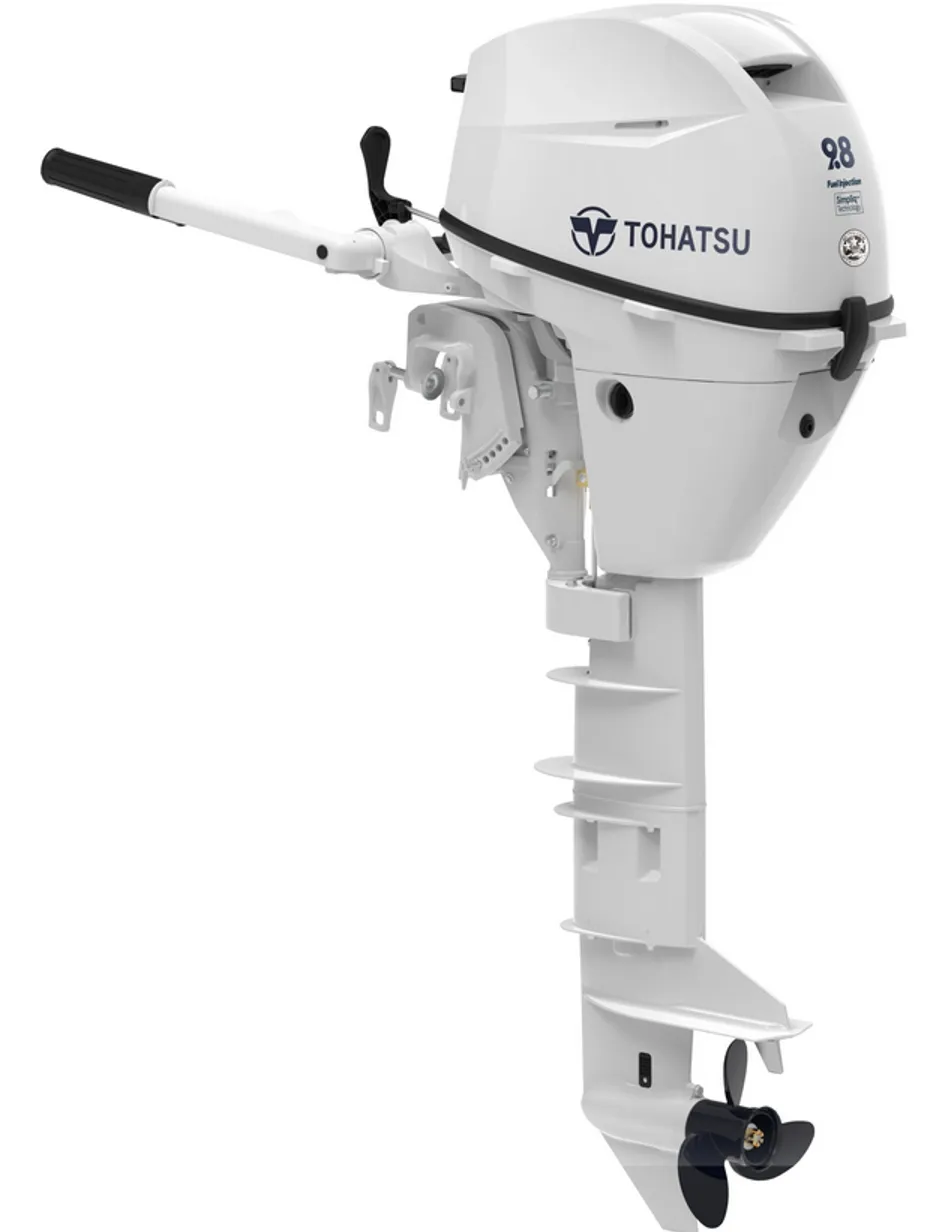
Description: Boasting the highest power-to-weight ratio among 2-cylinder outboards in the 9.8/9.9 hp class, this model features electronic fuel injection and electric start (required starting battery not included). Sail-oriented features include an extra-long shaft, a large-diameter, low-pitch 4-blade prop, and a 7 amp/84 watt alternator. Includes an external 3.1-gallon tank and fuel line. MFS9.8CEFTUL model, in Aqua Marine Blue, includes power trim and tilt (weighing 106 pounds and online priced at $2,994*).
- Horsepower: 9.8
- Displacement/top RPM: 209 cc/6200
- Cylinders: 2
- Weight (lb.): 95
- Power-to-weight ratio (watts/kg): 169.4
- Fuel system: EFI
- Shaft length (in.): 25
- Alternator (amps/watts): 7/84
- Prop diameter x pitch/blades: 8.7 x 5/4
- Starting: Electric
- Online price*: $2,880 (*Lowest price found online August 2025)
5. Honda 9.9 HP BFP10D3XH
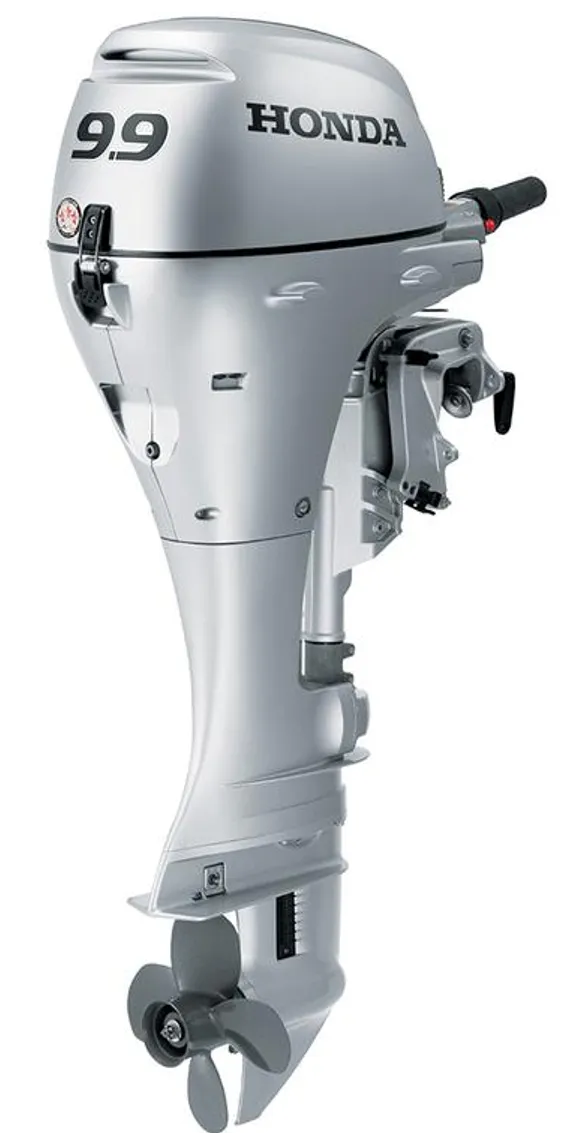
Description: High displacement, a big four-blade prop, and a low top-RPM rating contribute to this motor’s reputation for high thrust, low fuel consumption, low noise and long life. Available with a 25-inch shaft, this manual-start Power Thrust model has a lower cost and lower motor weight than the electric-start version, and since no starting battery it required, it’s among the lightest overall power packages on the market. Includes 6 amp/76 watt alternator and an external three-gallon tank and fuel line.
- Horsepower: 9.9
- Displacement/top RPM: 222 cc/5500
- Cylinders: 2
- Weight (lb.): 107
- Power-to-weight ratio (watts/kg): 152.2
- Fuel system: Carb
- Shaft length (in.): 25
- Alternator (amps/watts): 6/76
- Prop diameter x pitch/blades: 10 x 6.5/4
- Starting: Manual
- Online price*: $2,907 (*Lowest price found online August 2025)
6. Honda 9.9 HP BFP10D3XHS
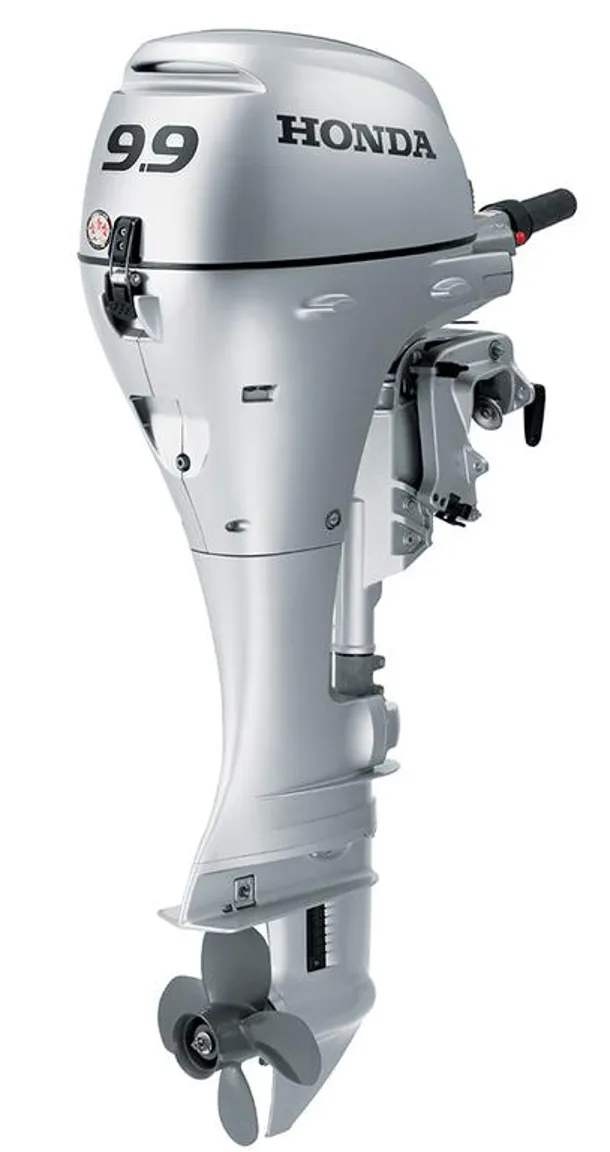
Description: High displacement, a big four-blade prop, and a low top-RPM rating contribute to this Power Thrust model’s reputation for high thrust, low fuel consumption, low noise and long life. Available with a 25-inch shaft, this electric-start model includes class-leading 12 amp/148 watt alternator (required starting battery not included). Eternal 3.2-gallon tank and fuel line included. BFP10D3XHT model with factory-installed power trim and tilt also available (weighing 119 pounds and online priced at $3,295*)
- Horsepower: 9.9
- Displacement/top RPM: 222 cc/5500
- Cylinders: 2
- Weight (lb.): 113
- Power-to-weight ratio (watts/kg): 144.1
- Fuel system: Carb
- Shaft length (in.): 25
- Alternator (amps/watts): 12/148
- Prop diameter x pitch/blades: 10 x 6.5/4
- Starting: Electric
- Online price*: $3,260 (*Lowest price found online August 2025)
7. Mercury 9.9 HP 9.9 EXLH-CT
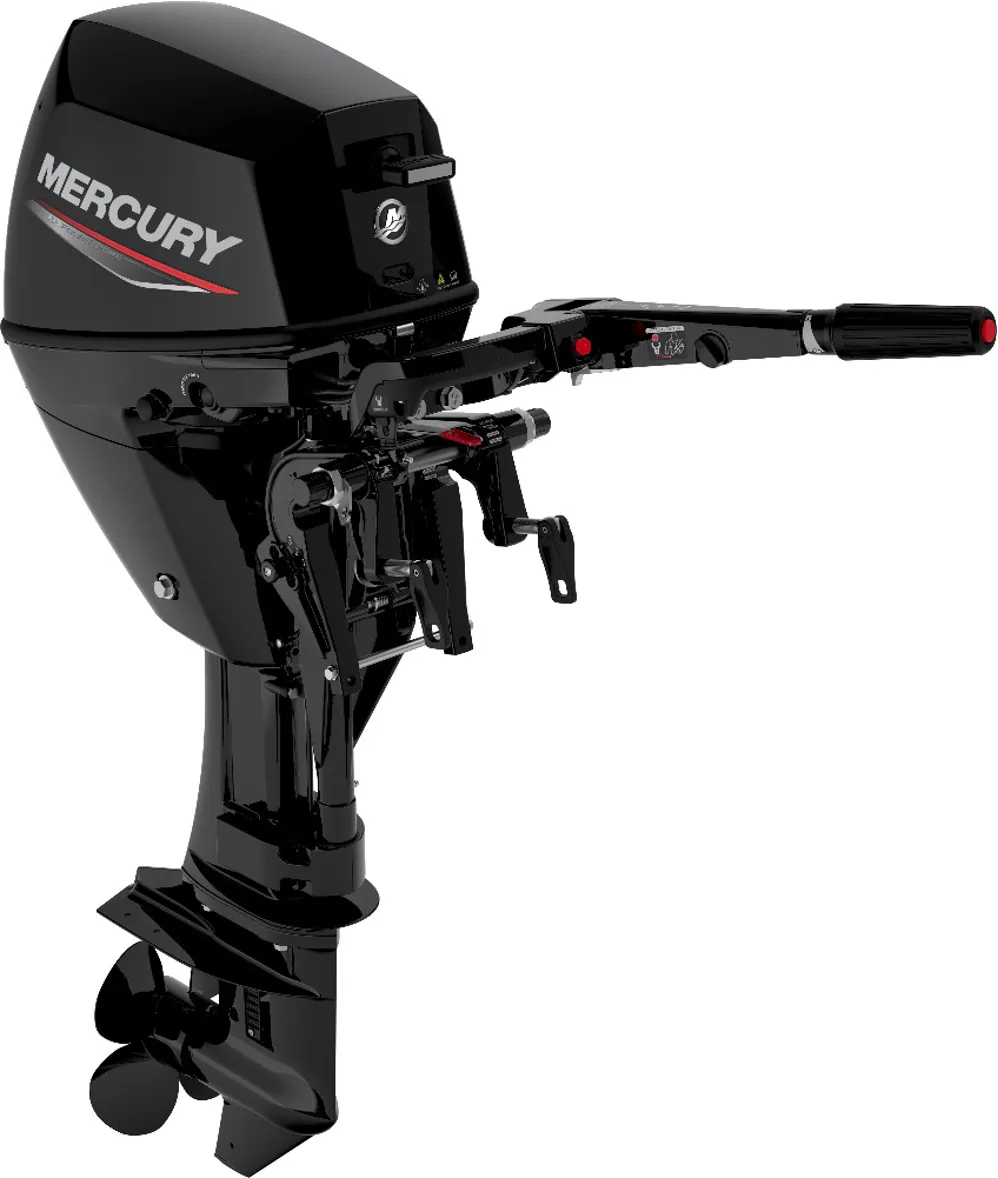
Description: Offering among the highest power-to-weight ratios in the 9.8/9.9-hp class, this model features electronic fuel injection, electric start (required starting battery not included) and a 12 amp/145 watt alternator. Available with an extra-long, 25-inch shaft, this “Command Thrust” model features an oversized gear case and four-blade prop (8.9 x 8.5-inch-pitch is standard, but low 5-inch-pitch prop geared to displacement speeds is a $240 MSRP option). “Shift-In-Grip” tiller handle eases operation on sailboats with tall transoms, as operators can control shift, throttle, and stop all from the grip at the end of the tiller handle. Includes manual, six-position tilt and a ratcheting trim mechanism that eliminates the need to move a pin. Includes 3.2-gallon tank and fuel line.
- Horsepower: 9.9
- Displacement/top RPM: 209 cc/6000
- Cylinders: 2
- Weight (lb.): 111
- Power-to-weight ratio (watts/kg): 146.6
- Fuel system: EFI
- Shaft length (in.): 25
- Alternator (amps/watts): 12/145
- Prop diameter x pitch/blades: 8.9 x 8.5/4†
- Starting: Electric
- Online price*: $3,184 (*Lowest price found online August 2025) †Low 5-inch pitch prop is $240 MSRP option.
8. Mercury 9.9 EXLHPT-CT Pro Kicker**
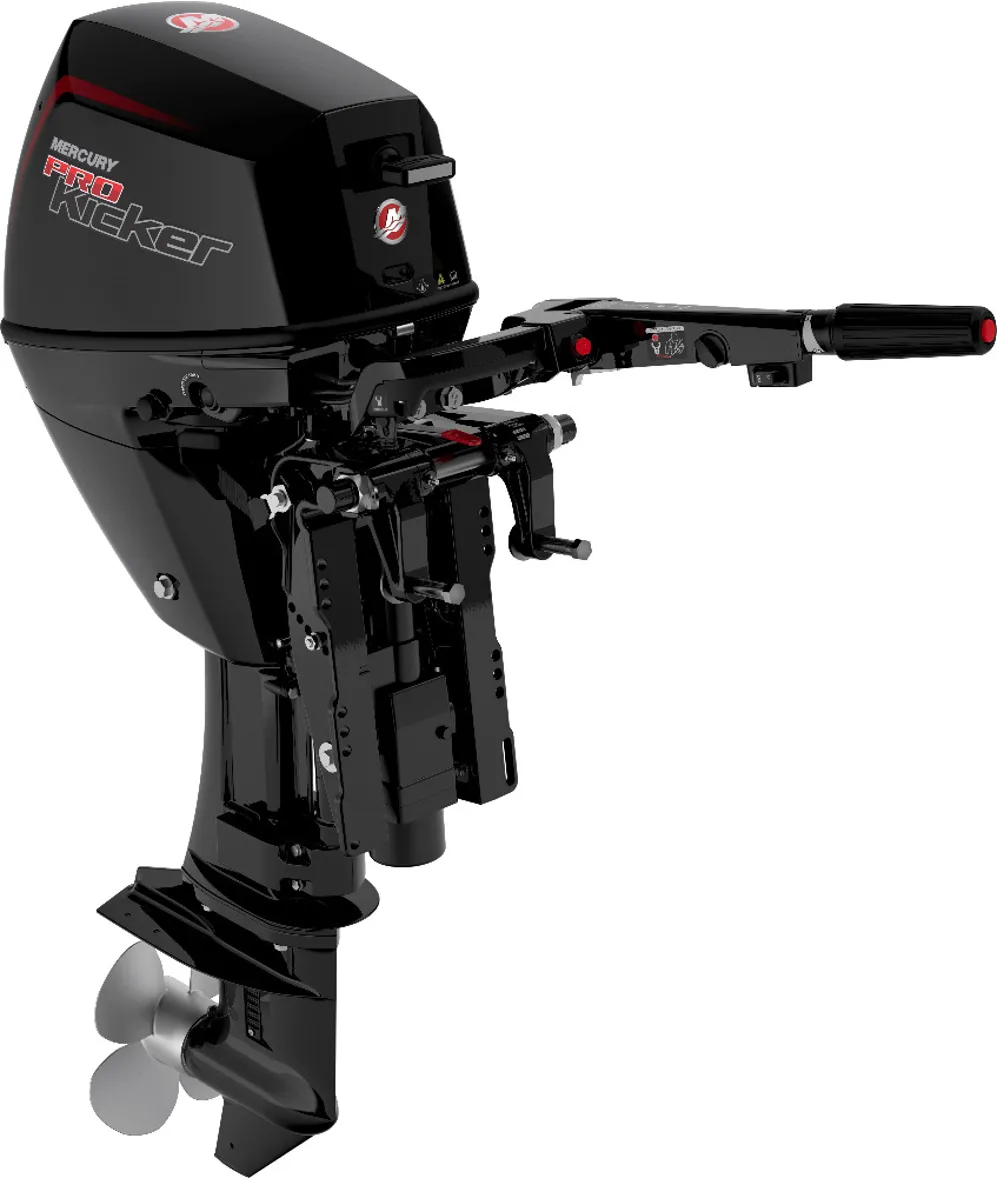
Description: Offering the highest displacement in its class as well as an oversized “Command Thrust” gear case and four-blade, low-pitch prop, Mercury’s 9.9 Pro Kicker offers plenty of low-end torque while electric fuel injection promises fuel economy and easy starting. “Shift-In-Grip” tiller handle eases operation on sailboats with tall transoms, as operators can control shift, throttle, and stop all from the grip at the end of the tiller handle. Comes standard with power trim and tilt and electric start (required starting battery not included). Includes 3.2-gallon tank and fuel line.
- Horsepower: 9.9
- Displacement/top RPM: 333 cc/6000
- Cylinders: 2
- Weight (lb.): 118
- Power-to-weight ratio (watts/kg): 137.9
- Fuel system: EFI
- Shaft length (in.): 25
- Alternator (amps/watts): 12/145
- Prop diameter x pitch/blades: 8.9 x 5/4
- Starting: Electric
- Online price*: $3,690 (*Lowest price found online August 2025) **Power trim and tilt included as standard feature.
9. Suzuki 9.9 HP DF9.9 BTHX5/BTHW5**
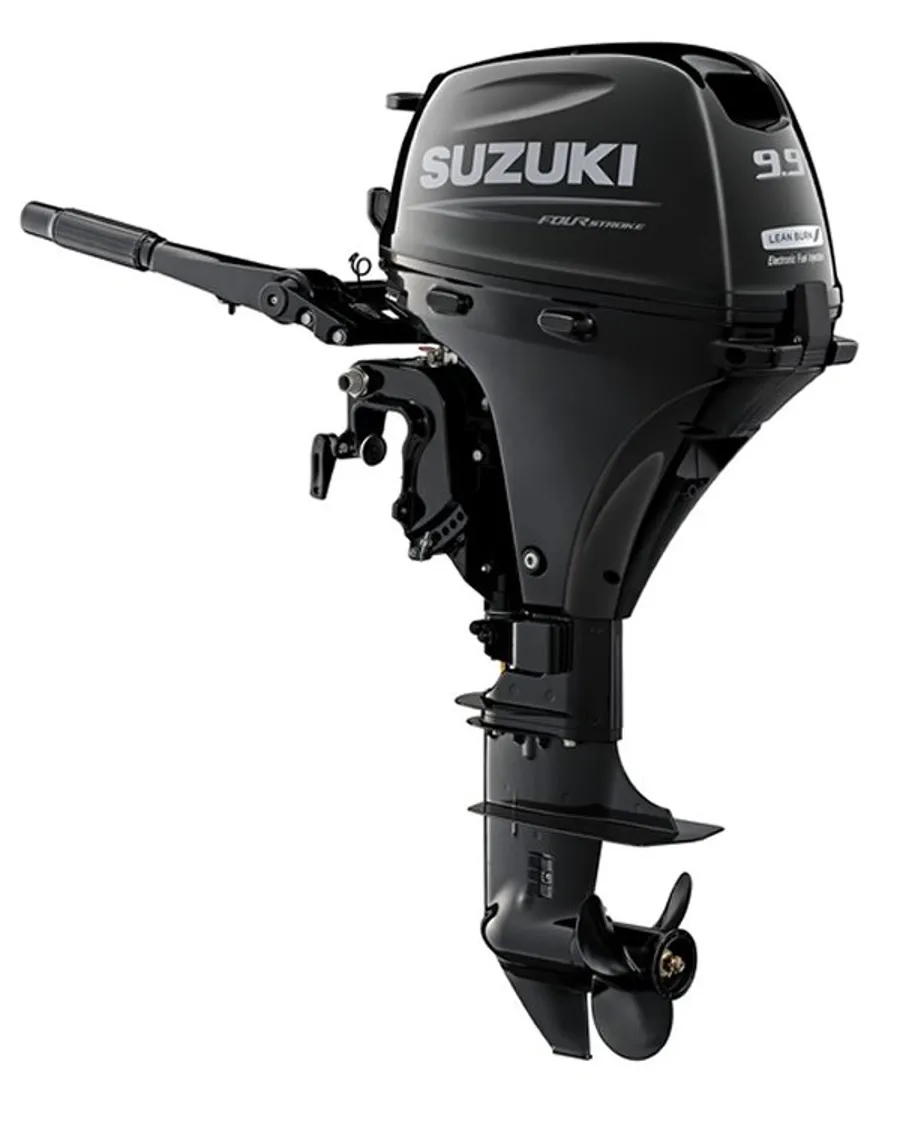
Description: Offering among the highest displacements, largest props and lowest prices in the 9.8/9.9-hp class, this Suzuki outboard comes standard with power trim and tilt, electronic fuel injection and electric start (required starter battery not included). The BTHX5 model is gray while the BTHW5 is white. Includes 3.1-gallon fuel tank and fuel line.
- Horsepower: 9.9
- Displacement/top RPM: 327 cc/6000
- Cylinders: 2
- Weight (lb.): 128
- Power-to-weight ratio (watts/kg): 127.2
- Fuel system: EFI
- Shaft length (in.): 25
- Alternator (amps/watts): 12/145
- Prop diameter x pitch/blades: 10 x 5/4
- Starting: Electric
- Online price*: $2,890 (*Lowest price found online August 2025) **Power trim and tilt included as standard feature.
10. Yamaha 9.9 HP T9.9XWHB High Thrust
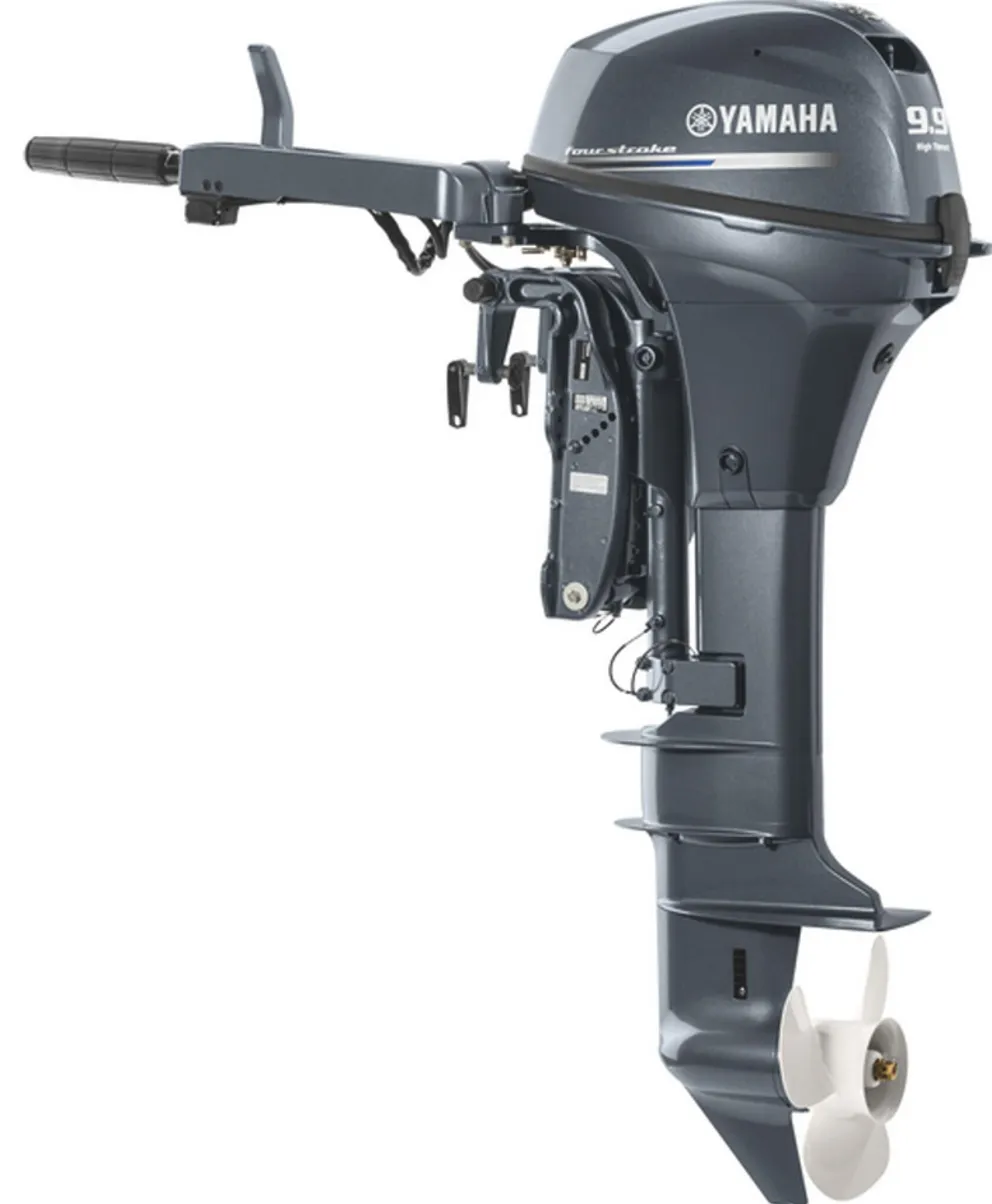
Description: Boasting the second-highest power-to-weight ratio in its class and a massive 11.75-inch (three-blade) prop, the Yamaha T9.9 has a reputation for quiet operation and is a popular choice for auxiliary sail power with its 25-inch shaft and 6 amp/76 watt alternator. T9.9XPHB model includes factory-installed power trim-and-tilt (weighing 121 pounds and online priced at $3,598). Fuel tank, fuel line, and required starting battery not included.
- Horsepower: 9.9
- Displacement/top RPM: 212 cc/6000
- Cylinders: 2
- Weight (lb.): 104
- Power-to-weight ratio (watts/kg): 156.7
- Fuel system: Carb
- Shaft length (in.): 25
- Alternator (amps/watts): 6/76
- Prop diameter x pitch/blades: 11.75 x 7/3
- Starting: Electric
- Online price*: $3,453 (*Lowest price found online August 2025)











I believe the second formula should be HP = disp/1000 x SA/100, not disp/100 x SA/100.
Steve: Sharp eye on the math (as my own calculations show)! Thanks. I will have this corrected in the article.
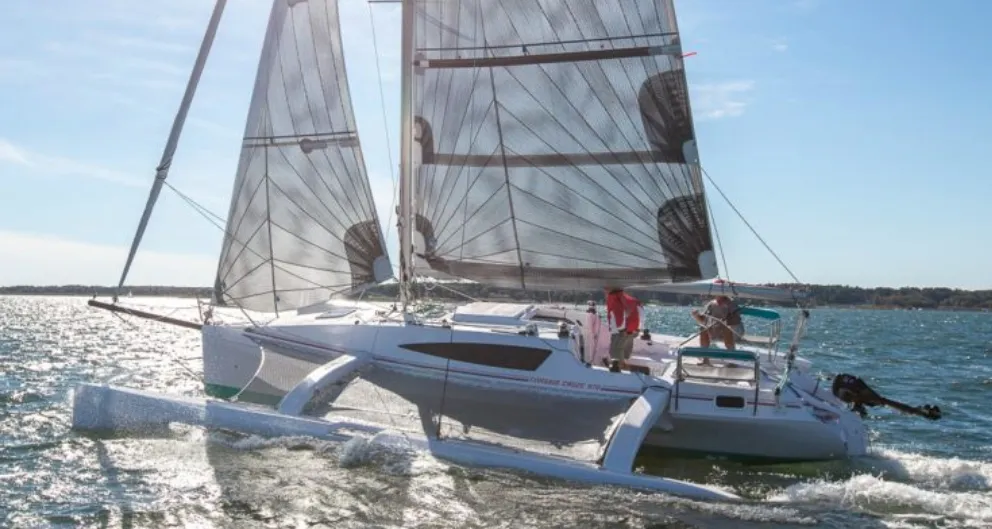
On the topic of horsepower calculations, the displacement/1,000 x sail area/100 formula does not apply to mutihulls, which are still displacement boats but carry far more sail area. In the absence of a manufacturer’s recommendation, I’d go with at least 2 HP for every 1,000 pounds of displacement. For the Corsair 970 shown above, for example, the 4,800 lb. displacement x 2 HP per 1,000 would call for 9.6 HP (so one of the 9.8 or 9.9 HP models in this guide. As it happens, Corsair dealers usually sell the boat with a 9.9 HP, and the manufacturer’s recommended maximum is 15 HP.
Doug, thanks for an info-packed article. I recently replaced a Tohatsu 6 manual start with a Merc 6 manual start. I could install the 60 pound Tohatsu myself, but had to have a friend help with the 95 pound Merc.
Steve: Thanks for your comment. I take it you mean Merc 9.9 (a two cylinder model that weights about 95 pounds)? Just curious about the model/size of the boat and the performance difference with a 9.9 HP versus 6 HP?
Steve: Thanks for your comment. I take it you mean Merc 9.9 (a two cylinder model that weights about 95 pounds)? Just curious about the model/size of the boat and the performance difference with a 9.9 HP versus 6 HP?