

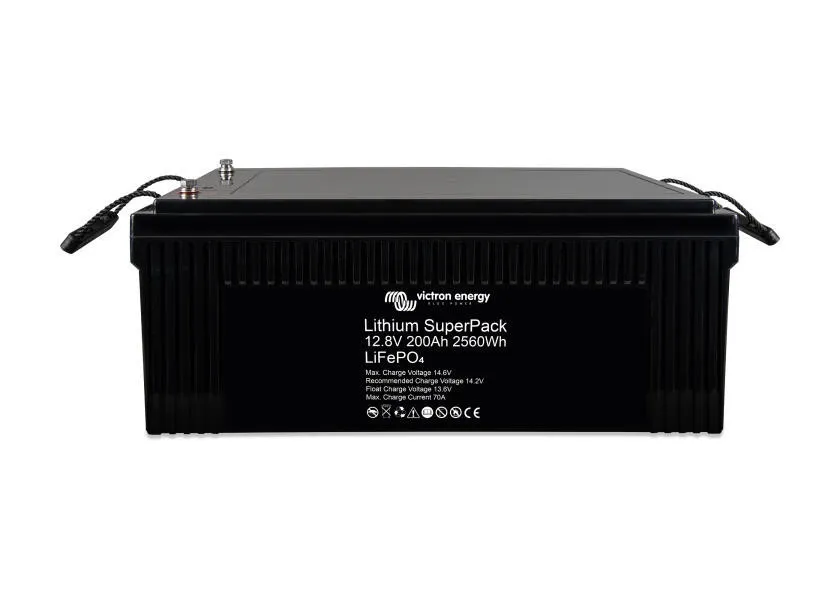
In the series of articles "Lithium Batteries for Small Boats," "Lithium Batteries for Small Boats: Install Guide" and "Lithium Batteries for Small Boats: Troubleshooting" we concluded that a practical configuration for the typical sailboat is to retain lead acid on the start side and upgrade to LiFePO4 technology on the house (or leisure) side. This article builds on that by exploring what to look for in selecting such a LiFePO4 battery.
To continue reading this article or issue you must be a paid member. Sign in

Join Practical Sailor
Get full access to Practical-Sailor.com – more than 4,000 articles – for just $34.
Join today and save 42% off our full price.








It says 100 Ah on the Li Time battery pictured. Also my Li Time battery that looks like the one pictured has Bluetooth.
Check out SFK, made in the US
Hmm…my Victron 330s have BT and cost less than what is posted for the 200 above.
I have 15 KW of Eco-Worthy metal case UL approved BT LiFe batteries in my home solar/backup system and they tested to full specs and have performed well for the 4 months I have had them. I have 4 165Ah metal case DCHouse BT LiFe batteries in my sailboat, which I believe are made in the same factory as the EcoWorthy. They also tested to full capacity and have performed well for 9 months. Metal cases help me sleep better, just like the wires in my house are in metal conduit! (A plastic case heater nearly burned my house down 4 years ago and plastic case Li battery consumer devices did burn down 2 of my counsin’s houses in the last 2 years!)
While the comments about fewer bigger batteries makes sense, the BMS systems on these batteries makes them complex electronic devices, which have a lot more failure modes than traditional LeadAcid batteries. So having a few batteries in parallel provides needed operational redundancy. If cost is no concern for you, paying 2-5 times the dollars per watt above, may get you something. My view with a lifetime working in these industries is that this market will inevitably consolidate and if your battery maker is not around, you won’t get that 10 year warranty serviced. The most expensive and the cheapest makers tend to not survive, so picking a company with a good market strategy and a good product makes sense. Buy a $50 LiFe battery capacity tester on Amazon and test every new LiFe batteries full capacity so you can return it right away if it does not meet specs.
I would agree with all that you say, here. Thankyou. Like you, I like the idea of having my LiFePO4 encased in steel. On multiple batteries – the sole issue with parallel operation is to ensure both batteries are equally loaded (which means you need common busbars, with equal length conductors – something that should not be difficult to achieve). Series connection is a whole different subject, however, as the risk is that one battery becomes under-charged while the other is over-charged (a common cause of battery failure). The simplest way to avoid that is to buy a 24V (or 48V) battery in the first place. The alternative approach is to have an external BMS, that is capable of monitoring all cells, as if they were a single battery. The LiFePO4 market place is so competitive, however, that manufacturers do not want to discuss such potential weaknesses and consequently all seem to claim that there is no downside to series operation.
So, what is the recommendation for best value?
So much depends on where you live and the complexity of your system. If you have a multi-battery system, maybe for propulsion service, then Victron is the gold standard. If it’s a simple, single battery house system, I am very happy with my Eco Worthy purchase – the price is hard to beat, I like the steel enclosure and their technical support was dependable..
With regards to LiFePO4 batteries, would you consider installing them under sleeping quarters, assuming that the installation has Class T fusing, a switch to isolate the bank, and appropriate sized wiring?
That’s a good question. From what I recall of the ABYC standard, they talk about the location being secure, not overly hot or cold etc but nothing about proximity to personal space. Storage is usually so limited on a sailboat, that one has to make tough decisions such as you pose – personally, i would be more comfortable sleeping over a LiFePO4 battery than – say, tins of inflamable paint or cleaning products.
The key questions that still need to be resolved are what standards NFPA and ABYC are going to modify and post in 2026 as well as USCG CFRs. From what I have read, USCG and NFPA are awaiting authorization to study and expand their rules and standards. This will have an impact on these types of batteries in recreational marine vessels. They will likely also impact what type of firefighting equipment is going to be required. NOTE: currently ABYC, NFPA and USCG identify the batteries as “Lithium”. They consider LiFePO4 under the umbrella “Lithium” technology. While the industry claims LiFePO4 to be far safer and less susceptible to Thermal Runaway, they are not immune. I for one, will remain in the camp of AGM (lead acid) as the standards and CFRs are clear, stable and defined regarding monitoring and firefighting equipment on my sailboat.
With the advent of larger LiFePO4 batteries why shouldn’t you use them to start a small inboard diesel? The measured inrush current of my older Universal M4-30A engine is 170A with a constant draw of 70A while cranking. Using the Sterling battery example in the article it has a 300A BMS and can easily handle the required load at just 56% C with inrush. A 200A BMS with a 200A plus battery should work just as well. If I have made sure the charging infrastructure (absolutely critical), eg. shore charger and Alternator with external voltage regulator, is in place what problems are likely to occur?
IMHO we need to restructure our thinking regarding batteries. Lead Acid batteries are NOT benign. We are just used to the dangers.
On engine starting – yes, the real concern has been with big currents flowing through a small battery. Bigger LiFePO4 batteries partially address that concern. Note, however, that most outboard motor manufacturers will not honor their warranty, if started by a lithium-ion battery, because experience has been that the BMS can trip out on the starting surge current plus their alternators were designed for lead acid charging.
Secondly, as you say, it is regrettable that all the various agencies have included LiFePO4 in the much broader category of Lithium-Ion, as the risks are not comparable. I gather that the various manufacturers have been lobbying, for LiFePO4 to be separated out but I guess the industry is still too young, for such a distinction to be possible. While the risk of a runaway thermal event in a LiFePO4 battery is not zero, my understanding is that the risk only really arises with abuse, such as puncture, overheating, over-discharging etc. or through amateur wiring configurations etc.
Since there are so many LiFePO4 batteries on the market, I can understand why you limited your review to ten. In the course of your research for this article, did you happen to consider RedOdo? I have a pair of 12 v models and to date have been pleased with their performance. The company’s support system has also been very responsive.
As you say, we had to limit which batteries we looked at, and explained that we did so by limiting it to those that the major retailers support. I just checked up the Redodo name, however, and yes, they look very legitimate. Pleased that they are working out for you.
What about the elephant in the room, Battleborn? Was there a conscious decision to leave them off the review list? A lot of controversy about them at the moment online.
That’s interesting. The sole reason I didn’t include them was because they are not marketed through any of the major retail channels. i was aware, however, that the YT Channel, ‘Sailing Uma”, originally had (i think) 12 of them and removed them well before their normal life expectancy, due in part to multiple BMS shutdowns (which they blamed on the way they used the batteries, rather than the product).
Very glad to see this buyer’s guide on LiFePO4 batteries. Great stuff overall, but for the sake of US readers, it would be nice to see the dimensions in inches as well as mm (though one model is listed in inches). It’s just math, so readers can do the conversion, but for future guides it would just be easier to have both dimensions across all models. Also for comparison’s sake, It’s worth noting the size of standard Group 24, Group 27, and Group 31 batteries for comparison’s sake, as many boats are set up with boxes or trays for these sizes. Here they are in mm: Group 24 = 260 L X 173 W X 225 H; Group 27 = 306 L X 173 W X 225 H; Group 31 = 330 L x 173 W x 240 H. Few of these batteries seem to conform to these standard sizes, so what would you advise on finding boxes or trays, if needed, and reconfiguring for required space if you think it’s best to go with bigger batteries?
From an electrical point of view, bigger batteries are always going to be preferable to several smaller batteries (whether in serues or parallel). Given the ultra-competitive landscape, manufacturers seem to avoid raising raising any concerns over multiple battery configuration (see my response to a similar comment above) . I believe the concept of a battery box or tray goes back to wet lead acid batteries, where there was a concern in containing any liquid spill. The new ABYC-13 standard only refers to the mounting being both secure and well ventilated (which wouid argue against anything like a battery box). On my own installation, I secured my single battery, with straps to a solid platform floor and the corner of two walls – so on three of the six sides – with zero movement and good ventilation
Personally I’m very happy with my 2 x 300Ah 12V Epoch Pro batteries in my Victron based system. I kept the AGM starting battery but added a Victron DC-DC charger for the different battery types. Epoch has a great product line and excellent support, and integrates perfectly with Victron equipment.
Given ABYC communication requirements are the first 4 the only ones that can be used on a boat?
i checked all of their published material and found none of them made such a claim – indeed it’s possible that the ABYC spec is so recent that none of them are yet capable of complying. You will need to ask them directly. One wouid presume, however, that this only requires a software (not a hardware) upgrade, so compliance should not be too difficult.