
A storm trysail rarely gets the close look it deserves. Designed to replace the mainsail in a severe storm, it spends most of its life in the sail locker.
The sail is required by offshore race rules and is a must for ocean-voyaging boats, but most modern production boats arent even set up for a trysail.
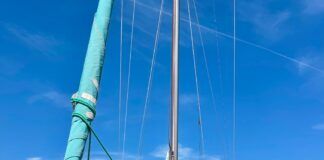
The trysail hoists on the mast, but must be capable of flying independent of the boom. To make setting the sail as easy as possible, the boats mast typically has a separate parallel track for the trysail. Feeder tracks that route the trysail into the mainsail track can work in some cases, but are generally less desirable. Stand-off tracks for in-boom furling, as well as some stack packs, and static lazy-jack systems can complicate a retrofit.
Trysail sheet blocks should be mounted port and starboard, allowing the sheets to lead fairly to a winch. Snatch blocks are not the first choice for this job.
It is best to work closely with a sailmaker and/or the boats designer to get the right size and shape trysail. It should be cut flat, and the center of effort located to optimize stability and helm balance.
For more advice and recommendations on sails – what to buy, carry and use, purchase Practical Sailor’s downloadable ebook A LOOK AT SAILS, PART TWO: Headsails & Furling Gear.
Also, check out the complete 3 volume series, PRACTICAL SAILOR’S A LOOK AT SAILS – Complete Series at a price that gives you one ebook free when you buy the other two.