Rating Rules
In my readings, I keep coming across references to boats built under either IOR or CCA rules. Unfortunately, nobody bothers to mention what those were or are. Please explain the differences to this non-racer and how this new-found knowledge might assist someone looking for a good bluewater cruising boat. Thanks.
-Mike Hirko
Gig Harbor, Washington
IOR and CCA are acronyms for racing rules. IOR stands for International Offshore Rule. CCA stands for Cruising Club of America. Neither rule is used any more, but boats built according to them are still around.
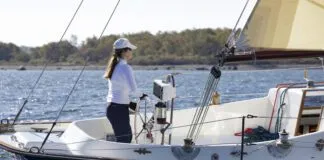
The CCA rule was developed by, you guessed it, the Cruising Club of America. Its popularity peaked during the 1960s. The club’s intent was to encourage the design of boats that were true dual-purpose; that is, they could be raced and cruised with equal proficiency. The CCA penalized light weight because its writers believed that moderate to heavy displacement makes for more comfortable and seaworthy offshore passages. Typical displacement/length ratios were in the mid- to high 300s. It also penalized long waterlines, so CCA-type boats tend to have long overhangs. Though no 1960s boat would seem beamy by today’s standard, the CCA rule did encourage wider beam than previously thought wise. Other peculiarities of CCA-inspired designs are keel/centerboards and yawl rigs. The racing success of Carleton Mitchell’s Finisterre encouraged other keel/centerboard designs, such as the Block Island 40 and Hinckley Bermuda 40. This came as something of a surprise, because the purpose of a centerboard, after all, is to allow shoal-water cruising. And as for the yawl rig, it was favored because the area of the mizzen sail was essentially “free” under the rule.
Where the CCA rule required each boat to actually be weighed, the IOR estimated displacement based on a number of hull measurements. Designers began to focus on these critical measurement points, trying to achieve favorable low ratings, and this became more important than worrying about displacement. (One telltale result common to IOR boats is tumblehome, where maximum beam is not at the rail, but lower on the topsides.) As designer Ted Brewer wrote 20 years ago when the IOR was still in effect, “Lighter displacement is not penalized as long as the hull fits into the measurement formula. Lower D/L ratios are the result.”
The IOR influenced yacht design in other ways as well. Beam continued to increase. Concurrently, long keels with attached rudders disappeared in favor of deep fin keels and spade rudders. The yawl rig disappeared (partly because it is more expensive) in favor of the basic sloop rig, with a large foretriangle and small mainsail. IOR boats therefore typically require big genoa sheet winches and strong crew to trim the headsails. A good IOR design, like the S&S-designed Tartan 41, is a powerful upwind machine, but because of its pinched ends it can be squirrelly off the wind, especially under spinnaker.
No handicap rule is ever perfect, and by the mid-1980s, dissatisfaction with the IOR eventually led to its demise. The boats were expensive to race competitively, and they began to look strange. It was slowly replaced by the MHR or Measurement Handicap Rule and later by the IMS or International Measurement System. People who didn’t want to spend a lot of money and anxiety on grand prix racing helped the growth of the PHRF (Performance Handicap Racing Formula), which doesn’t really measure anything-it just records how successful individual designs are racing other boats.
Today, there also is strong interest in one-design classes. Where one-designs used to be limited to daysailers, a number of today’s keelboat designs like the J/105 and Mumm 30 theoretically give all sailors an equal shot at victory (the hulls may be the same, but new sails every season make a big difference).
CCA boats probably make better cruising boats than IOR designs, though there certainly are exceptions. Because of their age, CCA and IOR boats can represent good values on the used boat market. A Luders 33, built by the Allied Boat Co. during the 1960s, is still a handsome boat, and well built. But it should be surveyed carefully, because it’s coming up on 40 years old. Similarly, one of Doug Peterson’s 1970-era IOR designs can be bought for a song, and cruised well…if you can deal with deep draft and a strenuous rig.
———-
Rope Instead of Chain?
I keep my J/42 at a mooring and there is a significant problem with electrolysis of the mooring chains and shackles. Would using a titanium shackle make electrolysis of the gear less likely? Could one of the new synthetic braids be substituted for the light chain part of the two-chain connection via swivel to the Helix anchor, and thereby avoid the electrolysis of the exposed chain? Attaching zincs to the chain does not appear to reduce the loss of chain diameter to the stray current.
-Ted Zaleski
Brick, New Jersey
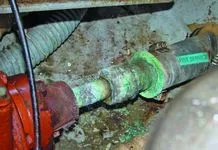
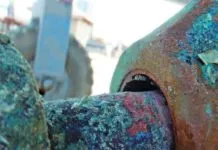
The problem of galvanic corrosion, which is caused by the current generated by two different metals in a conducting medium (seawater is ideal), was discovered in 1763. The British Admiralty’s experimental copper sheathing applied to HMS Alarm stopped the teredo worms cold, but the ship almost sank because of severe corrosion and failure of the iron fastenings in the ship’s planking and rudder. The Admiralty’s engineers were savvy enough to note that it happened only where the two metals were in contact.
What you probably have, Ted, is, as you said, electrolytic corrosion, which is caused by stray currents from an external source. There’s lots of stuff zinging around your modern harbors.
It’s all further complicated by factors over which you have no control…the temperature and salinity of the water and how fast it moves. Corrosion can be accelerated by crevices and under barnacles, and by the simple friction of the chain links rubbing against each other.
The upper, lighter part of the chain you mention is called the “riding chain,” as opposed to the “ground chain,” which runs from the anchor to the swivel, and generally lies on the bottom. The bottom, especially mud, tends to protect the ground chain quite well, while the riding chain seems to deteriorate more the closer it gets to the warmed water and sunlight of the surface. So there are a number of destructive forces at work on the riding chain.
Consulting a table showing the volts relative to what they call a saturated calomel half-cell suggests that a titanium shackle won’t help. Titanium is at the opposite end of the galvanic series from steel. Although it’s good to have a small bit of the noble metal (titanium) working on the bulkier, less noble metal (steel), the further apart on the series, the greater the electronic flow.
In a standard mooring set-up, the heavy ground chain, which should be at least one and a half times the maximum depth of the water, is shackled to the buried mooring, and runs to a swivel. The riding chain, which should be at least as long as the maximum water depth, is shackled to the other side of the swivel, and then runs up to the surface, where it’s often shackled to the bottom end of a steel rod that extends through a mooring buoy. The steel rod has an eye on top to which a mooring pendant (with a thimbled splice) can be attached with either a shackle or with a thimbled splice made directly on the rod’s eye. The latter is better because it eliminates one shackle, one wear point, and one metal-to-metal contact.
However, that steel rod isn’t very trustworthy. It’s subject to corrosion inside the mooring ball, and we’ve seen more than one come apart. Better to shackle the pendant directly to the riding chain, then buoy the whole connection. If the buoy fails, the boat stays anchored.
If you substituted a high-modulus line for the riding chain, you would provide a very helpful disconnect, at about the halfway mark, between a bunch of different metal parts.
Matt Allingham, one of New England Ropes’ technical whizzes, said any line made of Dyneema (such as his new single braid called Endura 12) would be perfect. Dyneema absorbs no water, so constant immersion would do no harm. It withstands chafe very well, so the bottom end of the riding chain substitute would not be affected, as it drags around in the mud or sand. (Rock or shell might be a different matter.) For that small upper end of the line that might be exposed to sunlight, Allingham said it should last a minimum of three years, and is easy to keep on eye on.
Without having tried this method ourselves, we can’t endorse it outright-but to us it makes sense, and it’s not without precedent: Caretakers of coral reefs have installed polypropylene rope-rode moorings for years in order to protect coral from the scrapings of metal ground chains. They’re not expected to do storm duty, because of the relative vulnerability of the polypro, and the fact that the lower ends are anchored in ways meant to be minimally destructive. However, we can’t see why some of this ferociously strong high-tech rope, properly spliced and thimbled, wouldn’t do at least as well as galvanized chain in a robust mooring system. We’ll try to do some experimenting with this idea.
———-
No Steel Wool on Stainless
In a May 1 PS Advisor on removing rust from stainless, we carelessly used the phrase: “…you’ll probably have to follow with steel wool.” We should have said bronze wool, or any non-metallic abrasive. As several readers have pointed out, steel wool can make matters worse, because tiny particles of the steel can get into the crevices of the stainless and rust themselves. We were admonished, also, for not mentioning Wichinox as a cleaner. See www.wichard.com.