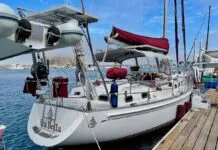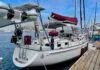

The Cabot 36 is a sought-after, medium-displacement, 36-ft. cutter from the 1970s that can provide security and comfort for a budget-conscious sailor willing to maintain an older boat. Capable of crossing oceans—she was designed from an East Coast/Atlantic Ocean perspective—and equally reliable as a coastal cruiser, the Cabot 36 is worth a look.
History
The Cabot 36 was developed and constructed by Cabotcraft Industries in Sydney, Nova Scotia on Canada’s Atlantic coast. A pair of industrious sailors set up shop in an industrial park during the fiberglass boat construction boom of the early 1970s. Their business was supported by the local and provincial governments as a project to train and employ workers from a recently closed mine.
With plans and drawings from the team of Ted Brewer and Bob Walstrom, the design was for an ocean capable sailing vessel with a more modern cutaway keel promising more nimble maneuverability in tight quarters. It was constructed in an era where fiberglass and resin were affordable so plenty was integrated into the hull and deck. There would be no oil-canning in this hull.
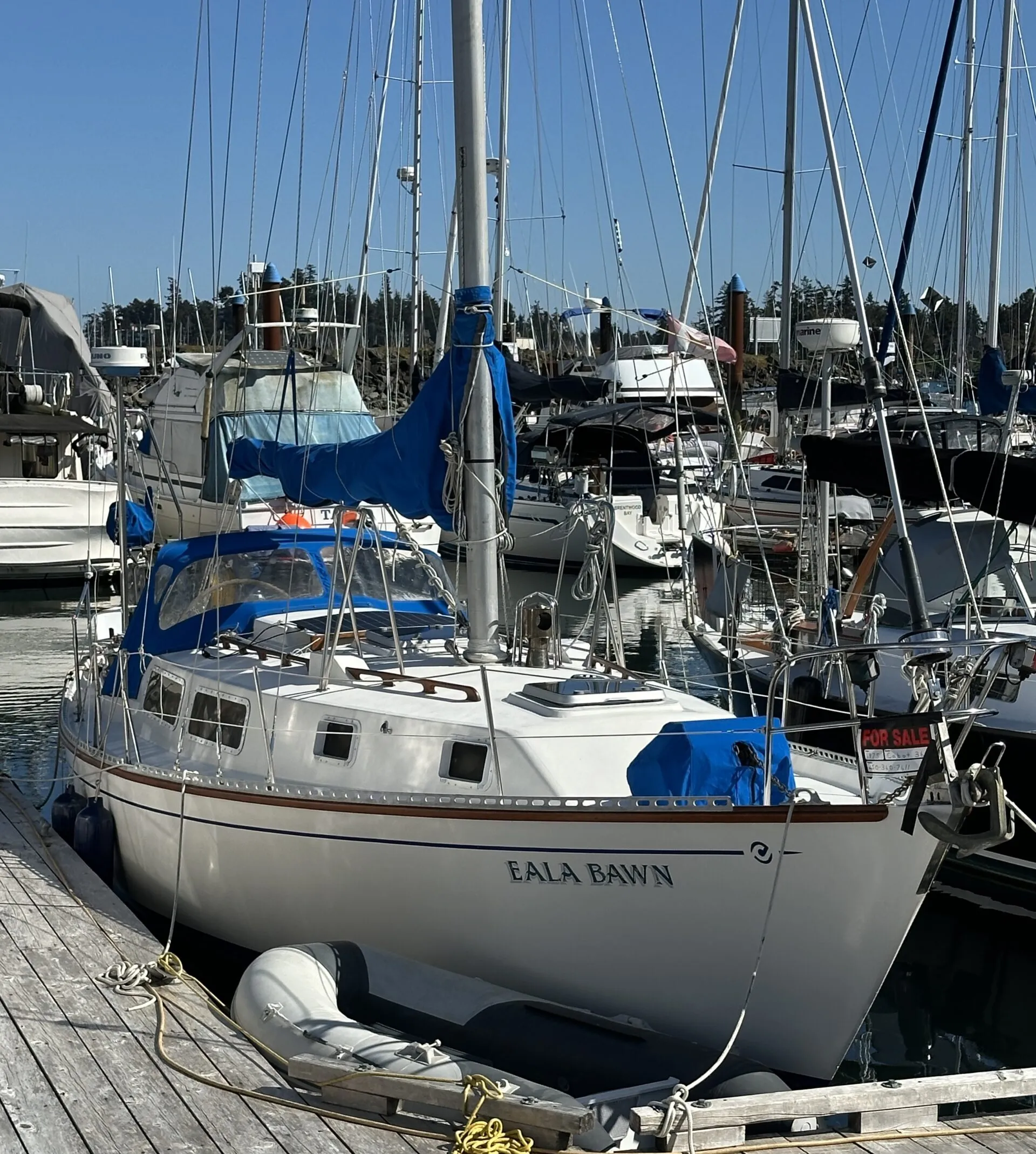
A total of 49 Cabot 36s emerged from the factory, some sold as hull and deck for owner completion, most completed in the factory. This is something to keep in mind when a Cabot 36 is on your horizon as a possible purchase. Eventually the retraining project was deemed completed and government funding dried up. With supply prices rising in the late 70s combined with a slumping sailboat market, continued production was no longer fiscally profitable and the business shut down.
Specs
With an overall length of 35.6 feet (10.8 m) on an 11.6 ft (3.56 m) beam and a waterline length of 29.7 feet (9 m) the Cabot 36 has the potential of a 7.3 knot maximum hull speed. She is not exactly shoal draft at 4.7 feet (1.45 m). The hull carries 5,500 lb. (2,495kg) of lead for its 17,800 lb. (8,074 kg) overall weight, providing a capsize screening formula of 1.79—well within the 2.0 ocean rating category.
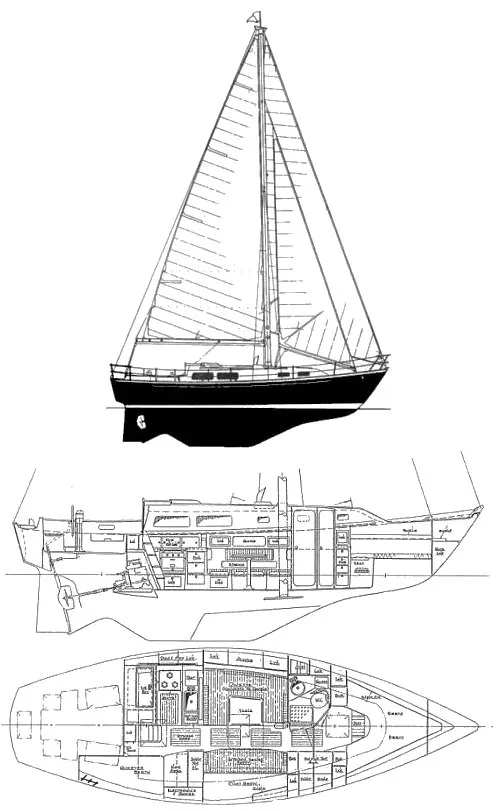
Sailboat Specifications Courtesy of Sailboatdata.com
Hull Type: Fin with rudder on skeg
Rigging Type: Cutter
LOA: 35.58 ft / 10.84 m
LWL: 29.67 ft / 9.04 m
S.A. (reported): 632.00 ft² / 58.71 m²
Beam: 11.67 ft / 3.56 m
Displacement: 17,800.00 lb / 8,074 kg
Ballast: 5,500.00 lb / 2,495 kg
Max Draft: 4.75 ft / 1.45 m
Construction: FG
Ballast Type: Lead
First Built: 1974
# Built: 49
Builder: Cabotcraft Industries (CAN)
Designer: Ted Brewer/Robert Walstrom
S.A. / Displ.: 14.89
Bal. / Displ.: 30.90
Disp: / Len: 304.24
Comfort Ratio: 33.17
Capsize Screening Formula: 1.79
S#: 1.55
Hull Speed: 7.30 kn
Pounds/Inch Immersion: 1,237.19 pounds/inch
I: 44.50 ft / 13.56 m
J: 14.80 ft / 4.51 m
P: 39.00 ft / 11.89 m
E: 15.50 ft / 4.72 m
S.A. Fore: 329.30 ft² / 30.59 m²
S.A. Main: 302.25 ft² / 28.08 m²
S.A. Total (100% Fore + Main Triangles): 631.55 ft² / 58.67 m²
S.A./Displ. (calc.): 14.88
Est. Forestay Length: 46.90 ft / 14.30 m
Eala Bawn
Originally purchased by Specialty Yacht Sales in Vancouver, British Columbia, Eala Bawn was one of the first production Cabot 36s offered for sale to the public. She was transported from Nova Scotia to the west coast by rail. The boating market was booming in the Pacific Northwest in the mid-1970s and the owner of Specialty Yacht Sales believed an ocean capable boat was a sure thing. However, he fell in love with the boat and purchased her, sailing in local coastal waters for two years before he decided racing was in his future. The Cabot 36 was not particularly suited for that endeavor and was traded for a racing sloop.
Her second owner had offshore dreams that included Cape Horn and sailing across the Atlantic to Wales, his family home. Modifications and upgrades over the next three years were undertaken to attain the dream that never materialized. Eala Bawn was on the market again and Brian, the current owner, was fortunate enough to learn of the pending sale. With his own dreams of a sailing life, Brian purchased an upgraded five-year-old Cabot 36 in better than new condition.
On Deck
Ventilation
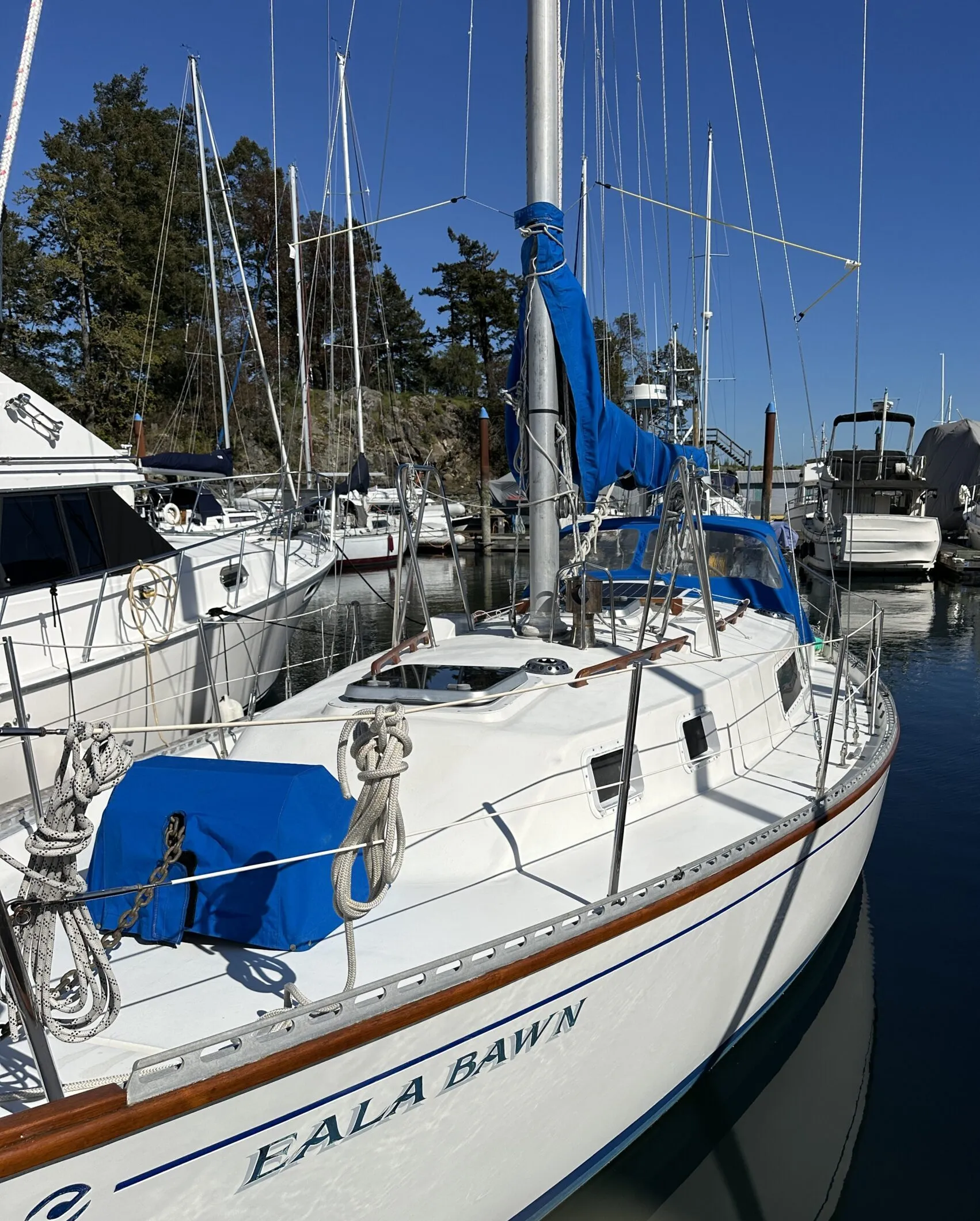
With plans of living aboard with his young family in the cold winters of the Pacific Northwest, Brian removed the two dorade boxes on deck. The four opening ports and large seaworthy Lewmar hatches provide more than adequate ventilation below decks. Four large, fixed windows accompany the opening ports on the cabin trunk allowing plenty of light into the cabin. From a review of online examples of this boat, there were multiple options for the fixed window sizes. Aboard Eala Bawn the windows have been replaced with new, thicker Lexan and more substantial aluminum frames, but mimic original factory size. This is rather unusual for a boat designed to take the rigors of ocean sailing.
Companionway and Safety Features
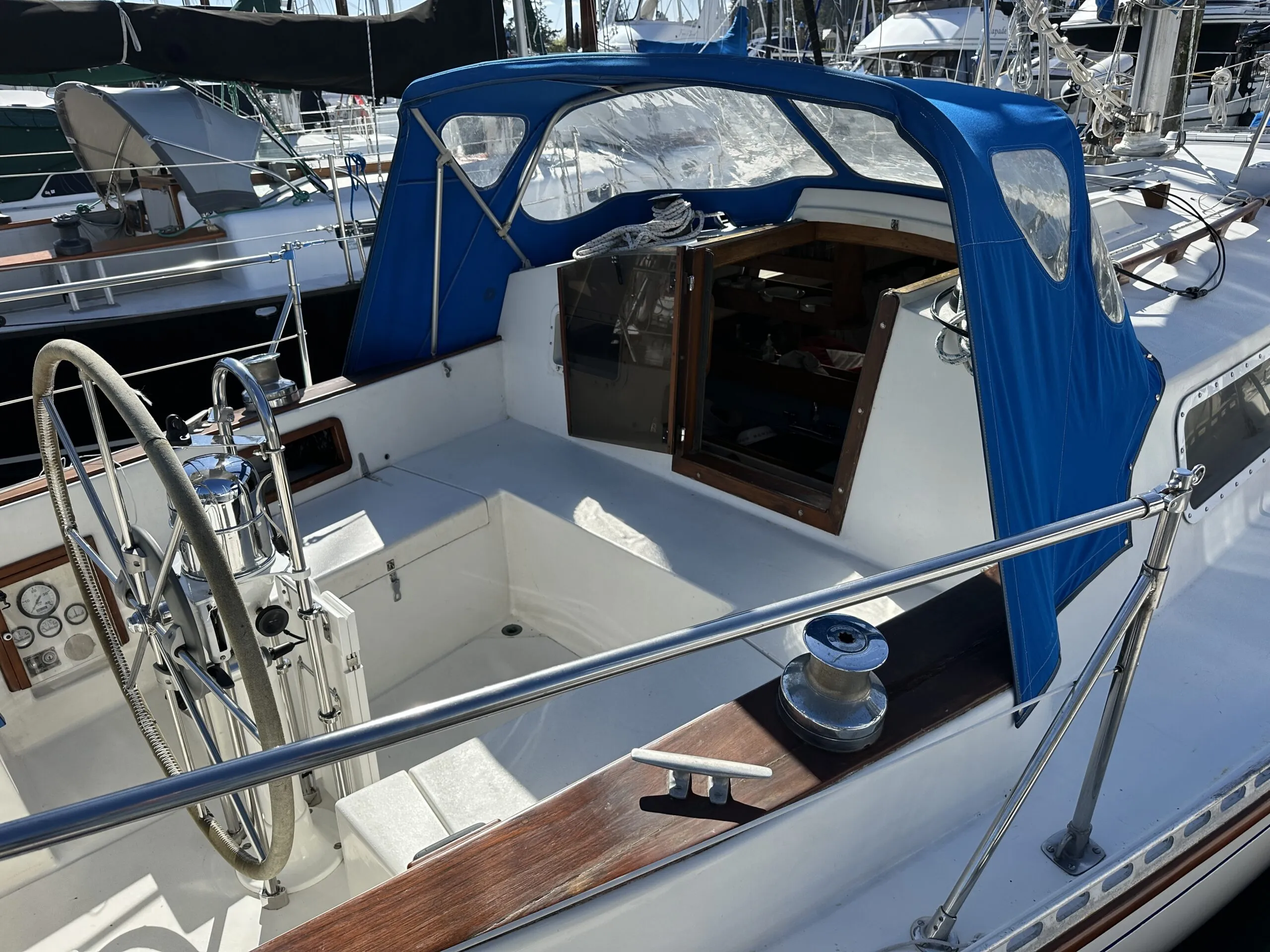
The large companionway slide has a proper seagoing hood to keep solid water out of the cabin when a wave breaks over the bow. The plywood companionway boards have been replaced with a hinged Lexan door, which makes it easier to enter and exit the cabin. Two winches on the cabin top adjacent to the companionway allow for sail control from the cockpit.
Teak handrails stretch forward along the coach roof to the foredeck. Substantial bulwarks topped by a teak cap rail and a slotted aluminum toe rail running from bow to stern add to the sense of security on deck.
Rig
The aluminum mast is keel-stepped with the original factory rigging replaced three years ago after almost 50 years of service. By today’s standards, the single spreader rig is substantial and designed for crossing oceans without concern for failure. Waist-high, custom stainless-steel guards adorn both sides of the mast for security while working on the cabin top.
No Genoa Tracks
There are no genoa tracks on the wide side decks, the slotted toe rails are the points to which any turning blocks are attached. Although it was common practice with many sailboat builders of the day, and may still be common practice today, applying sheeting blocks to the aluminum toe rail is likely to stress the fasteners and cause leaks in the hull/deck joint as years go by. Such a wide sheeting angle also limits pointing ability. But then the Cabot 36 was never intended to win races to windward.
Foredeck
Moving forward, the cabin trunk slopes down to a relatively spacious foredeck and small anchor locker. After years of manually hauling up the anchor and chain, Brian—being an ever-resourceful man with ideas—had a fisherman-type anchor windlass fabricated out of stainless steel and mounted on the foredeck. The complete ground tackle chain is wrapped around the drum. This unit is a two-speed manual windlass with a four-foot lever.
Although it is capable of being hydraulically or electrically powered, Brian likes the reliability of the manual set up. Perhaps not conducive to sailing with all that weight high on the foredeck, the assembly has not caused Brian any maintenance issues. Although the Cabot 36 was designed with an optional cutter rig set-up, the windlass on the foredeck precludes that option.
Cockpit
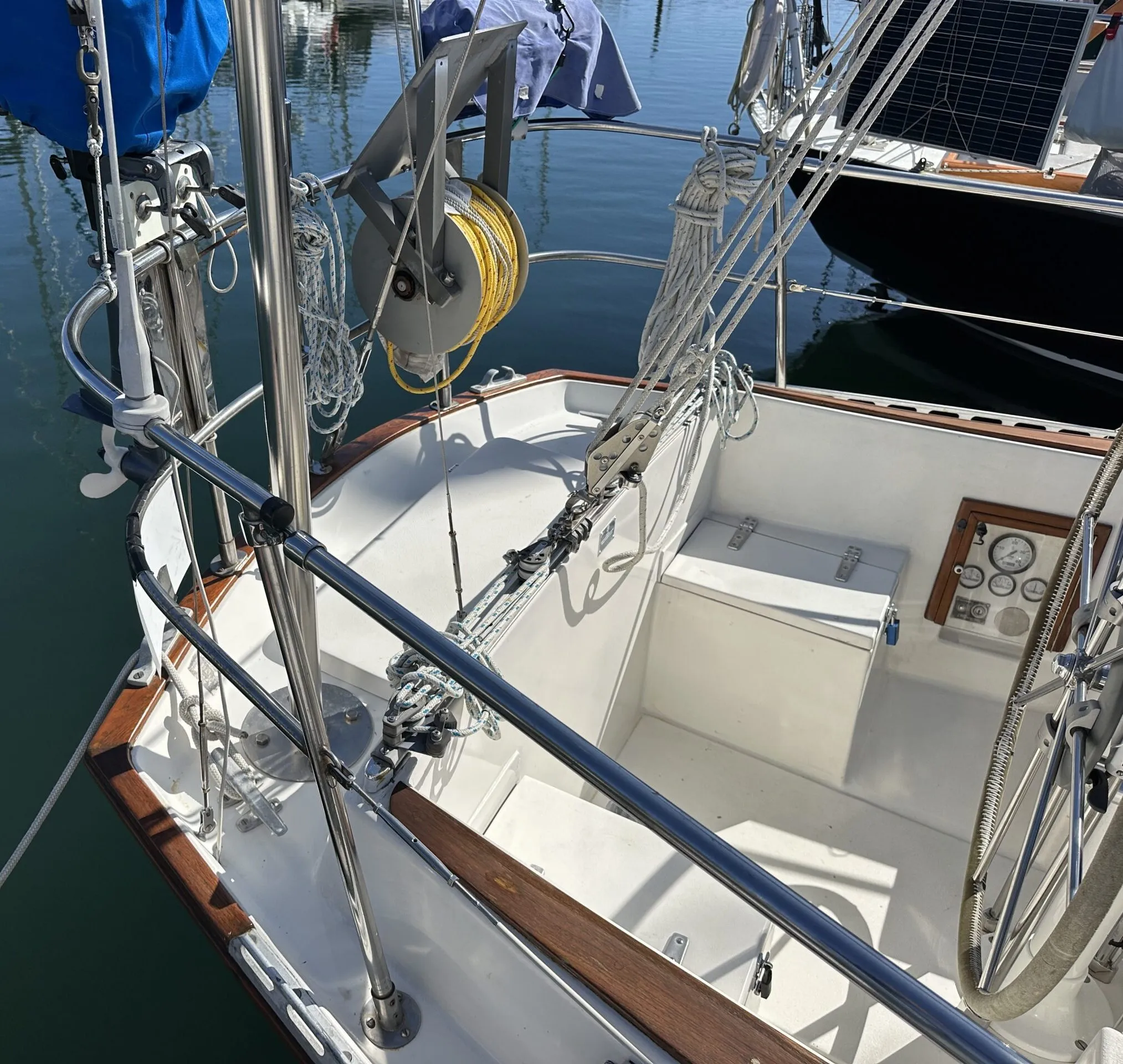
When compared to modern day coastal cruisers, or even ocean-certified production sailboats, the cockpit of the Cabot 36 is small. But by the standards of the day, this cockpit was deep and almost oversized for an ocean-crossing design. The bridge deck is at seat level requiring a step up before entering the cabin.
Storage
The T-shaped foot well provides plenty of space for skipper and crew. Two propane lockers that form the “T” at the aft end of the cockpit allow for safe storage of 10-lb. propane bottles with a raised helm seat between them. Where most helm seats swing up and out of the way for access to a swim grid at the stern, the Cabot 36 simply has additional storage space against the aft wall of the cockpit enclosure. Room for a life raft perhaps?
Helm
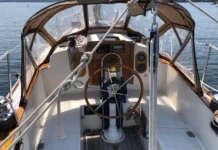
A 24-in. wheel on a binnacle came standard from the factory. This makes getting around the cockpit easy. However, reaching the wheel from a seated position on the wide cockpit coaming is an uncomfortable reach. Brian has replaced the original wheel with a 36-in. model that makes getting around a bit more difficult, but driving the boat is much more practical. Engine controls are abeam the wheel to port, which is very handy.
Traveler
The mainsheet traveler is mounted atop the aft end of the cockpit coaming, behind the helm, with access to mainsheet controls easily at hand for the helmsperson. However, watch for the mainsheet whipping by the helm position in a tack or gibe!
Behind the traveler is a very small aft deck and lazarette locker for storage of sailing paraphernalia.
Finishings
The cockpit coamings are topped with traditional teak planks, which is very nautical but necessitates annual maintenance. From the factory, the non-self-tailing, two-speed primary winches were mounted on the coaming, just a little too far forward to be handy to the helm. I suspect that some owners may have upgraded to self-tailers and perhaps moved them aft to be more convenient.
Built for Ocean Sailing
The seat backs and the cabin trunk are tilted back just enough to be comfortable as backrests for long passages. The port side seat has a large, deep locker that the average sailor would have no difficulty climbing into. The starboard seat has a shallow locker necessitated by the quarter berth underneath. But there is plenty of room for sailing gear accessible from the cockpit. For ocean sailing, this has the feeling of a very deep, secure cockpit.
Interior
Galley
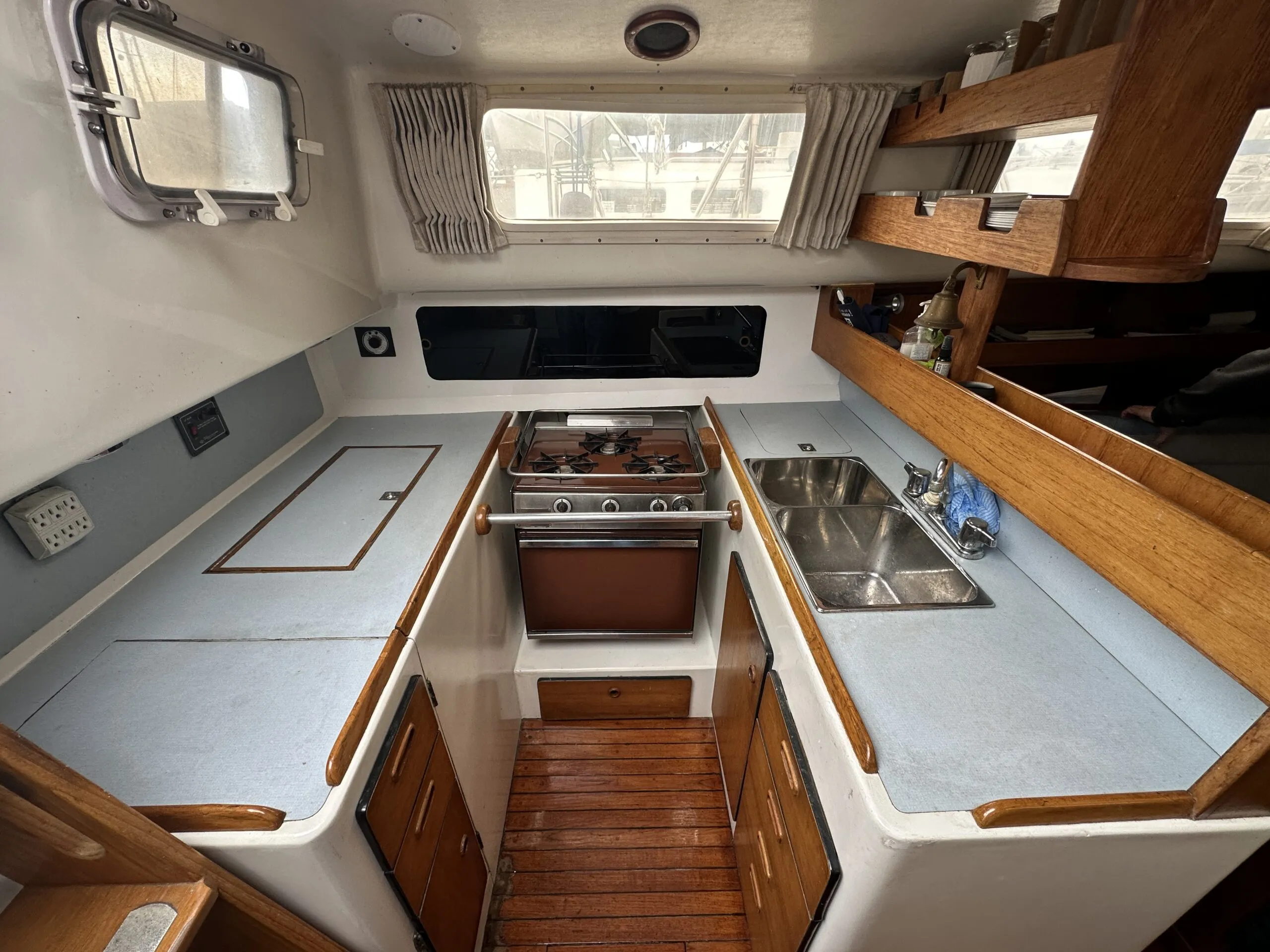
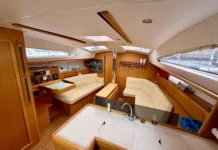
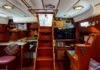
Down the three steps of the companionway a fully functional U-shaped galley with three-burner propane range (probably pressurized kerosene or alcohol from the factory) is immediately to port. A huge icebox is against the aft bulkhead and deep enough that the bottom is barely within reach. Brian has added four inches of insulation to the inside of the box, professionally glassed in and looking factory original, then installed 12-volt refrigeration. With relatively limited galley storage space, Brian fabricated a handy overhead open storage cabinet as a bit of a divider between the galley and salon. A double sink with storage underneath completes the galley.
Salon
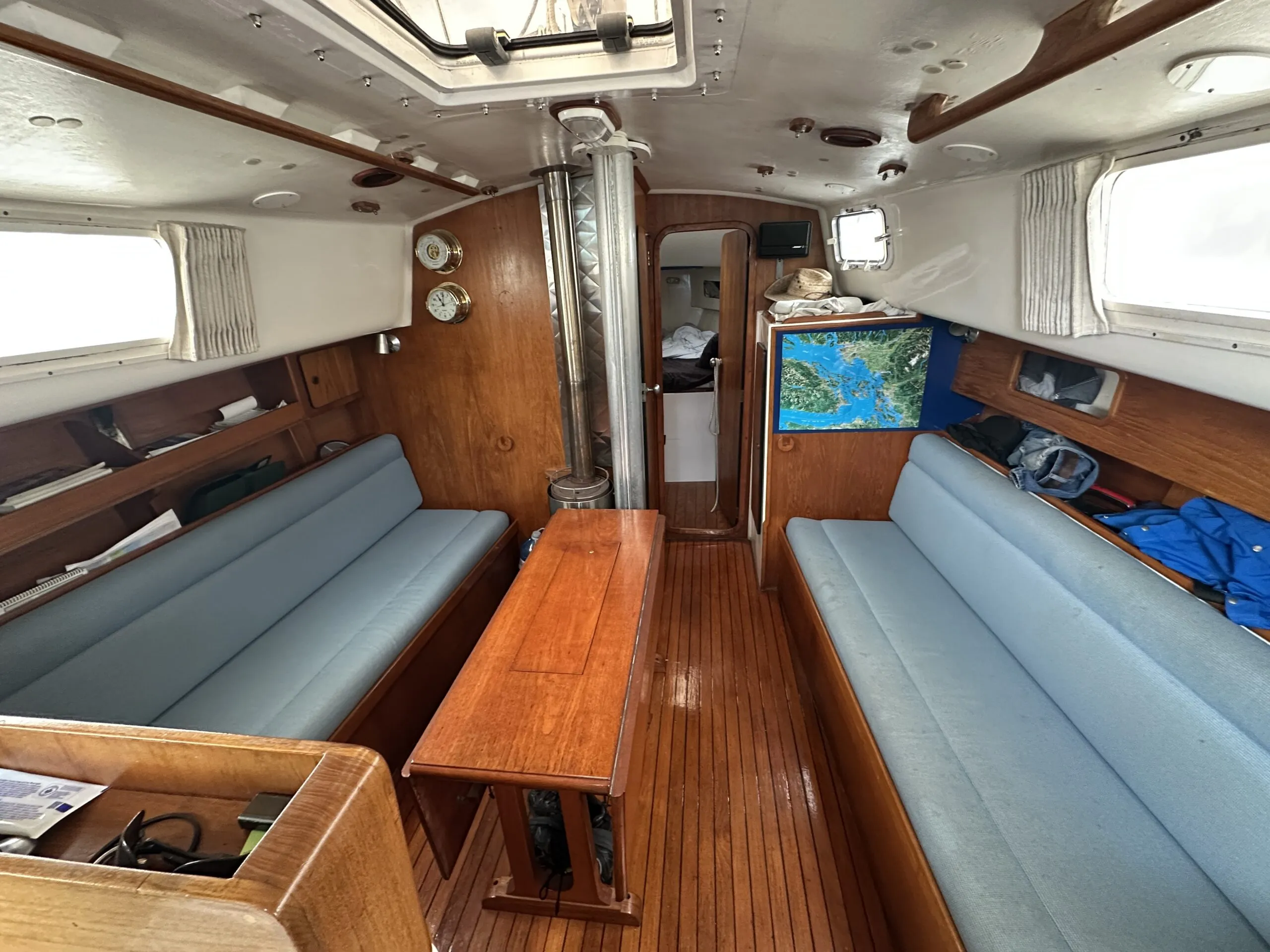
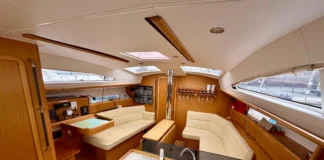
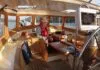
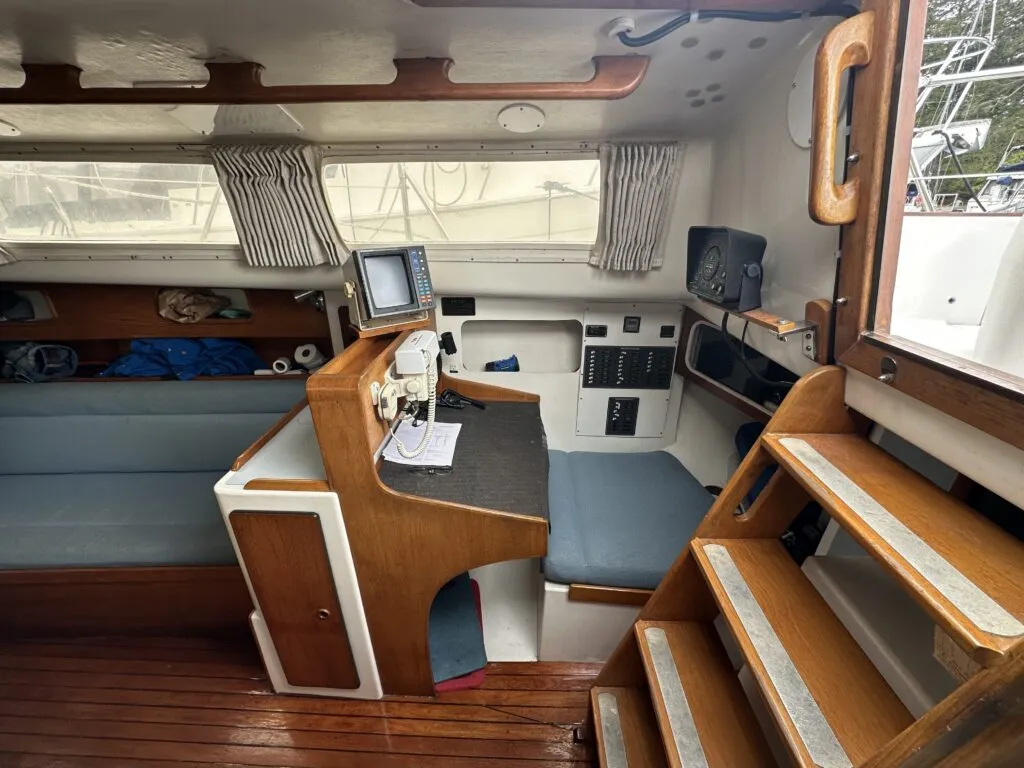
Although the Cabot 36 emerged from the factory with a standard layout of a U-shaped galley and a dinette forward to port with additional seating to starboard in the salon, the previous owner did not think that suitable for long distance off-shore sailing. The interior was professionally modified with the dinette removed and simple settees installed port and starboard. A solid, folding teak table was set on the centerline against the mast.
The open storage bins behind the settees were enclosed with nicely fabricated cabinets, ensuring stored items stayed put in any kind of seaway. Access to storage under the settees was by way of opening doors along the cabin sole. It is very inconvenient to search for and gain access to anything stored here. Lids are now installed under the seat cushions to improve access to storage. Provisions for lee cloths were included for both settees.
Finishings
Originally finished with the ubiquitous teak and holly laminate sole, the cabin sole of Eala Bawn was replaced with a solid teak sole to survive the intended long-distance cruising. In anticipation of voyages to Cape Horn, a diesel-fired Dickinson Antarctic heater was mounted against the forward bulkhead. While this offers far more heat than a 36-ft. boat would ever need, it still functions perfectly after over 40 years of service. It was fully appreciated by Brian and his young family for the years they lived aboard through the damp Vancouver winters.
Nav Station
To starboard of the companionway is a small forward facing navigation table with seating provided by the leading edge of the quarterberth. The electrical systems aboard Eala Bawn have been professionally replaced and upgraded with a modern electrical panel located against the hull.
Quarterberth
The quarterberth could be deemed suitable only for small children. Although of significant size for sleeping, getting in through the small opening behind the navigation deck requires gymnastic abilities not suitable for aging adults. Brian uses this space for general storage and has expanded his house battery capacity into this space.
Head
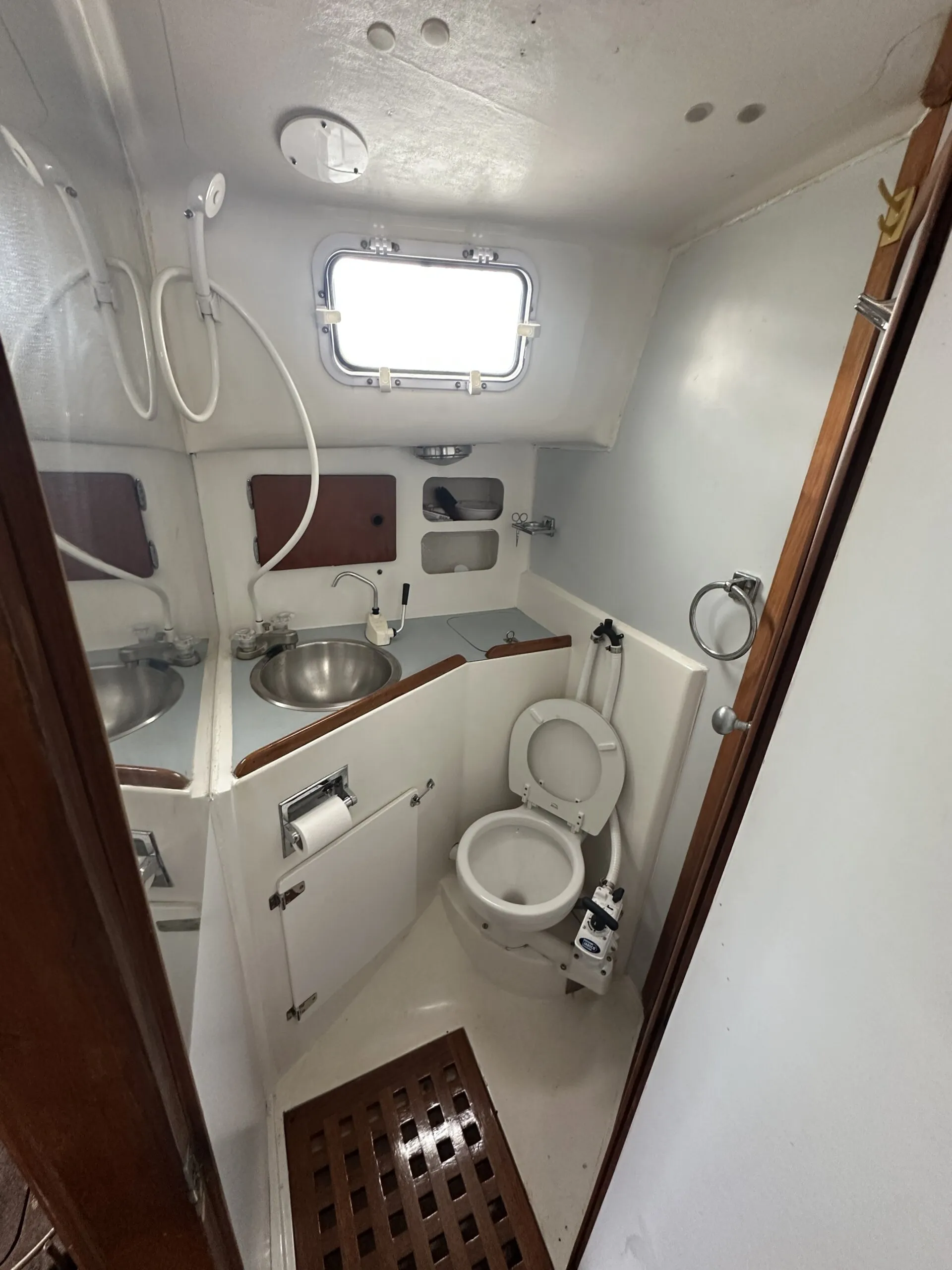
Forward of the salon is a relatively spacious head compartment to port with a shower and vanity cabinet finished in clean white gelcoat and melamine. An opening port provides ventilation. A large hanging locker is located opposite to starboard.
Forward is a large V-berth with storage bins overhead along both sides, great for keeping nicknacks within easy reach at first light. Hanging lockers for clothing are also available.
Tankage
Two separate tanks, one 60-gallon (273 L) fiberglass tank under the cabin sole form-fitted into the aft end of the bilge and a 30-gallon (136 L) tank forward under the V-berth provide plenty of capacity for extended cruising. The forward tank drains into the main cabin tank through a controlling valve.
A 15-gallon (68 L) holding tank is located under the V-berth adjacent to the extra water tank.
Mechanical
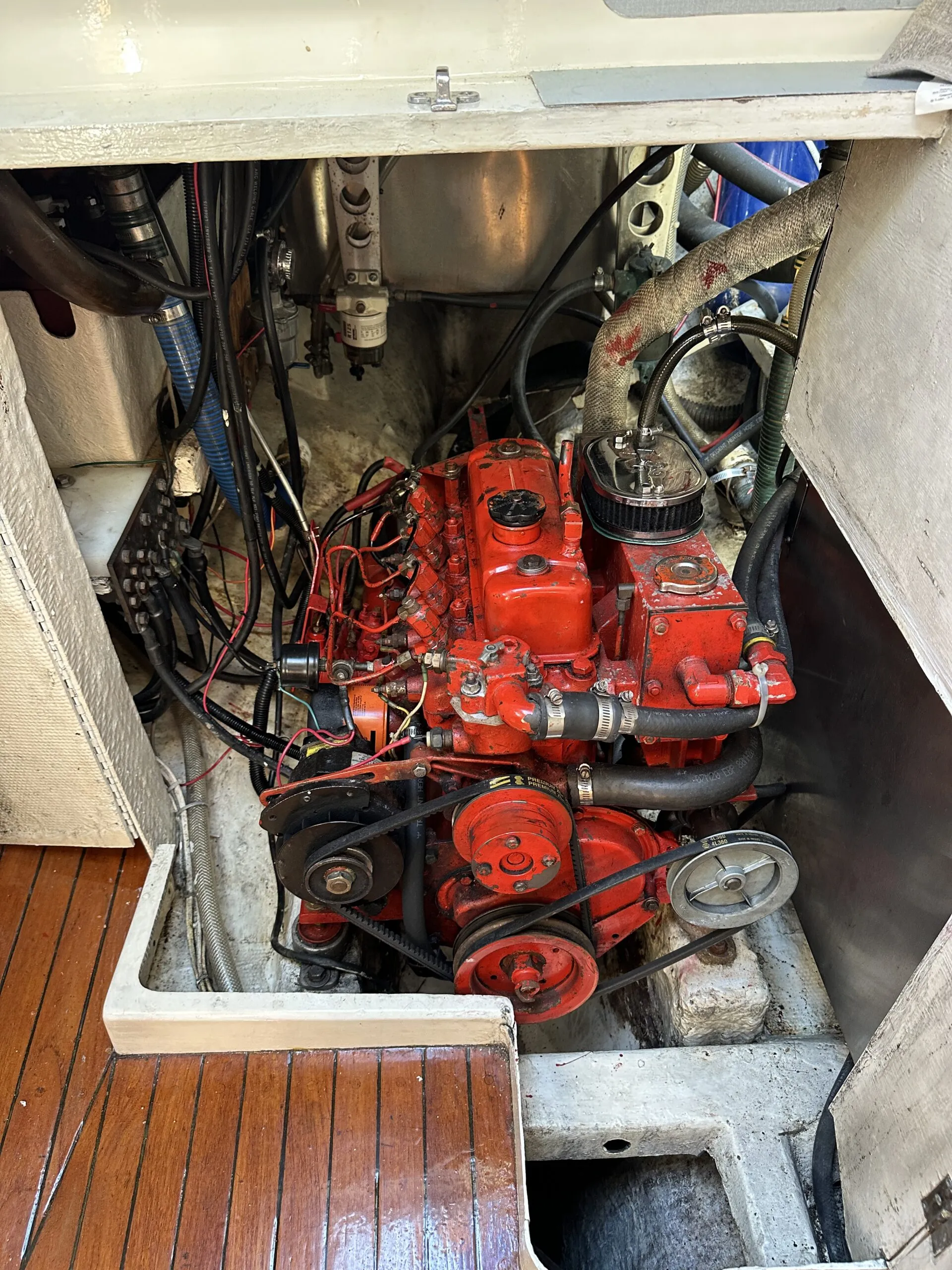
The original factory-installed, four-cylinder Westerbeke 30 still resides under the companionway steps. For engine access, part of the galley cabinetry can be swung out, and with the steps and a portion of the opposite cabinetry swung out, there is remarkable access to the maintenance points of the engine. Other than routine maintenance and upgrades (heat exchanger, alternator, etc.) a mechanical inspection of the engine a few years ago indicated that the basic structure is still going strong after more than 5,000 hours.
For Brian, cruising speed is a comfortable 1,800 RPM on an engine rated for 2,500 RPM, sipping a half-gallon per hour at about 5.5 to 6 knots. The original Paragon transmission is still considered bullet proof.
Aft of the engine is space for the fuel tank. Originally constructed of black iron, the factory tank was replaced after two years of service with an aluminum tank that Brian subsequently changed out to a 30-gallon (136 L) 316 stainless-steel tank.
Performance
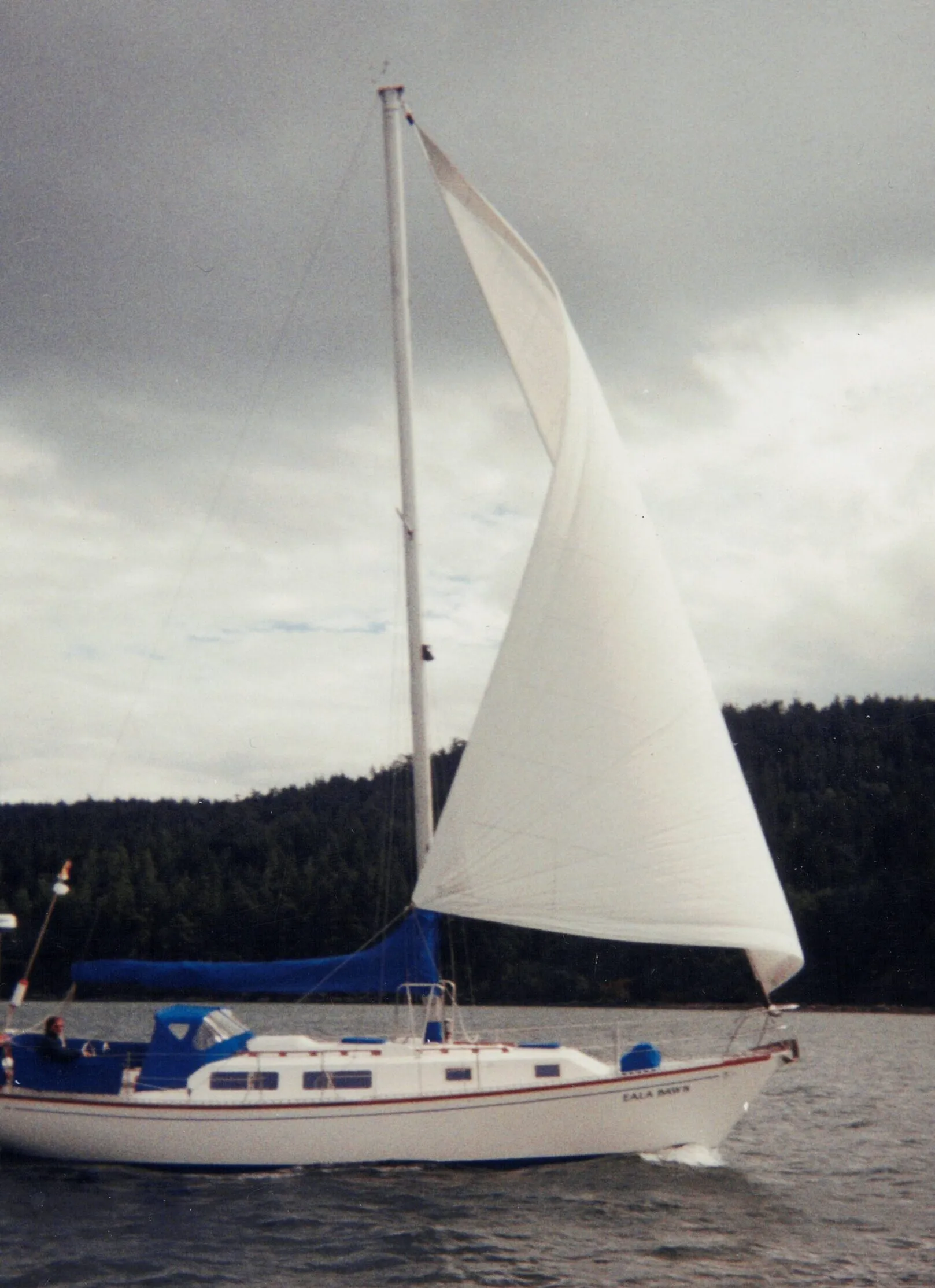
Circumstances prevented a sea trial aboard Eala Bawn. But as would be expected for a heavy, full keel boat, maneuvering in tight places takes a bit of planning and patience. With a cutaway forefoot and the keel extending back to support the rudder, the Cabot 36 is not going to be a round-the-buoys dancer for weekend racing. But she will track true in open water and provide a comfortable motion in almost any sea state.
Conclusion
Designed for crossing oceans, that’s where she will excel. The interior layout, whether as modified on Eala Bawn or in the original configuration of a dinette, can comfortably host a couple or small family. The cockpit is deep and secure. With her weight and sail plan, the Cabot 36 will not heel excessively and will track true without constant attention to the wheel. With the over-construction of the early fiberglass boats in the 1970s and 80s, and with attention to maintenance, the Cabot 36 will still be sailing well into the future.
Market Scan Contact
1977 Cabot 36 Private seller
$27,500 USD via SailboatListings.com
St Martin Caribbean Sailboat Listings