While world leaders and presumed financial wizards set to work trying to right the global economy with some very expensive bailers and sponges, Practical Sailorhas taken the time this month to dig through our recent collection of Chandlery submissions to see if we can find anything more useful. Given sailors capacities for innovation (aka “jury rigging”), were holding out hope that the next great invention-the ultimate stimulus package-lies somewhere in our growing stockpile of Chandlery items.
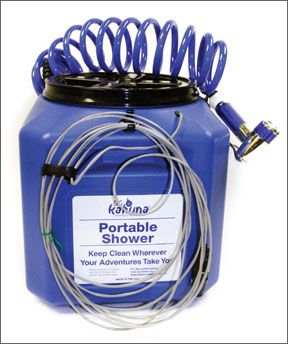
Big Kahuna Shower
Our search for a portable shower for Jelly, our Catalina 22 project boat, led us to the Big Kahuna portable shower. The shower features an integral tank, a 12-volt pump, and a trigger spray nozzle. After a few hours in the sun, it provides a comfortably warm shower with more pressure than conventional solar bags that you hang from the rigging.
We tested the original 6-gallon version, which plugs into any cigarette lighter and has a 20-foot-long cord. Water supply is powered by a Rule 360 GPH bilge pump. Although it occupies more space than a solar shower bag, the tank doubles as a storage container when its not in use, and its easier to clean. Available on the company website for $120, this is a product that a DIY-er could handle.
Bottom line: The Big Kahuna is more expensive than solar showers or the 2-gallon agriculture pump sprayers that often are re-purposed for onboard showers, but its more convenient and effective. Request the optional tie-down hooks.
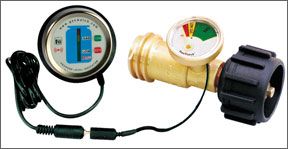
Gas Watch
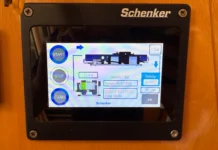
This inexpensive device might not revive the global economy, but it has the potential for saving a marriage. Recently improved with a remote display that can be mounted below, the Gas Watch monitors propane tank pressure with a diaphragm sensor, allowing more precision than an ordinary Bourden-tube pressure gauge, according to the maker. When the indicator dial or display hits the yellow zone, youve got about two hours of cooking time left. In the red zone, youve got 20 minutes.
Bottom line: The new translucent fiberglass tanks from Trident (www.tridentmarine.com) offer cruising sailors a more practical way to track consumption. Nevertheless, since the Gas Watch is cheap (the basic model is $20 at Walmart) and doubles as a leak detector, its worth a look.
Flow-Rite
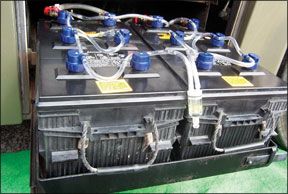
Many of the most helpful marine products solve problems that shouldnt exist in the first place. If boatbuilders stopped burying batteries in dark lockers, thered be no need for the remote watering devices from Flow-Rite.
The company makes four different lines of automatic battery-watering devices, all of which have been thoroughly tested by U.S. Battery, one of the nations largest manufacturers of wet-cell, deep-cycle batteries. The system of tubes and valve-regulated caps allow you to remotely fill all of the battery cells using a detachable squeeze bulb pump and tube. The valve tops allow you to fill each cell to the right level without overfilling. Prices start at $40.
Bottom line: Were impressed with this product, which allows us to fill the inaccessible batteries on one of our test boats without even looking at them. The system is not a substitute for regular checking of the state of electrolyte or other routine maintenance.
Fresh Flush
Theres real potential for any invention that promises to tackle head odors, and the Fresh Flush takes a familiar, yet novel approach. The basic PVC tank with an ordinary toilet float valve effectively acts like the water tank on a domestic toilet, providing a freshwater flushing system that keeps waste isolated from the potable water supply. Mounted high on your boat and piped into a pressurized freshwater supply, the system eliminates one of the major sources of head odors in a saltwater boat, decaying marine organisms.
So far, only 10 of these units have been put into service, leaving limited reports from the field, but the developer, Gene Conley, offers a money-back guarantee. Although a handyman can assemble a similar unit for less, Conley does it for you for $300.
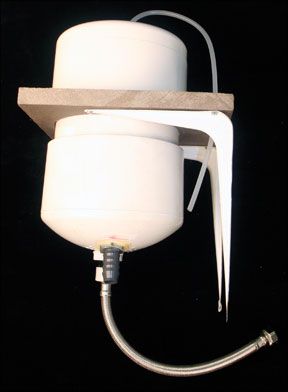
Bottom line: For the dockside dweller with easy access to fresh water, the Fresh Flush offers a way to flush the system of standing saltwater, helping to eliminate or greatly reduce odor. We will be conducting further testing in the field to evaluate its suitability for cruising.
Chafe-Pro
North Carolina-based Fjord Inc. produces American-made chafe gear for the commercial and military markets as well as a line of products for the yacht market.
Practical Sailor received two single-layer “yacht-grade” samples of abrasion-resistant chafing gear and one sample of Chafe-Pro double-layer commercial grade chafing gear. All three use a proprietary chafe-resistant nylon weave and feature a full-length slit with heavy hook-and-loop closures that allow them to be installed on dock or mooring lines without untying the lines.
We tried the chafing gear in various applications and found them be flexible, abrasion resistant, and easy to use. The company offers several different grades suitable for everything from dock lines to commercial towing. Prices at the Chafe-Pro online store start at $20 for a pair. Custom designs are available.
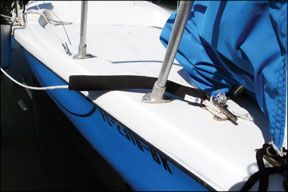
Bottom line: We found this to be an excellent product that conformed tightly to bends and resisted chafe well. Although Velcro on the inside will grip large-diameter, soft-lay line, wed add light lanyards to keep them in place on smaller diameter lines.
Fendercleat
We have an instinctive aversion to anything that is meant to replace a perfectly good knot, but this compact solution to securing a fender caught our eye.
Developed by PS reader Del Wiese, the FenderCleat is a cleat-like tool milled from a piece of Starboard. Although marketed as a means for securing fenders on boats with aluminum toerails, it can also be used for adding purchase when tying down something. The short video on www.fendercleat.com, explains it all. A pair of FenderCleats sells for $15.
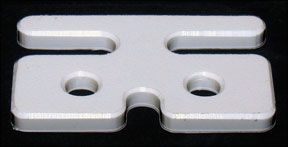
Bottom line: Its elegant, simple, and fulfills its mission perfectly, but if you truly need this device, a good book on sailing knots should come first.
Wrino Hook
Australian-based Wright Innovation sent us this novel evolution of a boat hook that allows the user to lasso a piling as well as perform other mooring tricks from the boat without precarious acrobatics.
Adjustable from 3 to 7 feet, the telescoping pole is very well made of anodized aluminum with high-density plastic grips and a secure twist lock. The pole features two hooks at the business end. The smaller hook is well suited for snagging small lines, and the larger one good for grabbing mooring balls. The most interesting additions are a semi-circular line clip at the end and a lasso holder clip, which slides along the pole to change the size of the lasso.
We tried the pole several times while docking and found that with little practice and the right size lines, it worked just as it was designed. It was particularly useful for lassoing tall pilings at low tide.
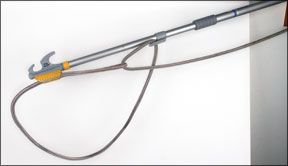
We found lines of half-inch to 5/8-inch diameter worked best. Selling in the U.S. for $83, including shipping and handling, the pole costs about twice as much as other poles on the market, but its also a notch above in terms of quality.
Bottom line: The Wrino clip system performs just as advertised, and the owner of a daysailer or bay boat who must regularly deal with mooring balls or tall pilings at the local slip will appreciate its convenience. However, a longer (8-foot minimum) single-piece boathook that wont collapse under rigorous pulling or pushing loads remains essential aboard a cruising boat. Its hard to beat the traditional wood pole with a bronze tip.
Leatherman LED Lights
The December 2007 issue of Practical Sailorlooked at a variety of flashlights from nine different manufacturers, with the Pelican Recoil 2410 coming out on top. The introduction of Leathermans line of S-Lights, the S-1, S-2, and S-3, gave us an opportunity to check out the most recent advances in LED technology.
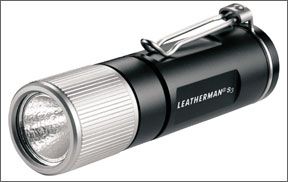
With an advertised 100 Lumen spot, the 2.8-ounce S-3, powered by a single CR123 battery came closest to meeting our previous criteria, so we took it out for a test run. For comparison, the $70 S-3 was matched up against the mi6 Tactical flashlight from Dr. LED, a light that earned a Recommended rating in the last test. Though priced about the same, the mi6 weighs twice as much as the S-3 and requires two CR123 batteries.
Surprisingly, the Leathermans powerful spot was not far behind that of the Dr. LED, one of our higher-rated spot beams. However, after 15 minutes on high power the flashlight was too hot to touch. The beam is very evenly distributed in the low and medium power settings. We dropped ours two stories onto the office parking deck, and it kept right on working.
Bottom line:A corrosion-prone body, high price, low battery life (1.5 hours at high beam), and an oddball battery keep it out of contention for an ideal marine penlight. Still, its the perfect gift for the landlubber gadget heads in the family-provided they wear gloves when using it on high power for an extended time.
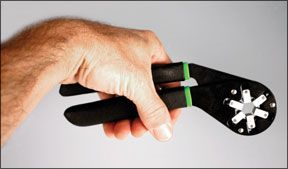
Bionic Wrench
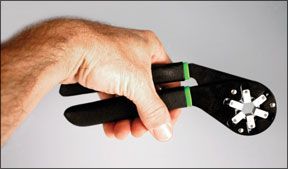
While fishing around in a friends toolbox one day, we came upon the Bionic Wrench from Loggerhead Tools. Available in three different sizes, this interesting hybrid tool-part pliers, part adjustable wrench-provides six facets that automatically adjust to grip stubborn nuts or bolts. We used it on a few of the bolts in our penetrating oils test (see page 37), and it released the hold of some badly rusted nuts without causing any damage. The grip could be more ergonomic, but the Bionic Wrench is a nice option to have when you don’t feel like digging out the right box wrench or socket.
Bottom line: Like many tools, the Bionic Wrench is prone to corrosion in the marine environment, but its handy to have in the garage. Tool junkies will definitely want to drop in on the Loggerhead website.
Great Neck ToolKit
Why anyone has yet to come up with an off-the-shelf tool kit that meets the need of the cruising sailor is a mystery to us. Sure, even the best kit will need to be supplemented with specialized tools, but youd think someone would develop a kit that caters better to sailors needs. In our last test of off-the-shelf products (March 2002), kits from Craftsman and Sea Choice edged out those from U.S.-based Great Neck. Weve had the Great Neck 125-piece mariners kit on board one of our test powerboats for over two years now, and it met our routine maintenance needs on all but two occasions, once when we needed vice grips and another when repairs called for a deep socket. The box is holding up, and the tools are only showing minor corrosion. The socket wrenchs engagement has become spotty. Should the kit start to really disappoint, the companys quality assurance guarantee will replace it free (postage pre-paid).
0)]
Bottom line: This $80 made-in-China toolkit has held up longer than we expected, but we still advise readers opt for a Craftsman tool kit or a similar higher quality kit.