

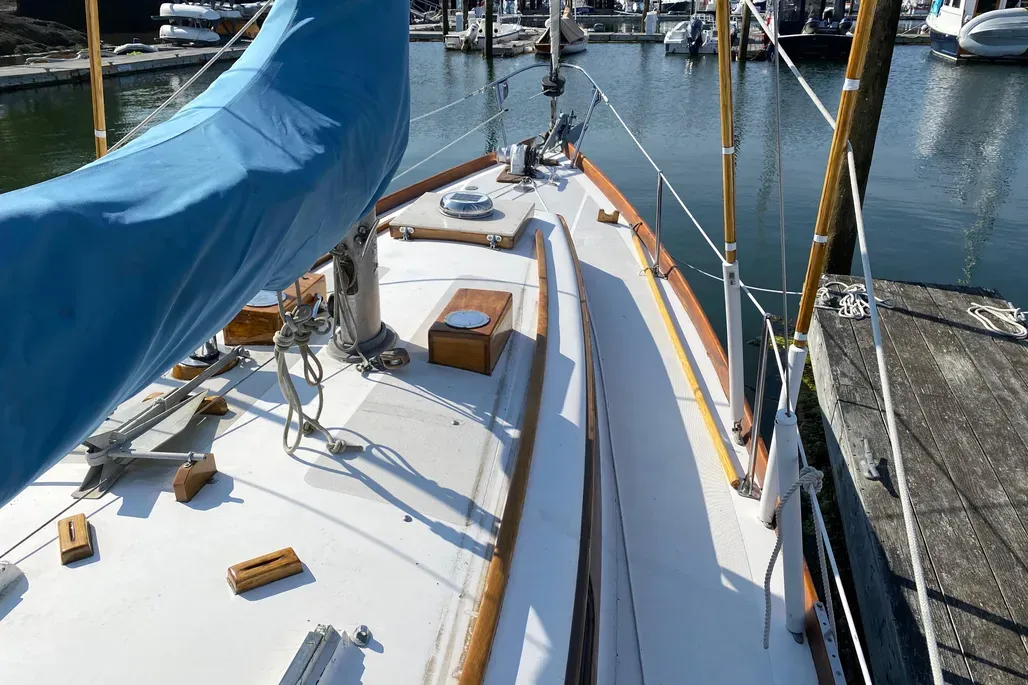
Henry R. Hinckley & Co. of Southwest Harbor, Maine, has had some notable successes over the years, and this solid glass 35-footer ranks right up there with the best of them. She was built in several variations between 1963 and 1975 and was preceded by eight boats built in wood. Class records indicate that a total of 125 fiberglass Pilots (including eight built in Chile using tooling made for the Chilean Navy with Hinckley’s assistance) were built in total.
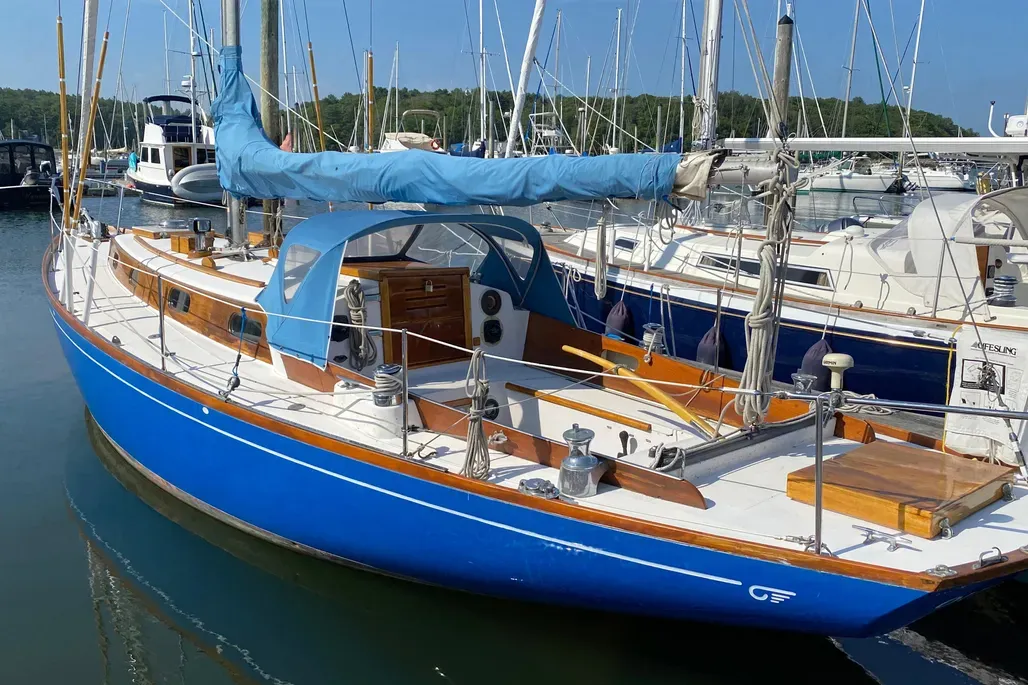
Most remarkable for her beauty, this balanced, traditional-looking boat with a deeply curved sheer and plenty of overhang fore and aft has had a full life. Cruising widely, racing seriously, weekending and daysailing in most of the planet’s best sailing grounds, she embodies that “wholesome, dual purpose ideal” that many sailors put at the heart of the sport.
By modern standards she’s a bit cramped, a tad slow and a touch clumsy. Hinckley has long been known to build boats well, but at what price? Some owners have sailed their boats for 30 years or more, and when a Pilot comes on the used boat market today it’s not likely to stay there long. Often the boats fetch prices in excess of $70,000.
Designed by Sparkman & Stephens when the firm was at its most dominant, the Pilot was the state of the boatbuilding art at the beginnings of the fiberglass era. It’s tempting to think of her as dated and a litmus of how far we’ve come, but many sailors still see her as the sum and substance of what a boat should be. Whether you think of her as a relic or exemplar, however, hers is an intriguing tale.
History
Says Bob Hinckley, one of the founder’s sons (his family sold the company in 1997): “The success of the Bermuda 40 removed any lingering doubts about the suitability of glass reinforced plastic as a boatbuilding material. By 1962 it was clear that fiberglass was to be the future of the Hinckley company. We had already built a Sou’wester Junior in glass, and since the boat was 30 ft. LOA, it seemed only logical to build one in the 35-ft. range to fill out the line.
“The two boats which were under consideration were the Hinckley 36 and the Pilot 35. Both had been popular cruising boats in wood during the 1950s, and each had its own strengths. Of the two the Pilot was probably a little bit prettier and faster, but her freeboard was very low. Gilbert Cigal, who had played such an active role in the development of the Bermuda 40, favored the Pilot and his opinion was valued by my father. The decision was made to have Sparkman & Stephens modify the lines of the hull to give her more freeboard and otherwise facilitate her construction in glass. They are wonderful boats. I owned one for 10 years myself. When I see one, even after all of these years, I’m still moved by how pretty she is.”
Evolution of the Design
Rod Stephens wrote a design history of the boat in 1983 on the occasion of the 20th anniversary of her launch: “S&S Design No. 539 was one of our first yacht designs prepared after World War II. The dimensions were 32’11″ LOA, 24′ DWL, 9’6″ Beam, 4′ 9″ draft. Sail area was 523 sq. ft. The design displacement was 11,970 lb. The first boats were constructed (in wood) by Fisher Boatworks in Detroit and later by Thomas Knutson Shipbuilding in Huntington, NY.
“In 1955 at the request of Henry R. Hinckley, a ‘new Pilot’ was the subject of our Design No. 1219. The new boats were slightly longer on deck and at the waterline and drew an additional 2 inches. Beam remained 9’6″ and six square feet of sail area were added. “Hinckley built eight of these ‘Hinckley Pilots’ in wood. One was a yawl, the rest were sloops. They displaced 12,900 lb.
“In 1962, again at the request of Hinckley, who had been building in fiberglass, the Pilot design was revised and became our Design No. 1727. The design was extended to LOA 35′ 9″, DWL 25′, Beam 9’6″, Draft 5’0″, Sail area 554 sq. ft. and Displacement 13,500 lb.
“It was this design that became known as the Hinckley Pilot 35 built exclusively by Henry R. Hinckley & Co. Of the 117 fiberglass Pilots built in Maine, 25 were yawls.”
Design
While Bob Hinckley remembers the final redesign as “essentially adding another strake to the hull to give her some more freeboard to make her drier and roomier,” there was more to it than that. Says Bruce Johnson, former Chief Designer at S&S: “The boat was worked up when Aage Nielsen was with the firm, and between Aage, Olin, and Rod a beautiful boat was drawn which has maintained its superstar status to this day.”
The Pilot is very good looking. If there’s a comment that echoes repeatedly from her owners it’s “everyone says she’s the prettiest boat in the harbor.” Her design team combined a boldly curved sheerline, drawn-out ends, a jaunty aft-raked transom, and a straight but not severe houseline into a traditionally eye-pleasing package. She comes from a bygone era and her looks suggest the good old days “when boats were boats.” She has some other timeless virtues, too and many owners and sailors in general appreciate her for her simplicity, integrity and durability.
Old-School Compromises
However, sailboat design has progressed in the more than 50 years since the Pilot was born. She is short on the waterline. This limits both her top-end speed and her payload. She has a full keel with its attendant overabundance of wetted surface and lift/drag inefficiencies. She has a short rig which makes her less than jazzy to sail in light air. Her keel-hung rudder makes her turning circle inconveniently wide. Sail controls are elementary.
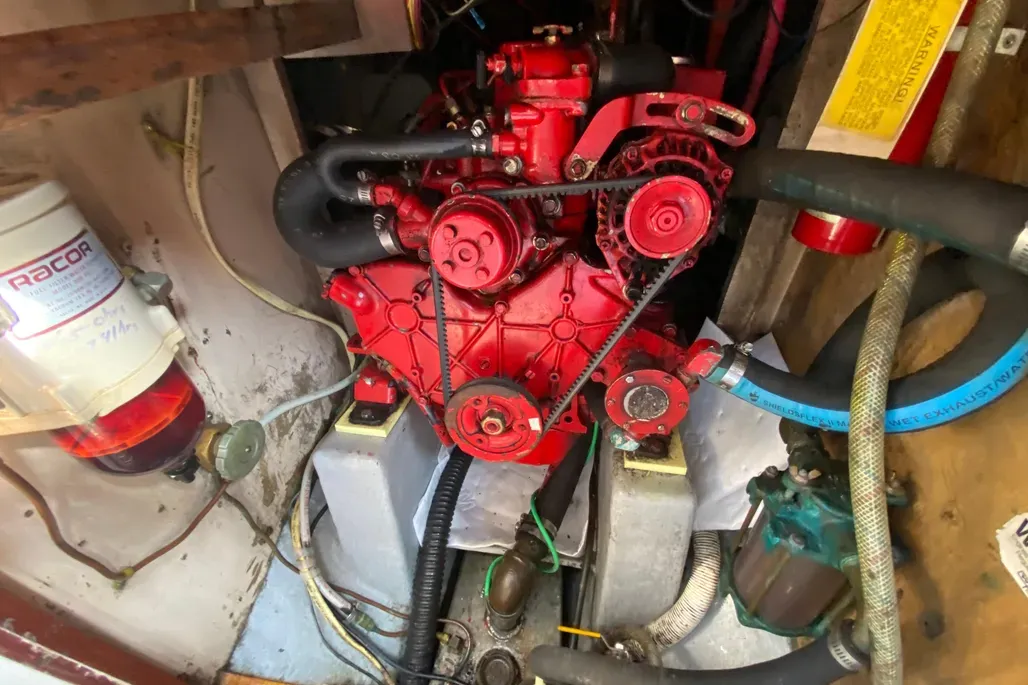
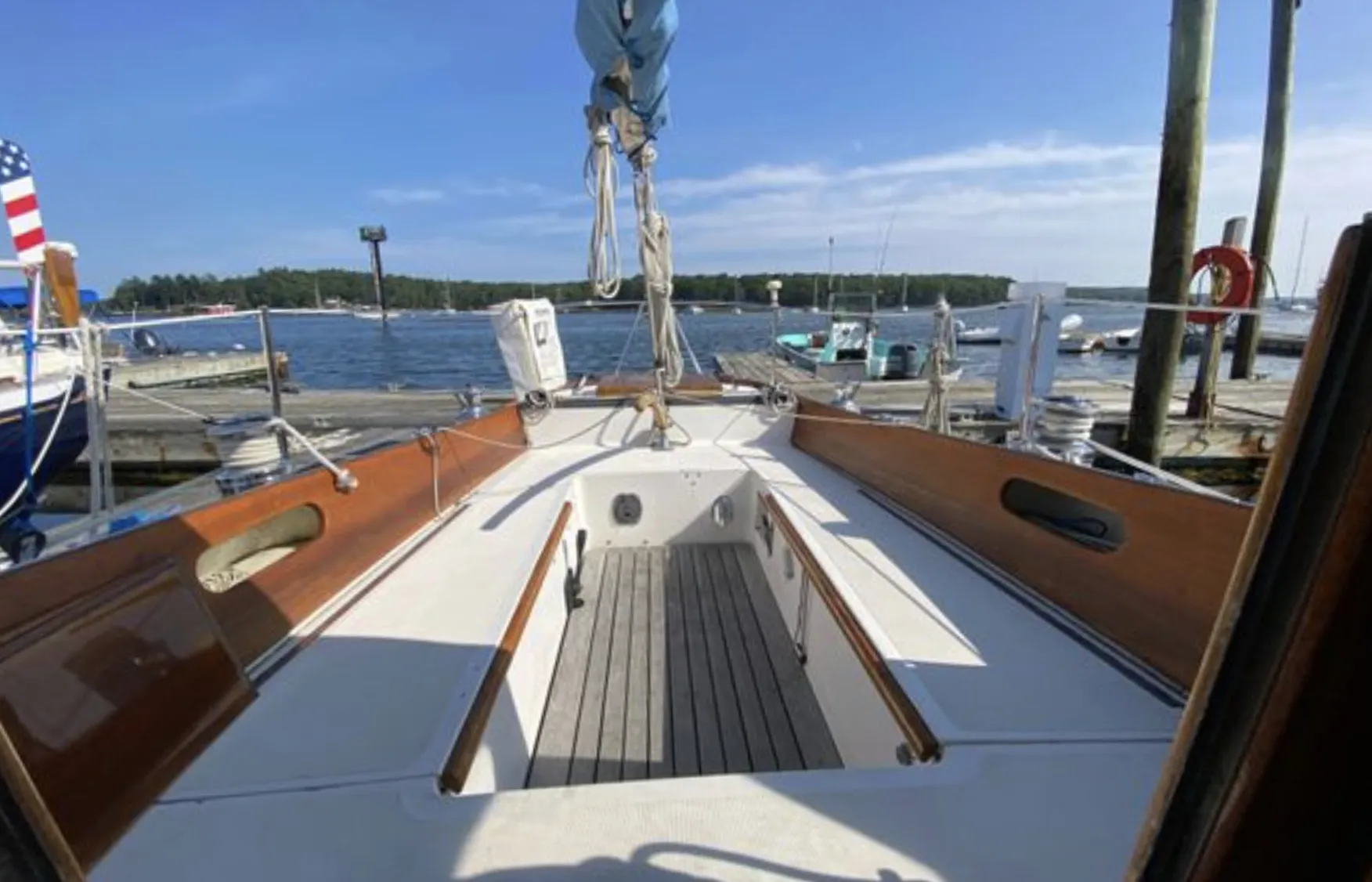
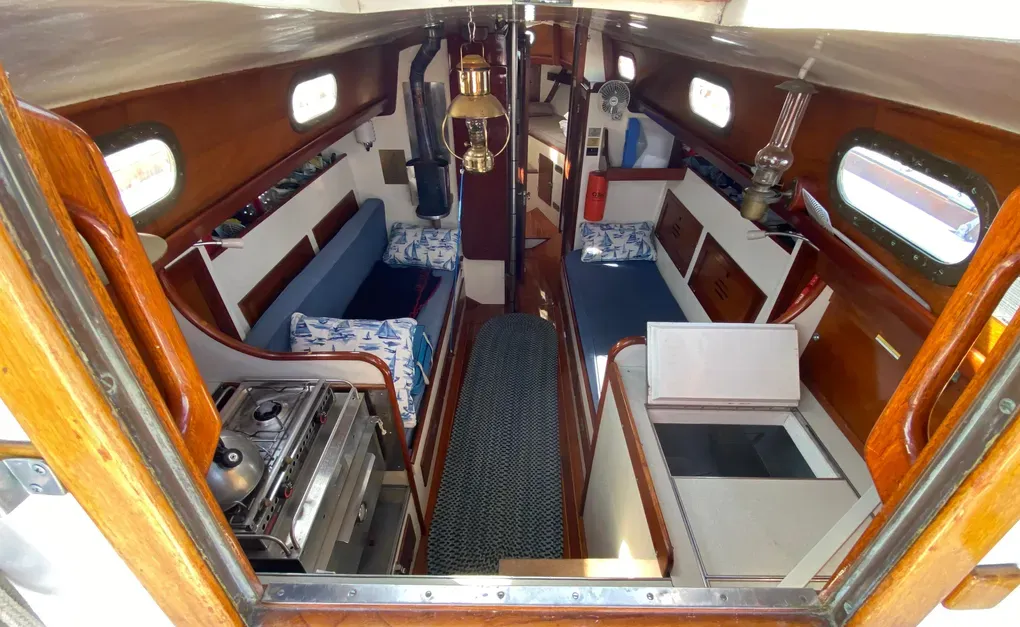
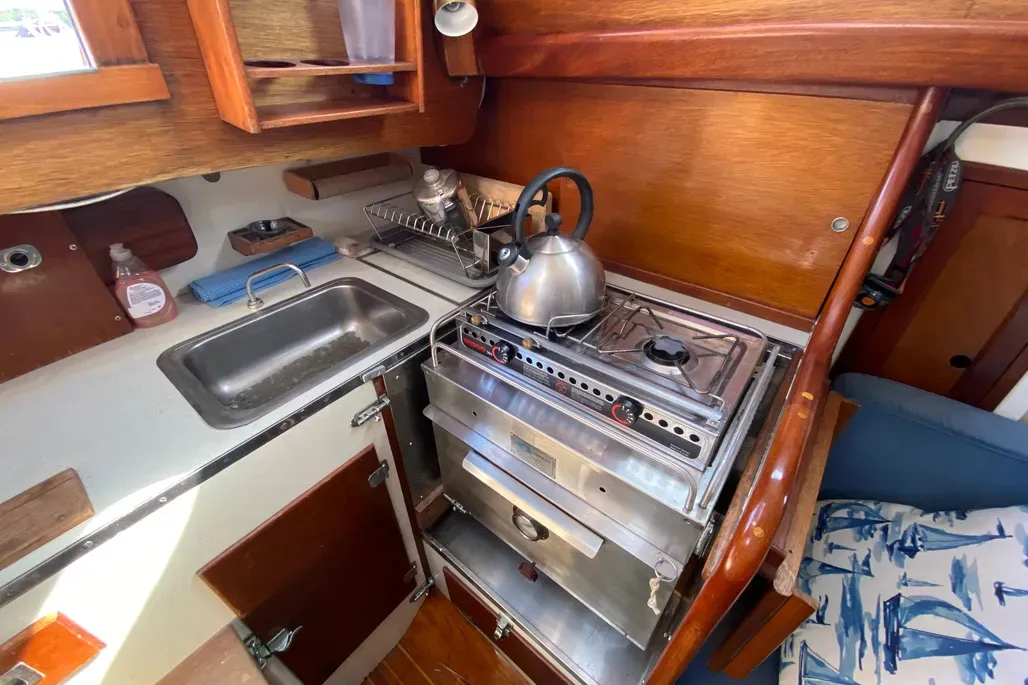
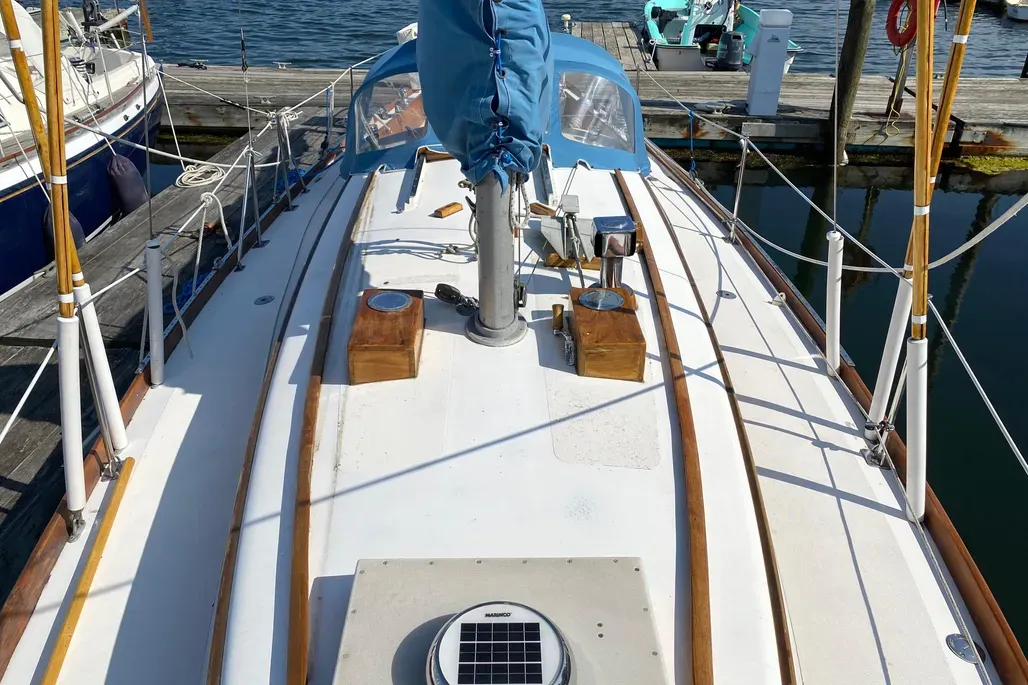
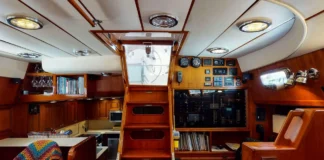
Conventional wisdom has it that fewer than one in ten sailboats today ever sees the race course. Such was not the case with the Hinckley Pilot. Block Island, Mackinaw, Monhegan, Annapolis-Newport, the Great Ocean Race Race— Pilots have been in them all and done well. They have also scored well or won championships in handicap series in San Francisco, Buzzards and Biscayne Bays. Overall, the ratio of Pilot owners who report having raced their boats is much closer to one in three than one in ten. One of the pillars of Sparkman & Stephens’ racing success has always been an emphasis on upwind performance. The Pilot 35 is no exception. Despite overlong spreaders and over-wide sheeting angles that were standard design elements in her era, she goes well to windward. To some, a Pilot 35 may seem tender, especially compared to modern boats with more beam, form stability, and deeper ballast. “They heel fairly fast initially,” says one sailor, “but if you keep the angle of heel under 20 degrees she’ll stay very lively and make very little leeway. She’s a real lady to sail when it starts to blow.” “I’ve always favored the sail combinations that the yawl rig makes available,” says another owner. “Also, as a CCA measurer I was not unaware of the rating advantage of the yawl rig. I could often sail with the sloops but enjoy a foot better allowance.” Sloop and yawl, however, the boats have compiled an enviable record. As boats and owners have grown older, however, and racing has evolved, fewer and fewer Pilots now make it to the starting line. Though her relatively low freeboard can invite the occasional wave aboard, her ends are full and she is acceptably dry in most conditions. Her short waterline combines with long overhangs to make her hobby horse, however. Thanks to her long keel, though, her motion is gradual—nothing like the snap-roll that some fin-keelers can be guilty of. “She’s a substantial boat that’s comfortable in a seaway,” an owner concludes. “What I’ve come to appreciate most about my boat in the more than 30 years that I’ve had her is her size,” an owner from Maine reports. “She’s big enough to be comfortable but small enough so that the loads never get to be overpowering. One man can do just about everything. When I’m trying to shoehorn into the head I want a bigger boat, but when it comes to sailing, I like the Pilot the way she is.” Almost every Pilot owner will tell you how badly she steers in reverse under power. “She certainly doesn’t go straight. It’s a case of learning your boat and adjusting.” The boats were originally equipped with Sea Scout or Atomic Four gas engines. Well over half of today’s owners have replaced those gas engines with diesels, the Westerbeke 4-99 supplied by Hinckley being the most common. Says one owner with a Westerbeke fitted with a three-bladed prop, “The engine is big enough so that we get up to cruising speed of 6 knots or better at less than 2000 rpm. It’s nice to have reserve power and to get where you’re going without any more noise or fuss than necessary.” Engine access on the Pilot has always been an annoyance. Most owners think their Pilots are very well-built. In fact, not a single one (from our modest sample of over 20) gave their boats anything less than highest marks in the construction category. Writes Don Danilek, compiler of the Pilot 35 Yearbook, “The Pilot’s construction, like her design, is legendary. From the faired stemplate with its integral chocks and tack fitting to the integral flagstaff as part of the stainless stern pulpit, the Pilot is the epitome of quality construction.” In reality, no one really knew what “the epitome of fiberglass construction” was in the pioneering days that produced the first Pilots. Therefore, they were overbuilt. The hull laminate in the way of her keel was up to an inch thick. Nowhere is her solid glass hull less than 3/8-in. thick. Her two hull halves (she was built in a clam-shell mold due to worries that her slight amount of tumblehome might make her difficult to release from a standard one-piece mold) are taped over with layers of matt and roving that make stem and stern virtually bulletproof. Bob Hinckley recalls a Pilot being dropped from a TraveLift six feet onto her stem. “Creased the gelcoat for about a quarter of an inch around the impact spot,” he remembers. Her 4,200-lb. lead keel was attached with 3/4-in. Everdur bolts. The hull and deck on the Pilots were joined using the system Hinckley employed on all of its boats: The deck was bedded on wet mat laid on a 6-in. wide inward flange on the hull. Screwed in place while the chemical bond set up, it was then capped with a toerail bolted through both flange and deck. “The method pretty well removes the problem of deck leaks,” Hinckley says. “All you might get is problems in the way of the chainplates or the stanchions, but we bed them very well, too.” Interior wood was equally robust, right down to the inch-thick treads of the teak and holly cabin sole. Extra fiberglass reinforcement went into the chainplates and in longitudinal stringers designed to stiffen the hull fore and aft. “When we first worked on our boat,” says Danilek, “my wife Jane remarked, ‘On this boat, when I lean on something, it leans back.’” At a displacement of 13,500 lb., the Pilot pays some performance penalty for being so strongly built. Many of today’s 35-footers not only afford more waterline and room but weigh in at from 3,000 to 6,000 lb. less. The lighter the boat, the less “dead weight” there is to subtract from performance. Also, in reckoning the cost of a boat you’ve got to figure on the cost of the materials that went into her. Heavier boats cost more for that reason. Still, it’s hard to argue with Hinckley’s success. One owner discovered mild blistering after 15 years. Another felt that the mast column did not provide enough support for her deck-stepped mast. Aside from those criticisms we gathered a raft of comments like: “Absolutely NO failure of rig or gear in 15 years!” “The gelcoat still looks good after 23 years.” “We’ve never had any problem getting insurance because she’s so well built.” “A boat for a lifetime. Hull/deck joint, standing rigging… all top drawer.” It’s certainly possible to use materials more efficiently and produce sprightlier boats, but Hinckley’s conservative brand of over-building has produced boats that have consistently proven durable as well as capable through the years. Pilots have been built with four, five and six-berth layouts. All of the arrangements have been geared to the boat’s narrow beam and long ends. This makes for very workable accommodations in a seaway: Grab rails are always close at hand and there’s never very far to fall. Elbow room for relaxing, dining or gathering is at a premium, though. The five-berth plan, chosen in about one quarter of the boats built, makes, we think, the best use of the main cabin space and comes closest to the sort of “main saloon” that contemporary designs offer in a boat of this size. The ice box feel of fiberglass was a worry when the switch came from wood. Hinckley’s answer was to “build a wooden boat inside the glass one.” Except for the smoothed and comfortingly painted overhead, everything below was made of or sheathed with wood. Phillippine mahogany (later replaced by Honduras) sheathed hull sides, bulkheads and the underside of the decks so “not an inch of fiberglass shows.” “During the mid-60’s we were building a Pilot a week,” Bob Hinckley remembers. “A big key to keeping that pace was the amount of pre-fabbing of interior elements that we did outside the boats.” The Pilot was one of the first cases in the glassboat era of keeping the quality in a boat while taking hours out of building her. It was the woodshop where most of those efficiencies were achieved. ”Superbly…” “Splendidly…” “The company has been very responsive…” Few and far between are the Pilot owners who don’t have very good things to say about Hinckley. The excellent reputation that the folks in Southwest Harbor enjoy today began, we feel, at least in part with the Pilot. With the shift from a workmanlike wooden pleasure boat to an elegant, high quality mini-yacht, the company staked out the trail it was to follow up to the present—traditional appeal, rugged construction, and a focus on quality, which all result in enjoyable boats. Hinckley also grew from being just a builder to being an outfitter, authority and maintenance helpmeet. Take the number of Pilots (almost half) that have been returned to Southwest Harbor for Awl-Gripping, a new interior, a carbon fiber spar, and other refit items. The “family center” keeps drawing boats back and sending them forth refurbished and gleaming. And keeping the boats new is keeping Hinckley green. Finally, take the case of the “factory installed extra.” Hinckley has definitely done the homework necessary to keep its boats outfitted with gear and equipment that suits their character as well as makes things easier for their owners. Take the modestly-priced cabin heater. How many owners would have known and cared enough to put a fireplace below on their 35-footer, but the little stoves (“They really don’t work all that well. I’d prefer an Espar heater under the cockpit seat,” Bob Hinckley says) are just one of the many added elements that gave this classy little auxiliary her sparkle when she first arrived. Decades later, while there may be better ways to stay warm below, the Pilot 35 still keeps a lot of her glow. Contact – www.hinckleyyachts.com This article was published 12 June 2001 on and has been updated.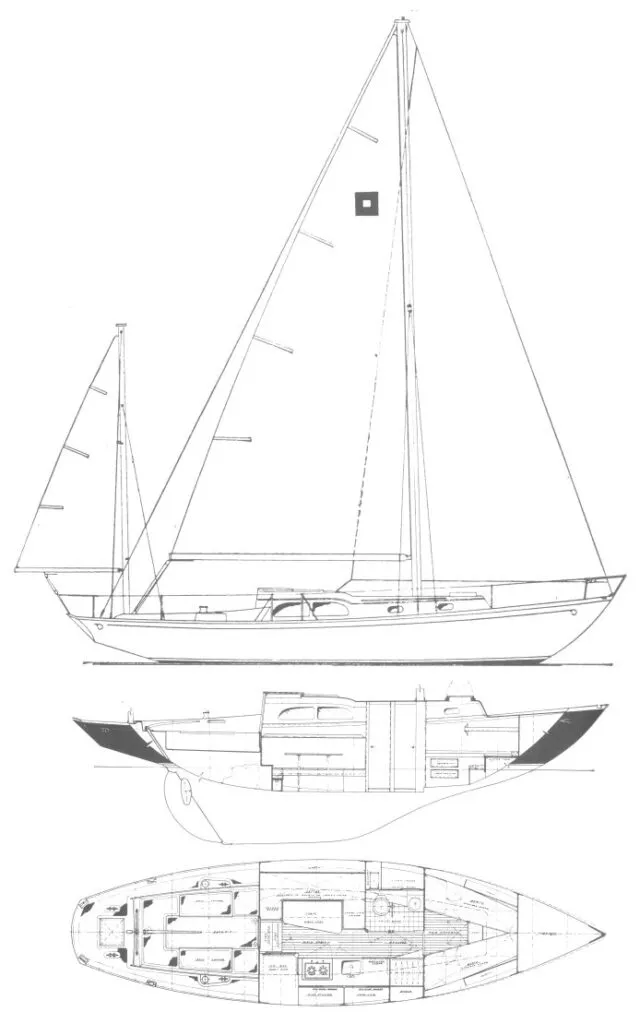
Sailboat Specifications Courtesy of Sailboatdata.com
Hull Type: Long Keel
Rigging Type: Masthead Sloop
LOA: 35.75 ft / 10.90 m
LWL: 25.00 ft / 7.62 m
S.A. (reported): 550.00 ft² / 51.10 m²
Beam: 9.50 ft / 2.90 m
Displacement: 13,700.00 lb / 6,214 kg
Ballast: 4,600.00 lb / 2,087 kg
Max Draft: 5.00 ft / 1.52 m
Construction: FG
Ballast Type: Lead
First Built: 1962
Last Built: 1975
# Built: 117
Builder: Henry R. Hinckley & Co.(USA)
Designer: Sparkman & Stephens
Make: Westerbeke
Model: 4-107 FWC
Type: Diesel
HP: 35
S.A. / Displ.: 15.42
Bal. / Displ.: 33.58
Disp: / Len: 391.43
Comfort Ratio: 37.39
Capsize Screening Formula: 1.59
S#: 1.09
Hull Speed: 6.70 kn
Pounds/Inch Immersion: 848.61 pounds/inch
I: 40.25 ft / 12.27 m
J: 13.83 ft / 4.22 m
P: 35.08 ft / 10.69 m
E: 15.50 ft / 4.72 m
S.A. Fore: 278.33 ft² / 25.86 m²
S.A. Main: 271.87 ft² / 25.26 m²
S.A. Total (100% Fore + Main Triangles): 550.20 ft² / 51.12 m²
S.A./Displ. (calc.): 15.43
Est. Forestay Length: 42.56 ft / 12.97 m
Performance
Handling and Comfort
Maneuverability Under Power
Construction
Hull and Deck Integrity
Materials and Durability
Accommodations
Conclusions
Market Scan Contact
1964 Hinckley Pilot 35 East Coast Yacht Sales
$54,500 USD 207-283-0774
Georgetown, Maine Yacht World
1964 Hinckley Pilot 35 Gray & Gray Yachts
$44,500 207-387-7167
Harpswell, Maine Yacht World
1970 Hinckley Pilot 35 Metinic Yacht Brokers
$67,000 USD 207-606-7403
Harborside, Maine Boats.com







Interesting article, but, as I’ve written before, why do I never see a review of the Taswell line…specifically of the Taswell 43? Please do a review of it, either on facebook or written.