

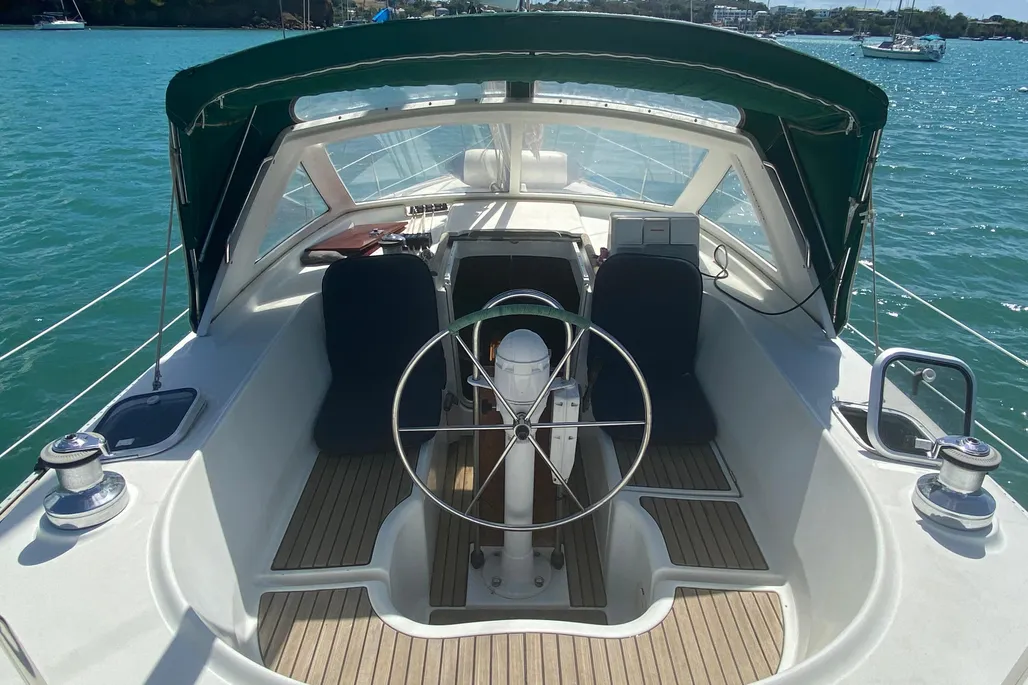
Center cockpit sailboats still make good cruisers. In the early 80s, the Morgan Out Island 41, a pioneer among center cockpit production boats, was the most popular auxiliary over 25 feet. The pendulum has since swung toward all-round performance and a yachtier aesthetic; nowadays most new cruising boats have aft cockpits. Still, the center cockpit alternative can be a good one.
Center cockpit cruisers offer the maximum in two-couple privacy, simplify control from the cockpit sail handling, afford superior maneuvering visibility, and most sailors find enclosed center cockpits more secure than lower, more-open aft cockpits. And a center cockpit plan layers functions one atop the other to provide, especially in the 35 to 45-foot size range, the maximum in interior space and living room.
Taking one upwind in a chop may not be an exquisite experience and many are boxy and hard to look at but center cockpits have their strengths.
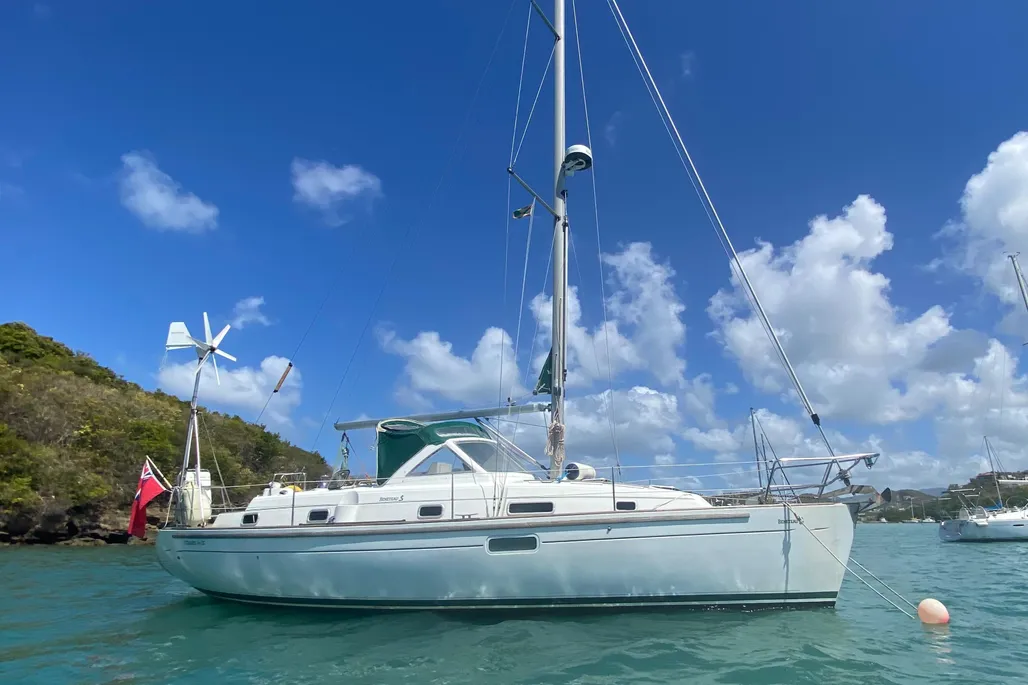
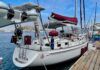
The Beneteau 36 CC is a good example of the modern center cockpit cruiser. What mid-cockpit boats do well, she does remarkably well. Her accommodations are exceptional. And she is a better sailboat than her kind have tended to be. Making a hull that is one third as wide as it is long perform well is a trick. Making a snub-nosed, turtle-back profile look pretty is a trump. Designer Jean Berret (Berret/Racoupeau) and stylist Armel Briand, have, however, come quite close.
The Company
Beneteau is the planet’s largest sailboat builder (over 25 feet). The company dates back to 1884 when Benjamin Beneteau founded a yard at Croix-de-Vie on the Atlantic Coast of France. Today, it is a worldwide operation. It is hard to find economies of scale in sailboat building. Niche builders and custom shops are much more prevalent than colossal companies. Still, Beneteau’s size offers advantages.
The hours that it takes to build a boat are a very significant variable in its price. From designed-to-be-built stipulations in the planning stages through production line efficiencies and labor-saving automation, Beneteau succeeds at taking out of its boats hours that smaller builders can’t. Further benefits include serious purchasing power, ongoing in-house research and development, and the resources to engage design masters like Berret, Finot, Andre Mauric, Philippe Starck, Pinafarina, and Bruce Farr.
Although the Beneteau giant employs around 8,000 people and spans the globe, it has kept sailors in the company loop, retained most customers as friends, and been responsive to market realities. It would be hard to confuse Beneteau chairwoman Catherine Pourre with Henry Ford, and the Oceanis 36 is hardly a cruising Volkswagen. Still, Beneteau’s size helps it market sailboats.
The Design
Jean Berret’s rise in Grand Prix racing began in the 80s with Ton Cup successes and climaxed with the Beneteau One Ton that dominated Admiral’s Cup competition in 1987. He has since worked closely with Beneteau, drawing more than a dozen models in the First (racer/cruiser) line.
Beneteau’s Oceanis (full cruising) line began in the early 80s with designs to emphasize ties with the elements instead of shielding sailors from the sea and sun. The Oceanis series was well-received, with their swim platforms, transom showers and hull windows. They left, however, something to be desired in point-to-point speed and sailing efficiency. 1990s models, like the 45F5 from Farr, helped address that. Berret then added sizzle to the center cockpit cruisers.
Hull Shape
The shape of the 36’s hull throws no roadblocks in the way of performance. The hull began, in fact, as the First 36 performance cruiser. It has a narrow entry. The forebody is relatively straight sided. This entry wedge is what most tubby center cockpit hulls lack. The Oceanis 36 CC is thus an improvement on the breed upwind. Her transition to wide-bodied midsections is graceful.
What is essentially a very beamy boat is differentiated from a swimming float by the way in which her sectional shape and hull rocker are massaged to make her powerful without being clunky. Her beam-to-length proportions are not sylph-like, but both wetted surface and displacement are kept to a minimum. She also has a long, gradual exit that lengthens her effective waterline. A deep (4-ft. 8-in.) high-aspect ratio rudder is generous. What it costs in wetted resistance is more than paid back through control. Given a 315 sq. ft. mainsail and a 6-foot deep keel, the hull works well for the First 36S7, which has the same hull. However, with a 258 sq. ft. mainsail and a 5-ft. 2-in. wing keel, the Oceanis 36 CC won’t sail the same.
The First displaces 11,684 pounds, the Oceanis 13,382. Factor in the drag of the keel wings at moderate or slow speeds and performance suffers again. Add the reduced efficiency of a roller-furling main and performance goes down further. Even though its hull is race-bred and efficient, the Oceanis 36 has performance limitations. Her displacement/length ratio is 197, and the sail area/ displacement ratio is a lackluster 15.65.
Built for Comfort
But you can look at it the other way. The Oceanis 36 is built for comfort. She offers more head and elbow room, more usable space, than many larger boats. Putting all of that in a race-bred hull, while it doesn’t equal built for speed, still improves the sailing abilities of built-for-comfort. The rig is a standard, if slightly short, masthead configuration. The genoa is 60 percent of the overall sail area. It is an efficient and time-tested combination but one which means more muscle work in a breeze than many cruisers like to expend.
Interior Design
In 1988, Beneteau teamed up with Philippe Starck. Called the new le Corbusier by some art critics, he made his name by designing furniture, then night clubs, then jewelry, even pasta. When it came to working with Beneteau, he said, “Everyone has dreams in their head of how things should be. I try to match the thing to the dream. Boats are no different.” Styling for the Firsts then went into an old-time luxury liner motif on the inside and designer signature patches on the transoms (just like blue jeans).
Beneteau still uses a designer/stylist modus operandi, but Armel Briand, stylist for the Oceanis 36, is more traditional than Starck. A faceted transom; a subdued, blister house line; and an elongated hull port are elements of his exterior style. Below there is nothing as unique as Starck’s pewter fixtures, gull wing windows, and bird’s eye mahogany paneling, just understated wood and white with splashes of upholstery.
The Interior
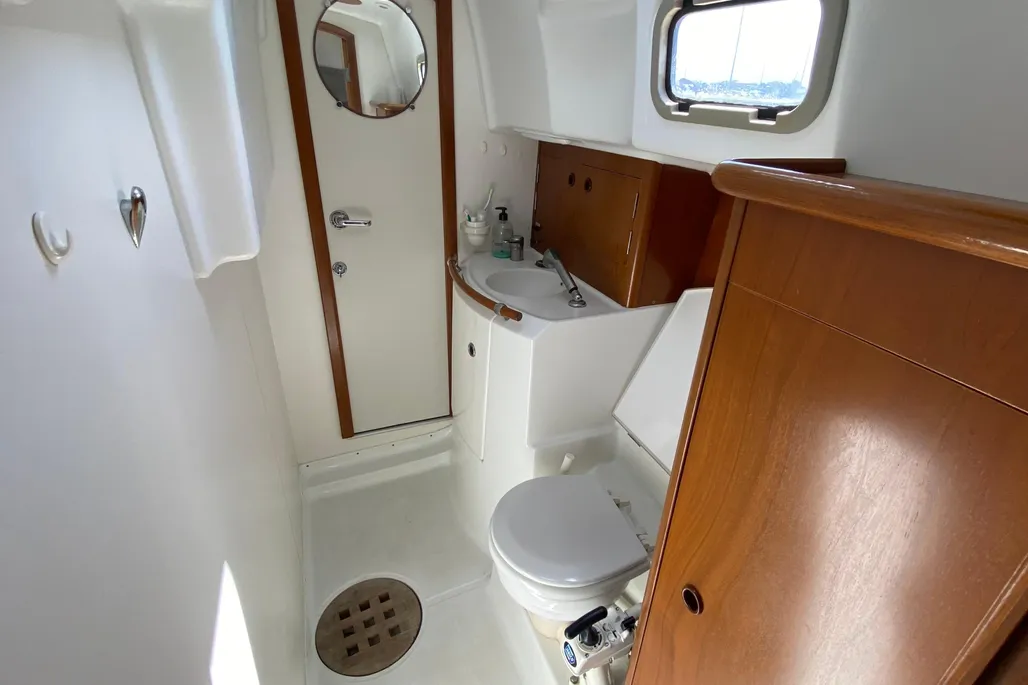
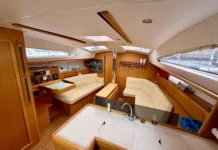
While the Oceanis 36 is wide, she’s not overwhelmingly deep. That helps her appearance, but it means that headroom throughout is limited to 6-ft. 1-in. with 6-ft. clearance in the head and galley/passageway. That said, the staterooms, head, galley, and saloon are all exceptionally roomy. The engine room (beneath the companionway) is also much bigger than most. Access to filters, injectors, oil fill, et. al., is superior. Hard to find in most boats this small, theres also realistic room for auxiliary machinery (air conditioning, generator, etc.).
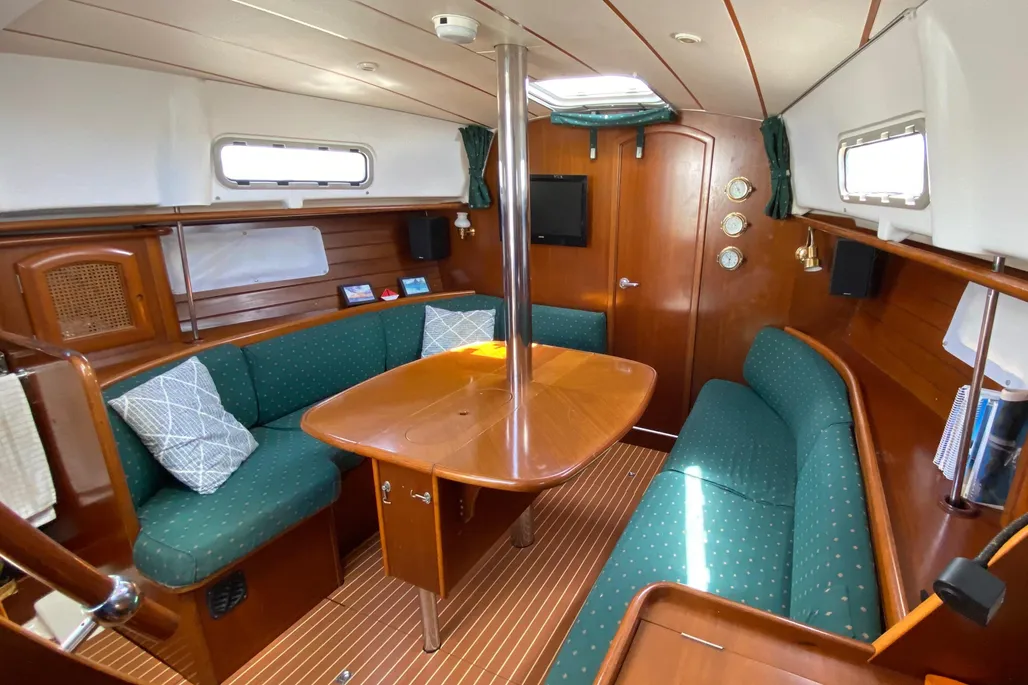
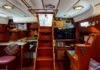
While both platform double berths are wide, they are short (6-ft. 2-in. aft and a tapered 6-ft. 4-in. forward.) The aft cabin is a master cabin, however, with settee, vanity mirror, and hanging locker. Forward on the starboard side is a generous and well-designed head/shower. One of the few tight spots is where the forward head door swings open into the navigation area, but a disappearing seat for the oversized nav table helps.
Galley
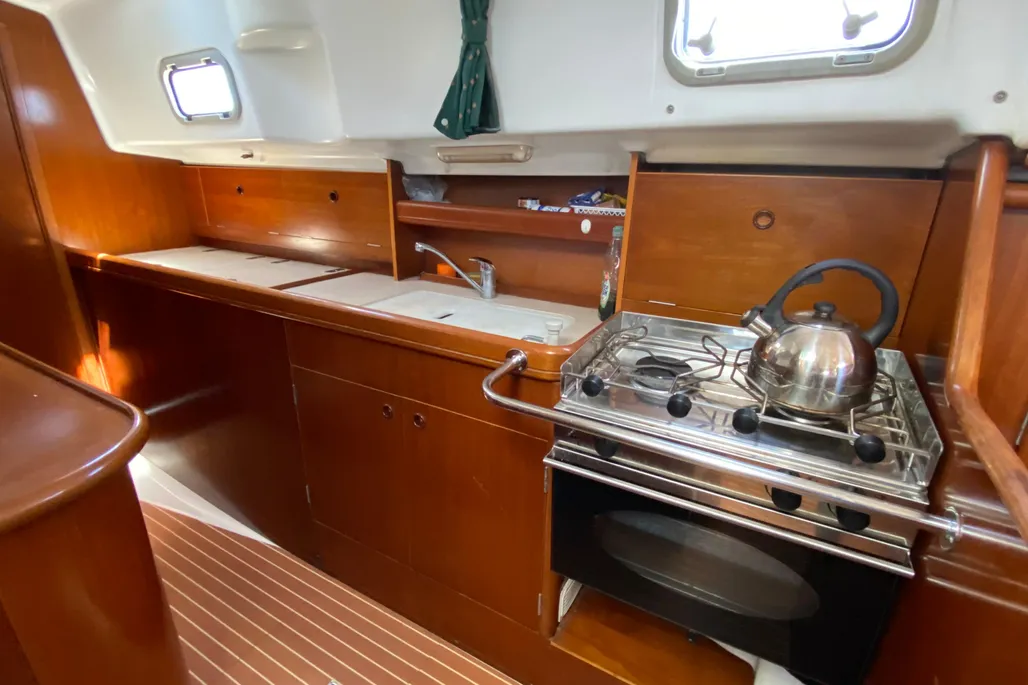
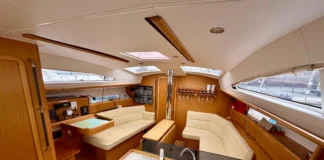
The galley is ranged along the port side outboard of the passageway. Well-designed for work at sea, it affords 6 ft. of counter space as well as good light and air. The saloon makes use of the boats beam with wide shelves extending out to the hull sides behind the settees. Big areas of convenient stowage plus an open feel are the advantages. Hull ports provide light plus a view. The forward cabin has two hanging lockers. Locker fronts throughout are caned. Interior finish is a Beneteau hallmark. Few production boats offer the same amount and quality of lustrous, well-worked wood below. We wonder about the living in a show room feel of life aboard, but were not complaining!
Construction
Most Beneteaus are built using interior liners. The Oceanis 36 hulls are hand-laid in a female mold using vinylester resin in the skin of the laminate to combat osmosis and polyester resin in the rest of the laminate. The company says no more about laminate schedules. Compared to resin transfer methods such as SCRIMP, which improve glass-to-resin ratios (yielding lighter, stronger hulls), hand lay-ups now are pretty ordinary.
While still in the mold, the hull is reinforced with a full-length fiberglass grid structure. Extending in most areas to a foot above the waterline, the grid is a complex system of athwartships and longitudinal molded stringers and floors that stabilize the hull and distribute rig loads and working strains. It incorporates molded-in, stainless steel chainplate tie-downs, engine bed, water tanks and sump. The liner is made of woven plus unidirectional glass and polyester resin and is bonded over much of its surface to the hull. The success of the method depends on the precision and strength of the bond. Beneteau has been building boats this way since the late 70s. Its track record is good.
Rudder
One thing that has changed is the rudder assembly. It is a composite rudderstock (made of unidirectional glass and vinylester resin) wound with a continuous filament of unidirectional glass (and polyester resin) to form an integral shaft/blade. The stainless/fiberglass amalgams that it replaces were costlier and trouble-prone. The composite shaft has a breaking strength nearly three times greater than the stainless.
However, a number of Beneteau owners complain about play in their steering systems. One owner, who had a new bearing plate installed (at no charge by Beneteau) between the top of the shaft tube and the quadrant, said that Beneteau fixed the problem just about completely. The composite shaft also eliminates the widespread problem of corrosion inside the rudder, usually where the rudderstock is welded to the webs.
Deck
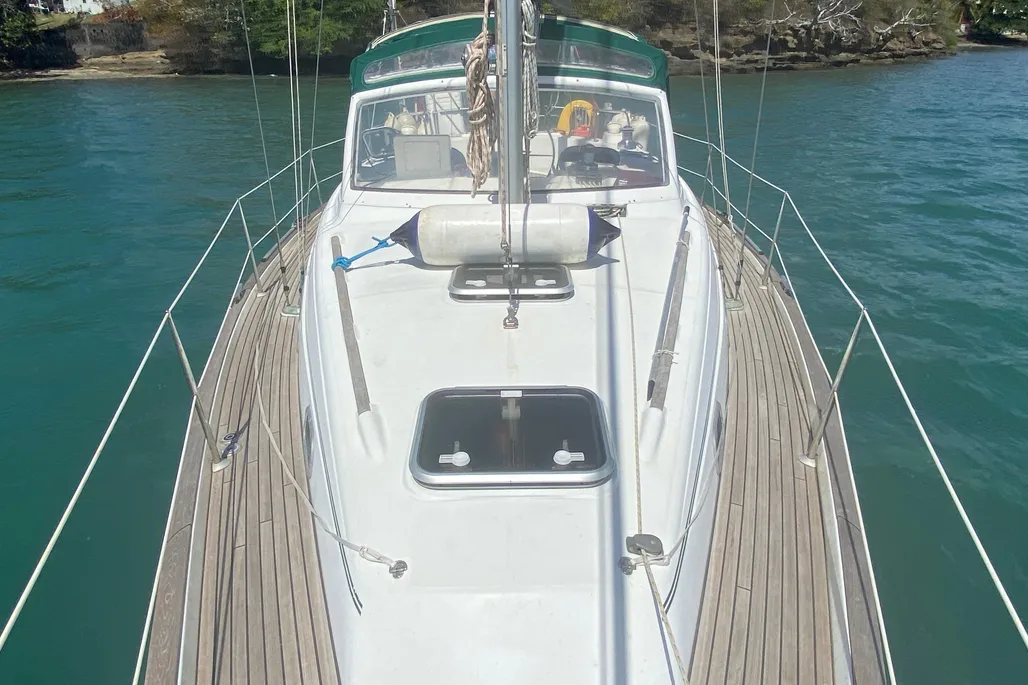
End-grain balsa forms the core for the deck. Beneteau does the right thing in terms of using solid glass wherever hardware is attached, but, as is true with most boats, you may face a substantial chore to mount additional deck gear correctly.
The deck is placed atop an inward-turning hull flange. The joint is bonded with space age polyurethane glue and mechanically fastened through the teak toerail with screws. There is no fail-safe aspect to the design; it depends on care, precision, and experience (as well as the properties of the adhesive.) Here again, Beneteau’s history is good.
Keel
The keel is iron, which requires an epoxy treatment to prevent corrosion. We prefer lead, which is denser and non-corrosive, and, of course, more expensive. Don’t forget that Beneteau, like Hunter and Catalina, is highly value conscious.
Sails
A furling mainsail and genoa are standard. Beneteau used to use Isofurl, but after some problems in Europe with some Isofurl headsail furlers failing (a number of rigs fall down, all in Europe) a recall was issued. The Isofurl headsail furlers were replaced with Facnor, another French vendor not widely known in this country.
Performance
Most boats are at their worst beating in light to moderate air and a seaway. In these conditions, we found Oceanis worse than most. She gets almost all of her power from her headsail, and the rail-mounted genoa car tracks don’t allow tight sheeting angles. The parasitic drag of a winged keel is most insidious in these conditions and the roller-furling main isn’t big enough (or shapeable enough) to be much help. From here, things get better. More breeze provides more power and puts less of a premium on the efficiency of the overall rig.
The Oceanis is beamy. This gives her fine initial stability. Her ballast/displacement ratio is only 31 percent, however. That means that once she starts to heel her righting moment drops sharply-she becomes tender. Reefing is an easy solution, but, especially with the standard (too full when rolled part way) headsail, it didn’t prove to be a good one. The boat is not meant to be raced nor is she designed to supply that last 10 percent of optimal upwind speed.
Off the wind, the 36 is a chunky rocket. Her relatively clean underbody, good initial stability, fine entry, long waterline, and graceful exit help her click off the passagemaking miles very quickly. Even when she heels in a puff and buries a hip, she will answer to her deep rudder rather than spinning out.
Under power, the 27-hp. Yanmar diesel pushed her easily to hull speed with plenty of throttle in reserve. Backing to starboard is hard until she gets moving. She climbs to port right away in reverse (with a three-bladed prop) but will steer once she develops even a small amount of stern way.
For people under 6 feet, the Oceanis 36CC offers more living space than any boat we’ve seen of comparable size. The accommodations are not only roomy but attractive, practical, and functional-either for cruising or for living aboard. She goes to weather better than most similar boats, but she falls short of being a good upwind performer. She reaches and runs with good quickness. In some ways, Beneteau can offer more product for less money than many of its competitors, especially in the area of finish and outfitting. The breadth of its dealer network and the depth of its building history are additional plusses. That, and the fact that there aren’t many other new boats quite like the Oceanis 36 CC, make it a new boat to consider. New, the base price was $126,500. For comparison, a Hunter 376 started at about $120,000 and a Catalina 36MKII at about $107,000. Production for the 36 CC ended in 2003, and used models are currently selling between $57,300 and $69,000.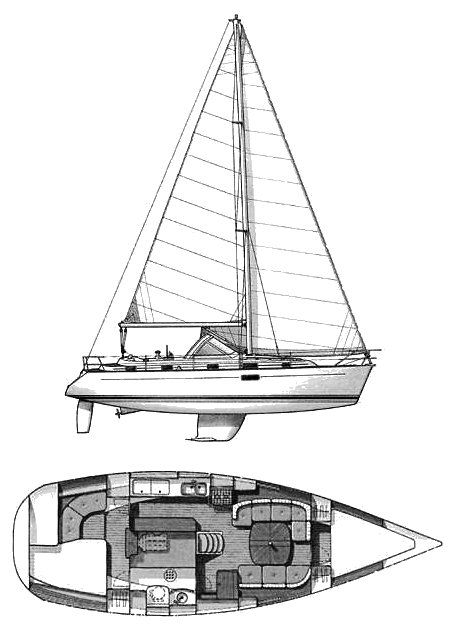
Sailboat Specifications Courtesy of Sailboatdata.com
Hull Type: Wing Keel
Rigging Type: Masthead Sloop
LOA: 36.42 ft / 11.10 m
LWL: 31.16 ft / 9.50 m
S.A. (reported): 630.00 ft² / 58.53 m²
Beam: 12.50 ft / 3.81 m
Displacement: 13,228.00 lb / 6,000 kg
Max Draft: 5.00 ft / 1.52 m
Construction: FG w/balsa core deck
Ballast Type: Iron
First Built: 1998
Last Built: 2002
Builder: Beneteau
Designer: Berret - Racoupeau
Make: Volvo
Model: 2030
Type: Diesel
HP: 28
Fuel: 40 gals / 151 L
Water: 110 gals / 416 L
S.A. / Displ.: 18.09
Disp: / Len: 195.19
Comfort Ratio: 21.61
Capsize Screening Formula: 2.12
S#:
Hull Speed: 7.48 kn
Pounds/Inch Immersion: 1,391.73 pounds/inch
Conclusions
Market Scan Contact
1997 Beneteau Oceanis 36 CC Clarke and Carter Carribbean
$59,000 USD +1 473 422 6418
St George, Granada Yacht World
1999 Beneteau Oceanis 36 CC Prestige yacht Sales
$69,000 USD 203-344-7462
Stamford, Connecticut Yacht World
1999 Beneteau Oceanis 36 CC Seacoast Yachts
$64,900 USD 562-374-7213
Long Beach, California Yacht World







Late review….
Didn’t Beneteau stop making these in 2003?
Beneteau probably has production dates on their website. We have several decades of boat reviews on the site. Thanks for the heads up, I’ll have someone go through it and try to bring it up to date.
Dear Darrell,
I recently posted this on a sailing forum recently. You obviously know a lot about this boat, perhaps you can help?
Davits on 1998 Beneteau Oceanis 36c
…
Hey everyone.
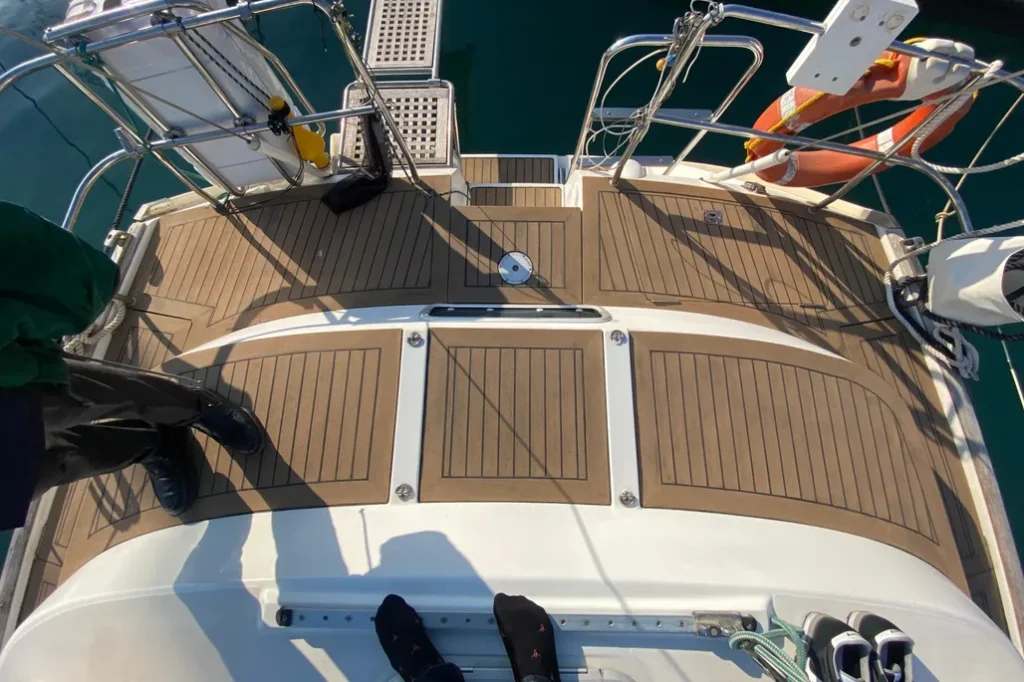
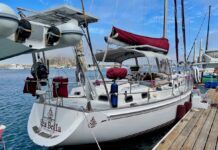
I’m trying to understand the load capacity for the davits that are installed on my 1998 Beneteau Oceanis 36cc. I.e how much weight can the davits hold?
I have checked inside the boat and it appears that the davits are original from the factory build as the starboard davit bolts and backing plate are mounded into the fiberglass.
There are no markings (make/model#) on the davits etc so I’m not sure who built them (Beneteau or another company for Beneteau)
Does anyone have this capacity info or suggestions on how to figure it out?
Many thanks
Oli