

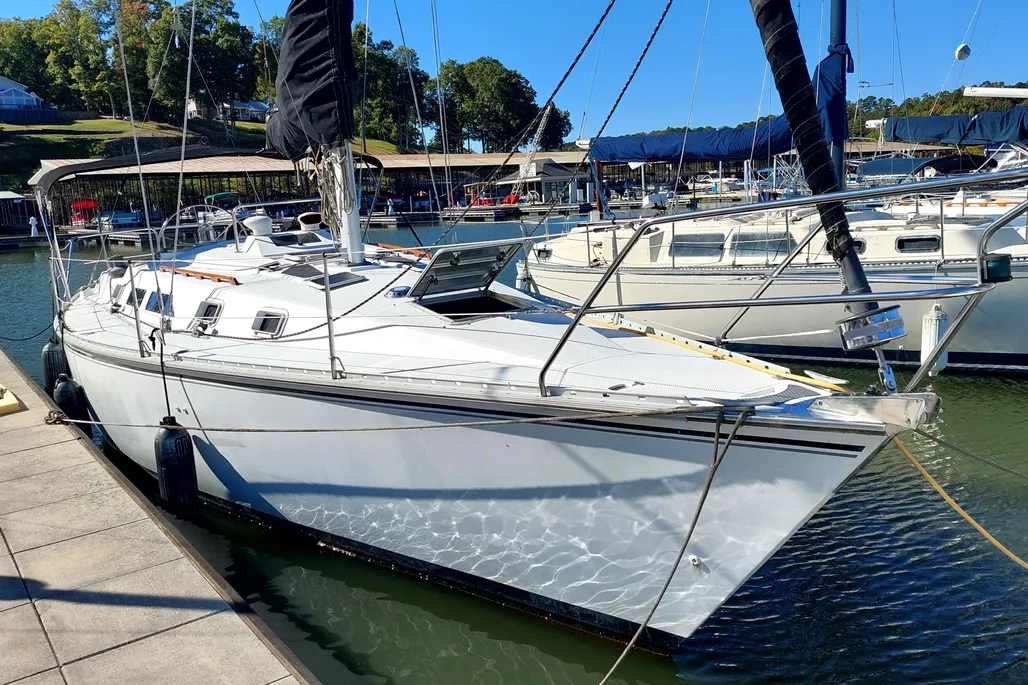
When the Hunter 34 was introduced in late 1982, it was the second of the “modern” generation of Hunters, the first being the rather remarkable Hunter 54. The Hunter company, which is now shuttered, was strongly identified with the long-distance singlehanded racing of its former president, Warren Luhrs, who died in 2013. Luhrs’ racing boat designs were innovative, and the concepts of innovation and high-tech rubbed off, to some degree, on Hunter’s production boats.
Hunter always went after the entry-level cruising boat owner, and traditionally pushed its “Cruise Pac” concept—a boat delivered equipped down to the life jackets, and ready to go. This certainly reduces the amount of decision making required by inexperienced boat owners, and was a successful marketing strategy. For more experienced sailors who would rather choose their own gear, the Cruise Pac idea is not necessarily a plus.
In just over three years, over 800 Hunter 34s were built. For the 1986 model year, the 34 was phased out in favor of the even more Eurostyled Legend 35.
A number of Hunter 34 owners responding to our survey moved up from smaller boats in the Hunter line—exactly what every builder would like to see happen. All reported that the Hunter 34 was lightyears ahead in both design and workmanship compared to earlier models.
Because the Hunter 34 was only in production for a few years, few changes were made between model years. You are therefore less likely to find major upgrades on older boats than you would find on a boat that has been in production for a long time.
Sailing Performance
The Hunter 34 is a fast boat, particularly in light air. This is due almost entirely to her huge rig, which towers over 51-ft. above the waterline. Owners report that in winds of from seven to 12 knots, the boat is practically unbeatable in club racing. The typical PHRF rating of 135 for the deep keel boat is faster than most other cruiser/racers of her size.
There is a price to be paid for that speed, however. A number of owners responding to our survey report that the original Hunter 34 is a very tippy boat, in either the deep keel or shoal draft version. In winds of 15 knots true or more, it’s time to reef the main when going upwind. In fact, the boat’s lack of stability is the single most commonly criticized aspect of the Hunter 34’s performance in our survey. One owner was considering cutting several feet off his mast. Others have stepped down from 150% headsails to 135% or smaller overlaps.
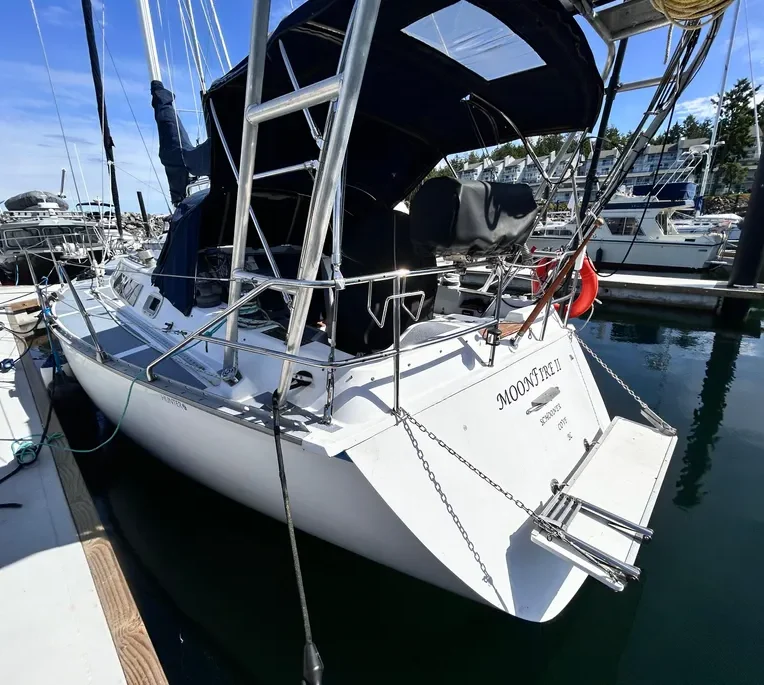
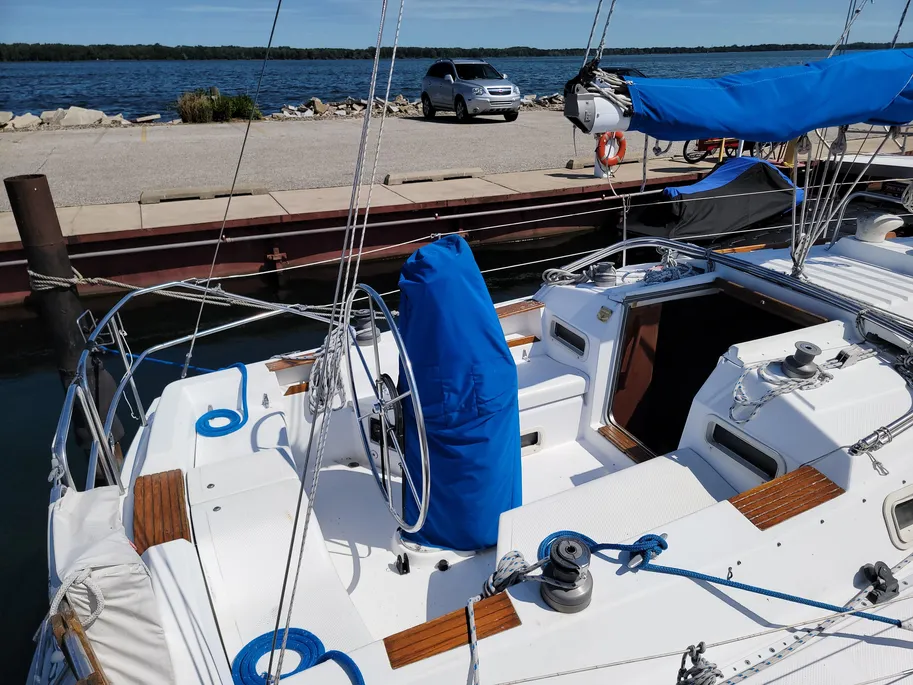
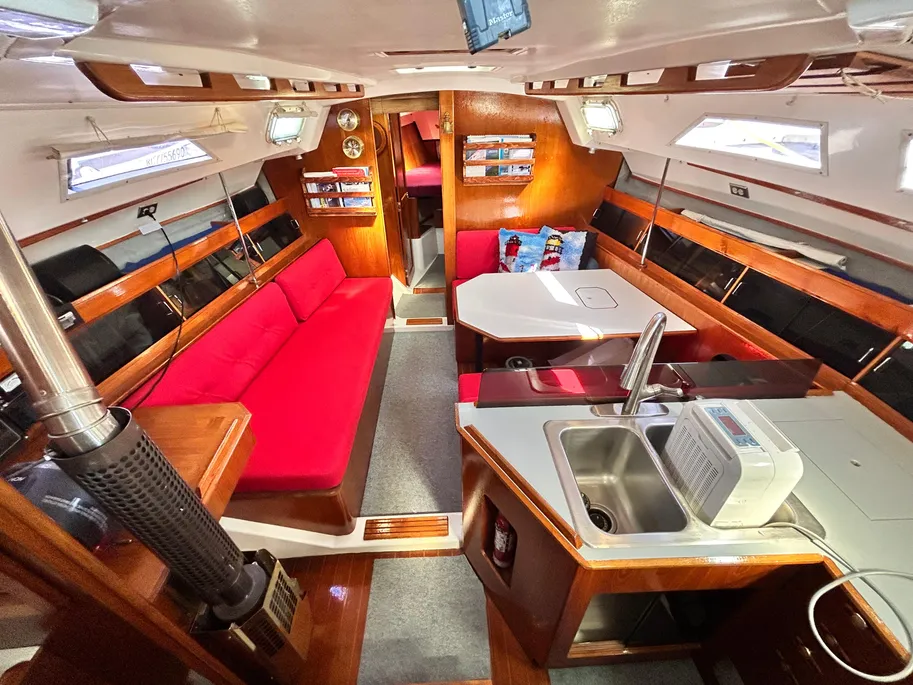
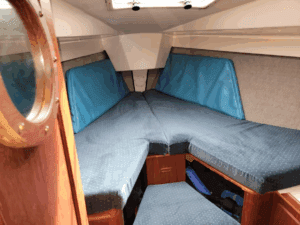
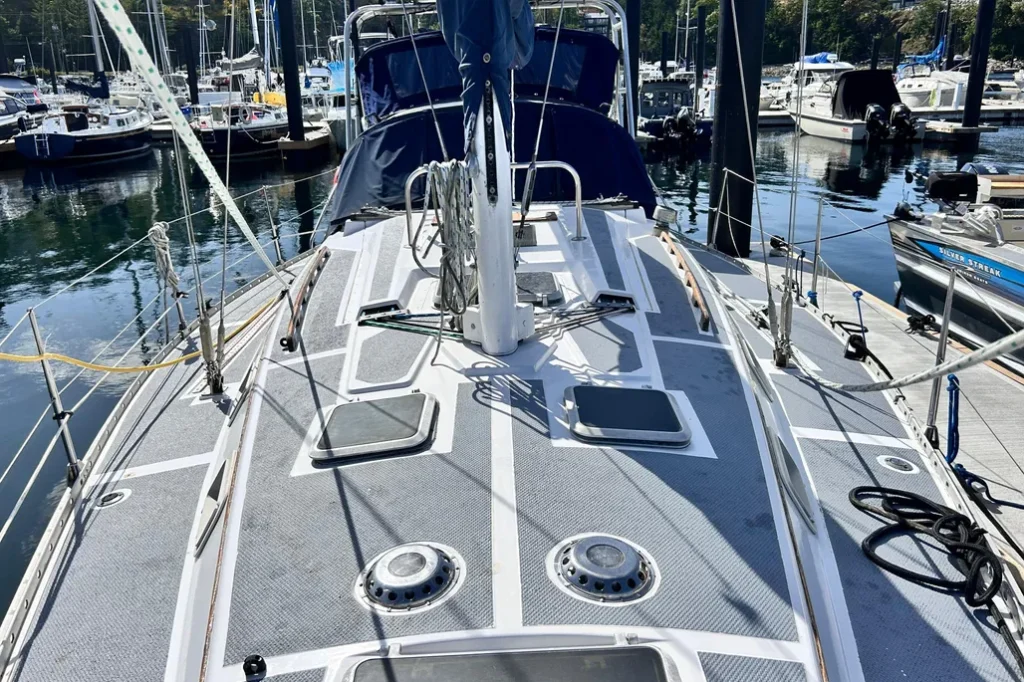
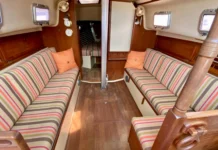
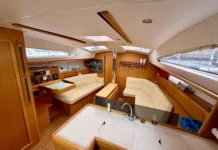
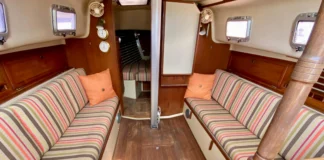
Normally, you would expect a boat with a 42-percent ballast/displacement ratio to be stiff. The keel of the deep-draft Hunter 34, however, has most of its weight and volume up high, while the shoal draft keel, even with its extra 220 pounds of ballast, still has a fairly high vertical center of gravity. This just goes to show that you can’t judge a boat’s stability by its ballast/ displacement ratio—you’ve got to know how far down that weight is, too. Models late in the production run had more ballast. The 1985 Hunter 34 brochure shows about 450 pounds more ballast than in the 1983 model. For cruising, the additional ballast would be a real plus. For club racing with a full crew, the lighter boats could be sailed faster. Using headsails smaller than 150% on the Hunter 34 would be a good idea, particularly if you couple them with a modern roller furling system. A 135% jib can more effectively be reduced to 110% than a 150% genoa can be reefed to 120%. Since the boat is sensitive to sail area, a good headsail roller furling system is a must, in our opinion. According to several owners, the Hunter 34 carries substantial weather helm in anything more than very light air. This may in part be due to the boat’s tenderness. As boats with wide sterns and narrow bows heel, the waterplane becomes substantially asymmetrical, which can give the boat a pronounced tendency to head up. This weather helm may be exacerbated by an original rudder design that some owners report was both too small and too weak for the boat. Several owners reported cracking of the original rudders, which Hunter replaced with a larger, stronger, “high performance” rudder. Unfortunately, in some cases Hunter only paid part of the replacement costs; owners were stuck with the rest. We wouldn’t want a Hunter 34 without the high performance rudder. The better rudder was standard equipment on 1984 and 1985 models. The complex B&R rig, with its swept-back spreaders and diamond shrouds, is also a headache for some owners. There’s a lot of rigging for a novice to adjust, and according to our survey, the dealers who commissioned the boats were not necessarily more capable of adjusting the rig than the owners. One problem with the B&R rig is that, on any point of sail freer than a broad reach, the mainsail will fetch up on the spreaders and shrouds. You can apply patches to keep the spreaders from poking holes in the mainsail, but we think the shrouds are likely to chafe on the sail almost from head to foot when running, no matter what you do. In addition, the lack of either forward lower shrouds, baby stay, or inner forestay means that if the headstay goes, the rig may follow before you can do anything to prevent it. One owner in our survey reported losing his rig when the roller furling headstay failed. Most new sailors have enough trouble tuning a simple, single spreader rig with double lower shrouds. The multi-spreader, multi-shroud B&R rig may seem incomprehensible to them, and they may never be able to tune the rig for good performance. The boat is very fast upwind, but only average in speed off the wind. With a spinnaker, downwind performance would be greatly improved. The high aspect ratio mainsail simply doesn’t project enough area for efficient downwind sailing, particularly since you can’t square the boom to the mast due to the swept-back spreaders. Most Hunter 34s are equipped with the Yanmar 3GMF, a three-cylinder, fresh water cooled diesel that puts out about 22.5 hp. This is an excellent engine, although early versions, according to some owners in our survey, were plagued by vibration. Some of the first Hunter 34s were equipped with the Westerbeke 21 diesel. In our opinion, the Yanmar is a much more desirable engine. For boats to be used in salt water, check to make sure that the engine is fresh water cooled, rather than raw water cooled. Some early versions of this engine lacked fresh water cooling, and they will not last as long when used in salt water. Access to the engine for service is good. The Yanmar is more than adequate power for the boat, and she should cruise under power at 5 1/2 knots or more without any trouble. The fuel capacity of 25 gallons should give a range of about 275 miles. Hunters are mass-produced boats at the low end of the price scale. The Hunter 34 was the first “small” Hunter to be built with a molded hull liner. A molded liner can add considerable strength to a single-skin boat, and the use of integral molded furniture components can greatly speed assembly. Assembly is the right word, too: these boats are assembled, rather than built. The original tooling for a hull liner is quite expensive. It is therefore only practical on a boat that is expected to have a fairly large production run. Not everything about the Hunter 34’s hull liner is a plus, however. According to several owners, any leakage from the stuffing box can be trapped between the liner and the hull, never draining to the bilge. This could not only smell bad after a while, but could possibly cause problems in a cold climate if trapped water freezes without room to expand. The preassembly technique common with liners also means that many systems are installed in ways that can make them difficult to service after the hull, deck, and liner are put together. Hunter quality control is criticized by some owners in our survey. Complaints include chafed hoses, raw edges, systems hooked up improperly, and leaking ports and hatches. In our opinion, that’s a quality control problem, pure and simple, and it can be a maintenance headache for owners. One owner reported a leaking hull-to-deck joint. When he checked it, he found that many of the bolts had apparently never been torqued down when the hull and deck were joined. We don’t think the boat should have left the factory in that condition. On the positive side, owners of Hunter 34s who had owned older Hunters report that in general the construction details of the 34 are superior to those of older boats. Do not expect to find a lot of fancy teak joinerwork on the Hunter 34. Some owners complain that both the interior and exterior teak trim is poorly fitted and poorly finished. Obviously, you could do a lot to improve this if you wanted to—as some owners have—but don’t expect a dramatic increase in the value of the boat for your efforts. The iron keels of the Hunter 34s can also be a maintenance headache. Some owners say the keels did not come from the factory with adequate protection to avoid rusting—which is almost impossible to prevent with an iron keel. Other owners report that the keel-to-hull seam cracks open, allowing salt water into the joint—which results in more rust. This is a cosmetic problem now, but we think it could over time become a structural problem. The deck molding has been a source of trouble on some boats. The molded non skid isn’t very nonskid when it gets wet. There are also a number of reports of gelcoat flaws in the deck, including voids and blistering. At least one owner reports that the outer deck laminate in his cockpit has separated from the wood core. Several owners complain that some molded deck components—cockpit locker covers, anchor well covers—are simply too light, and tend to crack. The Hunter 34 was one of the first boats under 35 ft. to offer a tri-cabin layout, and this interior design is frequently cited as a primary reason for buying the boat. Now, of course, it is common for boats this size to have three cabins. The only real complaint voiced about the interior of the Hunter 34 is the narrowness of the foot of the forward V-berth. Despite being pushed far forward in the hull, the forward cabin feels big due to the long cabin trunk, which extends clear to the anchor well, giving extra headroom over the berth. Standing headroom in the forward cabin drops off to less than 6 ft. due to the sloping cabin trunk. Just aft of the forward cabin is a full-width head. This makes a lot of sense in a boat this size, since the combination of head and passageway would make for both a cramped head and a narrow passageway. According to some owner surveys, the plumbing for the toilet leaves a lot to be desired. They report that the holding tank system smells, apparently due to porous hoses and a poor vent design. Instead of the more common U-shaped dinette, the Hunter 34 has a rather old fashioned dinette with athwartships seating. This certainly makes it easier to convert the dinette to a double berth, but it means that you can seat a maximum of four at the table for dinner. On the port side, the head of the settee berth is used as the seat for the chart table—a design compromise, since that settee is one of only two potential sea berths on the boat. Original specifications call for a two-burner kerosene stove. Kerosene never caught on as a cooking fuel in this country, partly because it is so difficult to get high-grade kerosene here. Propane or CNG would be far better choices for cooking fuel, since low-grade kerosene is a dirty fuel, and alcohol is expensive, inefficient, and in our opinion, dangerous. As you would expect on a boat this size, the aft cabin is pretty small, with limited standing area. Despite the fact that the double berth is mostly under the cockpit, there is adequate headroom over it due to the fact that the cockpit is quite shallow. The privacy of the tri-cabin layout is very important for a family with children, or owners that like to cruise with another couple. The single fixed berth in the main cabin means that the boat will sleep only five without making up the dinette. “Only” five is a pretty good number in a boat this size, and the most important thing is that it sleeps five in a reasonable level of comfort. All in all, the interior of the Hunter 34 is well thought out and livable. The general design and finish of the Hunter 34 are far ahead of older boats by the company. The Eurostyling of the deck and interior were pretty unusual when the boat first came out, but fairly typical of boats built five years after the Hunter 34 was introduced. Nevertheless, this is still a mass-produced boat with what some owners consider mediocre quality control and finishing details. It is a fast sailer, but may be so tippy that it discourages some novices. You should definitely sail the boat before you buy it. The B&R rig may also scare off some new sailors. Because of the problems with the deck molding, a used Hunter 34 should be carefully and professionally surveyed before purchase. If you want a fast, modern small coastal cruiser with maximum room at minimum cost, a Hunter 34 would be a good choice. But remember that you’re buying a mass-produced boat, and it’s not realisitic to expect custom quality at this price.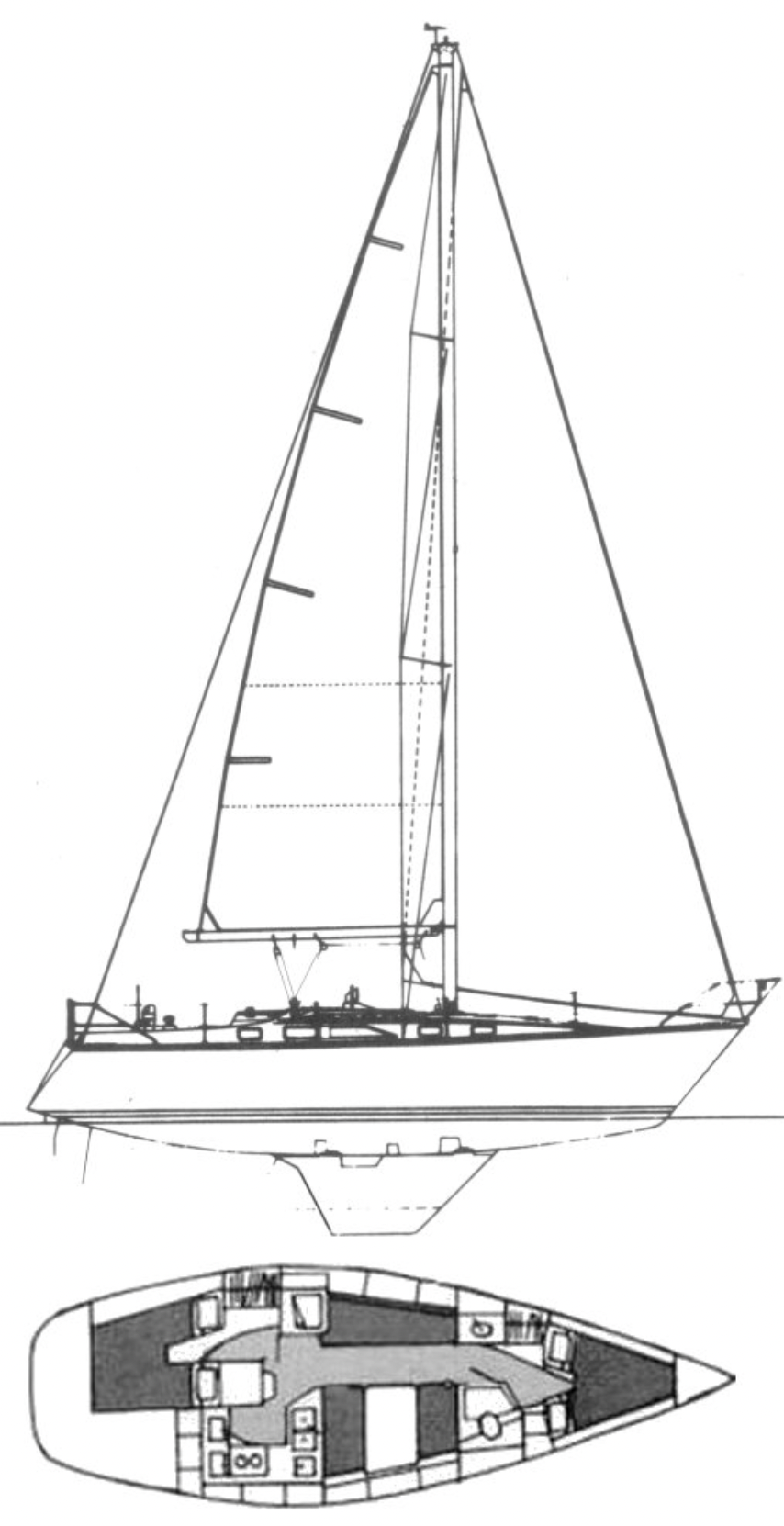
Sailboat Specifications Sailboatdata.com
Hull Type: Fin w/spade rudder
Rigging Type: B&R
LOA: 34.42 ft / 10.49 m
LWL: 28.25 ft / 8.61 m
S.A. (reported): 569.00 ft² / 52.86 m²
Beam: 11.58 ft / 3.53 m
Displacement: 11,820.00 lb / 5,361 kg
Ballast: 5,000.00 lb / 2,268 kg
Max Draft: 5.50 ft / 1.68 m
Construction: FG
Ballast Type: Iron
First Built: 1983
Last Built: 1987
Builder: Hunter Marine (USA)
Designer: Cortland Steck
Make: Yanmar
Model: 3GM
Type: Diesel
Fuel: 25 gals / 95 L
Water: 65 gals / 246 L
S.A. / Displ.: 17.61
Bal. / Displ.: 42.3
Disp: / Len: 234.05
Comfort Ratio: 23.25
Capsize Screening Formula: 2.04
S#: 2.39
Hull Speed: 7.12 kn
Pounds/Inch Immersion: 1,168.89 pounds/inch
I: 47.42 ft / 14.45 m
J: 13.75 ft / 4.19 m
P: 41.00 ft / 12.50 m
E: 11.75 ft / 3.58 m
S.A. Fore: 326.01 ft² / 30.29 m²
S.A. Main: 240.88 ft² / 22.38 m²
S.A. Total (100% Fore + Main Triangles): 566.89 ft² / 52.67 m²
S.A./Displ. (calc.): 17.54
Est. Forestay Length: 49.37 ft / 15.05 m
Weather Helm
Complex Rig
Engine
Construction
Stuffing Box
Quality Control
Iron Keel
Interior
V-Berth
Head
Dinette
Galley
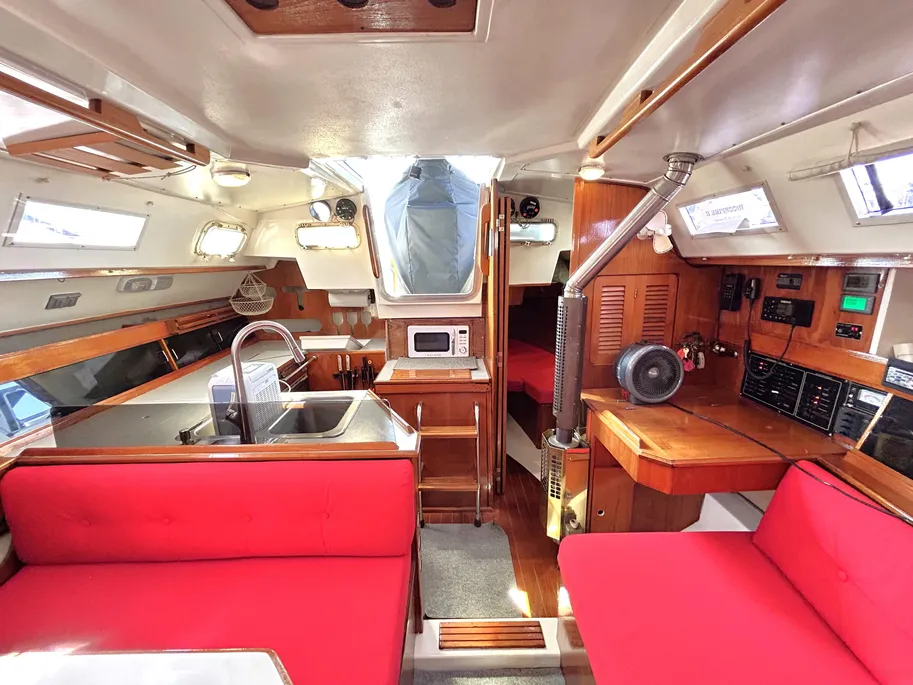
Aft-Cabin
Privacy
Conclusions
Market Scan Contact
1984 Hunter 34 Yachts 360
$24,000 USD 954-799-3492
Erie, Pennsylvania Yacht World
1984 Hunter 34 Harris & Ellis Yachts
$28,910 USD 416-639-2584
Kingston, Ontario Yacht World
1987 Hunter 34 Rooke Sails Inc.
$21,500 USD 901-350-2269
Luka, Mississippi Yacht World






Thank you for the comprehensive report. It is very practical and enlightening allowing a potential buyer to make an educated decisiion
I have a deep keel version of the 1999 Hunter 340 – Trinity. She has excellent pointing characteristics allowing her to sail up to 15 degrees off the apparent, and we win races as a result. However, it takes a bit of wind to move her with our 110% headsail. She’s best around 15 knots apparent; above that reefing is advised going to windward. I don’t consider her tippy, but certainly if you push her, you’ll get lots of helm and the rail in the water. I’ve raced her single handed in Georgian Bay in 35-42 knots apparent, winning the Meaburywood Trophy in 2021, an inter-club race of 15 boats. I like her a lot but being on the cusp of retiring, I am looking for a bigger boat to allow longer range cruising.
I refurbished a 1984 ‘dock condo’ 34 in Florida in 2018/2019. The layout was excellent, that’s why I tackled the task. Only major issues; replacement of the wasted prop , shaft and coupling(electrolysis), rigging was certainly salt-water exhausted, major cleaning of shoal draft keel refinished with 4 coats of epoxy primer, replacement of the Cruising Design furler with an updated version, installation of refrigeration & insulation into a totally uninsulated icebox (from which significant condensation made me think there were deck leaks!), installation of propane stove and a 10 lb propane storage box under the bridge of the twin hatch covers of the enormous lazerette, and replacement of the acrylics in the hatches and the main sliding hatch. Most interesting find was a very-rusted pair of fiberglass shears under the dampness of the uninsulated icebox. Hunter-Marlowe wasn’t interested in retrieving them 🙂
With the rigging replacement it was fascinating tuning the rig on saw horses on the ground with the instructions found on the WWW. Keeping track of all the various ‘wires’ during the process required focus and made me love my single spreader, cutter rigged 43′ mast back home even more.
Sold with pride, and good–bye Florida in 2019.