

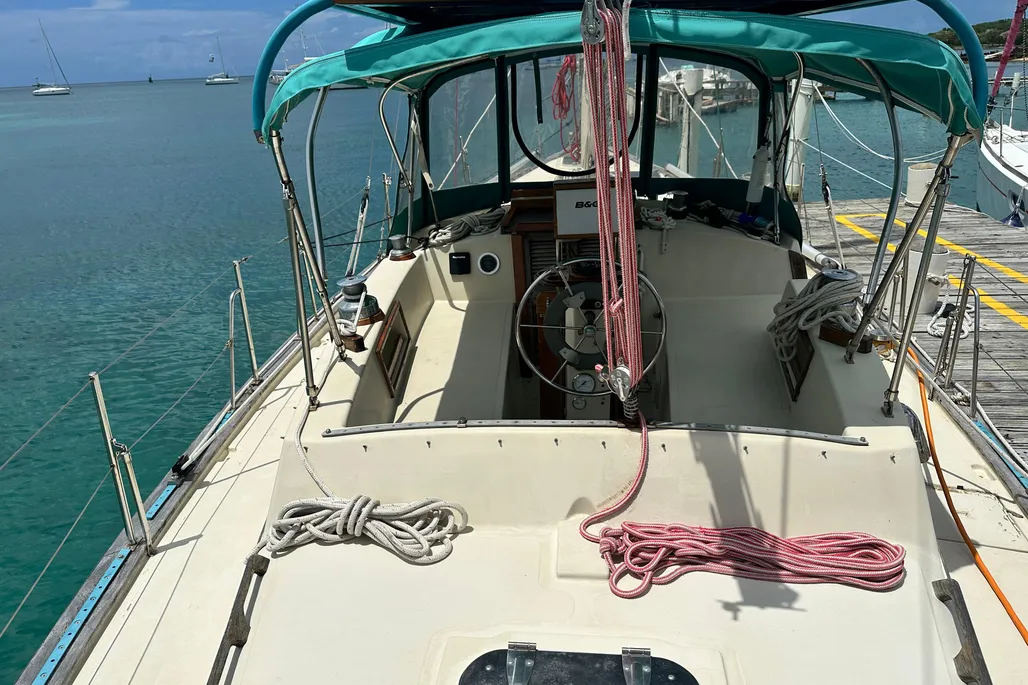
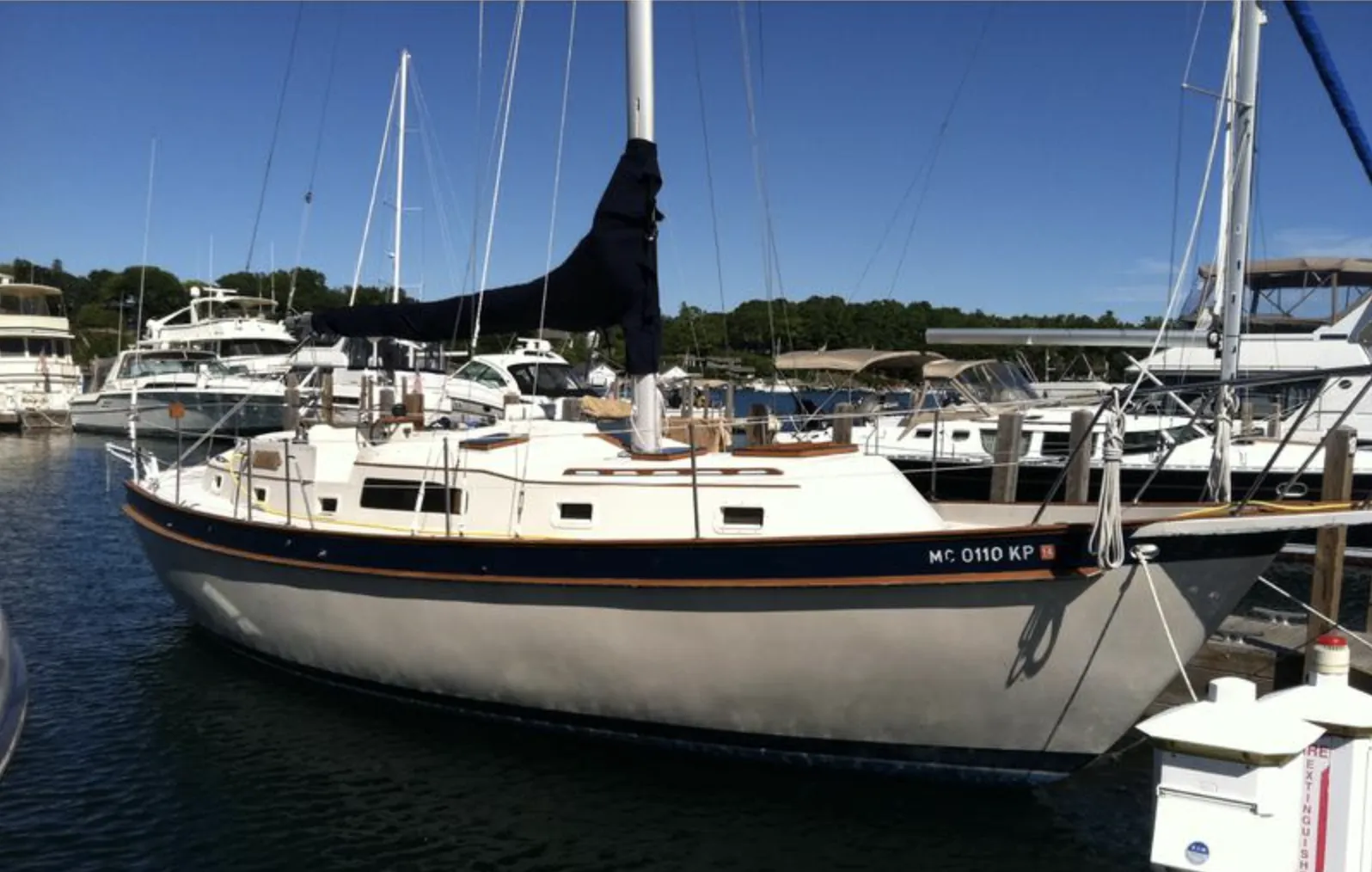
An evaluation of the Irwin 37 threatens to expose all our prejudices about boatbuilders and cruising boats. In general we like sturdily built, finely finished, well performing boats that reflect traditional standards (if not design) and lasting value. Irwin Yachts built boats of mediocre quality and finish and marketed them to buyers looking for as much boat as possible for the price. In every sense of the word, Irwin boats, of which the Irwin 37 is archetypal, are production boats. They were mass produced, carefully priced, simply advertised, and widely sold to a broad spectrum of customers. We hasten to add that the more than 600 Irwin 37s sold between 1971 and the model’s demise in 1982 conclusively prove that many sailors do not share our prejudices.
The last version was designated the Mark V, representing the popular strategy of numbering the steps in the evolution of a design even though the changes may be minor.
From the outset the Irwin 37 was a roomy, appealing cruising boat that was once described as the Chevrolet Bel Air of the boat market. Her greatest appeal was to the sailor/owner who is into comfortable anchorage living rather than sailing performance or construction details.
Irwin Yachts was considered to have the most notoriously slipshod quality control among the larger boat builders. No other boats have as poor a reputation for warranty claims, delays in commissioning, missing or incorrect parts, and mislocated hardware as Irwin. Similarly an examination of virtually any Irwin-built boat reveals details that reflect cost savings but are problems; some, in our opinion, serious (gate valves on all through-hull fittings) and some trivial (through-hull fittings not installed flush with the hull).
Construction
There are no basic industry standards for fiberglass construction; the primary criterion for adequate hull laminate strength seems largely a matter of in-use durability. Some builders, in the absence of such standards, overbuild their products (CSY, for example).
Irwin Yachts, on the other hand, have hulls and decks molded to specifications that are, by industry comparison, light. By our standards the Irwin fiberglass layup is minimal; that is one reason the boats have a low price. Yet basic laminate is not where cost savings are most apparent.
More conspicuous are cosmetic flaws. In two of the later 37s we looked at, there were obvious deep hollows in the bottom. These are evidently the result of pulling a still “green” hull from the mold and setting it in a four-point building cradle. The supports dished the laminate, probably permanently.
Print-Through
For years Irwin Yachts suffered from print-through, whereby the pattern of the underlying roving in the laminate was visible in the topside gelcoat. This later was considerably reduced with the use of Cormat between the roving and the gelcoat; in the later 37s we examined, print-through was negligible. This print-through remains an unsightly feature of older 37s, especially in the dark paint of the sheerstrake.
Flaws that Impact Drag
In our examination of the 37s we also noted sloppy underwater fairing around the rudder gudgeon and where the “Adapt-A-Draft” keel is attached. These types of flaws, coupled as they are with such details as protruding through hull fittings and squared off trailing edges, produces needless drag for a boat whose performance under sail is already suspect.
Bowsprits
The earliest Irwin 37s did not have bowsprits. The result was a hazy gracelessness that was accentuated by obvious unevenness in the sheerline, unrelieved topside expanse, and Clorox-bottle styling, not to mention dimples and gelcoat blemishes. To improve performance with more sail area Irwin added a molded fiberglass bowsprit. Serendipitously the extension did wonders for the aesthetics. Less fortuitously the glass sprit also became a source of warranty claims when, if tightening the rigging caused it to flex, the gelcoat crazed.
The final version of the bowsprit is of welded aluminum. In a mid-production boat we examined, the bobstay is a threaded stainless steel rod with jaw terminals at each end. The newer boats have the rod welded between two plates on each end, a less costly fitting. As the lower end will be continually awash and thus vulnerable to corrosion, we think the welded construction is a mistake. Similarly we are concerned about the stainless steel rudder gudgeon, which has shown evidence of stress corrosion.
Gelcoat Issues
The Irwin 37 has a history of warranty claims against defective gelcoat—too thin (or missing), too thick, discolored, crazed, or covering voids. Where this happened in the diamond pattern non-skid deck surfaces that Irwin produced into the early ’80s, inconspicuous repair was well nigh impossible.
The problem drove Irwin dealers and new owners to distraction and fueled much of the scuttlebutt about Irwin’s poor handling of warranty claims. In the last boats, Irwin put on a random non-skid pattern, easier to repair. Irwin also went to a better quality gelcoat.
Hull-to-deck Joint
Another common question about Irwin Yachts has been its hull-to-deck joint. Contrary to common industry practice, the joint in the Irwin 37 consists of overlapping flanges joined with a polyester slurry and fastened on about 6-in. centers with stainless steel self-tapping screws. Most builders now use a semirigid adhesive and bolts, a technique we favor. We believe this more positive attachment is called for on boats going to sea.
Chainplates
The chainplates of the 37 are stainless steel webs laminated into the topsides during the hull layup. This technique was developed by Irwin and is imitated by a number of builders whose chainplates are at the outer edge of the deck. It seems to be a satisfactory installation and indeed preferable to early Irwin 37s which had the chainplates through-bolted to the topsides.
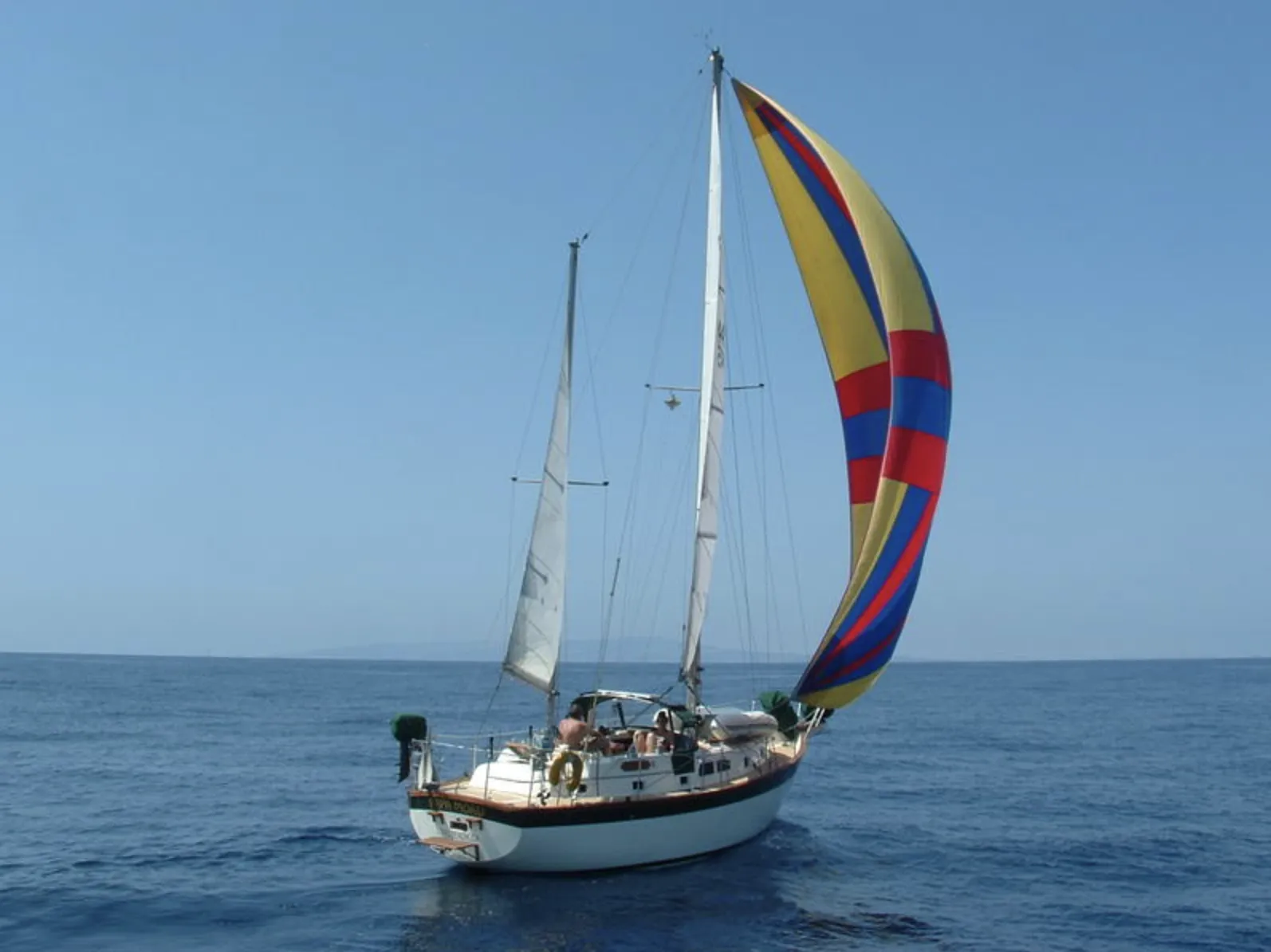
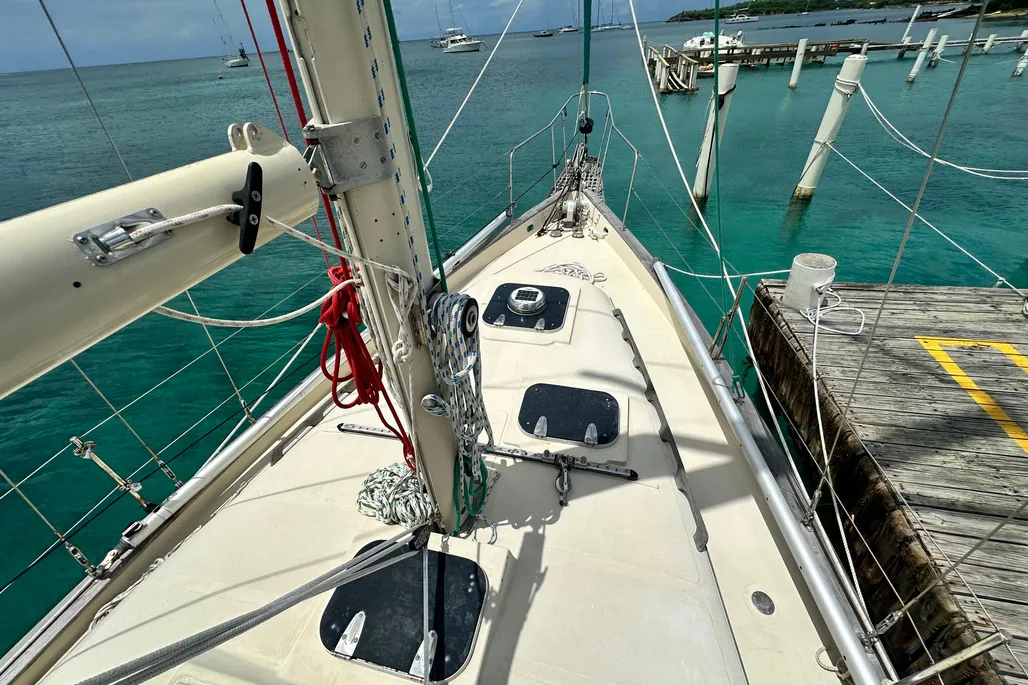
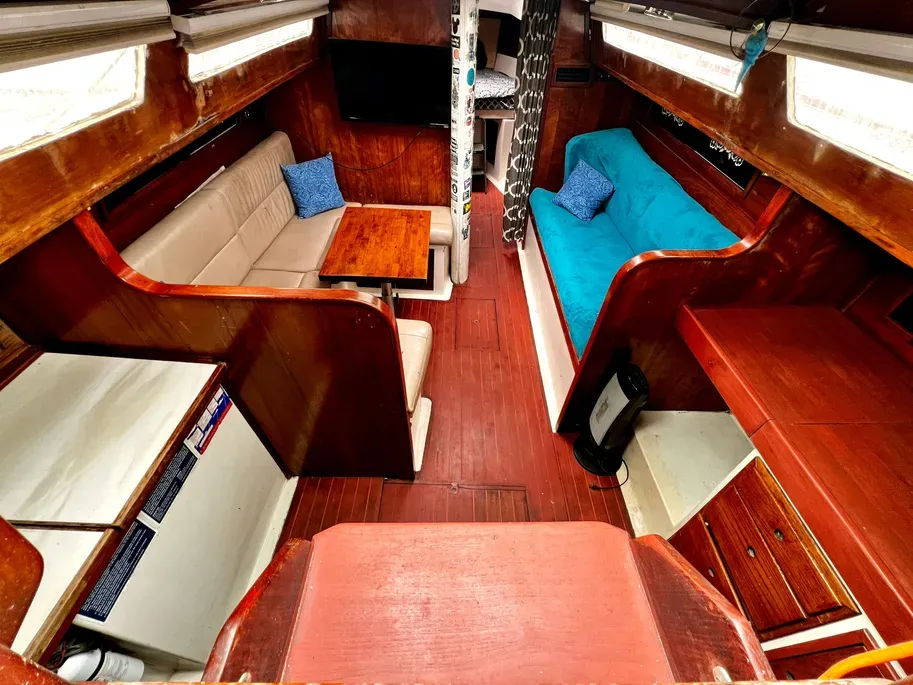
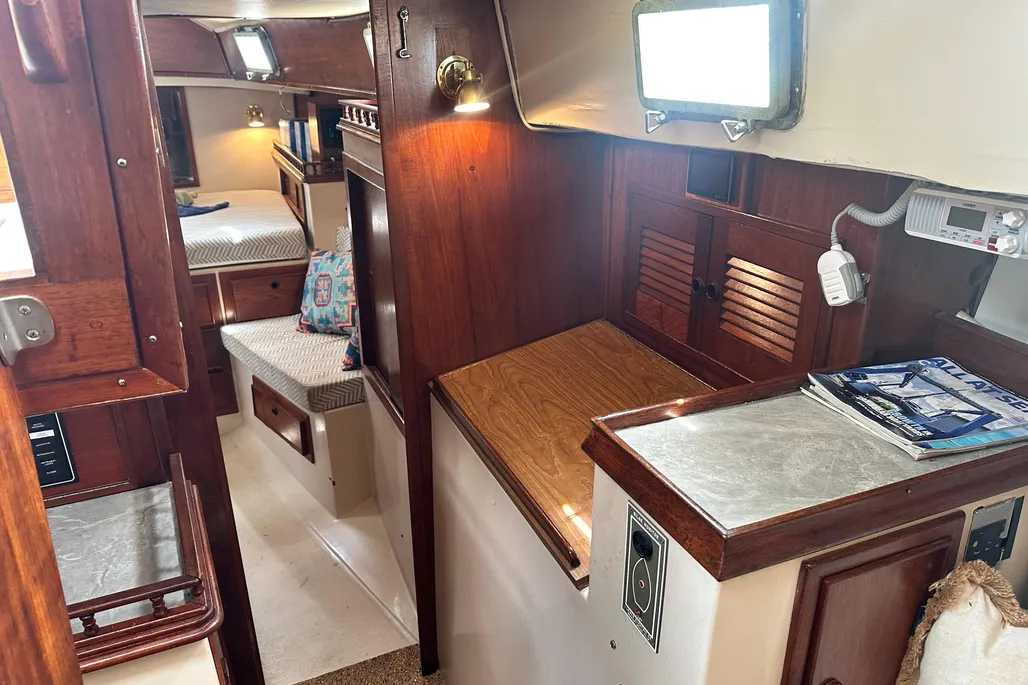
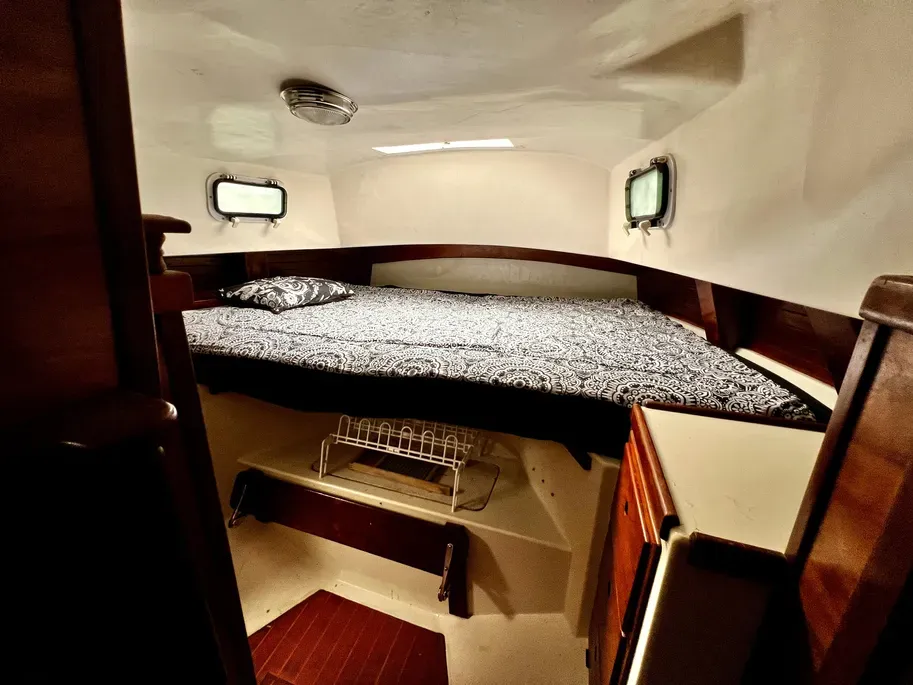
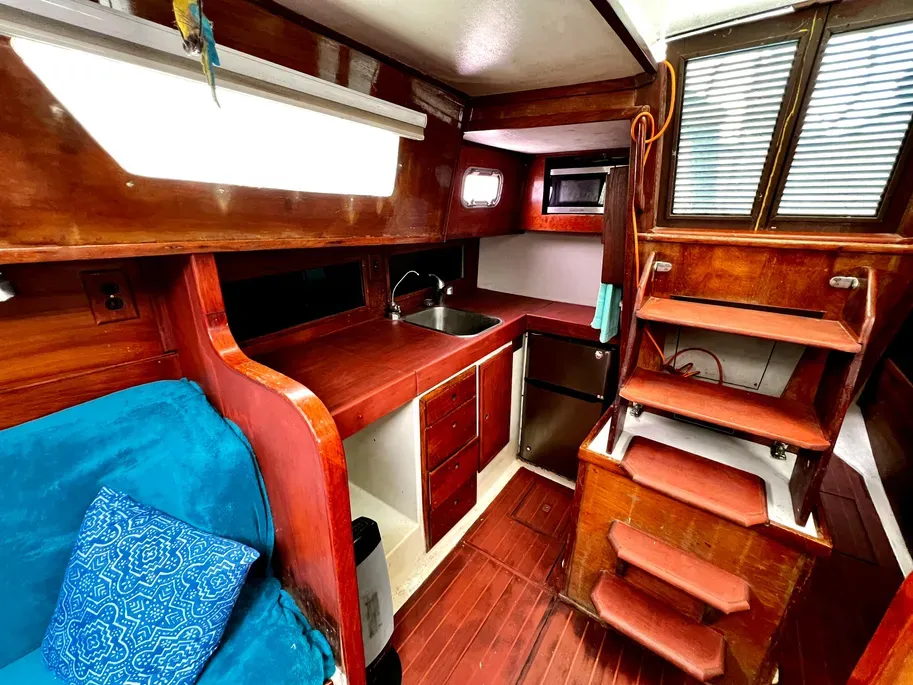
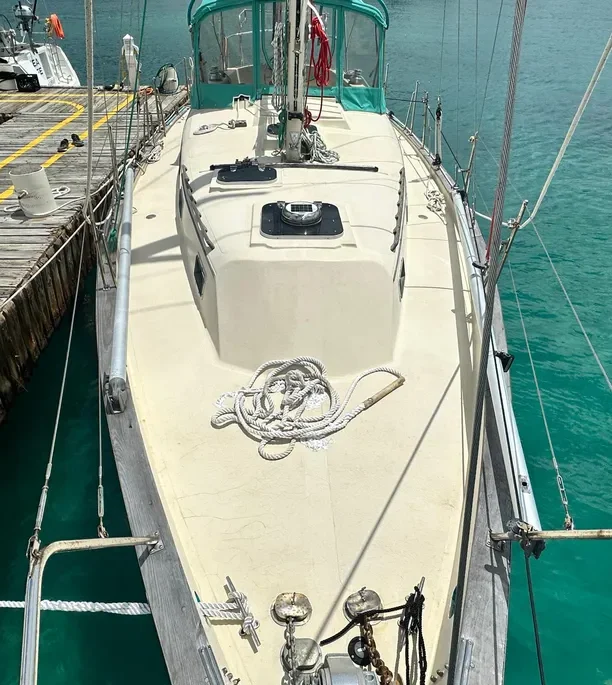
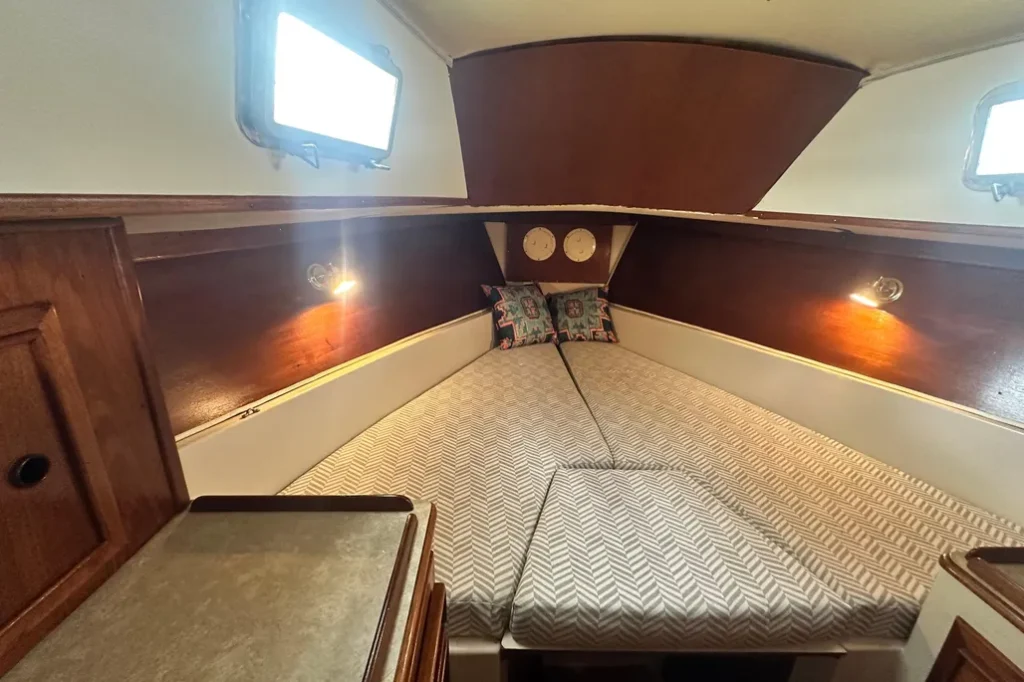
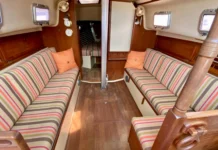
Virtually everyone from whom we elicited information on the Irwin 37 either dismissed as unimportant or derided her performance under sail. She seems a classic example of the all-too-common cruising boat that does everything better than handle as a sailboat. A number of owners we talked to do not seem bothered by this shortcoming. We, again with our prejudice, would be. The Irwin 37 comes standard with a sloop rig; the roller furling genoa was an almost unanimously specified option. A cutter rig (with a club jib) and a ketch rig were two other options. In any configuration she is a boat that seems ideally suited for a couple to sail. The sail area is modest with the ketch carrying about 60 square feet more sail than the sloop, just about enough to compensate for the windage of the mizzen mast. Personally we think the cutter rig is the best answer of the three, the staysail providing a handy headsail in hefty conditions and doing away with the clutter, expense and windage of the mizzen. Plainly the standard shoal draft keel without a centerboard is inadequate for sailing to windward. If a buyer wants shoal draft, they should consider the centerboard version. The board does thunk in its trunk when down, a harmless if annoying distraction. Fully raised it remains quiet; what a relief in the middle of the night at anchor. For optimum performance we recommend the deep keel. Still, do not hope too earnestly for scintillating windward work; for such joy you should consider a host of boats other than the Irwin 37. Owners have indicated to us their willingness to accept indifferent performance under sail. However, we have heard complaints about the amount of attention the helm needs and some difficulty in steering the boat both under sail and under power—“Steering is stiff and my wife (98 lb.) has difficulty at times.” We suspect some of this chore is the result of an unbalanced semi-spade rudder being driven by a relatively small diameter steering wheel through an aft-cabin layout that requires considerable routing of the steering linkage. The Irwin 37 has a 40-hp Perkins 4-108 diesel engine driving a three-bladed propeller with 2:1 reduction through the after edge of the keel. That is a combination that bespeaks of performance under auxiliary power. In fact, with the standard shoal keel and that combination for power, the Irwin 37 might reasonably be labeled a motorsailer if that term had not fallen into such disfavor in recent years. The combination also suggests that the Irwin 37 should appeal to the powerboat owner looking to sail as a way to reduce their fuel consumption without sacrificing the room and amenities of the moderate sized powerboat. Certainly we think it is a worthwhile alternative to the ad hoc conversions of sailboat hulls and rigs to sailing powerboats with their high deckhouses, awkward sail handling systems, and sundry other compromises. If performance is not a priority in the design of the Irwin 37, livability is. The Irwin 37 is a coastal cruiser for two couples or a family of four. She has the most practical aft cabin layout we have seen on a stock boat under 40 feet. The layout has remained essentially unchanged since the 37 was introduced and features a spacious aft cabin, a step-down galley, a more-than-adequate walk-through passageway, and a forward cabin that should not make its occupants feel like they are in steerage. Fundamental to the Irwin Yachts design and marketing philosophy is that the interior should instantly appeal to those who value a cozier, home-y look. The decor is Production Boat Contemporary: tufted velour cushions, plenty of teak, and color-coordinated carpeting. We are not impressed with the so-so craftsmanship and unsanded finish of the joinerwork nor with the antiseptic molded hull liner, but these are details that do not immediately affect the illusion of quality, comfort, and spaciousness. Thus the interior of the 37 minimizes seagoing machismo: there are no handrails, sea berths, navigation sanctum, or sailbag stowage. Below, with the possible exception of the gimballed stove, one can easily forget that under certain circumstances a sailboat may not always be upright or free from motion. It would be hard to imagine being aboard an Irwin 37 at sea. There is no berth one could sleep in comfortably. The settee berth to port is too narrow and the settee to starboard is too short. One owner remarked that even when the settee berth is to leeward, a nap-taker is rolled out of it during a gentle afternoon sail. But what the 37 may lack at sea she more than makes up for at bedtime at anchor. Both the athwartships after berth and the forward V-berth are queen-sized with 4-in. mattresses. The two cabins are separated by 30 feet of boat and closed doors. Each has a private head. There are good hanging lockers, lots of drawers, a few scuttles and assorted nooks and crannies. Yet someone forgot to build in places to store dry, warm food. For cold food there are, now get this, one front opening Norcold refrigerator (standard) and two, yes two, large top-opening iceboxes. In fact, both iceboxes are so sizable that their bottoms are difficult to reach. One of them (under the rudimentary chart table) might be better used for dry food storage except that getting at its contents would be at best inconvenient. The alternative is to use the galley icebox as a dry well and rely on the Norcold despite our longtime prejudice against using front opening boxes which depend on electrical power away from a dock. Perhaps this refrigerator is the best giveaway as to what type of cruising the 37 is best suited for. Two other points about the interior deserve comment, one favorably and one not so. Engine access and sound insulation are among the best we have seen in a production boat, helped by removable panels on the sides of the walk-through. To check the dipstick and heat exchanger water there is no need to move the companionway ladder. In short, if the engine of the 37 seizes from lack of oil or overheats for lack of water, the owner has only himself to blame. On the other side, the bulkhead-mounted fold-up, drop-leaf cabin table will not survive the first fall against it when a powerboat leaves a wake. It might not even withstand the weight of a rib roast. The first thing we would do after buying an Irwin 37 that still had the stock table is find ourselves a rugged, attractive fixed cabin table. (The next thing we would do is to make the seats comfortable.) The Irwin 37 is a handy boat to sail. The sidedecks are wide, the rail rises to a low bulwark forward to give a sense of security and the cockpit coaming has an opening to starboard but is low enough to climb out of anywhere. The bowsprit is designed to carry a 30 lb. plow anchor housed in a roller chock. Hawseholes (of polished aluminum, replacing the line-chafing fiberglass on older boats) are mounted in the bulwark for docklines. Oddly enough neither the hawseholes nor the roller chock give a fair lead to the pair of deck cleats. The stanchions are mounted through the deck into blocks drilled to fit, a system that we think gives a rugged support. In early 37s the stanchions went into fiberglass tubes glassed under the deck; in later boats they go into wood blocks (saving cost and complexity). In contrast to this sturdy structure, the bow and stern pulpits are screwed on the teak rail cap. We hardly recommend that attachment. The cockpit is small, accommodating at the most four adults at a time. Yet the seats are long enough to stretch out on and access below is easy. We are not bothered by the absence of a bridgedeck or companionway sill for safety because the cockpit is high and amidships, hence dry. Besides, Irwin’s advertising notwithstanding, we doubt if many owners would consider offshore passages, given all the limitations the 37 would have at sea. We like the number, design, and placement of the “smoked glass” opening hatches/skylights. Like many designs that have tropical cruising and chartering as part of their destiny, the Irwin 37 has a well-ventilated interior. On deck stowage is limited to one gigantic locker, the lazarette. The trouble is that for storing fenders, docklines, sheets, snorkeling gear, etc. as well as an odd sail or two, it would leave everything hard to get at. You cannot reach the bottom from the deck and without some owner-installed shelves, hooks, and bins the contents would be in chaos. Ironically, considering the persistent badmouthing of the Irwin 37 around the waterfront, older models have retained their value reasonably well. The reason seems simple: the Irwin 37 offers many buyers what they are looking for in a boat. When new in the early ’80s, the Irwin 37 was about $15,000 less expensive than, say, the Tartan 37 or the Pearson 365. A Hunter 37, by contrast, could be sailed away for about $10,000 less than the Irwin 37. And for the dollars, the Irwin 37 is a lot of boat. Many owners report looking seriously at smaller boats and settling on the 37 when they (and their wives) see the spacious 37 for the same price as the smaller boat. For that price they get what they see as a summer home afloat. Deep water cruising may be a distant dream but the immediate desire is a comfortable and impressive boat for weekending and two weeks in the Bahamas, the Eastern Shore, or out of Long Island Sound. For any boat that retains its stock features, we’d plan systematic and regular upgrading. Expect to replace the standard through-hull gate valves with seacocks or ball valves. Divide the humongous lazarette. Run the halyards aft to the cockpit when they need replacing. Build some pitch into the seats of the settees. Rebuild the “navigation station” into handy food storage. Mount a larger diameter steering wheel so you will no longer have to steer standing up or perched on the edge of your seat. Finally, take a sail on a boat meant to sail effectively to windward, just so you’ll see what you are missing.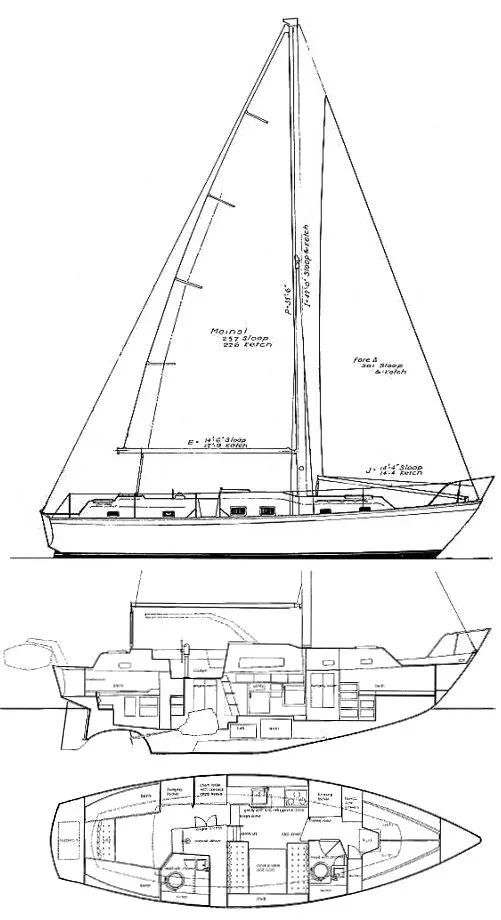
Sailboat Specifcations Sailboatdata.com
Hull Type: Fin with rudder on skeg
Rigging Type: Masthead Sloop
LOA: 37.00 ft / 11.28 m
LWL: 30.00 ft / 9.14 m
S.A. (reported): 558.00 ft² / 51.84 m²
Beam: 11.50 ft / 3.51 m
Displacement: 18,000.00 lb / 8,165 kg
Ballast: 6,700.00 lb / 3,039 kg
Max Draft: 5.50 ft / 1.68 m
Construction: FG
First Built: 1971
Last Built: 1975
Builder: Irwin Yachts (USA)
Designer: Ted Irwin
Make: Perkins
Model: 4-107
Type: Diesel
HP: 40
Fuel: 80 gals / 303 L
Water: 50 gals / 189 L
S.A. / Displ.: 13.05
Bal. / Displ.: 37.22
Disp: / Len: 297.62
Comfort Ratio: 33.51
Capsize Screening Formula: 1.76
S#: 1.43
Hull Speed: 7.34 kn
Pounds/Inch Immersion: 1,232.72 pounds/inch
I: 42.00 ft / 12.80 m
J: 14.33 ft / 4.37 m
P: 35.50 ft / 10.82 m
E: 14.50 ft / 4.42 m
S.A. Fore: 300.93 ft² / 27.96 m²
S.A. Main: 257.38 ft² / 23.91 m²
S.A. Total (100% Fore + Main Triangles): 558.31 ft² / 51.87 m²
S.A./Displ. (calc.): 13.06
Est. Forestay Length: 44.38 ft / 13.53 m
Handling Under Sail
Handling Under Power
Interior
Not Suited for the High Seas
At-Anchor Comforts
Storage
Engine Access
Cabin Table Issues
Deck Layout
Cockpit
Ventilation
Stowage
Conclusions
Plan for Upgrades
Market Scan Contact
1974 Irwin 37 Peninsula Yacht Sales
$33,000 USD 805-984-8550
Oxnard, California Yacht World
1980 Irwin 37 Sea Lake Yachts LLC
$30,000 USD 281-957-6137
CHRISTIANSTED, U.S. Virgin Islands Yacht World
1980 Irwin 37 Engel Volkers Yachting Americas
$25,000 USD 949-835-4876
Saint Petersburg, Florida Yacht World








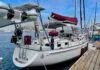
I’ve got an Irwin 37 CCKetch ( 1974). Bought it from a consignment yard in terrible shape. None of my stanchions are rail mounted, and my cockpit accommodates 6 adults easily.
I have made modifications – moving my chainplates outboard ( alla Pacifico’s seacraft)
My sail locker was already partitioned in two parts. The lazarette I like as it is. A man could make his home there.
The previous owner sailed her every year ( for 9 years) from Maine to the Bahamas and back. I’ve got the customs stamps to prove that. I’m in Newport RI, and the furthest I’ve ever gone is to Yarmouth NS.
A slow trek to be sure, but very comfortable. I’ve got a 100 gal diesel tank, giving me 600 nm range under power at about 6.5 knots.
Yes , she ain’t no Shannon. She’s old and slow, and won’t point worth a nickel, but my wife, son, daughter and cat love her.
I told her you called her mediocre. Hurt her feelings, but she’ll get over it by tomorrow’s sail.
On a 1982 37′ ketch configuration and we see the issues mentioned but feel her “Ketchup” makes up for it in size comfort and sailability.
I was owner of Irwin 37 MK V for 9 years.
The article is written quite one-sided. Maybe the author had a bad day or there was a bad weather period, due to which he was sailing deprived and had to let out the frustration somewhere.
Irwin boats still sail and have outlived many other boat types.
My boat has always been reliable and has gotten me through all situations.
This brought a tear to my eye! Learned to sail and crusied for 20 years on a 1972 Irwin 37 sloop. She was a tank, sailed sideways when hard on the wind (so you learned to reef that main early) and was a good old girl who always got us home. Either they aren’t as slow and clumsy as the critics say or we just learned how to tweak the sails well enough to keep up with buddy boats. We installed a detachable inner forestay for a jib to use in higher winds. Worked great. We sailed her all over the Bahamas and Central America. We re-did the saloon/galley cabinetry, added storage under the v-berth, always kept her pretty and sold her for good money (in Guatemala!) Let the boat snobs tut-tut away.
We have a 1987 Irwin sloop. Definitely not a Swan, maybe a pelican. I would like a thicker layup in the hull. We did have problems with blisters, since completely rectified. We have a large wheel and steering has never been a problem. We typically “sail” down river from Portland Oregon and as far north as the Alaskan border; 14 years now, for 3 months at a go. Livability works for us. The first five years without autohelm. The high center cockpit is a delight. We have a full canvas enclosure and modified forward viewing with glass and a windshield wiper! It rains here. Sometimes a lot. And there is so much water detritus, mostly logs, that the viewing is critical. The Irwin 38′ boat measures 43′ overall. I won’t speak to sailing performance because the author is more knowledgeable and we rarely have summer wind in the northwest in the direction we want to go. We know what we have and it serves us well.