

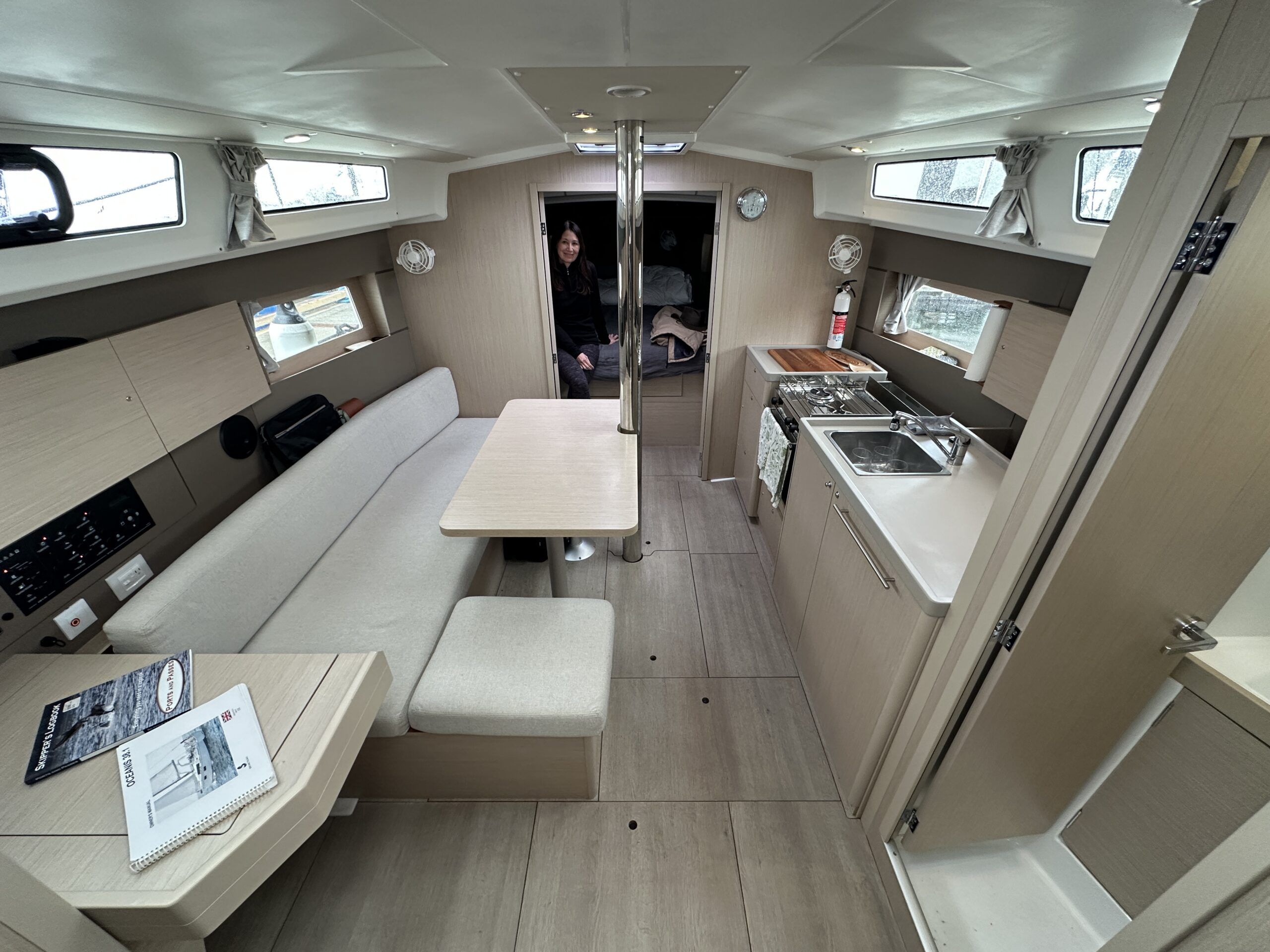
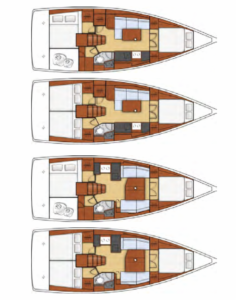
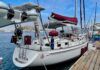
The Beneteau 38.1, considered by many sailors to be an optimal size for a coastal cruising couple with occasional guests, has been in production since 2017. The hull subject of this review is number 700, obviously a successful model for Beneteau. Numerous configurations emerged from the factory with multiple options for both interior and exterior design. On deck, the mainsheet arch is optional although I suspect it has become standard in the later years. Below decks the choices seem endless. From dual aft cabins with limited cockpit lockers to a single athwartship aft cabin with a large cockpit locker. A U-shaped galley to port with opposing settees over a folding center table, or long galley to starboard with a single settee to port.
Design
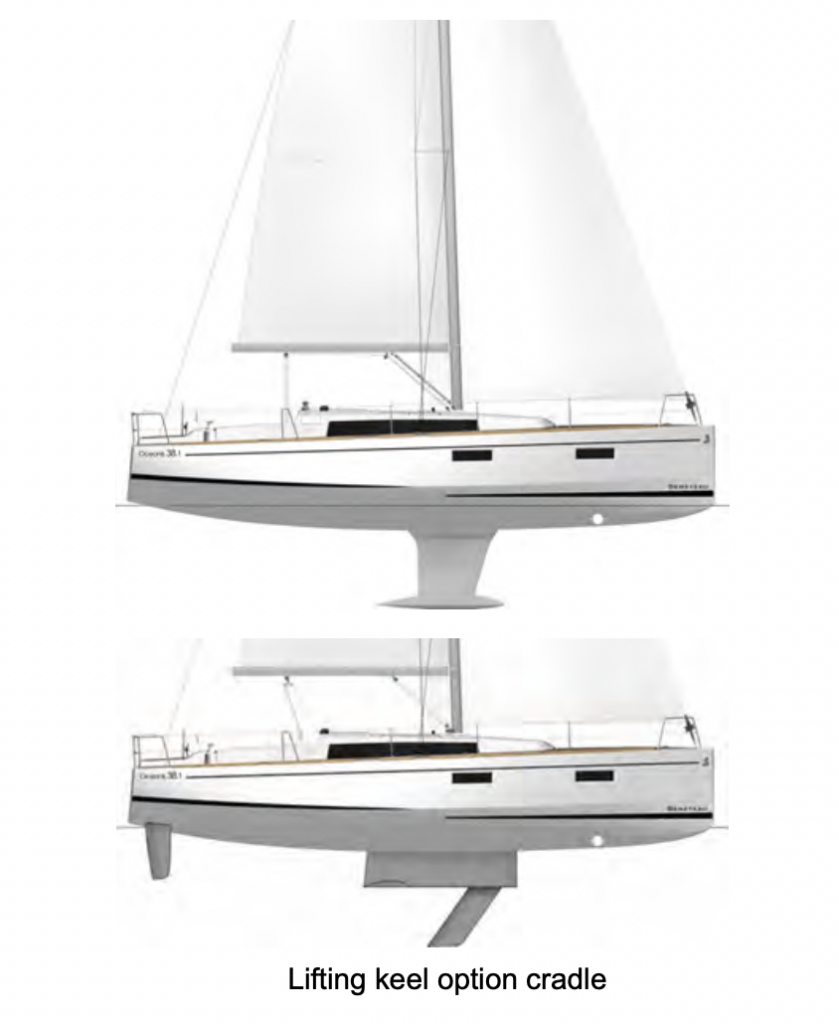
Below the sharply chined hull the options included a deep draft cast iron fin keel with bulb at 6 ft. 10 in. (2.09 m), or the shallow draft 5 ft. 5 in. (1.54 m), still with a bulb. With a beam of just over 13 ft. (4 m), the design carries that width from just aft of amidships right to the stern. This provides huge amounts of space for a 38-ft. boat at the cost of upwind sailing performance. But remember the old adage, gentlemen don’t sail to windward!
Sailboat Specifications Courtesy of Sailboatdata.com
Hull Type: Fin w/bulb & dual rudders
Rigging Type: Fractional Sloop
LOA: 37.73 ft / 11.50 m
LWL: 35.17 ft / 10.72 m
S.A. (reported): 707.19 ft² / 65.70 m²
Beam: 13.09 ft / 3.99 m
Displacement: 15,102.00 lb / 6,850 kg
Ballast: 3,946.00 lb / 1,790 kg
Max Draft: 6.83 ft / 2.08 m
Construction: FG
Ballast Type: Cast iron
First Built: 2017
Builder: Beneteau (FRA)
Designer: FINOT-CONQ
Type: Diesel
HP: 30
Fuel: 34 gals / 130 L
Water: 34 gals / 130 L
S.A. / Displ.: 18.59
Bal. / Displ.: 26.13
Disp: / Len:
154.98
Comfort Ratio: 21.14
Capsize Screening Formula:
2.12
S#: 3.35
Hull Speed: 7.95 kn
Pounds/Inch Immersion: 1,644.97 pounds/inch
I: 45.96 ft / 14.01 m
J: 15.72 ft / 4.79 m
P: 43.47 ft / 13.25 m
E: 13.81 ft / 4.21 m
S.A. Fore: 361.25 ft² / 33.56 m²
S.A. Main: 300.16 ft² / 27.89 m²
S.A. Total (100% Fore + Main Triangles): 661.41 ft² / 61.45 m²
S.A./Displ. (calc.): 17.38
Est. Forestay Length: 48.57 ft / 14.80 m
Mast Height from DWL: 54.30 ft / 16.55 m
Although Beneteau advertises the 38.1 as a light displacement boat, her 15,100-lb. (6,850 kg) displacement is identical to the Catalina and Tartan yachts of the same length, and heavier than the closest sistership, the Jeanneau 38.
With Jeanneau under the Group Beneteau umbrella since 1995 and sharing many design and hardware resources, the Jeanneau line is tilted towards a performance cruiser while Beneteau, particularly in the Oceanis series, aimed at maximizing creature comfort at the expense of some sailing performance.
Hokusai
Roger, the new owner of this Beneteau 38.1, has a sailing history that stretches back to the canals and lakes of the Netherlands where he sailed local design skiffs. As an adult Roger immigrated to Canada, where he club raced in keel boats out of Toronto and cruised the Saint Lawrence Seaway. He demonstrated his dedication to sailing when he took a five-day sailing course while his wife Romy stayed home tending to their newborn. The couple eventually moved to Calgary where they visited family on British Columbia’s Sunshine Coast, and spent summers exploring local waters on a cruising power boat.
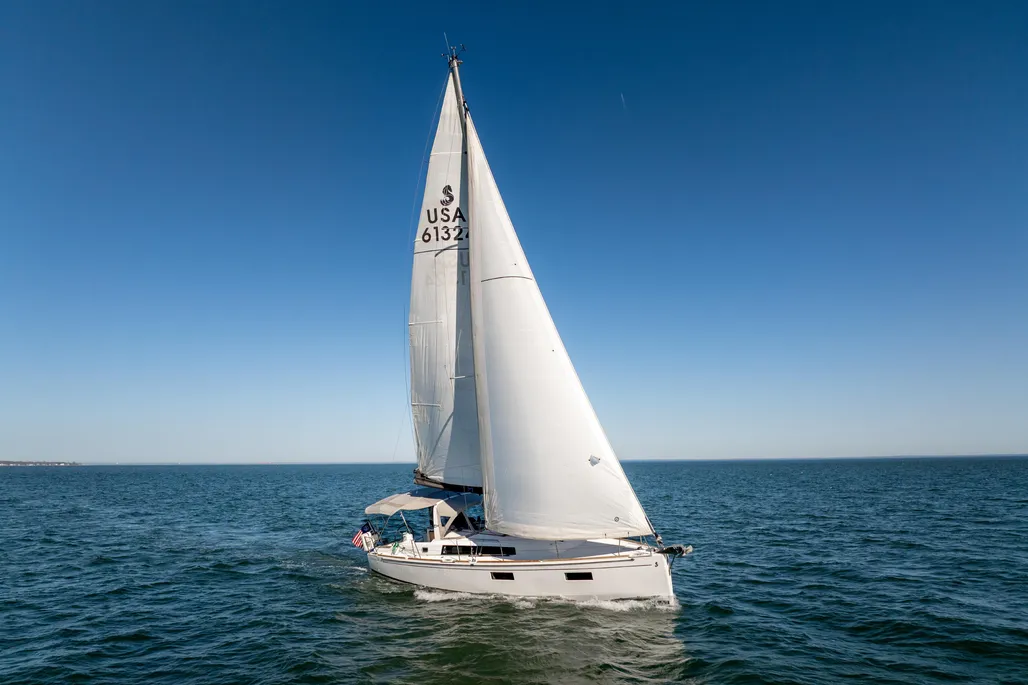
Although they resided in Calgary, a few sailing adventures on charter sailboats along the BC coast caused them to contemplate purchasing their own sailboat. Roger focused on Beneteau because he liked the open, coastal design of the moderately sized boats. After scouring the coast for a summer cabin without any luck, Roger and Romy looked for a “cabin-on-the-water” style of sailboat. They had no dreams of ocean sailing. When the 2023 Beneteau 38.1 came onto the market, they jumped at the opportunity.
The boat, renamed Hokusai, a renowned Japanese master artist, is in like-new condition and now ready to sail in the heart of Canada’s west coast sailing paradise.
Cockpit
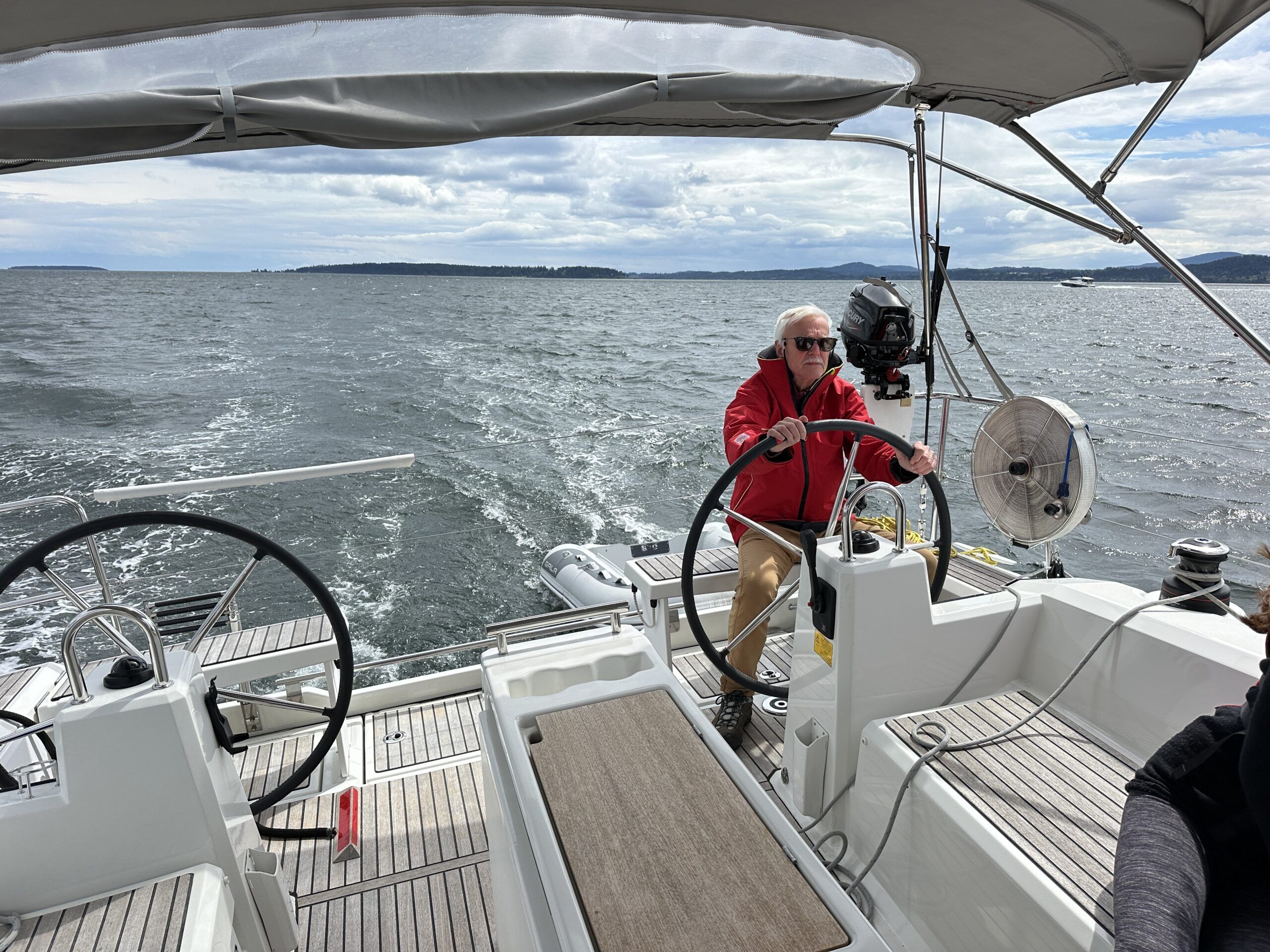
First impressions of the Beneteau 38.1 are of gleaming white gelcoat and an oversized cockpit. This boat is all about outdoor space and entertaining. For a 38-ft. boat, this is a big cockpit. With the two aft cabins underneath it’s also relatively shallow—a feature amplified by the low coamings and open stern. Although visually appealing, the low coamings do not really provide comfortable back support—cushions will be required. This is unusual for a boat with a focus on comfort. A full-length bimini covers the cockpit from the dodger to the stern. Adding side panels to fully enclose the cockpit would more than double the living space.
Helms
The split backstay and stainless-steel corner pushpits create a spacious feel, the twin pedestals and wheels are far enough apart not to visually interfere with the open space. Each helm has a small, hinged seat that swings up and out of the way against the lifelines, which create even more space. There is ample room behind the helm stations to be comfortable. Unfortunately, when you are seated behind the wheels there is no forward visibility over the coach roof—dodger or no dodger. Standing is required for a view forward. Better yet, sit on the teak coaming for a view beyond the bow along the side deck. In debris-infested waters like the Pacific Northwest, keeping an eye for floating logs is paramount.
Transom
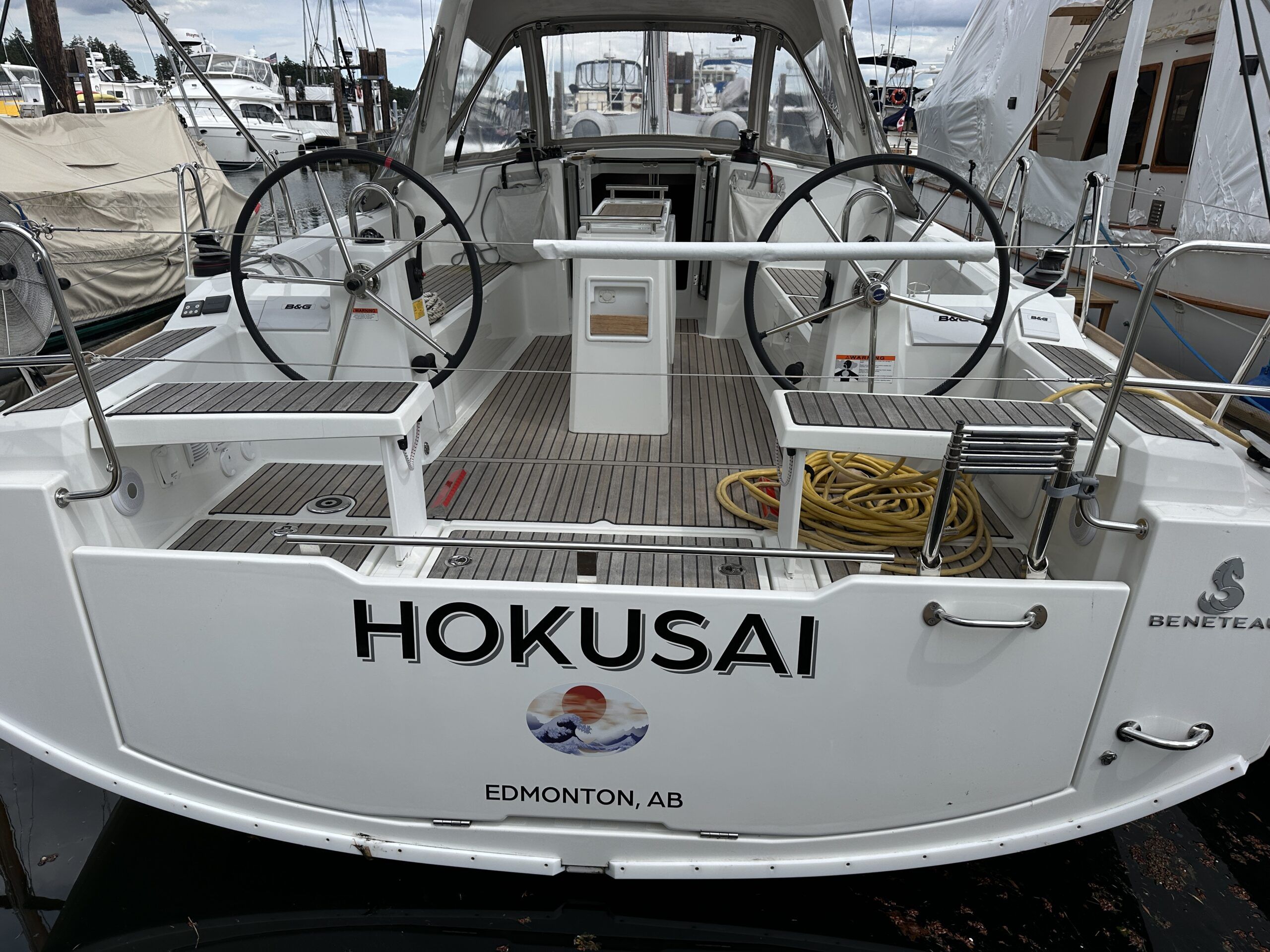
With the transom panel in the “up” position there is no solid transom coaming, simply a stainless-steel wire gate. Lowered, the panel becomes a swim grid with boarding ladder, extending the area aft of the helms even further. The lowered grid also allows easier access to the center locker under the cockpit sole. The lid for this locker is unusual because it’s not attached with hinges, it simply floats free.
Storage
The two side lockers have hinged lids and are deep, offering plenty of storage for sailing gear. There is also a shallow cockpit locker aboard Hokusai at the aft end of the starboard settee, which is the penalty for having two aft cabins. In the single aft cabin configuration, there is a cavernous locker under the port settee.
Instruments
The pedestals themselves each have a 7-in. B&G chartplotter that incorporates boat speed and depth into the display. The separate wind instrument is outboard at the starboard side helm. The electronic engine control panel and bow thruster panel is on the port side. There are multiple downsides to this configuration. First, important data on the chartplotter is at almost knee level, which is well below line-of-sight for critical viewing. Any alerts or dangers presented by the chartplotter are easily overlooked. Second, the wind instrument should be mounted forward in the cockpit so it is visible to crew adjusting sails, as well as staying within line-of-sight to the helms. However, this configuration does allow for a clean cockpit. If sailing efficiency is not the primary reason for ownership, this works.
The Beneteau 38.1 has the throttle on the port side pedestal, which is high enough to be handy. However, it’s still a long reach from the starboard side wheel when approaching a dock for a starboard tie. If years of powerboat configuration can provide dual throttle controls, why can’t sailboat manufacturers?
For sail control, the Harken two-speed, self-tailing primary winches are forward of the helm positions, mounted on dedicated pads on the coaming. The winch position requires reaching over or around the pedestal. The mainsheet controls are on the aft edge of the cabin trunk, out of reach of the helms.
On Deck
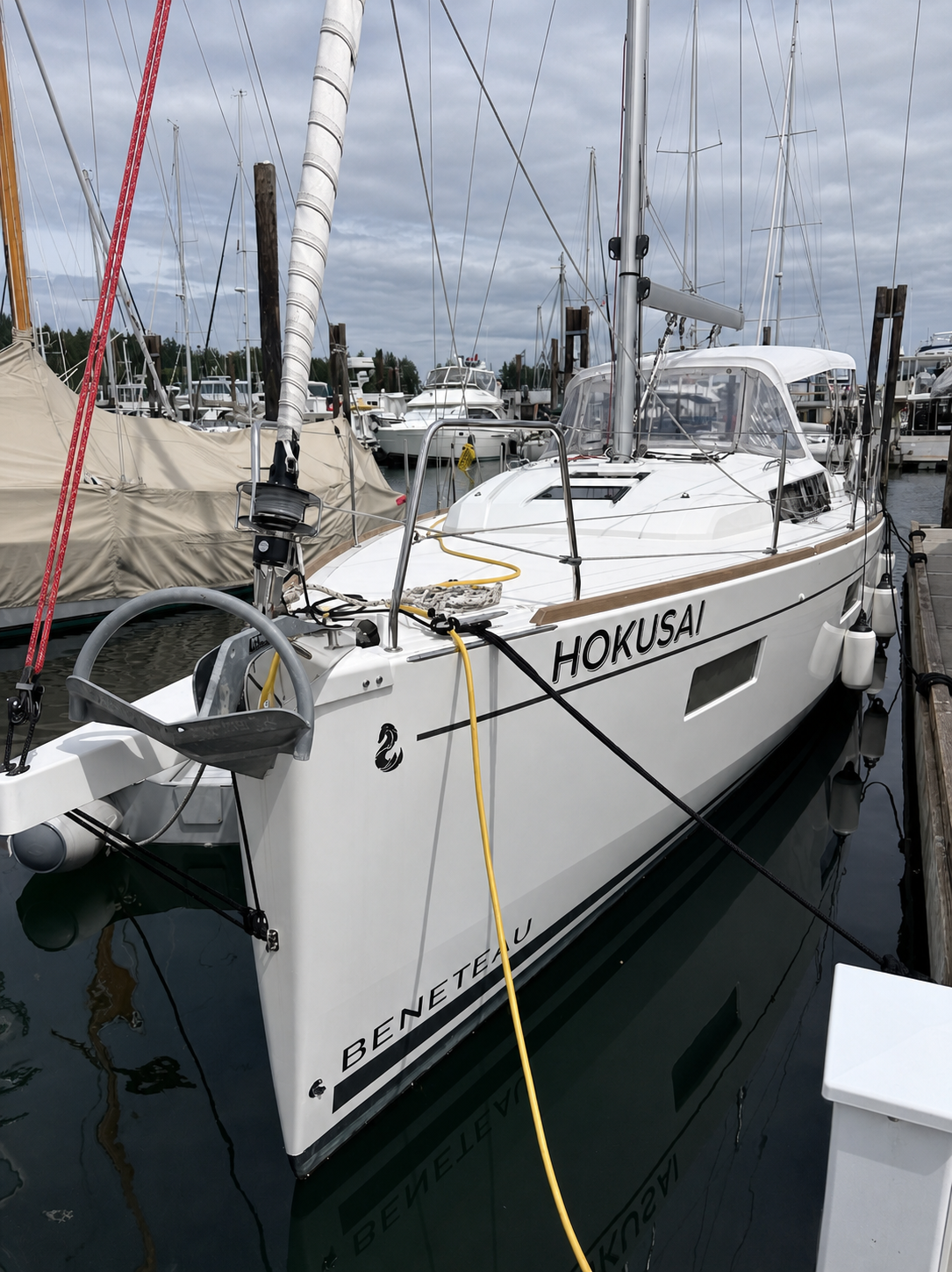
Moving forward on the wide side decks there is a grab handle on the arch leading to stainless steel handrails along the coach roof forward to the bow. There is, however, a considerable gap between the arch and coach roof. Aboard Hokusai, a small fabric handhold is attached to the dodger for added security.
Due to the long spreaders, the stays are mounted just inboard of the teak toe rail at the widest point of the hull. This allows easy access to the foredeck but does hamper pointing ability should anything other than a 100% jib be flown. The only tracks on deck are short and mounted inboard along the cabin trunk. This will impact any desire to include a larger genoa without having to install additional tracks.
Mast
The double spreader, Z-Diffusion aluminum mast is deck mounted on a stainless-steel plate. The plate provides fixed points for turning blocks for sail controls, the lines turning out to deck organizers and back to the cockpit stoppers and winches. All lines are exposed on deck which, in many cases, is preferable to being hidden under fiberglass deck plates. It is easier to spot line wear and keep that part of the deck clean. With a roller furling main on Hokusai there would be very limited reasons to be up on this part of the deck with lines underfoot. However, this could pose some difficulty should the fully battened main be selected. The halyard for the Code 0 has a two-to-one purchase to the masthead and also leads back to the cockpit.
Boom
The mid-boom mainsheet has a fixed point turning block on the arch and is led forward to the mast and then back to the cockpit. The control line for the solid boom vang also terminates in the cockpit. Essentially, there is no need to move forward for sail control while underway.
Foredeck
At the bow the anchor well is deep with plenty of room for chain and rode storage. There is room for fender storage if desired. The windlass is mounted off set on a platform inside the locker—the top of the windlass protrudes above the deck hatch.
A standard mini bowsprit integrated into the hull form allows for the addition of code 0 sail halyard systems. The stainless-steel anchor roller is off set to port to line up with the windlass and provides space for a single anchor.
Sails
For sails, the configuration aboard Hokusai includes a roller furling main of 393 sq. ft. (32.7 sq m), and a genoa that is marginally over 100% at 355 sq. ft. ( 33 sq m). The optional Code 0 adds 700 sq. ft. (65 sq m), almost doubling the total sail area. Sail options for the Beneteau 38.1 include a smaller self-tacking jib (a track would have to be added ahead of the mast), a full batten main flaked on the boom with lazy jacks, and an asymmetrical spinnaker.
If any kind of performance sailing or racing is to be considered, secondary winches would have to be installed in the cockpit where the coaming configuration would make that addition somewhat difficult.
Interior
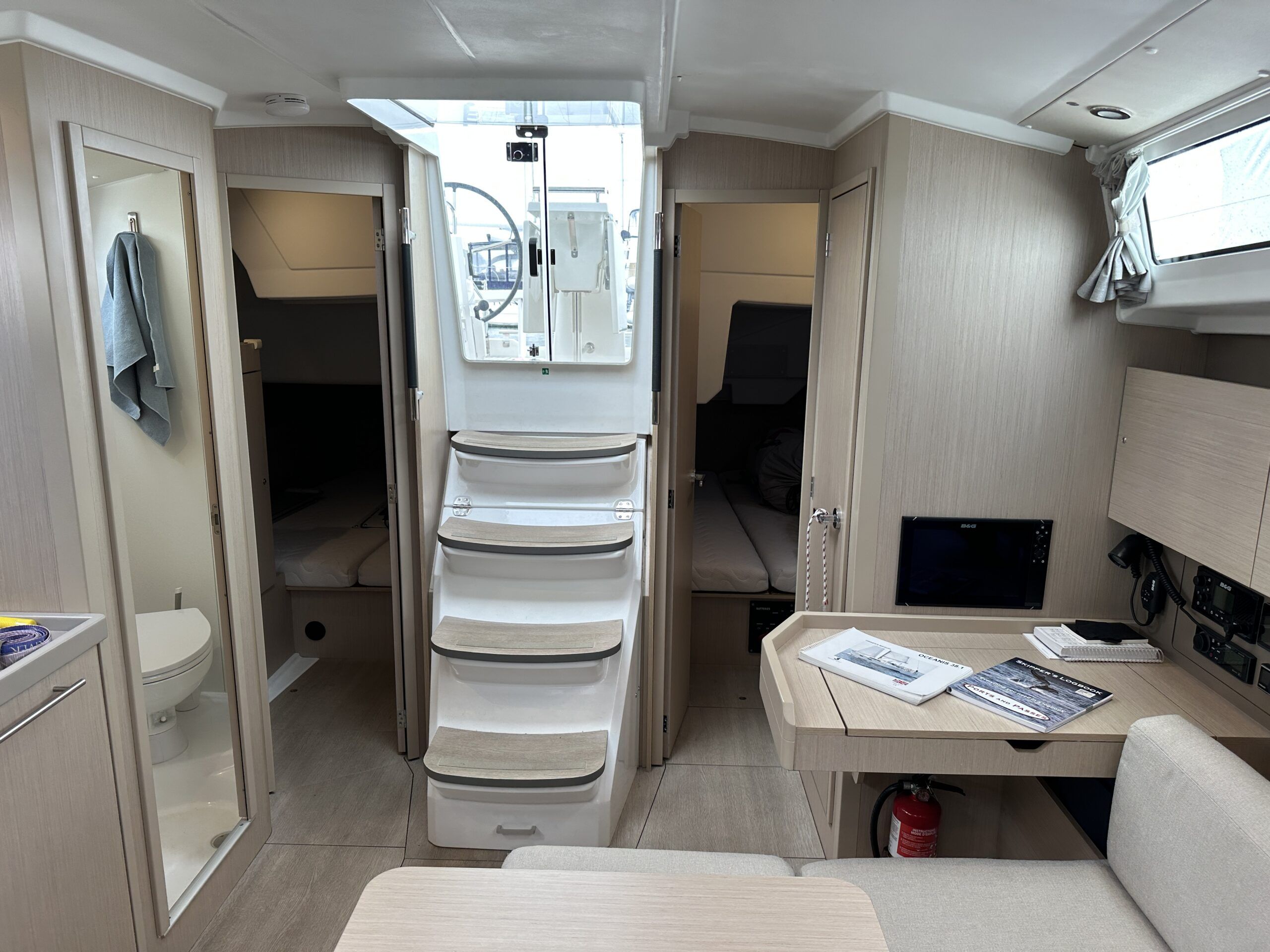
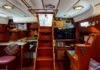
When you climb over the low companionway lip and down the four steps into the main cabin, you’re greeted with a light and airy space. The overall impression is one of somewhat stark openness with white oak paneling everywhere, including the sole. The factory does offer alternative wood finishes. Immediately to starboard is the door to the starboard side aft cabin. A generous double mattress extends under the cockpit floor behind the engine compartment. There is limited standing headroom with a substantial closet and drawers against the outboard side. In the dual aft cabin configuration this cabin is mirrored on the port side.
Head
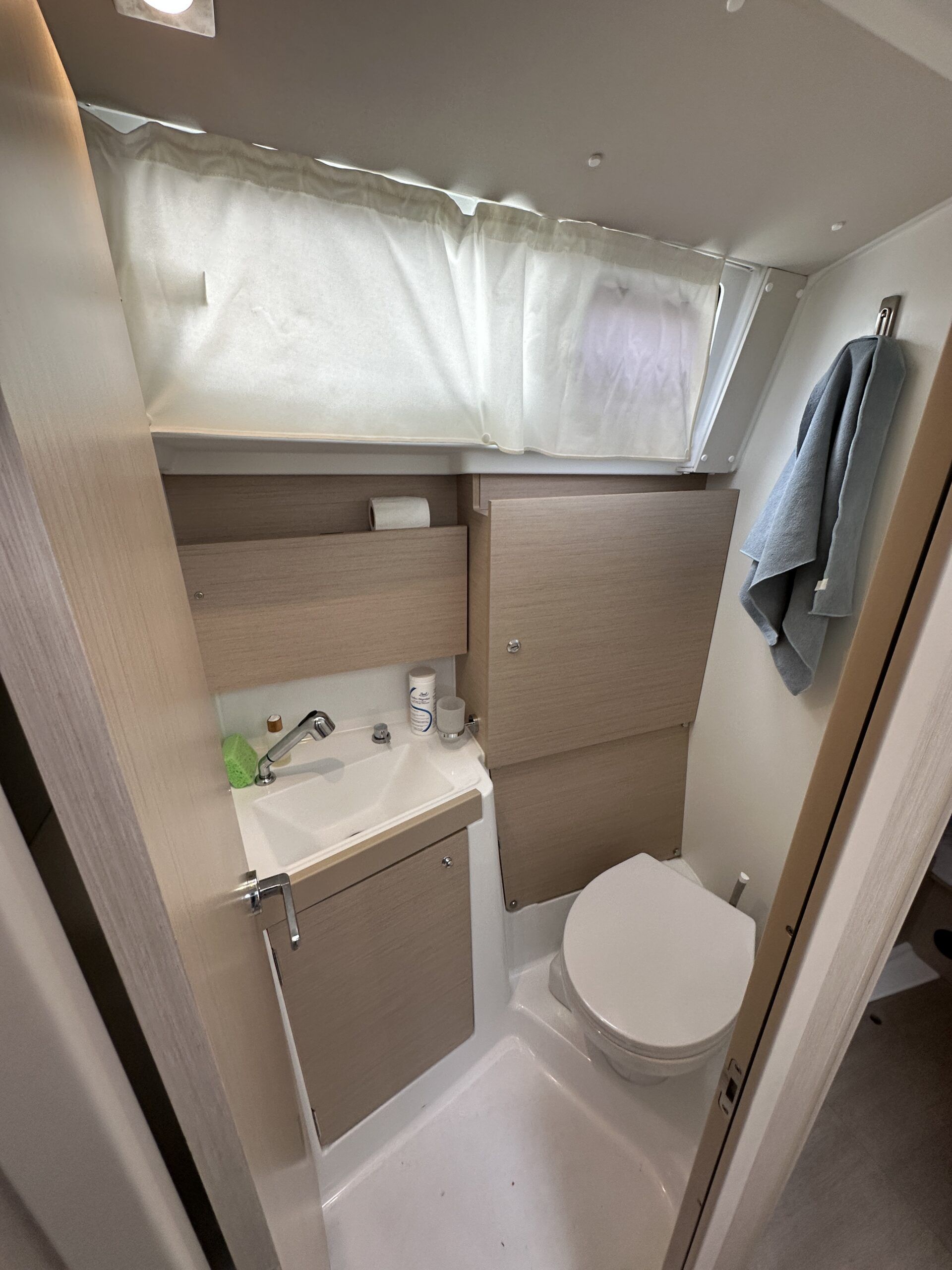
Just forward on the starboard side is the single head compartment. This is well-ventilated with an opening port and overhead hatch—the compartment is on the small size considering it also incorporates a shower. In the different configurations of the 38.1, the single aft cabin version has a separate shower compartment on the port side. On Hokusai, with the double aft cabin, that space is an enormous hanging locker.
Nav Station
Moving forward into the cabin, a small aft-facing navigation station is to port and provides seating with a settee. There is room here for the electrical panel and accompanying electronics. Aboard Hokusai there is a B&G 12-in. chartplotter against the bulkhead.
Galley
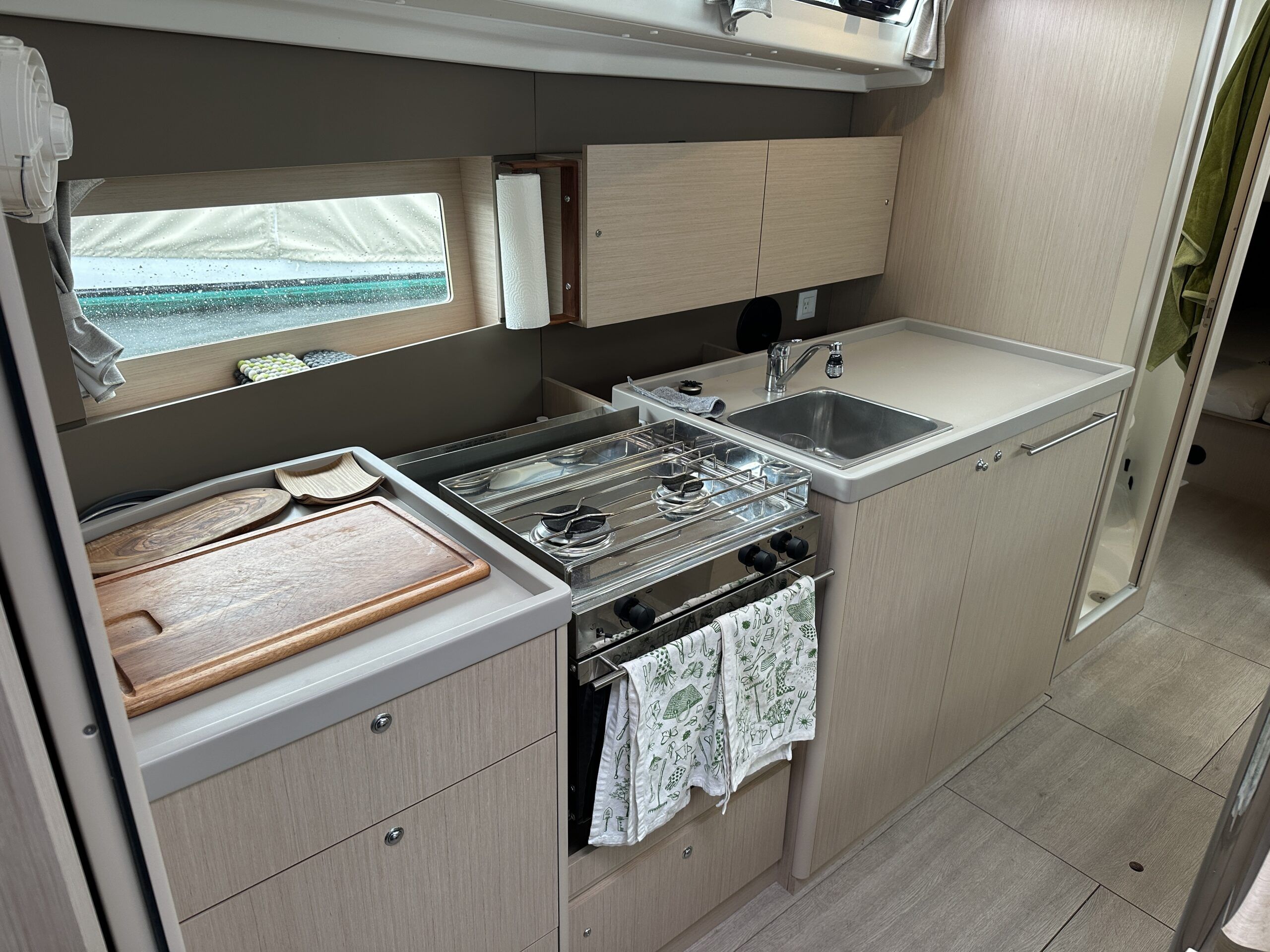
On the starboard side of the main cabin is the galley, which stretches from the head compartment to forward bulkhead. It includes a front opening fridge/freezer, single sink and two burner propane stove/oven that complements the abundant counter space. Under counter cabinets and drawers provide plenty of space for supplies and cookware. A large hull window lights up the entire area.
Salon
The single settee in the main cabin stretches forward to the main bulkhead along the port side. An unusual feature is a single-person seat that creates an “L” shape. With storage underneath, this seat lacks back support for relaxing, and simply provides additional space at the table. Unfortunately, although constructed almost completely independent of the main settee, one oak panel extends all the way from the hull, which prevents removal of the entire box without resorting to a saw. This single seat intrudes on usable cabin space and serves little function when only a couple is onboard. If there are guests, I suspect most of the dining would be outdoors on the large cockpit table.
The large, fixed salon table is secured to the mast compression post, which allows for access to the settee from both the fore and aft ends. However, with seating limited to one side, any more than three people would be a problem.
The dominant feature of the main cabin is the double doors to the forward cabin. Closed, they provide privacy to the V-berth. Open, they more than double the visual space of the interior.
Forward Cabin
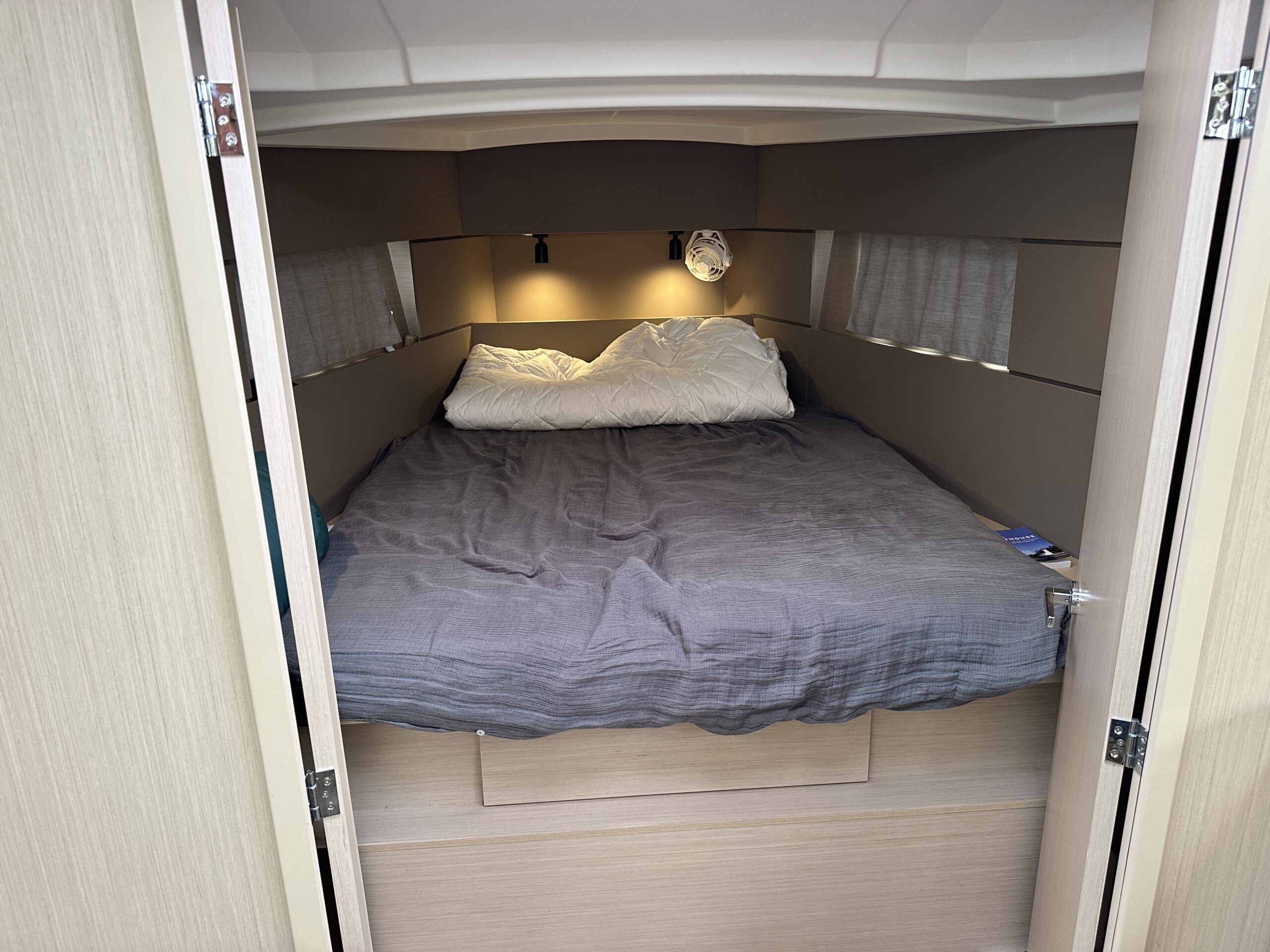
The forward compartment has a bright, airy feel with large hull windows and an opening overhead hatch. The bed is a generous size with a hanging locker on the starboard side and a drawer cabinet on the port. With the double doors open, this compartment feels enormous—it is visually open all the way to the companionway.
The salon sole is made up of individual panels of the same color and texture as the cabin paneling, most of panels are removable without tools. Access to the sump and various plumbing equipment is unhindered. These would need to be secured for offshore or regatta racing.
Mechanical
The Yanmar 3JH40 diesel with sail drive is mounted under the companionway with relatively open access through the companionway steps and removable panels in the aft cabins. Fuel capacity is 34 gallons (130 liters) in a single tank. Although a single 34-gallon (130 liter) water tank is standard, Hokusai includes an additional 52-gallon (200 liter) tank for extra capacity. A 21-gallon (80 liter) blackwater tank and 6-gallon (25 liter) hot water tank complete the plumbing features. As mentioned earlier, with the number of Beneteau 38.1 produced over the years I suspect there are many variations of this configuration.
Performance
I was fortunate enough to be invited aboard Hokusai on what proved to be a gusty day off the Sidney, British Columbia waterfront. Fortunately, the winds came from the land on a short fetch and seas never built to an uncomfortable level during our sail.
The Yanmar sounded comfortably distant under the cockpit sole as we powered out of the slip into a narrow fairway. With the twin rudders there is no direct prop wash on the rudder to play with directional control in tight quarters. This is where the standard bow thruster is almost essential.
Visibility Issues
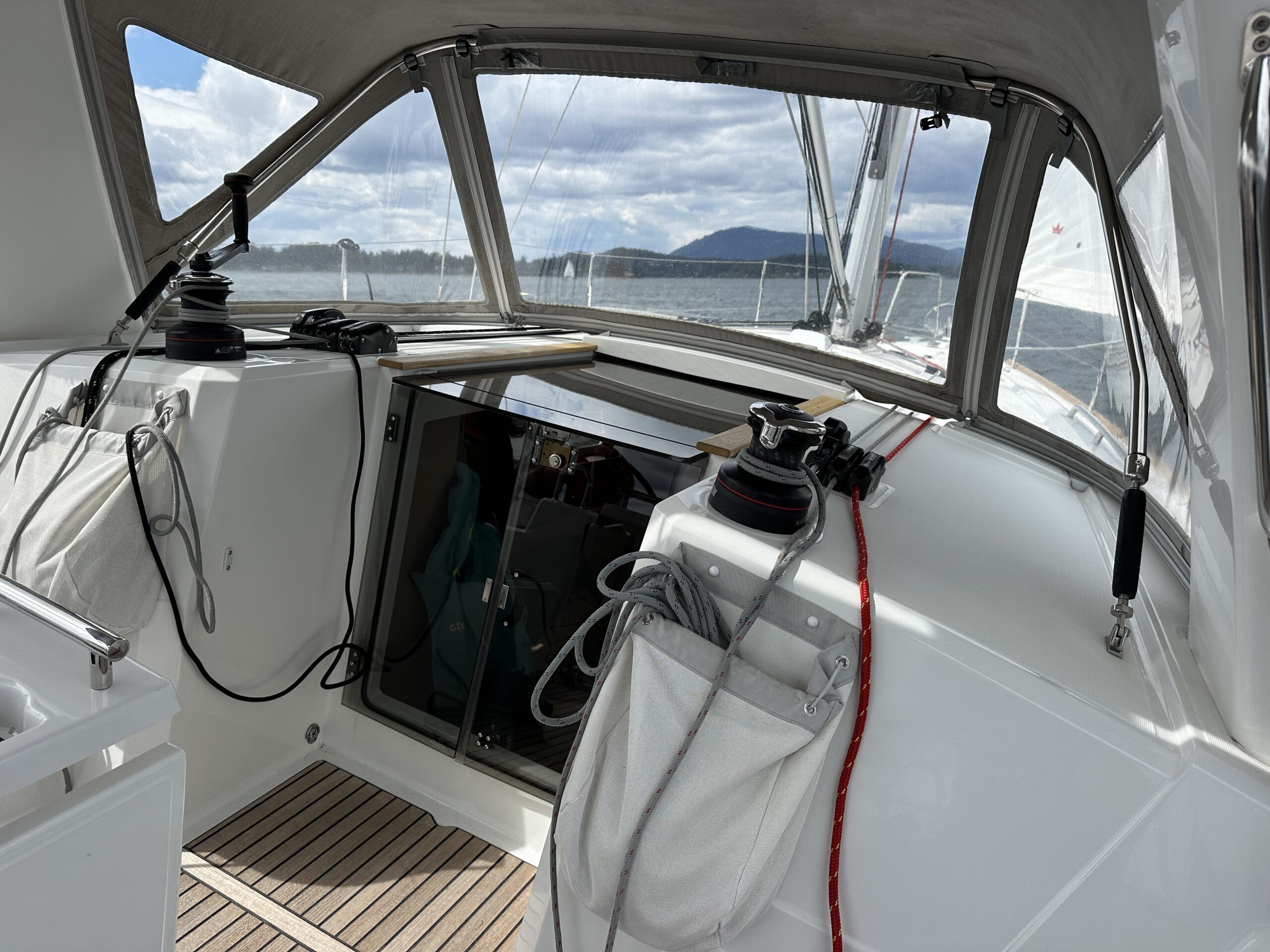
With only a short distance to travel into open water, and with the wind over the starboard quarter, there was no real need to test the engine at full throttle. The main was soon rolled out and the diesel banished to silence. And this is where the limitations of the bimini were soon apparent. Aboard Hokusai, the bimini is one piece from the trailing edge of the dodger to the stern. Although there is a large window built into the canvas over the helm stations, handling the main at the cabin top winches, where all control lines are located, does not allow for a view of any of the sails. This configuration makes it very difficult to tune the main without repeated steps to the side deck to look up. Roger and Romy are considering separating the bimini from the dodger with a removable panel.
Under Sail
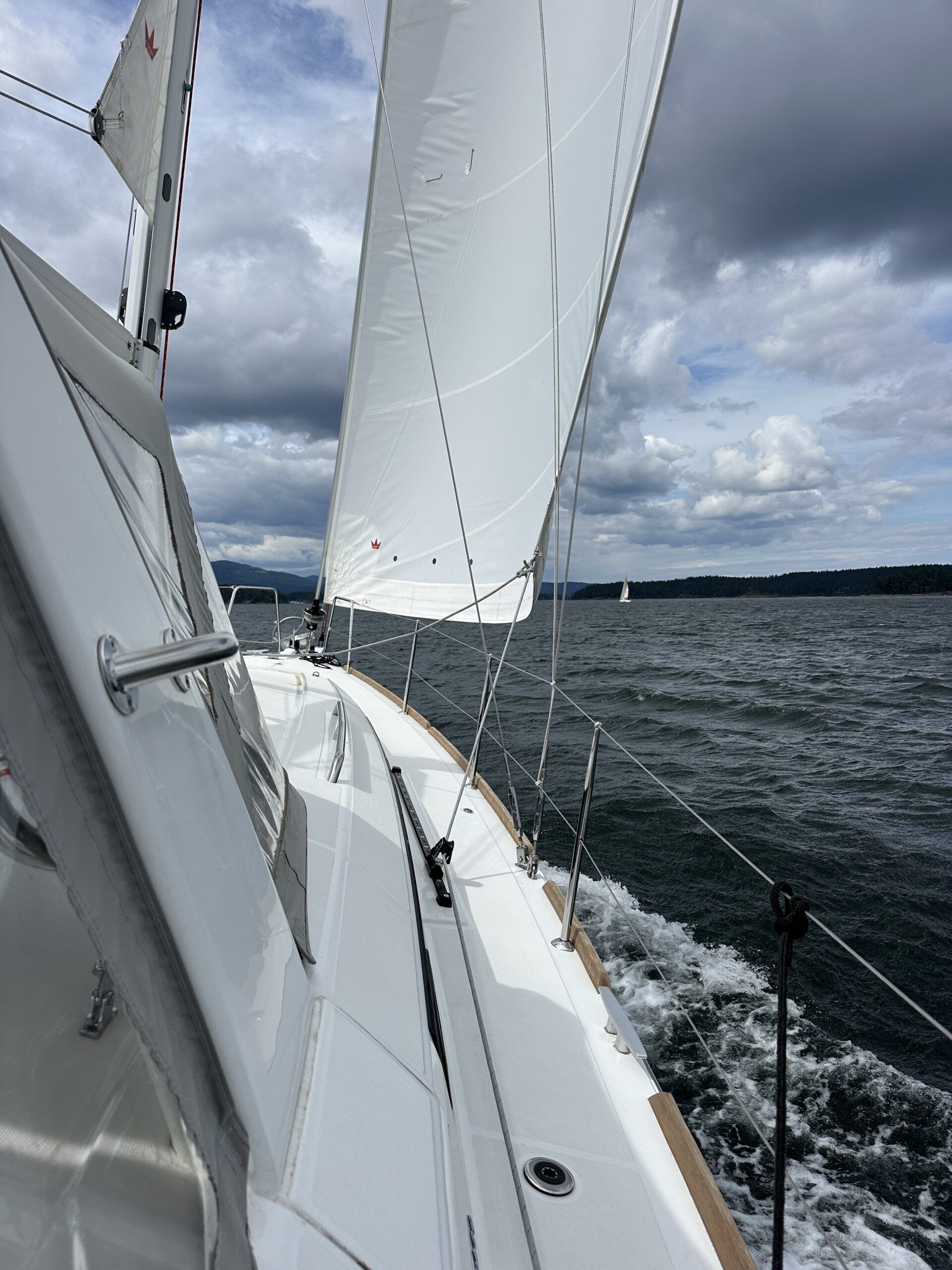
With the wind gusting to 12 knots, we rolled out the small genoa on a handy and smooth furler. The control line is at the port side helm, and a line stopper and a turning block lead to the primary winch on the cockpit coaming. This became important when the wind picked up later in the sail. The Beneteau 38.1 immediately surged ahead in an almost sports car acceleration. This was a bit surprising considering the overall weight and sail plan area.
We were soon on a close reach sailing at hull speed, heeled over enough that the windward rudder was leaving no discernible trail in the water. The fully submerged leeward rudder was performing as designed with a light and positive directional control. It was not exactly the stability of a full keel, but the hull form was controllable and as the gusty winds increased, there was never a feeling of imminent rounding up. Letting the main out under these conditions was paramount.
Higher Winds
The wind was soon gusting over 25 knots true, which was not in the forecast, so we rolled up the main with the assistance from the cabintop Harken self-tailers. This hull form is best sailed as close to flat as possible and excessive heeling is not productive. Attempts to sail to windward with just the genoa demonstrated that the track did not reach back far enough. With the car all the way back the foot of the genoa could not be flattened. Of course, rolling up a portion of the genoa would also solve this problem.
Under these conditions tacking to windward to determine angles was simply not practical. The boat sailed at and beyond hull speed on a tight reach in a controllable manner. Moving about in the cockpit under these conditions demonstrated that there were handholds in the appropriate locations. Visibility forward to the genoa tell tails was excellent from the leeward coaming. But with a stern this wide, the view to windward was completely obstructed when heeled over.
Light or moderate wind performance cannot be spoken for. This was only the second sail on this boat for both Roger and Romy, so it was time to head back to the dock. The Code 0 would have to stay in the bag.
Under Power
Returning into the harbor against the gusty wind proved that, under power, the Beneteau was controllable with plenty of reserve power available from the Yanmar. The turning radius was tight and predictable, despite the lack of prop wash on the split rudders. The bow thruster was available if needed.
Conclusion
Is the Beneteau 38.1 designed for ocean passages? The cockpit and interior design strongly suggest that isn’t the primary purpose. Could the design cross an ocean? Sure, any boat could cross an ocean. Joshua Slocum did it in a carved-out log canoe. But that isn’t her design purpose. The Beneteau 38.1 is a fine weekend or short-passage coastal cruiser for a couple with potential guests. With three cabins, I suspect the focus was the charter business in warm climates. With six adults, which is the berth capacity of this configuration, or a medium size family aboard, those numbers may work well in the cockpit, but below decks will definitely be crowded.
For Roger and Romy, who are sailing in the Pacific Northwest where safe anchorages abound and shore facilities are available within easy reach, the Beneteau 38.1 could be considered the perfect sailboat. There is plenty of room outdoors under the bimini on a boat designed to sail flat—it meets all their priorities of a safe cabin on the water. With a few modifications to Hokusai’s sail plan and cockpit layout, she could also become a competitive club racer. Every sailboat design is a list of compromises and this boat checked off all the boxes on their preferences. Happy sailing!
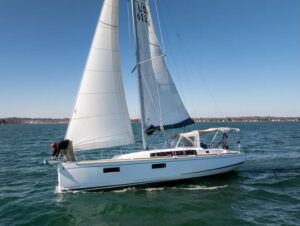
Market Scan Contact
2019 Beneteau Oceanis 38.1 Chris Jester
$190,000 USD
+19497750665
Newport Beach, California Yacht World
2021 Beneteau Oceanis 38.1 Clarks Landing Yacht Sales MD
$269,000 USD
410-936-4656
Shady Side, Maryland Yacht World
2022 Beneteau Oceanis 38.1 Brian Winter
$278,950 USD 856-644-4890
Riverside, New Jersey Yacht World






FYI: My Tartan 3800 displaces 16,700 lbs, 10% more than the Beneteau 38.1, and that’s prior to upgrades and options. While there is nothing “wrong” with the Beneteau product, comparing it to yachts like Tartan does a disservice to brand. It’s like comparing a Chevrolet to a BMW, nothing wrong with a Chevrolet, but………
Hello Sean. I certainly wasn’t intending to slag either Tartan nor Beneteau, it was just a weight comparison between two boats of similar length. I could have chosen any fin-keeled spade rudder design. Comparing Tartan against Beneteau if other categories would be unfair as they are not designed for the same style of sailor or sailing. Thanks for reading the article and providing a comment.
Bert Vermeer
Well,Tartan is an more narrow boat, its not as useful in warmer climates, older design and poorer design in my eyes, I do have a newer Hallberg rassy now, but with Tartan and my boat, I will prefer Beneteau 38.1 in mediterranian.