
Co-founded by Charlie Britton in the early 1960s, Tartan Yachts was established on the shores of Lake Erie in Grand River, Ohio. The original Tartan was the very successful 27, first launched in 1961 with 648 constructed. Another early model was the 34-ft. Sparkman & Stephens design that continued in production until 1978. A young Tim Jackett joined Tartan Yachts in 1977 and, working through a series of owners, became the in-house designer in the mid-70s. Jackett moved up the corporate ladder, designing numerous Tartan and C&C models when that famous line of racing boats was acquired by Tartan.
The 395 was introduced in 2019 with 16 completed boats emerging from the Ohio factory before the production run ended in 2026. A model refresh is underway for 2027 with significant changes to construction and available packages. The first of the new series, simply called the Tartan 40, is currently under construction and will be available in the fall of this year.
Tim Labute, Practical Sailor Editor in Chief, produced a very informative video on developments within the boating industry touching on Tartan and Catalina Yachts.
Myrthe
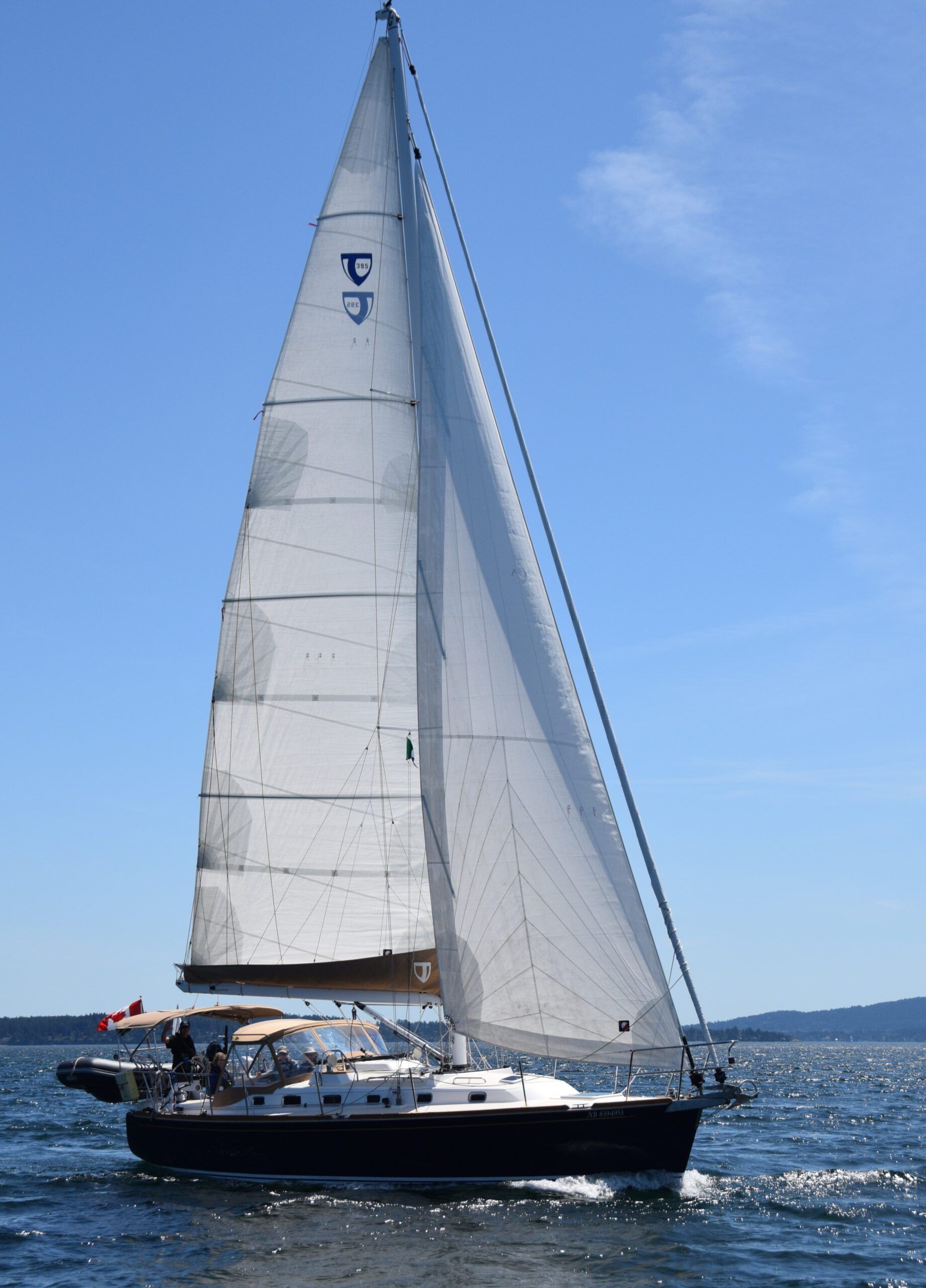
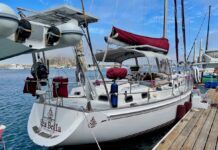
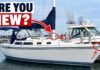
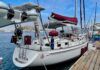
The Tartan 395 subject of this review is hull #6 of that line, Myrthe. She was purchased new in Annapolis after being displayed in the 2022 Annapolis Boat show. Myrthe (derived from the Dutch word for the Myrtle plant which has long been associated with beauty, fertility, and love in various cultures around the world) was trucked across the continent and launched in Anacortes, Washington, then imported into her new home at Port Sidney, British Columbia.
A few warranty issues were quickly resolved by Seattle Yachts, the Pacific Northwest Tartan distributor and owner of Tartan Yachts at the time. A few upgrades, including stern dinghy davits and personal choice running rigging, were undertaken. The proud new owners, Bill and Shirley, had sailed charter boats of similar size including Catalina, Beneteau and Jeanneau in various parts of the world. That experience focused what they wanted in their retirement boat.
After scrutinizing Tartan 3400 and 3700s, Bill and Shirley were impressed with the build quality, seamanship-oriented interior and traditional lines. A search for a larger sister ship brought them to the new Tartan 395. Although fully capable of crossing oceans, the goal was a safe and comfortable coastal cruiser to explore the rugged coast of British Columbia.
Hull
The Tim Jackett-designed Tartan 395 is constructed using an epoxy modified vinylester resin, solid below the waterline and with a polyvinyl chloride (PVC) foam core sandwich above. The decks are a hybrid. The cockpit sole and coamings are PVC foam core while the cabin top, cockpit seats and working deck are balsa cored.
Three keel options are available, the standard deep keel fin with a 6-ft. 2-in. (1.8 m) draft, a beavertail (fin with wings) with a 4-ft. 10-in. (1.47 m) draft and a centerboard with a 4-ft. 3-in. (1.29 m) draft up, 8-ft. 3-in. (2.51 m) with the board down. All keels are external lead with the deep draft at the lightest at 5,500 lb. (2,494 kg) and the centerboard with additional weight at 6,800 lb. (3,084 kg) as the heaviest.
Myrthe has the beavertail and Bill is undecided if that choice is right for deep, west coast waters. Fortunately, Tartan has designed the hull and keel joint identical on all hulls. The keels are interchangeable without structural modification with just the centerboard option requiring a pennant tube.
Steering from the twin helms is by cable to a single, elliptical rudder on the centerline. This is a benefit of the almost 13-ft. (4 m) beam not being carried all the way to the stern. No need for twin rudders. The single rudder is in the prop wash and allows for excellent maneuverability in tight quarters.
On Deck
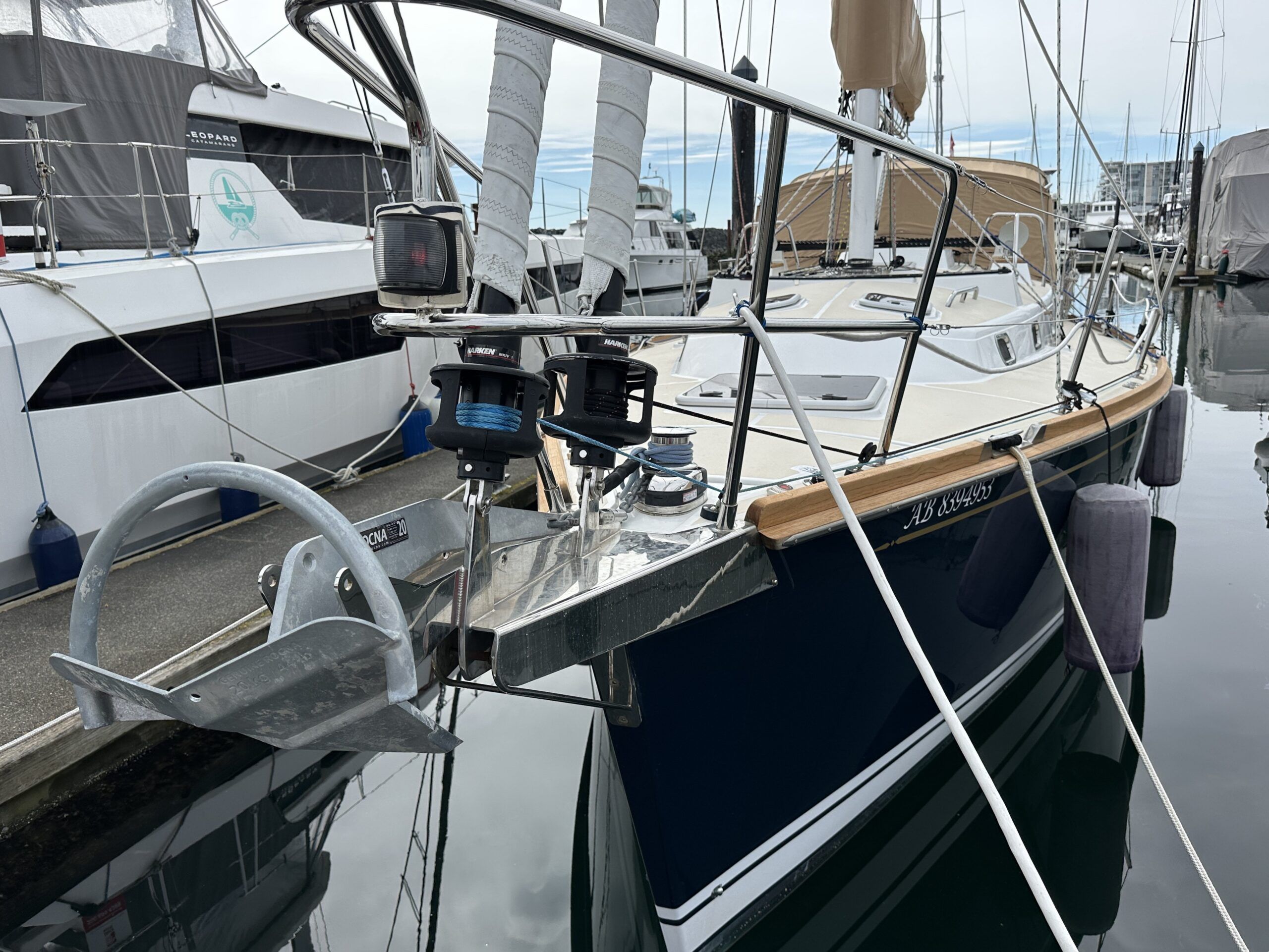
The bow supports a custom fabricated anchor platform that includes fittings for two Harken manual furlers for the jib and reaching sails. A single bow roller hosting a Rocna anchor leads to an above deck windlass that feeds chain into a substantial divided locker. While it isn’t the largest locker for a 40-ft. sailboat, it is more than adequate for plenty of chain and rode on one side along with a spare anchor and rode on the other.
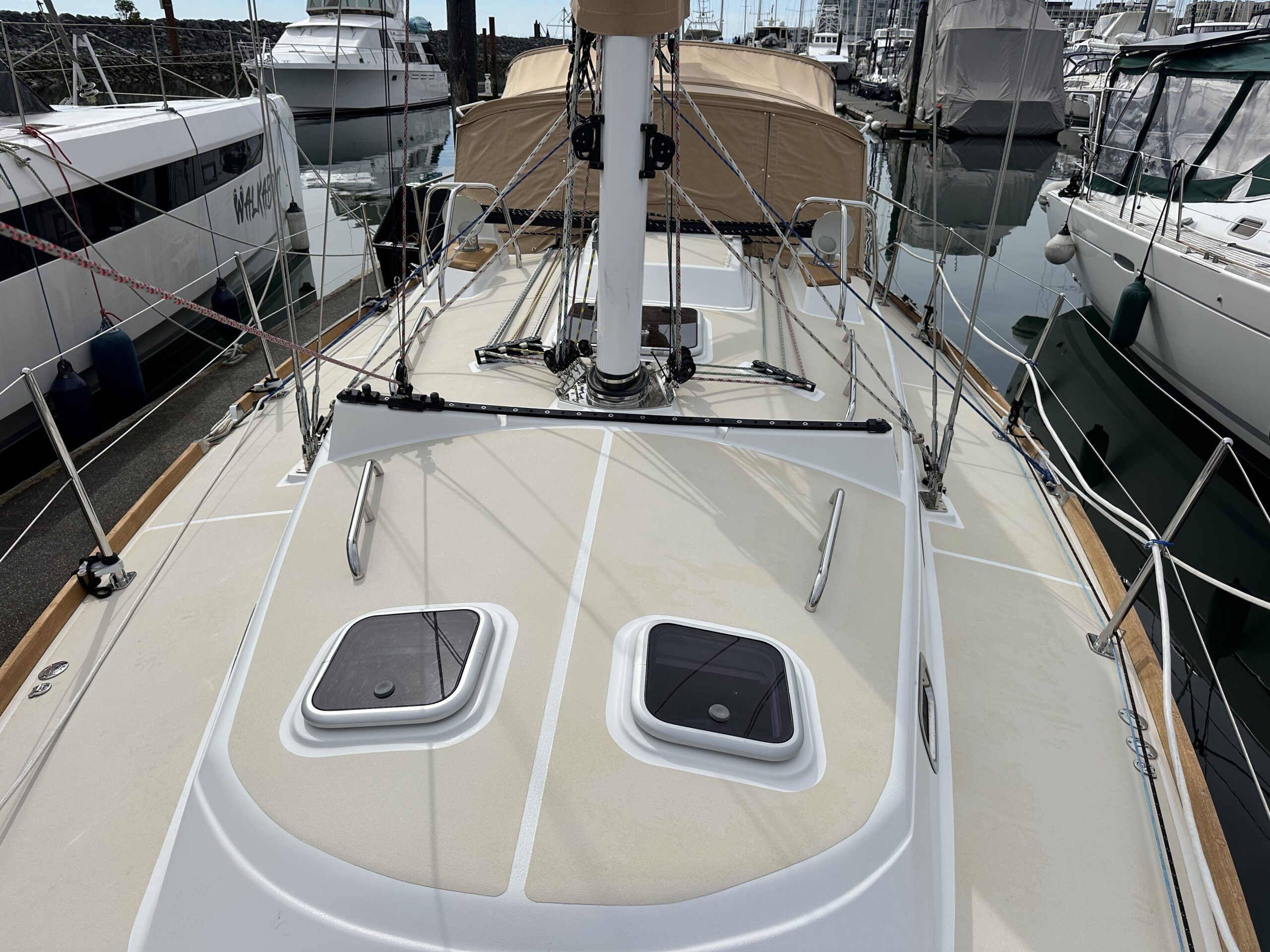
The foredeck includes a large opening hatch set back near the beginning of the cabin trunk, plenty of room for sail management or dinghy storage. The single curved track for the self-tacking jib is set on a fiberglass base just forward of the mast.
Safety Features
Double lifelines extend from pulpit to pushpit with side gates at the cockpit. Aboard Myrthe the wire lifeline has been replaced with solid stainless steel from pushpit to gate for greater safety. Sail control lines on the cabin top lead from the mast base to deck organizers and back to clutches and winches at the trailing edge of the cabin trunk. All are clearly visible on deck, not hidden under fiberglass panels.
Stainless-steel handholds extend from the companionway to the foredeck. A beautiful teak toerail adds to that sense of security on the wide, unobstructed side decks. Yes, it requires added maintenance, but it is a touch that separates the Tartan line from the fiberglass masses. Aboard Myrthe the dodger also has a stainless-steel hand hold for the gap between the cockpit and cabin top.
Twin dorade vents just forward of the cockpit add ventilation below decks when the weather closes in. Both are protected by three-point stainless guards allowing for additional handholds.
The Rig
The Tartan 395 has a solent rig on a 51.83-ft. (15.80 m) carbon fiber mast that reaches almost 63 feet (19.07 m) above the waterline. If your sailing dreams include the Caribbean using the ICW, the 65-foot clearance will be close. Of course, the 395 is fully capable of undertaking this journey down the Atlantic coast in ocean waters.
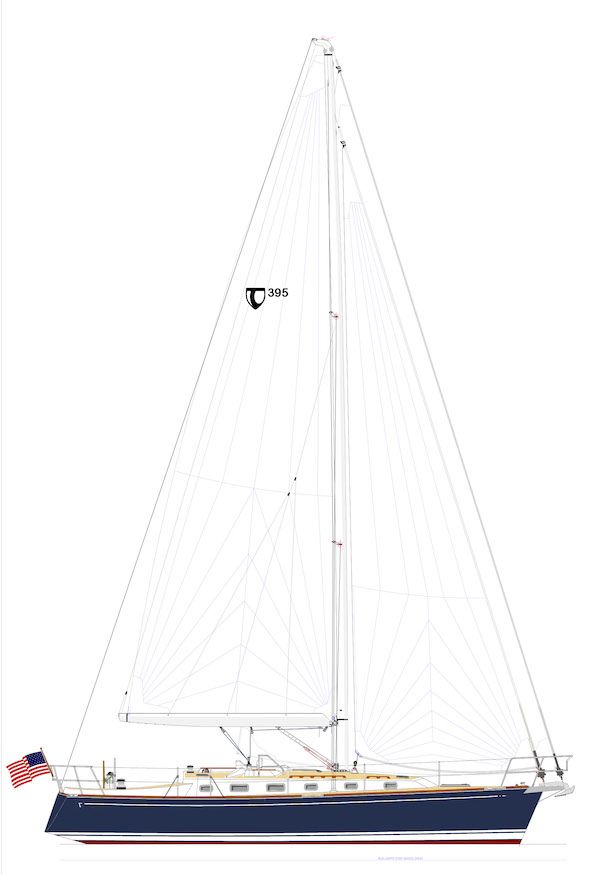
Sailboat Specifications Courtesy of Sailboatdata.com
Hull Type: Fin w/bulb & spade rudder
Rigging Type: Solent
LOA: 39.50 ft / 12.04 m
LWL: 33.25 ft / 10.13 m
S.A. (reported): 794.73 ft² / 73.83 m²
Beam: 12.83 ft / 3.91 m
Displacement: 16,000.00 lb / 7,257 kg
Ballast: 5,500.00 lb / 2,495 kg
Max Draft: 6.17 ft / 1.88 m
Construction: FG
Ballast Type: Lead
First Built: 2019
Builder: Tartan Marine
Designer: Tim Jackett
Type: Diesel; Saildrive
HP: 40
Fuel: 40 gals / 151 L
Water: 100 gals / 379 L
S.A. / Displ.: 20.10
Bal. / Displ.: 34.38
Disp: / Len: 194.31
Comfort Ratio: 23.53
Capsize Screening Formula: 2.04
S#: 3.13
Hull Speed: 7.73 kn
Pounds/Inch Immersion: 1,524.28 pounds/inch
I: 51.83 ft / 15.80 m
J: 15.00 ft / 4.57 m
P: 50.75 ft / 15.47 m
E: 16.00 ft / 4.88 m
S.A. Fore: 388.73 ft² / 36.11 m²
S.A. Main: 406.00 ft² / 37.72 m²
S.A. Total (100% Fore + Main Triangles): 794.73 ft² / 73.83 m²
S.A./Displ. (calc.): 20.10
Est. Forestay Length: 53.96 ft / 16.45 m
Mast Height from DWL: 62.58 ft / 19.07 m
The double spreaders are narrow enough that the stays terminate on raised fiberglass pads against the coach allowing unobstructed access along the side deck. The backstay is split, allowing for the addition of simple hardware for adjustment.
Mainsail
The fully battened Sobstad mainsail with lazy jacks in a stack-pack is controlled with the mainsheet on a traveler just forward of the dodger. The mainsheet can be adjusted from both sides of the cockpit with a continuous line brought back to the twin helm station winches. The Tartan 395, like many models in the Tartan line-up, is driven by the large main.
Jib
The 100% self-tacking jib is set on the inner forestay and with a curved track just forward of the mast. Tension on the jib sheet is adjustable with a single line leading back to the cockpit winches. Barber-haulers on eye-pads allow for infinite adjustment on the leach and foot although this option has not been needed aboard Myrthe yet.
Reacher
A light-airs cruising 130% reacher is set on a permanent stay ahead of the jib and attached to the stainless-steel anchor platform. The sheet tracks are set on the aft end of the teak toe rail which does tend to limit pointing ability. But the reacher is not generally regarded as a pointing sail anyway.
With only two self-tailing Harken winches set up outboard of the helm stations, which is handy for the helmsperson, there is no practical place to add winches for a true cruising or symmetrical spinnaker. The obvious spot on the cockpit coaming is where a helmsperson would perch for a view of the jib tell-tails and approaching waters.
Cockpit
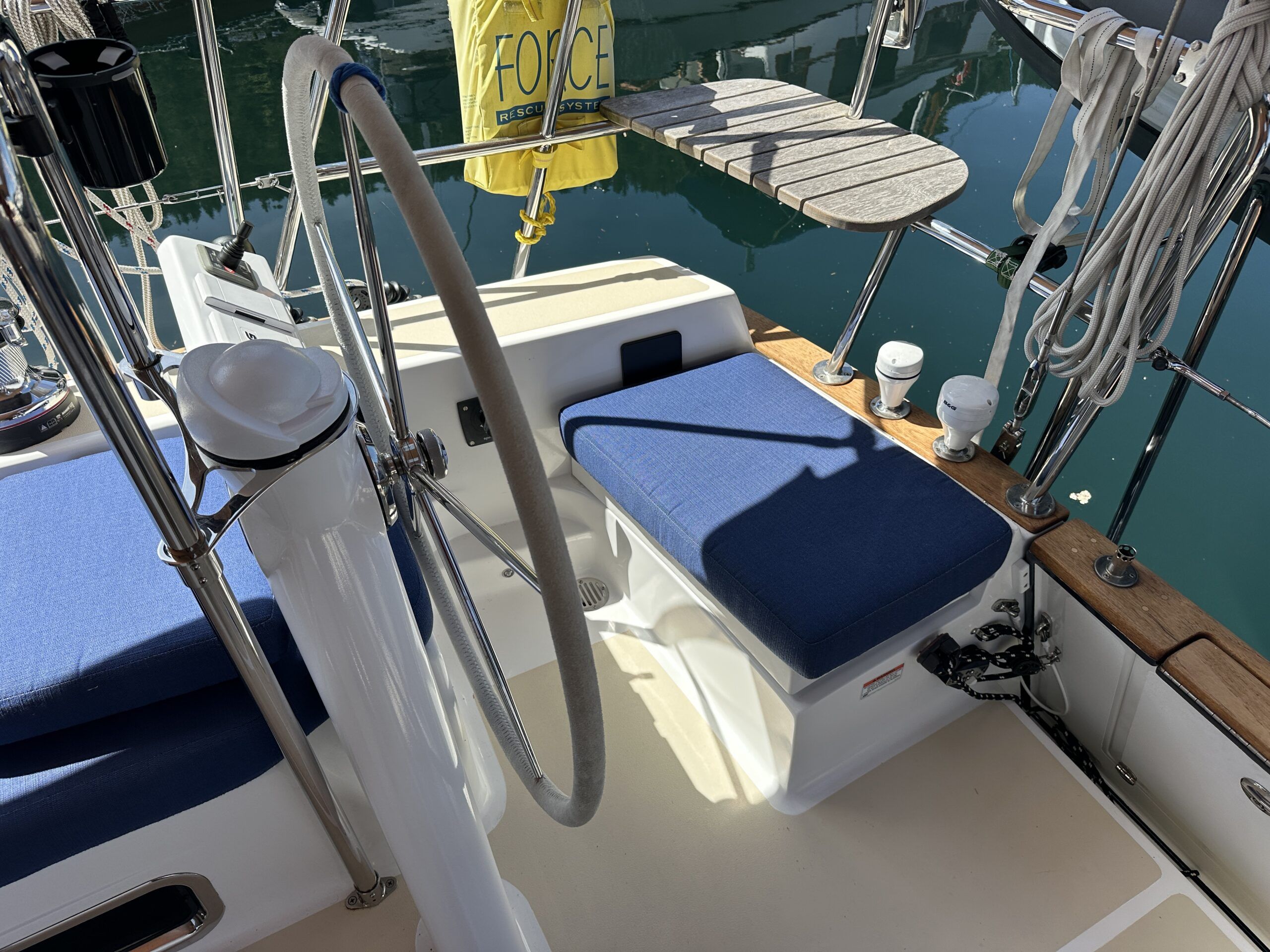
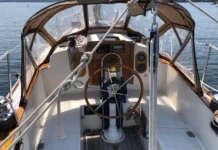
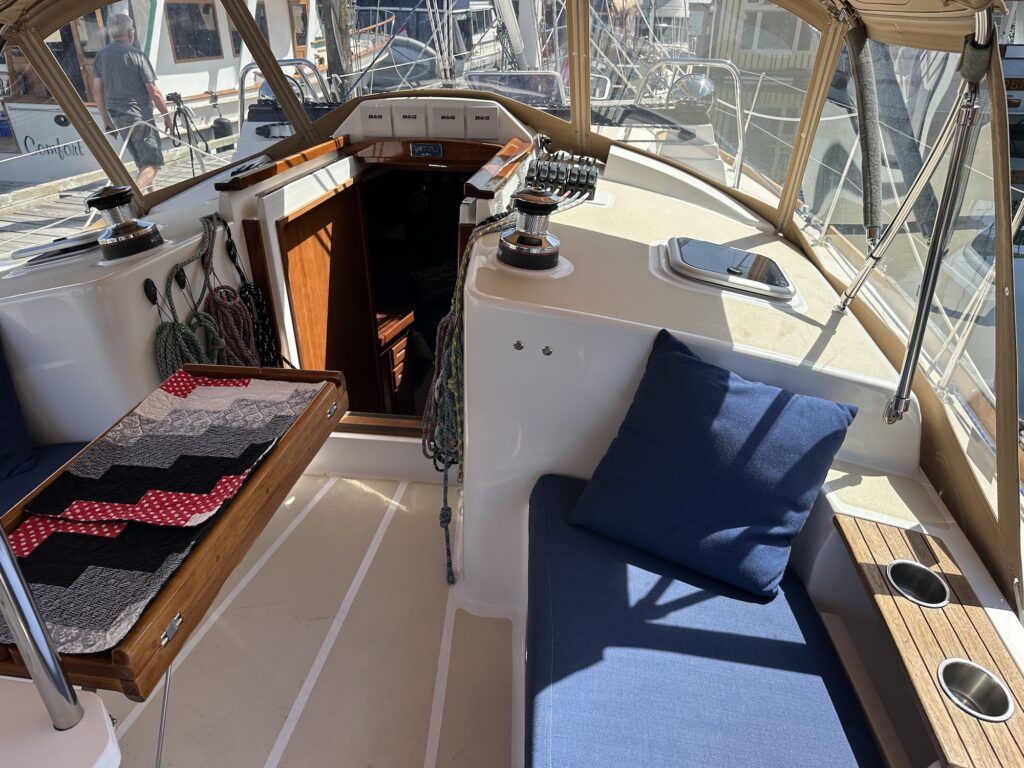
The Tartan 395 has a relatively large cockpit and what appears to be standard on all modern beamy sailboats—dual helm stations. The starboard station displays the autohelm, bow thruster and windlass controls. Once again, the engine throttle/gear shifter is mounted at ankle height on the starboard side, a long way from the port side helm when approaching a dock on that side. Each helm station also has a substantial grab rail at the top, handy for the helmsperson when the breeze picks up and the world starts to tilt. All sailing instruments are located in pods at the forward end of the companionway, clearly visible to everyone handling sails in the cockpit.
Binnacle
A central binnacle, separate from steering pedestals, contains engine instrumentation, room for a chartplotter and features a proper hand hold at the top. It also supports a cockpit table. The welcome feature here is that the table folds down and, with folding leaves, is completely out of the way when not in use. This really opens up the center of the cockpit. The compromise is that there are very limited options to brace your feet when heeled over.
Winches
The cockpit coamings are sufficiently wide to incorporate a small sailing gear cubby topped with a teak cup holder, an addition that is rarely seen on modern sailboats. Single Harken self-tailing two speed winches are located midway back to the helm stations, within reach of the helmsperson stretching over or around the wheel. With only two cockpit winches to control the main, jib and reacher sheets there are clutches to allow the winches to be unloaded and available for whichever sheet needs adjusting. What appears to be a somewhat complicated set-up is actually easy to manage while underway.
Not Ideal for Long-Distance Cruising
With the aft cabin configuration on the 395 the cockpit sole is, of necessity, relatively shallow. Combined with the low coamings that allow easy access to the side decks, the layout could not be considered a truly comfortable long-distance cruiser. Although there is satisfactory back support against the cabin bulkhead, the coamings do not provide tall enough support without additional cushions.
There are small seats for the helmsperson at the wheel but, again, no back support for long distance comfort. Seated here provides no visibility forward over the coach roof or dodger anyway. Standing behind the wheel, or perched on the wide coaming, provides the best view forward. Of course, there are also the pushpit seats that allow excellent visibility forward, but the helms are out of reach.
Swim Platform
The drop-down swim platform at the stern is relatively small when compared to modern Beneteau and Jeanneau models that span the entire width of the cockpit. It is small, but handy when boarding from the stern or emerging from the water. This configuration, with an actual transom, also lends a sense of security to the cockpit in any significant following sea. An integrated swim ladder is built into the platform.
Mechanical
The Tartan 395 emerged from the factory with two 110-amp AGM house batteries and a dedicated starting battery. This was not deemed adequate by Bill and Shirley for the potential demand of a two-compartment refrigeration system and a separate freezer if any extended cruising was planned. They did not want to run the diesel every morning and evening to keep up with demand, so Bill upgraded to a pair of 460-amp hour Lithium batteries along with a Victron control system for the house circuits.
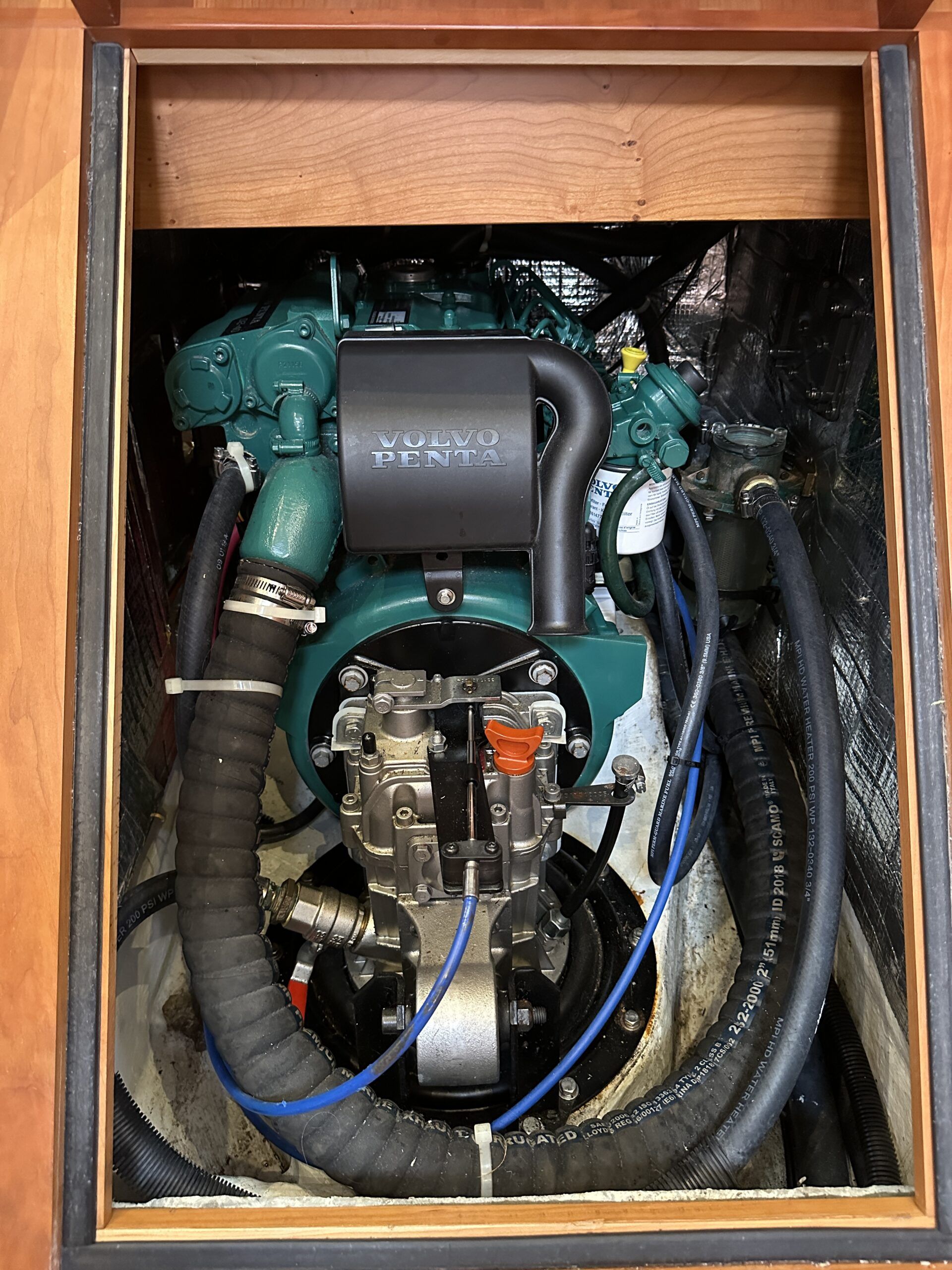
A Balmar XT 170-amp alternator with Wakespeed regulator were added to the Volvo Penta D240 diesel to keep up with charging demands. The solar panel option was also explored and, although the electrical connections are available at the stern, the two flexible 100-watt panels are stored below until needed. Bill has calculated that even if they stay at anchor for up to five days there won’t be any need to run the engine.
Access
The Volvo Penta D2-40 four-cylinder diesel is set on a reversed sail drive under the companionway steps. This makes the raw water impeller somewhat difficult to access as it’s on the front of the engine, facing aft. The steps and a hinged shelf in the aft cabin can be lifted to reach common engine checks. A double Racor fuel prefilter replaced the original Volvo prefilter, which is accessed under the aft berth mattress.
Tankage
Fuel capacity is 40 gallons (151 liters) in a single stainless-steel tank under the starboard salon settee.
The main stainless steel water tank is located under the port side settee, balanced by the stainless-steel fuel tank under the starboard settee. An additional plastic water tank is located under the V-berth for a total capacity of 66 gallons (250 liters). Bill has added a Spectra water maker to extend cruising capability.
Interior
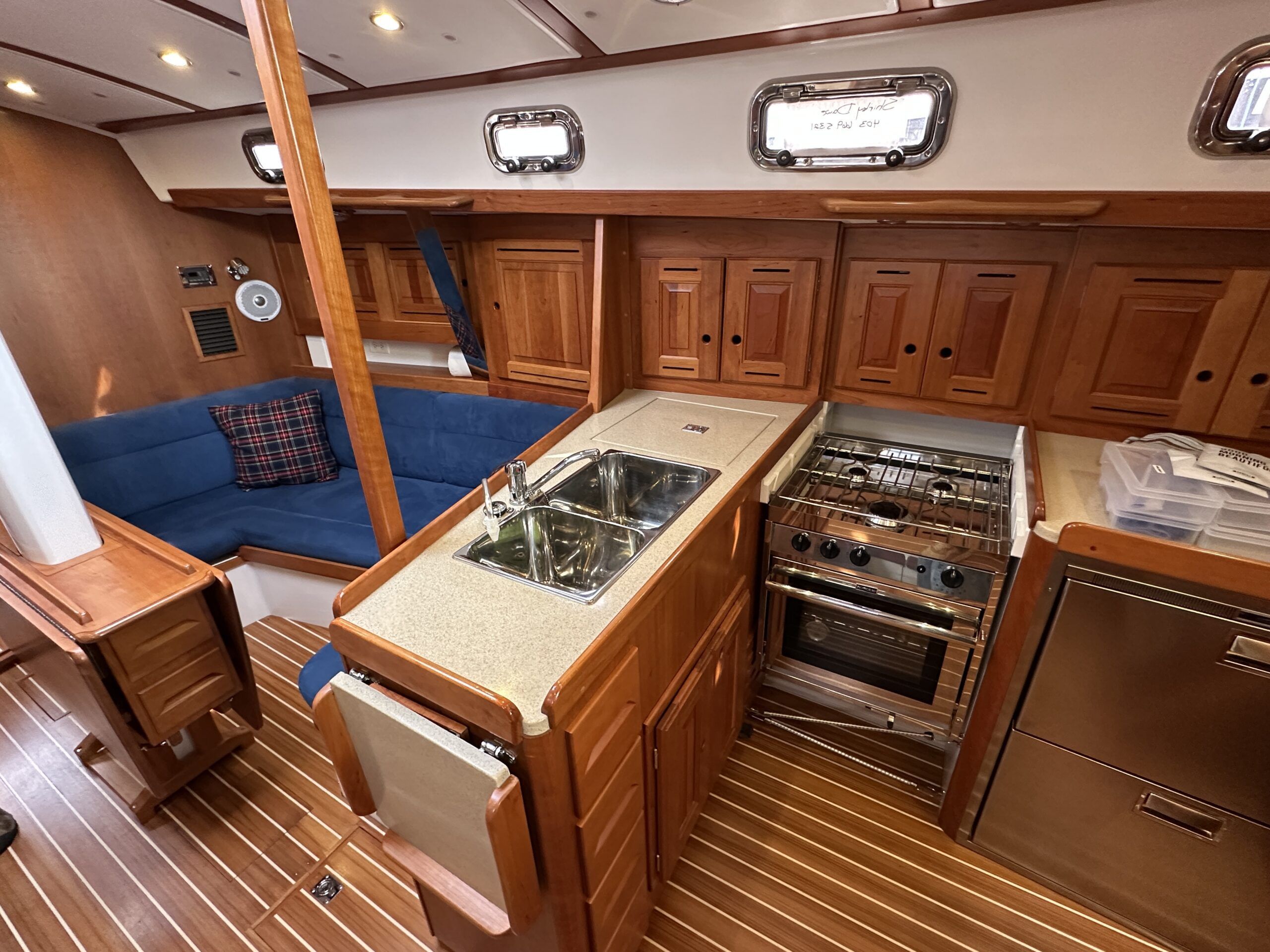
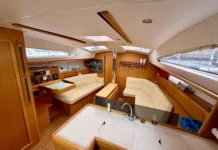
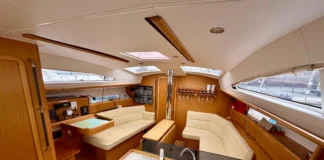
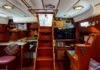
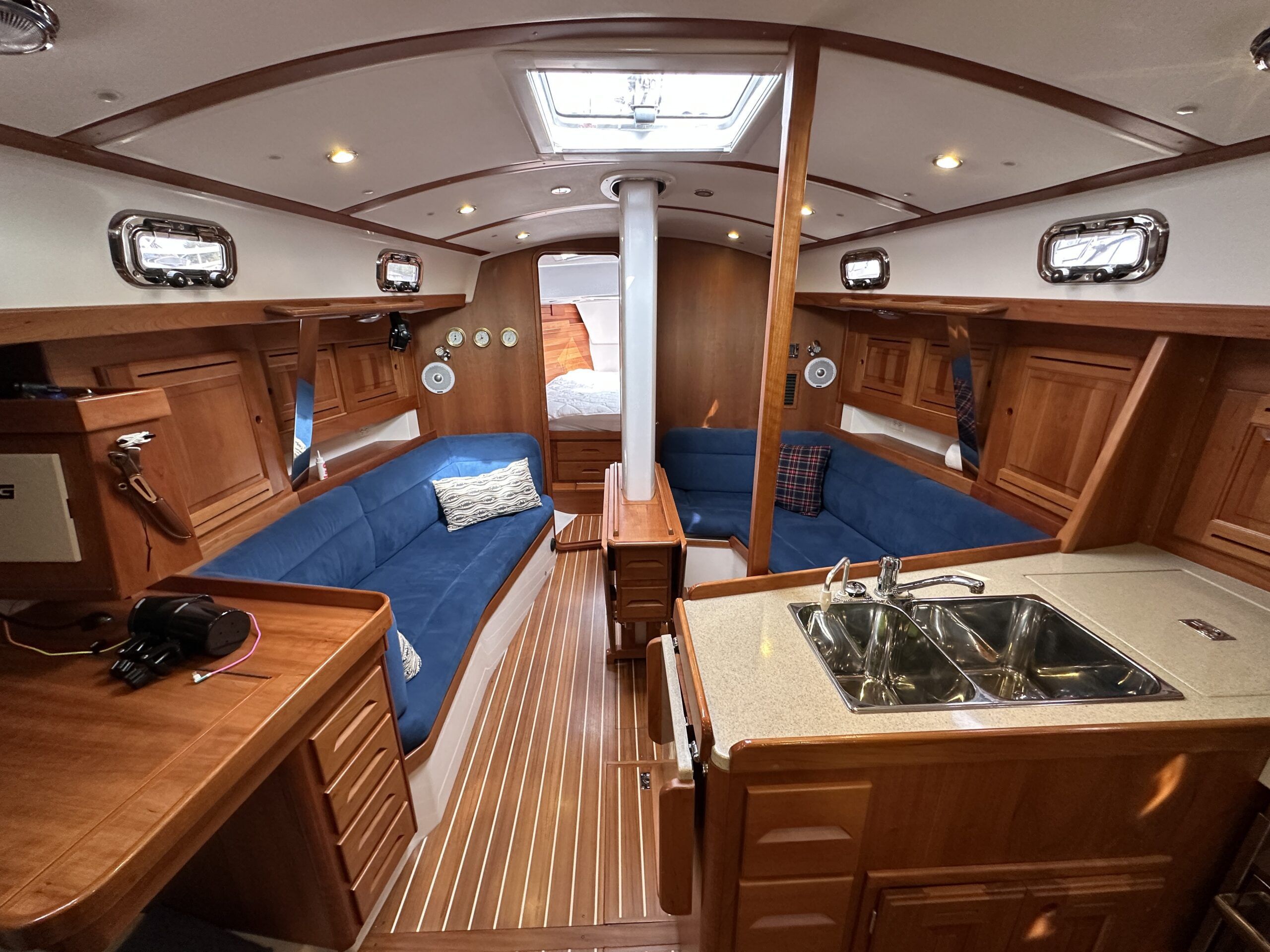
Stepping over the low lip of the companionway and down the five steps into the main cabin is akin to a return to luxury sailboats of a bygone era. Aboard Myrthe, the warm cherry woodwork is accented with deep blue upholstery and varnished battens crossing the white overhead. Tartan offers options in interior finish and upholstery—the light teak on Myrthe is my favorite.
Multiple opening portlights and hatches allow plenty of light and ventilation into a very inviting interior. As is traditional, there are no hull windows for viewing the outside world while seated in the salon. Some may see this as a detriment; others view it as a prudent safety and maintenance factor for the years to come. The teak and holly cabin sole matches well with this interior.
Galley
Immediately to starboard at the companionway is the galley with a three-burner propane range/oven, front opening two compartment refrigerator, top loading freezer and centerline double sink. Although a front-opening refrigerator is not the most power-efficient, the configuration does allow for additional counter space. There is also a small flip-up extension inboard of the sink that adds to that space.
Galley storage is plentiful behind beautifully crafted cabinets with additional under-counter drawers. High fiddles with open corners allow easy cleaning of the Corian countertops. With all the opening portlights and overhead hatches ventilation is not a problem. An air conditioning unit came with the build but gets little use in the PNW. With no line-of-sight overhead storage, the galley becomes part of the saloon, keeping the chef involved in any table conversation. The high counter fiddles and a cherry post on the salon side of the galley provide excellent handholds when the boat heels over.
Aft Cabin
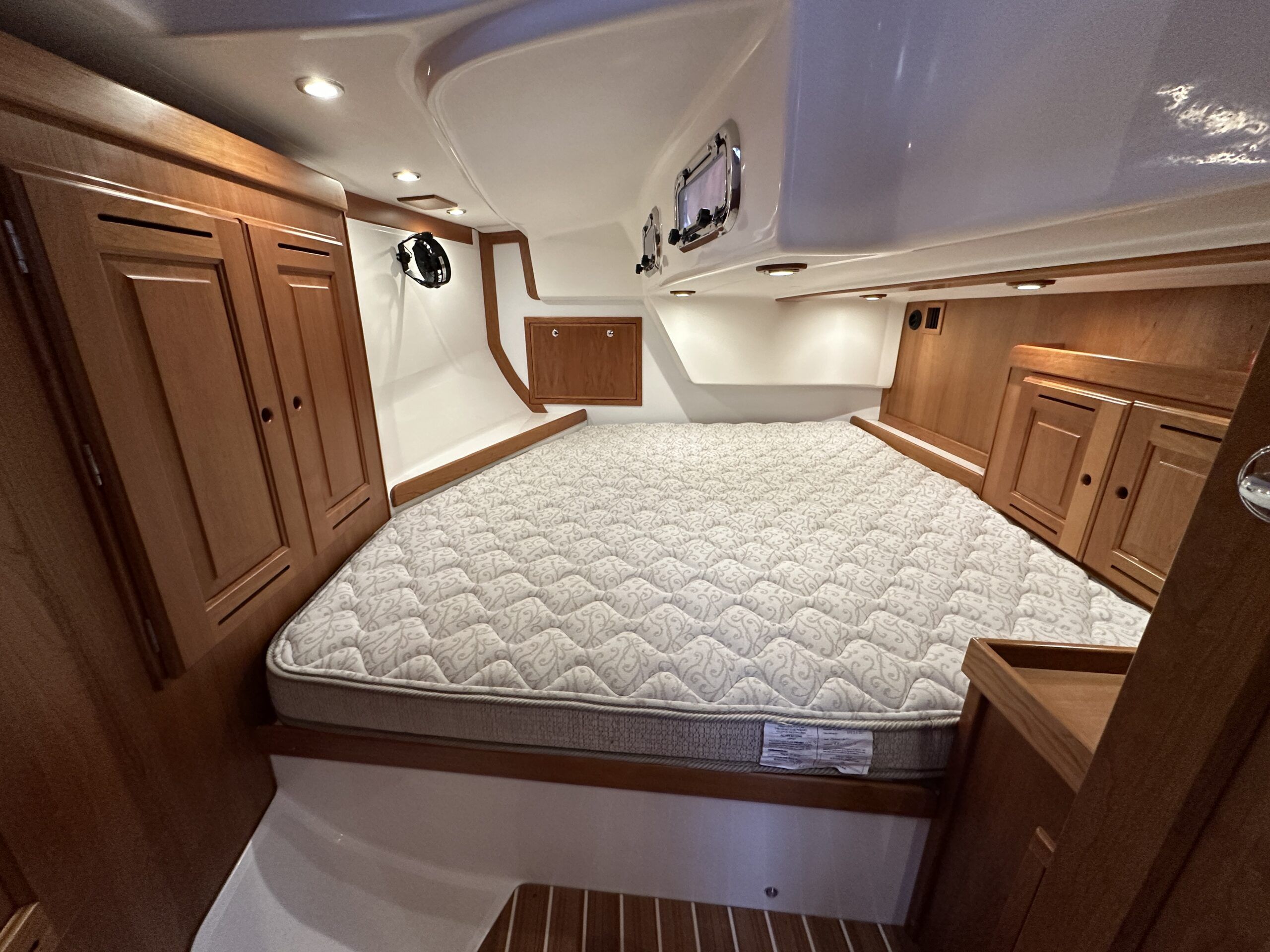
Astern of the galley is the roomy aft cabin. For a 39-ft. boat, this cabin is far from claustrophobic. The ample double-wide mattress is longitudinal. No one is trapped behind a sleeping partner at three in the morning. Dual opening portlights and an opening hatch provide light and ventilation. Tartan has included well designed lighting to make the space seem even larger. Storage behind cherry cabinetry is abundant against the hull with adequate standing room to change.
Nav Station
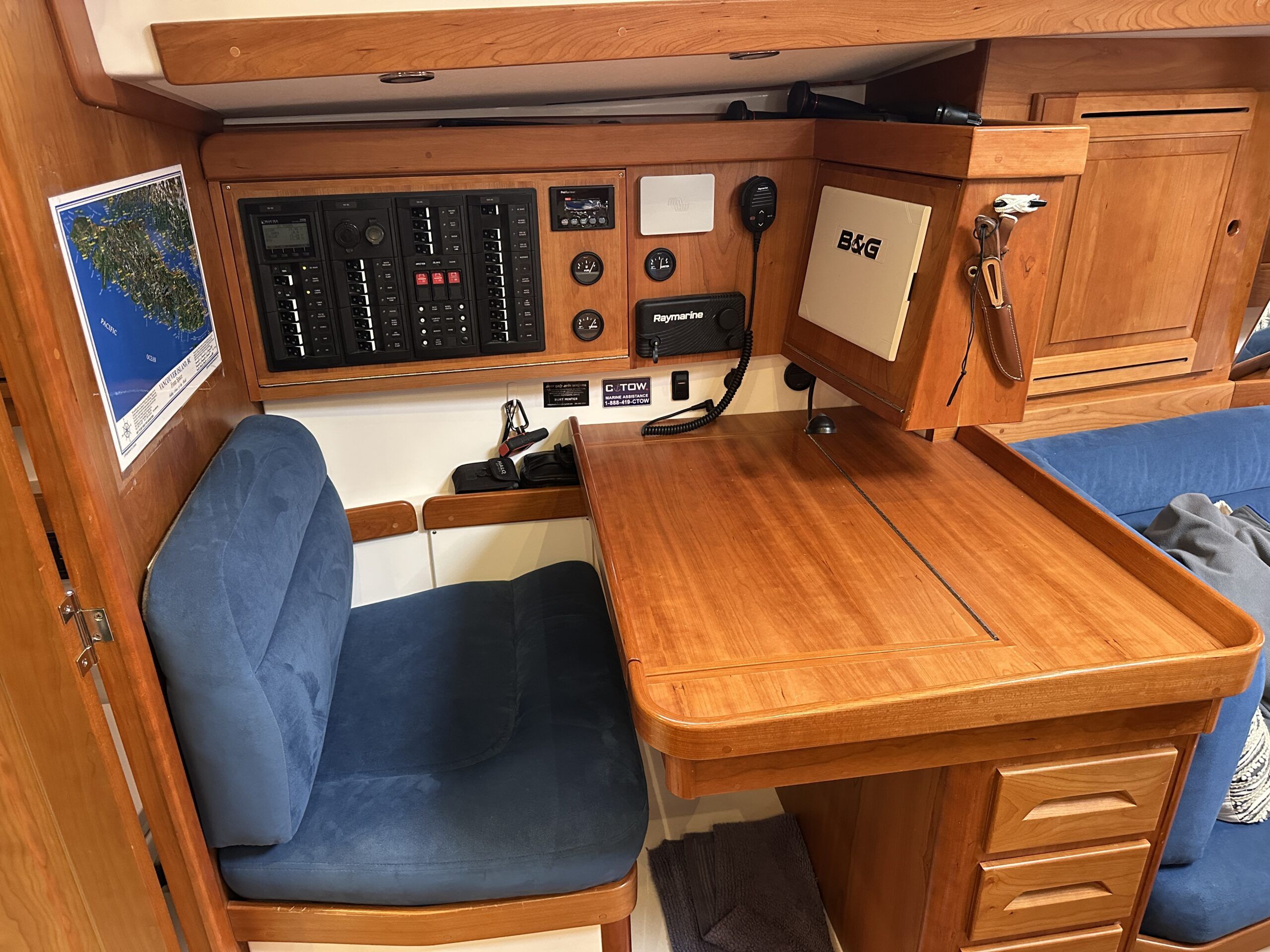
To port of the companionway is the forward-facing navigation station. Although the table is not a traditional chart size, they seldom are in this size of production boat, there is plenty of room for modern instrumentation and guidebooks. A well-organized electrical panel complements the instrument space. There is storage in the chart table and in drawers underneath.
Head
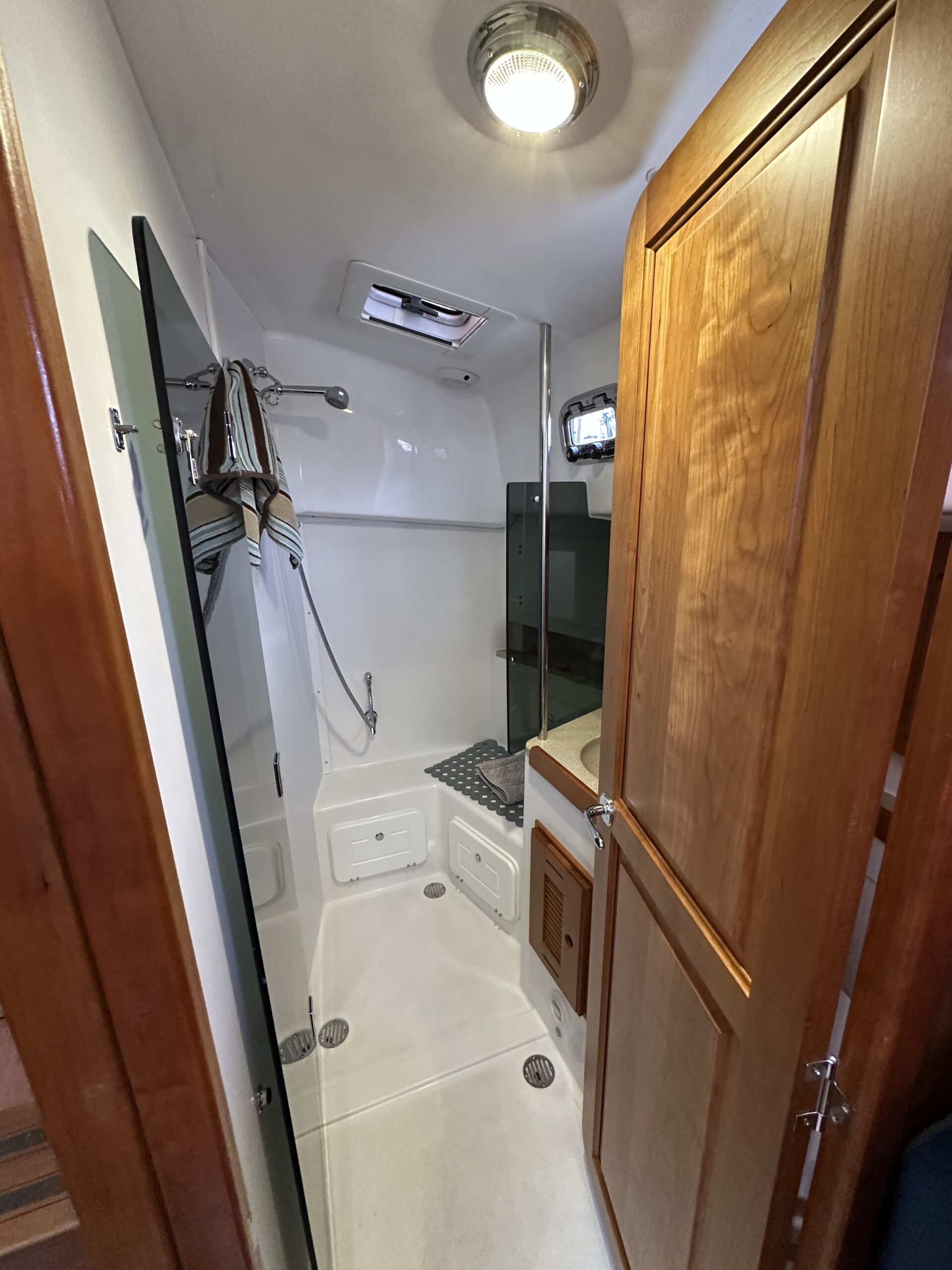
Aft of the navigation station is a very roomy head with a glass door to separate the shower from the vanity cabinetry, which keeps the space cleaner. Opening portlights and an overhead hatch provide the necessary ventilation. A welcome feature is a stainless-steel, sole-to-overhead post as a handy grab rail in a seaway.
Saloon
Moving forward into the main saloon the space is dominated by the centerline folding table and white keel-stepped mast. On Myrthe, the settee fabric is traditional dark blue which, unlike popular light or white upholstery, will age without showing daily use. A filler expands the starboard side settee into a comfortable double berth if required. Both settees could easily be adapted into sea berths with proper lee cloths. There is an abundance of storage behind the crafted teak cabinetry.
The opening portlights and overhead hatches provide plenty of light and ventilation into the main cabin. Predominant on both sides of the main cabin are highly polished stainless-steel straps tying the deck chainplates to the hull grid behind the settees. It’s reassuring to see the strength built into the structure holding the mast up. But these straps will be a bit of a hazard to the back of the head when seated here.
Lifting the floorboards shows a relatively shallow bilge with access to the keel bolts.
V-Berth
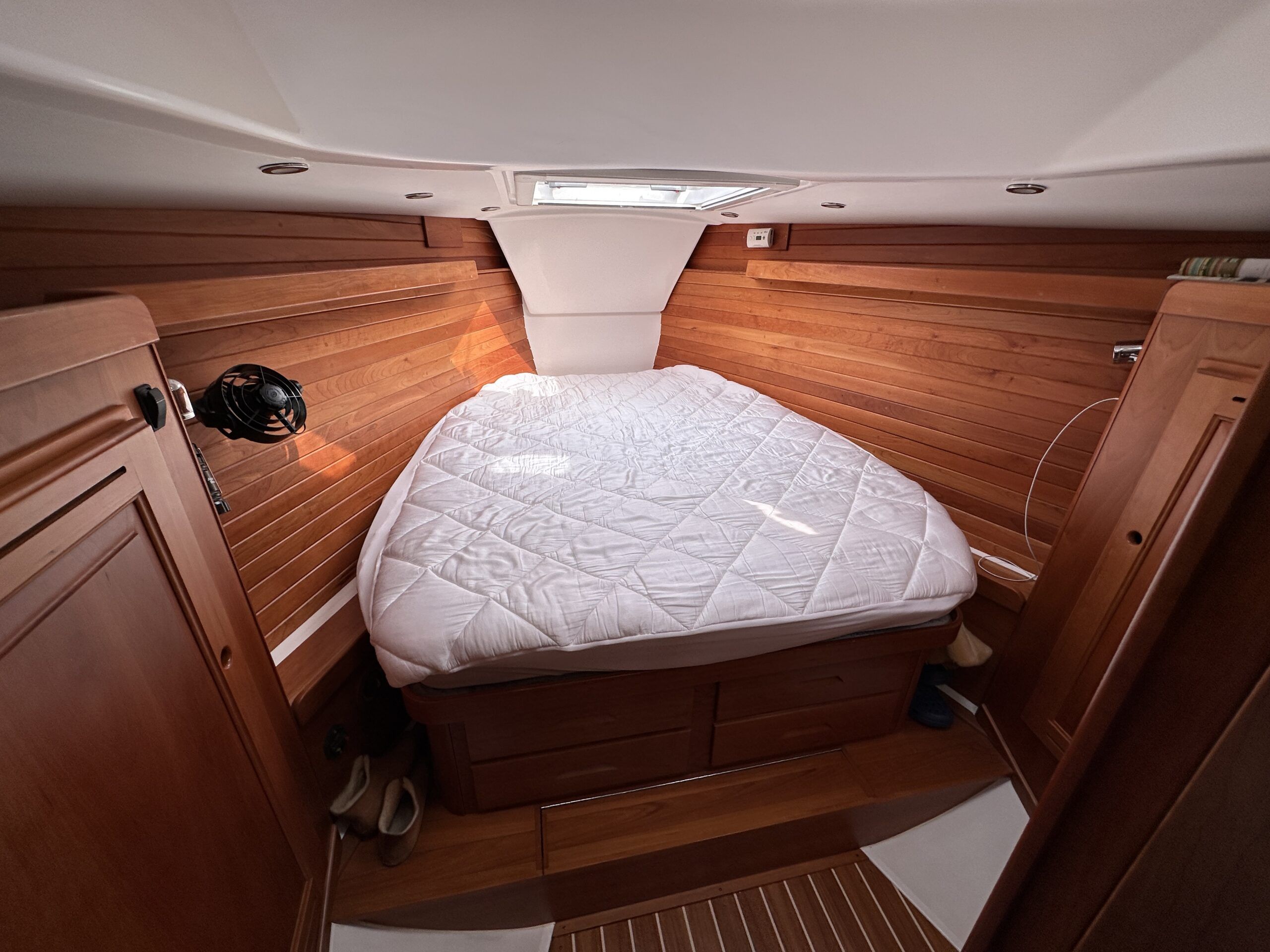
Moving forward is the welcoming V-berth. Not palatial in the sense of amenities, but a very inviting place to put your head down after a long day on the water. A large overhead opening hatch provides flow-through ventilation for this cabin as well as the rest of the boat. There are no fixed or opening portlights in the hull. Some may deem the lack of such openings a bit confining, but this is a boat capable of ocean crossings, not just a dock queen.
I would feel comfortable knowing there are no potential leak points where waves slap the hull. The wood trim is opulent with plenty of storage in hanging lockers and drawers under the mattress.
Sailing Performance
Although Bill and Shirley haven’t had the Tartan out in heavy airs just yet, the boat has demonstrated windward performance of over 7 knots in 12 knots of true wind. In 18-20 kn true under jib and two reefs the Tartan 395 reached 7.5 kn on a close reach. A third reef has been added to the main for better heavy weather control options given the large mainsail, smaller self tacking jib, and no separate track on the carbon mast for a storm sail.
Self-Tacking Jib
While not a fan of self-tacking jibs in the past, Bill is now sold on the simplicity of such a set-up. The reacher on the solent-stay points higher than expected. Of course, the sailcloth is of lighter material and is not expected to be used in anything over 12-15 knots. It is more like a Code 0 than an asymmetrical spinnaker.
As in most sailboats with self-tacking jibs, the main is large. Downwind performance is hampered by the main covering the small jib. This is where the reacher shines and adds downwind speed. The downside is that with the solent rig the reacher must be furled to clear the forestay and furled jib in a gibe or tack. This isn’t a real problem on a long passage in open water but does induce considerably more work in coastal sailing.
Pointing Ability
With the shallow beavertail keel Bill is finding pointing ability to windward is limited to tacking through a full 90 degrees in lighter winds. It would be interesting to compare the deep keel version in windward performance.
Under power the boat achieves 5.5 knots at a very comfortable 2,000 rpm. With a maximum continuous output of 3,400 rpm on the Volvo, there is lots of power left to achieve the 7.7 knot hull speed if needed.
Conclusion
As a boat reviewer, I try to keep an open mind on the latest developments in boat designs and what sailors want. But deep down I’m a bit of a traditionalist, yet not to the point of wooden hulls, full keels and gaff rigs. A sweeping shear with an efficient sail plan and underbody catch my attention.
The Tartan 395 strikes all the right parameters. It is a beautiful, classic design constructed to very high standards with a promise of standing up to ocean conditions. The deck and cockpit layouts are ergonomically correct at anchor as well as thrashing to windward in a serious chop. Safety is a serious consideration in the design, with readily available hand holds both on deck as well as below.
The interior is roomy without being a dance hall—compact without being a dark claustrophobic cave. The fit and finish of the cabinetry is second to none and shames the Ikea-like finish of many production boats. It has a warm and inviting interior that is welcoming after an invigorating day of sailing on a beautiful boat.
Is this the perfect sailboat in the 40-ft. range? That’s in the eyes of the sailor. Every design is a series of compromises. This design is not going to surf down waves with an oversized sail plan and wide flat stern. It’s also not going to reach the windward mark like a stripped out IOR racer. But it will satisfy a great many demands in a very safe and comfortable manner, with speed and excitement to boot. Like many models from the Tartan line of yachts, the 395 should be high on the list of desirable boats on any sailor’s list.
Market Scan Contact
2019 Tartan 395 San Juan Sailing & San Juan Yachting
$404,000 360-516-4956
Bellingham, Washington
Yacht World
2020 Tartan 395 Crusader Yacht Sales
$379,000 (216) 510-9134
Annapolis, Maryland Yacht World