

This is a 33-ft. sailboat that people talk about like it belongs in a museum. They price it like it belongs in a trust fund. And they refuse to sell it, like there’s buried gold in the bilge. Why does this little boat have such an oversized reputation? Why do sailors who want to cross oceans keep whispering about it decades later? Why, when you actually go looking for one, does it feel less like shopping for a used boat and more like trying to buy a family heirloom from someone who has no intention of letting it go?
The Hans Christian 33 arrived around 1980 when offshore cruising boats were still expected to look like they’d been drawn by candlelight. Heavy displacement, full keel, cutter rigs, teak decks, bronze hardware and high bulwarks. Interiors felt more like little ships than floating condos. Hans Christian did not just participate in that world, Hans Christian leaned into it with both feet, wearing sea boots.
Design
The design is generally attributed to Harwood Ives, a prominent yacht designer best known for shaping the iconic heavy-displacement, bluewater cutters for Hans Christian Yachts. A string of designs were built in Asia, tied to the Taiwanese boating world that built so many ocean cruising boats of that era. A review of the Hans Christian boat works was published in Practical Sailor by long time contributor Darrell Nicholson in November of 2024 and can be seen here.
Production numbers for the 33 are usually listed around 165 to 168, depending on the source, with production stopping in 1988. That’s not very many 33s. That matters because this is not a Catalina 30 or Hunter 34 where you can open a listing site and choose from a dozen examples. The Hans Christian 33 is a boat that decides when you’re allowed to shop for it.
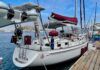
The reason sailors still care is obvious the first time you see the profile. This does not look like an average 33-ft. sailboat. It has a bowsprit, a cutter rig, a canoe stern, and a full keel with a keel hung rudder and proper propeller aperture. It has high bulwarks and a compact, little ship posture that makes people stop scrolling to have a look. It’s short in length, but not small in attitude. It looks like a boat that’s never worried about looking modern.
Specs
On paper the numbers explain part of that feeling. The Hans Christian 33 is just under 33 ft. (9.9 m) on deck with a waterline length of 29 ft. (8.9m), with a theoretical hull speed of 7.42 knots. The beam is 11 ft. 8 in. (3.56 m) with a draft of about 5.5 ft. (1.68 m). Displacement is usually listed at 18,500 to 19,000 lb. (8,391 kg) with ballast of 6,300 to 6,500 lb. (3,084 kg). Sail area is about 600 sq. ft. (55.7 sq m).
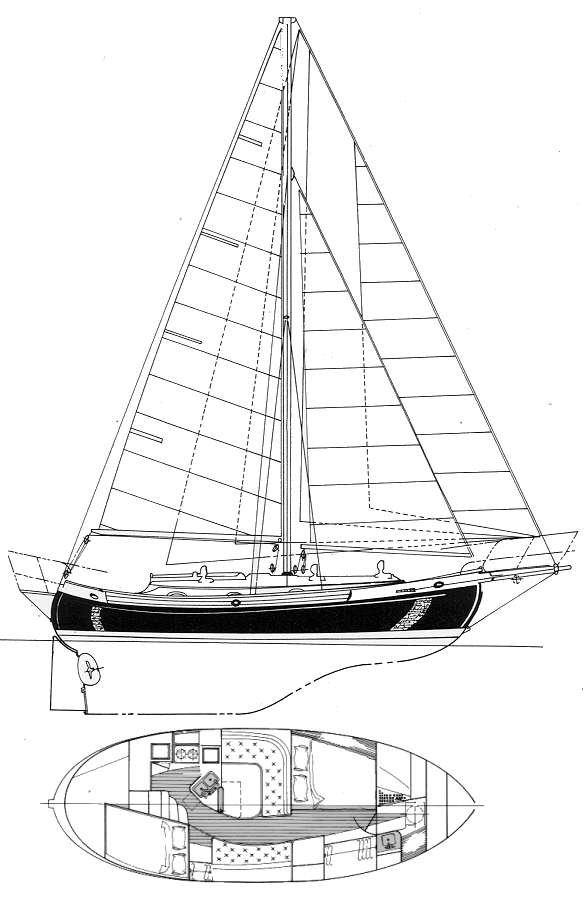
Sailboat Specifications Courtesy of Sailboatdata.com
Hull Type: Long Keel
Rigging Type: Cutter
LOA: 32.75 ft / 9.98 m
LWL: 29.17 ft / 8.89 m
S.A. (reported): 600.00 ft² / 55.74 m²
Beam: 11.67 ft / 3.56 m
Displacement: 18,500.00 lb / 8,391 kg
Ballast: 6,800.00 lb / 3,084 kg
Max Draft: 5.50 ft / 1.68 m
Construction: FG
Ballast Type: Iron
First Built: 1980
# Built: 165
Builder: Anderson Yachts Ltd. (TAIWAN)
Designer: Harwood Ives
Type: Diesel
Fuel: 80 gals / 303 L
Water: 120 gals / 454 L
S.A. / Displ.: 13.78
Bal. / Displ.: 36.76
Disp: / Len: 332.75
Comfort Ratio: 35.84
Capsize Screening Formula: 1.77
S#: 1.28
Hull Speed: 7.24 kn
Pounds/Inch Immersion: 1,216.34 pounds/inch
I: 40.00 ft / 12.19 m
J: 18.00 ft / 5.49 m
P: 34.00 ft / 10.36 m
E: 14.10 ft / 4.30 m
S.A. Fore: 360.00 ft² / 33.45 m²
S.A. Main: 239.70 ft² / 22.27 m²
S.A. Total (100% Fore + Main Triangles): 599.70 ft² / 55.71 m²
S.A./Displ. (calc.): 13.77
Est. Forestay Length: 43.86 ft / 13.37 m
Mast Height from DWL: 49.25 ft / 15.01 m
With a capsize screening formula of 1.77 based on those numbers, it’s about as safe an offshore sailboat can be. This is a compact, heavy displacement cruiser and every inch of it seems determined to remind you of that. The weight is the first big clue. A modern 33-ft. (10 m) sailboat can be a roomy coastal cruiser, or quick club racer with a big cockpit and open interior, weighing in at around 10,000 lb. ( 4,500 kg). This 33 is playing a different song entirely. It’s willing to carry stores, water, fuel, ground tackle, tools, spares, and a couple of sailors who aren’t just sailing for the afternoon. And it’s trying to be serious about it.
This is why the boat appeals to a very specific kind of sailor: the sailor who sees the small cockpit and thinks safety instead of inconvenience; the sailor who sees a full keel and thinks tracking instead of sluggishness; the sailor who sees teak and thinks beauty before they think about sandpaper; and the sailor who doesn’t just want a boat that can go offshore but wants a boat that feels emotionally committed to that idea.
Construction
Construction on these is generally considered stout. The hull is solid fiberglass, thick and heavy in the old school way. This is not a boat engineered to minimize weight. It was built with older logic; more material was better than less material. That doesn’t mean that every example of this boat is perfect. And it definitely doesn’t mean you can skip a survey.
The basic hull is not usually the thing that people are afraid of, it’s an anvil. The questions are about everything attached to it. That means the water and fuel tanks, the wiring, the chainplates, the plumbing, the steering gear, the seacocks, the rigging, and the entire civilization hidden behind the teak joinery.
These boats are old now, even the good ones are old. And because the interior is full of beautiful traditional woodwork, access can be sort of a mixed bag. The same cabin that makes the boat feel warm and expensive can make repairs feel like archeology with a flashlight and socket set.
Mechanical
A number of different diesel options were available from the factory over the eight-year run of construction. Original options appear to be 24- to 35-hp Yanmar diesels. Considering that these boats are now well on in age, it’s most likely that the original diesel has been rebuilt or replaced by now, particularly the 24-hp model as this would be considered somewhat underpowered today.
Access to the engine is by way of the two removable panels behind the companionway steps, access panels in the quarterberth, and access through the port side cockpit locker. The engine control panel is located in the companionway and is not very visible from a steering position in the cockpit. Throttle and gearshift are on the pedestal where they should be.
Tankage
A single fuel tank will hold 80 gallons (303 liters) of diesel which, when combined with the relatively small engine, will provide plenty of motoring time. Water capacity is 120 gallons (454 liters), which is substantial for a 33-ft. boat. I suspect that many of these boats will have added water makers or temporary bladders for extended cruising. There is not much room for solar panels to supplement electrical capacity. Over a bimini or atop a dodger are two options.
On Deck
Magazine reviews and owner opinions agree on the basic personality of this boat, even when they disagree on whether that personality is a blessing or punishment. Reviewers praise the substance, the traditional construction, the storage, the secure deck layout, the interior atmosphere and the offshore pedigree. But they also circle the same details as warnings. The weight, the maintenance, the teak, the cost and the fact that this little boat is not always little in ways that matter.
With the bow sprit and all the aft hardware, the overall length stretches way beyond 33 ft., closer to 41 ft. That means that the 33 ft. can sound modest in conversation and then get less modest at the marina office when you’re paying the bill. You think you’re buying 33 ft. but in some practical ways you’d be buying something much longer, much heavier and much more complicated.
Check the Teak
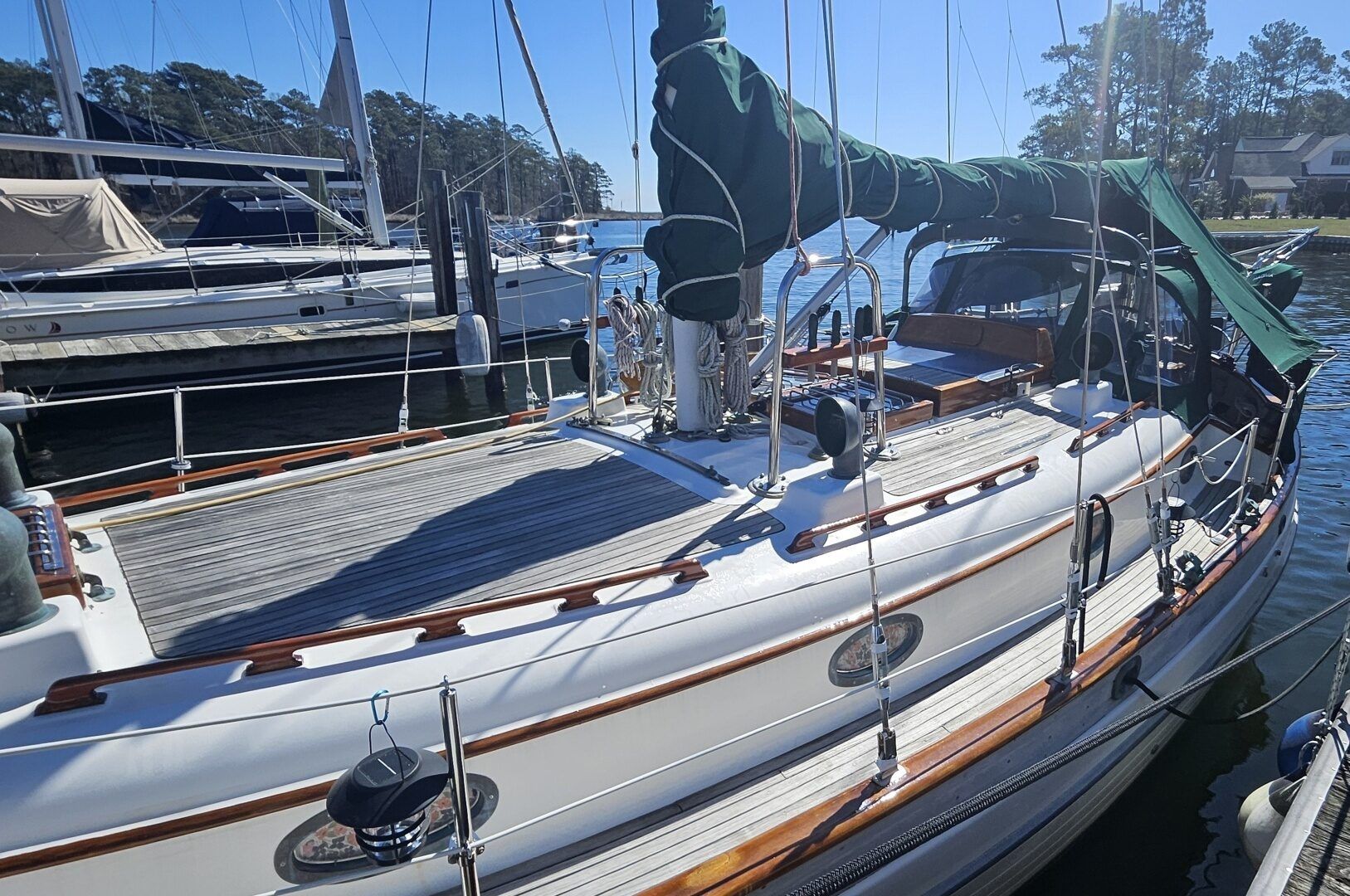
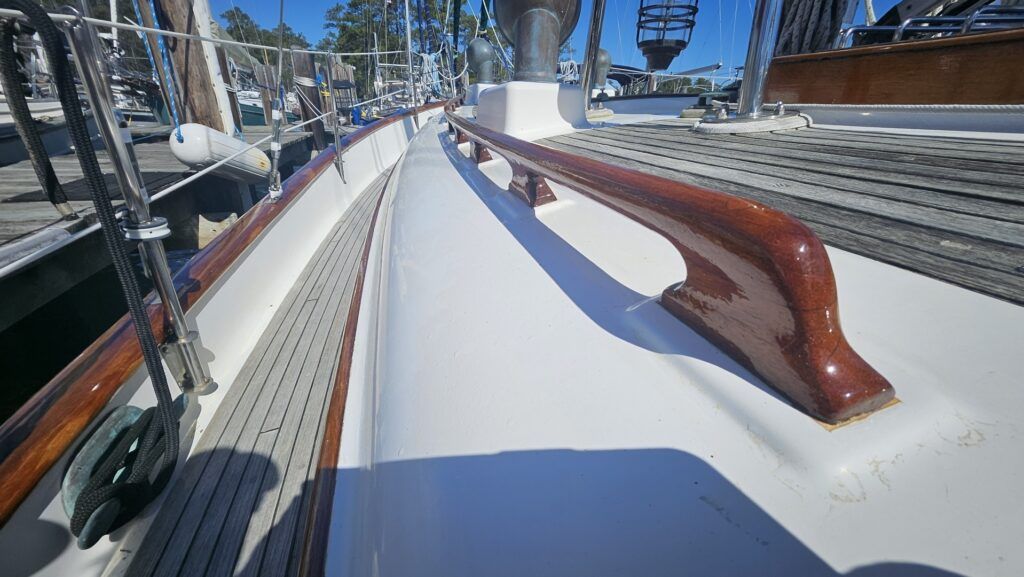
The deck is one of the reasons that people fall in love with this boat. It has that traditional, protected, working cruiser feel. The bulwarks are high, the side decks are secure, the bow sprit and ground tackle arrangement look ready for real anchoring, not just dockside photography. It’s the sort of deck that makes you imagine moving forward at sea with one hand on the rig and the other questioning every financial decision that led you there.
But the deck is also one of the reasons that surveyors start looking very closely. Many of these boats were fitted with teak decks. Teak decks on an old cruising boat are never just teak decks. They’re a maintenance history. They’re moisture management. Beneath them you’ll find old fasteners, bedding failures and rotten cores. Expensive decisions hiding under teak wood. On a boat like this, teak is part of the magic. But it’s also part of the responsibility of owning it.
Foredeck
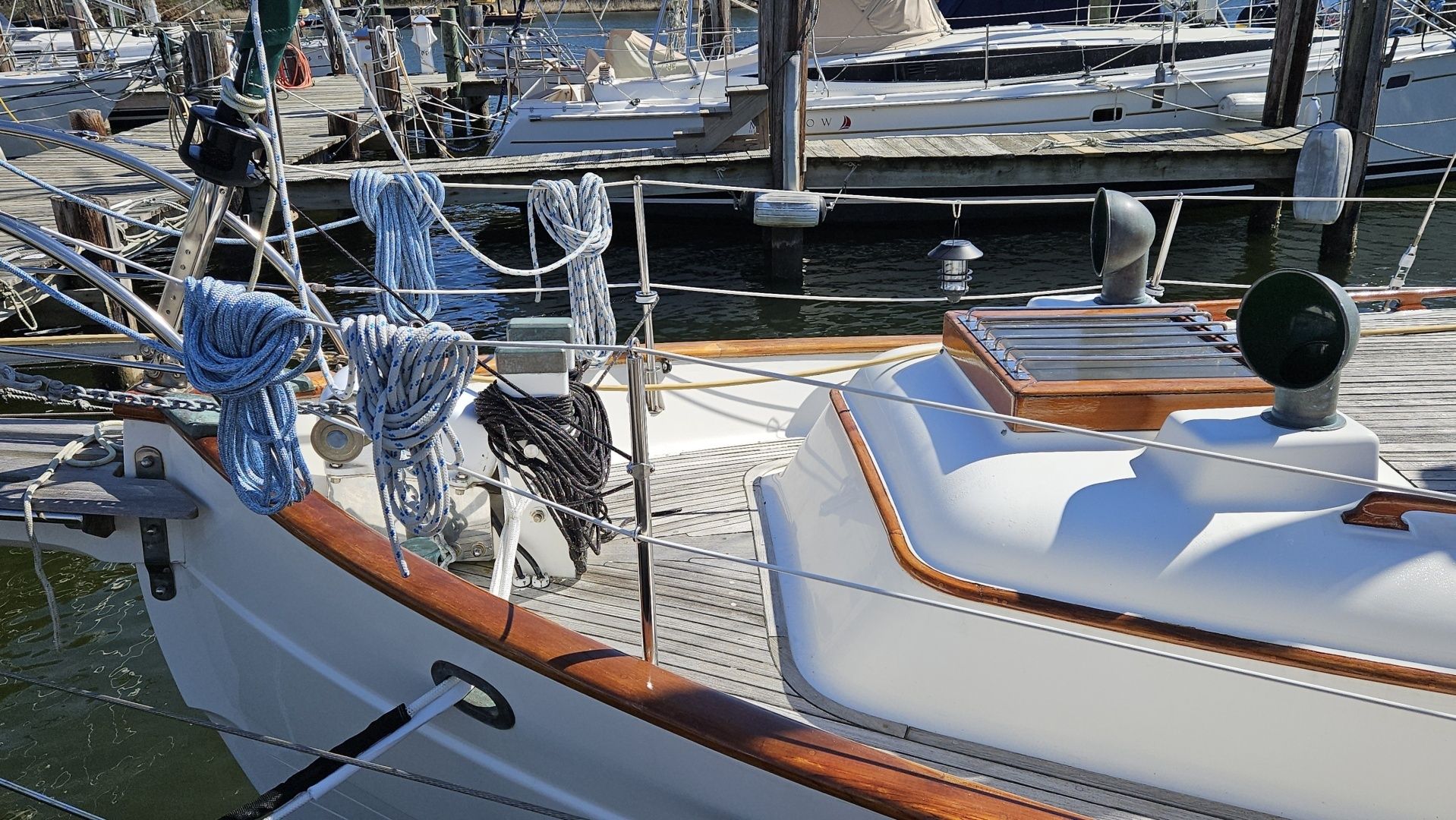
At the bow, of course, is the long teak bowsprit with stainless steel pulpit. Twin anchor rollers allow for redundancy in anchoring tackle. With no anchor locker on deck, the windlass feeds rode and chain down houser pipes into the deep locker, accessible through the head compartment. Although the side decks are narrow, they are also unobstructed. The chainplates are attached outboard to the hull, very traditional. Teak handrails adorn the cabin top from cockpit to the forward deck. The tall bulwarks add to the sense of security when moving forward. Dorade vents add to ventilation below with a proper companionway hood to keep seas out of the interior.
Rig
The single spreader aluminum mast is supported with mast guards to provide security when raising or lowering the sails. Winches on the mast assisted in this endeavor although, by this time, many owners would have routed those halyards back to the cockpit for additional safety. The boom is supported by gallows over the companionway, probably incorporated into owner installed dodgers.
Cockpit
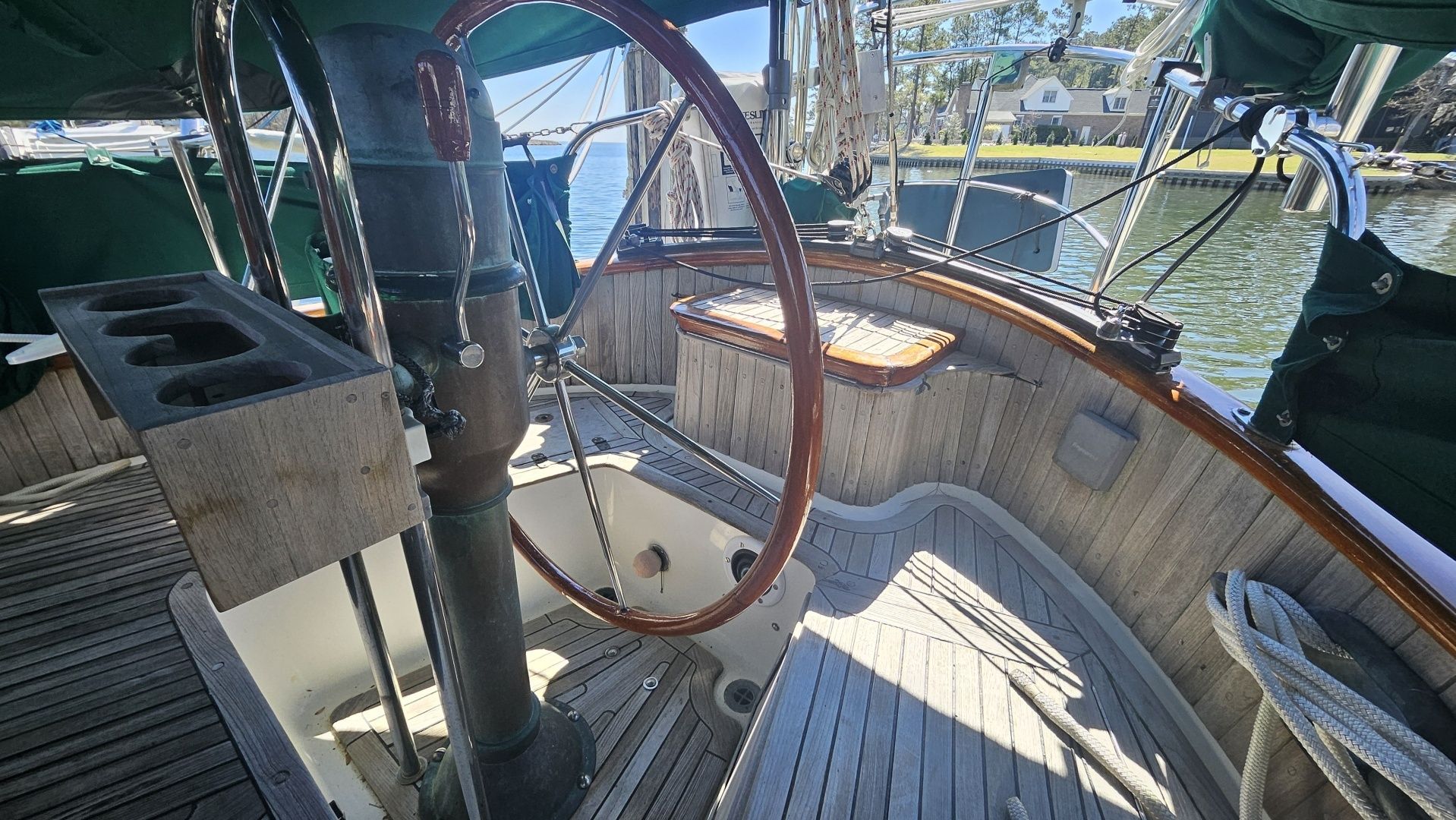
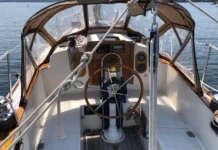
The Hans Christian 33 cockpit is small. There is no other way to describe it. If you’re looking for a dock queen to host parties, this is not the boat for you. Three sailors are going to make it cozy. The coamings are tall and comfortable on the back. The pedestal and wheel occupy most of the space and it’s almost like they are in place as an afterthought, as if sales pressure forced the addition of this configuration.
A simple rudder would make more sense here, but the canoe stern would make that difficult. Behind the wheel there is a helmsperson seat that allows good visibility forward. The genoa winches are at hand from the helm. This is not a boat that you will board from a dinghy at the stern. Traditional side gates are really the only option.
Interior
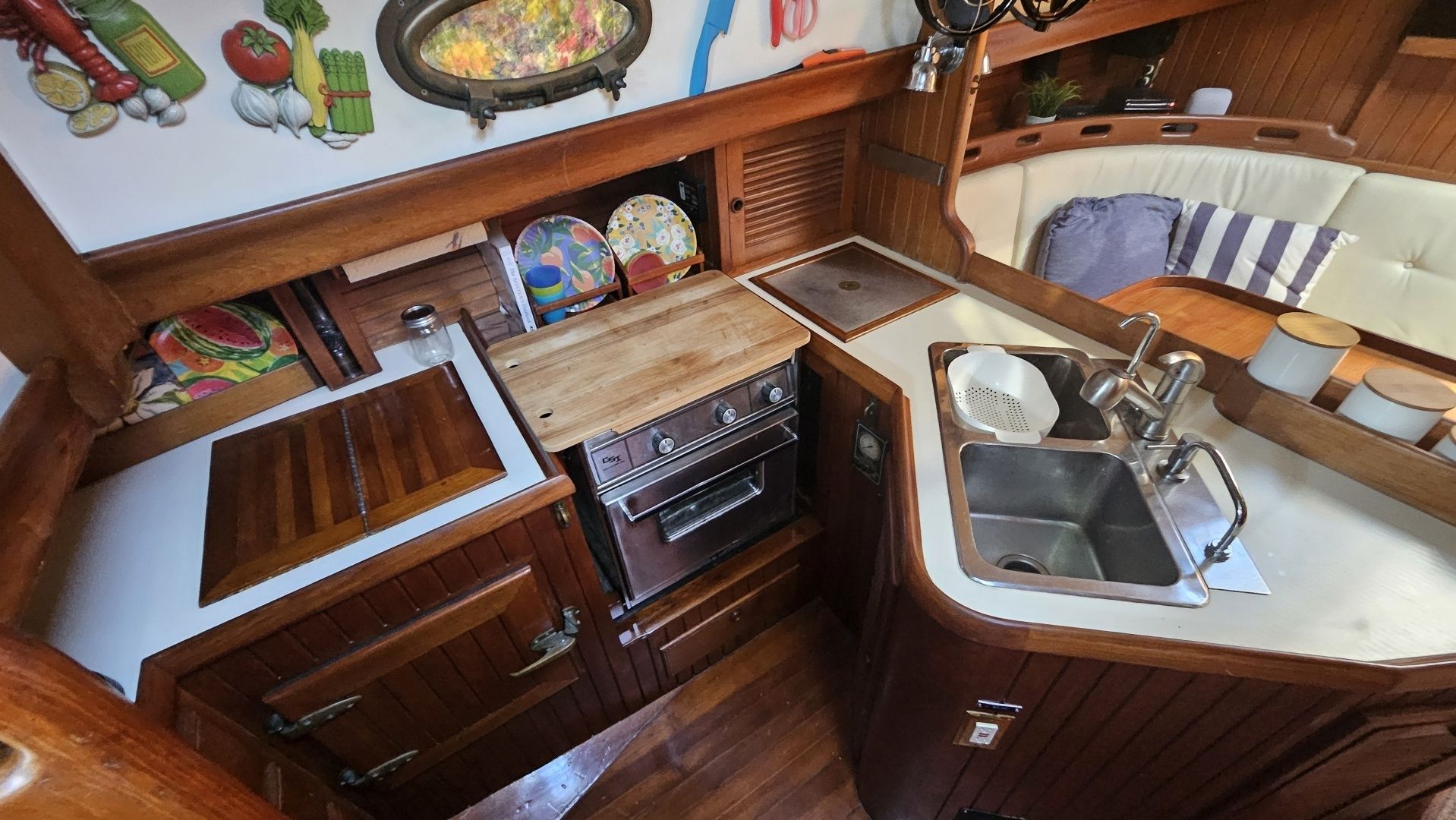
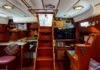
Access to the cabin is over a bridge deck and through proper, removable companionway doors. Below, the Hans Christian 33 earns a lot of its reputation. The interior doesn’t feel like a bare-bones small cruiser. It feels dense, warm and serious. Of note, particularly for a boat with offshore dreams, the interior abounds with handholds in the most appropriate places.
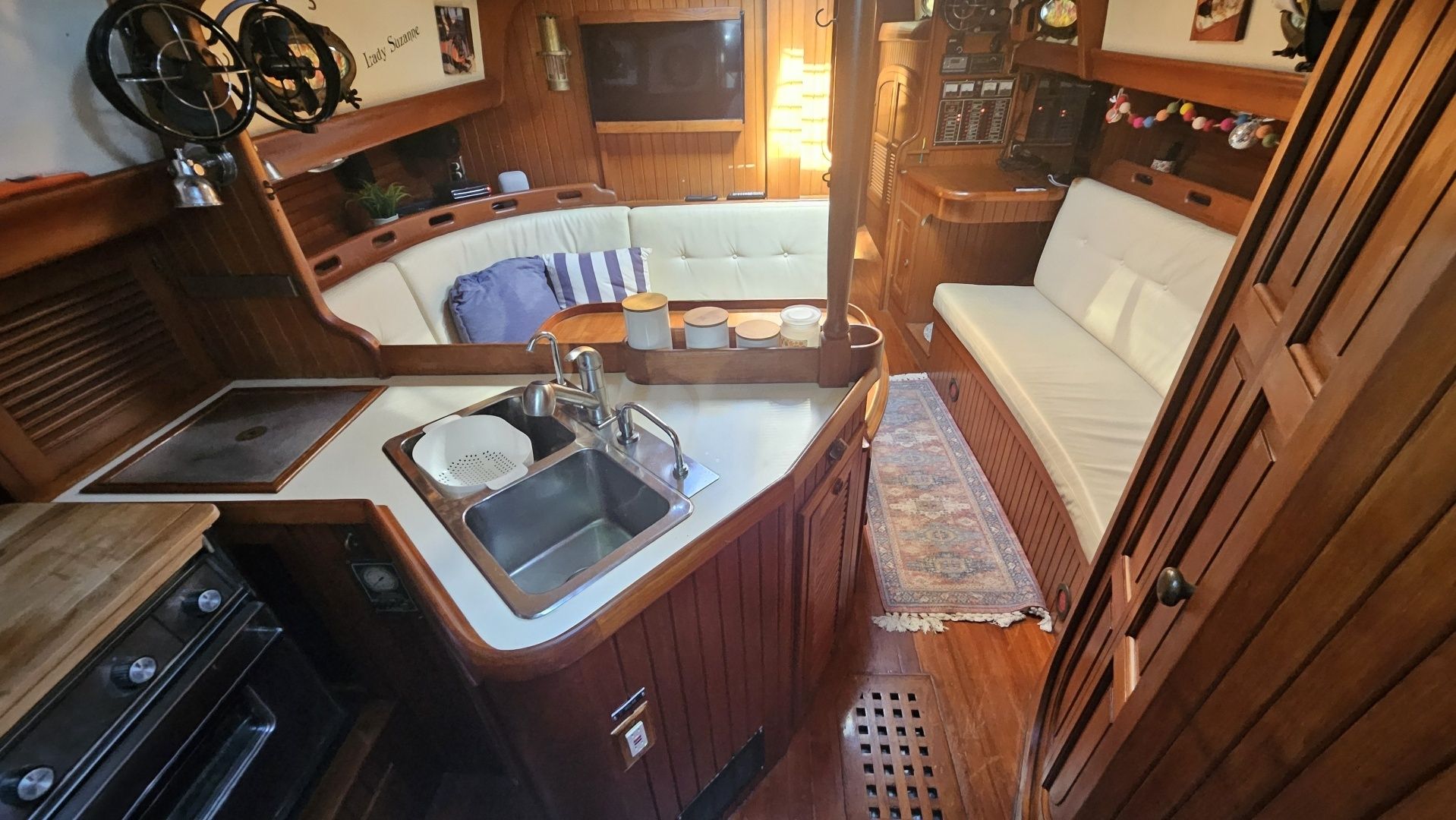
To port is a proper, compact galley. A sea going layout with a double sink on the centerline, a two-burner propane range and plenty of storage. A deep top-loading locker can hold all sorts of galley equipment with additional storage behind teak doors along the hull and under the counter. A refrigerator with both top and front access is against the aft bulkhead. The compact design of the galley eliminates the need for any straps to keep the chef in position, but also limits counterspace. An opening port is right over the range and an additional opening port allows a view into the cockpit.
The Saloon
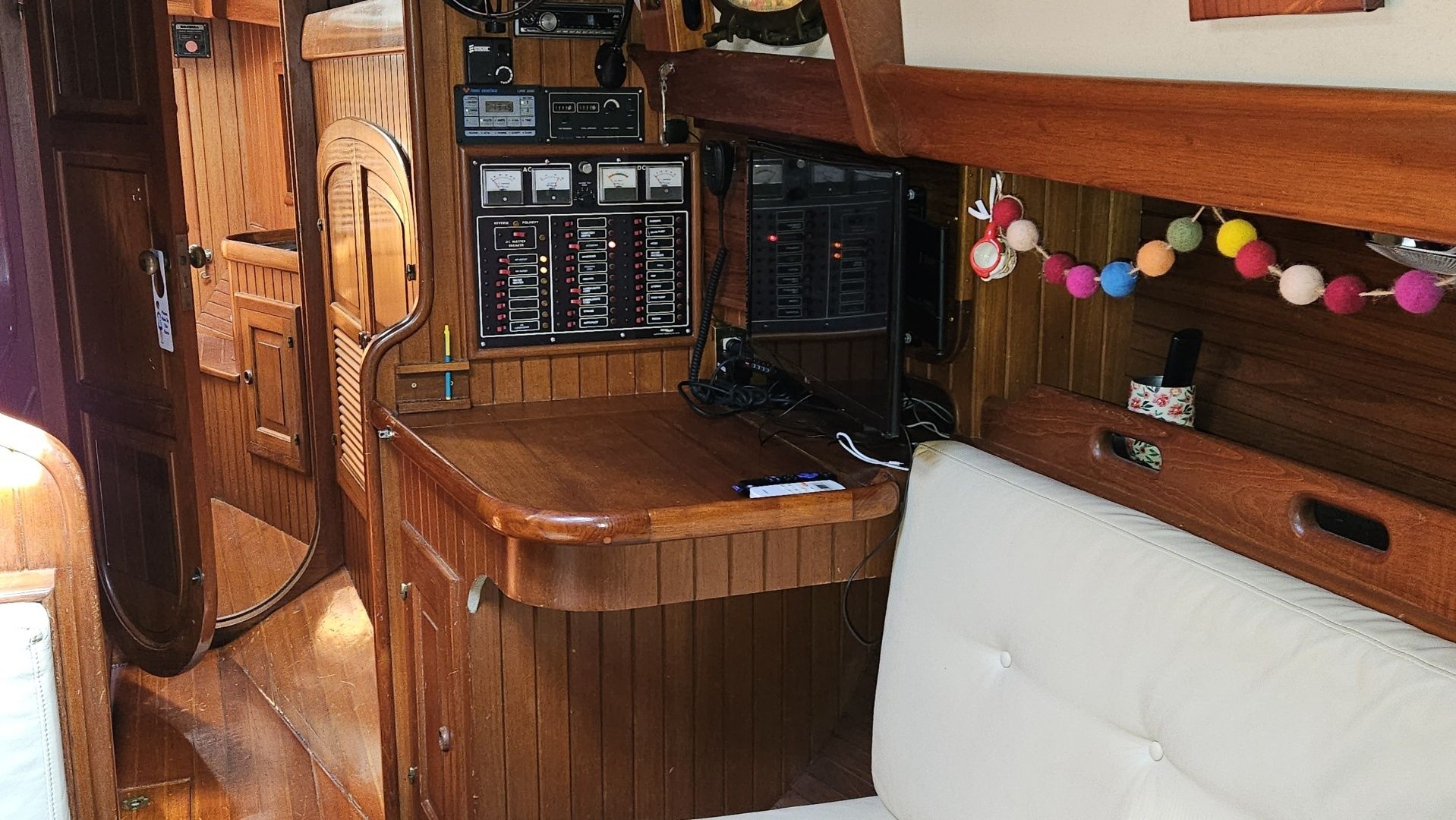
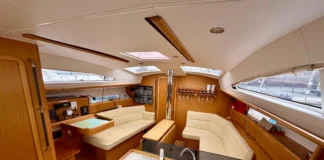
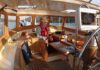
The saloon has a substantial table on the port side, fixed against the galley wall with an L-shaped settee that provides comfortable seating for six. The table provides additional storage underneath. The opposing settee—with a lee cloth—would be a great sea berth. There is storage, both open and behind teak cabinetry, against the hull on both sides. The navigation station is at the forward end of the starboard settee, a departure from the usual location next to the companionway.
Against the forward bulkhead is room for electronics or, in earlier models, a substantial electrical panel to control all the ship’s systems. Against the hull is open storage and somewhat limited space for electronics. The tabletop lifts for storage of all the usual navigational tools and “random stuff” that always seems to gather here. In later years the electrical panel was moved to a narrow space above the companionway under the cockpit sole.
Pullman Berth
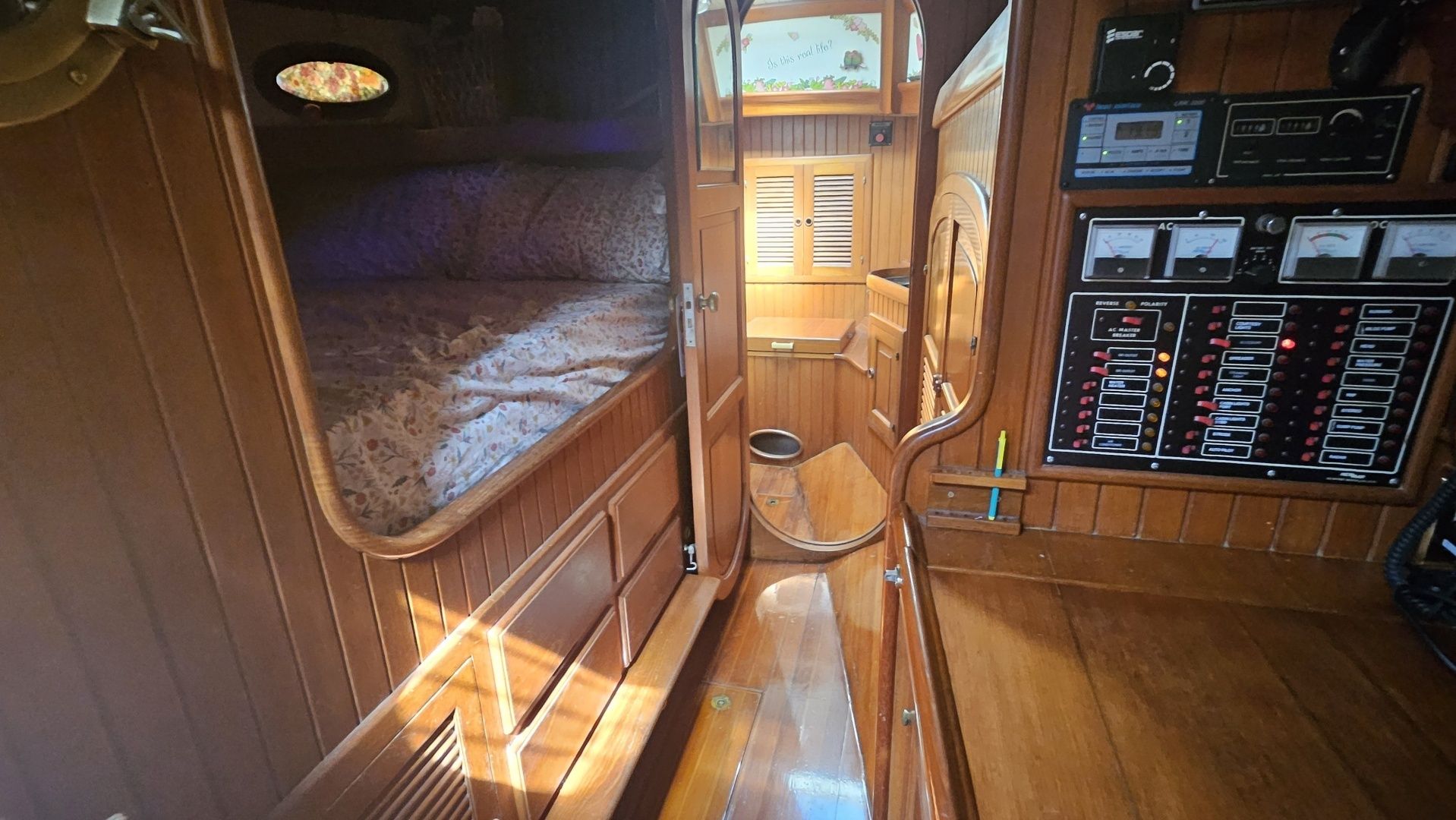
Depending on the version, a forward pullman berth is on the port side with lockers and drawers to starboard. The entire space under the queen size berth is storage. Space for cruising equipment and storage is not lacking in this boat. The unfortunate compromises with this layout is that someone is going to have to crawl over the sleeping partner to get out of the berth, and there is no door between the salon and the sleeping cabin. This is a real lack of privacy with guests on board. With only a couple on board this shouldn’t be a problem.
Head
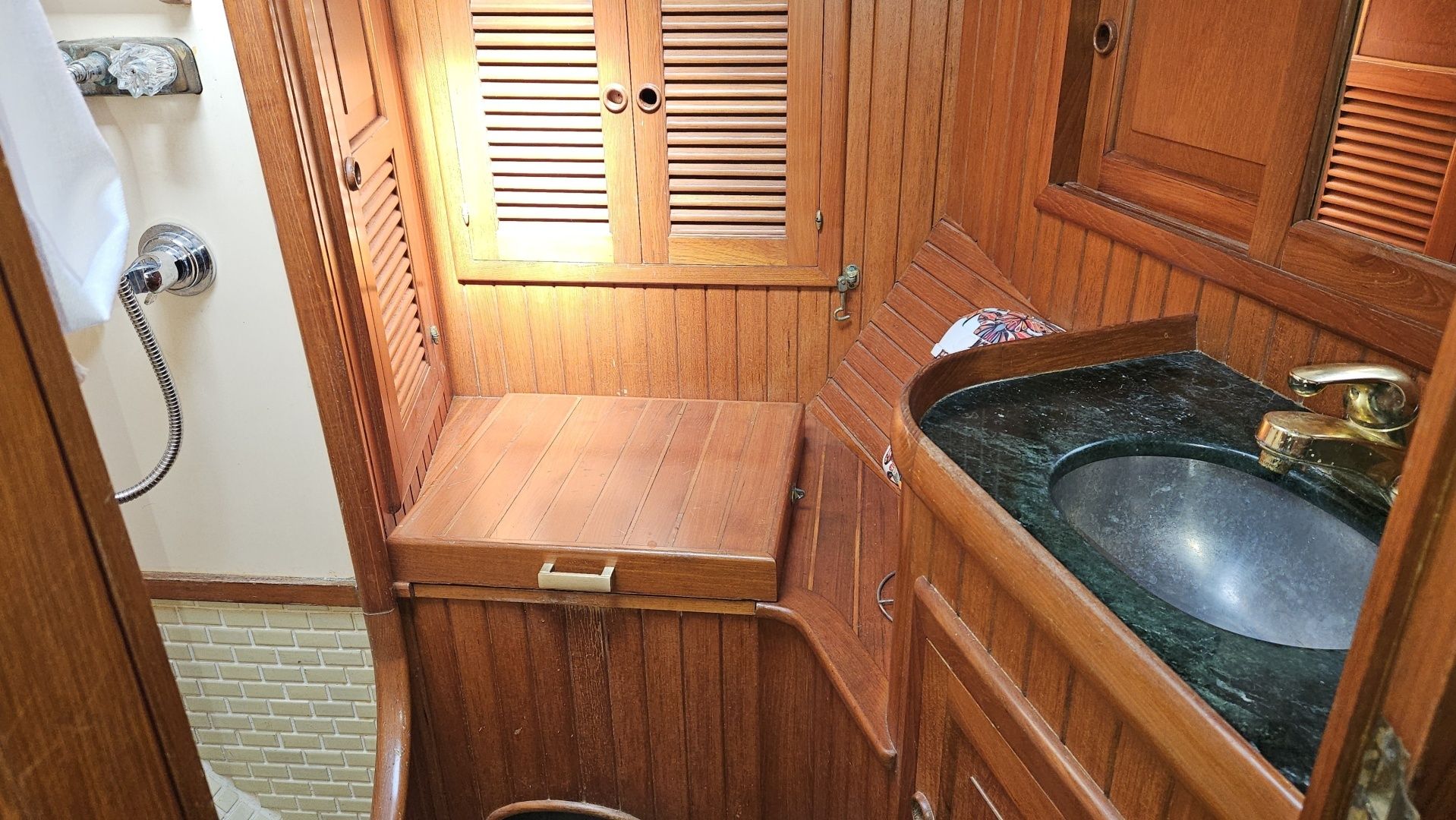
Forward of the main sleeping cabin is the absolutely gorgeous head compartment. The toilet is hidden under beautiful teak cabinetry. The door to the head can be left open and you’re not staring at a toilet all the time. A separate shower stall is to port, a vanity with storage to starboard. Forward of the shower is a hanging locker and additional storage space. With a large opening hatch overhead ventilation is not a problem.
Unfortunately, it is the only head and with guests aboard for any long-distance cruising, it may be somewhat awkward when having to transit the sleeping compartment to use. It’s located at the bow and may not be the most comfortable space in a seaway either.
Quarterberth
There’s also a useful aft quarterberth separated from the salon with a solid teak door. An oversized twin mattress occupies most of the space with a vast compartment underneath suitable for equipment or storage. For those guests using this cabin there is a vertical locker as well as compartments against the hull. Two opening ports, one to the cockpit, provide light and ventilation.
Under Sail
Under sail the warning is predictable. It’s a full keel heavy displacement cutter. The sail plan is not going to leap around in light airs as a club racer with a teak fetish. Momentum is part of the experience. So is patience. But older reviews suggest the boat may not be as dead in light airs as the stereotype suggests. A Yacht Monthly test found it moving much better than expected in light air.
The cutter rig is a major part of that appeal. On a boat like this it’s not just decoration, although it certainly looks the part—it’s beautiful. The cutter rig gives you options. You can divide the sail plan into smaller pieces, reducing canvas more intelligently and keep the boat balanced when the breeze picks up. For a smaller offshore boat sailed by a short-handed crew, that’s magic.
The full keel and keel-hung rudder matter too. This is not a boat designed for twitchy marina performance. It’s not going to spin around like a fin keeler, and it won’t back up in a cheerful obedience like a modern twin rudder cruiser. Maneuvering around docks the Hans Christian 33 will remind you that old boats have opinions. Offshore, that long keel gives you tracking, rudder protection and a steady old cruiser feel that sailors either love dearly or find maddingly dull.
Conclusions
The Hans Christian 33 feels like it’s designed for a couple who intended to live aboard and sail, not just survive a weekend with a cooler. This is where this boat separates itself from a lot of the other 33-ft. boats. It packs long range cruising into a compact hull. It gives you a cabin that feels less like a floating apartment and more like a sea chest. Everything seems to have a place, everything seems to have been drawn for motion and storage and weather. It’s romantic, but not flimsy.
Then there is the market. A 33-ft. sailboat from the 1980s should be fairly easy to categorize. But the Hans Christian 33 is not bought by average 33-ft. boat buyers. The market is thin. Old listings show that clean examples hold value very, very well. Depending on condition and location, these boats have often appeared in the high five figures and sometimes into six figure territory. For a boat of this size that can look absurd, until you remember the scarcity, the dedicated following, the offshore reputation, the beauty of these things, and the cost of getting one properly sorted out.
Understand if You Want a Project Boat
The dangerous ones are the cheap ones. A tired Hans Christian is not a bargain bluewater cruiser, it’s a project with a mast. If the teak decks are failing and the core is wet and the tanks are original and the systems are tired and the brightwork has been allowed to go feral, you’re not buying a cheap ocean boat. You’re buying a restoration contract with a rudder attached to it.
Owner Refits
This is why owner refits are such an important part of the real story. People take these boats seriously enough to completely rebuild them, cruise them and keep them alive for years longer than they were intended to be.
But those refits also show the scale of commitment. Deck work, brightwork, deck core replacement, portlights, plumbing and electrical systems, rigging, engine upgrades and interior work. This boat is not just an object, it becomes a long-term relationship with a book of receipts.
Market Scan Contact
1985 Hans Christian 33 Curtis Stokes & Associates
$125,000 252.474.6000
Oriental, North Carolina Yachtr
1981 Hans Christian 33 League City Yacht Sales
$79,800 346.594.5874
Kemah, Texas Boats.com
And that’s the real question. The Hans Christian 33 is not hard to understand because it’s mysterious. It’s hard to understand because it’s honest. It tells you what it is: a heavy, traditional, beautiful, maintenance intensive, capable, and slow by modern standards—it is a reassuring offshore sailboat. It’s not really practical in every marina. If you like a small ship feeling in a compact hull, this is the boat for you. But it does not give it to you for free.
Would you have one of these? Does the promise of maintenance and compromises work for you? I’d love to hear from you in the comments. Let me know.
If you’re interested in compact ocean cruisers, have a look at these Practical Sailor reviews of similar designs:
- Bristol Channel Cutter 28: Circumnavigator’s Choice
- Cabot 36 Used Boat Review
- Island Packet Estero Used Boat Review
- Cape Dory 30 Used Boat Review
- Pacific Seacraft 34 and 37





Soooo……….
HC 33?
or
Mason 33?
Same year.
I absolutely would buy one, having had a HC38 Mk2. Only 2 things hold me back — just slightly! — an uncooperative husband who has never experienced being ‘boatstruck’, and our increasing age. But boatstruck I am, for, literally, decades, and currently have a 1985 Baba, which I would trade in a heartbeat for the right well-maintained and upgraded (people, stop thinking about solar and the newest electronics and devote time and money to replacing rigging, wiring, hoses, sails, winches and seacocks, please!) HC33. And give those engines some love. Leisurely sailing and being able to walk forward and admire her lines while she romps along? That’s so my thing.
It helps that I actually enjoy sanding and varnishing and teak is just so beautiful… See?Boatstruck.