

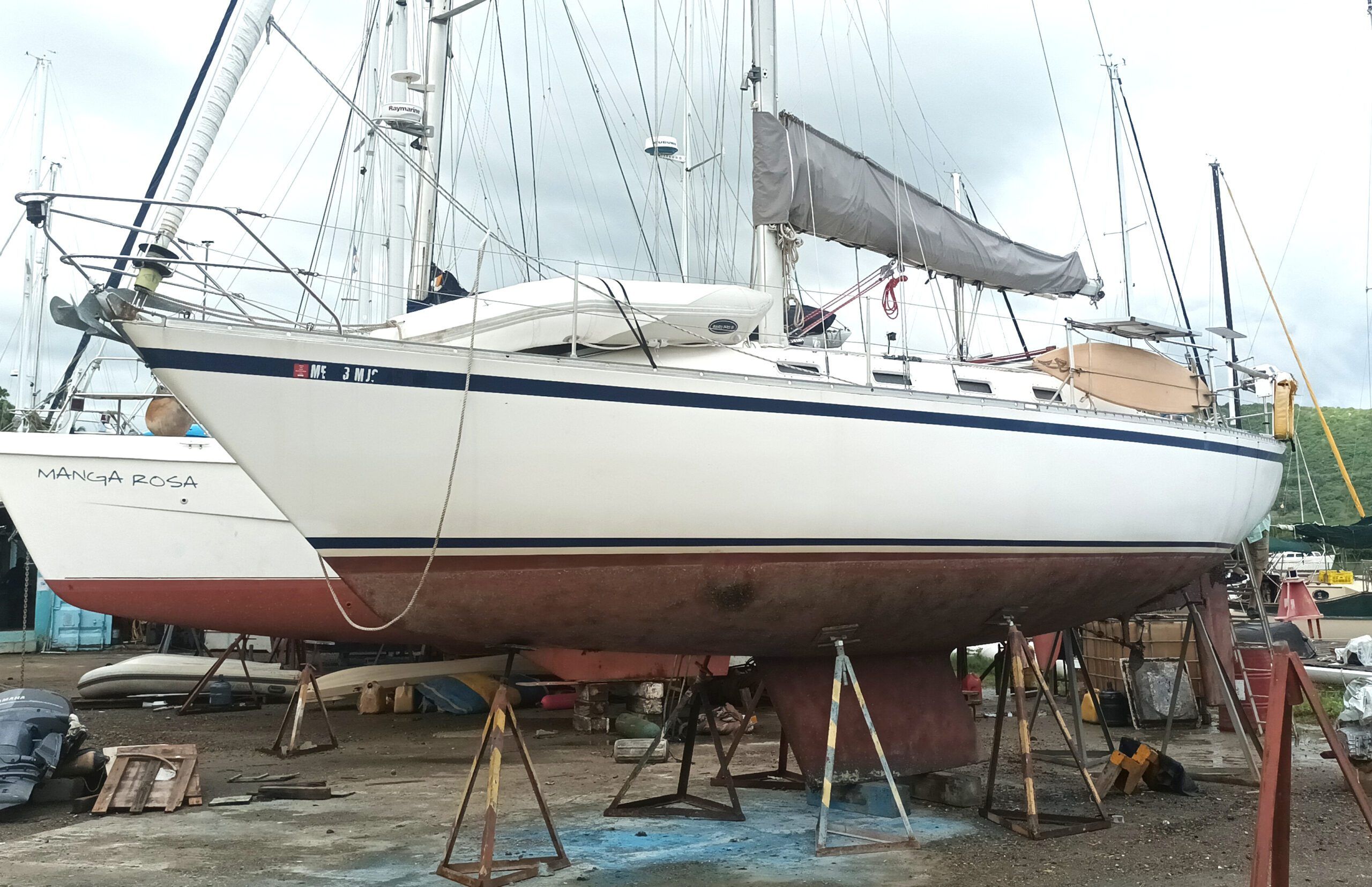
I received a message regarding surveying a 1980 CS 36: “I bought a sailboat with two friends and need a survey,” the WhatsApp message said. Since they had already bought the boat, I assumed the survey was for insurance purposes, so I asked. However, the response was, “It’s not for insurance. We just want to know what it needs and how seaworthy it is before we set sail.”
I’ve been surveying boats since 2007, so nothing surprises me, but this was a first and I thought it was a prank. The deposit was sent to me, and an inspection date was set. The sailboat was to be lifted and surveyed in its cradle. This was no prank, but the question still resonated in my head. Why would somebody buy a boat and decide to have it surveyed a few weeks later? Was it in that terrible condition? I found out through the coconut line what they had paid.
The Boat
CS Yachts was a Canadian boat manufacturer founded in 1963 by Paul Tennyson, under the name Canadian Sailcraft. They specialized in designing and building fiberglass sailboats. They were located in Brampton, Ontario. Their first boat was a 15-ft. dinghy in 1963 and their final boat was a 34-ft. built in 1989. After building thousands of boats, the company ceased operations in 1992.
The price they had paid for this 1980 CS 36 was way below market value. Canadian Sailcraft (CS) made a decent solid boat and usually fetched top dollar. I think I had the answer to my question, but I had to wait three weeks to find out.
First Impressions From the Yard
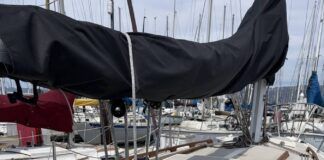
Rainy season had begun in the Dominican Republic, but it was sun and clouds the day of the survey. As I walked in the boatyard, I dodged puddles and mud looking for the CS. I spotted her a short distance away, she was sitting quietly in her cradle looking like a ten from thirty feet away. The mast was standing, her rigging was complete, and an anchor was on the bow. The morning sun shone on her top side and the paint glittered. The saying, “Not all that glitters is gold,” would later prove to be true.
I walked around her like I always do, not being judgmental but just taking in early observations. Nothing looked out of the ordinary until a head popped out of the cockpit saying hello—“I was hired to change the seacocks, and I’ve got two done so far.” His name was Wes and he had been anchored in the bay for the past few years and did odd jobs to feed his kitty. Nice guy. He had his teenage son helping him.
Hull Inspection
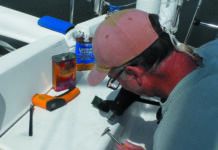
I walked around again and took some pictures and videos. My ritual is to sound the hull with a surveying hammer, then test for moisture and take pictures with an infrared camera. I began sounding on the port side midship. The first few taps were fine and then a deep “thud” and then another and another. I marked the area of concern with painter’s tape and continued sounding until I had come full circle. There were many areas of concern on both sides. My moisture reader confirmed it. Readings were consistent at 18-26% on the port side and 18-40% on the starboard side. The areas of concern all read between 27-40%. All CS sailboats are supposed to have solid fiberglass hulls, so this high level of moisture concerned me. I sounded the rudder next and took readings—42-56%. The CS sailboats are known for water penetration in their rudders, so I was expecting this.
Deck Inspection
I climbed up the ladder in my muddy sandals. The cockpit was already full of mud, junk and a fairly new Suzuki outboard. I removed my sandals and walked the deck to the bow. On the port side near the rigging, I felt and heard a crunching noise. I started sounding at the bow and worked my way to the stern. Again, it was a mixture of normal soundings and deep “thuds.” Moisture readings were normal to high all over except for two areas. Port and starboard sides midship showed no moisture because under the gel coat was dry rot. About three feet of dry rot on both sides. This was the crunching sound I had heard earlier. To make matters worse, the area surrounding the mast had moisture readings of 44-53%. The mast was keel stepped so this wasn’t as much as a concern as the hull and rudder. At least the rigging surveyed well.
A Neglected Interior
As I entered the companionway, I found that the stairs had been removed to make room for the workers to change the seacocks and through-hulls. I managed to climb down into the chaos. The interior was a mess and didn’t leave a good first impression. The V-berth was full of junk as was the saloon and galley. The wood on the walls was dull with a light gray coating of mold. I noticed water marks under each opening port window and the wear on the teak grab handles.
The wood on top of the wet locker was totally delaminated from the water entering the port window. The sink in the head was stained beyond resurrection, and the toilet was full of mildew. The previous owner obviously wasn’t into cleaning or maintenance. There was a new B&G chartplotter but everything else was original. The cushions all showed years of wear and neglect.
Engine Concerns
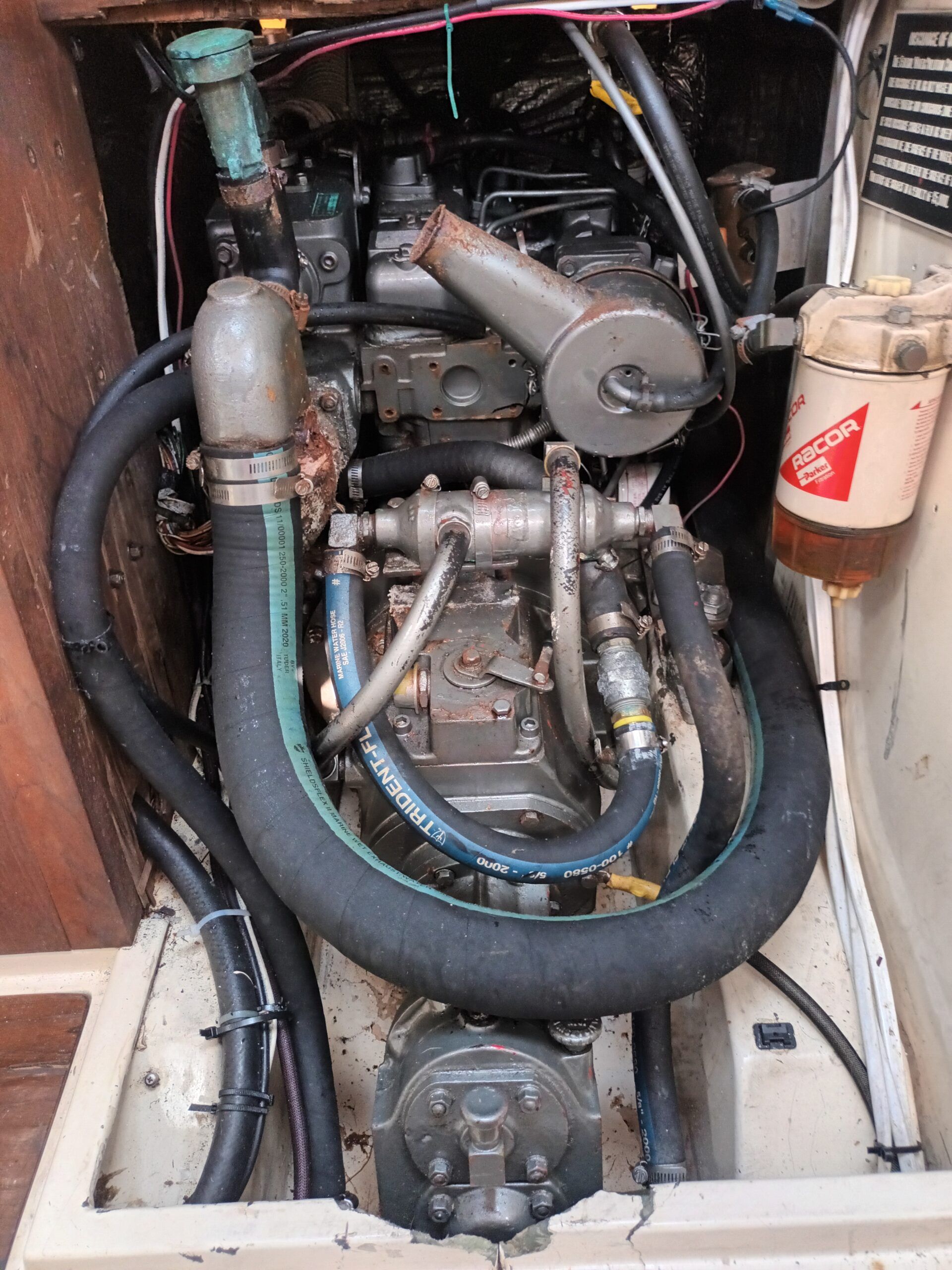
The first thing I saw on the engine was the surface rust. The rust was especially noticeable where the wet exhaust hose entered the elbow. The hoses and wiring were in good condition and there was no smell of diesel. I looked at the serial number, and the engine was from 1992. Another surprise. I started the engine for a few seconds to hear her run. The gearbox was loud and made grinding noises when put into gear.
Electrical and Safety Deficiencies
I tested the DC panel, and everything worked. Great! I started inspecting the batteries and the solar system. I couldn’t locate the solar controller. The owner had wired the two 100-watt panels directly to the AGM battery. No controller and no fuse. This goes against all safety practice and is an accident waiting to happen. In the event of a fire, the fire extinguishers were neatly stored in various compartments instead of being mounted in designated areas. There were many other surprises along the way.
Mystery Hull Construction
All searches indicate that the hull is made of solid fiberglass, however when I inspected one of the holes where a through-hull was removed, wood can clearly be seen sandwiched in between fiberglass. This would answer why the hull had high moisture. The mystery is why this hull was not solid fiberglass?
Final Verdict
After about three hours of dodging junk and excusing myself as I tried to work with two other people near me, my inspection was done. I wrote the report the very next day and had two full pages of recommendations including: immediate attention, safety concerns and suggestions. After sending the report I always offer to have a call to discuss it and answer questions. I explained my findings clearly and in detail. I ended by saying that this vessel was not seaworthy. This was the very first time that I deemed a vessel not seaworthy in a report.
Lessons Learned
The buyers were three mid-twenties novices with dreams of sailing the ocean. We’ve all been there and it’s a great dream…with the right boat, a seaworthy boat. They must have got caught up on the low price. The repairs needed will be double what they paid and I’m still not sure it will be seaworthy unless I get to inspect it again. They sent me a video of the water inside the rudder (shown earlier in this article). The foam interior was saturated with water. They said they were going to have the yard do the necessary repairs.
My lesson learned was to remember to tell the buyer to not only have the vessel clean and free of clutter for the survey but also not to have anybody doing work during the survey. I really didn’t think this needed to be said.
The hardest lesson, though, is remembering how many people are like those three buyers: eager, undercapitalized and vulnerable to a great price. The market is currently flooded with sailboats at enticing prices, but it’s important to get a pre-purchase survey before committing. I don’t like to see people wasting money and wish these buyers would have had a pre-purchase survey done—I’m sure they would have walked away.
How to Find a Qualified Marine Surveyor
If you’re buying a boat, get a pre-purchase survey before you commit. Here’s how to find a qualified surveyor:
Buying a boat can be overwhelming enough, but finding an accredited marine surveyor can make it even more so. In boat meccas such as Fort Lauderdale and Miami, Florida, finding an accredited marine surveyor isn’t difficult. There are hundreds at your disposal. However, in certain areas of the Caribbean for example, your pickings might be slim to none. This could mean flying one in to inspect your vessel. All expenses paid by you, of course.
Word of Mouth
The most common way to find an accredited marine surveyor is using your favorite search engine. A better way is word of mouth. A sailor that has just gotten their vessel inspected and recommends a particular surveyor could save you time and frustration. Choosing a recommended surveyor eliminates the guess work on whether the surveyor you found online is reputable, honest and does satisfactory work. People don’t usually recommend a person that did poor work and are not satisfied.
Credentials
Surveyors need credentials such as training and accreditation by Navtech USSA, SAMS (Society of Accredited Marine Surveyors) or NAMS (National Association of Marine Surveyors). Having passed the rigorous training from these institutions demonstrates the professionalism of the surveyor and his ability to properly inspect a vessel. Being a member of the ABYC (American Boat & Yacht Club) is also an important credential. ABYC provides training to marine surveyors assuring that they comply with the marine standards in electrical systems, safety equipment requirements, refrigeration, corrosion and many more. Most insurance companies will demand to see the surveyor certification before proceeding with a quote.
Ask the Right Questions
Here are some questions to ask when speaking to an Accredited Marine Surveyor:
- Does your surveyor have contractors’ liability insurance? Some marinas and yacht clubs will not allow contractors on their property without this insurance. If your surveyor does not have insurance, ask the marina or club if they require it before hiring the surveyor. I’ve seen surveyors turned away at the gate on many occasions. This can be a major cost and inconvenience to all involved. If they don’t have this insurance at a minimum, how serious are they?
- Ask how long they have been surveying and inquire about their training and education.
- Ask which credentials they have.
- Ask to see a sample survey. Review samples from several surveyors and read carefully between the lines.
- Ask if they have ever had a survey rejected by an insurance or finance company.
Resources
See “Evaluating Marine Surveyors.”
Here are a few websites to locate an Accredited Marine Surveyor:










Scary about the amount of water in that rudder. Many foam core rudders have the same issue, fully submerged all the time with no-where for the water seeping through the fiberglass (not waterproof in the long term) to evaporate. A fiberglass hull also absorbs water over time, but the water molecules can evaporate inside the boat. I have a fully enclosed keel and at every haul out, if I drill through the bottom leading edge I will get water leaking out from small voids between the fiberglass and lead ballast. Welcome to old boats!