

Are Marelon through-hulls a good modern replacement for bronze or a failure waiting to happen? Common refrains are: “Okay above the waterline if you want to save money and weight, but I want bronze below the waterline,” or “Through-hulls are too important to the ship’s safety to save money on, fit bronze.” Is there a basis to this skepticism when it comes to “plastic” through-hulls? For example, do they have a record of failure? Have people used them and had problems or might this just be prejudice against new innovations?
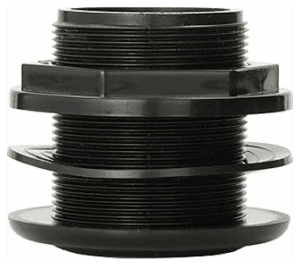
First, there is a difference between PVC through-hulls and Marelon ones. We have probably all seen this type of fitting sold in chandleries and plumbing supply shops sold as through-hulls. I have certainly seen, and removed, them from boats I have worked on. Once they have been installed for a year or two, they usually shatter with a moderate blow from a hammer. They are generally sold as bulkhead fittings and cost around $20. They look the part until something gets dropped on them or someone stands on them. The problem is they are made from PVC which is a quite low strength thermoplastic and prone to deterioration from UV exposure. I suspect it is this type of cheap plastic that has led to the poor reputation of all “plastic” through-hulls.
So What Should We Fit?
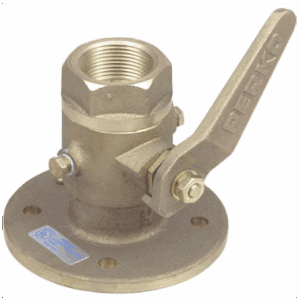
The ABYC standards for seacocks are that a seacock shall be securely mounted so that the assembly will withstand 500 lb. of static force applied for 30 seconds to the inboard end of the assembly. So you and two other crew members should be able to stand on it without it breaking. Also, there are specific requirements for the materials it is made from to ensure corrosion and UV resistance, and that all through-hulls should have a means of closure, i.e. a valve. Traditionally this meant a bronze fitting with a large, through-bolted flange that integrated either a ball valve or plug valve.
These have been around for generations and have proven themselves over time in all types of hulls. They are still made but the example pictured costs $405 not $20. The temptation to go for a cheap option is obvious.
Is Bronze the Ultimate Maintenance-Free Option for Through-Hulls?
While bronze was the traditional go-to, it does have some issues in modern boats, apart from the price. We now generally have complex A/C and D/C electrical systems. The seawater intake is naturally connected to the boat’s ground because there is a seawater connection to the engine block, which in turn is grounded to the electrical system. ABYC also requires that all metal underwater fittings are linked via grounding wire to the ship’s common ground. Why might this be a problem with bronze fittings?
While bronze is pretty much impervious to corrosion from sea water, if you pass an electrical current through it the zinc can be stripped out (bronze is an alloy of copper and zinc along with other metals). This leaves a pure copper fitting which is very weak. Stray currents can arise for lots of reasons from faults in the boat’s electrical systems, or even a boat moored next to ours, to faulty earths in the dock supply. While bronze fittings almost never had problems in traditional boats, in modern electrically-intensive boats and marina environments, “de-zincification” due to stray currents has become a significant issue.
What Are the Alternatives?
Stainless steel through-hulls that meet the ABYC standards are available and are the cheapest option that does. Most of our deck fittings and rigging is stainless so at first glance that would seem to be a good option. Stainless does, however, have an issue. It derives its corrosion resistance by forming an oxide layer when exposed to air that prevents rust. If it is not exposed to air this does not happen and it rusts just like mild steel. If you have ever removed a chainplate and found the back is badly pitted, this is what I am talking about.
Through-hulls need to have large flanges which are bolted to the hull and this face is sealed from the air, exactly the conditions that will lead to corrosion. The solution is to bed the fitting with a sealant in the same way that we would bed a deck fitting. This works but is not maintenance free. Sealant has a finite lifespan and fittings have to be re-bedded every few years. Stainless through-hulls are the same, they should be regularly checked and periodically removed and re-bedded.
Marelon
This is where Marelon comes in. It is not a “plastic” like PVC, it is a composite reinforced material. It has more in common with the fiberglass composite used to make hulls than any “plastic” fitting. It has been in use for more than 20 years without problems and fully complies with the ABYC standards. In terms of strength and corrosion resistance, it is at least as good as bronze.
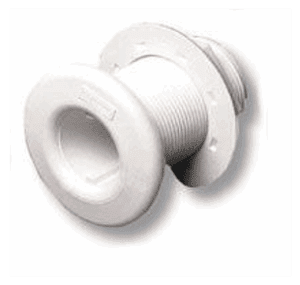
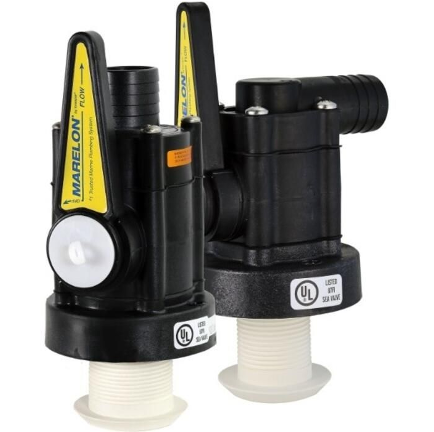
Marelon also has two big advantages, first it is much lighter than metal fittings and second it is not metal. That means it is not conductive, cannot suffer stray current corrosion or other dissimilar metals problems and does not need bonding. For anyone sailing in lightning-prone areas it also does not form a lightning path to ground so is less likely to get blown out in a strike. In terms of cost, it is more expensive than stainless but less than bronze. Pictured are examples of Marelon fittings as a plain skin fitting and with a Marelon shut-off valve attached (photo at top of article). As you can see the valves are quite bulky, which could be an issue in some installations.
Where Would Marelon Win Over Stainless or Bronze?
Metal Hulls
The first one is any metal hull. Metal fittings in aluminum hulls in particular can have serious problems with corrosion from dissimilar metals. Steel hulls, while not as bad, also have issues. It is much easier to fit a Marelon fitting than to weld an aluminum or steel one in if additional through-hulls need to be added.
High Performance or Race Boats
The weight advantage here is the big plus point. A 1.5-in. Marelon skin fitting and valve weighs 1.48 lb., the same thing in bronze weighs 6 lb. Never mind cutting the end off your toothbrush, change the skin fittings.
Fiberglass Hulls
While the advantages are less clear, I suggest there is a maintenance advantage over stainless because Marelon fittings will not need re-bedding as often. I also think that not needing to connect a grounding circuit could be an advantage. Fitting the grounding takes time and needs heavy gauge wire, which has a significant cost. Also, the circuit has to be checked and it is not uncommon for terminals or wires to corrode if they are low in the boat or in the bilge. Marelon avoids the need for any of that.
The weight saving, while probably not that important, is also a point in its favor. Cruising boats often have a lot of through-hulls and the weight saving could be in the order of 20-50 lb. For any boat sailing in lightning-prone areas there is a significant benefit as lightning strikes can blow out metal through-hulls. It is not common but has led to sinkings.
Marelon Disadvantages
So is there anywhere I would not use Marelon fittings? About the only disadvantage I can see with Marelon is that you can’t use it as a radio ground. Bronze through-hulls are excellent as a ground for both SSB and VHF radios so you may want to keep one for that reason. Except on a race boat or a metal hull where there was evident corrosion, I would not strip out serviceable bronze fittings and replace them with Marelon.
There may also be some cases where the cost is not justified. An example may be if you are fitting a half inch through-hull as a tank breather above any possible waterline. This could never threaten the hull’s integrity and does not need a shut-off valve so a cheaper and simpler fitting could be used.
Conclusion
So should you fit Marelon? For metal hulls the answer is almost certainly yes. For high-performance boats the weight savings alone make it worth considering. For fiberglass boats it comes down to whether you value the reduced maintenance and elimination of stray current issues enough to justify the cost over stainless. If you already have serviceable bronze fittings there is no need to replace them, but when it comes time for new installations or replacements, Marelon is worth serious consideration as a modern, proven alternative to the traditional bronze standard.
References
- ABYC standards. Available online for the boating industry but requires a professional account.
- Technical and test results for Marelon. Thanks to Anchor Marine Surveyors, UK.
- Forespar, the makers of Marelon products.












No mention of TruDesign from NZ? Rebranded as GemLux in USA.
Thanks for this one. It did not show up in my research because I was looking specifically at Marelon and these are described as ‘glass reinforced composite.’ They also do not carry ABYC approval. However, they do have ISO standard 9093-2 from a Canadian certification lab, which is equivalent They are also a bit cheaper. So thanks for that information.
Do modern instruments such as knot meters and depth sounders use Marelon? I believe they do.
How would Marelon do in a fire aboard a steel or aluminum vessel? I seem to remember a case where non-metallic through-hulls melted and caused a sinking in an otherwise survivable emergency.
Thanks for this well written article!
I think it’s kind of funny how upset people get about plastic below the waterline when the whole boat is plastic. I have found the ‘squishiness’ of marelon to be an advantage, one can add pressure tightening the fitting and have that pressure subtly deform the fitting and threads to store the pressure in the form of a tighter seal, instead of just breaking the strands of fiberglass by directly transferring all the pressure through the fitting to the hull material.
I thought Marelon was the way to go until I tightened up a new 1 1/2 above the waterline through and it snapped off in my hand . Part of the surfaces were not parallel on both sides . I screwed up . But a bronze fitting would either have obviously not fit , or leaked . At that point I would have i would have fixed the situation. I cannot see Maralon in the same light as bronze after this .
Marelon is all I have on my boat and, compared to my many previous boats. I would definitely switch all thruhull fittings to Marelon if I did not have them already. Especially here in cold winter Canada. Marelon fairs much better in freezing conditions…
A key point that is hinted at in this article is that a skin fittings below the water line requires a flanged seacock, not a plain valve. I bring this up because we constantly see installations, even on new boats where skin fittings are installed and a valve, (bronze, marlon, TruDesign) that is simply screwed on the “stalk”. this completely violates the strength and integrity of the system and often suggests that the threads are mis-matched because most valves do not have straight thread. Another thing to consider is that most EU built boats have gone DRZ Brass rather than bronze. They recommend replacing these valves about every 5 years in salt water. So Yes to Marlon flanged secock TruDesign with flanged adapter and proper bronze flanged seacock such as those by Spartan. I am not a fan of Bronze-Stainless ball valves (even quality marine brand ball type flanged models), but a plug valve can easily be serviced and will outlast the hull.
Pardon my ignorance, but how do you get the thru-hull actually through the hull with a valve already attached to it?
You mount all ABYC certified through hulls from inside the boat. The flange buts against the hull. On the outside, there is a ring and usually 4 bolts that go through the flange and ring, clamping them to the hull. Non certified through hulls frequently mount from the outside and have a flange nut screwed in from the inside. This will usually not pass the ABYC load test, but, depending on the situation, my be fine as long as the flanges are a good size
I have added or replaced Marelon thru-hulls on my J/92 and in most cases, I’ve used Vinylester bonding “filler” (the boat yards I frequent call it “snot”) with an 1/8″ thick piece of fiberglass board, G10, to give it a thicker hull to go through. Last year I had my 3/4″ engine Marelon thru-hull, which had worked hard for 4 or 5 years at least handle break. Its possible it was original with the boat, so that would be 33 years.
That caused a trickle of water to start coming in from the hole were the handle came out, which necessitated an emergency haul out. I did get the water to stop by using silicon on the handle part, sticking it in place and wrapping it with electrical tape. I admit, pretty much every year since I’ve owned the boat, I told myself I need to replace that thing next year…
Other notes, this is the old style Marelon thru-hull not the same handle as the current ones. Mine had a screw, which had long since stripped that held the handle in place. The water came in because the valve was partially open.
What about counterfeits? Is there a way to tell a bogus Marelon thru-hull? I am so concerned about this that I bought my bronze through-hulls factory direct from Groco, paying full retail.
This is an increasing problem, whether you are buying batteries, stainless screws or anything else for the boat. I have no answer except due diligence and some skepticism. Don’t buy a ‘Marelon’ seacock if someone is selling it for $50, and do some research before you buy from a company. Be especially cautious of sellers on platforms like Amazon who have only been selling for a short time and don’t provide a physical address. One thing I often do is look up a supplier’s address on Google Earth. Does it look like a marine company, or is it an office above a taxi firm in a back street?
(bronze is an alloy of copper and zinc along with other metals)
It would be more accurate to say “Bronze is an alloy of copper and tin along with other metals.”
Brass is an alloy of copper and zinc.
Very true, but copper and tin are very close on the galvanic series and don’t cause electrolysis problems. Most bronze contains some zinc, and zinc-copper is highly reactive, so that is the one I think we need to worry about. This is a good explanation from a leading manufacturer of bronze fastenings. Go to Fairwinds fasteners.com, Blogs, news, why does bronze turn red or pink.
Thanks for all the comments. Feedback from readers is a real boost when you are writing. It has been a while since I published anything in Practical Sailor as I have been busy renovating my boat and writing a book; Budget Sailboat Restorations, which will hopefully be out ready for the 2026 season.
I hadn’t thought about the effects of the cold. I take the point and agree, especially if you keep a boat somewhere like the Great Lakes. I was also not aware of TrueDesign from New Zealand, and I will look into whether they are available in Canada.
Trudesign have been available in Canada at least since 2014 when I put mine in. When I bought my boat it had bronze except for a Marelon for the holding tank discharge. The marelon wouldn’t budge and the surveyor wouldn’t guarantee the condition of the bronze. (He said that he had lightly tapped an apparently sound bronze ball valve only to have it break off.)
The Trudesign have been faultless, never needing “exercising” and never stiff. I added the support collars as they hadn’t been released when I installed the valves.
I believe Rekord Marine is the distributor for Canada.
My Beneteau 42s7 is outfitted with Shakewell seacocks, a FRP type of valve that fits flush to the hull. They use a plunger style valve that can be removed for servicing while boat is in the water through use of a blanking plug (think of your speed transducer thru hull). The distributor/manufacturer is based in Finland, but are slow to respond for parts and there are no other distributors. Genius devices, only downside is support. Hot marina makes bronze thru hulls a must replace item every third haul out for the other boaters at this location.
Interesting seacock shame about the availability. What is going on at your marina? I have personally had bronze seacocks that were more than 60 years old and still perfect. Do they give a reason? Are they perhaps not distinguishing between brass and bronze?
I’m a fan of Marelon. I’ve seen old bronze seacocks break off when the handle is difficult to move and dezincification has occurred. That’s definitely scary! Nothing’s perfect. Carry spare parts and lube. As for the comment regarding fire risk, it occurs to me that a fire that’s melting Marelon in the bilge may be a fire that has already consumed everything valuable about your boat.
I would also add that the plastic hose attached to it will be long gone…
We replaced all our bronze thru hulls with Marelon Series 93 valves and thru hulls during a 2015 refit of our ‘81 Bristol 41.1. They are OEM on many new boats, and have served us well. We apply Marelube lubricant yearly and during any mid-year haul outs. We note the comments on how (not) well they might handle a fire, but nonetheless would recommend them to anyone considering replacing their bronze units.
I have had Marelon exclusively on our last 3 boats. First an Able Apogee for 23 years, then a PDQ41 for 5 and now a Catalina 425 for 2 years. No failures or problems on any of the boats and minimal maintenance consisting of occasional cycling. Before that it was bronze with variable result and more maintenance. I think the choice is clear.
I replaced all of the non-isolated bronze seacocks on my steel boat 20 years ago with Marelon. Other than the blood sweat and tears getting the five 1 1/2 valves installed with cabinetry in place, they have served with only annual silicon lubrication admirably.
as for the fire risk I rationalized that with fire “burning up” the valves would be at little risk- they’re all below the water line- and by the time they were at risk, the boat was going down anyway; so, what’s the problem?
One key advantage of TruDesign for a GRP hull is the option of setting the skin fitting, thru-hull, in with epoxy. Thus it becomes part of the hull; no leaks, no twisting, no movement. The seacock valve is then sealed and secured with a caulk, such as 4200 with load bearing collar. It can be changed, if ever need be. With a backing plate of G10 epoxied to the inside of the hull, and the skin fitting epoxied to the hull and backing plate, the installation is quite robust. Need to change out? Just drill out with a hole saw. I installed a new 1 1/2″ galley sink drain this way, and will change out all the other thru-hulls at next opportunity. I don’t know if Marelon fittings can be installed in the same way.
PS: One issue with Tru-Design. The “throat” is not always the same as the nominal pipe diameter. For example a 1″ valve takes 1″ NPS/Hose barb but has a 3/4″ ball valve inside. This save on manufacturing, I guess. But limits the options of sizes where volume of water flow is critical, say for engine raw water intake. Check the spec sheets carefully.
Also, because of the NPS threads on the valves, one must use the Tru-Design NPS hose barbs for proper fit.
Trudesign have been available in Canada at least since 2014 when I put mine in. When I bought my boat it had bronze except for a Marelon for the holding tank discharge. The marelon wouldn’t budge and the surveyor wouldn’t guarantee the condition of the bronze. (He said that he had lightly tapped an apparently sound bronze ball valve only to have it break off.)
The Trudesign have been faultless, never needing “exercising” and never stiff. I added the support collars as they hadn’t been released when I installed the valves.
I believe Rekord Marine is the distributor for Canada.
I’m a big fan of the product. Two points I would make—1-marelon doesn’t come with backing plates I strongly suggest glassed in backing plates to spread the loads when torquing a handle especially if it’s stuck or resistant . 2-no different than bronze, exercise the handles every month or two and lubricate (from the outside in) when hauled out.
After six years in the Caribbean, the bronze valves needed maintenance. The test performance of Marelon and my 30-plus years in polymer R&D convinced me to make the switch. I installed two Marelon through-hull valves in my Jeanneau 45.2 in 2005. They have served us flawlessly. The only suggestion would be a more sturdy handle, and I see from the picture in your article that the valve handle has been beefed up.