



The Search for Reliable Hands-free Onboard Communication Systems
Being able to communicate with a hands-free communication device along the length of the deck allows crew to coordinate activities like anchoring, docking, and going up the mast. Practical Sailor testers experimented with two systems: Motorola SX800R two-way radios and Nautic Devices Yapalong 3000. Both the Motorola and the Yapalong comprise a cell-phone-sized transmitter/radio unit and a separate handset. We tested them during anchoring, masthead repairs, and docking. The products were used with their mated headsets in various weather and sea conditions, including light rain and spray. The Motorola unit also was tested with a compatible Fire Fox Sportsman Throat Mic.
Rust Busters: Spray Solutions for Seized Fasteners and Other Metal Hardware
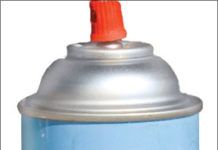
For those of us living, working, and playing on the water, rust can show up all too often, as the trailer for one of Practical Sailors test boats recently reminded us. Testers tried four aerosol products marketed as penetrating oils-WD-40, Liquid Wrench, PB Blaster, and CRC Freeze-Off-on the rusted U-bolts, and seized nuts and bolts of the neglected trailer to determine which is the best rust buster.
Mailport: 04/09
I read with interest your evaluation of first aid kits, which wrapped up with the final installment in the December 2008 issue. Id like to add a couple of points: Weekend, cruising, and bluewater sailors should invest in a good up-to-date first aid and CPR course. It is as important as a functional bilge pump. The responsible sailor can outfit a substantial and superior first-aid kit for much less money than a commercially available kit. The kit should be appropriate for the expected duration a victim will need treatment prior to evacuation. Most commercial kits contain a lot of fluff and are unnecessarily redundant-a lot of Band-Aids. I stress to distance sailors stocking a few prescription items and aggressive treatment for seasickness, beyond Bonine. I favor a solid medical text such as "A Comprehensive Guide to Marine Medicine," by Dr. Erick Weiss and Dr. Michael Jacobs, or "Medicine for Mountaineering and other Wilderness Activities," by James Wilkerson. The latter is available from Mountaineer Books. Both texts give guidance on stocking kits appropriate for your boat. Remember, the victim may be the captain or medical officer, and a novice may be the one rendering treatment. A medical guide is an invaluable resource.
Next Best Thing
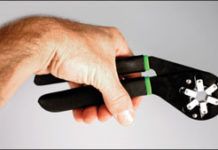
While world leaders and presumed financial wizards set to work trying to right the global economy with some very expensive bailers and sponges, Practical Sailor has taken the time this month to dig through our recent collection of Chandlery submissions to see if we can find anything more useful. Given sailors capacities for innovation (aka "jury rigging"), were holding out hope that the next great invention-the ultimate stimulus package-lies somewhere in our growing stockpile of Chandlery items.

Bottom Paint Tests 2009 Spring Update
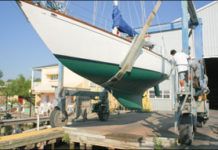
Over the years, Practical Sailor has tracked the evolution in marine antifouling paints. Shaped by government regulations, environmental concerns, and industry innovations, the shift started with tin-based paints in the 1980s. After tin-based paints came under fire for the harm they cause marine life, copper-based paints grew in popularity. Now, concerns about the impact of copper on the environment have led to the development of copper-alternative paints, such as zinc-biocide and water-based antifoulings. We continue to sort through the data to help you find the best bottom paint for your boat. This report offers an update to our panel tests after six months and 18 months in the water as well as the head-to-head tests under way on our test boat fleet. Some of the best performers (out of 72 paints tested) at six months were hard paints and specialty antifoulings such as Copper Shield 45 Hard made by Blue Water, VC Offshore by Interlux, Copper Guard by Pettit, and Sharkskin by Sea Hawk. The best ablative paints at six months included Copper Shield SCX 45 by Blue Water, EP-21 by Epaint, and Hydrocoat and Vivid Free by Pettit. The top long-term bottom paints-those appropriate for multi-season antifouling protection-included Interlux Micron 66, Pettit Trinidad SR, and Interlux Epoxycop. These extensive tests also included marine bottom paints from Awlgrip, Flexdel, and Microphase Coatings. The lineup also covered re-branded products from West Marine.
A Smorgasbord of Tools and Patience Are Required For the DIY Epoxy Barrier Coat...
Practical Sailor Technical Editor Ralph Naranjo sets out to remove a few layers of bottom paint and the underlying Interlux InterProtect epoxy barrier coat, which was applied to his boat hull in 1982. While non-toxic, eco-friendly paint removers work well on removing antifouling paints, one-part enamels, and varnish, all bets are off with epoxy coatings. With a good selection of chisels, a penchant for keeping them sharp and no aversion to hard work, Naranjo battles the pock-marked, blistered barrier coat. His arsenal included three chemical strippers-Peel Away Marine Safety Strip, Peel Away Smart Strip, and Franmar Soy Strip, an array of sanding disks, and random orbital sanders. His report offers how-tos, tool tips, and a rundown of the costs associated with the DIY barrier coat removal to answer the question: Is it really worth doing it yourself?

Digging the Daily Grind
This months bottom paint article got me thinking again about Practical Sailor. We are, in some ways, the old barnacle of the marine publishing world, clinging tenaciously to an independent, ad-free format, while our brethren are whisked off by the current toward banner ads, YouTube videos, and blogs, where opinions and advertiser bias often supplant fact-based reporting. Ours is not an easy road. If it was, thered be others doing it. I dare not try to calculate the man hours that went into conducting the tests in this months issue. The annual bottom paint project alone consumes weeks. Then theres the multi-day pull-tests for the rope-clutch comparison, the days spent dissecting 9.9-horsepower outboard engines, and a long week of comparing 27 different kinds of clear-vinyl cleaners. And I havent even mentioned the dirtiest project featured this month, Technical Editor Ralph Naranjos epoxy barrier coat removal project-a hot, dusty ordeal carried out for weeks during a Chesapeake Bay heat wave.
The Great Metal Polish Showdown
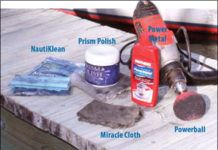
Practical Sailor last tested metal polishes in March 2007, and the best choice for most jobs was the Miracle Cloth. The treated cloths best feature is its ease of use. Since that test, Practical Sailor has come across a couple other products: another impregnated cloth product called the NautiKlean, two cloths that are meant to be used together; and Mothers Power Metal, a polish that can be used with the drill-mounted Powerball, a foam ball that allows power polishing around curves and in tight spaces. Theres also a smaller mini-Powerball. Testers pitted the NautiKlean cloths and the Mothers mini-Powerball and Power Metal Polish against the Miracle Cloth on a variety of metals, including anodized aluminum, stainless steel, and bronze. Testers also included a one-year-old tub of Prism Polish, a conventional polish that did well in the last test.
Wear and Tear Pad Review
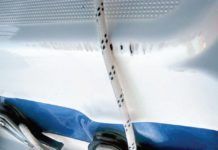
Over time, chafing from lines can actually wear away gelcoat. Likewise, chips will appear where hatches or ports bang. While eliminating chafe is the best course of action, in some cases, a protective patch can be a viable solution. Faced with a chafe problem on his own boat, sailor Andrew Grogono developed the Wear and Tear Pad, an ultra-thin (.002 inches) piece of 301 stainless steel backed by an all-weather double-sided tape. To use, just peel off the backing paper and stick the patch on the hull at the point of friction or impact (making sure the hull is clean and dry, first).
Practical Sailor Tests the Alado Jib Furler
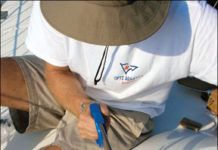
Practical Sailor finds the Alado Nautica headsail furler to be easy to install and a worthwhile sail-handling tool. One feature that sets the Alado apart from other jib or genoa furlers is its staggered slotting of five-foot foil sections that slide together and interlock over a conventional wire or rod headstay. This design allows the do-it-yourselfer to fit each foil section over an attached headstay, and simply push the formed furler up the wire or rod. Mainstream headsail furlers tend to be assembled on the ground and installed with the mast horizontal. The Alado furlers design uses integral halyards to place a compression load on the foil, eliminating the need for Loctite, set screws, and a top swivel. We tested the Alado over five months of coastal cruising and daysailing.

O’Day 40 – A Budget Cruiser for the Bahamas
The O’Day 40 (1986) is one of those cruising sailboats that somehow slipped through the cracks of sailing history. Built during the final years...


Latest Sailboat Review
Island Packet Estero Used Boat Review
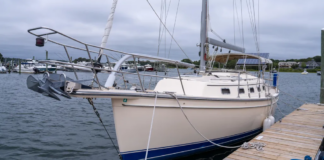
Florida-based Island Packet targets a relatively narrow niche, so the toughest competitors to its new boats are often older Island Packets. Introduced in 2010, the 36-foot, shoal-draft Estero is the company’s latest attempt to introduce a distinctive model that doesn’t stray too far from the company’s proven formula for success: moderate displacement, full-keel cruisers designed to be lived on, sailed far and in comfort, and endure the bumps, scrapes, and storms that cruising boats inevitably encounter. After sailing the Estero on Florida’s Sarasota Bay and inspecting its interior, construction, and systems, Practical Sailor testers noted that the shoal-water cruiser will appeal strongest to Island Packet fans who’ve been waiting for a shoal-draft, easy-to-sail boat that compares to the IP37 in terms of interior space. These strengths will be most apparent on intracoastal or riverine adventures like the Great Loop.