

Clear the Decks: Anchor Wells and Bow Rollers
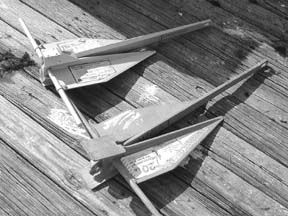
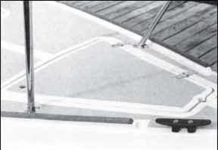
Ever since some ancient mariner broke a toe tripping over the killick stowed in the bow of his curragh, sailors have sought to solve the mysteries of ground tackle stowage. The solutions have been endless, and as a rule compromises. A significant portion of the interior volume of a 19th century warship was given over to the storage of anchor rode. Even aboard modern boats, the search for the proper stowage of several anchors and chain, plus hundreds of feet of sometimes slimy nylon anchor line, is one that occupies both designers and boat owners. Two "modern inventions" — the anchor well, and the bow roller — have greatly eased many of the problems of ground tackle stowage. But even these developments vary greatly in quality and design, some creating more problems than they solve.
Chafe Protection for Dock Lines
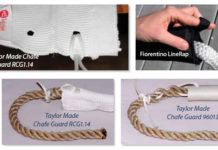
The best anti-chafe material to rely on in a storm is the one that resists abrasion, doesn’t cause heat build-up in the line, and can be easily installed—even if the line already has been deployed. Practical Sailor tested five commercially made products marketed as chafe protection for lines on boats: the Davis Secure, from marine accessories maker Davis Instruments; LineRap from Para-Anchor manufacturer Fiorentino; Chafe-Pro from the North Carolina-based Fjord Inc; and two sets of Chafe Guards by Taylor Made. Products ranged from single-skin webbing designs to tough Dacron double-layer designs, and the chafe gear’s attachment, or locking, methods were an integral part of the ratings. (The products don't work if they don't stay in place.) Chafe gear was put through a series of abrasion tests and was rated on price, ease of use, and performance.

Is Hand-stitched, Nylon Webbing Strong Enough?
Rope is the mainstay of sailboat rigging, and knot-craft and splicing are the marks of a seaman. Sewn joins are also practical-and weve explored those in depth (see PS October 2014 online)-but there are times when flat webbing serves better; for example, reefing strops, jacklines and tethers, and straps for attaching sails and tackle to spars. But how do you form the loops required to attach them to hardware and other fittings?
Alarming Trend Shows Minimal-duty Windlasses Becoming More Common on Cruising Sailboats
Although the day sailor or marina hopper may not need heavy-duty ground tackle or heavy-duty windlasses, it is alarming to see lightweight windlasses appearing more often on boats deemed long-range cruisers. It pays to confirm that your boat’s windlass was selected for ruggedness and reliability. Practical Sailor Technical Editor Ralph Naranjo examines what goes into the making of a windlass at Ideal Windlass in Rhode Island. Naranjo outlines windlass choices and examines windlass design, materials used to make the devices, and windlass repair. Windlass distributors and manufacturers spotlighted in the article include Ideal Windlass, IMTRA, Lewmar, and Maxwell.
Adding Some Zing To Anchor Testing
Quantifying anchor loads is tricky business, and our article on the topic, beginning on page 24, gives some insight into the trouble a tester faces when trying to compare the performance of various types of anchors. Apart from the obvious questions about the bottom type and the scope amount to be used for evaluating, testers need to sort out more subtle details, such as how the anchor should be set, how the load should be applied, and what the pull direction should be.
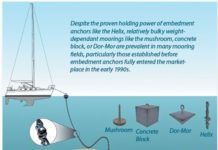
Screw types prove their mettle in load testing.
The mechanics at work at the other end of your mooring line matter as much as the mooring line and pendant. In 2009, Practical Sailor reported on two pull tests held 12 years apart (See Mooring Anchors for Sensitive Seabeds, Practical Sailor August 2009). We also reported on the results of a third test being carried out by contractors for the City of Sarasota, which at that time was about to become one of Floridas seven pilot mooring fields. Boot Key Mooring Field, which took a near direct hit from Hurricane Irma in 2017, was another harbor participant in the program (see adjacent article).
Mooring Anchors for Sensitive Seabeds
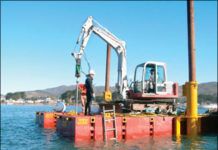
Mooring anchors fall into two general categories: those that rely on sheer weight and mass to provide holding and the embedment types that penetrate the sea floor. There are also some hybrids that rely mostly on their weight, but also embed themselves in the sea floor over time. BoatUS projects and municipal tests on Sarasota Bay, Fla., support helical screws as the best option when it comes to choosing mooring tackle, particularly in sensitive areas. Practical Sailors evaluation of mooring anchor types includes the Helix screw, Manta Ray, Dor-Mor, Mushroom, and concrete blocks.
Anchor Rodes for Smaller Sailboats
The usual advice for anyone seeking all-rope anchor rode is usually to just get some three-strand nylon anchor. The makes sense. Three-strand nylon is inexpensive, wears best, and is easy to splice. But one size, or even one type of rope, does not necessarily fit all situations.
Spring Lines for Storm Preparedness
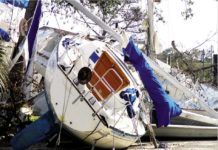
A well-secured boat in the best-designed marina can't be expected to survive a direct hit from a hurricane. Major boat-insurance companies recommend hauling out and tying down your boat, but that isn't always an option, nor is it any guarantee.
Assessing the Anchor Kellet
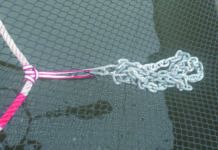
One of all-chain rodes most popular features among cruising sailors has little to do with anchoring-and everything to do with stowing. With a well-designed bow roller, windlass, hawse hole, and chain locker, your rode and anchor will deploy and stow belowdecks faster and with far less effort than nylon rode requires. But for a smaller boat without a windlass or deep chain locker, an all-chain rode is often impractical. Even cruising sailors who are perfectly equipped for all-chain anchoring often find that their nylon secondary anchor better is suited for some anchoring situations.
How Long Do Sails Last?
How long do sails actually last? Sailmakers often say cruising sails last around 10–15 years, but what happens when you discover a sail that’s...



Latest Sailboat Review

Jeanneau 55 Boat Review
This recent sailboat from Jeanneau may as well be a spaceship. They’ve taken all the time-honored designs of a monohull aft cockpit and turned...