

New Mantus Swivel
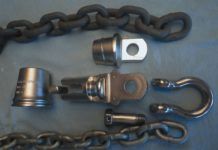
In our recent article on anchor swivels (see PS September 2015 online), we reiterated our view that swivels are unnecessary in most anchoring situations. For those who insist on using one, we suggested staying away from cheap varieties, and using only load-tested designs that exceed the rating of the anchor chain from every angle of pull. (None of the ones we have found that meet this criteria are cheap.) Shortly after that article, Mantus Anchors, a relatively new maker of anchors and anchoring accessories, introduced its swivel, which it claims is as strong as an ordinary shackle and priced in a range that ordinary cruisers can stomach.
Estimating Galvanized Coating Thickness
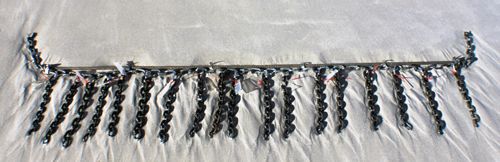
There are no industry standards for how thick a galvanized coating should be on an anchor chain or mooring chain, and manufacturers don't publish this information. Fortunately, with a bit of sleuthwork, you can determine just how good the galvanized coating is on your chain by carrying out a couple of tests on some sample links you can obtain from your local chandler.
Making Sense of Marine Chain Standards
Chain is made from wire. The cross-sectional area and strength of the wire determines the strength of the chain. The weld of each link should be stronger than the wire, so if a chain breaks, it should break in the body (wire)-usually at the crown, or the curve in the link-not the weld.
Anchors for Muck, for Under 200 Bucks
In soft mud, the low-priced Lewmar Claw stands out in short- and long-scope testing
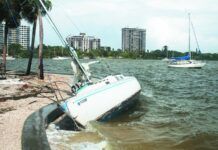
Ground Tackle Inspection Tips
Your anchoring system is only as strong as its weakest component, which includes not only the rode, but also shackles, splices, mooring bitts, cleats - in short, any gear used to secure your boat while at anchor. Proper maintenance includes inspection of these as well as laying the rode out for thorough examination at least annually.
Adding Some Zing To Anchor Testing
Quantifying anchor loads is tricky business, and our article on the topic, beginning on page 24, gives some insight into the trouble a tester faces when trying to compare the performance of various types of anchors. Apart from the obvious questions about the bottom type and the scope amount to be used for evaluating, testers need to sort out more subtle details, such as how the anchor should be set, how the load should be applied, and what the pull direction should be.
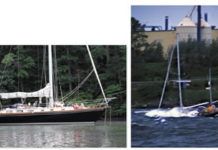
Manson vs. CQR Sea Trials
When the forecast turns bad, and its time to find shelter in a new cove or harbor, questions arise about the holding ground, swinging room, and the influence of tide, current, and surge. But there should be little question about the ground tackle and whether or not its up to the challenge at hand. Its true that no anchor comes with a written guarantee to always set and hold, and there are conditions in which each may fail, but the more time one spends anchored out, the more overkill or ground tackle safety margin is warranted. During our acquisition of sea sense, we inevitably discover the range of conditions that our primary (working) anchor can handle, usually discovering its limitations the hard way.
Elastic Mooring Systems
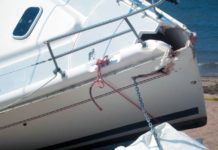
When Hurricane Irma plowed through the Florida Keys, it left behind both a trail of destruction and a wealth of information for us to learn from. One of the most instructional episodes took place at the municipal mooring field at Boot Key in Islamorada.
Nearing the End of Our Chain – Mooring Chains Tested
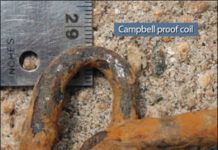
Practical Sailor dropped seven different lengths of 5/16 mooring chain in Long Island Sound 2 1/2 years ago. We reported on the initial inspection and the one-year inspection. After a quick look at the chains at the two-year mark, we left them in the drink for another six months and then pulled them. During the test, all chains had the upper parts exposed to air twice a day and were subjected to constant wear from waves and tidal changes. When we retrieved the chains for the final time, we found the greatest loss of material just below the halfway points in the 5-foot lengths. Chains we tested were Acco, Campbell, Chinese, and Suncor. Chains tested were galvanized, zinc-plated, and stainless steel.

Reliable Chain Connections
We often get asked about joining two shots of chain together without compromising strength. You have a number of options-including some that are just plain bad. The important thing is to make sure the connector is of the highest quality and that it matches or exceeds the strength of your existing chain.
Morgan 382 – The $30K Boat Nobody Talks About
The Morgan 382 might be one of the most overlooked cruising sailboats ever built. Designed by legendary naval architect Ted Brewer and produced between...


Latest Sailboat Review

Jeanneau 55 Boat Review
This recent sailboat from Jeanneau may as well be a spaceship. They’ve taken all the time-honored designs of a monohull aft cockpit and turned...