


Reducing the Nylon Rode Sling-shot Effect
Again we speak heresy! Practical Sailor has published at least four articles explaining why stretchy nylon bridles and snubbers are vital. But if the rode is nylon instead of chain, this no longer applies. The rode provides all the impact absorption we need, perhaps more than we need. By analogy, a bridle should function like an anti-sway bar on an automobile, keeping the boat centered.
Make Your Own Over-the-Boom Riding Sail
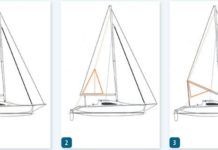
Delighted with the performance of the over-the-boom riding sail, we decided to make our own.
Rest Easy with a Riding Sail
Even when your anchor is well designed and ideally matched to your boat, there are four common factors that can cause an anchor to drag: poor bottom, short scope, insufficient shock absorption, and yawing. Each of these reduces the holding capacity of the anchor, and they are additive. That is to say that any one of them can ruin your day, solving only one or two of them does not ensure good holding, and the more problems you solve, the better youll sleep.
Sails and Summer Projects
While most of us are-hopefully-out sailing this summer, we know that many sailors are busy with system upgrades, do-it-yourself projects, and the usual marine maintenance adventures. Here are some archive articles we think will help you tick off the tasks on your to-do list.
Mailport: anchoring etiquette, stern-tied boats, and wind generators
I really appreciated the article Anchoring in Crowded Harbors (see Practical Sailor, June 2019). The difficult and critical part is always estimating distances, and the guides you gave (two-to-three mast heights, using fractions of a nautical mile, etc.) can be difficult to do accurately in a crowded harbor with the sun setting, with some of that information available only at the helm, and multiple boats moving to anchor. As a bow hunter, I am…
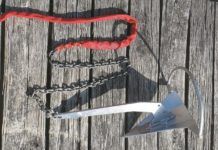
Collapsible Anchor Prototype Tested
A big rollbar-style anchor on a bow roller is now synonymous with cruising. They are efficient in many types of bottoms and reliably rotate or reset when the wind and tide change. Unfortunately, they are shaped awkward and are difficult to stow anywhere other than a bow roller. Lacking this, many smaller boats, both sail and power, are forced to store the anchor in either a shallow bow locker, a snag-prone railing bracket, or in a lazarette.
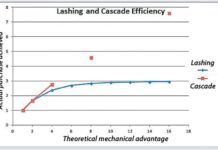
Some Simple Tricks to Tensioning Lashings
We've seen both turnbuckles and lashings side by side on matching boats. Why the difference in approach, since both designers are obviously comfortable with synthetic standing rigging?
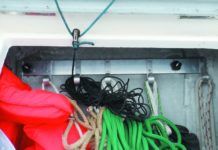
Sailboat Accessory Hooks
Boats are always challenged by limited storage space. Many production boats share two common features: they have lockers that are either bottomless or wet at the bottom, and those lockers contained broken storage hooks installed by the previous owner. Over the years weve been on the lookout for storage hooks that wont fail and reconsidered the places where they can best meet our needs.
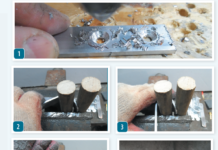
The DIY Hanger Hook
It was a given that anything added to the cockpit locker of our F-24 test boat had to be quickly removable. All of the bolts for cockpit gear, fuel lines, and half of the wiring is accessed by worming through this narrow locker into the space under the cockpit, and any obstruction would render it inaccessible. Because the backside is the hull, through-bolting was not an option. The previous owner had epoxied on a few hooks, but gluing plastic to fiberglass is pretty hopeless and only the scars remained.
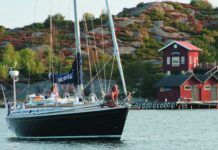
Anchoring Legal Responsibility
We often get questions about anchoring rights. While it is commonly understood that the first boat arriving in an anchorage has privileges, many see this as a matter of etiquette, but it is also a legal issue. The below citations are from the case Juniata 124 F. 861 US Admiralty Court, E.D. Virginia, 1903. Other rulings we reviewed generally agree.]
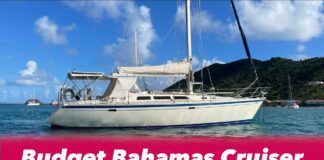
O’Day 40 – A Budget Cruiser for the Bahamas
The O’Day 40 (1986) is one of those cruising sailboats that somehow slipped through the cracks of sailing history. Built during the final years...


Latest Sailboat Review
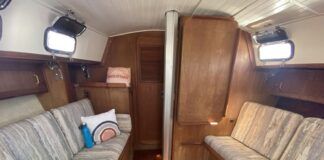
Caliber 33 Used Boat Review
The Caliber is a peculiar blend of tradition and innovation, of security and performance, of practicality and pizzazz. All of the owners we heard from were "satisfied." One called the 33 his favorite boat over six decades of sailing.