

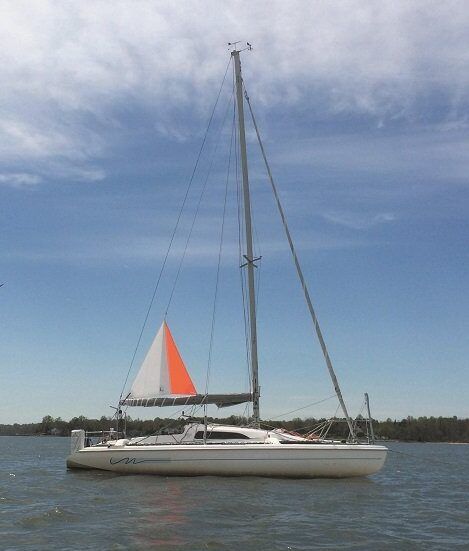
Again we speak heresy! Practical Sailor explained that stretchy nylon bridles and snubbers are vital. But if the rode is nylon instead of chain, this no longer applies. The rode provides all the impact absorption we need, perhaps more than we need. By analogy, a bridle should function like an anti-sway bar on an automobile, keeping the boat centered.
What We Tested
We tested double-braid nylon, non-stretch polyester webbing, and Dyneema bridles on our Corsair F-24 trimaran. In light winds, we noted very little difference between them. However, when the wind piped up to 25 knots, the nylon bridle would stretch as much as 10 percent under load, particularly if a gust caught it from the side, placing up to 300 pounds of stress on a single leg of the bridle. Since only one leg stretches, the attachment angle to the boat changes by as much as 17 degrees and yawing increases. A non-stretch bridle keeps attachment angle constant.
Observations
We measured tension with both nylon and polyester bridles. If the yaw angle was the same, the force throughout the swing was the same, and the nylon rode provided sufficient gust and wave damping. However, uncontrolled, the nylon bridle allowed increased swing angle and thus greater force because of increased windage.
Lighter boats are more subject to fore-aft surging, known as horsing. Light multihulls are particularly susceptible to this, since they have significant windage and very little fore-aft drag. Nylon is king when it comes to reducing wave impacts, but it can also turn into a bungee cord, launching the boat forward with each lull in the wind. Thus launched forward, the rode maintains less tension and the boat is more free to yaw with the next gust.
Reducing Nylon Rode
One solution is to limit the amount of nylon rode. For example, in studying snubbers for chain rode, we concluded that 30 to 60 feet of nylon was generally enough. If we anchor in 8 feet of water, with the bow roller 10 feet above the bottom, and with 7:1 scope, the total length of rode is 70 feet. If we use 10 feet of chain and 20 feet of non-stretch bridle, the remaining nylon rode is 40 feet, within the safe range. There will be sufficient shock absorption but not excessive surging. However, under no conditions should you reduce the total length of nylon in the anchor rode to less than 30 feet. In such cases, switch back to a nylon bridle to prevent excessive shock loads on the anchor or hardware.
Bottom Line
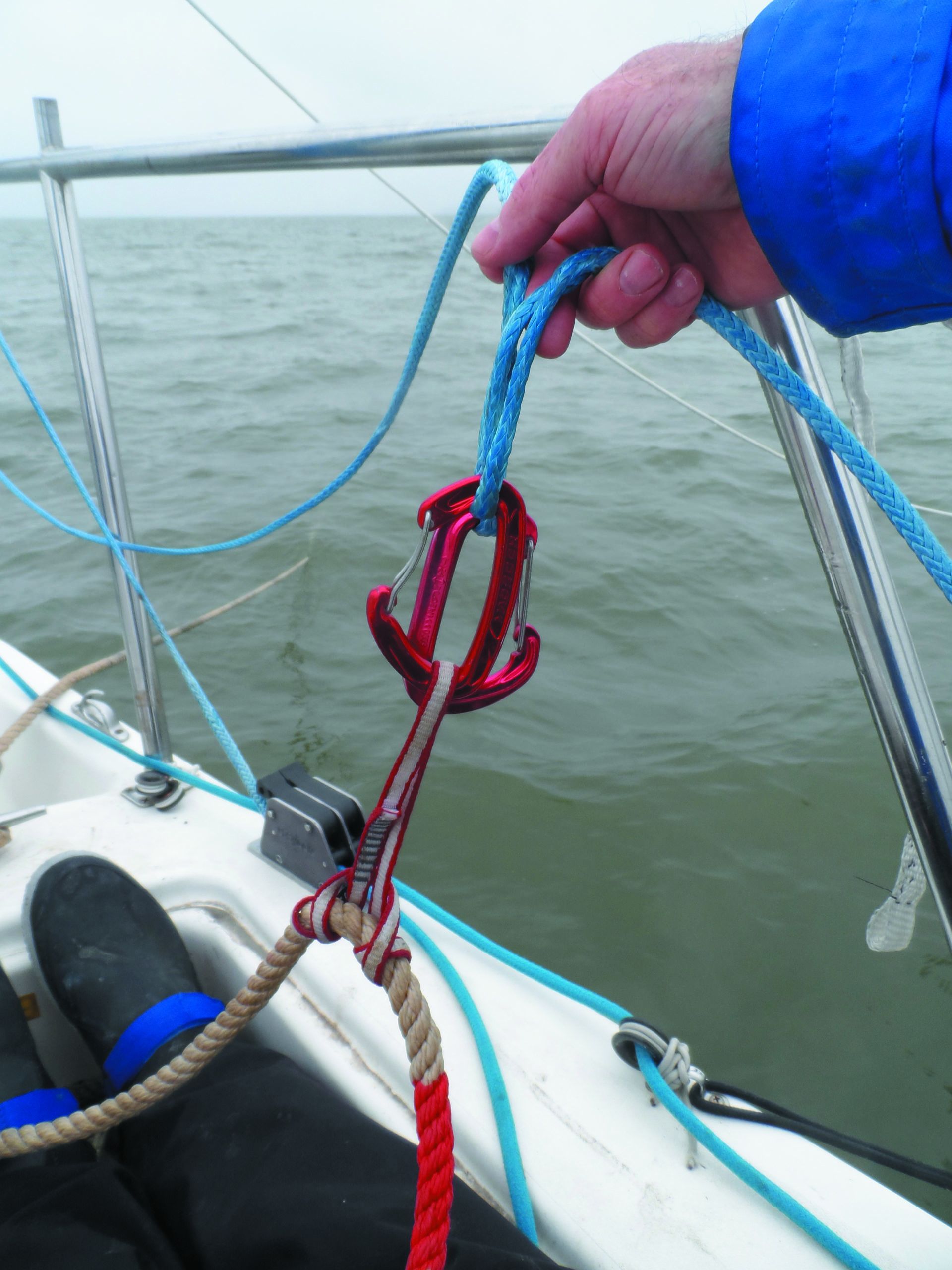
A non-stretch bridle reduced yawing and horsing, and thus reduced the forces and tugs on the anchor. We now use a Dyneema bridle on the F-24.
This article was published on 15 July 2019 and has been updated.







Having a drag bucket, (in the water), chain, (with out anchor, on bottom), & or kellet on anchor line rode, may help reduce, (hobby?), horsing, (around), yaw, & or jerking. ‘B J’. R U interested in my 330 page, 12 main boat & 60 year, personal Sailing Stories, (& the mistakes, (& or jokes)), within?