


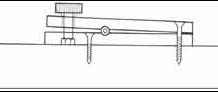
A Homemade Tiller Tender
On my Catalina 22 I have a tiller tender which has served me well for many years — and it didn't cost a cent. On top of the tiller are two pieces of 3/8" x 3/4" hardwood about 5" long. The two pieces are drilled horizontally, at the joint line, about 2" from the end to accommodate a 3" length of split neoprene which has an inside diameter slightly less than the diameter of the braided line which runs to the coamings. Two holes drilled vertically near the ends are used to fasten the device to the tiller.
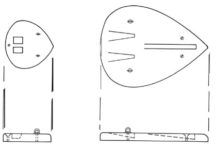
Wooden Anchor Chocks
Conventional commercially available anchor chocks, though convenient, can be nasty metal toe stubbers and not particularly attractive. In contrast, wooden chocks are easy to make, handsome, and relatively snag- and toe-proof.
Smooth Runnings: Bullet Blocks Battle
Practical Sailor tested more than a dozen bullet blocks (sized 40 to 45 millimeters) from eight marinedeck hardware manufacturers: Barton, Garhauer, Harken, Karver, Holt, Ronstan, Schaefer, and Selden Mast. The units tested were ball-bearing and roller-bearing designs, and the growing trend toward more composite material and less metal construction was evident among the products. Blocks were loaded to 200 pounds-well within the safe working load for the test blocks-and testers measured the amount of force required to move a line in a closed loop set up. Once the efficiency test was complete, the blocks were subjected to an aerated saline bath to gauge corrosion and oxidation tendencies. Weight, price, safe working load, cheek material, and attachments were also evaluated.
From the Bench to the Bath
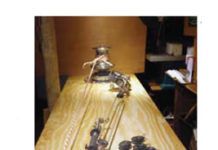
With some modification to our bench-test jig, we were able to place two blocks in opposition to each other, attach them via a closed loop of ultra low-stretch line and place the system in tension. The load-inducing mechanism was a vertical capstan Ideal anchor windlass capable of incrementally adding tension to the mix. A Dillon AP dynamometer was placed in series with the tension-creating tackle, and during each test, the load on the closed loop was closely monitored.
Rope Test Yields Rope Hernias
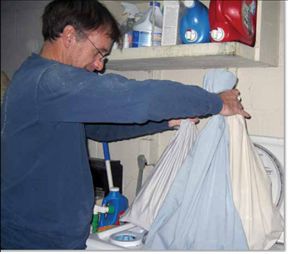
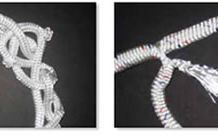
Researching an upcoming article on the effects of various cleaning chemicals on ropes, our testers scrubbed and machine-washed mountains of nylon and polyester rope of every description. Samples ranged from three-strand dock line encrusted in marine life to brand-new polyester double-braid line. Our testing for that article continues, but we want to report one immediate finding relevant to any sailor who is wondering how to deal with old or dirty lines. Fully 70 percent of our test samples, including new and used line from New England Ropes (NER) and Samson Ropes, experienced failure of pre-spliced eyes; the buried portion of the core worked its way out of the main line and into the eye, where it carried zero load. In some cases, these failures were scarcely visible, while in others, the tail was exposed.
Replacing Teak Decks, the DIY-er’s Way
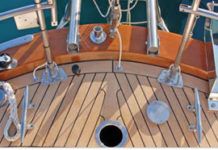
Practical Sailor contributor and world cruiser Joe Minick details the steps he and his wife took to replace the wornout teak deck aboard their Mason 43, Southern Cross. Minick breaks down the major tasks of the three-month project and explains how they saved a lot of money by doing some of the work themselves. The article looks at the pros and cons of a do-it-yourself teak deck refit; planning and budgeting; step-by-step removal of hardware and the old deck; and the detailed installation process of the new deck.
West Marine Updates Recalled Tether
West Marine has released a new, improved version of the safety tethers it voluntarily recalled last summer. As we reported in the August 2010 issue, West Marine recalled its model 9553512 (single) and 9553504 (double) safety tethers—which featured Kong hooks on the boat end and snap shackles on the user end—over concerns about the durability of the split ring connecting the snap shackle’s release pin and the lanyard.
PS Advisor: Rotten to the Core
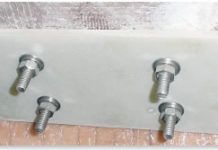
Do you have any suggestions on a book or manual that explains how to replace a cored deck where most of it is soaking wet? I replaced a 1.5-square-foot area and was surprised to see that it was so wet and rotten that I could grab the wood core and squeeze it like a sponge.
Improve Your Catalina 30: Upgrading the World’s Most Popular 30-Footer
The Catalina 30 is a remarkable success story. We suspect that more Catalina 30s have been built than any other boat of that size anywhere in the world. While the basic boat has remained unchanged since it was introduced in 1975, there have been dozens, perhaps even hundreds, of minor developments in the boat in the course of a production run that is approaching 4,000 hulls. The advantage of a boat in production for so long is a high degree of product refinement over the years. The challenge for the owner of an early version of the boat is to upgrade his boat to the standards of models currently in production.

How To Help Your Boat Survive A Major Storm
Hurricane Gloria was a most impolite lady. She barreled up the Atlantic coast, scaring the heck out of people from Florida to Massachusetts. Despite the fact that the storm didn’t live up to its billing, hundreds of boats in New York, Connecticut, Rhode Island, and Massachusetts were destroyed or severely damaged. In some cases, the boats were lost through no fault of the owner. No amount of preparation will save your boat if another boat drags down on it in the middle of a hurricane. In other cases, however, lack of proper preparation was a major cause of a damaged boat. There’s no excuse for that type of loss.

Small Boat, Big Keel Why This 27 Footer Works
What makes a small sailboat truly seaworthy? In this video, we take a deep dive into the Pacific Seacraft Orion 27, a rugged, long-keel...



Latest Sailboat Review
Island Packet Estero Used Boat Review
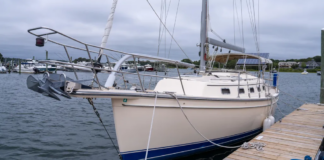
Florida-based Island Packet targets a relatively narrow niche, so the toughest competitors to its new boats are often older Island Packets. Introduced in 2010, the 36-foot, shoal-draft Estero is the company’s latest attempt to introduce a distinctive model that doesn’t stray too far from the company’s proven formula for success: moderate displacement, full-keel cruisers designed to be lived on, sailed far and in comfort, and endure the bumps, scrapes, and storms that cruising boats inevitably encounter. After sailing the Estero on Florida’s Sarasota Bay and inspecting its interior, construction, and systems, Practical Sailor testers noted that the shoal-water cruiser will appeal strongest to Island Packet fans who’ve been waiting for a shoal-draft, easy-to-sail boat that compares to the IP37 in terms of interior space. These strengths will be most apparent on intracoastal or riverine adventures like the Great Loop.