

Metal Chafe Plates: Functional Remedy for Scrapes and Scratches
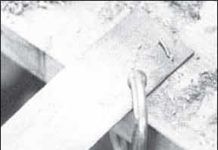
What do you do when the pin in the leg of your folding cabin table digs up the cabin sole? What do you do about the groove in the top of the teak toerail caused by your dock lines? What about the scuffs in the varnished bulkhead behind the companionway ladder? The answer is that you make chafe plates to solve all three problems. While chafe plates can be made out of almost any material — sheet PVC, thin stainless steel, aluminum — the most readily available and easily worked stuff is plain old brass. Brass can be purchased in many forms: sheet, solid round bar, pipe, tubing, and half oval, for example. It is quite cheap. If you have a local scrap metals dealer, you can buy enough scrap brass in various forms for $10 or less to keep you busy with a lifetime of projects. If there's no metal dealer at hand, most hobby shops carry substantial supplies of brass, although hobby shop brass tends to be thinner than what you want for most jobs.
Clear the Decks: Anchor Wells and Bow Rollers
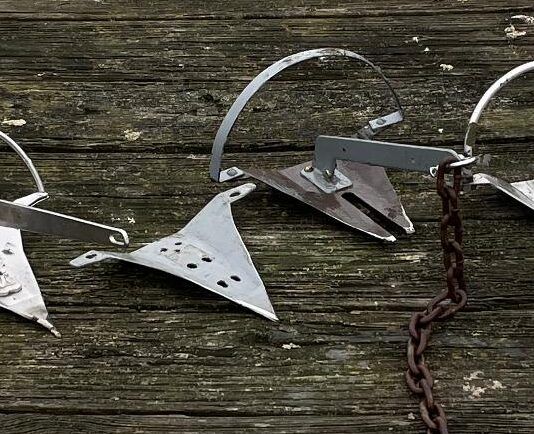
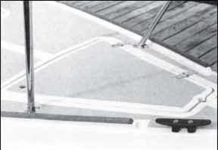
Ever since some ancient mariner broke a toe tripping over the killick stowed in the bow of his curragh, sailors have sought to solve the mysteries of ground tackle stowage. The solutions have been endless, and as a rule compromises. A significant portion of the interior volume of a 19th century warship was given over to the storage of anchor rode. Even aboard modern boats, the search for the proper stowage of several anchors and chain, plus hundreds of feet of sometimes slimy nylon anchor line, is one that occupies both designers and boat owners. Two "modern inventions" — the anchor well, and the bow roller — have greatly eased many of the problems of ground tackle stowage. But even these developments vary greatly in quality and design, some creating more problems than they solve.
Taming the Wild Boom: Two Designs for a Gallows
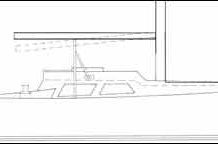
A wildly flailing boom is one of the most dangerous objects aboard a sailboat. If you could completely control the boom at anchor and under power, and while raising, lowering, and reefing the sail you'd avoid worry, save energy and be much safer. For this reason, many serious cruising boats have traditionally carried permanent boom gallows. They usually take the form of metal pillars bridg ed across the top by a wooden cross member. Bolted to the deck at the aft end of the cockpit or on the aft deck itself, they serve several functions: holding the boom firmly when the sail is down; catching the boom easily as the sail is lowered; and, perhaps most importantly, keeping the boom steady during reefing operations.
Design For: Stern Rail Mount Work Surface
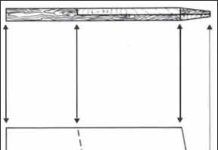
For those who enjoy fishing or charcoal cooking, here's a design for a stern rail mount work surface useful for fish cleaning and meat cutting, and big enough to hold a hibachi when moored. I got the idea from yacht designer C.W. "Chuck" Paine, and Chuck got the idea from some Caribbean charter boats. You could also clamp a vise to the work surface and thus have a handy little work bench for onboard repairs and modifications. Mounted as it is on the stern rail, it is at a useful height, and offal and mess are easily cleared overboard. A hibachi used on the surface demands careful use, of course — as with any open flame on a boat — but it's about as far outboard a position as can be found. It's also a lot cheaper than those charcoal grills designed to be clamped to the stern rail.
A Homemade Tiller Tender
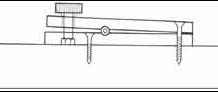
On my Catalina 22 I have a tiller tender which has served me well for many years — and it didn't cost a cent. On top of the tiller are two pieces of 3/8" x 3/4" hardwood about 5" long. The two pieces are drilled horizontally, at the joint line, about 2" from the end to accommodate a 3" length of split neoprene which has an inside diameter slightly less than the diameter of the braided line which runs to the coamings. Two holes drilled vertically near the ends are used to fasten the device to the tiller.
Wooden Anchor Chocks
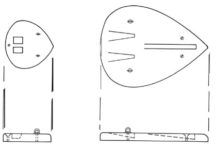
Conventional commercially available anchor chocks, though convenient, can be nasty metal toe stubbers and not particularly attractive. In contrast, wooden chocks are easy to make, handsome, and relatively snag- and toe-proof.
Smooth Runnings: Bullet Blocks Battle
Practical Sailor tested more than a dozen bullet blocks (sized 40 to 45 millimeters) from eight marinedeck hardware manufacturers: Barton, Garhauer, Harken, Karver, Holt, Ronstan, Schaefer, and Selden Mast. The units tested were ball-bearing and roller-bearing designs, and the growing trend toward more composite material and less metal construction was evident among the products. Blocks were loaded to 200 pounds-well within the safe working load for the test blocks-and testers measured the amount of force required to move a line in a closed loop set up. Once the efficiency test was complete, the blocks were subjected to an aerated saline bath to gauge corrosion and oxidation tendencies. Weight, price, safe working load, cheek material, and attachments were also evaluated.
From the Bench to the Bath
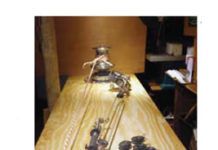
With some modification to our bench-test jig, we were able to place two blocks in opposition to each other, attach them via a closed loop of ultra low-stretch line and place the system in tension. The load-inducing mechanism was a vertical capstan Ideal anchor windlass capable of incrementally adding tension to the mix. A Dillon AP dynamometer was placed in series with the tension-creating tackle, and during each test, the load on the closed loop was closely monitored.
Rope Test Yields Rope Hernias
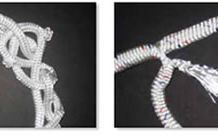
Researching an upcoming article on the effects of various cleaning chemicals on ropes, our testers scrubbed and machine-washed mountains of nylon and polyester rope of every description. Samples ranged from three-strand dock line encrusted in marine life to brand-new polyester double-braid line. Our testing for that article continues, but we want to report one immediate finding relevant to any sailor who is wondering how to deal with old or dirty lines. Fully 70 percent of our test samples, including new and used line from New England Ropes (NER) and Samson Ropes, experienced failure of pre-spliced eyes; the buried portion of the core worked its way out of the main line and into the eye, where it carried zero load. In some cases, these failures were scarcely visible, while in others, the tail was exposed.
Replacing Teak Decks, the DIY-er’s Way
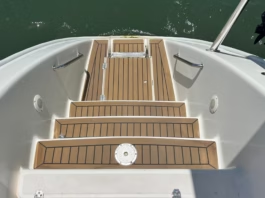
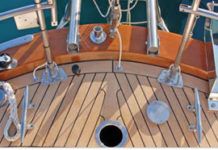
Practical Sailor contributor and world cruiser Joe Minick details the steps he and his wife took to replace the wornout teak deck aboard their Mason 43, Southern Cross. Minick breaks down the major tasks of the three-month project and explains how they saved a lot of money by doing some of the work themselves. The article looks at the pros and cons of a do-it-yourself teak deck refit; planning and budgeting; step-by-step removal of hardware and the old deck; and the detailed installation process of the new deck.
Latest Logbook

Practical Sailor Logbook – September 2026
In September we tour the Hans Christian 48T — the offshore cruiser many sailors call the holy grail — walk the custom Antigua 60...

Video: The BEST Sailboat You Can Buy for $35,000 – Catalina...
If you’re searching for a mid-30-foot sailboat, affordable cruising sailboat, liveaboard sailboat, first sailboat, or a capable used sailboat for coastal cruising, the Catalina...



Latest Sailboat Reviews
Learning by Doing on a $5,000 Catalina 30 Mk II
When Davis’s mother started talking about wanting to do something “big” for retirement, Davis and Gloria half-jokingly threw out an idea that seemed suitably...