


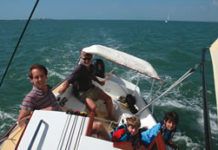
Small Boats in the New Economy
A critique of conventional Western economics, Schumachers Small is Beautiful argues for a simpler, decentralized economy that puts the focus on individual productivity and general well-being, rather than gross domestic product. Although Schumachers critics associate some of his proposals to the radical back-to-nature movement of the 1960s, many of his ideas are as relevant today as they were when Small is Beautiful was published. Prime Minister David Cameron is among several contemporary leaders whose economic vision has been influenced by Schumachers work.
Foil-less Furlers Test
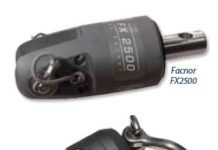
Practical Sailor compares two new continuous-line furlers, the Seldn CX15 and Profurls new NEX 2.5, with the Facnor FX2500, which was named the PS Best Choice foil-less furler in the March 2008 issue. Testers unfurled the test boats sails then sailed a 120-degrees reach, and with the mainsheet blanketing the drifter, eased the sheet and hauled away on the roller furlers endless line. A spring scale measured the initial tension it took to start the process. If improving your boats light-air sailing performance is a priority, a foil-less furler could be a user-friendly, roller-furling solution.

Light-air Sailing with a Twist
Today’s breed of well-engineered, conventional, slotted-luff headsail furlers affords a wonderful home for the compromise genoa—a 12- to 25-knot, easy to handle, 120-135 percent sail. The compromise genny is neither working jib nor light-air-optimized headsail—and the idea of making it a 4-ounce, 150-percent genoa defies both shape concerns and material constraints. The setup leaves many boat owners, in their quest to optimize power under sail, seeking a light-air solution.
Furling Gear Break Down
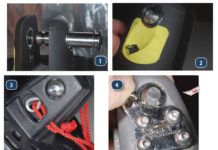
All of the latest endless-line furlers that we’ve seen have greatly improved on older designs’ latch-and-catch systems.
PS Advisor: Pondering the Keel-ectomy
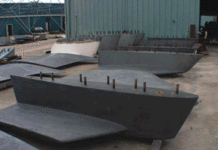
My wife and I have moved our O’Day 39 to the Oriental area of North Carolina. We have the three-cabin version without the formal nav station. Our draft with our lead-ballast keel is 6-feet, 4-inches. Since we are going to be sailing in the Pamlico Sound, Neuse River, and the Intracoastal Waterway, we are being told we should modify our keel to better cope with the shallower water.
Anchor Lockers II
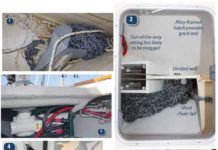
When a boat is floating at rest, an anchor locker drain should be able to shed all water in the locker. Residual water evaporates, but it leaves the salt behind. The brine combines with the sulfur-laden bottom residue, creating a galvanic reaction and a puddle of rust. Even on this new boat, anchored only a few times, water trapped in the anchor well has already becoming a chemistry experiment.
Anchor Lockers Part I
The contemporary anchor locker setup favors clear-deck convenience. This compromise can have some serious disadvantages. As with most things on sailboats, boat owners/buyers have to weigh the pros and cons and find a balance that meets their needs.
Sealing Anchor Chain Spill Pipes
Anchor lockers are a convenience to coastal cruisers but no friend to offshore sailors. Passagemakers often forgo a deck-clearing locker for a belowdecks anchor-chain well. An angled spill pipe leads the anchor chain from the deck to the well, which often is under the forepeak and behind a watertight bulkhead. The setup not only eliminates the flooded-bow worries inherent with an on-deck locker, but it also moves the chain and anchors’ weight lower and further aft, where it should be to avoid hobby-horsing.
A Look At Anchor Lockers
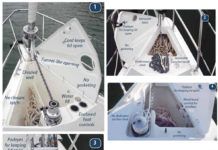
For several years, Practical Sailor has peeked into anchor lockers at the Miami and Annapolis boat shows and recorded the good, the bad, and the just plain poorly designed. This photo essay highlights some of the highs and lows of locker design, and shows examples. If you're looking to buy a sailboat or to make sure your foredeck is properly set up, then checkout this report. A few points that we look at: all points of locker access should be able to be made watertight; cleat leads and opening the locker do not conflict; the bitter end of the chain is tied (rather than shackled) to a hard point; and on-deck anchor locker versus belowdecks anchor well.
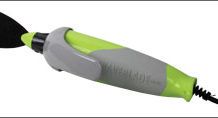
Chandlery: March 2011
More and more boat bottoms are being coated with low-biocide and biocide-free antifouling as environmental regulations and boater eco-consciousness continue to evolve. As a result, those bottoms are being cleaned more frequently, and boat owners are seeking out tools that will make the job less work.
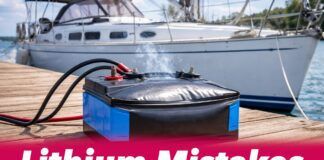
Lithium Batteries on Sailboats: The 3 Mistakes Everyone Makes
Lithium batteries are one of the most popular sailboat upgrades today—but they’re also one of the most misunderstood. In this Practical Sailor Saturday episode,...



Latest Sailboat Review
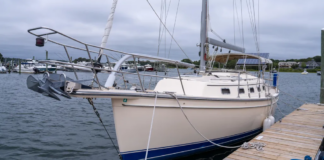
Island Packet Estero Used Boat Review
Florida-based Island Packet targets a relatively narrow niche, so the toughest competitors to its new boats are often older Island Packets. Introduced in 2010, the 36-foot, shoal-draft Estero is the company’s latest attempt to introduce a distinctive model that doesn’t stray too far from the company’s proven formula for success: moderate displacement, full-keel cruisers designed to be lived on, sailed far and in comfort, and endure the bumps, scrapes, and storms that cruising boats inevitably encounter. After sailing the Estero on Florida’s Sarasota Bay and inspecting its interior, construction, and systems, Practical Sailor testers noted that the shoal-water cruiser will appeal strongest to Island Packet fans who’ve been waiting for a shoal-draft, easy-to-sail boat that compares to the IP37 in terms of interior space. These strengths will be most apparent on intracoastal or riverine adventures like the Great Loop.