



Sheathing Bulkheads, Part II: Fit, Glue and Finish
Last month, we showed you how you could turn a big, expensive pile of lumber into a smaller pile of bulkhead sheathing and a large pile of sawdust. This month, we’ll show you how to transform that pile of sheathing into beautiful new bulkheads for your boat. Like making the sheathing stock in the first place, installing it is a tedious operation, full of opportunities to make mistakes.
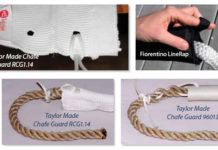
Chafe Protection for Dock Lines
The best anti-chafe material to rely on in a storm is the one that resists abrasion, doesn’t cause heat build-up in the line, and can be easily installed—even if the line already has been deployed. Practical Sailor tested five commercially made products marketed as chafe protection for lines on boats: the Davis Secure, from marine accessories maker Davis Instruments; LineRap from Para-Anchor manufacturer Fiorentino; Chafe-Pro from the North Carolina-based Fjord Inc; and two sets of Chafe Guards by Taylor Made. Products ranged from single-skin webbing designs to tough Dacron double-layer designs, and the chafe gear’s attachment, or locking, methods were an integral part of the ratings. (The products don't work if they don't stay in place.) Chafe gear was put through a series of abrasion tests and was rated on price, ease of use, and performance.
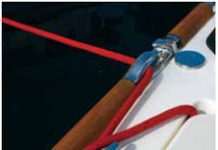
T’is the Season for Planning
Chafe protection for docking and mooring lines is essential for securing a boat ahead of a storm, but boat owners should also be sure to inspect the cleats themselves. The cleats should be beefy enough to handle the task at hand, and they should be properly supported with sturdy, easy-to-inspect backing plates. In addition to ensuring your cleats are structurally sound, it’s also important to pay attention to line leads. If a line must make a sharp bend at a chock or cleat, the risk of chafe increases significantly, and attaching anti-chafe gear at the bend is imperative. Find out whether your cleats are up to snuff—and how to replace them if they’re not—in our look at chocks and cleats in the March 2010 issue.
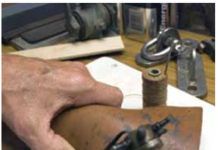
Old Salt’s Anti-chafe Solution
Being a team of diehard do-it-yourselfers, we decided to try our own hand at devising a workable solution to defeating line chafe. After fiddling with canvas, old fire hose, and even messing around with some Kevlar, we settled on leather—an old rigger’s standby. It proved to be rugged and remained unholed after a ride on the belt sander. The fabrication process was kids craft 101, and there was something quite seafaring about the result. …
Tis the Season for Planning
Chafe protection for docking and mooring lines is essential for securing a boat ahead of a storm, but boat owners should also be sure to inspect the cleats themselves. The cleats should be beefy enough to handle the task at hand, and they should be properly supported with sturdy, easy-to-inspect backing plates. In addition to ensuring your cleats are structurally sound, it’s also important to pay attention to line leads. If a line must make a sharp bend at a chock or cleat, the risk of chafe increases significantly, and attaching anti-chafe gear at the bend is imperative. Find out whether your cleats are up to snuff—and how to replace them if they’re not—in our look at chocks and cleats in the March 2010 issue.
Old Salts Anti-chafe Solution
Being a team of diehard do-it-yourselfers, we decided to try our own hand at devising a workable solution to defeating line chafe. After fiddling with canvas, old fire hose, and even messing around with some Kevlar, we settled on leather—an old rigger’s standby. It proved to be rugged and remained unholed after a ride on the belt sander. The fabrication process was kids craft 101, and there was something quite seafaring about the result. …
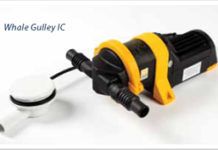
Where Credit is Due: July 2011
Letters to Practical Sailor, June 2011. This month's letters cover subjects such as: Whale Pumps, Rigging and More!
Taming the Anchor Dancer
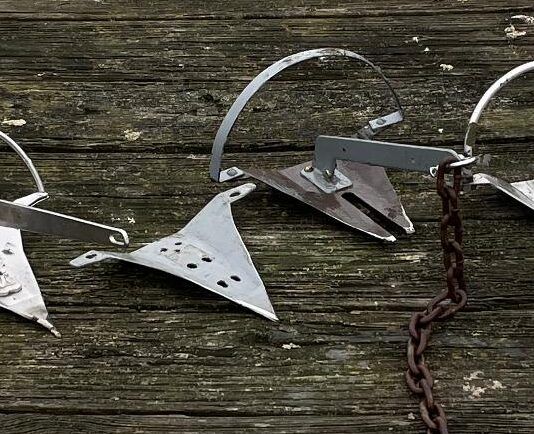
In any wind, our Jenneau 39i charges around an anchorage like a scalded cat, fetching up at the end of each tack (bow more than 90 degrees from the direction of the rode) with a noticeable jerk—even with a scope of more than 5:1. Comparing the behavior of other, more traditional boats in the same anchorage suggests that our centroid of windage is well forward, and that the cutaway foot and high-aspect keel offer limited resistance to the turn.
Design For: Winch Handles
Making spare winch handles is a simple job for a competent metal worker. This I discovered because our Norlin designed Scampi, Windhover, has eight winches, all of which were manufactured before the world standardized on the 11/6" winch handle lug size. Since Windhover's 9/16" size handles are difficult to obtain and impossible to find at discount I went to Frank "Red' Grobelch, a superb metalsmith/welder of Waukegan, Illinois with some ideas for making up some spares for me. I'm so pleased with the results that I'd recommend the project to any reader who is a competent metal worker or has a friend who is. Even if you can use and buy standard 11/16" size handles, your mental state when clumsy Uncle Fred drops a handle overboard will be far more buoyant if you know you can easily replace the lost handle in your own shop.
The Multifarious Mainsheet
The mainsail is a big part of the motive power of almost every sailboat. The art of mainsail control, however, is a relatively modern one. One tool that greatly facilitates mainsail control is the traveler. Traditionally, the mainsheet traveler was a heavy bronze or iron rod that allowed some control over the position of the boom relative to the centerline of the boat. In heavy air, the main could be eased down to leeward without easing the sheet, helping to keep the boat on her feet with the main still sheeted down. Compared to modern travelers this is a primitive system, but it can be made to work.
Latest Logbook

Practical Sailor Logbook – September 2026
In September we tour the Hans Christian 48T — the offshore cruiser many sailors call the holy grail — walk the custom Antigua 60...

Video: The BEST Sailboat You Can Buy for $35,000 – Catalina...
If you’re searching for a mid-30-foot sailboat, affordable cruising sailboat, liveaboard sailboat, first sailboat, or a capable used sailboat for coastal cruising, the Catalina...



Latest Sailboat Reviews
Learning by Doing on a $5,000 Catalina 30 Mk II
When Davis’s mother started talking about wanting to do something “big” for retirement, Davis and Gloria half-jokingly threw out an idea that seemed suitably...