

Multi-stage Battery Regulators
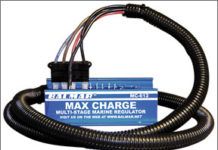
I am building an electrical system that will hopefully support wife and two teenage daughters. With this objective, I am planning approximately 1,000-amp hour battery bank. I see lots of hype about the external three-stage voltage regulators. Do they really provide more amp hours during the limited engine running time? If so, I have not found any definitive side-by-side comparisons that convince me that three-stage regulation is more efficient than a single-stage constant voltage regulator.
Fuel Filtering Systems
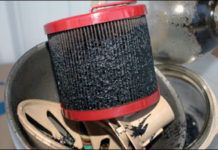
I am the new owner of a 1979 Tayana Vancouver 42 with a Volvo D2-55B diesel engine installed in 2004. Fuel is held in two 80-gallon fiberglass tanks and filtered via a Racor 500 utilizing No. 2010 filters. I use 2-micron filters and Biobor JF Anti-Fungal additive. Despite fuel scrubbings, I continue to have to change primary fuel filters with each fueling. I have been told that I don't need as fine a filter as the 2-micron, but I don't want to risk increased maintenance of the diesel. What do you recommend?
Two Marine Toilets go Head to Head in Practical Sailors Test of Simple, Manual-Flush...
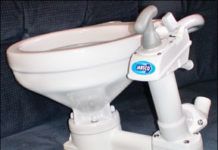
Practical Sailor contributor Mike Slinn installed two heads, the Raritan PHII and the Jabsco Compact Marine manual head, on his Beneteau First 435 and tested them during the summer cruising season in British Columbia. Two other brands of marine toilet were considered but for various reasons (fit in the head, et.), they werent chosen. The test looks at how both heads performed during the all-too-short Canadian summer and whether or not an expensive marine head does better in a long-term, real life test of marine heads. Our previous tests have shown that if you are looking for long-term reliable service from your head, you have to pay for it. Is the Raritan, at twice the price of the Jabsco, worth the investment? We also looked at fighting head odor and how it can be controlled and eliminated by the use of proper hose and proper hose connections.
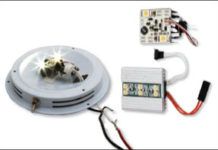
A Trio of Sailboat Lighting Options
One of the fastest moving targets in boating equipment is LED lighting. While researching products for a larger test, we stumbled across three products that struck us as potential stocking-stuffers worthy of mention this month. The Lightship Solar Light, manufactured in China and introduced by Simply Brilliant in the fall of 2006, weighs only 5.5 ounces and sells for $15. Its powered by the sun, but stores that energy in a rechargeable, nickle-metal hydride (NiMH) battery. The battery, circuitry, 2x2-inch photovoltaic panel, and three LEDs (two white, one red) that produce the light are all mounted to a polycarbonate plate that fits snugly inside a housing of the same material, with a silicone O-ring to keep out moisture. That housing has three legs fitted with small suction cups, enabling the Lightship to stick easily to the underside of a hatch or inside of a portlight. Wed like to see the product modified for easier mounting in more locations.
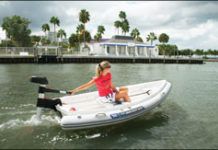
The future of marine propulsion? Practical Sailor sea-trials the portable Torqeedo Travel 801L electric...
Three things attracted us to the long-shaft Torqeedo: It is a light motor; it is a portable motor; and it is an electric motor. The dream of being able to easily tuck the daysailers engine in the cuddy cabin, or tool around silently in our dinghy, is alluring. And the Torqeedos detachable, rechargeable battery makes that possible. Unfortunately, two of the features that we find so attractive are also potential trouble spots.
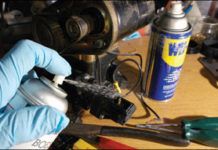
Practical Sailor Tests Spray-On Protection for Electronics and Electrical Systems
Seawater and electricity love each other with a fatal attraction, and when they break barriers to get to each other, we suffer from the destruction left in their wakes. Enter aerosol corrosion inhibitors. If you spray sensitive electrical circuitry-including printed circuit boards-with the aerosol rust inhibitors we tested, theyll prevent corrosion from interrupting circuits and water from creating circuits where they arent wanted. Our test lineup included Boeshield T-9, Corrosion Block, CorrosionPro Lube, CorrosionX, CRC Heavy Duty Corrosion Inhibitor, CRC QD, LPS 1, Strikehold, TC-11, WD-40. The TC-11 was our top pick.
Practical Sailor Tests Manual and Electric Outboard Engine Brackets
We used a four-stroke Honda BFP 9.9 horsepower outboard (92 pounds) and a Mercury ME 9.9 (84 pounds) four-stroke to test eight engine brackets that can be used on sailboats. Testers figured the 9.9 engines to be the middle road between the commonly used 5 horsepower and 25 horsepower. Five manufacturers responded-Fulton, Garelick, Marine Tech (Panther), JR Marine, and Garhauer-with eight different brackets, four manual and four electric, all rated for four-stroke 9.9 engines. The main test criteria were ruggedness, quality of materials and workmanship, ease of assembly and mounting bracket on a boat, clarity of instructions, ease of mounting an engine on the bracket, ease of operation, and price. For the purpose of comparison, brackets can be divided into three categories: fixed or stationary outboard mounts, retractable manual lift engine mounts, and electric trim and lift/tilt mounts.Choosing the mounting bracket thats best for a certain sailboat will depend on the horsepower and weight of the outboard to be used, the length of its shaft, and where it is to be mounted.Among testers top picks were the Garelick pump-action 71092 for best manual engine bracket and the pricey Garelick 71095 for the best electric bracket. For the budget-minded sailors, we recommend the inexpensive Fulton MB1820 or Panther 40.

Oil and Fuel Filters
One Practical Sailor contributor, the manager of a custom boatbuilding and repair/refit yard, had this reply: "Not all filters are created equally: There are differences from filter to filter. We see no problem using after-market filters whose reputations are proven: brand names such as Fram (makes filters for Honda, Chrysler, and others), NAPA, Wix (Wix actually manufactures NAPAs Silver and Gold series filters), Fleetguard (owned by Cummins Filtration), and Baldwin to name a few.
Propulsion of Tomorrow
There is a lot of dispute about the benefits of diesel-electric propulsion over traditional diesel, and comparable numbers are hard to come by. Could you arrange a test? Diesel-electric benefits in charging house batteries and powering the fridge are obvious, but propulsion is less so. What I would like to see is a chart of the kinetic energy of each system in the X-axis, and in the Y-axis, consumed fuel. That ratio should be the value that counts. Of course, a range of appropriate propellers would also have to be tested.
9.9-horsepower Outboard Engines Put to the Test
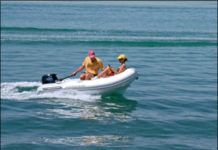
Todays 9.9-horsepower four strokes pack just the right amountof punch for a portable dinghy engine. The downside, as you may have guessed, is their hefty weight. The three Practical Sailor tested range in weight from 82 to 92 pounds. All are two-cylinder, water-cooled engines that take about a quart of oil, and all are pull-start models, with chokes that need to be used only when the engine is cold. All come with a standard 3.1-gallon plastic fuel tank, a fuel hose, and an aluminum propeller. In terms of propulsion, none of these portable outboard engines has it all. So after evaluating how easy each was to operate, transport, store, and maintain, we based our recommendations on weighing each engines pluses and minuses.
O’Day 40 – A Budget Cruiser for the Bahamas
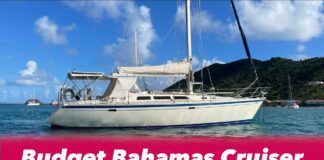
The O’Day 40 (1986) is one of those cruising sailboats that somehow slipped through the cracks of sailing history. Built during the final years...


Latest Sailboat Review
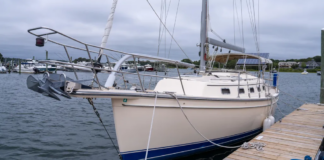
Island Packet Estero Used Boat Review
Florida-based Island Packet targets a relatively narrow niche, so the toughest competitors to its new boats are often older Island Packets. Introduced in 2010, the 36-foot, shoal-draft Estero is the company’s latest attempt to introduce a distinctive model that doesn’t stray too far from the company’s proven formula for success: moderate displacement, full-keel cruisers designed to be lived on, sailed far and in comfort, and endure the bumps, scrapes, and storms that cruising boats inevitably encounter. After sailing the Estero on Florida’s Sarasota Bay and inspecting its interior, construction, and systems, Practical Sailor testers noted that the shoal-water cruiser will appeal strongest to Island Packet fans who’ve been waiting for a shoal-draft, easy-to-sail boat that compares to the IP37 in terms of interior space. These strengths will be most apparent on intracoastal or riverine adventures like the Great Loop.