



Mailport: 12/09
I have a Pearson Ensign 1962 now at a slip in New Rochelle, N.Y. This season marked the first time we had the luxury of keeping our boat at a slip. In order to maneuver through the marinas byways without worrying, I bought a 24-volt Minn Kota outboard (80 pounds of thrust) and two 12-volt batteries, which I hook up in series. Not only am I able to stop start, turn, etc., in the marina, but-to my surprise-in the calm sound water, I can nip along at about 3-4 mph with myself, two crew, and the 3,000-pound boat. The result is that Ive only used my 5-horsepower Mercury outboard once this year. My electric outboard doesn't stall; it has variable speed like no ones business; reverses with relative ease, and is less expensive-though more cluttered-than the self-contained electric outboards you recently reviewed. Am I part of a growing trend or just weird? If the former then it might be worthwhile testing electric outboards for boats my size (22.5 feet) and commenting on their applicability.

PS Advisor: Safe Mounting for Radar
I am looking at antenna mounting options for my 2.2-kilowatt radar. I like the idea of keeping the antenna out of the foretriangle and its sail and rigging, but am a little concerned about crew exposure by mounting the antenna aft on a pole or lower on the backstay. The manufacturer (Furuno) mentions nothing about exposure hazards in its installation manual. Does a hazard exist in this configuration?
PS Advisor: Synthetics for Marine Diesels?
Mobil 1 extended performance oils for automobiles are advertised as providing engine protection and performance at extended intervals of up to 15,000 miles or one year, whichever comes first. Its 5W-40 Turbo Diesel Truck oil meets American Petroleum Institute (API) standards for diesel truck lubrication, and except for the price ($5-$8 per quart, or three times the price of conventional multi-grade oil), would seem to be an attractive option for ocean voyagers who might otherwise have to carry out an oil change at sea. However, the official party line at Mobil 1, as we expected, is that you should defer to your manufacturer’s recommendation on oil type, weight, and service ratings appropriate for your engine. Typically, if an engine maker does certify the use of a high-mileage oil, it is in combination with routine sampling of the oil to determine its condition.
Boat Holding Tank Sensor Long-term Test Update
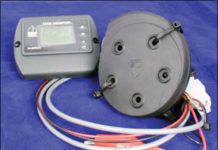
Last year, Practical Sailor installed and tested seven internally mounted liquid-level monitoring kits, including the sensors and their mated remote display panels, in a polyethylene holding tank; the results were reported in the May 2008 issue. The sensors spent the following nine months marinating in the tank, with the occasional sloshing by a tester, before being re-tested to see how well they continued to perform. The test field comprised float sensors, neumatic sensors, and an ultrasonic sender. Float sensors included Sealand TankWatch1, Dometic DTM4, Groco TLM Series, and Wema SHS-8. Air-pressure-fueled sensors included Fireboy-Xintex PTS and Hart Systems Tank Tender. BEP Marines (Marinco) TSI sender uses ultrasonic pulses to measure liquid levels.
Practical Sailor Tillerpilot Test: the Simrad TP10 and the Raymarine ST1000 Plus
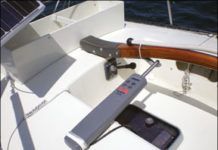
Offshore sailor Skip Allan tested two entry-level tillerpilots, the Simrad TP10 and Raymarine ST1000, aboard his 27-foot sloop during last years Singlehanded Trans-Pac race. The autopilots were used during varying weather conditions and sea states, including gale conditions. The review considers characteristics of the Raymarine tillerpilot and Simrad tillerpilot, including price, power supply, drive thrust, installation ease, user friendliness, construction, and performance.
Conversion Kits that Turn Your Boat’s Ice Box Into a Galley Refrigerator
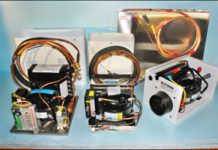
Practical Sailor tested three kits that convert onboard ice boxes into full-fledged refrigeration systems. The three reefer conversion kits in the review-the Waeco-Adler Barbour Cold Machine (CU 100) from Dometic Corp., the Frigoboat Capri 35F by Veco SPA, and the Sea Frost BD-represent a cross-section of whats available on todays refrigeration conversion kit market. Testers looked closely at energy efficiency and the 12-volt units abilities to cool a small ice box with the least amount of amp hours possible. Testers looked at quality, details, reliability, and cooling capacity.

Riffin on Foods that Need No Fridge
You might be surprised how well you can eat fresh without a fridge, even in the tropics. Onions and potatoes will keep for weeks (but not together, please). Lemons, limes, and oranges-especially those with thick skins-will survive for weeks. Fresh green tomatoes shrug off lumpy seas and still ripen nicely. Bananas don't like cold to begin with. Hang a green bunch from the backstay, and theyre happy. Be ready, though. They ripen fast . . . banana bread for breakfast! Rice and beans offer simple sustenance. Wrap them in a homemade tortilla, add a little hot sauce, and its Mexican Night. Wax balls of cheese, Parmesan wheels, and long sausage links turn the galley into a deli. Breadfruit is a born voyager, but taste best cooked over an open fire. (Baking is the safer choice while underway.) Coconuts last ages, but husk them ashore, where a long stake and machete can be wielded without harm. Big purple mangoes are hardier than the yellow varieties. Pick them when they bear a tinge of purple. Theres a secret to ripening a green papaya. (Tell me if you know what it is!) Or you can and shave a green one into a fiery Thai curry.
Shore-Power Boat Fire Protection
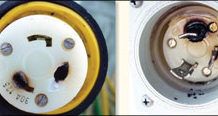
With the increased demand to have all the electrically powered comforts of home onboard, it should come as no surprise to boaters that the majority of AC-related electrical fires involve overheated shore-power plugs and receptacles. Prime Technology, aims to change all that with the introduction of its Shore Power Inlet Protector (ShIP for short), a monitoring and alarm device that automatically disconnects AC shore power when excessive heat is detected at the power inlet connector. We reviewed the ShIP 110 designed for use with a 110-volt, 30-amp system. The company also offers a similar unit (the ShIP 220) for use with 220-volt, 50-amp service. Charred plugs and receptacles are the result of resistance build-up (due to loose or corroded connections), which generates heat and the potential for fire, a problem especially prevalent among vessels that continually run high energy loads such as water heaters and air-conditioning units. In addition to monitoring the temperature of your vessels shore-power inlet plug and its wiring, the ShIP system automatically disconnects AC shore power when an unsafe temperature is detected, providing visual and audible alarms. (The audible alarm shuts down after five minutes to avoid prolonged disturbance to surrounding boats.)
New Air Breeze Wind Generator Field Tested
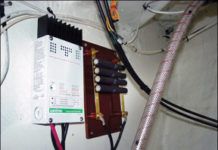
As sailors, wind energy is at the forefront of our lives. The Practical Sailor wind generator test in March 2007 included a prototype of the Air Breeze from Southwest Windpower. Last year, the company debuted the Air Breeze in the alternative energy market for recreational boaters; it is distributed through retail giant West Marine. Using the same criteria as our 2007 test, Practical Sailor tested the Air Breeze for several months under a variety of conditions, using it to charge the ships batteries aboard a Union 36. The wind generators body is cast aluminum, and its blades are made of glass-filled polypropylene. Testers found it quiet, easy to mount, and reasonably priced at $900.

Marine Refrigeration: Traditional Thermostats vs. Digital Thermostats
Modern galley refrigeration moved far beyond simple holding-plate refrigeration systems, and now competes with the more easily installed evaporative refrigeration systems. One key to efficiency in any refrigeration system is an accurate thermostat. Practical Sailor compares a more expensive digital thermostat to a traditional, less expensive mechanical capillary thermostat. Refrigerator and freezer tests pitted the Grunert Marine Air Systems mechanical capillary refrigeration thermostats against the Scad Technologies SensiStat digital thermostat. Mechanical thermostats are valued for their simplicity and reliability, but a digital thermostat may outperform mechanical thermostats when it comes to maximizing marine refrigeration performance.
Latest Logbook

Practical Sailor Logbook – September 2026
In September we tour the Hans Christian 48T — the offshore cruiser many sailors call the holy grail — walk the custom Antigua 60...

Video: Why Are Tartans So Expensive? Inside the Tartan 3700
If you’re researching Tartan Yachts, looking for the best traditional cruising sailboat, comparing premium used sailboats, shopping for a bluewater cruiser, or considering a...



Latest Sailboat Reviews

Learning by Doing on a $5,000 Catalina 30 Mk II
When Davis’s mother started talking about wanting to do something “big” for retirement, Davis and Gloria half-jokingly threw out an idea that seemed suitably...