

With many options on the market in the 9-in. multi-function device (MFD) category, which chartplotter works best for the needs of cruising sailors, racers and budget-minded boaters?
Before you start digesting the insights into the units we are about to discuss, especially if you are new to chartplotters, I highly recommend pressing pause here to read Bert Vermeer’s deep dive into the world of MFDs, “Which Chartplotter is Best for You?” as his information might narrow this list before you scroll.
For additional pro perspectives, I spoke to experienced sailor Michael Garretson, President of Sea & Land Yacht Works in Wakefield, Rhode Island—a specialist in marine electronics.
Size
The 9-in. chartplotter form factor slots perfectly into the size discussion somewhere between the, “I might as well just use my iPhone,” and, “You are going to need a bigger boat (for your chartplotter).”
Michael Garretson agrees with the happy size of the 9-in. chartplotter. He has found that 7-in. plotters are challenged for legibility and that those who have mounted 12-in. plotters on their helm pedestal find them “massive” and better suited for below-decks use at a spacious nav station.
Interoperability
Unless you are trying to pair a new chartplotter with an existing radar or self-steering system, the market is your oyster when it comes to choosing an MFD for your boat. All of the units we are about to take a glance at are very capable chartplotters. If you already have a (fairly new) radar system and autopilot, the brand of the chartplotter of your dreams may already have been pre-determined for you as mixing one brand of MFD with another brand of radar or autopilot most likely will present interoperability issues for your boat.
Regardless of radar and autohelm compatibility, you may want to tie in your wind, depth and speed inputs into a new chartplotter. NEMA networking can allow these individual systems to talk to each other, but not always—another thing to look into before your purchase.
If you are not planning on pairing your MFD with other systems on your vessel, you can simply choose the chartplotter that works best for you and set sail.
User Interface
User interface (UI) is critical to how much you enjoy using your chartplotter. I break this down into two categories: tactile (hardware) and navigation (software).
Tactile
It is a touchscreen world, but there is still something to be said for not only the tactile experience of pressing buttons and turning knobs, but also for the usefulness of having physical controls for your chartplotter. This is especially important in the world of sailing when the sea is moving the boat and/or the clouds above are drying themselves. While Garretson admires the Garmin chartplotter, he also points out that it is solely a touchscreen unit and says, simply, “I don’t like that.”
Navigation
The “navigation” part of software UI is not referring to your position on the earth, but how easy and intuitive it is to operate your MFD through home screens, menus, options, etc. If you have the option of looking at different brands, I recommend finding demos in a local boating store and spending some time playing with different chartplotters. Does one seem more user friendly than another? Are you able to navigate to different pages and function intuitively or are you fumbling about and getting lost inside the matrix? Having a chartplotter that you enjoy using should be a definite purchasing goal.
Now, let’s take a peek at some popular 9-in. MFD options with an eye on UI as well as sailboat specific feature sets.
Chartplotter Chart Data Screen Resolution Screen Size User Interface Sailboat-specific Features Price at Defender
Furuno TZtouch3 9 Vector or Raster or Satellite Photo or 3D Data or C-Map or CMOR 1280 x 720 9" Hybrid (touchscreen + controls) No $2,195
Garmin GPSMAP 943xsv Garmin Navionics+ or BlueChart/LakeVu G3 1280 x 720 9" Screen Only (optional button/knob controller accessory available) Yes $1,399
B&G Zeus³ 9" C-MAP US Enhanced Preloaded Maps with Coastal and Inland Coverage 1280 x 720 9" Hybrid (touchscreen + controls) Yes $2,599
Raymarine Axiom 2 PRO S Navionics and LightHouse Raster and Vector Charts sourced from leading map makers like NV Digital, Blue Latitude, and more 1280 x 720 9" Hybrid (touchscreen + controls) Yes $3,025
Simrad NSS evo3S 9 C-MAP US Enhanced Preloaded Maps with Coastal and Inland Coverage 1280 x 720 9" Hybrid (touchscreen + controls) No $2,699
Lowrance HDS Pro 9 C-MAP® DISCOVER OnBoard charts with 1-foot contours on 19,000+ US Lakes, 9,400+ Canadian Lakes or worldwide basemap 1280 x 720 9" Hybrid (touchscreen + controls) No $1,699
SI-TEX NavPro 900 Navionics+ USA 800x480 9" Hybrid (touchscreen + controls) No $873
1. Furuno TZtouch3 9
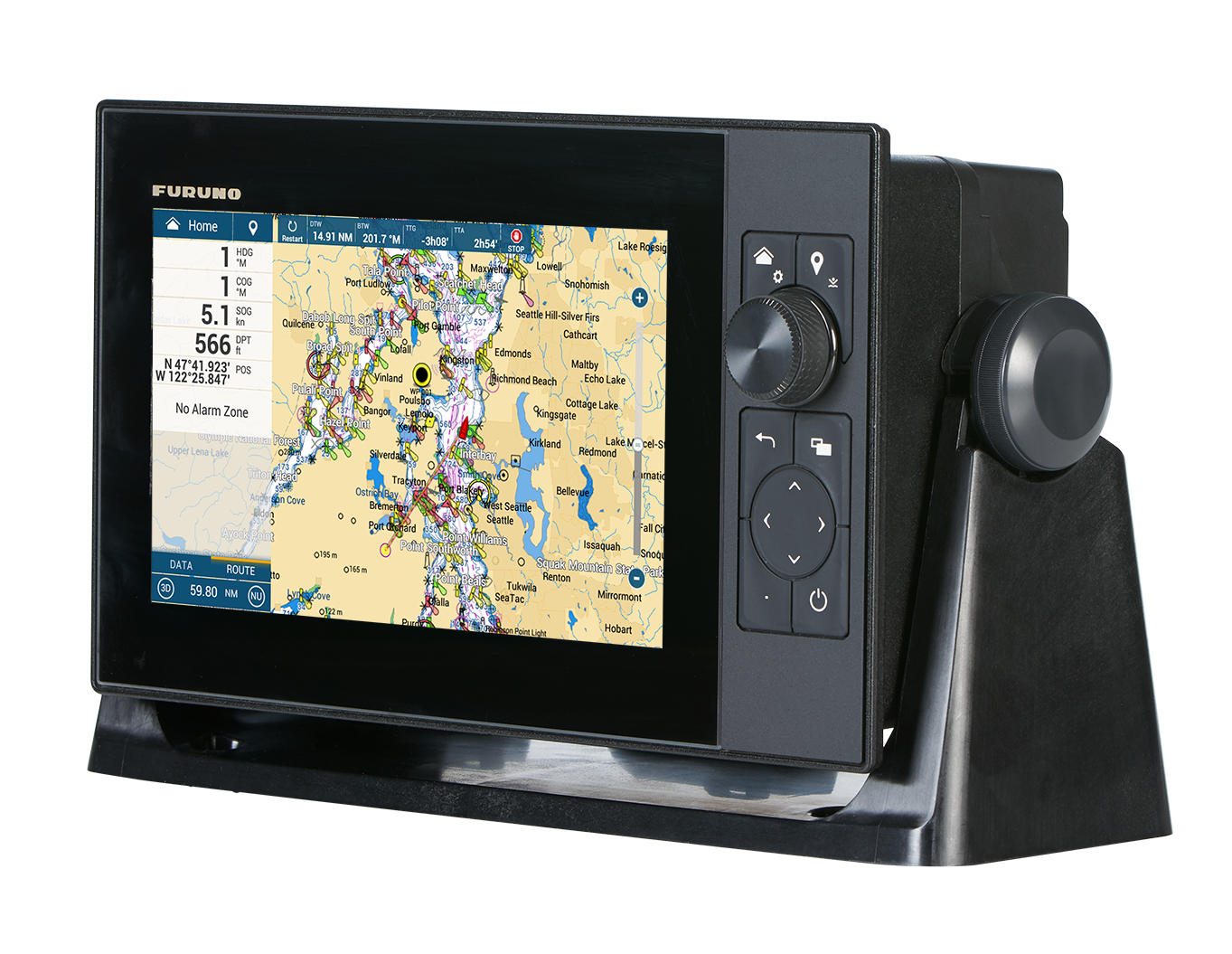
Furuno claims that the TZtouch3 9 is the easiest multifunction device (MFD) to use on the market today. As a navigation device, the Furuno is more than capable of helping you get from A to B, but it does lack some of the sail-specific features of some of the other plotters on this list and, as proof of this, you’ll be hard pressed to find many sailboats on the Furuno website or in their brochures!
One thing I like about the TZtouch3 9 is the combination of touch screen, push button and knob UI. The Furuno controls are well done and have a nice feel to them.
Another nice UI feature is that Furuno has made it easy to jump between modes with edge swiping and single-tap button functionality—so you are never more than one tap or swipe away from an alternate display (if you have multiple functions coming into the plotter).
2. Garmin GPSMAP 943xsv

At home on either power or sailboats, and armed with sailboat-specific tools and features, the Garmin GPSMAP 943xsv features a full-touchscreen display. The fact that the unit does not have knobs or buttons, like the Furuno, makes the overall unit more compact as the screen and bezel complete the unit’s facia.
The Garmin is fast, intuitive, and feature-packed, but the touchscreen-only interface gives both Garretson and I pause. Garmin does sell several different remotes for the unit that can give you the button/knob experience—at an additional cost. These remote button/knob controllers be a worthy upgrade for those sailing in dynamic environments.
Specifically for sailboats, the GPSMAP 943xsv incorporates Garmin’s SAILASSIST™—a comprehensive software suite that incorporates features like visual laylines, a wind rose, race start guidance, wind gauge, heading and COG lines, polars, sail-centric route planning and more.
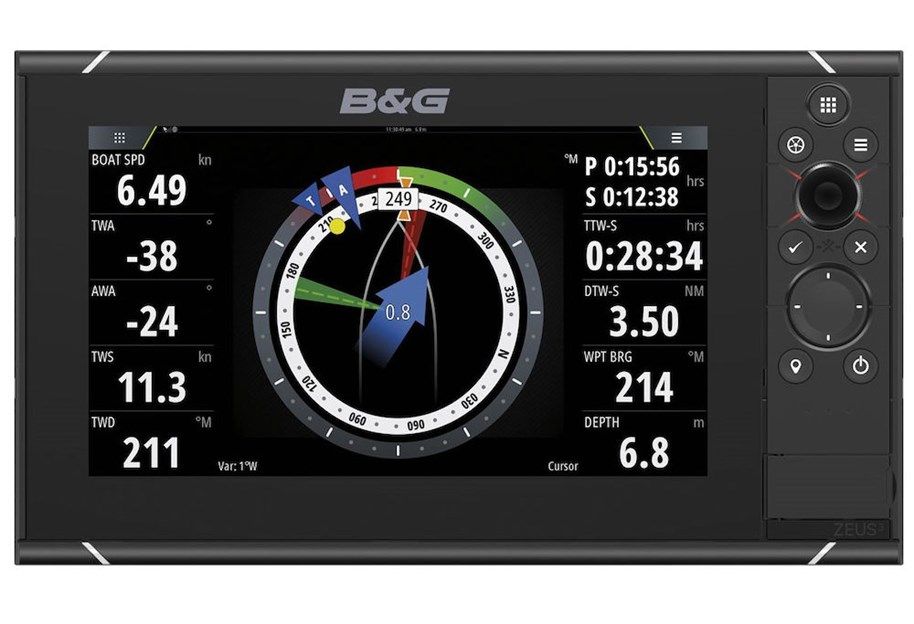
3. B&G Zeus³ 9
While the Furuno TZtouch webpage has no pretty sailboats to look at, the B&G Zeus3 9 webpage and brochure forgets to include the powerboat crowd. Fully in the world of sailboat-focused chartplotters, the B&G unit is designed with both cruising and racing sailboats and sailors in mind. Garretson, an authorized B&G dealer, refers to this unit as the “top of the hill.”
Control of the plotter is centered on a knob, keypad, and buttons along with touchscreen interfacing.
Sailing specific features include the SailSteer page showing wind, speed, heading, COG, layline and waypoint information in a clean graphical presentation. There is also RacePanel that feeds critical racing information to the helm. Laylines and SailingTime are other useful presentations that help you plan your voyage, or trip around the buoys. You can also connect the display to your phone or tablet to see your B&G screen on your smart device.
As a bonus, Garretson has even been able to get newer B&G units to “talk” to older autohelms from other brands.
4. Raymarine Axiom 2 PRO S
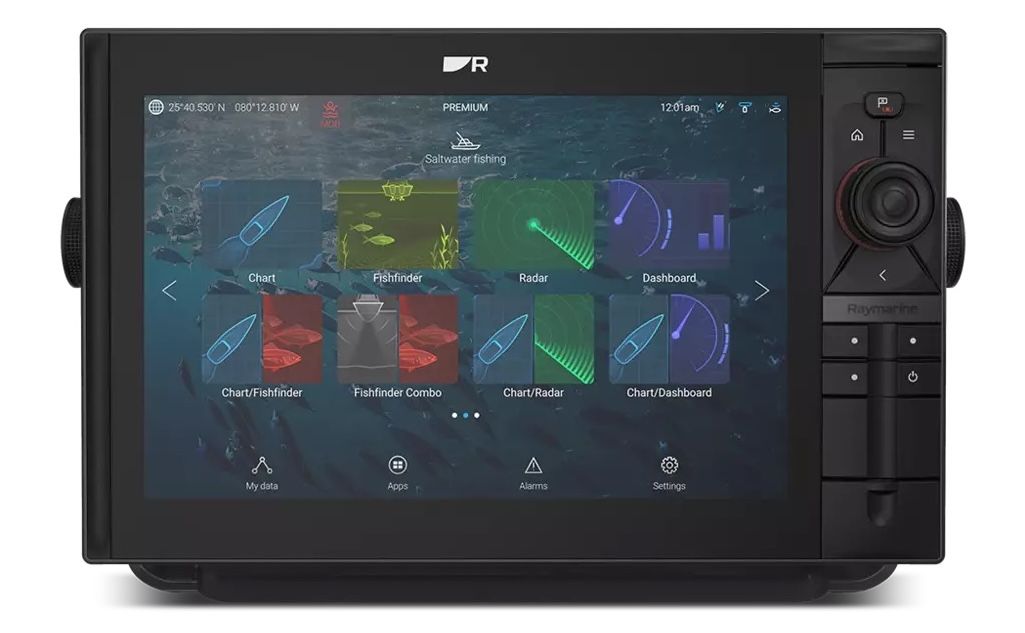
Raymarine’s Axiom 2 PRO S 9-in. chartplotter gives, perhaps the best looking display of the bunch as far as graphics and menus. The 9-in. Axiom 2 PRO S has manual controls in addition it its touchscreen interface and comes with sailing-specific features like laylines, race start line and timer, sail plan recommendations, and sail plan recommendations.
For days and nights alongside the pier or on the hook, the Axiom becomes an entertainment system with video, audio and even Netflix functionality. Several other units on this list have similar multimedia features, and some have HDMI connections to run other screens, but the Raymarine’s ability to do this was front-and-center on the demo unit.
Several professionals in the business have told me that Raymarine used to set the standard for marine electronics, but it is currently falling behind the competition with products having both hardware and software issues. Raymarine also did themselves no favors by having proprietary plugs and cables for their SeaTalk system although they are now moving to more universal plugs with and without adapters.
Garretson says they pretty much only install or recommend Raymarine to customers if they already have Raymarine radars or autopilots on board. As a fan of the brand from years past, I hope they get sorted out and I hope those running Raymarine equipment are having smooth sails.
5. Simrad NSS evo3S 9
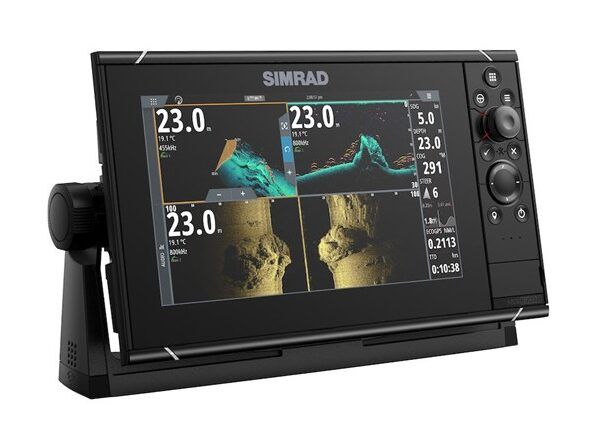
If you think the Simrad NSS evo3S 9-in. chartplotter looks, on the outside, identical to the B&G Zeus3 you are not seeing things. They are identical units—both delivering hybrid UI with touchscreen interfaces bolstered by an intuitive knob controller and buttons to access different features.
The Simrad unit, like the Furuno and Raymarine, is not sailing-centric. If you don’t want the sailboat features, the Simrad has all the core (non-sailboat) capabilities of the B&G, but at a lower price.
And, like its B&G cousin, you can also wirelessly connect your smart devices to make a repeater of the Simrad information.
6. Lowrance HDS Pro 9
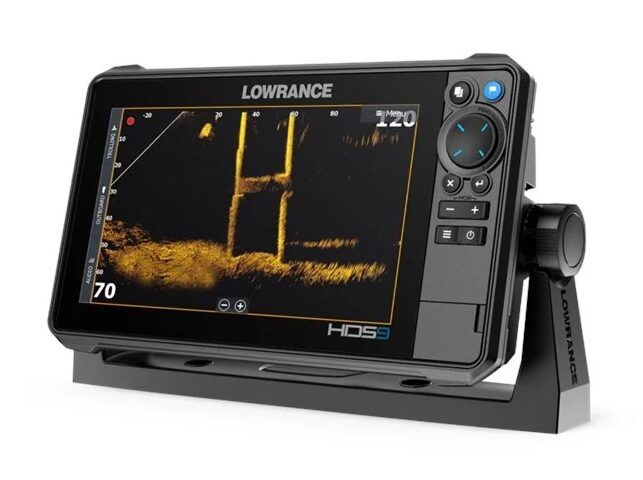
The Lowrance HDS Pro 9 is fishing focused with extensive sonar and fishfinding technology packed into it along with third-party charting options to provide navigation data for sailors.
Another non-sailboat-featured unit, the HDS Pro 9 is features a touchscreen interface along with a keypad and buttons. There is no useful control knob on this unit.
7. SI-TEX NavPro 900
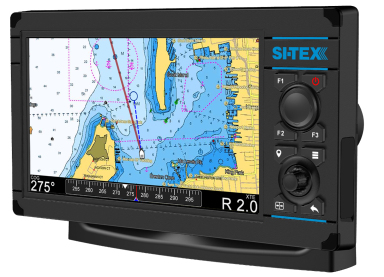
The SI-TEX NavPro 900 is a solid chartplotter that undercuts the price on other units on this list and has a more dated visual presentation. Touchscreen UI is supplemented by buttons, a keypad, and a joystick controller.
SI-TEX does not deliver sailboat-specific features, but the unit does provide an attractive nav screen with multiple display options, WiFi back-up, and Android smart device interoperability.
Summary
Of the above units, the Garmin, B&G and Raymarine feature a true suite of sailing features and technology. The remaining chartplotters on the list are competent electronic navigation tools that will work great on any sailboat, just without extra features designed for wind-powered craft.
Thanks to Sea & Land Yacht Works’ Michael Garretson for his time and sharing his experience and knowledge of all of the chartplotters discussed here.






Thank you for this.
What about the RayMarine Axiom 2 Pro? It has the buttons and knob which are a must.
Hi Ward,
Thanks for your comment. Yes, the Axiom 2 Pro does have a hybrid control system and would be great for sailing. Unfortunately, my reference list did not contain this model but I appreciate you bringing it to the attention of your fellow sailors here!
Best,
Todd
I don’t know how the author and the ‘Pro” guy …a B&G dealer hmm… could have missed the Raymarine Axiom 9 Pro2 S which is BOTH sailing-centric and hybrid-touch.
Although I am not a Raymarine fanboy, my entire nav system is RM only because they used to bend over backwards to ensure backward compatibility. This meant you could upgrade bits of the system at your leisure instead of having to do the whole shebang at once at a cost exceeding many boats’ value. Sadly that compatibility is no more since the axiom series.
So my 2 yr old autopilot has full functionality with my 30+ yr old wind instrument and 12 yr old (hybrid touch) plotter. Including the 40 yr old depth ‘ducer and 20 yr old module. this mess uses all 3 gens of seatalk and nmea 0183 AND 2000, and it works fine, with kudos and gratitude to very patient RM tech support.
Hi John,
Thank you for your comment and bringing my attention to the Axiom Pro. I was given a list of units to cover and the Axiom Pro was not on that list. Having said that, I should have taken a deeper dive into the Raymarine plotters and included the Axiom Pro in the list.
Thanks also for sharing your experience with Raymarine and its backwards compatibility as well!
Best,
Todd
There is an error in this report relative to the Raymarine Axiom+ 9 unit.
The table for this unit shows it as a “NO” as to having sailing-specific features. It does indeed have sailing specific features, for both racing and cruising. Right from the time of setup, the unit asks if you are in a sailing vessel (vs. fishing and a couple other options). It has robust racing features, including the ability to incorporate polar performance data. Several other things that I’ve found helpful.
I invite the authors to check it out, and correct their table. I’ve had mine for a couple months and it works great….a really advanced piece of tech. Did you interview actual users, or just industry “pros” who may or may not have an ax to grind?
Hi Mark,
Thank you for bringing my attention to this. In my limited hands-on experience with this unit I missed the sailing features and the Raymarine website does not highlight these features, so an error was introduced to the table.
After taking a deep dive into the Axiom+ operation manual, I did see the sailing features and we will be updating the table and text.
Thanks again! I appreciate the backup!
Best,
Todd
The reason that I don’t care for Raymarine plotters is that they use their proprietary SeaTalk and not true NMEA2000. The used sailboat, that I purchased for inland cruising, came with an older Raymarine autopilot, etc. and I can’t even get an N2K interface for these older devices. I currently use Lowrance at the helm because it can accept AIS data which is important. With NMEA One Net coming interoperability is even more important as it can handle radar data transfer. I was on the original N2K design advisory committee as an Institute of Electrical and Electronic Engineers member. We worked long and hard while contacting manufacturers to come up with what we hoped would be a universal instrument interface standard. Almost all manufacturers use true N2K. As a 16-year full time riverboat captain and Caribbean recreational cruiser I have used Lowrance, Simrad, B&G, and Raymarine. Based on my experience I believe B & G is the best choice for serious offshore sailors and racers. I use OpenCPN running on a Raspberry Pi with my TV as a large monitor for inland cruise planning and transfer routes to my helm Lowrance.
Hi John,
Thanks for chiming in here with your knowledge and experience!
Best,
Todd
I have an Axiom 9 touch screen that interfaces with WiFi Quantum Radar and Autopilot. My Legacy 28 bounces around too much for the touch screen so I added a RM 150(?) keypad that really helps. All installed 2018. Only issue has been failure of Quantum redone. Had to replace with new unit that had both WiFi and cable last month. WiFi works fine for now but I will replace with cable once I can get it through the tubes if the radar arch. I also added AIS receive from Standard VHF with special adapter. I’d like to be able to squeak AIS but blew my budget in new radome this year.
Helps.
Thanks for sharing, Randy! Please send your WiFi password when you can. 🙂