

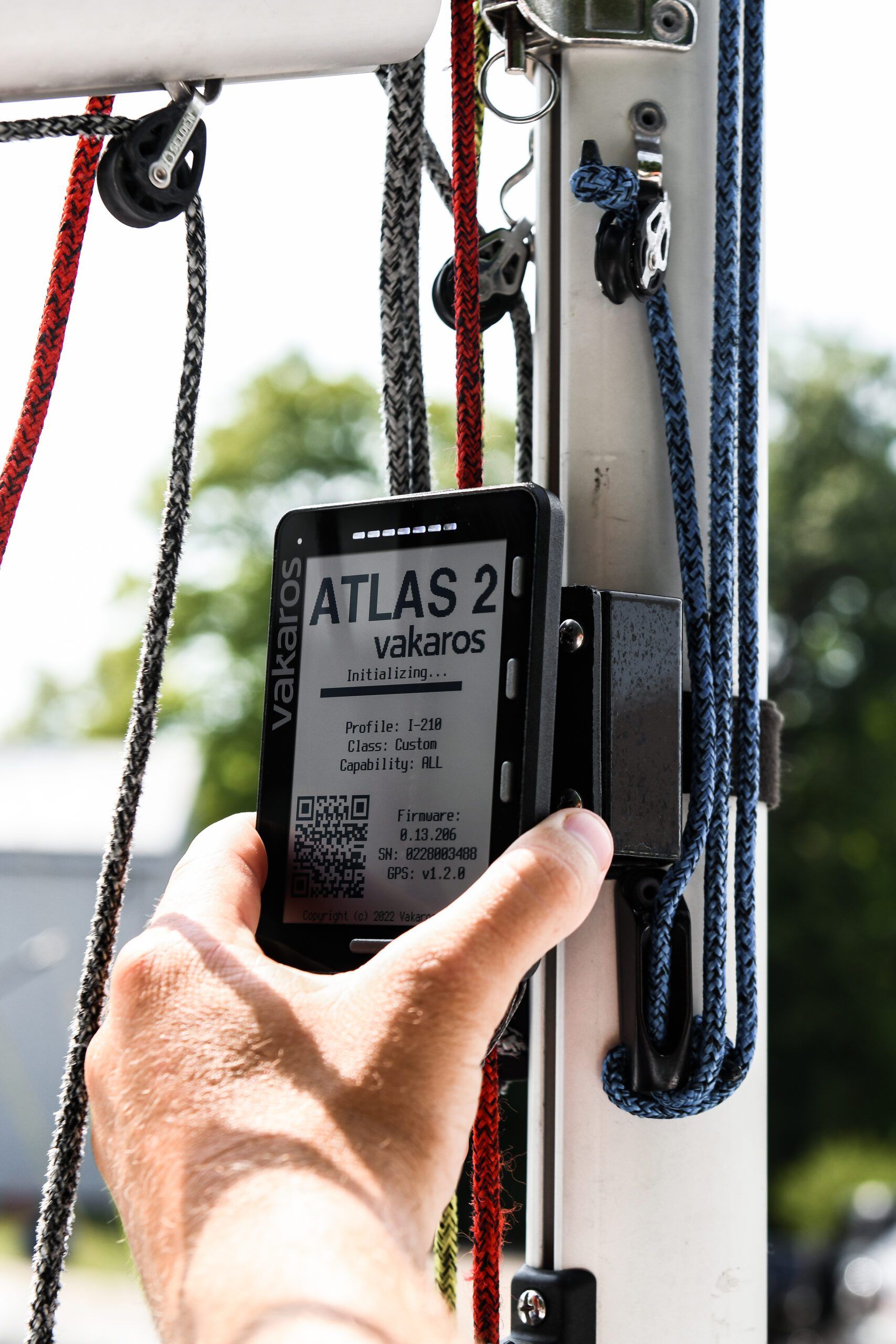
The Vakaros Atlas 2 sailing instrument is making waves in the sailing community. It bridges the gap between high-performance racing technology and practical cruising applications. Labelled as an “all-in-one” instrument, it features highly precise GPS, a magnetic compass, heel and trim measurement and much more. Yet, unlike traditional GPS devices, it also supports wireless links to select wind and water sensors, allowing a lightweight, wire-free experience for keelboats.
Born in a Basement, Built for the Water
Vakaros began as a passion project. Founded in 2018 by Todd Wilson and Jake Keilman, two catamaran sailors from Atlanta, the pair worked together to bring the Atlas instrument to life. Their vision was to build an instrument that would give them the data they needed to sail faster.
“They started building in their basement on nights and weekends, and came out eventually with the Atlas One,” explains Doug Wake, Vakaros Director of Marketing and Events. The first units were handmade, but by 2022, the company had advanced to shipping the Atlas 2, their current flagship product.
While Vakaros was conceived with racers in mind, the instrument has found a devoted following among cruising sailors looking for simplified, reliable instrumentation without the hassle of complex wiring systems or multiple displays.
Simplicity is the Ultimate Sophistication
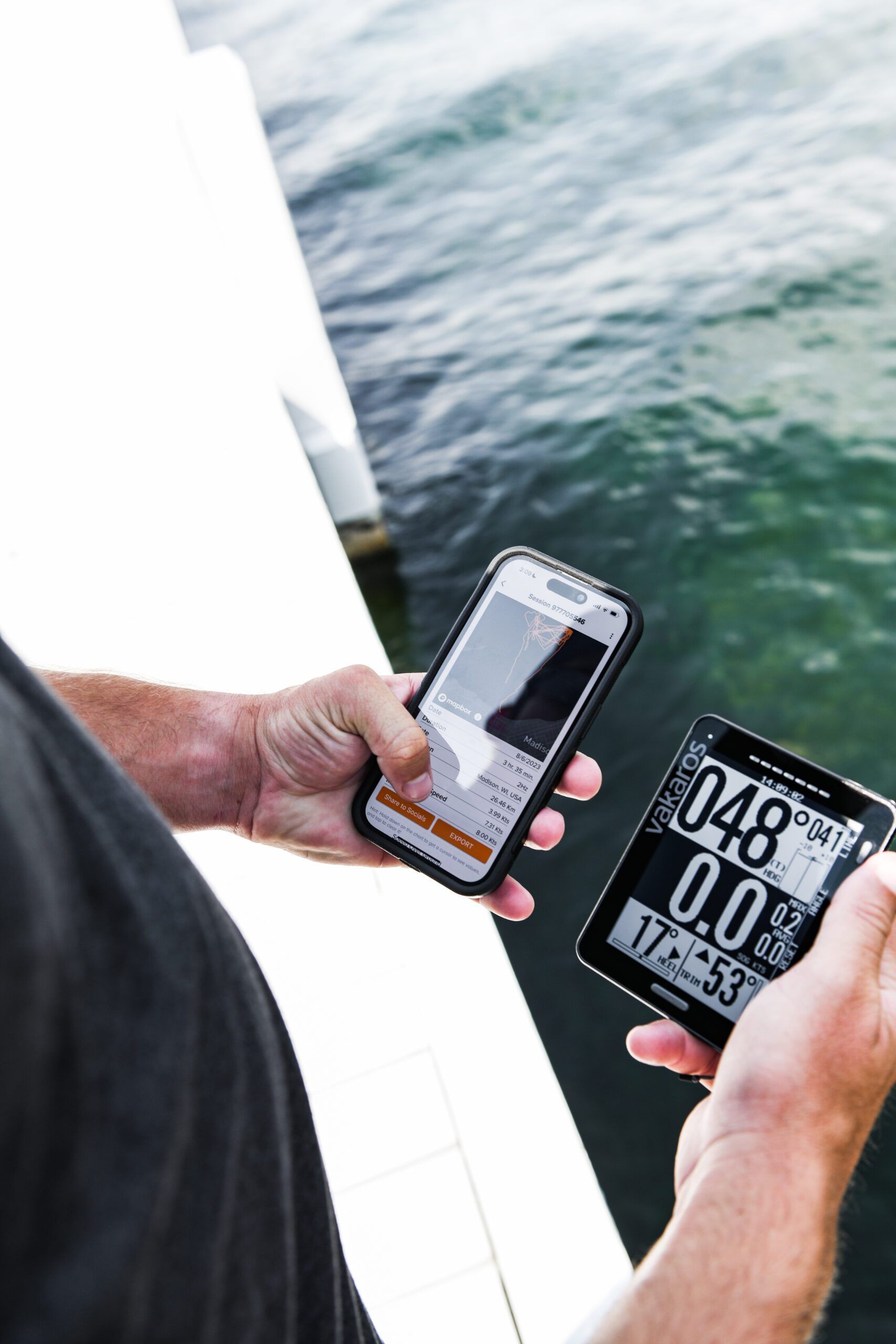
The Atlas 2’s appeal to cruisers lies in its simplicity. As Doug explains, “If you have your 30-foot cruising boat and you just like to go out for a sail on the weekends, the Atlas 2 is an incredible standalone instrument. It can give you your heading, your speed and more. You don’t have to pull any wires through your mast, or hook up any external power.”
For cruisers who value minimalism and reliability, the Atlas 2 offers a compelling package. It contains internal sensors for speed and heading, features a backlight for night sailing, and boasts an impressive 100-hour battery life—all in a compact, self-contained unit, weighing just 175 g (6.2 oz) and measuring 3.5 by 4.5 in.
“Our whole message is, it’s simple,” says Doug. “You could get a better instrument setup if you spent four times as much and 20 times the time. For most people though, they want something they can stick on, that wirelessly connects, so they can just go sailing.”
Power Independence
The Atlas 2 stays true to its standalone philosophy with wireless charging capabilities. Unlike instruments that tie into a boat’s electrical system, the Atlas 2 can be topped up using a wireless charging pad connected to a 12 V outlet or even a solar wireless charger.
Bridging the Gap: The NMEA 2000 Integration
While the Atlas 2 shines as a standalone unit, Vakaros is expanding its capabilities with a significant development: integration with NMEA 2000 systems.
“Typically boats that already have wind and water speed systems have already integrated into a NMEA network,” explains Doug. “This advancement allows the Atlas 2 to connect to that network as well to display a much wider range of data.”
This development, expected to launch by April 2025, dramatically expands the Atlas 2’s utility for cruising boats. Sailors can now wirelessly connect the Atlas 2 to their existing NMEA 2000 network, displaying data from any compatible wind sensor, depth transducer or other instruments through the compact Atlas interface.
“We’re going from something that really thrives as a standalone instrument and now has the ability to integrate into these bigger boat Wi-Fi systems that most sailors have,” Doug notes.
Practical Applications for Cruisers
Consider a scenario familiar to many cruisers: a nighttime sail to a new anchorage. With the Atlas 2’s backlight and wireless connections to depth and wind sensors, you can monitor critical data without fumbling through multiple displays or navigating a complex menu system.
The Atlas 2 also logs all your data, allowing you to review your path and conditions after your sail. This feature could be handy for analyzing what went right—or wrong—during challenging situations like dragging anchor or navigating tricky passages.
Data-Driven Decision Making
For competitive sailors, the ability to make evidence-based decisions has been transformative. George Lee Rush, an up-and-coming, competitive New Zealand sailor, uses the Atlas 2 with his training partners to compare different gear configurations under varying conditions.
“There was one particular day in the Moths when it started off quite light and then got windier. Seb [Menzies] and I were using a different stiffness of mast, and we could see as the wind built when one piece of kit started becoming stronger than the other,” George recalls. “You can recognize that anyway, but being able to put data to it and have some certainty is really interesting.”
This data-driven approach has opened up new opportunities for sailors to fine-tune their equipment and technique. “It’s opened up a whole bunch of new opportunities,” says George.
Community Innovation
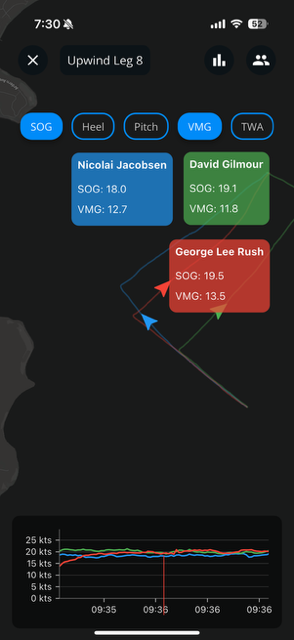
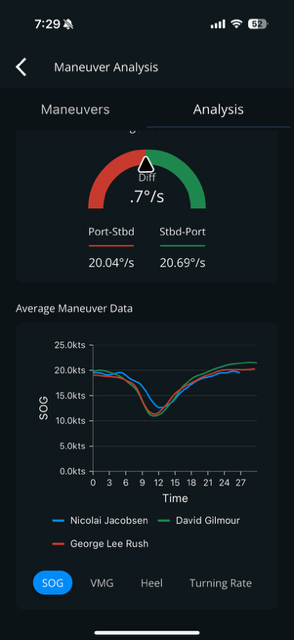
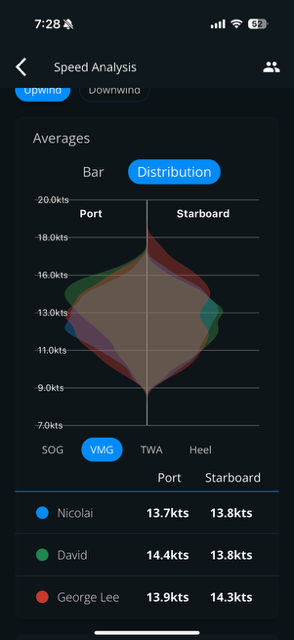
What’s also particularly fascinating about the Vakaros system is how the sailing community has embraced and extended its functionality. Norwegian sailor Nicolai Jacobsen has developed an app called Vantage Sailing that works with Vakaros data to provide even more detailed analysis. While still in its beta-testing phase, the app is due to hit the market in the coming month.
“You literally just upload your data to your phone from the Vakaros and then download that to a file, which you plug into the Vantage app,” George explains. “It gives you all your stats, like your speed and your VMG. It calculates an expected wind angle, analyzes your maneuvers, and it just does it all for you.”
Race Day Applications
For those who race their yachts, the Atlas 2’s start line functionality is particularly valuable. This feature provides the exact distance to the line, meaning sailors have accurate data to improve their pre-start routine.
Some classes have rules that say the device can only be used for post-race analysis, whereas others have found a middle ground, with the device offering a locked mode that only displays compass information while still recording data for later analysis.
The Price of Simplicity
The Vakaros Atlas 2 positions itself as a cost-effective alternative to comprehensive instrument systems that often require professional installation and significant investment. At $1,199, the Atlas 2 emphasizes value through simplicity. Rather than competing with feature-packed, integrated systems, the Atlas 2 offers the essential information most sailors need in a package they can install and use without specialized knowledge.
Conclusion: Technology that Doesn’t Get in the Way
The Vakaros Atlas 2 represents a refreshing approach to marine electronics—one that prioritizes reliability, simplicity and independence over complexity and interconnection. For cruising sailors who value straightforward solutions and don’t need (or want) the extensive capabilities of high-end racing instruments, the Atlas 2 offers an appealing middle ground.
With its internal sensors, long battery life, wireless charging and forthcoming NMEA 2000 integration, the Atlas 2 deserves consideration from cruisers looking to upgrade their instrumentation without the hassle of rewiring their boat or mastering complex systems.
Sometimes, the best technology is the kind that just works when you need it—and stays out of your way when you’re simply enjoying a day on the water.
B&G Vulcan 7R






Reads like a paid promo. And why do they not mention the price here? Because it costs around $1,200… 2x more expensive than the competitors, and that’s before buying charger and NMEA2000 integration.
It does read more like an advertisement that I am used to from Pratical Sailor.
Always interesting to see new techy stuff.
It reads exactly like I would expect when reviewing a new, untested product.
Pretty hard not to be enthusiastic about the technology and pretty hard to present any possible negatives before it has been out for a while.
(And the price is clearly shown)
Could have easily been designed as an application; of course, the exorbitant price tag wouldn’t exist!