

Even sailing greenhorns are familiar with those red coiled lanyards that are, theoretically, attached from an engine’s cut-off switch (ECOS) to the operator’s life jacket (or, more likely, belt loop).
In reality, those lanyards (a.k.a., ECOS links) are often left dangling from the tiller or helm-side remote ignition/throttle because many boaters just aren’t vigilant about tethering themselves to the cut-off switch whenever they get underway.
On April 1, 2021, a new U.S. federal law went into effect mandating the proper use of ECOS links on boats equipped with cut-off switches. Technically, the law only mandates proper use of the cut-off switch on any boat 26 feet or smaller and built in 2000 or later, but you get the idea. Where sailors are concerned, the law is mainly relevant to outboard-powered dinghies because it only applies “when operating on plane or above displacement speed.” Even in the case of performance-oriented sailboats that can actually get up on plane, they are generally doing so under sail, not power.
What sailors truly need is a system that doesn’t just meet the engine-cut-off requirement (whether a boat is outboard or inboard powered); they need a man overboard (MOB) system that sets off an alarm, at a minimum, and offers other forms of assistance if the captain or a passenger goes overboard when under power or sail. All of these systems are capable of setting off an alarm in the event of an MOB when under power, but not all were designed with sailing in mind (at which point the engine ignition is turned off). Encouragingly, at least two systems offer MOB functionality without the engine turned on, and newer systems also go further, logging MOB locations, providing return-to-MOB site navigation on a smartphone app or chartplotter, and supporting data-informed emergency communications.
Starting Points
The ECOS law hasn’t changed the fact that it can be a hassle wearing a tether, so enter the wireless engine kill switch (a.k.a. wireless ECOS link). A few of these devices existed before the ECOS law went into effect, but the mandate has definitely stimulated competition, with no fewer than four new systems emerging since 2020.
The first thing to know about these systems is that you’ll need a relatively dry spot to install the core network module/hub and wire it to a 12-volt power supply. Thus, a rigid inflatable boat (RIB) or a skiff with a helm station and a protected dash or console of some sort is the smallest application you would consider. The hub is also typically hard wired to the engine cut-off switch, so you want it in close proximity to the ECOS.
How the Systems Work
Small transmitting fobs (a.k.a. tags) are worn by the captain or by the captain and all passengers, including pets. Systems usually include wrist band and neck lanyard options for wearing the fob. Newer systems offer smartphone-based apps and integrate with NMEA 2000 (N2K) networks and/or multi-function/chartplotter displays, automatically logging MOB positions and easing return navigation to the spot where the passenger fell into the water. (Note: MOB positions are the spot over ground where the person fell in, but these systems can’t track subsequent movement from that spot due to currents or wind drift—that is unless the person in the water and the boat happen to get back into within range of the MOB system’s wireless network, at which point you’ll hopefully see them).
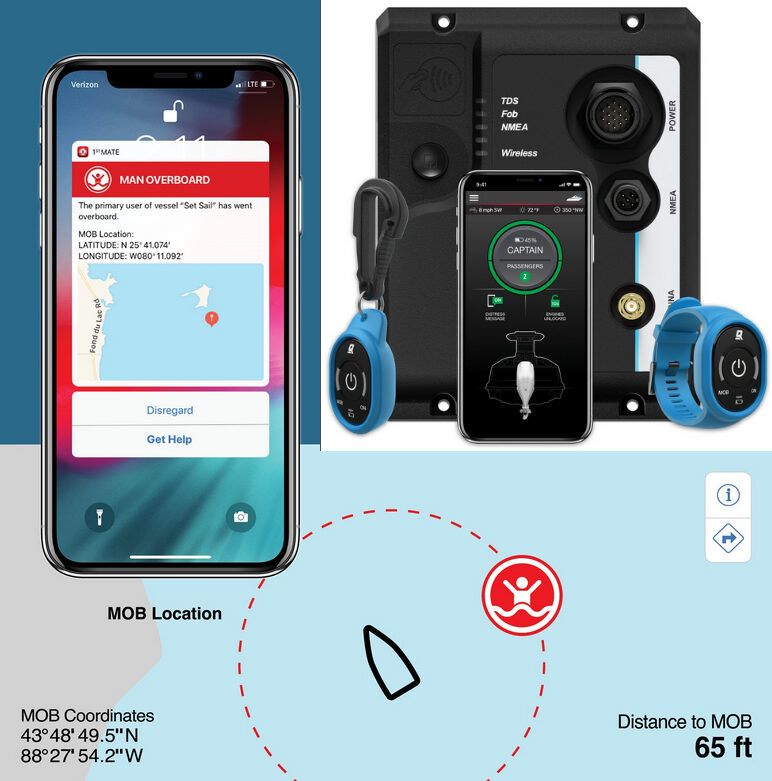
Practical Sailor previously covered the wireless kill switch category back in 2020, detailing systems including Fell Marine’s MOB+ and Propeller Guard Technology’s Virtual Lifeline. (A third system, called Autoteather, seems to have disappeared from the market.) Since that article was published and the ECOS law was enacted, new systems have been introduced by ACR Electronics, 1st Mate (a partnership between Brunswick/Mercury Marine and Fell Marine), and marine electronics supplier Garmin. All six systems are detailed below:
Wireless Engine Cut-Off Switches/MOB Alarm Systems
Manufacturer ACR ACR Fell Marine Firstmate Garmin Propeller Guard
Model OLAS Guardian OLAS N2K MOB+ 1st Mate System OnBoard Virtual Lifeline
Year Introduced 2020 2023 2015 2020 2025 2005
Alarm/cut-off trigger Proximity Proximity Proximity + immersion Proximity + immersion Proximity Immersion
Integrations None N2K None N2K or Mercury SmartCraft motors Garmin chartplotters None
Phone-based app Yes Yes No Yes No No
Price (with one fob) $379.00 $479.00 $249.00 $299.99 $499.00 $529.00
Additional fobs $91 or 4 for $332 $91 or 4 for $332 $50.00 $127.00 $128.00 $129.00
Propeller Guard Technology Virtual Lifeline
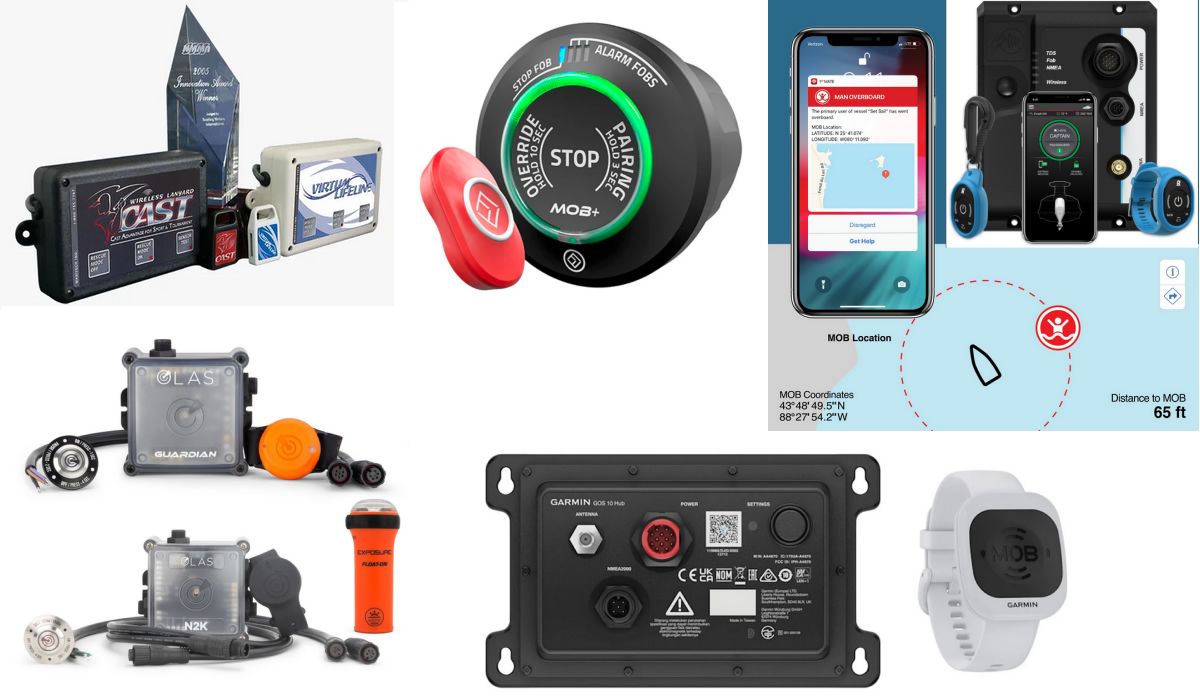
Introduced way back in 2005, Virtual Lifeline is sold mainly to public safety and law enforcement agencies, but the company also sells directly to consumers online. It’s the only system that relies exclusively on immersion in water (rather than losing proximity to the wireless network) to shut off the motor and trigger an audible alarm.
Propeller Guard says it chose immersion because proximity-based alarms might not go off if prop torque quickly pulls an unmanned helm hard over, putting the boat into a “circle of death,” wherein it might run over the person who fell overboard (a concern with fast, planing boats).
Virtual Lifeline is available in a surface-mount package with a built-in antenna and one fob ($529) or a ruggedized helm-mount version with a separate antenna and two fobs ($699). Either system can be configured for outboard or inboard engines with cut-off switches.
Fobs are shielded from spray and have built-in, non-replaceable batteries said to last up to three years. There is no limit to the number of fobs that can be used, and they do not have to be paired with a network. The system is ready once you turn on the ignition. If the helmsperson wearing the only sensor falls overboard and the engine shuts down, a passenger simply shifts the engine into neutral and presses a “Rescue Mode” bypass switch in order to restart the motor and go back for the person in the water.
Fell Marine MOB+
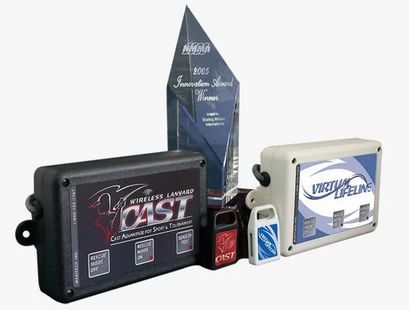
The MOB+ system, from Fell Marine, introduced in 2015, is geared to boats up to 25 feet in length (the effective limit of its wireless network). Owners of larger boats are encouraged to consider the newer 1st Mate system (covered below), introduced by the Fell Marine/Brunswick Marine partner company of the same name.
At the core of the MOB+ system is a dash- or helm-station-mounted hub that is installed in close proximity to the ECOS, to which it must be wired. The MOB+ System “Basepack” ($249) also includes an antenna, one fob (with replaceable battery), a wiring harness, and a wiring kit to connect to power and the engine cut-off switch.
Up to four fobs can be paired with the hub. The first fob to be paired is designated as the captain’s fob (a.k.a. stop fob). Subsequent paired fobs are designated as passenger (a.k.a. alarm) fobs. If the captain goes overboard, the engine will stop and an alarm will sound. Passengers can press the “override” switch for 10 seconds in order to restart the motor and go back for the captain. If a passenger fob is immersed or goes beyond the reach of the network, an alarm will sound. Fell offers wrist bands (in multiple colors), neck-worn lanyards and dog tags (all sold separately).
1st Mate Marine Safety and Security System
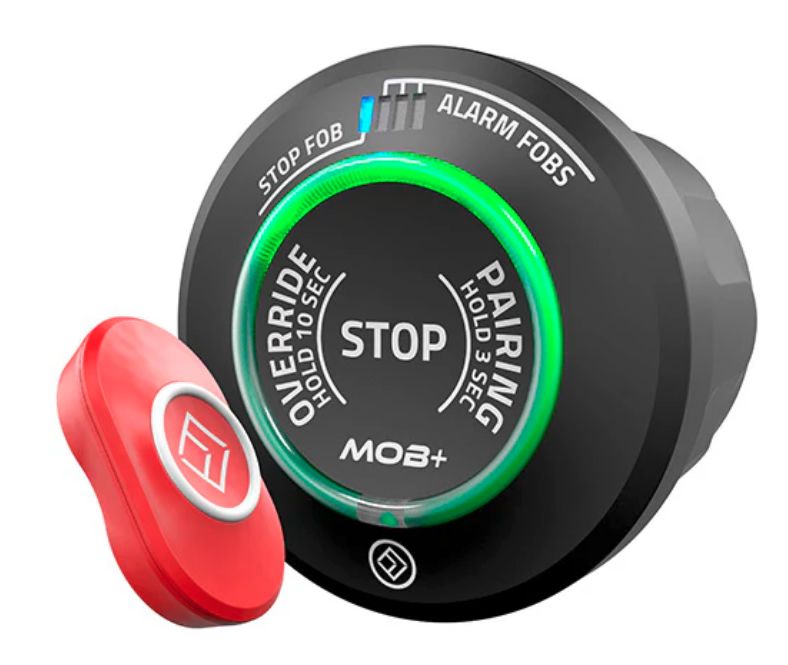
Fell Marine and Brunswick Marine (owner of Mercury Marine) partnered to form the 1st Mate company in 2018, and in 2020 it introduced the 1st Mate Marine Safety and Security System. The system supports man overboard monitoring for the captain and up to seven passengers as well as distress messaging, return navigation to the MOB position, and boat theft deterrence, all through a smartphone app.
1st Mate offers two distinct systems: one for Mercury SmartCraft engines and one for all leading engine brands, including non-SmartCraft Mercury outboards. SmartCraft engines start at 25 horsepower, so this variation isn’t a fit for the smaller-than-25-hp outboards often chosen by sailors for RIBs or auxiliary sailboats.
App and MOB Features
The 1st Mate single-engine starter kit ($299) includes the central hub, a wiring harness, antenna, a near field communications (NFC) chip, one fob, and both a wristband and a carabiner clip so you chose how you wear the fob. The interface for the system is a free app, available for Apple and Android phones, which supports fob pairing, distress messaging, return-to-MOB position navigation, and theft deterrence using the NFC chip (which you attach to your key ring). You can also use security PINs or fingerprint or facial recognition on your phone. The phone-based app also supports ongoing updates of system firmware, bug fixes, and software-based functionality.
As with the MOB+ system, if the captain (stop fob wearer) goes overboard, the engine shuts down, the MOB position is logged to both the app and any connected N2K networks, and alerts are sent to the hub, the app and any fobs worn by passengers. Assuming at least one passenger has the app installed, they can follow instructions on return navigation to the position where the captain went overboard. If a passenger goes overboard, the MOB position is logged, the alarm goes off and, again, the app can be used for return navigation to the position where the passenger fell into the water. In the event a captain or passenger can’t be recovered, the app supports emergency communications, relaying details including the position, heading, and date and time of the MOB event.
ACR OLAS Guardian and OLAS N2K
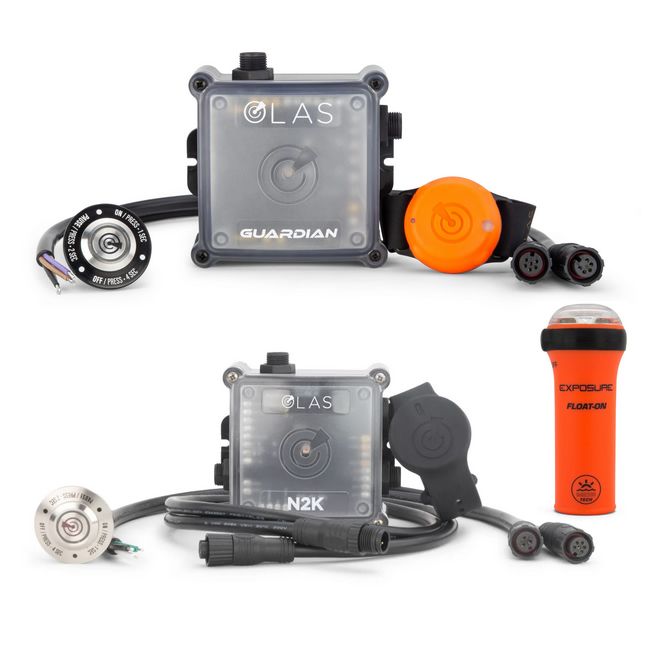
ACR Electronics, the maker of EPIRBs, personal locator beacons, and rescue lights, introduced Exposure OLAS Guardian ($379.95) and Exposure OLAS N2K (479.95) in 2020 and 2023, respectively. Both systems support MOB alarming and monitoring, engine cut-off, and return-to-MOB position navigation through the smartphone-based ACR OLAS app. The N2K version also integrates with NMEA 2000 networks, logging MOB events to N2K chartplotters and making that data available to N2K equipment such as AIS VHF devices.
OLAS stands for Overboard Location Alert System. The system employs a Bluetooth-based network supporting both fobs and an OLAS-transmitting Float-On floating pocket flashlight/emergency strobe.
The OLAS app supports a Solo Mode that enables automatic SOS messaging of MOB event details to a pre-entered phone number. If crew are left onboard, the app offers a directional arrow and distance information to return to the MOB location. The latitude and longitude of the MOB alert is also displayed for coordination with rescue services or nearby vessels. The app also generates a VHF call script that includes your vessel’s information and the last recorded MOB location.
App and Fob Options
The ACR OLAS app can manage and track up to 25 fobs, and fobs have three user-selectable modes. The default mode cuts off the engine and triggers alerts on the fobs of the remaining crew. The engine can be restarted after five seconds. Crew tag mode sets off an alert without cutting off the engine. Helm tag mode cuts off the engine if the tag goes beyond a user-specified distance from the hub, but it does not trigger an MOB alert.
ACR OLAS fobs are supplied with both a wrist strap and a neck lanyard and can be used up to seven days on a single charge. The charge state of each fob can be monitored in the OLAS app, and the tag also vibrates to indicate a low battery state. Fob recharging takes two hours.
Garmin OnBoard
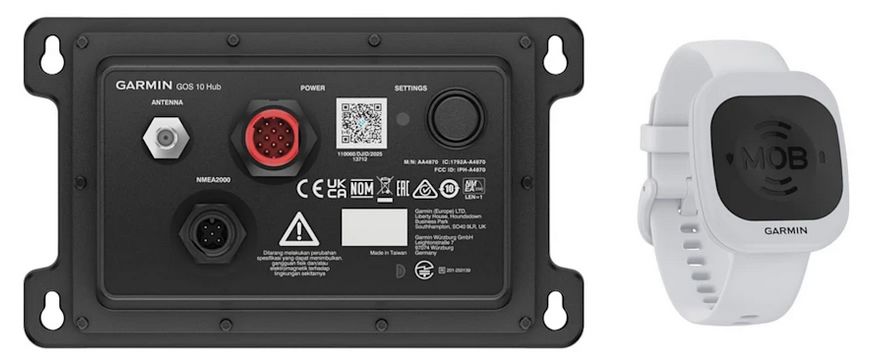
Introduced in 2025, the Garmin OnBoard System ($499) is the latest wireless engine cut-off/MOB system to be introduced. Like all other systems covered in this article, OnBoard combines a central hub that is wired to the engine cut-off switch and a wireless fob that can be worn on a wrist band or lanyard. The system supports up to eight fobs. Each fob’s replaceable battery is said to last up to 1,200 hours in use.
It’s no surprise that the OnBoard system integrates with Garmin chartplotters. What is somewhat surprising is that this system is set up and used exclusively through Garmin chartplotters. There’s no smartphone app, despite the fact that Garmin is the maker of Navionics apps and software. Garmin also produces plenty of dedicated apps for its marine and fitness devices.
Surely there are plenty of Garmin owners who know their chartplotters backwards and forwards and would know exactly what to do with a logged MOB event, but what if the captain is the one who goes overboard? It’s in this circumstance that we like the idea of a purpose-designed, simplified app for MOB navigation and emergency communications that can be freely downloaded and used by a trusted passenger with minimal training.
Caveats for Sailors
It’s great that wireless engine cut-off systems are evolving into full-featured MOB systems, but the market remains focused on the needs of powerboaters. Here are a few caveats that sailors should keep in mind:
Most of these systems are turned on by turning the engine ignition key.
The problem with wiring power to the ignition is that sailors tend to turn their engines off once under sail to avoid the drain of loads such as engine instruments and diesel engine preignition glow plugs. Only the ACR OLAS systems (both Guardian and N2K) are operated through an included, dedicated switch that is independent of the ignition (though you still connect to the engine cut-off switch). Garmin’s instructions for the OnBoard system show how to use a switch that is independent of the ignition, but you’ll have to buy that part. Electronics-savvy types could surely wire the other systems using a separate, dedicated switch, but you’d be on your own and might run afoul of the warranty.
It’s all about “the captain.”
The “captain tag” designation is another sign of a powerboat-oriented system. On the MOB+, 1st Mate and Garmin OnBoard systems, the captain’s tag is the only one that will shut the engine down if the operator goes overboard. We like the ACR OLAS system’s flexibility in having a choice of three roles for each tag. This approach extends the engine shut-off capability to multiple helmspeople. If the need is mostly about sailing, everybody can be designated as crew and the focus will be on MOB alarms, MOB location logging, return-to-MOB position navigation, and emergency communications.
Many inboard engines, particularly diesel engines, do not have electronic cut-off switches.
Older diesels often have mechanical shut-off devices that cut off the engine’s air supply, but these devices are not supported by these systems. There are aftermarket fuel shut-off solenoids available for less than $50, but here, too, you’d have to be a MacGyver type—or have a skilled installer—to make it work.
Sailing oriented functionality is lacking.
Perhaps it’s unrealistic to expect an NMEA 2000-integrated autopilot to be able to point the boat into the wind in the event of an MOB—the sailing equivalent of cutting the engine. Nonetheless, you’d think manufacturers would pay a bit more attention to the needs of sailors. Undoubtedly the legalities of steering control are much more fraught than just cutting an engine. I’m hoping an enterprising electronics manufacturer will come up with user-selectable MOB “actions” that could be set up by owners of N2K-integrated systems including autopilots.
Sizing Up Customer Reviews
This is not a hands-on, test-based review, but here’s a summary of “the wisdom of the crowds” available in the form of online ratings and reviews available (as of this writing) on the Apple App Store, Amazon.com and Westmarine.com:
- Virtual Lifeline sells direct, so you won’t find independent online ratings or reviews. Propeller Guard’s website does list and quote customers, including a number of public safety and law enforcement agencies.
- Fell Marine’s MOB+ system has been around a long time, so there are lots of buyer ratings and reviews. Amazon and Westmarine customer reviews average four out of five stars.
- The ACR systems look best suited to sailors on paper, offering a lot of desirable functionality including a smartphone app. Unfortunately, online ratings and reviews are scarce and decidedly mixed. Particularly troubling are multiple negative reviews of the ACR OLAS app on the Apple App Store.
- 1st Mate Safety and Security System is one of the newer systems. Ratings and reviews available at press time were favorable but few in number, with only 10 ratings and one written review.
- Garmin OnBoard was released in October 2025 so, there was only one buyer review available online at the time of this writing.
Author’s Recommendation
I actually purchased Fell Marine’s MOB+ system many years ago, but I never got around to installing it on the 22-foot, outboard-powered boat that I owned at the time. One wrinkle for sailors using auxiliary outboards is that this system’s wiring diagrams are for larger outboards and inboards with remote side-mounted or dash-mounted ignitions and cut-off switches. I would have had to jerry rig a separate power switch and wiring under the outboard’s cowling to the cut-off switch on the tiller of my 6-hp Tohatsu outboard. Buyers of the 1st Mate system will have the same challenge, as the wiring diagrams are geared to larger outboards with remote helm stations. No doubt messing with the wiring under the cowling of an outboard will run afoul of the warranty.
Now that I own a 30-foot sailboat with an inboard diesel, I’m waiting to see what improvements and app integrations might be added to Garmin’s OnBoard system. Engine cut-off might not be possible with my ancient Volvo Penta powerplant, but the MOB functionality is of interest. I own a fairly new Garmin chartplotter, so the Garmin announcement caught my eye, but I’d definitely want a separate phone app or integration with my Navionics-equipped tablet. Ideally the app would offer a simplified interface that my wife or son could easily use, and they should be able to download and use the app without requiring a separate subscription.
Waiting on Garmin and ACR
I also have my eye on the ACR OLAS N2K system, which has the best mix of functionality for sailors among these systems. OLAS Guardian and OLAS N2K notably include a “Solo Mode” that would offer MOB messaging support for my occasional solo sailing. What gives me pause with the ACR systems is the mixed OLAS app reviews on the Apple App Store and the paucity of buyer ratings and reviews, overall, even after several years of availability. Any announcements from ACR around system and/or app upgrades might persuade me to give this system a try.
One of these systems may be deemed right for you as is, but for now I’m content to wait for improvements from Garmin or ACR or for an entirely new system that can do more than just shut off an engine and sound an alarm.





I had the ACR OLAS system installed on my recently sold trawler. I am often a solo boater. My tag was in captain mode (overboard alarm and engine shut off), and my dog was in crew mode (alarm only). I used the system for several years, and it worked when I tested. Fortunately, no real emergencies. I will likely install the same OLAS system on my 40 foot cruising sailboat, as I solo there as well. I too recognize the sailing limitations. We all have pictured a perfectly trimmed sailboat sailing away on auto pilot after falling overboard. I have envisioned also wiring the OLAS to the autopilot. Once the autopilot’s power is cut off, the boat would eventually head into or off the wind. This may be pure fantasy. Thanks for this review, as one of my hesitations on going with the OLAS system again was the consideration of what else might be out there. Looks like I’ll go with the OLAS again.
Thanks for sharing your experience with the OLAS system. My review should have mentioned a third ACR OLAS system that is even more affordable. It’s called the ACR OLAS Core, and it’s available online for $178 ( https://www.westmarine.com/acr-electronics-olas-core—base-station-for-olas-transmitters-and-man-overboard-mob-alarm-system-20282109.html ). It costs less because it does NOT include a switch and does NOT integrate with an engine cut-off switch. It’s strictly the core MOB system.
I had not thought of cutting off the power to the autopilot instead of the engine. That might work (eventually) under sail, but if you WERE under power, the boat would presumably be doing great big circles. For my boat, which has a manual fuel cut-off, I’d have to find and install an electric cut-off switch and then have the system cut out both the engine and the autopilot. I’m going to wait and see what manufacturers come up with.
i installed a fell marine mob+ on my 35′ sailboat with diesel that i singlehand often. the boat also has a garmin reactor autopilot. i did a “hybrid” installation through a couple of relays whereby if i go overboard it both kills the engine and disengages the autopilot. so in the event of mob, the boat is incapacitated whether it’s under power or sail. in spite of the boat being larger than what fell recommends, i’ve had no problems withe range of the system
Thanks for sharing. How, exactly, did you rig “relays” to disengage the autopilot? That’s a crucial capability needed by solo sailors.