
Bluewater Prep: Boat Design Factors

Learn what design features make a bluewater boat safe and comfortable on the high seas.

0
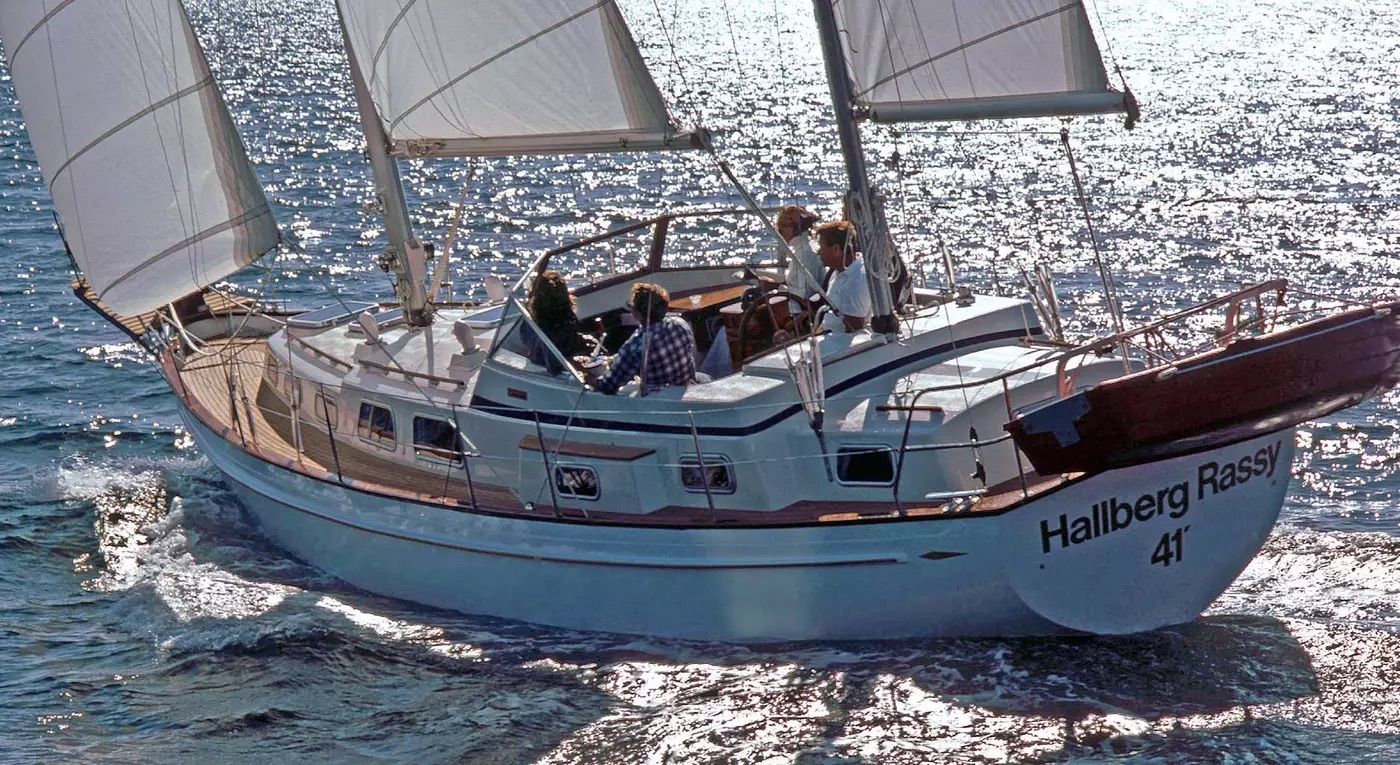
This Hallberg-Rassy 41 epitomizes the traditional approach to bluewater design. Will she go round the world? Of course, haw many times do you want to go?Courtesy of Hallberg_Rassy.

Offshore safety is in some ways simpler than coastal safety but there are some important differences in the approach you need to take. Close to the coast, the decisions you make on the water are critical to safety. For example, avoiding shipping lanes or bad tidal races are important. Once offshore, safety is more about preparation before you leave the dock, once you are “out there” you are pretty much stuck with what is coming your way and the resources you brought to deal with it.  In order to be reasonably safe offshore you need three things: right boat, right preparation and right crew. This article focuses on the right boat.

Get those three right, and you have a good chance of dealing with what the ocean serves up for you. Get any one of them wrong and things could get ugly for you.

What is Offshore or Bluewater Sailing?

Before we get into the meat and potatoes, what do we mean by offshore or bluewater sailing? I am going to base my classification on two things: communications and access to rescue. Communications is an important one. With all our modern technology we can communicate with rescue services from anywhere in the world but only if we have the right kit properly installed and know how to use it.

However most coastal boats don’t have that kit. They should have a VHF radio as a minimum. So my first boundary between coastal and offshore is when you get out of VHF range. That is generally about 30 to 50 miles offshore. I am going to refer to that as offshore sailing.

The second boundary is the point where it becomes difficult for shore-based rescuers to reach you. A typical SAR helicopter has a range of 300 to 500 miles and can reach that distance in 2 to 3 hours. A coastguard cutter may have a top speed of around 20 kn in reasonable weather so it would take 15 hours to cover 300 miles and 25 hours for 500. So if you are 600 miles offshore and need help, it is going to be at least a day before it gets there unless another vessel happens to be in your area. Don’t count on that, it is a big ocean! I have been at sea and not seen another ship for more than a month. This is bluewater sailing—anywhere more than a day from help.

What is the Right Boat?

Here are two examples of boats that have successfully crossed an ocean:

Thor Heyerdahl's raft Kon-Tiki crossing the Pacific Ocean, 1947. National Library of Norway. (Image/ Encyclopedia Britannica)
Thor Heyerdahl’s raft Kon-Tiki crossing the Pacific Ocean, 1947. National Library of Norway. (Image/ Encyclopedia Britannica)
Thomas Ruyant on Vulnerable, placed seventh in the 2024 Vendée Globe. Photo courtesy of North Sails.

Would I take a short-handed family crew across an ocean in either one, NO! So the question should be what is the right boat for you. That is a very important distinction. The right boat for a couple taking a one-year sabbatical and heading for the Pacific Islands with a couple of young children is going the be different to an experienced crew attempting the Northwest Passage or a circumnavigation around the great capes. Which ocean, time of year and crew make a difference. Since I don’t know your crew or your passage plan, I can’t tell you what boat to pick.

What I can talk about is the performance you should expect from different types of boats and why you may want to go with them. Sailboat design is highly complex. Every element in the design affects everything else, so isolating this or that element is quite challenging. I will start with some simple concepts, move onto some of the elements I consider really important and finish with some more technical stuff on things like stability.

How to Tell if a Boat is Suitable for Sailing Offshore

For most cruisers, their boat will be capable of meeting worse conditions than her crew. As cruisers, we want to enjoy our time at sea, not survive it. We also probably want a boat that will look after us, not one that constantly demands attention especially in rough weather. There are several factors that affect this.

Weight

It is a simple fact that a heavier boat will give a more comfortable ride than a light one. This is not just her total weight but also her weight to length radio. The higher both numbers are, the steadier the boat will be. In other words, a 20 ton boat will be steadier than a 10 ton one of the same length.

Dead Rise

This is the angle the bottom of the boat makes, in other words if she is V-shaped or flat on the bottom. When a V-shaped hull hits a wave or rides over it, she will cut into the water, divide the wave and land more gently. A shallow dead rise or flatter bottom cannot cut into a wave crest but rather lifts and rides up the wave. Once clear of the wave crest the bow will then fall into the trough. This is referred to as “slamming” and creates a very uncomfortable motion and makes working the fore-deck particularly treacherous.  This particularly makes a difference if the area forward of the keel has a low dead-rise.

Keel Area

As well as creating a righting moment, i.e. keeping the boat upright, the keel also prevents the boat from going sideways. At speed you only need a small area to do this so a deep, narrow keel can be very effective. However, the slower the boat goes, the more keel area you need to achieve the same thing. In rough weather the best strategy can be to jog slowly to windward, meeting the waves head on or to hove too and stop. To do either of these effectively you need a substantial keel area.

In a boat with a very narrow, deep keel, you will have very little ‘grip’ on the water and will simply be pushed sideways loosing a lot of ground to windward. The bow will also be easily pushed away by the waves so she will not keep her head to windward, which means you cannot safely hove to.  If you try to hove to you will constantly risk the seas turning the boat beam on to the seas and risk being rolled. The only thing you can do is run before the wind which is a lot more demanding on the crew and risks broaching.

Forefoot

This refers to how deeply immersed the bow is. A lightweight, flat-bottomed hull will generally only have a few inches below the waterline in the first third of her length. A more traditional, heavier hull will likely have a foot or two. The more hull that is under the water in the forward sections, the better the boat will be at keeping her head up to the wind, especially hove to or going slowly.

Directional Stability

With a big enough rudder, you may be able to force a boat to keep on her course, but offshore we want a boat with decent directional stability. This will make the helmsperson’s job easier, reduce the demands on the autopilot—particularly how much power it draws—and make the boat less susceptible to being knocked off course by waves. True, it will make her more difficult to maneuver in harbor but if that saves 50 amp hours day on the energy budget it could be a compromise worth accepting.

Sails and Sail Handling

The rig needs to drive the boat efficiently in all conditions. That may include everything from light airs to a severe gale. They must also be within the capability of the crew to handle. A typical 40-ft. cruising boat will need at least 1,000 sq ft of sail area to have a decent performance in a light wind of 10 kn. For the sails to produce the same amount of power in 40 kn that must be reduced to 60 sq ft. Also, the pressure on each square foot of sail will have increased by 17 times. No one sail will effectively cover this range, so offshore we need different sails for different conditions and therefore we must also be able to change them.

Ideally, we want each sail to be small enough for one person to take it  on deck and rig it even when the sea is getting lumpy. Most people find the size and weight of anything, except the main, that is over 300 sq ft problematic so ideally we want to break up the sail area. The main generally does not get changed but needs to be strong enough and be able to be reefed. If we start with 500 sq ft we need to be able to reef that to around 60 sq ft or carry a storm trysail.

So, What Sort of Boat Will Give Us This?

Below decks on the Hallberg-Rassy 41, which typifies the traditional bluewater cruiser. Courtesy of Hallberg-Rassy.

The traditional approach to designing a bluewater cruiser was to use a moderate to heavy displacement hull with full keel or long keel and skeg, give her a fully supported rudder a deep forefoot with a steep dead-rise forward and even amidships a dead-rise of at least 20 degrees. That would be matched to a low aspect, fairly heavy rig with a modest sail area split into a number of different sails. Most likely she would be cutter rigged and anything over 40 ft. would probably have two masts. She would have a high bow with plenty of buoyancy to lift over the waves but a pronounced sheerline and modest freeboard amidships to keep topsides windage down.

This type of design is typified by many 1960s designs and more recently boats like the Hallberg-Rassy. The philosophy behind this design to create a ship that will look after her crew in any weather and carry lots of stores, including large fuel and water tanks. In heavy weather she can hove to or jog to windward almost on her own while the crew are snug in their bunks wailing for things to improve. She would need a minimal watch in a gale, only requiring the crew to keep a watch for   shipping or problems such as something coming loose on deck.

While these designs have proved themselves crossing all oceans and clocking up innumerable circumnavigations, they do have some disadvantages. They are expensive to build because it takes so much material. Also, when molding in fiberglass, making anything with an integral keel needs a much bigger and more complex mold.

Because of her weight and limited sail area, she tends to be low on power under sail so slow in light airs. The low freeboard and relatively narrow hull means she heels quite a bit and gets plenty of water on deck. Below, the narrow beam and high dead-rise make for cramped accommodation for her length and her deep hull and small but heavy duty port-lights tends to make her dark. Her cockpit would be small to limit flooding so at anchor there is limited deck space for lounging and entertaining, plus keeping air flowing through a deep narrow hull is challenging, so in hot climates she could be stifling below.

Modern Bluewater Designs

While this design still perhaps represents the ultimate in “sea-worthy” designs, more recently people have moved towards larger volume and lighter weight boats with shorter keels and spade rudders. It is argued that in these days of satellite-based communications a boat should always be able to get comprehensive weather information while at sea. If you have a fast boat and can see the weather four or five days ahead, you can weather route around any potential problems so you don’t need a boat so focused on surviving hard going. The plus side is that you get a boat with much more spacious accommodation that is light and airy.

Although she may not have such large tanks with plenty of solar panels and a water maker, you don’t need to store as much water. Also, with faster passage time you don’t need to carry as many stores. There is also a wider network of marinas that can do repairs and service her plus you can fly spares to many more places if something is not available locally. It is easy to see why this design approach has become popular but are there many downsides.

Beneteau Oceanis 393. Image courtesy of Yacht World.

A more modern approach? The Beneteau Oceanis 393 from the early 2000s is a typical example of an offshore-capable cruiser. Her shallower hull, long fin and spade rudder maker her faster and allow a lighter more spacious interior without compromising her ability to carry the weight and tankage need for longer passages.

I would point to a few things. The spade rudder and short fin keel are quite vulnerable in a grounding or collision with something like a container at sea. To improve speed, she has a shallow forefoot and low dead-rise which can make her pound uncomfortably in a short and steep sea. Her lighter weight will give her a much more vigorous motion, making working on deck more challenging. Because of this, headsails, roller furling gear and possibly mainsails with all lines lead back to the cockpit would be desirable. While this can seem very convenient, it adds quite bit both to the cost and complexity of her running gear. At the same time, it reduces her sailing efficiency in any conditions where she needs to reef more than about 10 percent of her sail area.

The final issue is the idea that you can always see bad weather coming and avoid it. However good your communications and modern weather forecasting is, I am not sure I would want to trust my life to that in some parts of the world.

Below decks the 348 provides well-lit, spacious accommodation. Photo courtesy of SYS Yacht Sales.

Like everything else in the sailing world, it is always a compromise. Take the traditional design to extreme and you have a sea-tank that takes months to get anywhere and is therefore much more likely to encounter bad weather. Take the modern approach to extreme and you find yourself in a race-boat that really needs a large and very experienced crew to keep her delivering her performance. You may also have a boat that a shorthanded cruising crew will find completely exhausting to handle if they do get caught in bad weather.

As I think should be evident from this article, I consider good preparation, attention to detail, fitting the right sort of equipment and having a good understanding of the rigors of sailing in open water more important that any magical “bluewater boat” label.

Location-Dependent Design Choices

The sort of boat I would want would depend completely on where and what sort of sailing I was expecting to do in her. It should also reflect the skill and experience of her crew. I am currently sailing in the Pacific Northwest and south east Alaska. I also often sail solo and it will be my 70th this next birthday so I want a boat that I can rely on to hove to and ride out a gale while I go below and sit in front of the stove with my slippers on! We also frequently have seas above 10 ft. and are quite short so I want a boat that cuts through the waves without slamming. Consequently, I have a pretty traditional heavyweight double-ender. I go a fair way to achieving good passage times by having large, efficient and well-setup sails. Upwind she is not slow but downwind I don’t get anywhere near the speeds a modern shallow hull boat designed to plane can achieve.

Caribbean

If I was primarily still sailing in the Caribbean, I would want something with a large deck area as that is where you spend much of the time. I would want more spacious and airy accommodation to cope with the heat. Caribbean weather is more predictable in summer and sea states are milder in most areas with seas above 10 ft. being quite rare. The incidence of gales during the season is much lower than in higher latitudes so I would be pretty confident I could avoid being out in bad weather. Many of the current production boats are designed for exactly these conditions.

Pacific Islands

If I was looking at something like a trip to the Pacific Islands, the longer passages would push me towards a boat that was more oriented to bad weather and capable of carrying more stores. The same would be true for a boat doing an Atlantic circuit or anywhere north of Spain. This could be in the category of a fast cruiser but very much a moderate one with upgraded rig and deck gear. I would probably want a long fin and skeg to reinforce the rudder and be looking in the moderate weight are not a lightweight

Southern Ocean

Any boat going anywhere near the Southern Ocean or above 55 degrees north should, in my opinion, make no compromises, you are going to be sailing in 50-plus kn so make absolutely certain both the boat and the crew are prepared for it.

Multiple Locations

The real challenge comes for those making really extended passages and who are full-time cruisers. You may be in the Caribbean one season but then visiting New Zealand’s South Island and the Tasman Sea later in the voyage. In my opinion, the sensible choice would be a boat you will be comfortable with in the areas with the most extreme weather even if that means being less comfortable in other areas.

Conclusion

When it comes down to it sailing in the open ocean carries some risk and the level of risk you are prepared to live with is a very personal decision. The level of comfort you demand from the accommodation and the amount of space you need are also personal areas so nobody can tell you what boat is “right” for you on any particular voyage. What I hope I have been able to do is point you towards some important areas to consider and give you some ideas on how to read a boat’s design.

Roland Stockham got his start sailing Olympic-class 470s and Finns in his native England. He started his journey as a voyager crewing for yacht owners sailing to Europe because he was handy at diesel repair. His first cruising boat was a 26-ft. Folkboat with no engine. He lives in British Columbia and sails a 35-ft. Colin Archer design. He is a Royal Yachting Association certified Yacht Master and is qualified to make trans-oceanic deliveries.