Practical Sailor

  • Subscribe
  • Free Waypoints e-letter
  • Customer Service


Forgot Your Password?

  • Home
  • Sailboat Reviews

    Articles

    Boat Review: Marshall 22 Catboat

    Funding the Dream

    New Boat Review: Beneteau Oceanis 41

    Building a New Beneteau

    Sailboat Reviews

    Unbiased, detailed reports on dinghies, daysailers, racer-cruisers, cruising sailboats, and multihulls. Insights into boat construction and design. Solid advice on buying a sailboat.

    Sailboat Reviews - Index

  • Marine Electronics

    Articles

    Lighting the Way

    Useful and Fun Nautical Apps for iPad

    PS Reviews Cheap and Free iPad Nav Apps

    PS Sea-trials the iPad and Nav Apps

    Practical Sailor Reviews Iridium and Inmarsat Satphones

    Marine Electronics

    Extensive tests of GPS chartplotters, fishfinders, VHF radios, radar, AIS, navigation software, and handheld gadgets. Professional guidance on installing and operating high-tech sailing gear.

  • Sails, Rigging & Deck Gear

    Articles

    Of Safety Tethers and Comfy Cockpits

    Anchor Testing and Rode Loads

    DIY Trysail Track Retrofit

    Adding Some Zing To Anchor Testing

    A Practical Look at Sailboat Cockpit Design

    Sails, Rigging & Deck Gear

    Independent tests of halyards, sheets, furlers, anchors, snatch blocks, shackles, ropes, winches, vangs, cleats, booms, masts, and standing rigging. Expert guidance on choosing a mainsail, jib, or spinnaker.

  • Systems & Propulsion

    Articles

    Worthwhile Advice from Hose Manufacturers

    Y-valve Installation Advice and Troubleshooting

    Y-valves Under Pressure

    Marine Sanitation Hose Test

    Installing Hoses Highlights Their Differences

    Systems & Propulsion

    Comprehensive comparisons of pumps, batteries, solar panels, wind generators, inverter-chargers, watermakers, propellers, toilets, engines, and other marine systems. Tips on ship-shape installations.

  • Boat Maintenance

    Articles

    Mailport: April 2012

    Antifouling for Aluminum Boats

    Mailport: May 2012

    Product Updates

    Where Credit is Due: May 2012

    Boat Maintenance

    Bottom paints, topside paints, varnishes, waxes, protectants, cleaners, metal polishes. If it comes in a bottle or can, PS has tested it. Proven methods to protecting your floating investment.

  • Belowdecks & Amenities

    Articles

    Clean Bottom, Fast Bottom

    Grill Griddle Faceoff

    What’s Cooking Now?

    Mailport: March 2012

    Showers

    Belowdecks & Amenities

    Our top picks in galley stoves, cookware, cabin lights, refrigeration, and entertainment systems can help turn your cruising boat into a home. Creative solutions to the challenges of living aboard.

  • Personal Gear & Apparel

    Articles

    PS Tests Padded Sailing Shorts

    Testers Search for an All-star LED Spotlight

    Testers Check Beam Patterns and Illumination

    Personal Gear & Apparel

    Thorough test reports on binoculars, boat shoes, foul weather gear, hand-bearing compasses, sailing knives, flashlights, headlamps, sunglasses boots, and anything else that belongs in a skipper's seabag.

  • Safety & Seamanship

    Articles

    PS Analysis: The 2011 WingNuts Capsize

    Safety at Sea Part III: Rambler 100 capsize

    US Sailing Investigator’s Recommendations

    Lessons learned

    Rambler 100 Recommendations

    Safety & Seamanship

    Our testers evaluate life jackets, flares, life rafts, harnesses, man-overboard strobes, medical kits, seasickness aids, and emergency devices. Tips on marine safety gear, boat-handling, and emergency procedures.

  • Mailport & PS Advisor

    Mailport & PS Advisor

    Insightful letters from sophisticated sailors. Do-it-yourself projects and reader feedback on a wide range of boats, marine manufacturers, and sailing products.

  • Inside Practical
    Sailor Blog

Features

October 2011 Issue

Story Tools

  • Share |
  • E-Mail to a friend
  • E-Mail to the editor
  • Post a Reader comment
  • Printer Friendly

Past Adventures with Chemical Strippers

Temperature, dwell time, and sharp scrapers are as important as picking the right concoction.

In 2006, we tested nine different chemical strippers on a boat that had several years worth of accumulated bottom paint.

Our foray into sodablasting follows years of testing several different ways to remove bottom paint. Although you can simply attack the bottom paint with a power sander (an 8-inch sander-polisher is probably the most common tool for this purpose), this approach is messy, back breaking, and can expose the do-it-yourselfer to various health hazards. It can also lead to dings and divots in the gelcoat caused by overzealous sanding. Many yards prohibit do-it-yourselfers from sanding antifouling, or offer specific guidelines on how it can be carried out—often prescribing a chemical stripper to help contain the paint residue.

Chemical paint strippers break down the paint’s adhesive bond on the hull and make it easier to scrape down to clean substrate that can be repainted. You can choose different strengths of stripper depending on the job at hand, or you can vary the strength by leaving the chemical stripper on the hull longer.

Over the past 10 years, Practical Sailor has looked at a wide range of high-strength strippers developed specifically for removing marine paints—antifouling paints in particular. After experimenting with concentrations, dwell times (the amount of time you leave the stripper on the hull), and ambient temperatures, we found we could greatly reduce the scope of a paint removal project. However, we still came to the conclusion that there had to be a faster, easier way to remove bottom paint.
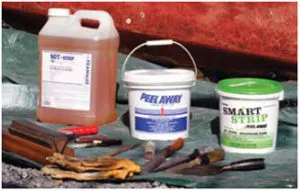
Three top products were selected for our 2009 test of chemical paint removers, from left: Soy-Strip, Peel Away, and Smart Strip.

The Tests

In November 2006, we looked at nine different marine strippers. Back to Nature Ready-strip was our Budget Buy, and Franmar Soy-Strip was our Best Choice. Two other products, Pettit Bio-Blast and Back To Nature Aqua Strip were Recommended. A past winner in PS testing, Peel Away Marine Safety Strip from Dumond Chemical, did not land among the top contenders. Dumond Peel Away Marine Strip II, Sea Hawk

Marine Paint Stripper, and Interlux Interstrip 299E were other products that did not make the final cut.

Not surprisingly, most of the strippers touted their eco-friendliness. Since the mid-80s, boatyards have been under pressure from both state and federal regulatory agencies to contain the toxins and heavy metals contained in bottom paints; chemical strippers helped meet that goal. The newer strippers also were water-soluble, simplifying cleaning and reducing volatile organic compounds leaking into the atmosphere.

In 2008, we updated our 2006 report with a test in slightly cooler temperatures—65 to 72 degrees versus 85-plus degrees in 2006—and on a more challenging overhead, horizontal surface. The test pitted the Franmar Soy Strip against a new, water-based product from Dumond, Peel Away Smart Strip. In that comparison, the Peel Away Smart Strip performed slightly better, although neither product did particularly well removing multiple layers of bottom paint. In this test, testers found that the dwell times could be sped up by covering the strippers with clear plastic to prevent evaporation.

In March 2009, we raised the stakes. Not only did we want to remove an antifouling paint, we also wanted to peel off a 25-year-old Interlux Interprotect epoxy barrier coat, that was beginning to fail. For that round, we selected “the best of the best” chemical paint removers from previous tests: Soy-Strip by Franmar (best in 2006), Dumond Chemicals’ Peel Away Marine Safety Strip (best in 2000), and Peel Away Smart Strip (best in 2009). Because of the longer dwell times needed to soften the epoxy coating, testers tried them with and without a covering: Peel Away’s proprietary paper for the Dumond products and a 1-mil clear plastic for the Franmar stripper. Testers found that the Peel Away Marine Safety Strip—with its thick, creamy consistency—was the most effective for heavy-duty epoxy-paint removal. The Franmar Soy Strip also worked, but not quite as quickly. The testers concluded that using either stripper alone, without covering the product to extend the dwell time, would not be effective against epoxy.


Read More on These Topics
  • Paints
  • Cleaning & Waxing
  • Repair Tools & Materials
  • DIY Projects
  • Boat Maintenance

Comments (0)

Be the first to comment on this post using the section below.


Add your comments ...

New to Practical Sailor? Register for Free!

Already Registered? Log in

Forgot your password? Click Here.

Advanced Search

Related Items

Articles

  • Where Credit is Due: June 2012
  • The Man Who Glued Too Much

Current Issue

Cover Image

May 2012

  • Y-valves Under Pressure
  • Anchor Testing and Rode Loads
  • Funding the Dream
  • Safety at Sea Part III: Rambler 100 capsize

Subscribe Today

Back Issue Archive

Resources

  • Practical Sailor Dinghy Survey Results
  • DIY Boatyard Survey
  • Sailboat Reviews - Index
  • DIY Projects
  • Bookstore
  • Issue Archives
  • Other Resources
  • Customer Service
  • About Us
  • Home
  • Subscribe
  • Give a Gift
  • Renew
  • Products
  • Customer Service
  • Privacy Policy
  • About Us
  • FAQs
  • Contact Us
Practical Sailor

© 2012 Belvoir Media Group, LLC. All rights reserved.