

Hunter Marine has a reputation as a builder of boats for sailors who favor creature comforts over performance. Some models from the company have been described as “floating condos.” Say what you will, this strategy propelled Hunter to a leading spot in the U.S. sailboat industry in terms of boats sold on an annual basis in the early 2000s.
However, when Hunter hired Glenn Henderson as chief designer and engineer in 1999, former company CEO Warren Luhrs (who died in 2013) signaled that Hunter was increasing its attention to better performance. Despite being an experienced long-distance cruiser, Henderson carved his reputation as a performance-oriented designer whose creations have fared well on the racecourse. The company was sold in 2012 and renamed Marlow-Hunter, however the production of Hunter boats stopped in 2024.
Design
The Hunter 38 replaced the 386, the last of which rolled out of the Alachua, FL, plant in May, 2004, following a seven-year run. In announcing the arrival of the new boat, Henderson said: “Our goal was to design a boat that was an exceptionally comfortable cruiser, yet offered outstanding performance and easy handling. The new 38 has met expectations.”
Wide Accomodations
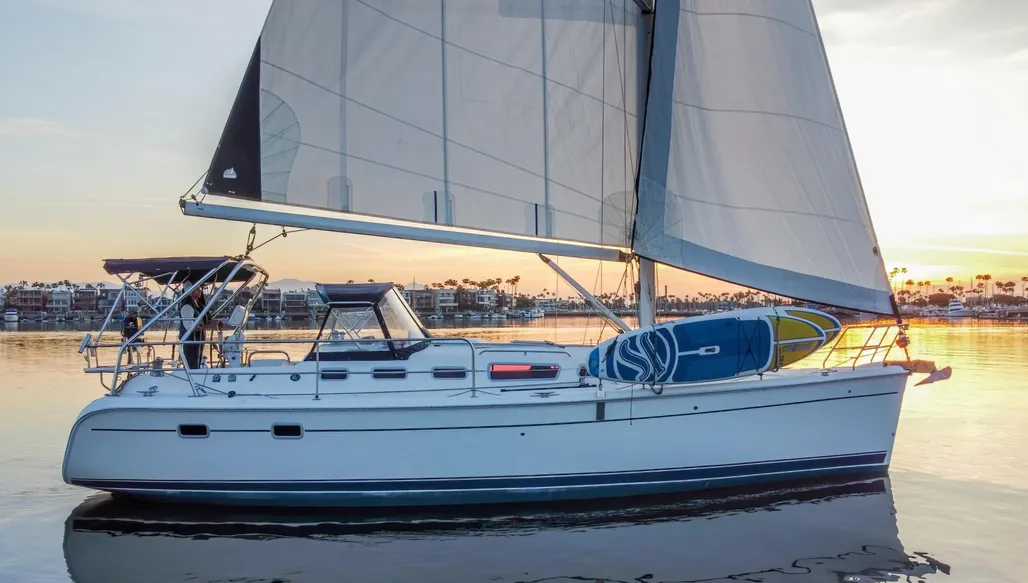
In our view, she has a Jekyll and Hyde appearance. Our first impression upon approaching the boat was that she’s just another specimen in a growing list of big-butted boats. The 12-ft. 11-in. beam is carried aft to the stern, where the athwartships measurement is 10 ft. 6 in. inside the cockpit, and freeboard is 50 in., so it’s at least two steps upward to board her at the transom. Her 6-ft. long, 20-in. wide seats surround a footwell that’s 36-in. wide at its narrowest point, and two, two-person pod seats are located on the stern rails. Clearly, the cockpit has been designed to accommodate up to eight people in comfort during the cocktail hour. And overhead, a bimini sits attached to a stout stainless steel frame.
Racy Elements
Move forward 38 feet and the Mr. Hyde side presents itself; there is no comparison with her predecessor. Her fine entry and near-plumb-bow are as racy as any early 2000s boat from Farr Yacht Designs. Due to her increased waterline, she won’t lack speed. There’s also just enough working space between the mast and bow pulpit—her J measurement is just 12 ft. 1 in., which means two-thirds of the boat is aft of the mast—for a bow person to attend to sails or muscle an anchor fitted on a stainless steel bowroller at the stem. Her small foretriangle and seven-eigths rig are married to a boom that extends over the stainless bimini frame to produce end-boom sheeting angles that are more efficient than a cabintop arrangement.
When viewed from abeam at a distance, her profile complements the racy bow as she presents a high-aspect sail plan and a relatively flat sheerline. Tinted, flushmounted, fixed plexiglass ports complement her aesthetics; they measure 16 in. x 28 in., and light her interior. This boat is less chubby than her cousins; a Hunter 306 that was tethered nearby is much less comely, having the boxy appearance produced when max headroom below is more important than appearance.
Responsive Engineering
Of the 38’s design, Henderson told us: “Attention was given to the volumetric distribution of the hull to even out pressures of water movement, utilizing the rudder as a major lift component along with the keel. In the past, designers relied primarily on keels for lift and resisting leeway. We discovered that using a large rudder and smaller keel was better. The result is a more responsive boat.” Henderson’s statement was affirmed when we backed the 38 off the dock amidst a cluster of other boats.
Sail Plan
Most of this vessel’s sail power comes from the mainsail, an arrangement that Henderson favors over relying on a large jib. “The whole sail plan is aerodynamically efficient. I will not design a masthead rig sail plan because the fractional rig with large mainsail delivers better performance, and the smaller headsail means easier sailhandling for both passengers and crew.”
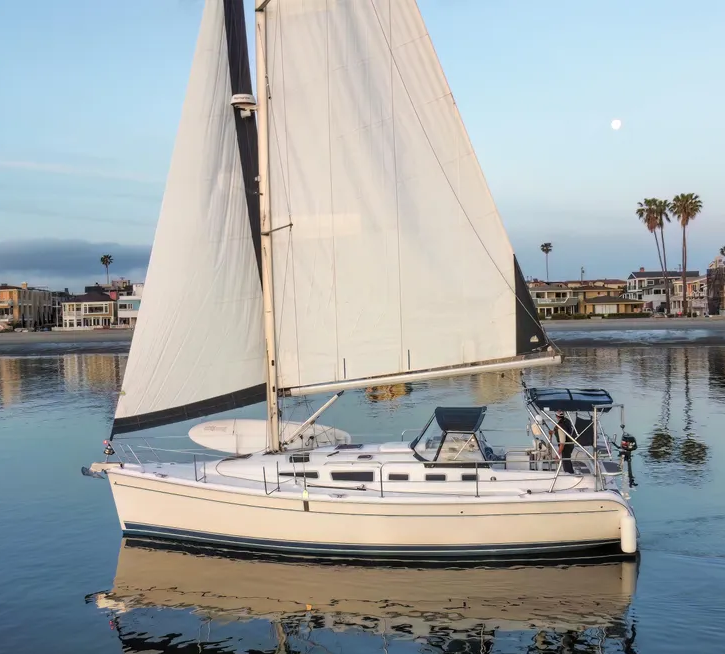
The new 38 is outfitted with the same anodized B & R double spreader Selden mast with support struts used on Hunter’s midsized yachts; having no backstay allows Henderson to fly a mainsail with a powerful roach and still install the bimini frame over the cockpit. To tame the large mainsail, in-mast furling is an option, which was included aboard our test boat.
“Balancing the sail plan, center of gravity, and underbody is important to get all the forces concentric,” explained Henderson. “The 38 doesn’t have a lot of pitch, doesn’t pound, and is easily driven.”
Stability
One contributor to stability is the boat’s displacement—17,674 lb., with 6,387 lb. of lead in the keel; that produces a ballast ratio of 36.14 percent. A second is a “center of gravity lowered by using a vinyl material for the headliner, instead of heavy fiberglass. That removes 350 pounds from the boat,” he said.
The “Hunter 38 in Context” chart (see sidebar) offers a statistical comparison of Hunter’s 38 with three of her contemporaries from prominent boatbuilders. Using this reference, she should be the fastest of the bunch. It’s clear that Henderson put a new face on the designs of Hunter’s products, and that’s a good thing. However, when she inevitably turns stern to, we’ll simply grit our teeth and accept the fact that Hunter understood the creature comforts that its clients demanded.
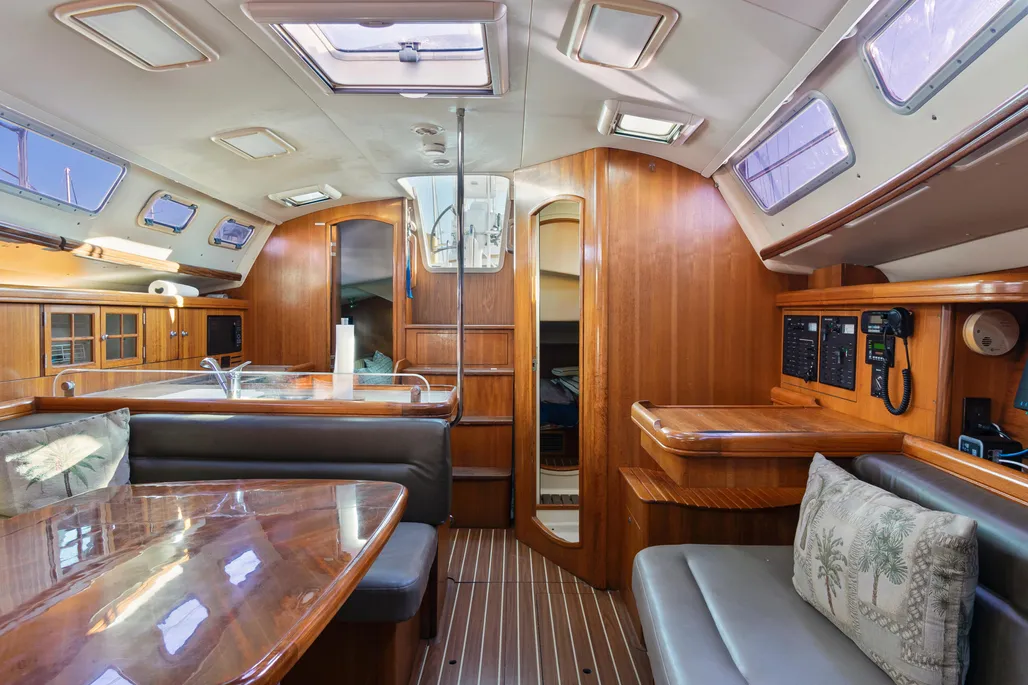
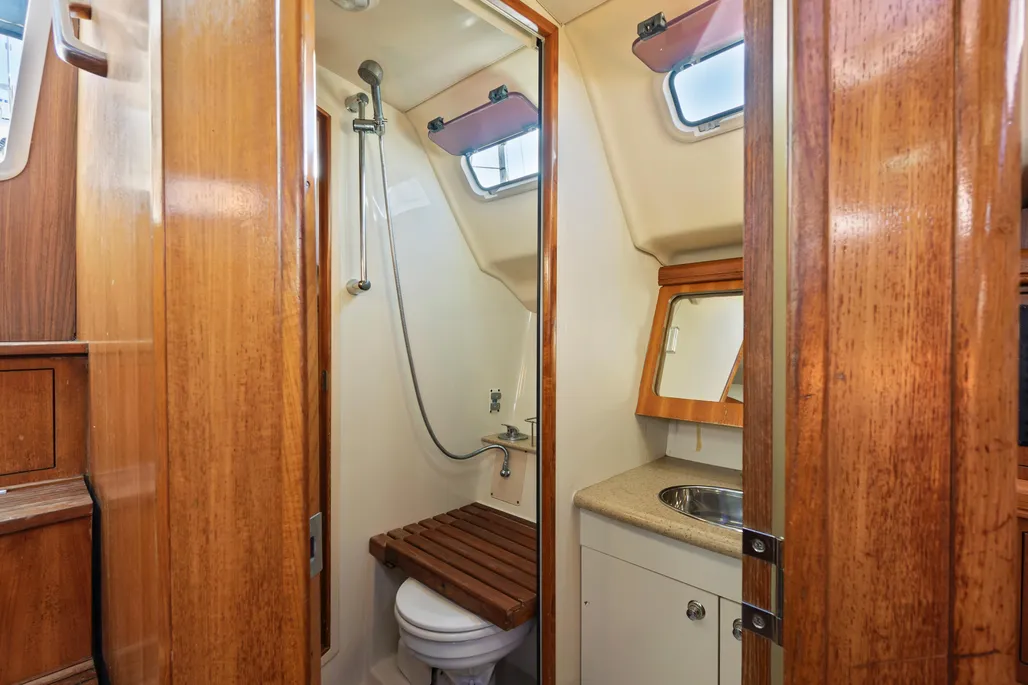
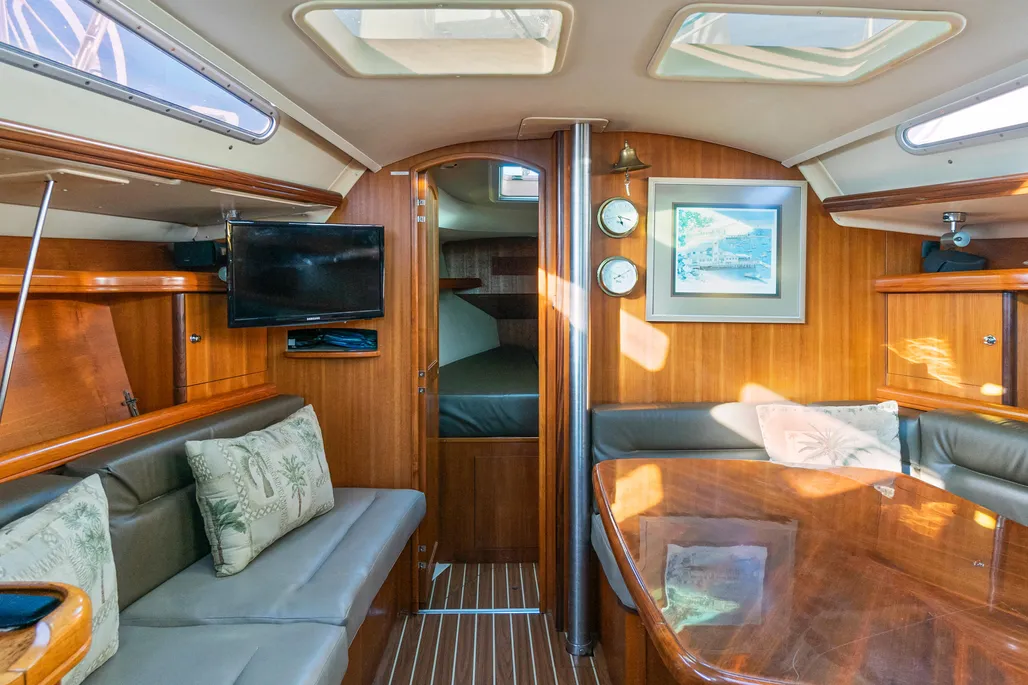
Two innovations are immediately obvious when boarding from astern. The swim platform measures 18 in. by 30 in., and has two steps, one of which folds up when boarding passengers. Henderson has designed a helm seat that rotates aft and downward, which fills the gap between the upper port and starboard steps, creating a stern entrance; it’s a clever idea. Cockpit seats, and the two pod seats are covered with Flexiteek™, a synthetic product that’s durable and stain-resistant. See “Synthetic Teak Durability Test.” The major shortcoming of the cockpit is the lack of storage space. A small locker to port contains the holding tank, a second one holds two propane bottles. The starboard seat covers an emergency hatch; also to starboard are a shallow locker for storing dock lines, and a second one that accesses manifolds and a heater. These spaces are small, as Henderson explained, because: “You’ve got to compromise somewhere,” to execute the balance of his design. Coupled with her wide body, the ‘Owner’s Version’ offers the most commodious and well laid-out aft stateroom we’ve seen on a boat this size. As an alternative, a tri-cabin version is available; that model is equipped with two aft cabins that provide space for passengers, or a large storage area. The second innovation: a 38-in. Edson destroyer-style wheel common on production boats this size. But in this case, Edson designed a folding wheel where port and starboard sections can be unpinned and folded inward to ease movement about the cockpit. During our test sail, the wheel remained locked in a circular form, so it appeared functional and safe. Leaves on the binnacle-mounted table can be elevated to create two plastic 18 in. x 18 in. tables. The base of the table also provides a foot brace, a requirement on a cockpit this wide. The third innovation is not original, but is rarely seen on production boats: deep fiberglass bins on either side of the companionway used to store halyard tails and other sail controls. This is a superior approach to using bags or cubbies that have historically been carved out of unused space in the coamings. On the 38, Hunter uses a stainless steel arch to support the traveler, which puts mainsail controls near the helm. A Harken mainsail track and traveler system sits atop the arch, and sheets are led port and starboard to cam cleats that allow the skipper to trim from the wheel, completing Henderson’s attempt to remove clutter from the cockpit. Two Sony marinized speakers and nightlights are also housed in the arch; the speaker controls are bedded in the companionway cover. Primary winches also are close to the helm, promoting singlehanded sailing. Despite these niceties, except when covered by the bimini, the arch detracts from the boat’s appearance, and adds weight aloft and windage. Though we’d be hesitant to sail out of San Francisco Bay with the bimini in place, we agree it would be a plus in less demanding regions most of the time. The boat’s deck hardware is top-drawer and large enough for assigned tasks. The primary winches are Lewmar 40 self-tailers led through Lewmar ballbearing blocks. On the cabintop are Lewmar 40s married to Spinlock XTS rope clutches. Lifelines are 23 in. above the deck, (meeting ISO standards), but would provide more security if they were 28 to 30 in. tall. The 1-1/2 in. fiberglass toerail running from bow to stern is what we expect on a boat designed for offshore work. The toerail is rounded, which will be appreciated by rail riders in the unlikely event that this boat does any racing. The sidedecks are 12-in. wide at the shrouds. The lower shrouds terminate near the base of the cabin, the uppers at the gunwale, so fore and aft movement is unimpeded. And a diamond nonskid surface offers good footing on a wet deck. The cabintop measures 86 in. between the handrails, so there is plenty of room for stowing a dinghy or other items. Small headsails were de rigeur for Henderson, and this boat is fitted with just two 48-in. long sections of track located at the base of the cabintop, providing tight sheeting angles between the shrouds. The standard furler is a Furlex 200S elevated 16″ in. above deck level so that it’s out of the way when hoisting an anchor, but this arrangement diminishes sail area and compromises upwind performance. A Simpson-Lawrence anchor windlass is located below deck in the anchor locker, a good location from a safety standpoint; the locker is large enough to house enough chain and rode for anchoring in deep harbors. Cleats located on the bow, amidships, and on the stern are 10-in. long, so they’ll accept dock lines beefy enough for a boat this size. A Lewmar hatch on the bow measures 22 in. x 22 in., a second located amidships is 24 in. x 24 in., letting the sun and wind pour in, or odors escape the cabin. They are supplemented by 10 in. x 12 in. opening ports amidships and over the galley. Henderson has designed a vessel that places an emphasis on crew comfort and smooth operation by locating the sail controls at the helmsman’s fingertips. The only drawback, however, occurs if the skipper becomes overwhelmed by simultaneously steering, trimming, reading a chart, and attending to the other duties that befall the master of any vessel. In this case, the stern section could become overpopulated. Still, the absence of lines cluttering the cockpit sole gets our approval. As with all Hunter sailboats, the 38 provides large living spaces. The layout of this model presents an L-shaped galley to starboard at the foot of the companionway, nav station to port, and sitting/dining area amidships. At anchor, the crew sleeps in the forward cabin; the skipper in the aforementioned aft stateroom. Headroom in the main saloon is a generous 6 ft. 6 in. The hull and cabinetry are constructed of smoothly finished teak, though the sole in the saloon is Everwear™, a low-maintenance laminate. The panels in the new headliner can be removed with a tool Hunter provides to get at wiring runs and deck hardware, and the cabintop is fitted with solid wood handrails running the length of the saloon, which are among the beefiest we’ve seen. The saloon will seat six guests with a dining table measuring 36 in. x 42 in. and settees 70-in. long with 15-in. high backrests. The width between the settee backs is 9 ft. The galley comes standard with a two-burner stove/oven combination located between an optional refrigerator aft and slide-out storage rack; outboard are cabinets large enough for the storage of eating utensils, and a niche for a microwave. A stainless rail at the front of the provides an attachment point for the chef when underway. Two stainless steel sinks are surrounded by a Corian surface, a Hunter signature that flies in the face of Henderson’s attempt to reduce weight. The countertop measures 60-in. x 20-in. when the sinks are covered, adequate for preparing meals for a crew of six. The 38 also has a good chart table measuring 20-in. x 18 in. Henderson placed a bulkhead on the forward edge of the table where instruments will be installed, with a useful stainless handhold attached to the cabinetry. The electrical panel is close at hand. The only drawback of the arrangement is that the chart table extends so far aft that the navigator’s seat cannot be fully elevated. The skipper’s stateroom is comparable to ones we’ve seen on large powerboats. The key ingredients are a 78-in. long, 60-in. wide platform on which a 4-in. thick mattress lives, with storage below. Interestingly, an open space between hull and headboard is designed for miscellaneous storage, as is a cabinet at the foot of the berth measuring 22-in. wide and 8-in. deep. There’s additional storage in a hanging locker. Cushioned seats measuring 23 in. x 20 in. located port and starboard create convenient sitting areas. But make no mistake, this sleeping area would not serve as a proper seaberth. Henderson has devised a dual-purpose engine cover. The box doubles as a fiddled vanity that, when removed, exposes both sides and the back of the engine, better than seen on most boats. Since the space between the berth and vanity is 23 in., the cover won’t need to be stored on the berth when servicing the engine—a very sanitary arrangement. The forward stateroom is just large enough for two adults. The berth is 86-in. long on the centerline, and 80-in. wide at the head; storage is below the berth and in a pair of cedar-lined hanging lockers. The single head is a two-compartment affair with doors to both the main cabin and the aft stateroom. Standing headroom is 6 ft. 2 in. in each space. The vanity-toilet area is large enough for most adults, and the shower area, which measures 24 in. x 45 in., is enclosed by a door, so the spaces may be occupied by two people simultaneously. We expect to find large living spaces on Hunter’s sailboats and the 38 doesn’t disappoint. However, it exhibits better fit and finish of joinery than boats built five years ago, a byproduct of computerized cutting tools, more attention to detail, and quality control. The layout is sensible, with living spaces proportionate to the amount of time that will be spent occupying them. And, we like a single head on a boat this size. It makes sense and frees space for other uses. We tested the boat in 5 to 10 knots of breeze and flat water on the Chesapeake Bay—conditions common to many areas around the U.S. The boat was fitted with an in-mast furling mainsail, and the company’s own literature indicates that this reduces sail area by 148 sq. ft. We feel that’s a tremendous price to pay for convenience, especially in light-air venues, and considering that sails are typically set once a day. On a 38-ft. boat displacing 17,000 lb., we’d opt for an electric halyard winch and a flaking system before sacrificing that much Dacron. We sailed with a full main with three vertical battens, which produced good sail shape, and a 105% headsail. Boat speed on our GPS registered 5 to 5.5 knots sailing in five knots of breeze, and increased to 7.5 knots in 10 knots of breeze when we eased sheets. Henderson said “that meets the design target and is about as fast as she will go.” The boat was light at the helm, responsive when sails were properly trimmed, and tacked through 85 to 90 degrees, better than we’ve seen on earlier Hunters. She heeled approximately 10 degrees in those conditions and provided a comfortable ride. She motors easily at 6 knots when powered by the Yanmar 27-hp engine. An optional 40-hp engine added $2,936 to the original price, but would be overkill except in areas where there are heavy tides or currents. We’re convinced that Henderson made progress in improving the performance of Hunter’s products. His major accomplishments are faster hull shapes and minor progress in the removal of unnecessary weight; i.e. the headliner in the saloon. Nonetheless, odds are that Corian countertops will always be installed, and the boats will continue to have big cockpits, a reflection of the market to which the company appeals. And, we’ll never get used to seeing those radar arches. With the original base price of $144,990, the Hunter 38 was at the low end of its respective market. Used boats are currently priced between $85,000 and $119,000. The quality of this boat is an improvement over previous models, and we think it bears close inspection for potential buyers. This article was first published on 6 April 2005 and has been updated. 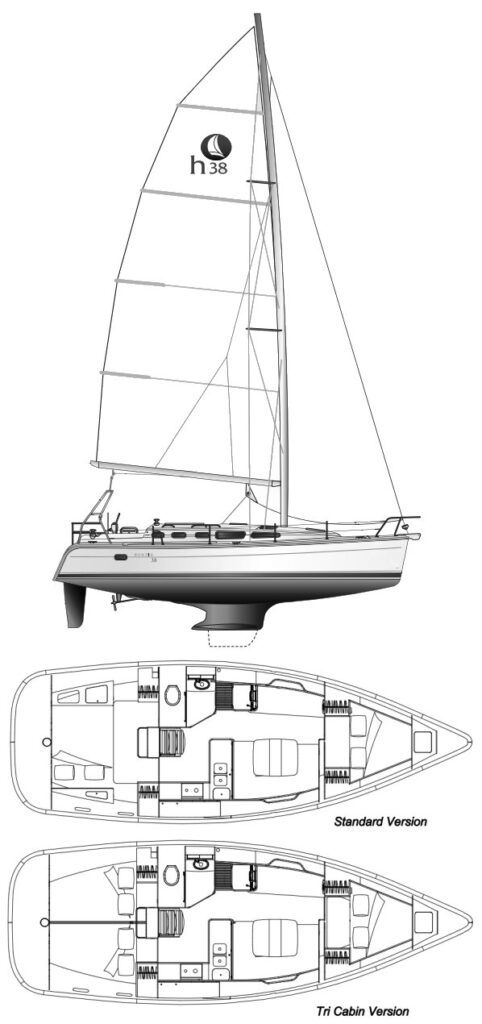
Sailboat Specifications Courtesy of sailboatdata.com
Hull Type: Fin w/spade rudder
Rigging Type: B&R
LOA: 38.17 ft / 11.63 m
LOD: 36.67 ft / 11.18 m
LWL: 34.67 ft / 10.57 m
S.A. (reported): 991.00 ft² / 92.07 m²
Beam: 12.92 ft / 3.94 m
Displacement: 18,342.00 lb / 8,320 kg
Ballast: 6,128.00 lb / 2,780 kg
Max Draft: 6.50 ft / 1.98 m
Construction: FG
First Built: 2004
Builder: Hunter Marine (USA)
Designer: Glenn Henderson
Make: Yanmar
Type: Diesel
HP: 29
Fuel: 35 gals / 132 L
Water: 75 gals / 284 L
Headroom: 6.50 ft / 1.98 m
S.A. / Displ.: 22.88
Bal. / Displ.: 33.41
Disp: / Len: 196.49
Comfort Ratio: 26.28
Capsize Screening Formula: 1.96
S#: 2.65
Hull Speed: 7.89 kn
Pounds/Inch Immersion: 1,600.53 pounds/inch
I: 46.67 ft / 14.23 m
J: 12.08 ft / 3.68 m
P: 47.42 ft / 14.45 m
E: 17.75 ft / 5.41 m
S.A. Fore: 281.89 ft² / 26.19 m²
S.A. Main: 420.85 ft² / 39.10 m²
S.A. Total (100% Fore + Main Triangles): 702.74 ft² / 65.29 m²
S.A./Displ. (calc.): 16.23
Est. Forestay Length: 48.21 ft / 14.69 m
Mast Height from DWL: 59.08 ft / 18.01 m
Deck Layout
Cockpit
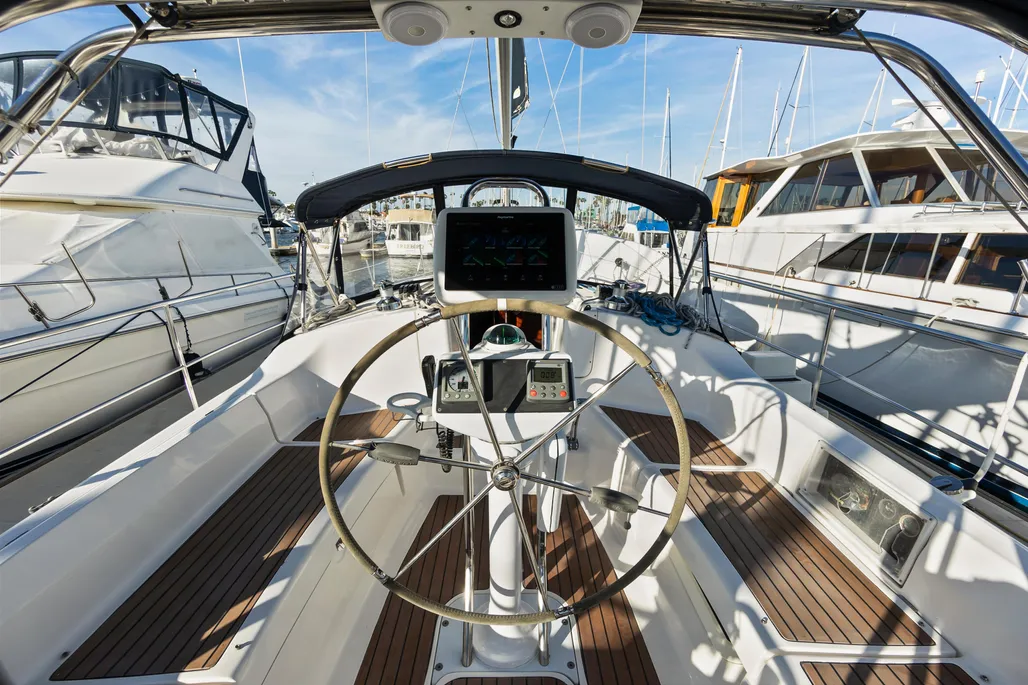
Wheel
Deck Hardware
Safety Features
Rig
Windlass
Ventilation
Accommodations
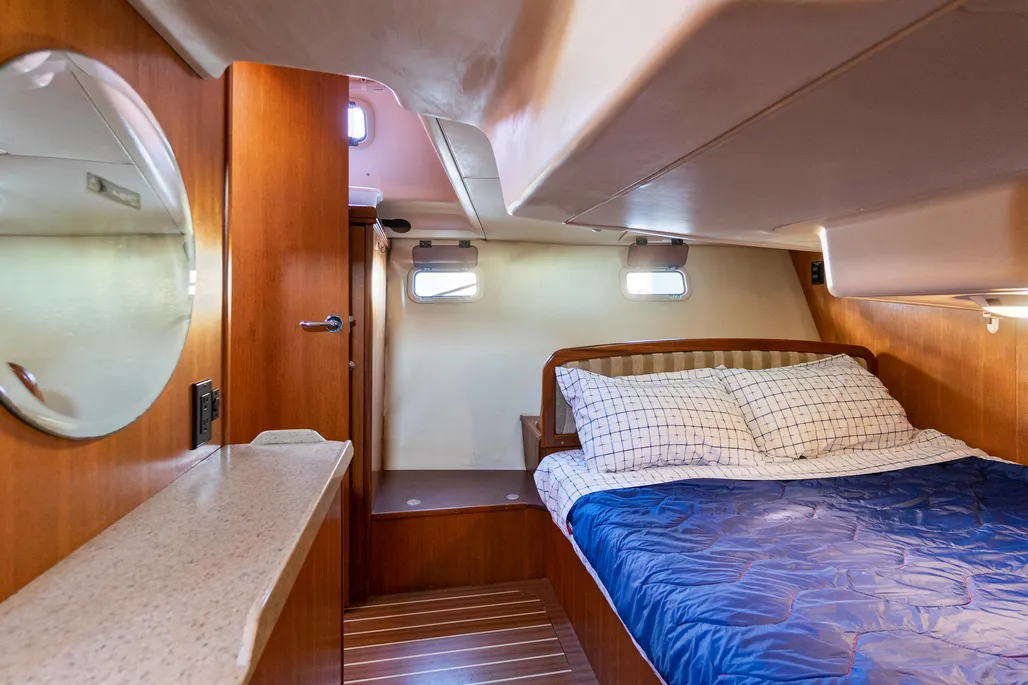
Galley
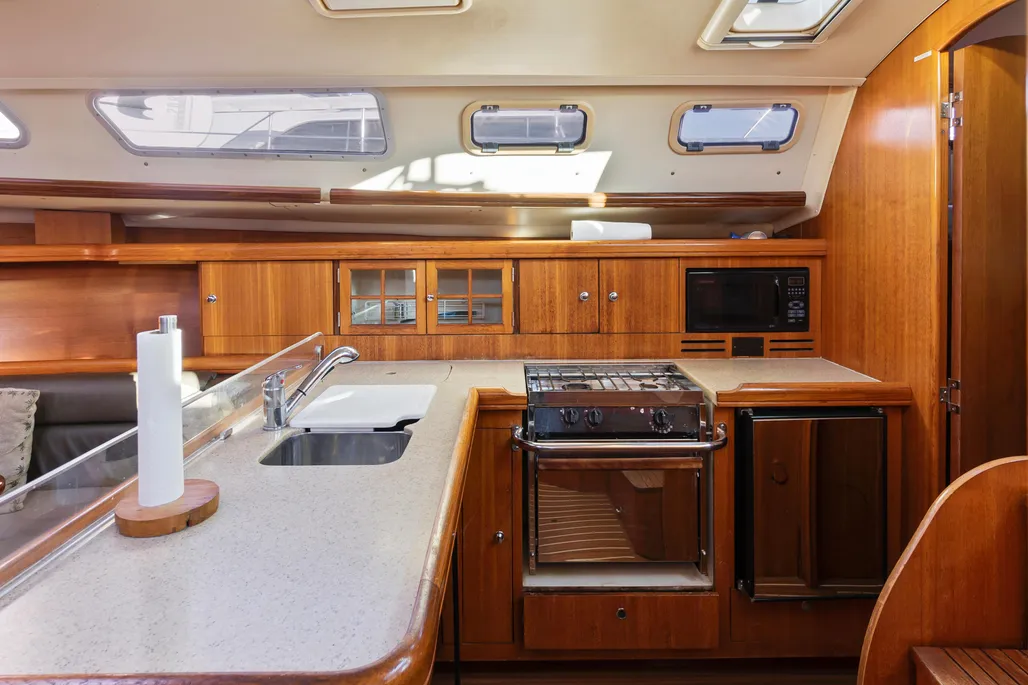
Nav Station
Skipper’s Stateroom
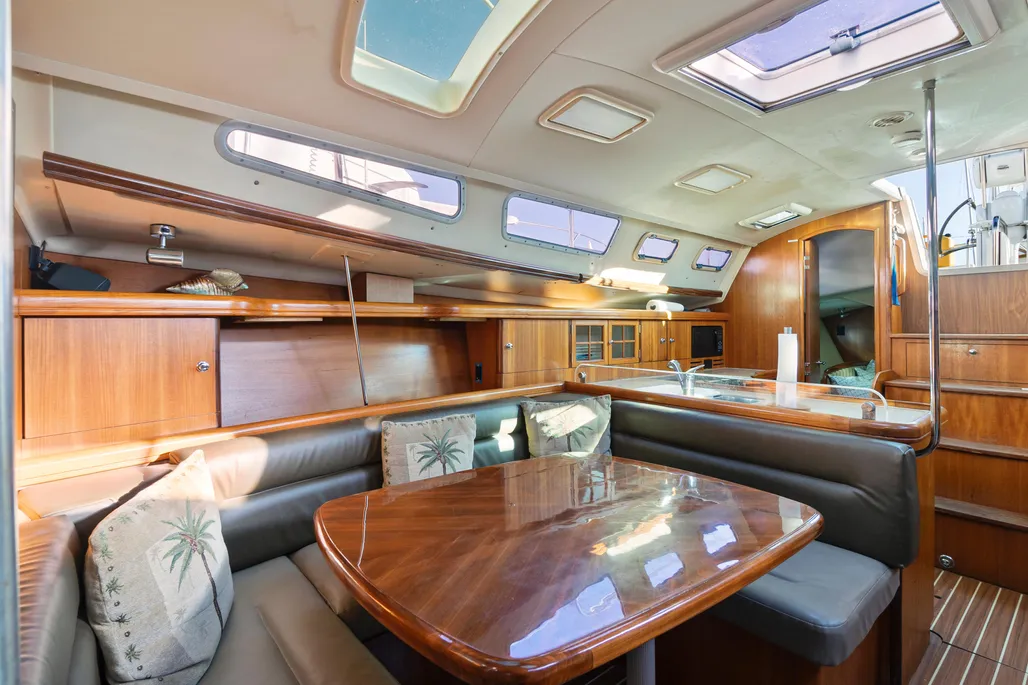
Engine Access
Forward Stateroom
Head
Performance
Conclusion
Market Scan Contact
2007 Hunter 38 Denison Yachting
$119,000 USD 562-469-5108
Long Beach, California Yacht World
2005 Hunter 38 Sandy Hook Yacht Sales Inc
$110,000 732-530-5500
Clearwater, Florida Yacht World
2006 Hunter 38 Seattle Yachts
$97,900 410-397-7323
Deale, Maryland Yacht World











All the links under “Also With This Article” are broken!!