

In the article “Is All-Electric Propulsion Practical on Small Sailboats?” we explored the current state of technology for all-electric marine propulsion. We concluded that range remains too limited for the vast majority of sailboats, although much depends on the operational use of the vessel. We also examined how range can be extended by adding solar and hydrogeneration capability, and concluded that these technologies generally favor bigger and faster boats.
The next question becomes: If battery technology has not matured sufficiently for all-electric propulsion to be viable, what about hybrid electric propulsion? Is that now of a maturity where it is viable for sailboat use? This article seeks to answer that question.
What Is Hybrid Electric Propulsion?
Any dual fuel arrangement—such as having both gasoline and electric outboards on a sports fishing boat—is a hybrid concept, and an excellent idea. For this article, however, we will focus solely on combining diesel and electric propulsion (e.g. hybrid electric), in a single integrated system. There are three ways to do so, two of which are of interest to us.
Diesel Electric
Firstly, and of least interest to us, is the diesel electric system, which has been used for decades in trains and commercial vessels. This system has a conventional diesel engine, but instead of the mechanical gearbox there is an electrical generator, controller and motor. The combined losses of the electrical components, however, exceed the losses of the mechanical gearbox that it replaces, which means that the system is less efficient, as well as being more expensive, more complex and with additional space and weight requirements.
The primary reason the system is used on trains is because of the need to deliver power to multiple axles (and, on ships, to power directional thrust), something which would be difficult to achieve through mechanical gearing alone. With a sailboat, however, there is no comparable need and therefore no obvious reason to consider installing such a system.
Serial Hybrid
If we add a large battery to that diesel electric system, however, we have what is called a serial (or series) hybrid, and that is of more interest to us. This is a big improvement over the diesel electric we just discussed, as it can: (i) propel the vessel on battery power alone (such as when silent operation is desirable); (ii) add optionality, in that the battery can be charged by shore power or renewables, as well as by the engine. We still have issues of cost, complexity, space and weight etc. however. Therefore the question remains whether the advantages can outweigh the disadvantages, a subject we explore later in this article.
Parallel Hybrid
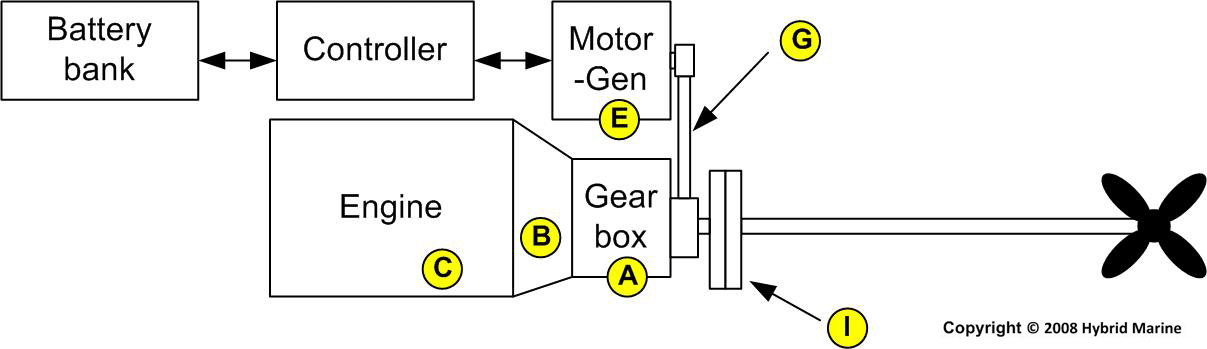
Of still greatest interest is the parallel hybrid propulsion system. This retains a conventionally sized diesel propulsion system, with its mechanical drive train and, in parallel to that, a battery driven electric motor (actually, a reversible motor and therefore a motor-generator), that is capable of being mechanically connected by clutch or pulley to the drive train.
That configuration adds flexibility, in that it allows (i) the vessel to be propelled either by the diesel engine or the electric motor or even both, simultaneously; (ii) adds further charging optionality, in that the battery can also receive a fast charge from the diesel engine driven motor-generator. The most obvious application would be to propel the vessel electrically, up to moderate speeds (or where silent operation is required) and conventionally with a diesel engine, once higher speeds are required.
Why Install Hybrid Propulsion?
There are multiple reasons to consider a hybrid propulsion system, starting with the early adopters who simply like the idea of new technology. In some jurisdictions there are regulatory emissions issues and, for others, the appeal is the concept of silent operation. For yet others, the appeal is the ability of a parallel system to deliver a fast-charge, feeding a LiFePO4 house battery system and its ever-growing power needs. This is significant, as the system can deliver multiples higher charging currents than a conventional alternator.
In “Is All-Electric Propulsion Practical on Small Sailboats?” we discussed that having reliable propulsion is a safety consideration. Given that the parallel hybrid system retains a conventional sized diesel engine, there should be no such concerns. Additionally, the parallel system offers a layer of redundancy. Should the diesel engine die at a critical moment, the electric battery system can take over the load.
Can we take the argument one step further, however, and conclude that a hybrid system can deliver such efficiency improvements so that the cruising range is materially increased? To answer that question, we first need to revisit how the various components perform under various loads.
Power Curves and Operational Efficiency
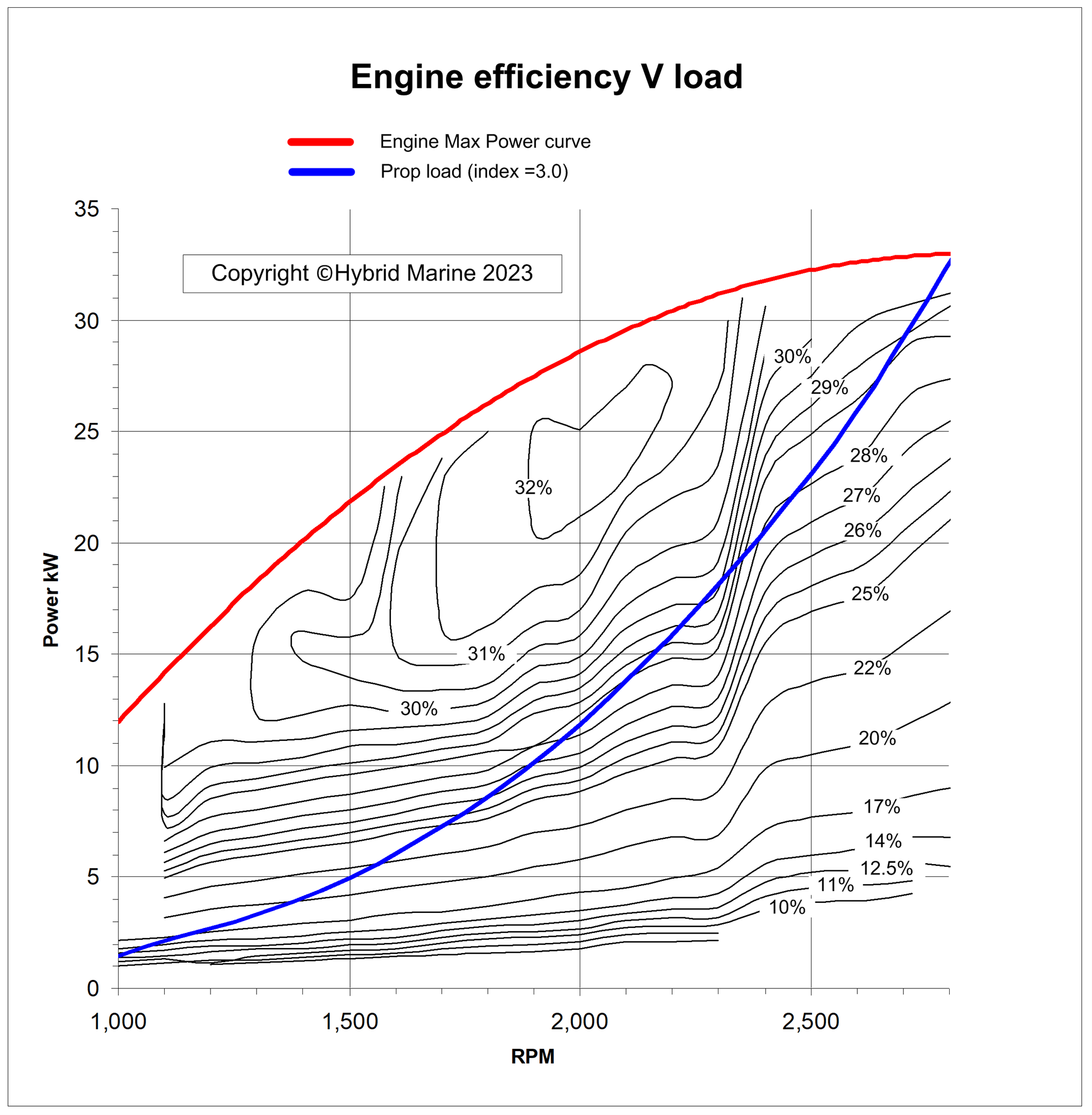
Firstly, while diesel engine power curves are unique to each engine, the highest efficiency is typically achieved somewhere in the mid-range, where it may be around 32 percent. At low load and RPM, diesel efficiency drops, and ultimately may dip below 10 percent.
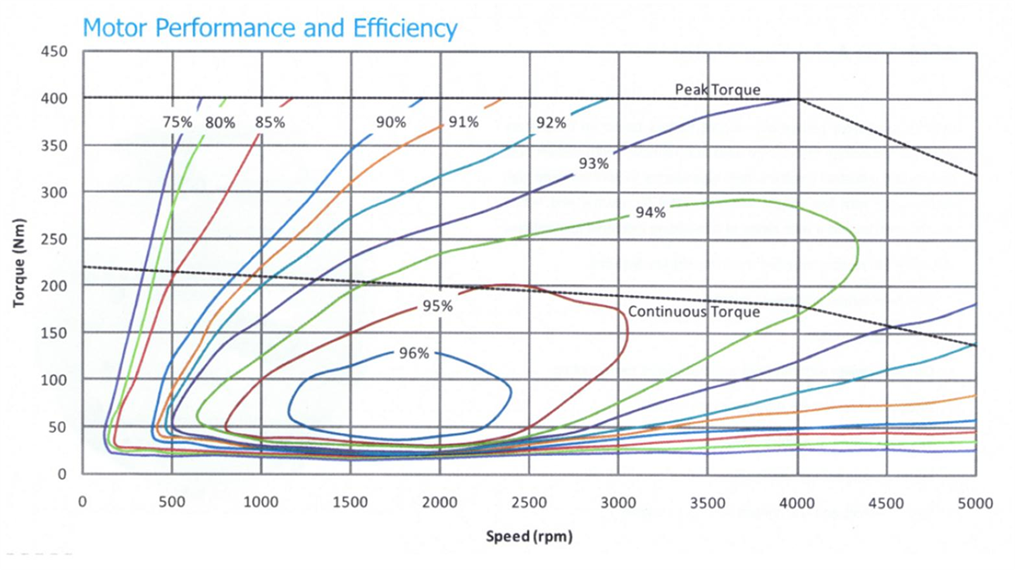
Similarly, electric motors have their own load and efficiency curves. While a manufacturer may quote a nameplate efficiency as high as 96 percent, that will only be at the optimum point of operation. At low load and RPM, the efficiency may drop to as low as 75 percent, or even lower.
Operational use of the vessel also matters. One of the industry leaders in this field, Hybrid Marine, include on their website an illustrative vessel power curve that shows the power required to maintain a given vessel speed under different sea states. This illustrates that, to make way in rough water (and windage) conditions, a vessel requires significantly greater power (potentially up to four times) than is required to operate under calmer conditions.
Selection and Design of a Hybrid System
Applying those three characteristics to hybrid system selection and design, we conclude:
- That it is a flawed approach to design any propulsion system around an assumption of calm water conditions, as real-world power requirements far exceed those.
- The fundamentals work in favor of parallel hybrid systems, because in a series system the electric motor needs to be sized to serve peak load, which means that for most of its operational life it would be operating at sub-optimal efficiency.
In an optimum case, therefore, with a parallel system we have both the engine and the electric motor-generator operating close to the optimum point of their respective efficiency curves, leading to measurable improvements in fuel economy. Much depends on the operational use of the vessel, however, with vessels that undergo long periods of low throttle use (such as offshore fishing vessels or craft in inland waters), benefiting the most and potentially by as much as 30 to 50 percent. Conversely, if most of the engine use is at cruising speeds (greater than two-thirds hull speed), little (maybe 10-15 percent) to no benefit will arise.
Add in Renewables
In the article “Is All-Electric Propulsion Practical on Small Sailboats?” we ran a set of high level, theoretical calculations, on the contribution that both solar and hydrogeneration could make. We theorized that renewables on a smaller sailboat could, at best, deliver two and one-quarter hours of propulsion in a 24-hour period. That is time we are not consuming diesel, however, which means, in effect, a further reduction of about 10 percent in fuel consumption.
If we were to run the calculation again, but for a catamaran or much larger vessel, with more deck space for solar panels and higher speeds for hydrogeneration, the contribution from renewables might climb to 20 to 30 percent.
Marketed Systems
In 2024, Yanmar released a conceptual data sheet for a parallel hybrid system called YF12e, although it has not yet announced when or even if the product will be commercially available. In the conceptual data sheet, however, it envisioned a complete package, based on a Yanmar 4JH80 or 4JH110 engine (an 80 or 110hp, 2-liter, turbodiesel), with gearbox, electric motor, Lithium-ion batteries, cooling, monitoring and controls. It claims that in one hour of operating in hybrid mode, it could create sufficient charge to allow one hour of propulsion in “EV mode.”
Beta Marine has been developing hybrid technology for over a decade, and their website includes a range of parallel hybrid systems, including units based on the Beta 30 and Beta 60 engines, thereby potentially catering for boats smaller than the conceptual Yanmar system. The Beta 30 version is fitted with a single motor/generator, capable of providing 10kW of electric propulsion. When in the generation mode, it can provide 5kW (8kW with optional boost alternators fitted) of power. For the larger models, Beta fits a twin motor/generator.
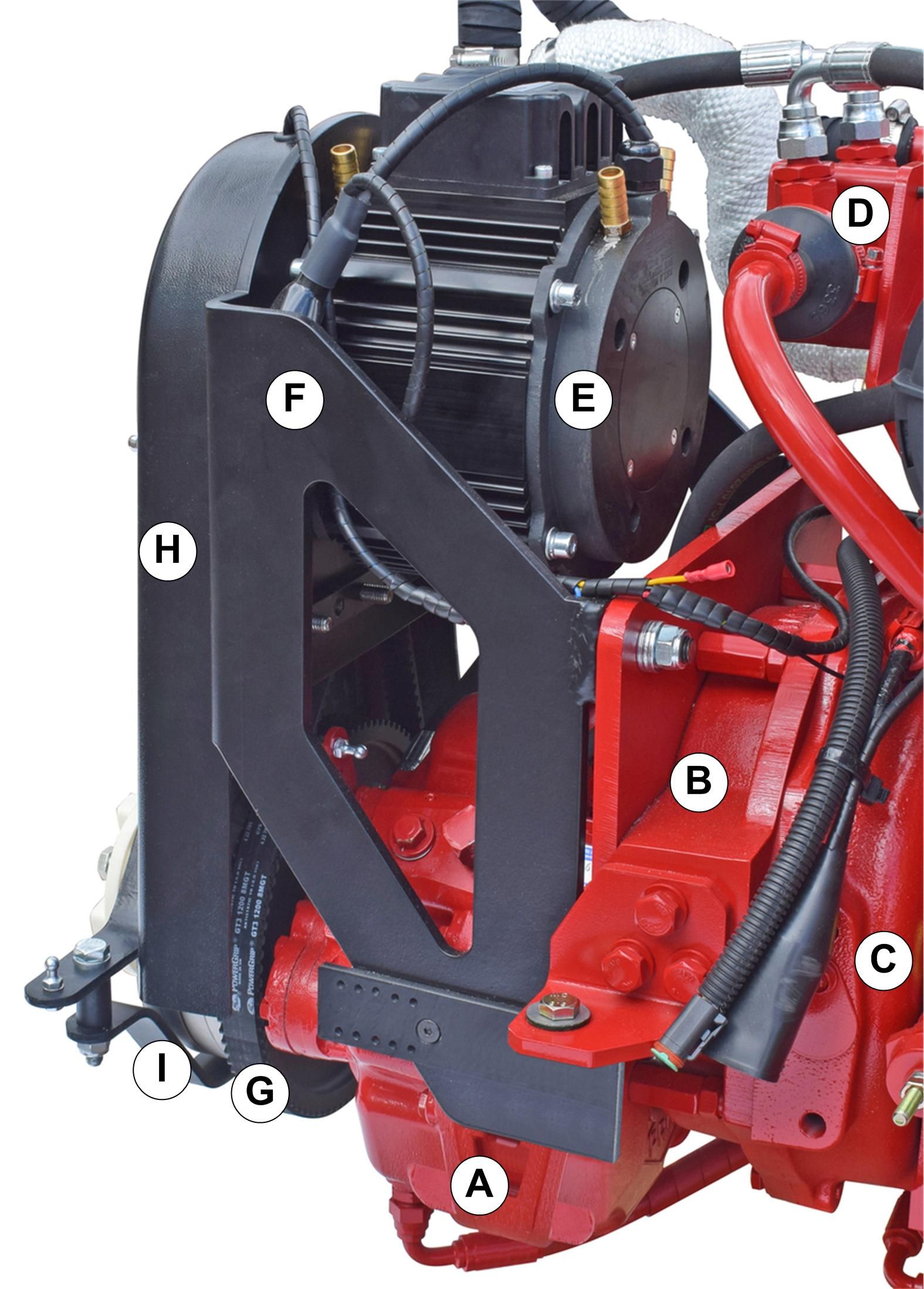
(Table/ Hybrid Marine)
Item Description
A Standard marine gearbox (in this case a PRM 150). On the right hand side this connects via bell housing “B” to the engine “C” (engine not shown). On the left hand side the output flange of the gearbox connects to a soft coupling and the propeller shaft
B Gearbox bell housing
C Marine engine,
D Oil cooler for gearbox
E A liquid cooled, brushless, motor/generator, the heart of the hybrid. This sits above the gearbox and connects to the output flange of the box via a pulley/belt arrangement.
F Motor/generator mounting bracket fixes the assembly to gearbox and bell housing
G A pulley is inserted between the gearbox output flange and the shaft coupling. This pulley then connects, via a toothed belt, to a pulley on the motor/generator.
H Belt guard
I Shaft Clutch. Allows the shaft to be disconnected from the gearbox so the hybrid can run as a stand alone generator without turning the propeller. This is an optional extra and is not required on some systems (for example canal boat hybrids replace this with a boost alternator)
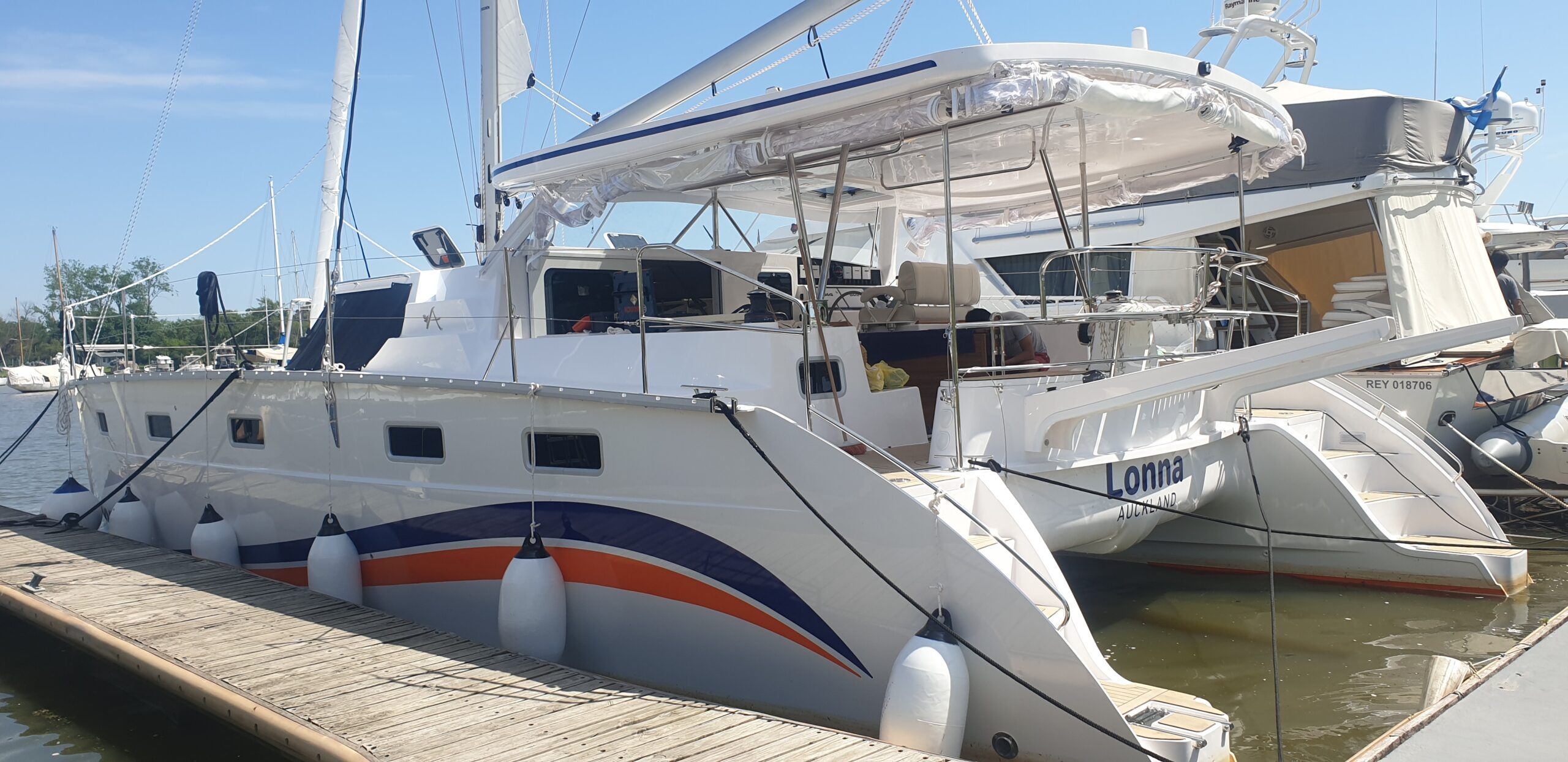
We mentioned earlier, the U.K. company Hybrid Marine, who have been successfully developing hybrid systems since 2002, with over 200 such systems delivered, based on both Yanmar and Beta engines. In 2007, they were the first to introduce a production parallel hybrid system and their website features a range of case studies. One of the larger examples is a French canal tourist boat, with twin Beta 105 hp hybrids with 40 kW of electric drive, which is capable of operating electrically for the entire day. Another case study features an Antares 44 catamaran, with twin parallel systems (e.g. a system in each hull).
Hybrid Propulsion on Monohull Sailboats
While there are multiple examples of hybrid systems on large or luxury catamarans, there seem to be relatively few on regular-sized monohulls. The YouTube Channel Sailing SV Delos built their own hybrid system for their 53-ft. Amel, which seems to have operated successfully over many years.
A Canadian company, OSEA, converted a 48-ft. ketch with a series hybrid system, and Hydro Marine have at least one conversion on a sailboat less than 40 ft. Generally, however, most of the hybrid examples are either working boats (especially those that experience long periods of low to mid throttle use) or catamarans.
What the Experts Say
Nigel Calder has been involved with many hybrid systems and is of the view that most serial hybrids systems, especially on smaller boats, were expensive failures. For the reason we just observed, builders installed too small a system to save money, and the boats were found to be underpowered in real world conditions. He said that he has seen many such installations removed and repowered with a conventional diesel engine.
Conversely, Nigel believes that parallel hybrid systems have largely been successful. He says that if he was building his boat today, he would install such a system.
Conclusion
Clearly, the parallel hybrid propulsion system is the preferred configuration and the market for that is maturing with a growing number of installed systems. The up-front cost is the major drawback, however, with figures (for a parallel system) quoted at up to twice the cost of a conventional engine and gearbox, not even considering the cost of the 48 V battery bank.
Space and weight are also a consideration, as there is a significant space requirement to house that battery bank. Finally, there is also the issue of complexity—while modern solid-state electronics have become remarkably reliable, they are still an additional layer of complexity that a boat owner needs to become familiar with.
We have already discussed the many advantages, including: silent operation, reduced emissions, redundancy with independent (diesel and electric) systems, and the ability to fast-charge battery banks. Fuel efficiency improvements supplemented by renewables can also increase range. The reality, however, is that few cruisers use their engine for more than 1,000 hours a year, so the fuel cost savings are unlikely to offset the upfront costs.
The bottom line? As attractive as all the features are, repowering to a parallel hybrid system will probably not make sense for most owners, unless they are a real enthusiast, unfazed by cost and complexity. Conversely, designing and constructing a new boat, particularly a larger boat or catamaran, around such a system may make a lot of sense, provided that the builder has the appropriate expertise and the buyer is comfortable with the complexity.








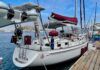
My 27 ft 3500# full keel sailboat gets in and out of the harbor with an electric motor with the battery topped up with a relatively small solar panel
2000 watts gets me up to hull speed of 4 to 5 knots
A Honda 2000i generator strapped on deck and plugged into a 650 watt battery charger lets me cruise along at 3 to 4 knots sipping gasoline indefinitely
Hybrid works if you don’t get fancy