

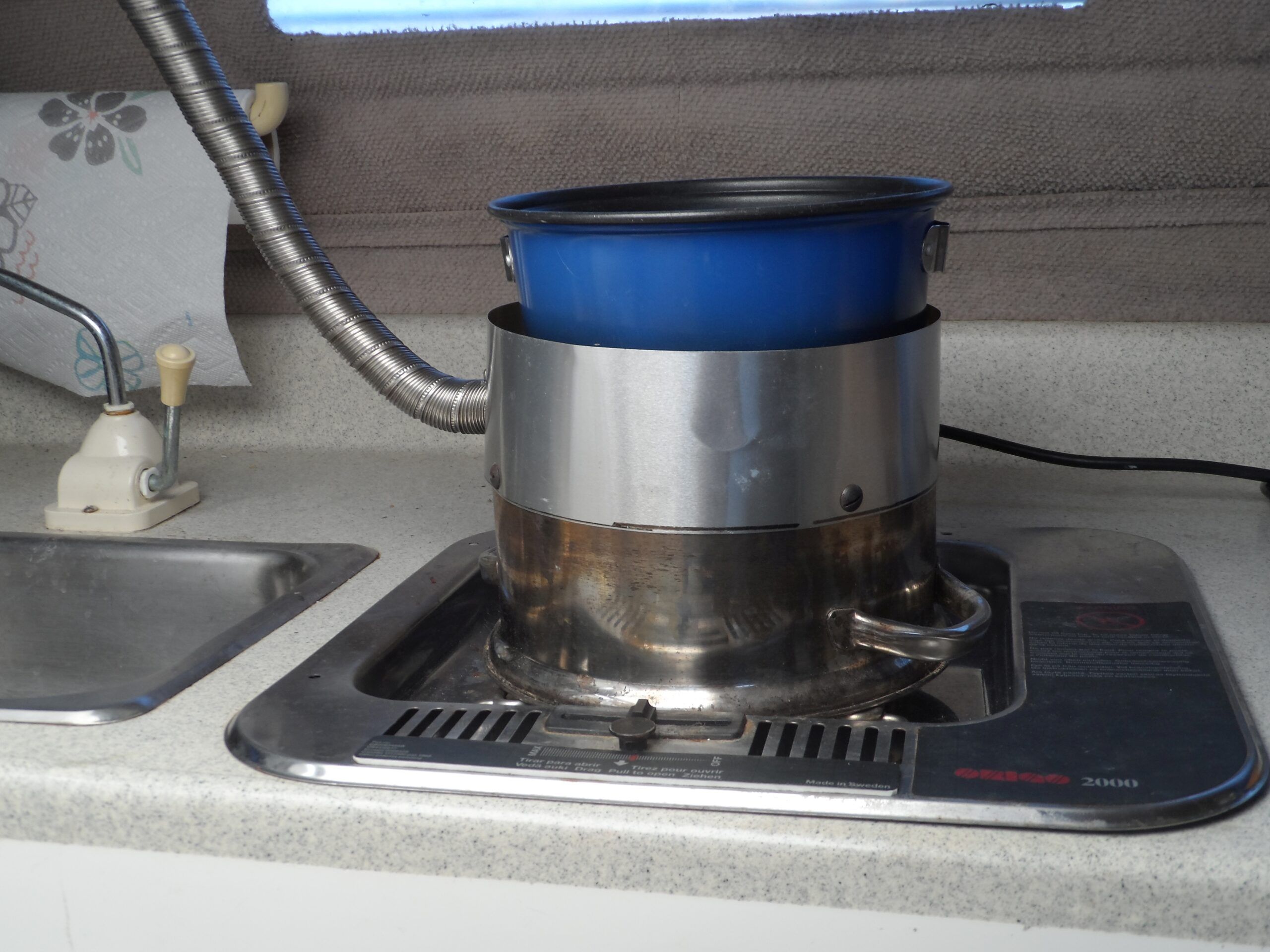
For my small F-24, with no cabin heating and no justification for the complexity of an installed system, this has been one of my best upgrades. I made it entirely from scrap in about an hour. It is based on the idea that most boats already have a heat source with some safety measures in place. All it needs is a heat transfer surface and a smoke stack, and you have a vented heater that is safer than a portable heater that vents combustion gases straight into the cabin.
Why Unvented Heat Is Dangerous
The first problem with portable propane or alcohol heaters, candles, lanterns, or just running the stove, is that lacking a flue, the combustion products (including carbon dioxide and water) end up in the cabin. Oxygen is consumed, and eventually carbon monoxide is generated. The rough and ready solution is to crack a window, but how wide, and if it’s actually cold outside, how much of the heat is lost?
A portable heater can be knocked over; running one underway in a seaway is asking for a fire. Even in harbor, do you have a safe location? On the other hand, an installed cabin heater with a flue is a complicated, bulky, and expensive affair requiring complex installation, wiring and plumbing. I did this on my cruising boat, but it’s overkill for a smaller boat that requires heat only rarely, for a few off-season weekends and cool evenings.
Safety Concerns and Limitations
None of the portable propane heaters I have seen are rated for use in a boat cabin, primarily because of concerns about propane cylinder leaks. Portable heaters do incorporate an oxygen depletion system, but it is a very simple affair; a thermocouple located near the pilot or main flame detects when the flame lifts off the burner. In theory, this prevents carbon monoxide generation, but there are other potential causes, including drafts and improper adjustment. They do not include CO or CO2 sensors. Finally, they are not approved for use in small rooms and they are not intended for continuous use.
A Safer Alternative: Use What You Have
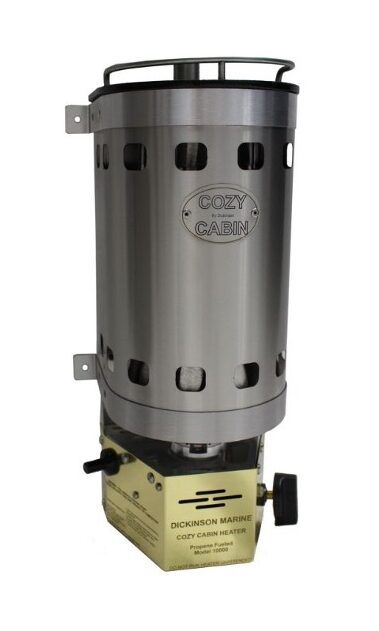
This led me back to the installed stove. It can’t tip over and it can’t start a fire unless something combustible falls on it. It does not include oxygen depletion sensors, but it’s easy to add a carbon monoxide monitor to the cabin. All that is needed to convert it into a simple vented heater is to provide heat transfer surface and funnel the exhaust outside the boat. The ubiquitous Dickinson Marine Cozy Cabin Heater is not much more than this; a simple burner below an inverted can heat transfer space, connected to a 1-in. stainless steel flue.
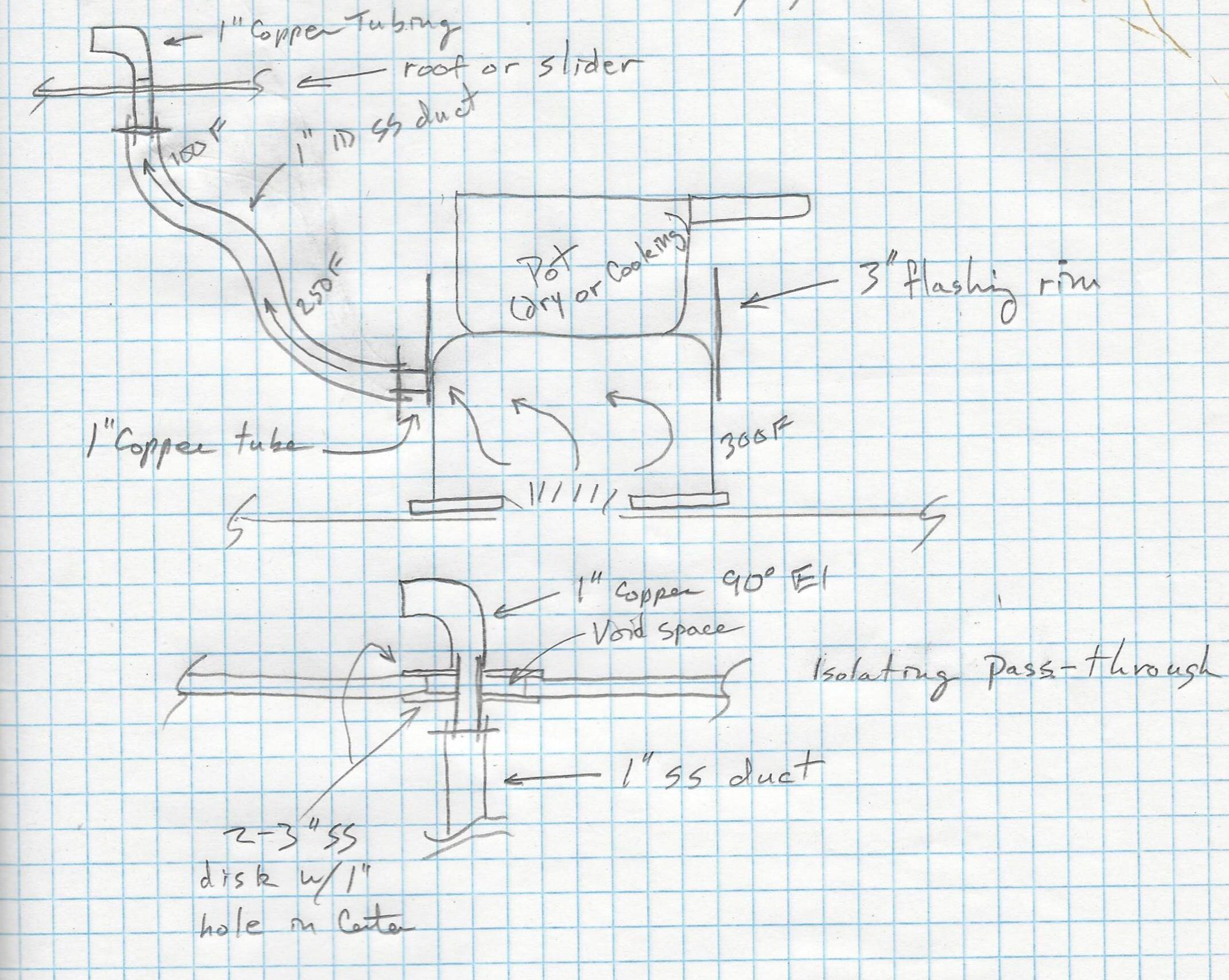
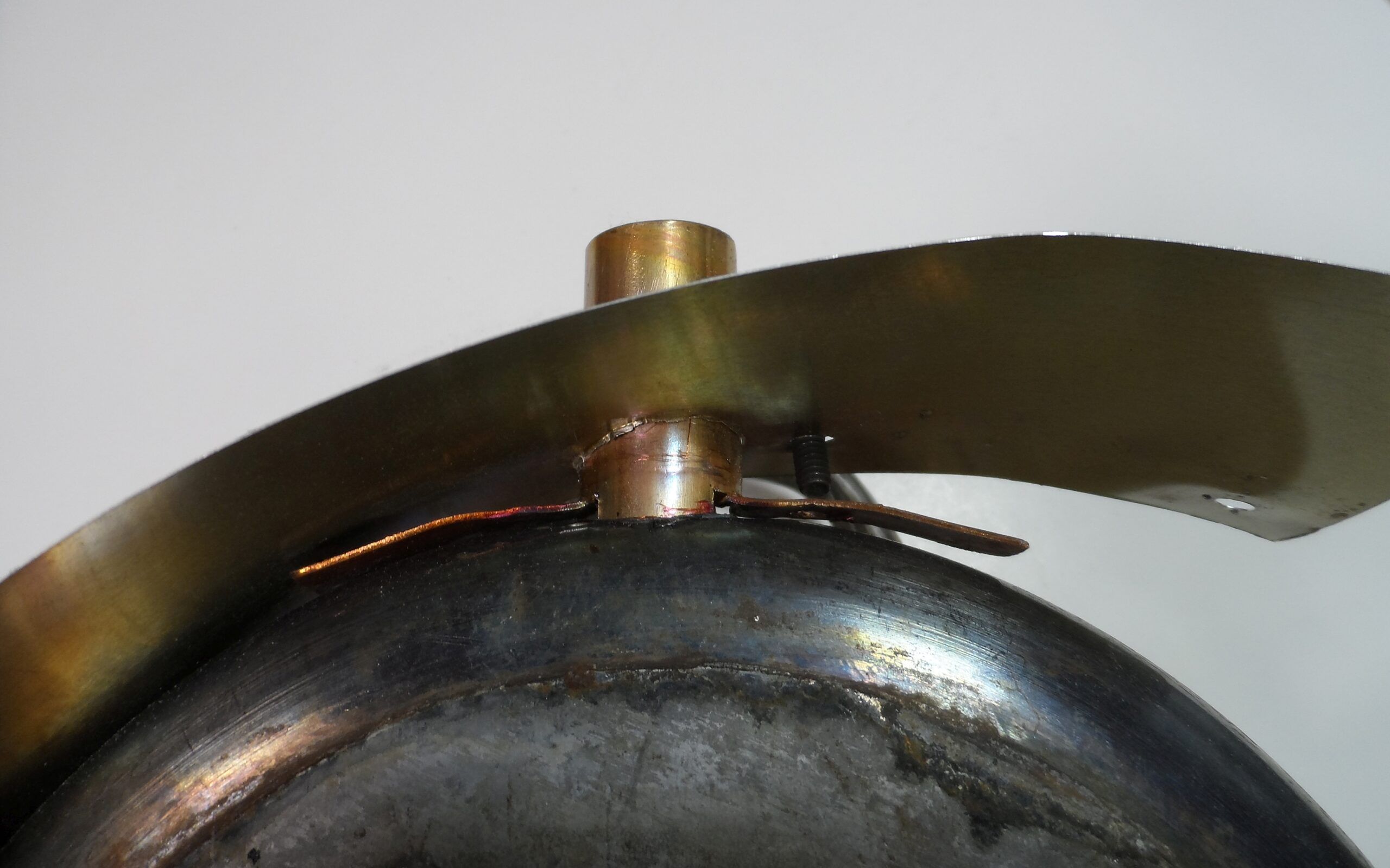
My F-24 trimaran has an Origo 2000, a non-pressurized alcohol stove, installed in the countertop. See “Living Aboard with an Alcohol Stove.” A retired 4-quart stainless soup pot provides the heat transfer surface for my stove top heater. I cut a 1-in. flue opening with a hole saw, into which I inserted a 1-in. copper pipe stub, secured by slitting the end to create tabs that could be bent inside and out. These were further secured with small bolts (blind rivets would be more streamlined).
Installation and Securing
Materials
- 1-inch ribbed duct hose, stainless. McMaster Carr 5241K13, $23.80 for 5 feet.
- 4- to 6-quart stainless soup pot, thrift store or retired from the home kitchen.
- Aluminum flashing
- 6 inches of 1-in. copper tubing
- (1) 1-inch copper 90-degree elbow
- Assorted small screws and two long cotter pins or nails.
- Plywood or similar to build slider insert, or better, install the flue through cabin roof or bulkhead if you will use the heater often.
Aluminum Roof Flashing Skirt
A 3-in. high aluminum roof flashing skirt was added to create a cooking surface on the top, as well as increasing heat transfer surface and improving sealing around the flue.
Flue Placement
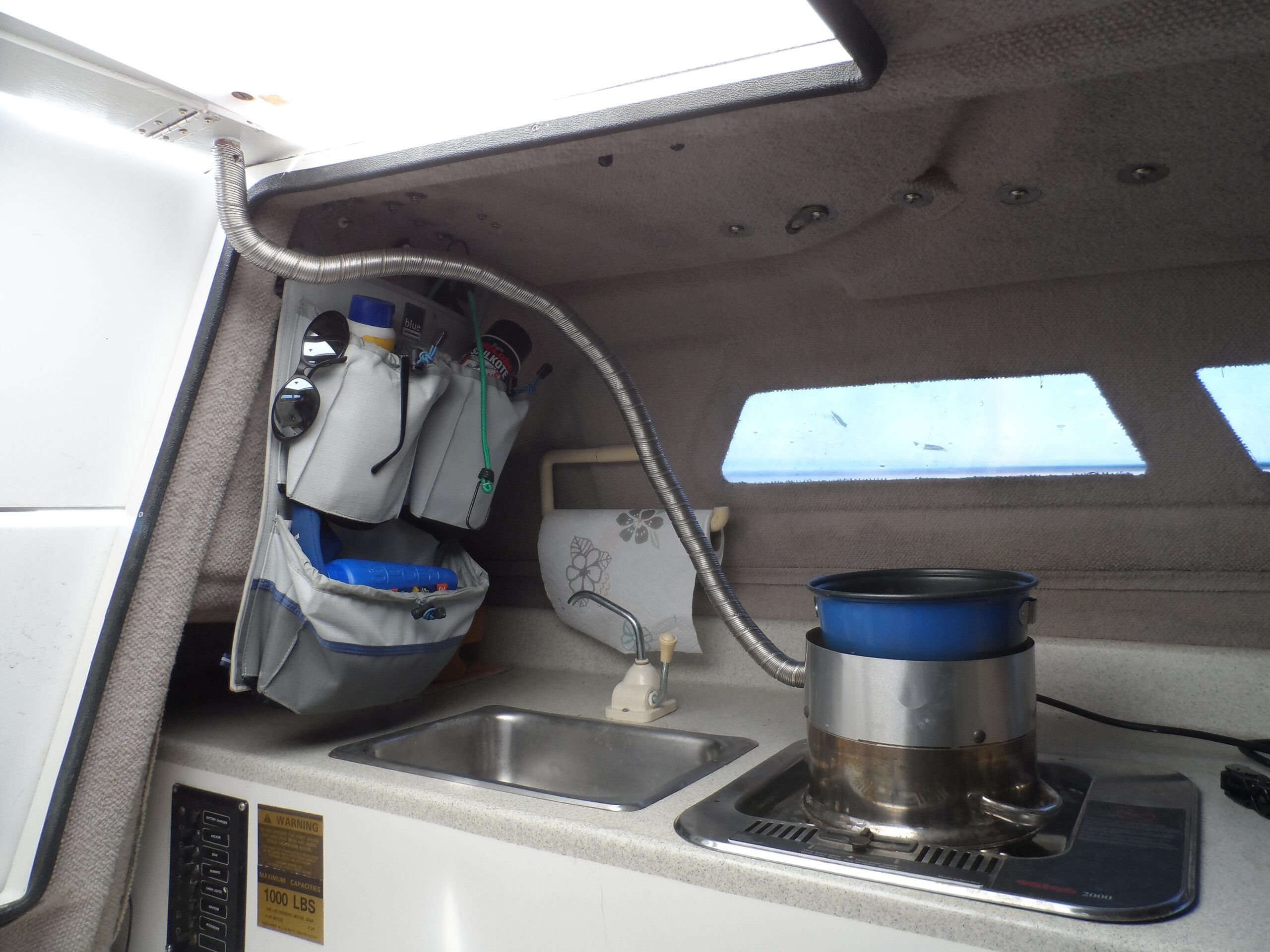
The 1-in. ID corrugated stainless steel duct flue must rise steadily towards the roof, without low spots, and be three to six feet long to further radiate heat and cool the exhaust. It is secured to the copper pipe at each end with a cotter pin or through bolt. There is no need for sealing since the fit is good and the entire length is under slight suction.
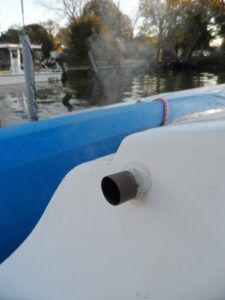
First, I tested the heater on our home stove, clamping the vent to the top of a 6-ft. step ladder, and then on the boat, fitting a 3-in. wide board to the aft end of the companionway slider and passing the flue through that (this avoided drilling a hole). See results, below. After a few uses, deciding there was nothing to improve in this simple design, I drilled a hole in the overhead. A 90 el pointed down keeps the rain out.
The heater is quite stable and there is no need to secure it on our F-24 trimaran. However, on a monohull prone to heel, a pot retention fiddle or a few small hooks from the pot lower rim to the grate can secure it.
Testing
Exhaust Gas Flow
I scanned the surface and flue with an IR thermometer. The pot surface reaches about 290 to 340 F. By the time the exhaust reaches the outlet, it has cooled to 90 to 150 F, proving high efficiency. I tested the air just above the pot, curious as to whether some of the exhaust was sneaking out under the bottom; the CO2 level was barely above background and the temperature never exceeded 200 F, confirming that essentially all of the exhaust goes up through the flue.
Above 80 percent on the flame regulator the CO2 did begin to rise—not surprising since this is above the firing rate of the Cozy Cabin, upon which the flue size and heat transfer surface sizing is based; keep the firing rate below 2/3 or use a larger flu.
Heat Output
The heater is very efficient, condensing much of the water vapor in the exhaust just like modern high efficiency furnaces. The Origo 2000 stove is rated at 7,000 BTUs. Because this heater uses the same flue size as the 5,000 BTU Sig Marine Cozy Cabin heater, I recommend not exceeding that combustion rate; the heat adjustment on the stove should be no more than two-thirds open.
This will give a heat output of about 1500 watts, or the highest setting of a typical portable electric space heater. That is enough to fully warm the cabin of my 24-ft. boat in 10 to 20 minutes in cool to cold weather.
If the firing rate is too high, some of the exhaust will back out under the pot and into the cabin; you will be able to feel the hot exhaust escaping around the lower edge of the upside down pot. You would need to crack a window, defeating the value of the extra heat input.
Cooking
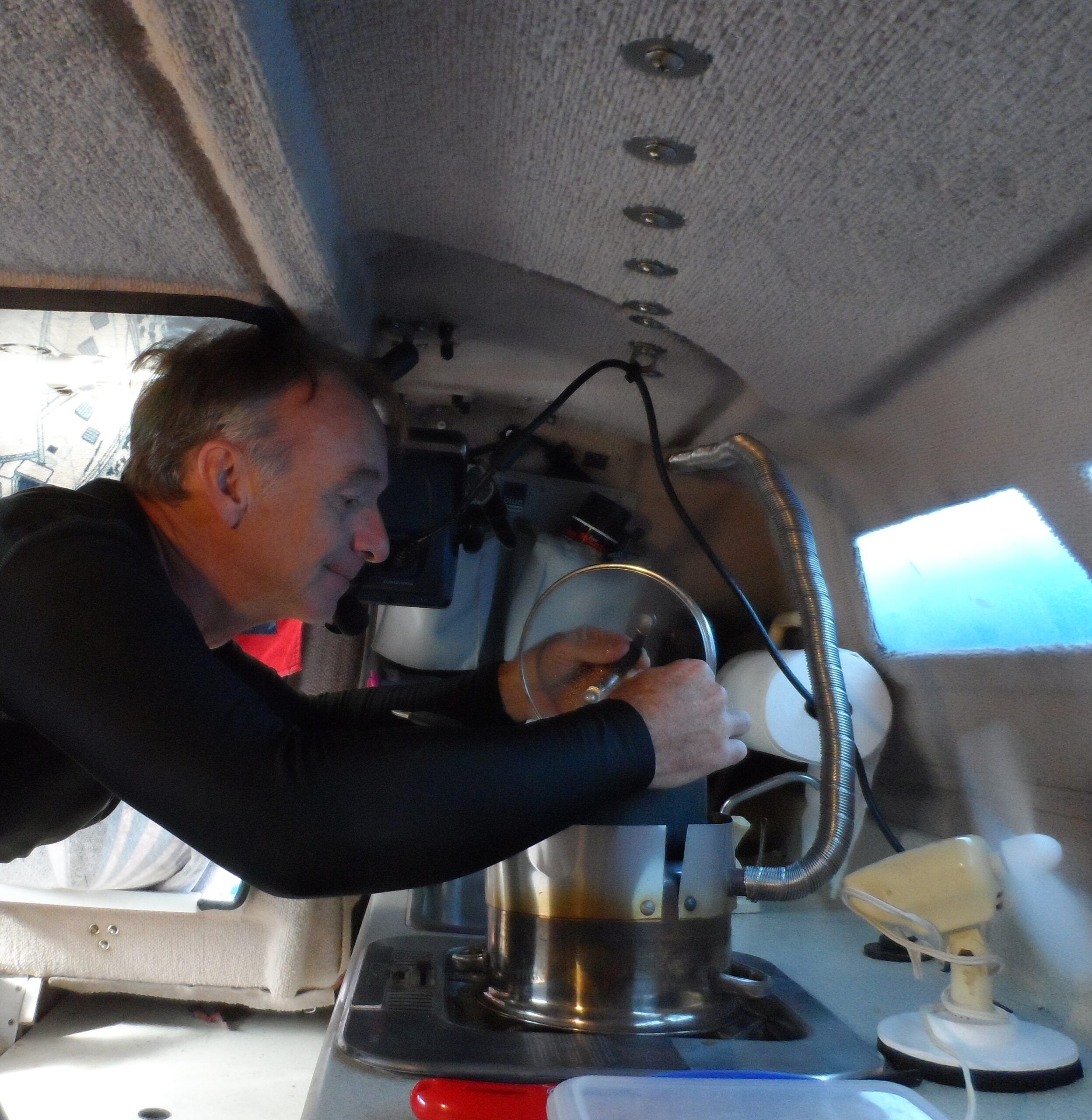
The primary purpose of the flashing rim is to improve heating efficiency, but it can also provide a cooking/warming surface. A pot placed on the upper surface with the burner on high will heat two cups of water to a boil in 10 to 15 minutes. Turned down, as it should be to warm the cabin, it will simmer a dish, without burning or polluting the cabin with carbon dioxide. Although the heater is stable enough to be used underway, do not cook underway; the pot may fall off, scalding the cook.
A small USB fan is directed towards the upside-down pot and slightly upwards toward the flue to improve heat transfer and distribute the warm air around the cabin. Keep it on low to prevent drafts.
Fuel Usage
Set at half throttle, the stove will burn for 10 to 16 hours, consuming 2 to 3 ounces of alcohol per hour. A fill-up generally lasts us two nights. Refill only when cool. See “Choosing the Right Fuel for Your Alcohol Stove.” A butyl or silicone rubber gasket placed over the canister (do not install until after the stove has cooled for a few minutes) prevents fuel evaporation when not in use (these are often lost and missing on older boats—replace it)
Other Fuels
This heater will work with stoves burning alcohol, propane, CNG, butane, and kerosene, as long as the firing rate is similar. The differences in combustion are small. The stove should be either installed in the countertop or of a low profile, stable design.
I don’t leave it on while I sleep. It’s not designed for that and I like sleeping under a thick quilt or in a warm sleeping bag. I don’t leave it on while away from the boat. I run it from sundown, through the dinner hour, until ready for bed. I use a carbon monoxide detector or and I leave the slider open a tiny crack to be certain.
It sure beats a damp cabin and cold fingers. More importantly, it avoids low oxygen, high CO2, and minimizes CO risk.
CO2 concentrations over 1,500 ppm affect thinking and are universally considered cause for investigation and correction. Over 2,000 ppm is considered serious by health departments. 10,000 ppm is the threshold of serious problems with medium-term exposure (many hours to days), and both OSHA and NIOSH limit workplace exposure to 5000 ppm. Burning propane or alcohol produces considerable water vapor, about 120 percent of the mass of the fuel consumed. Dry air is nearly as important to comfort as warm air because insulation remains more efficient. Dry your wet clothes outside if possible. I did a few simple calculations for my Corsair F-24. If I run an unvented portable heater at about 4,000 BTUs/hr (what is required for 45 F evening), assuming no ventilation other than combustion air replacement, CO2 levels will reach 60,000 ppm within six hours, about the threshold of unconsciousness. I ran the stove for one hour with the regulator half open and the cabin tightly closed; carbon dioxide reached 15,000 ppm (5,000 ppm OSHA limit) and carbon monoxide reached 100 ppm (50 ppm OSHA limit), both well into the danger zone. A cracked window will reduce this, but unless the window is open wide enough to admit considerable draft—rather defeating the purpose in cold weather—there remains a serious risk of exceeding the limits for good health and clear thinking. There is also water vapor; an unvented heater will raise the humidity 30 to 60 percent, making for a clammy cabin and causing condensation on the windows. After venting the cabin for an hour, I ran the heater for an hour with the flue as designed; the CO2 and CO levels were more than 90 percent lower, well within safe limits. Preparing a quick meal is acceptable because you’ll be finished in 30 minutes. If the pot will simmer for an hour or more, crack a window for fresh air and to vent the steam.
I value my brain cells and don’t take risks with them. Thus, I’ve never been a fan of portable heaters.
Carbon Dioxide
Humidity








Love it! I do really appreciate home (boat?) built solutions to common problems aboard.
I suggest you use Grammarly for free to check and correct your writing. Otherwise, this was a good article.
Does this meet ABYC/NMMA/ISO/CFR/NFPA/etc standards? No it does not. I checked ABYC and there are 5-10 different standards that apply to marine heating and cooking appliances depending on fuel and installation. I like DIY/Rube Goldberg solutions to common problems when they don’t involve electricity and fire or otherwise ignore industry safety standards… As a expert marine litigation witness, I think you are taking on personal risk and putting others at risk by recommending this potentially dangerous hack. There’s good reason that industry safety standards exist. Recommend you make note of them and don’t play with fire on boats!
I appreciate your meticulous nature. I’m glad you posted that, and readers should review your comment.
ABYC is a voluntary standard. Other than installed heaters with sealed air intake, no portable heating device, or using the stove for heat at any time other than while cooking a
meal, meets ABYC standards. I did not describe it as an installed heater. I made no such assertions about complying with ABYC. The article describes a stove accessory. Perhaps that could have been even more clear, so I restate it here. The heater described in the article is a stove accessory, and as such, its use subject to all of the precautions applicable to using a stove, including no operation while unattended or sleeping. It is not a heater per se.
In fact, I did mention installed heaters, and they are best solution for cruising boats that use heat. I had such a system on my cruising cat.
As a stove accessory, the only applicable NFPA standards I am aware of relate to rating of the cook top (I have assumed an industry-rated cook top), and installation of the cook top, including fuel systems (integral in the case of the alcohol stove I described) and the spacing of the cook top from the cabin ceiling, walls, and combustible materials. Obviously, safe, rated stove installation has been assumed and is something the user should review in any case.
The reader is given a list of limitations and precautions, and these are repeated here:
* Do not leave the stove on unattended.
* Do not leave the stove on when sleeping.
* Install a CO monitor/alarm.
* Only for use with installed stove. I could have included that this must be marine-rated and installed in compliance with USCG and NFPA requirements.
Common alternatives to installed systems include running the stove for heat (good chance of CO poisoning), placing a flower pot on a stove burner (same CO hazard, plus the danger of a red-hot pot falling and starting a fire, or exploding from heat stress, which we have seen in testing), using an unvented heater (hazards listed), or using an electric portable heater (I know of quite a few boats burned to ash from heaters flipping over). The Cozy Cabin Heater, common in smaller boats, does not meet ABYC requirements (must have sealed combustion air intake).
These are all things for the reader to consider. I have been active on API and NFPA committees in a former life, and appreciate your concerns. Standards matter.
—
Standards texts are notoriously difficult for non-industry people to access. I was on some of the commitees, and I understand that standards organizations are funded by standard sales. It’s a conundrum for the user.
I found this for stoves in the NFPA for homes.
Household cooking appliances shall have a vertical clearance above the cooking top of not less than 30 inches (760 mm) to combustible material and metal cabinets. A minimum clearance of 24 inches (610 mm) is permitted where one of the following is installed:
1. The underside of the combustible material or metal cabinet above the cooking top is protected with not less than 1/4-inch (6.4 mm) insulating millboard covered with sheet metal not less than 0.0122 inch (0.3 mm) thick.
2. A metal ventilating hood constructed of sheet metal not less than 0.0122 inch (0.3 mm) thick is installed above the cooking top with a clearance of not less than 1/4 inch (6.4 mm) between the hood and the underside of the combustible material or metal cabinet. The hood shall have a width not less than the width of the appliance and shall be centered over the appliance.
3. A listed cooking appliance or microwave oven is installed over a listed cooking appliance and in compliance with the terms of the manufacturer’s installation instructions for the upper appliance.
A boat is not a home. I did not find a heat shield or spacing requirement for boats. Dometic specifies 19.5 inches of vertical clearance and no heat shield is requirment. Grease flare-ups are a serious hazard, particularly on a boat in close quarters. Cooking is not to be taken lightly and a stove must never be operated unattended.
Did you consider making a coaxial exhaust hose? It would provide the benefits of:
– The exhaust pipe should be cool to the touch over its entire length.
– The exhaust would be much cooler as it exits the cabin
– Fresh combustion air would be directed near the combustion source.
– Even better efficiency.
It probably wouldn’t work for your boat, but I had a diesel drip heater mounted directly below a Dorade box. When in use, the lid of the Dorade box was hinged open and a rigid exhaust pipe was inserted through the deck. It made for a very clean installation.
No question there is room for improvement. The goal was very simple stove accessory.
My last heater had a coaxial flue. Preheating the intake air improves efficiency. In the case of a very tight boat it ensures an adequate combustion air supply. The exterior of the pipe is cooler. The exhaust temperature, on the other hand, will be slightly warmer because there is less radiation from the inner exhaust pipe (as the outer pipe reflects much of the IR back) and a lesser temperature difference between the exhaust and outside air (the intake air is quite hot near the stove).
But this also complicates construction and would make the heater bulkier, heavier, and more expensive to construct. My feeling is that if the heater is for more than very occasional use, an installed heater meeting ABYC requirements is the right choice (Andy was right about that).
The Wheems & Plath Yacht Lamp is a very effective, safe and debatably inexpensive heater. That has been my go to for the sailboats I’ve owned. Doesn’t warm up the cabin more than a couple degrees. But, I think, it dries out the air. Regardless, it makes the cabin surprisingly comfy.
Intake for combustion air. Any fuel-burning appliance, vented or not, marine or not, requires an intake for combustion air. ABYC requires that this be sealed to the appliance, to prevent pressure imbalances, but early codes did not.
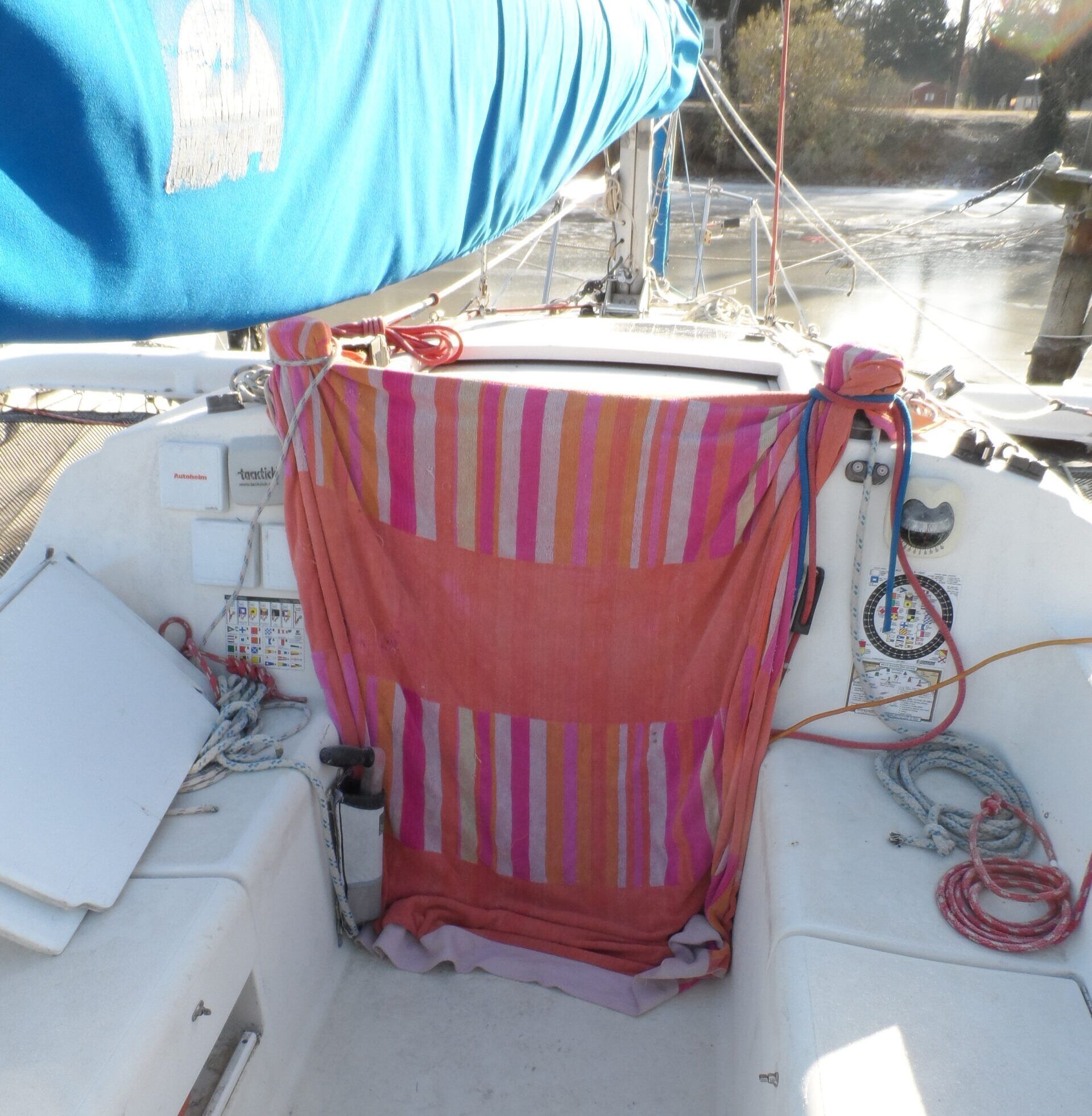
The standard rule of thumb is 1 square inch per 1,000 BTUs. A single burner is about 5,000-8,000 on high, and my installation included a nearby companionway louver with about 8 square inches of free area (subtracting for the grate). Most often, the companionway was covered with a fitted fleece blanket with a considerable gap around the bottom where it rests on the cockpit floor.
Cooking on a stove (without a sealed exhaust stack) requires about twice this at a high level (heat rises) for exhaust.
Be certain to supply intake air.