

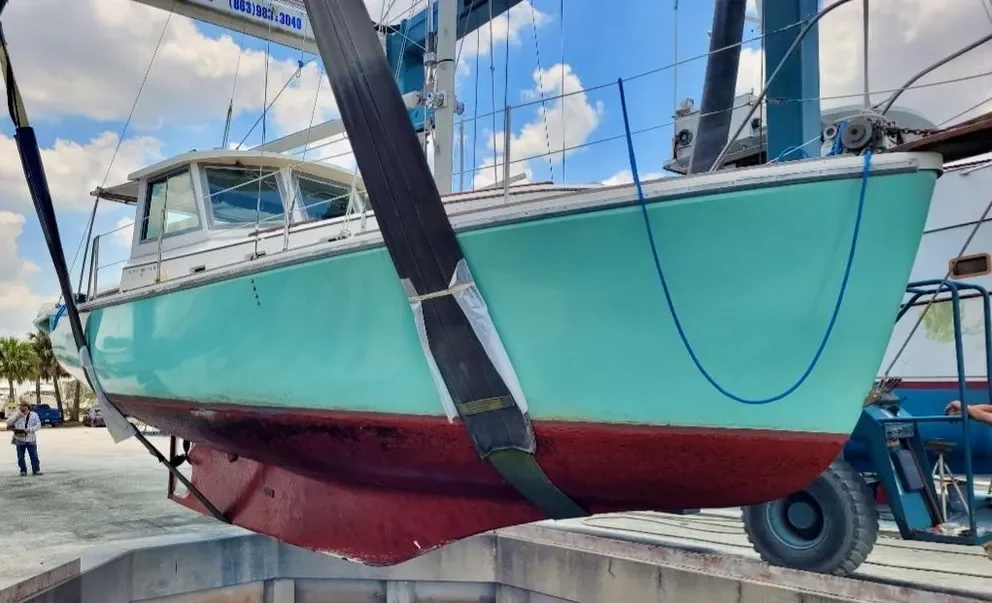
If you’ve ever looked at a sailboat and thought, “Yeah, but what if it didn’t suck when the wind dies?” welcome to the wonderful, and a little weird, world of motor sailors. In this article we’ll look at the Cape Dory MS300, a 30-ft. full-keel equipped salty little brick of a boat that sports a pilot house and sits somewhere between a sailboat, a trawler and a floating cabin—and refuses to be uncomfortable. The real question is, is this thing brilliant or is it one of those “does everything but nothing particularly well” compromises? Like a McGregor, for example.
If you’ve spent any amount of time boat shopping, you’ve probably had this moment. You’re looking at a sailboat, imagining yourself gliding along under full canvas, coffee in hand, dolphins doing whatever dolphins do, and then reality shows up. The wind dies. Now you’re drifting. Your carefully planned schedule is blown. Suddenly the romance starts to feel a lot like waiting in line at the DMV, except on the water.
That’s where something like the Cape Dory MS300 starts to make a lot of sense. This is a true motor sailor, not a sailboat with an engine as an afterthought, not a trawler pretending to sail because it has a mast bolted on like a hood ornament. This boat was designed from the ground up to do both jobs, and more importantly, to do them in a way that makes cruising easier. And that’s really what we’re evaluating here. Not whether it’s the fastest, not whether it’s the prettiest, but whether it’s a smart buy for someone who actually wants to use their boat.
Design
Designed by Clive M. Dent and built by Cape Dory Yachts between 1985 and 1990 with a small production of 47, the MS 300s formed part of a larger line of sail and power boats at that time. Cape Dory Yachts, originating in Bridgewater, Massachusetts in 1962, and going through various iterations turned to cruising power boats of various sizes in later years. The MS300 overall length is 29 ft. 10 in. (9.1 m) with a beam of 11 ft. 5 in. (3.48 m)—pretty wide for a 30 footer of this era. Draft is 3 ft. 11 in. (1.19 m) so gunkholing is a reality.
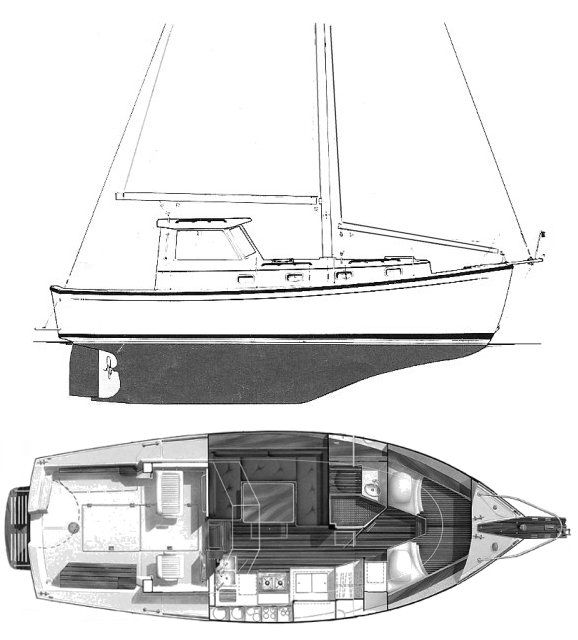
Sailboat Specifications Courtesy of Sailboatdata.com
Hull Type: Long Keel
Rigging Type: Masthead Sloop
LOA: 29.85 ft / 9.10 m
LWL: 26.50 ft / 8.08 m
S.A. (reported): 442.00 ft² / 41.06 m²
Beam: 11.42 ft / 3.48 m
Displacement: 11,500.00 lb / 5,216 kg
Ballast: 4,500.00 lb / 2,041 kg
Max Draft: 3.92 ft / 1.19 m
Construction: FG
Ballast Type: Lead
First Built: 1985
Last Built: 1990
# Built: 47
Builder: Cape Dory Yachts (USA)
Designer: Clive M. Dent
Make: Westerbeke
Model: W-46
Type: Diesel
HP: 46
Fuel: 50 gals / 189 L
Water: 75 gals / 284 L
S.A. / Displ.: 13.93
Bal. / Displ.: 39.13
Disp: / Len: 275.87
Comfort Ratio: 25.22
Capsize Screening Formula: 2.03
S#: 1.77
Hull Speed: 6.90 kn
Pounds/Inch Immersion: 1,081.33 pounds/inch
I: 40.75 ft / 12.42 m
J: 12.83 ft / 3.91 m
P: 35.25 ft / 10.74 m
E: 12.25 ft / 3.73 m
S.A. Fore: 261.41 ft² / 24.29 m²
S.A. Main: 215.91 ft² / 20.06 m²
S.A. Total (100% Fore + Main Triangles): 477.32 ft² / 44.34 m²
S.A./Displ. (calc.): 15.04
Est. Forestay Length: 42.72 ft / 13.02 m
Mast Height from DWL: 46.50 ft / 14.17 m
The long shallow keel has the propeller in a large aperture ahead of a relatively small rudder. Displacement is 11,500 lb. (5,216 kg), 4,500 lb. (2,041 kg) of that is lead ballast. Sail area is 477 sq ft (44.3 sq m). Not too big, easy to handle. This gives you a sail area to displacement (SAD) ratio of about 14. The capsize screening ratio is a very low 1.7. Hull speed is just shy of 7 knots.
Mechanical
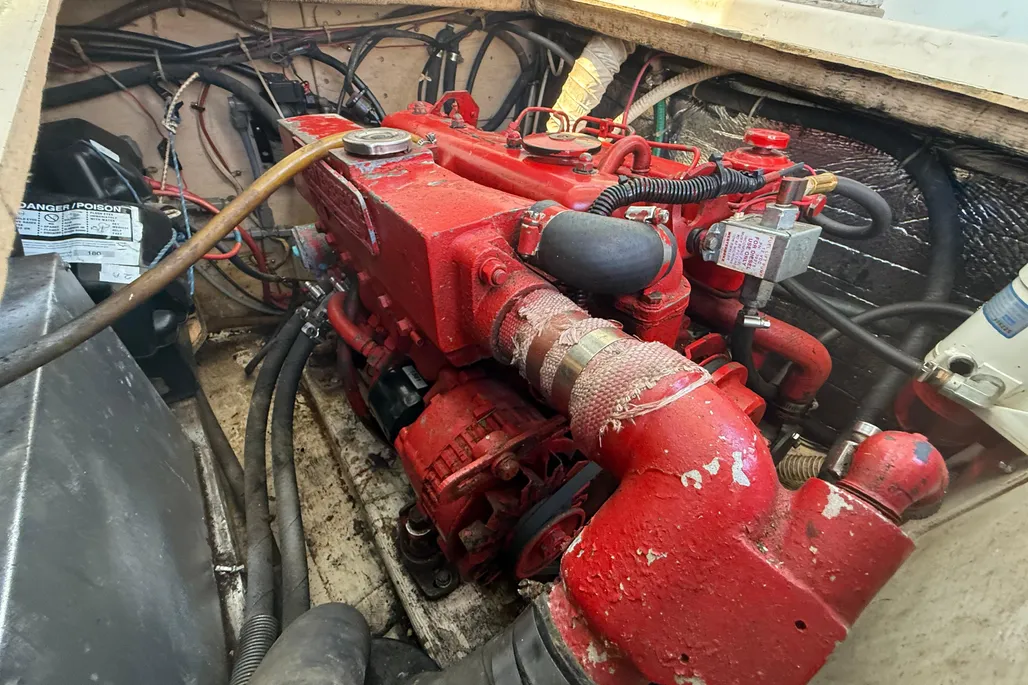
Power comes from a Westerbeke 46 diesel with the most real-world reports putting cruising speed right around 6 to 6.5 knots—right up to 7.5 should you be in a real hurry. With a fuel capacity of 50 gallons (189 liters) and burning an average of 1 gallon (4.55 liters) per hour, range is more than adequate. Air draft lands in the mid 40-ft. (12.2 m) range, depending on the set-up. This keeps you very much in play for the Intracoastal Coastal Waterway (ICW) without bridge anxiety.
What do these numbers really mean? The boat is wide, heavy and stable. It’s not built to be quick. It’s built to be predictable. That beam gives you interior volume you don’t normally get on a 30-ft. sailboat of that era. The displacement and ballast give you a boat that feels planted rather than skittish. And the sail area to displacement ratio tells you very clearly that sailing performance was not this boat’s priority. And this is not a criticism, it’s just a design brief.
Under Power
Under power the MS300 behaves exactly the way you’d want a cruising boat to behave. The flat run aft on the wide beam reduces stern squat under power. The full keel helps it track straight, which reduces workload at the helm. It’s not wandering around, it’s not hunting, it’s not asking you to constantly correct it like a shopping cart with a bad wheel. You set the course, you set the throttle, and you trim the sails, and it just goes. Think of it less like a sports car and more like a diesel pick-up. It’s not exciting, but it’s incredibly dependable. That matters a lot when you’re 100 miles from home. Of course, the compromise with that directional stability is a less than stellar maneuverability when you get to a marina or tight anchorage. Ask any full keel sailor.
Under Sail
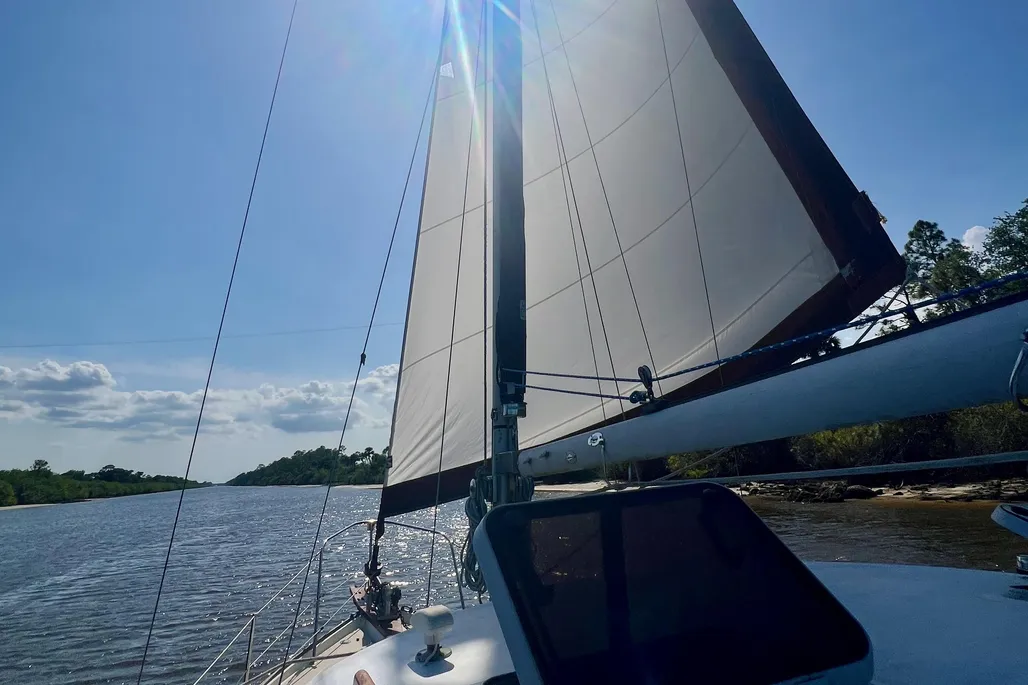
Expectations under sail need to be realistic. If you get a SA to displacement ratio of 14, it’s not a light air performer. In five knots of wind, you’re not really sailing, you’re just sort of negotiating. As breeze builds in the 10 to 15 knot range, the boat comes alive in its own way. It settles in, tracks well, and delivers steady, comfortable progress.
You’re not going to be pointing high or accelerating out of tacks like a performance boat. That’s not what you’re looking for if you’re looking at a motor sailor. But what you do get is a stable platform that doesn’t demand constant attention, or athleticism, or heroics from the crew. And that’s really the theme here. The boat is designed to reduce workload, not increase it.
Pilothouse Benefits
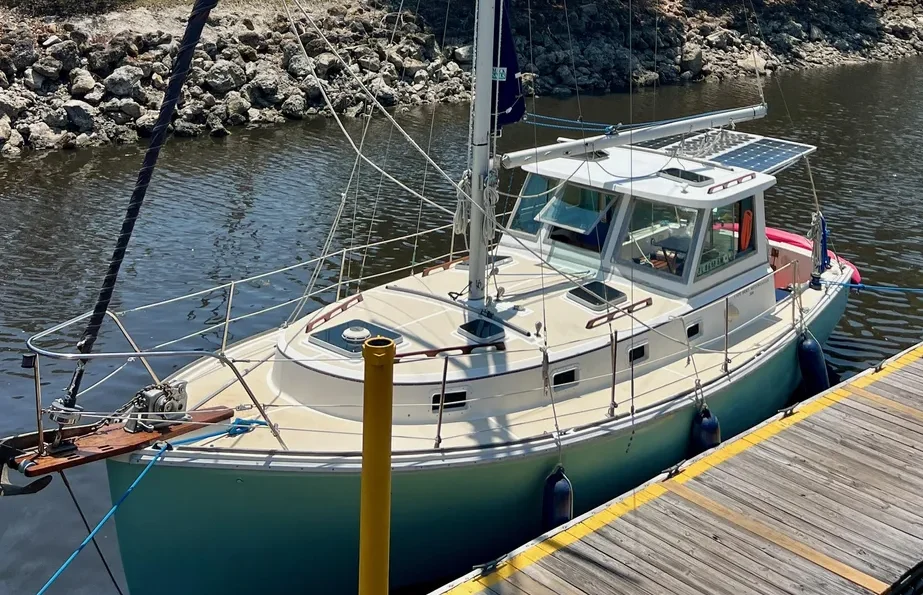
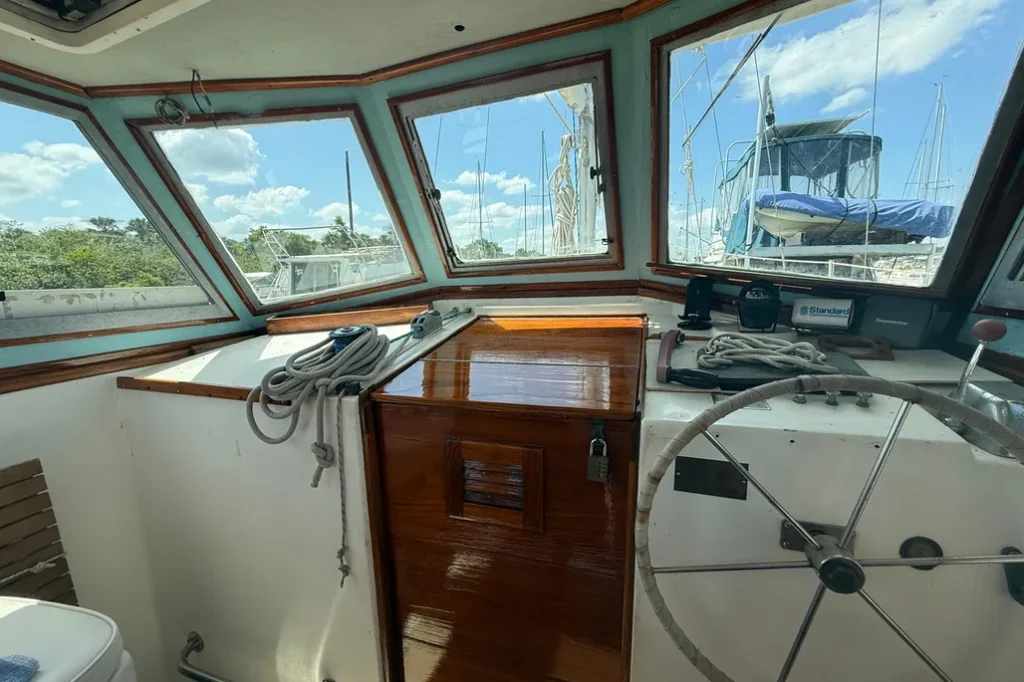
That becomes more and more obvious when you step into the pilot house. For anyone who’s spent time in sailing less than perfect conditions, this is a feature that changes everything. You’re inside, you’re protected, you have excellent visibility through real glass, not hazy plastic on a fabric dodger. You’re not getting soaked or frozen, or sandblasted by the spray. It’s the difference between enduring a passage and actually enjoying that passage.
And for cruising sailors, especially in places where the weather isn’t reliably warm and sunny, like most of the world, it’s not a luxury. This pilot house is a major upgrade in usability. The lockable companionway is the forward bulkhead of the pilothouse with, from the factory, the aft exposed to the open cockpit. But by now most owners have probably enclosed the aft end of the pilot house with a canvas or a solid enclosure, separating the pilot house from the cockpit. Even better, a fully enclosed cockpit featuring a hard or canvas top with removable side windows. This setup more than doubles the living area of this boat. Sailors can be an innovative lot.
On Deck
The teak anchor platform sits on a molded fiberglass structure that forms part of the small foredeck. With no room for an anchor locker, a hawse pipe feeds the chain from the windlass into a forepeak locker. The cabin trunk is relatively high with handrails back to the pilot house, then extending to the roof of the house.
The side decks are narrow to provide maximum room below, so the handrails provide security moving forward. Large hatches adorn the cabin top as well as the pilot house allowing plenty of ventilation. A traveller mounted forward of the mast allows for a self-tacking jib. There are also genoa tracks on the toe rail should a larger sail be flown.
The traditional masthead single spreader rig has sail halyards terminating at winches on the mast. Many have since been converted to have all sail controls lead back to the pilothouse, no need to go forward.
Interior
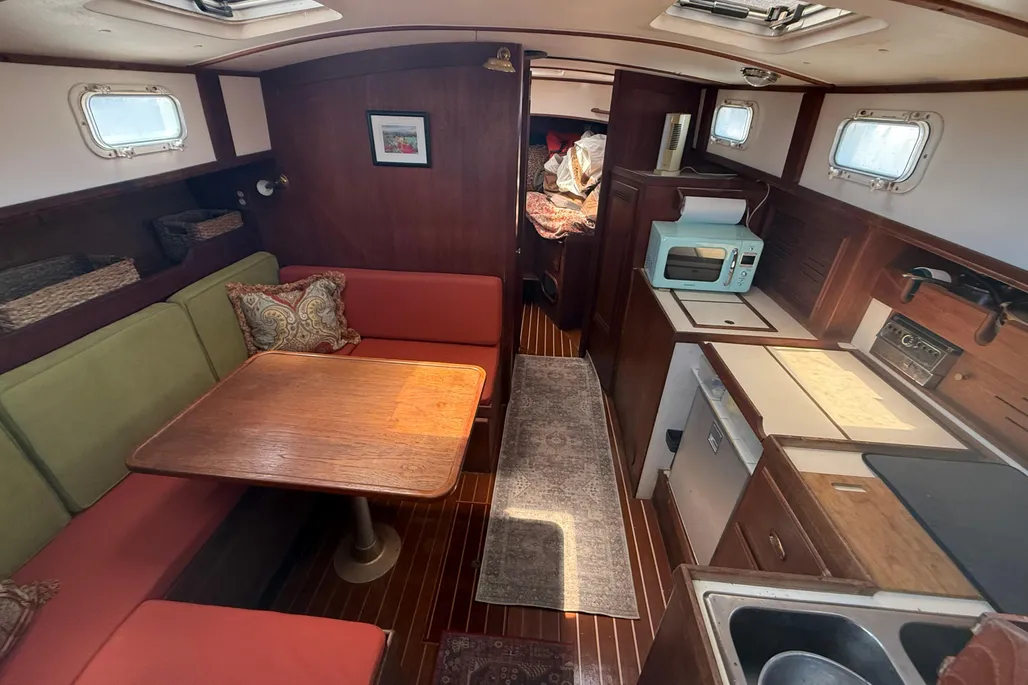
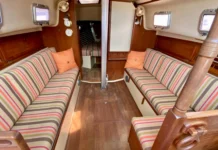
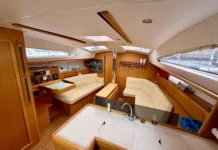
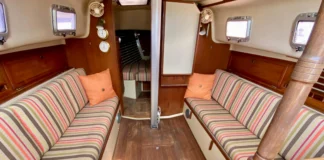
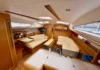
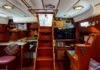
Climbing down two steps through the companionway, the layout continues to support a comfortable, secure mission. That over 11-ft. beam (3.48 m) carried almost to the stern translates into real usable space. An expansive galley is to starboard with a dinette to port. The galley features a two-burner stove, a large icebox and 75 gallons (341 liters) of water to keep you independent of marinas for a while. The salon feels open enough that you’re not constantly aware of the boats’ length. The dinette can be lowered into extra sleeping space if needed.
The forward V-berth is generous for a boat this size with a hanging locker to starboard. The head is to port and functional. It’s not a modern floating condo by any means, but it’s absolutely capable as a liveaboard or extended cruising platform. You can spend more time on this boat without it feeling like you’re camping. The pilot house also creates a second living space, which is something you don’t appreciate until you have it.
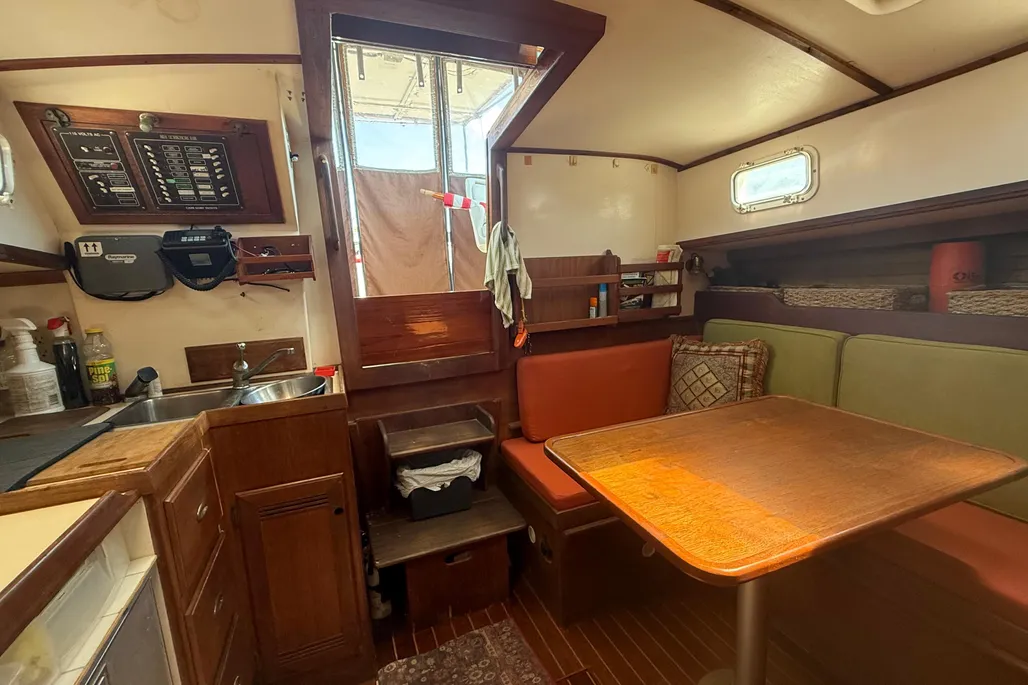
If the cockpit is enclosed, the living area out there is doubled. You can be inside, out of the weather, but still engage with what’s happening outside. Over time that makes the boat feel larger and more versatile than the numbers might suggest.
Pilothouse Trade-Offs
From a practical sailor perspective, the question is always the same, “What are the trade-offs with this boat?” Because every design is a set of compromises. With the MS300 the trade-off is clear. You’re giving up sailing performance in exchange for comfort, protection and flexibility.
If your priority is maximizing sailing efficiency, especially in light airs, this boat is not going to deliver. The numbers and the real-world reports are both going to confirm that. If your priority is being able to leave the dock more often, handle a wider range of conditions, and complete passages without being entirely dependent upon the wind, this design starts to look very compelling.
Owner’s Perspective
From an owner’s perspective there are a few areas that deserve attention. Pilot house windows on these boats are a known discussion point among the owners. This usually indicates potential for leaks or aging seals. Any flexing structure with multiple windows is inherently more complex to keep watertight. This is no exception.
The steering system also should be inspected carefully, including confirming the emergency tiller is present and usable. That’s not unique to this boat, but it’s often overlooked. And as with any vessel from the 1980s, condition is everything. Does it still have factory standing rigging? Does it have an engine maintenance log? This is an even bigger deal with a larger engine.
Always Check for Water Intrusion
Deck hardware and signs of water intrusion should all be evaluated thoroughly. What’s notable with the reviews of this boat is the absence of widespread structural concerns in any owner discussions. You don’t see consistent reports of major design flaws. Instead, you see a typically well-aging boat as far as maintenance and upgrades. This is generally a positive indicator.
A Boat for Getting Out There
Where does this leave us? The Cape Dory MS300 is not trying to appeal to everyone. It’s aimed at a very specific type of buyer, someone who values reliability over excitement, someone who wants to go cruising comfortably, extend their season and reduce their dependence on perfect conditions. They aren’t going to be brand new electric pickup type of people. They’ll have a 17-year-old Tacoma with a cab on the back.
It’s a boat for people who want to go and not wait. If your idea of boating is squeezing every ounce of performance out of the wind and trimming constantly and treating sailing like a sport, this is probably going to irritate you. But if your goal is to travel and explore and actually use your boat more, extending the season, the MS300 makes a strong, very practical case for itself. As does any motor sailor. And in the end, that’s what matters. Because the best boat isn’t the one that wins arguments at the marina, it’s the one that gets used.
A MS300 Example
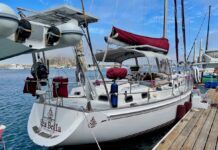
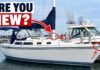
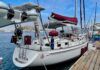
I found this minty green MS300 for sale in Fort Myers, and I think it deserves a look as an example. Not only is it a pretty color, it has actually been outfitted a little bit. The boat we’re looking at here is a 1986 Cape Dory MS300 listed for around $ 29,000 and, right away, the tone of the listing tells you exactly what this is. It’s not a polished, turnkey, just-bring-your-sunglasses, yacht. This is an honest, lightly updated, slightly scuffed cruiser that’s been used.
Cruising Experience
The current owner has had it for about five years and actually cruised on the boat. This is a good sign. Boats that get used tend to stay healthier than boats that sit quietly and decay while someone says that they’re immaculate in the advertising. There are some meaningful upgrades here too. The Westerbeke 46 was rebuilt in 2016, a big-ticket item if it was done right. It’s got a newer mainsail, roller furling, a serviceable jib, and about 300 watts of solar. That’s actually a really nice cruising set-up for a boat this size. It also has a manual windlass on the foredeck. Simple but effective.
Practical Interior
The interior is described as solid, which is listing language for not falling apart. In this price range that’s exactly what you want to hear. There are a couple of clues that this boat has been adapted for practical use rather than showroom appeal. It’s not glamorous, but it tells you the owner was thinking in terms of simplicity and not trying to impress the next buyer.
Year-Round Care
At time of this review, the boat was on the hard for storm season, sails off. This again reinforces an actively used and managed boat rather than just abandoned somewhere. The seller also claims it’s leak-free, which on a pilothouse boat with multiple windows is something you’ll definitely want to verify. But, it’s encouraging to see that stated outright in the ad.
Worth a Look
How does this specific boat stack up knowing what we know about these MS300? Honestly, it’s exactly the kind of example that you’d expect. Some meaningful upgrades have already been done and there is still room for improvement, and very much a use-it-now with improvements over time kind of boat. You can buy it and just get started. It’s not a restoration project, but it’s also not pretending to be perfect. And in a world of 1980s cruising boats, that’s often the sweet spot. If the structure is sound and the windows are dry and the systems check out, this could be a very practical, very usable entry into motor sail cruising without lighting your wallet on fire.
Opposite Spectrum Example
If you want a comparison from the opposite end of the 1980s sailing spectrum, look at this Caliber 33 used boat review on our website. It’s absolutely worth your time. It describes the Caliber as a rare mix of security and performance, with owners consistently calling it agile and nimble, and even one saying it was their favorite boat after decades of sailing.
It’s essentially the opposite end of the spectrum from the MS300, a boat that still prioritizes comfort and cruising. But this actually delivers lively sailing performance and sharp handling. Reading this review gives you a quick benchmark for what a well-balanced cruising sailboat looks like when it leans more towards sailing ability than motoring convenience.
And it helps you decide which side of that line you might actually be on.
Market Scan Contact
1986 Cape Dory MS300 Sydnie Collins
$29,000 USD +17633735950
Fort Myers, Florida Yacht World
1986 Cape Dory MS300 Oriental Yacht Sales
$38,500 USD
+12526327641
Oriental, North Carolina Yacht World





Everything screams “take the scenic route”. A Great Loop circuit would be a perfect use case for this. With a slippery sailboat hull, you’d spend a fraction on fuel that the trawlers are burning. And missing description of the aft deck: it’s open and flat, designed for folding motorboat-style deck chairs, would be equally perfect for fishing activity while at anchor every night in protected waters. This is going on my “retirement boat” short list for sure.